In This Article
No rx glasses in 2026: What You’re Really Buying
Maybe you’ve got perfect vision and a face that’s begging for a great frame. Maybe you stare at two monitors for nine hours a day and want something between your eyes and the glare. Or maybe you just saw a pair of tortoiseshell frames on a coworker and thought, “Why not?” Whatever brought you here, no rx glasses are one of the easiest style (and comfort) upgrades you can make — no eye exam required, no lab wait, no insurance paperwork.
But here’s the part most shopping guides skip: the category is packed with bold promises. Listings claim their lenses fix headaches, rescue your sleep, and “protect” your retinas. The honest picture is more nuanced. The American Academy of Ophthalmology says it does not recommend any special eyewear for computer use, because there’s no solid evidence that screen light damages your eyes. That doesn’t make no rx glasses useless — it just means you should buy them for the right reasons: comfort, glare control, UV protection outdoors, color preference at night, and, yes, looking sharp.
So this guide does three things. First, it compares seven real pairs you can order on amazon.com, from under-$20 basics to a genuine Ray-Ban frame. Second, it translates spec-sheet jargon (CR-39, TR90, UV400, “blocks 99% of blue light”) into what you’ll actually notice on your face. Third, it gives you practical, science-honest advice so you spend your money once — and spend it well.
What Are No rx glasses?
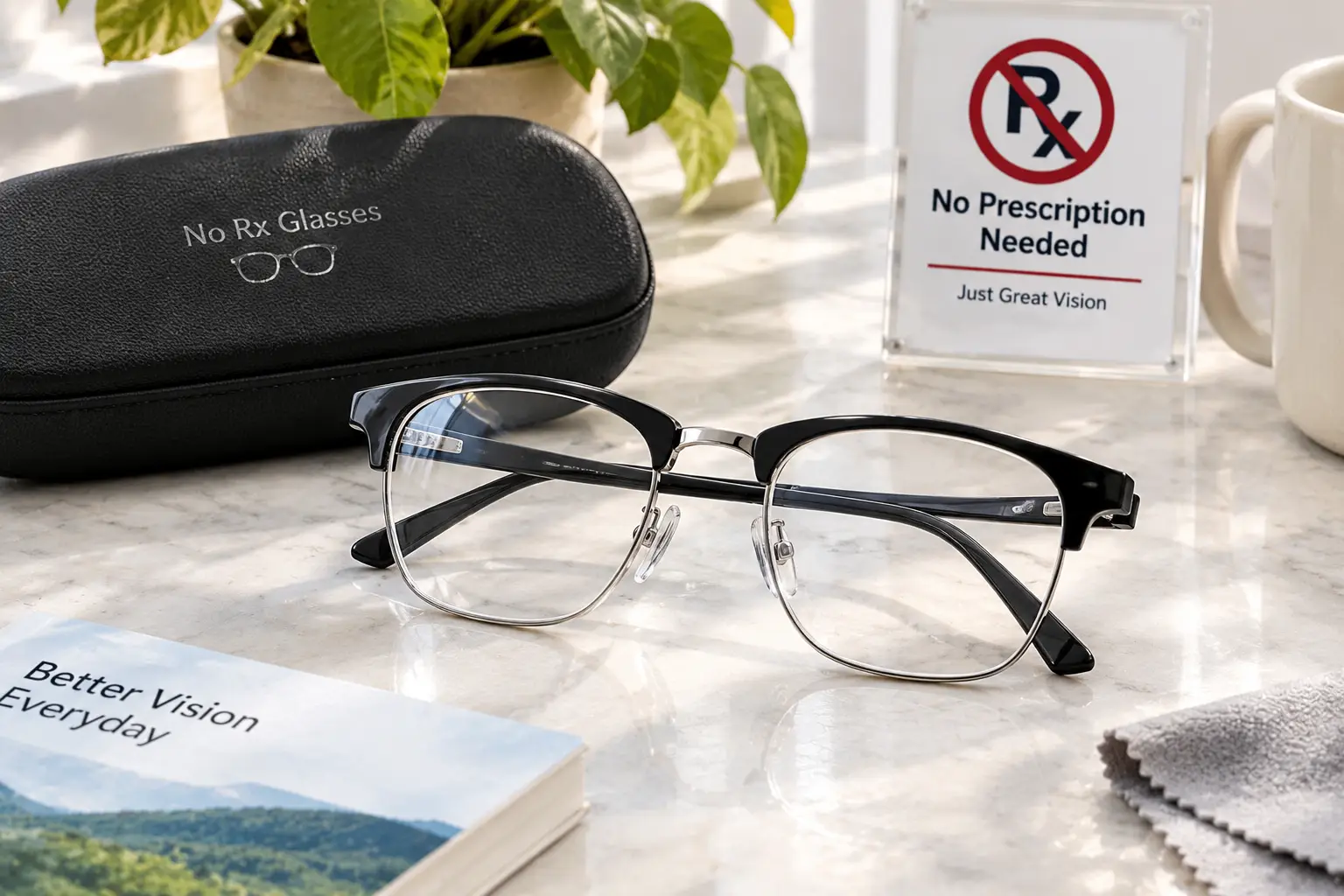
No rx glasses are eyeglasses with non-corrective lenses (called “plano” or 0.00-power lenses). They don’t change your focus. Instead, they’re worn for style, glare reduction, UV protection, or a blue-light-filtering tint. You can buy them online without a prescription, and they come in clear, lightly tinted, and amber versions.
Quick Comparison: 7 no rx glasses at a Glance
Before the deep dive, here’s the 30-second version. Price ranges reflect what we saw at the time of writing — always check the current listing, since prices shift constantly.
| Product | Lens Type | Standout Trait | Price Range | Best for |
|---|---|---|---|---|
| Felix Gray Nash | Clear CR-39, embedded filter | Premium optics, minimal color shift | Roughly $100–$150 | Felix Gray Nash: office pros who want “real glasses” quality |
| GUNNAR Intercept | Amber (65% filter at 450 nm) | Wrap frame, contrast boost | Around $50–$80 | GUNNAR Intercept: gamers and night owls |
| Peepers Blue Light Focus 0.00 | Near-clear, 0.00 power | Stylish frames, easy returns | Around $25–$45 | Peepers Blue Light Focus 0.00: style-first buyers |
| Cyxus 8082 | Clear polycarbonate | Classic square, lightweight | Under $25 | Cyxus 8082: first-time wearers |
| TIJN TR90 Square | Clear with slight tint | Flexible TR90 frame | Around $12–$25 | TIJN TR90 Square: students and budget shoppers |
| Gamma Ray Amber Non-Magnified | Amber, non-magnified | Cheapest amber option | Under $20 | Gamma Ray Amber Non-Magnified: testing amber on a budget |
| Ray-Ban RX5154 Clubmaster | Demo lenses (replaceable) | Iconic browline frame | Roughly $150–$220 | Ray-Ban RX5154 Clubmaster: fashion buyers who’ll add pro lenses |
Looking at the table, the real split isn’t price — it’s lens color. Clear lenses (Felix Gray Nash, Cyxus 8082, TIJN TR90 Square) keep your screen looking normal, while amber lenses (GUNNAR Intercept, Gamma Ray Amber Non-Magnified) filter more blue light but tint everything warm. The Ray-Ban RX5154 Clubmaster is the outlier: you’re buying a frame, and the lenses are a placeholder you’ll want to swap.
💬 Tap any highlighted pick to check today’s price and availability — one click helps other shoppers make an informed choice too! 😊
Top 7 no rx glasses: Expert Analysis
Each pick below was chosen from real, orderable Amazon listings and analyzed using manufacturer spec sheets plus aggregated customer review themes. None of these write-ups is based on a fabricated personal test — where review data is thin, we say so.
1. Felix Gray Nash — premium optics without the yellow tint
The Felix Gray Nash is what happens when a blue-light brand decides to make eyeglasses first and a “gadget” second. Its lenses are CR-39 — the same optical-grade plastic many labs use for prescription lenses — with a double-sided anti-reflective coating and a water-repelling top layer. In practice, CR-39 gives you crisp edges on text and less of the “fishbowl” distortion that bargain acrylic can produce.
Felix Gray says its filter is infused into the lens material rather than painted on, and claims it filters 15 times more blue light than standard clear lenses. Here’s what to weigh: a filter baked into the lens won’t scratch off, which is a genuine durability win. However, “15x more than standard lenses” is a relative claim, and independent research hasn’t shown that any blue light filter reduces eye strain. What you’re reliably paying for is optical quality, the anti-glare coating, and a frame that looks like a pair from an optician’s wall.
Reviews consistently praise the look and the lack of color distortion, and many buyers say the anti-reflective coating makes long video-call days feel less harsh. The most common complaint is price — especially compared with budget pairs that look similar in photos. Sizing varies across the lineup, so check measurements (the Roebling, for example, runs narrow-to-medium at 49-18-140).
Pros:
- ✅ Optical-grade CR-39 lenses with sharp clarity
- ✅ Filter is embedded, so it won’t wear off
- ✅ Virtually no yellow tint on screens
Cons:
- ❌ Costs several times more than budget alternatives
- ❌ Blue light benefits remain scientifically unproven
At roughly $100–$150, the Felix Gray Nash is the best-built clear pair here — worth it if you’ll wear it daily, overkill if it’s an occasional accessory.
2. GUNNAR Intercept — built for marathon gaming sessions
The GUNNAR Intercept is the gaming-glasses original, and its design goes beyond the lens tint. The amber lens is rated to filter up to 65% of blue light at the 450-nanometer peak, and it blocks UV. On paper, that sounds like a filtering spec — but in real use, the bigger change is contrast: amber makes whites look warmer and dark game scenes feel punchier.
The frame matters too. It wraps slightly around your face, which cuts side glare and may reduce the airflow that dries your eyes during long, low-blink sessions. It weighs about 1.16 ounces, which reviewers note stays comfortable under large over-ear headsets. GUNNAR’s “Focus” lens design also carries a very slight focusing power (reported at about +0.20), so strictly speaking it’s not a pure 0.00 lens — most people won’t notice, but it’s worth knowing.
Aggregated reviews from retailers like Best Buy lean positive, with many gamers reporting their eyes feel less “heavy” late at night, alongside some hedging about whether it’s placebo. A recurring note: the amber tint is a dealbreaker for anyone doing color-accurate work.
Pros:
- ✅ Wrap frame reduces side glare noticeably
- ✅ Light enough to wear with gaming headsets
- ✅ Strong amber filter for evening screen use
Cons:
- ❌ Amber tint distorts colors for design work
- ❌ Slight lens power isn’t a true plano lens
In the $50–$80 range, the GUNNAR Intercept is a fair buy for dedicated gamers; casual users will get similar comfort from cheaper amber pairs.
3. Peepers Blue Light Focus 0.00 — style-first frames with a safety net
The Peepers Blue Light Focus 0.00 is the fashion shopper’s pick — the brand leans hard into colors, cat-eyes, and statement shapes. Peepers is best known for readers, but its “No-Correction” line uses the same Blue Light Focus lenses at 0.00 power, sold on Amazon as a non-magnified option.
Per the brand, those lenses filter high-energy visible light in the 400–450 nm range (retailer listings cite more than 40%), add UV400 protection, and carry a seven-layer anti-reflective coating. Translation: the lens stays nearly clear, so you don’t get the “sepia filter” effect, while the AR coating does the heavy lifting on overhead-light reflections. Polycarbonate frames with spring hinges forgive being tossed into bags.
Brand-site reviews overwhelmingly focus on style and comfort, and many buyers say Peepers feel like a step up from drugstore frames. Note that much of the visible review volume comes from Peepers’ own site, so treat it as a smaller, self-selected sample. Direct purchases carry a 90-day return window; Amazon orders follow Amazon’s return terms.
Pros:
- ✅ Wide range of bold, trendy frame styles
- ✅ Near-clear lenses with multi-layer anti-glare
- ✅ Spring hinges hold up to daily tossing
Cons:
- ❌ Fewer independent reviews than big Amazon sellers
- ❌ Style selection at 0.00 is narrower than readers
At around $25–$45, the Peepers Blue Light Focus 0.00 hits a sweet spot: meaningfully nicer than bargain pairs without Felix Gray pricing.
4. Cyxus 8082 — the dependable first pair
The Cyxus 8082 is a classic square frame that has quietly earned a huge following on Amazon. Cyxus has been designing computer glasses since 2009, and this model sticks to the basics: a lightweight polycarbonate frame, polycarbonate lenses, UV400 protection, and a clear lens that the brand says absorbs blue light in the 380–450 nm band.
Polycarbonate is the practical hero here. It’s far more impact-resistant than glass (Cyxus cites 60 times), and it’s light, so the frame doesn’t pinch your nose after hours. The clear finish is the other win — reviews repeatedly mention that screens don’t take on an orange cast, which matters if you’re sharing slides or editing photos.
Across Amazon, the Cyxus lineup averages in the low-4-star range with thousands of ratings at the time of writing. Positive themes: subtle design that “goes with any face,” comfortable weight, and a useful cleaning cloth. Negative themes on third-party review sites include inconsistent fit on some models (temples spread wide) and skepticism about aggressive promo pricing on the brand’s own store.
Pros:
- ✅ Impact-resistant polycarbonate frame and lenses
- ✅ Clear lens keeps screen colors accurate
- ✅ Classic square shape suits most faces
Cons:
- ❌ Fit can run wide on some models
- ❌ Coatings feel less premium than CR-39 pairs
Usually under $25, the Cyxus 8082 is the lowest-risk way to find out whether you enjoy wearing glasses at all.
5. TIJN TR90 Square — flexible frame, feather-light feel
The TIJN TR90 Square is built around its frame material. TR90 is a thermoplastic that flexes instead of snapping, so the arms bend back when you sit on them — a real advantage for students who shove glasses into backpacks. TIJN’s clear square “nerd” style has become one of the more recognizable budget looks on Amazon.
Listings highlight adjustable nose pads and UV protection. The adjustable pads are the underrated feature: fixed-bridge budget frames often slide down smaller noses, while pads let you dial in the fit. Some TIJN lens options carry a slight yellow tint, so check the variant if color accuracy matters.
Amazon’s review summaries highlight style above all — customers call them trendy and say they match their outfits. One buyer mentions using them as wood-shop safety glasses, and here’s what that reviewer overlooked: fashion frames are not rated safety eyewear (more on that in the safety section). Some shoppers also report quality variation across TIJN models, which is common in this price tier.
Pros:
- ✅ Flexible TR90 survives backpacks and couches
- ✅ Adjustable nose pads improve fit
- ✅ Trendy clear-frame look at a low price
Cons:
- ❌ Quality consistency varies between models
- ❌ Some lens options add a slight yellow tint
At around $12–$25, the TIJN TR90 Square is the best “durable on a budget” pick for younger or rougher-on-gear wearers.
6. Gamma Ray Amber Non-Magnified — amber tint for pocket change
The Gamma Ray Amber Non-Magnified pair is the cheapest way to find out whether you like amber lenses before spending GUNNAR money. It pairs an amber tint with anti-glare treatment, UV400 protection, and a lightweight metal frame that the brand says resists bending and discoloration.
Here’s the practical meaning of amber at this price: the tint does most of the work. It warms the screen and softens harsh white backgrounds, which many people find relaxing in the evening. What you won’t get is the wrap design, precision optics, or coating quality of pricier gaming glasses. Make sure you order the “Not Magnified” listing — Gamma Ray also sells magnified readers that look nearly identical.
Reviews consistently praise the value; several buyers say the glasses cut glare and feel better than expected for the price. On the critical side, some Amazon Q&A commenters describe budget amber pairs as little more than yellow-tinted glare glasses — which, to be fair, is an accurate description of what amber lenses fundamentally are.
Pros:
- ✅ Very low cost for trying amber lenses
- ✅ UV400 plus anti-glare treatment included
- ✅ Light metal frame holds its shape
Cons:
- ❌ Easy to accidentally order magnified versions
- ❌ Optical clarity trails premium amber lenses
Usually under $20, the Gamma Ray Amber Non-Magnified is a smart experiment — if you love it, upgrade later; if not, you’ve lost little.
7. Ray-Ban RX5154 Clubmaster — an icon you can finish properly
The Ray-Ban RX5154 Clubmaster is a different animal: it’s a genuine optical frame, not a finished pair of glasses. Ray-Ban’s listings are explicit that it ships with demo lenses meant to be replaced. The browline design — acetate across the top, metal below — dates to the 1950s rockabilly era and remains one of the most recognizable frames ever made.
Why include it? Because many no rx glasses buyers are really buying a look, and this is the most authentic version of that look on Amazon. The honest caveat is the demo lens. Demo lenses exist so the frame holds its shape on a display; they aren’t designed as everyday optical lenses, and they usually lack anti-reflective coating. The smart move is to take the frame to an optician (or an online lab) and have 0.00 “plano” lenses with AR coating fitted. Ray-Ban also sells the frame in multiple sizes (49 mm and 51 mm), so measure your current glasses first.
We couldn’t verify a large, consistent body of Amazon reviews for this specific frame and colorway — ratings are spread thin across many sellers and variants. Ray-Ban’s brand reputation for build quality is well established, but buy from Ray-Ban’s official store or listings sold by Amazon to avoid counterfeits.
Pros:
- ✅ Authentic, timeless browline design
- ✅ Premium acetate and metal construction
- ✅ Ready for pro lenses, including prescriptions later
Cons:
- ❌ Demo lenses need replacing for daily wear
- ❌ Total cost rises once lenses are added
The frame runs roughly $150–$220 before lenses — excellent value as a long-term frame, poor value if you plan to wear the demo lenses as-is.
Full Spec Comparison of the Top 7 no rx glasses
Here’s how the seven picks stack up on the details that affect everyday comfort.
| Product | Frame Material | Lens / Filter | UV | Review Sentiment | Best for |
|---|---|---|---|---|---|
| Felix Gray Nash | Bio-based acetate | CR-39, embedded filter, 2-sided AR | Yes | Praised for clarity; price complaints | Felix Gray Nash: all-day office wear |
| GUNNAR Intercept | Lightweight wrap plastic | Amber, 65% at 450 nm, slight power | 100% | Gamers positive; color shift noted | GUNNAR Intercept: long gaming nights |
| Peepers Blue Light Focus 0.00 | Polycarbonate, spring hinges | Near-clear, 7-layer AR | UV400 | Style praised; smaller sample | Peepers Blue Light Focus 0.00: fashion-forward looks |
| Cyxus 8082 | Polycarbonate | Clear PC lens | UV400 | Solid; some fit issues | Cyxus 8082: trial pair |
| TIJN TR90 Square | TR90 flexible | Clear/slight tint | Yes | Style praised; variable quality | TIJN TR90 Square: students |
| Gamma Ray Amber Non-Magnified | Metal | Amber, anti-glare | UV400 | Value praised | Gamma Ray Amber Non-Magnified: budget amber |
| Ray-Ban RX5154 Clubmaster | Acetate + metal | Demo (replace) | Depends on new lenses | Sparse on Amazon | Ray-Ban RX5154 Clubmaster: long-term frame |
The pattern is clear: frame material predicts durability, while lens material predicts clarity. If you’re rough on gear, the TR90 of the TIJN TR90 Square or the polycarbonate of the Cyxus 8082 will outlast delicate acetate. If you read small text all day, the CR-39 optics of the Felix Gray Nash are where extra money genuinely shows up.
🛍️ Ready to Find Your Perfect Pair?
👓 Whether you want clean clear lenses for the office or a warm amber pair for late-night gaming, one of these seven has your name on it. Click any highlighted pick to check current pricing and availability — and give your screen time a stylish upgrade you’ll actually enjoy wearing!
How to Choose no rx glasses
Choosing well comes down to seven questions, in this order:
- Decide why you’re buying. Style, glare, UV, or evening color warmth? Your answer determines lens type — and prevents paying for features you don’t need.
- Pick lens color before frame style. Clear lenses keep screens accurate; amber lenses filter more blue light but tint everything. Designers and photo editors should stay clear.
- Prioritize anti-reflective (AR) coating. Reflections from overhead lights are the most noticeable daily annoyance. A good AR coating matters more than any blue-light percentage.
- Check lens material. CR-39 offers the best optical clarity; polycarbonate is the most impact-resistant. Both beat generic acrylic.
- Match the measurements. Copy the three numbers printed inside your favorite frame (lens width, bridge, temple length). A 2–3 mm difference changes comfort noticeably.
- Confirm the power is 0.00. Many listings bundle readers and non-magnified versions. Ordering the wrong one is the most common mistake.
- Read the return policy. Fit is personal. A generous return window is worth more than a small discount.
A quick expert note on step 3: if two pairs cost the same, choose the one with a better AR coating over the one claiming a higher blue-light percentage. You’ll notice the coating every hour; the percentage, according to current evidence, you probably won’t.
Getting Started: Your First 30 Days With Non Prescription Glasses
New wearers often give up in the first week — not because the glasses are bad, but because nobody told them what to expect. Here’s a practical onboarding plan.
Week 1: Break-in and fit
Wear your new pair in two- to three-hour blocks. Pressure spots behind the ears or on the nose usually mean the fit needs adjusting, not that the glasses are wrong for you. Many optical shops will adjust acetate and metal frames for free or a small fee, even if you bought them online.
Week 2: Set up your screen habits
Glasses work best alongside good habits. The American Academy of Ophthalmology recommends following the 20-20-20 rule and adjusting screen brightness, contrast, and distance: every 20 minutes, look 20 feet away for 20 seconds, and sit about an arm’s length (around 25 inches) from your monitor. These steps address the real cause of screen fatigue — reduced blinking and sustained close focus.
Week 3: Build a cleaning routine
Use the included microfiber cloth and a lens spray, never your shirt. AR-coated lenses show smudges more obviously, and dry-wiping grit is the fastest way to scratch them.
Week 4: Evaluate honestly
Ask yourself: do I reach for them? Do I like how I look? Is glare less annoying? If yes, you’ve found a keeper. If your eyes still feel tired, glasses probably weren’t the issue — see an eye doctor, since uncorrected mild vision problems are a common hidden cause.
⚡ Common first-month mistakes: wearing amber lenses for color-critical work, storing glasses lens-down, and leaving them on a hot car dashboard, which can warp frames and damage coatings.
Real-World Scenarios: Matching the Right Pair to Your Day
Specs are abstract, so let’s put three realistic buyer profiles to work.
💼 The remote marketing manager (budget: up to $150, 8+ screen hours daily)
Video calls, slide decks, and brand colors all day. Color accuracy matters, and so does looking polished on camera. The Felix Gray Nash fits best: clear CR-39 lenses won’t tint brand colors, and its double-sided AR coating reduces the glare “hot spots” webcams pick up from ring lights. If the budget is tighter, the Peepers Blue Light Focus 0.00 delivers a similar near-clear look with multi-layer AR at a fraction of the cost.
🎮 The evening gamer (budget: $20–$80, 3–5 hours nightly)
Late sessions, dark rooms, bright monitors. Here, amber earns its place, not because it’s proven to protect your eyes, but because many people simply find warmer, lower-contrast whites more comfortable at night. The GUNNAR Intercept adds a wrap frame and headset-friendly weight. Unsure whether amber suits you? Start with the Gamma Ray Amber Non-Magnified and upgrade only if you love the effect.
🎒 The college student (budget: under $25, mixed use)
Glasses will be sat on, dropped, and forgotten in lecture halls. The TIJN TR90 Square flexes instead of snapping, and adjustable nose pads help with fit. The Cyxus 8082 is the alternative for students who prefer a slightly more classic look and a clear lens for design coursework.
The takeaway: the “best” pair is the one that matches your color needs, your durability needs, and your realistic budget — in that order.
Problem → Solution: Fixing Common Complaints
Even a good pair can frustrate you if something small is off. Here are the most common issues and precise fixes.
Problem 1: Glasses keep sliding down your nose. ✅ Solution: Frames with adjustable nose pads (like the TIJN TR90 Square) can be pinched closer together. For acetate frames like the Felix Gray Nash, an optician can heat and bend the temples to hug your head. Silicone temple grips also work in a pinch.
Problem 2: Distracting reflections on video calls. ✅ Solution: Tilt your ring light or monitor slightly above eye level, and choose lenses with double-sided AR coating. Budget lenses often have coating on one side only, which is why reflections persist.
Problem 3: Everything looks yellow. ✅ Solution: You bought amber when you needed clear. Keep amber pairs like the GUNNAR Intercept for evening gaming, and switch to a clear pair like the Cyxus 8082 for daytime work.
Problem 4: Slight dizziness or “swimmy” vision. ✅ Solution: Check the listing — you may have ordered readers instead of 0.00 lenses. Low-quality lenses can also introduce distortion; upgrading to CR-39 or polycarbonate usually fixes it. If the issue continues, see an eye doctor.
Problem 5: Demo lenses look cloudy or reflective. ✅ Solution: This is normal for display lenses in frames like the Ray-Ban RX5154 Clubmaster. Have an optician install plano lenses with AR coating — it transforms the experience.
Clear Lens Glasses vs Amber Lenses vs Screen Settings
This is the comparison that matters most, because it decides what you’ll actually see all day. Clear lens glasses keep colors natural and look like standard eyewear to everyone around you. They typically filter only a modest slice of blue light, and they rely on their anti-reflective coating to make a noticeable difference. Amber lenses filter far more blue light, but the trade-off is obvious: whites turn cream, blues turn teal, and you’ll look like you’re wearing gaming gear.
There’s also a free option you already own: your device’s night mode. Most phones and computers can shift color temperature automatically in the evening, which accomplishes much of what amber lenses do — without anything on your face.
Finally, there’s the option most shoppers overlook: true computer glasses prescribed by an eye doctor. These are focused for your exact screen distance and are a different product entirely from non-prescription blue light glasses.
| Option | Typical Cost | Evidence for Reducing Eye Strain | Color Accuracy | Best for |
|---|---|---|---|---|
| Clear no rx glasses (e.g., Cyxus 8082) | Under $25–$150 | Not shown in trials | Excellent | Cyxus 8082: all-day wear and style |
| Amber no rx glasses (e.g., GUNNAR Intercept) | Under $20–$80 | Not shown in trials | Poor | GUNNAR Intercept: evening comfort preference |
| Device night mode | Free | Not a treatment; helps evening routines | Adjustable | Everyone, as a first step |
| Prescription computer glasses | Varies with exam/lenses | Addresses focus distance directly | Excellent | People with real focus issues |
The table shows why no rx glasses should be judged as comfort and style purchases rather than medical ones. If eye strain is your main problem, screen habits and an eye exam come first; if you want a comfortable, good-looking pair for screen days, clear lenses win for most people and amber wins for night-owl gamers.
Features That Actually Matter (and Ones That Don’t)
Marketing copy for eyewear is full of numbers. Here’s how to separate signal from noise.
✅ Features that matter
- Anti-reflective coating (both sides): Reduces glare from lamps and windows — the benefit you’ll notice immediately.
- Lens material: CR-39 for clarity, polycarbonate for toughness. Both deliver consistent optics.
- Frame measurements: The right width and bridge prevent headaches from pressure, which people often misattribute to screen light.
- UV400 protection: Genuinely useful if you’ll wear your glasses outdoors, since sunlight — not screens — is the major source of blue and UV exposure.
- Spring hinges or flexible frames: Extends lifespan significantly.
❌ Features that matter less than the listing suggests
- “Blocks 99% of blue light”: This usually refers to a narrow wavelength band, not all blue light. Clear lenses can’t filter heavily without tinting.
- “Improves sleep”: A large Cochrane review of 17 randomized trials concluded that blue-light filtering glasses probably make no difference to eye strain or sleep quality. Dimming screens before bed is a better bet.
- “Doctor endorsed” or “clinically backed” badges: Look for what was actually studied. A customer survey isn’t a clinical trial.
- Included blue-light test flashlights: They show the lens reflects a specific LED wavelength — not that your eyes will feel different.
Bottom line: spend on coatings, optics, and fit. Skepticism about percentages will save you real money.
Common Mistakes to Avoid When Buying Non Prescription Glasses
Most disappointing purchases trace back to a handful of predictable errors.
1. Ordering readers by accident. Many listings bundle magnified and non-magnified options on the same page. Always confirm “0.00,” “non-magnified,” or “no correction” before checkout.
2. Ignoring measurements. Buyers often choose frames from a photo on a model with a completely different face width. Measure your current glasses, or use a credit card held against your face as a rough lens-height reference.
3. Buying non prescription glasses to replace an eye exam. If you’re squinting, getting headaches, or holding your phone farther away, you may need correction. No rx glasses can’t fix that — and wearing them may hide the symptom longer.
4. Wearing demo lenses daily. Frames like the Ray-Ban RX5154 Clubmaster ship with display lenses. They look fine in photos but aren’t meant for daily wear.
5. Chasing the highest blue-light percentage. As covered above, high percentages require heavy tinting, and evidence of benefit is lacking. Prioritize clarity and coatings.
6. Skipping the return policy. Fit is subjective. A retailer with an easy return process lets you try a frame shape risk-free.
7. Using fashion frames as safety glasses. This one can actually hurt you — see the next section.
Safety, Regulations, and Standards
Here’s reassuring news: in the U.S., even non prescription glasses are regulated. Under FDA regulation 21 CFR 801.410, eyeglasses and sunglasses must be fitted with impact-resistant lenses. The standard “drop ball” test drops a 5/8-inch steel ball from 50 inches onto the center of the lens, and manufacturers must test samples from each production batch. Importers are treated as manufacturers under the rule, so imported budget pairs are covered too.
However, “impact-resistant” is not the same as “safety eyewear.” FDA guidance notes that impact-resistant lenses aren’t shatterproof. True safety glasses for workshops, labs, and job sites are tested to a far tougher industrial standard, ANSI Z87.1, and are marked “Z87” on the frame. None of the fashion frames in this guide carry that rating — so keep the TIJN TR90 Square out of the wood shop, no matter how sturdy it feels.
Are Fake Glasses Safe to Wear All Day?
Fake glasses — the term many shoppers use for non-corrective fashion frames — are generally safe for all-day wear when they use quality plano lenses. The risks come from poor optics: warped acrylic lenses can create subtle distortion that causes discomfort. That’s why choosing CR-39 or polycarbonate lenses matters. For kids, check that frames are sized for children and made from flexible materials, and remember that no evidence supports blue-light glasses as a substitute for screen-time limits.
Long-Term Cost and Maintenance
Price tags tell only half the story. What matters is cost per year of real use.
| Tier | Example Picks | Upfront Range | Typical Lifespan with Care | Best for |
|---|---|---|---|---|
| Budget | Gamma Ray Amber Non-Magnified, TIJN TR90 Square, Cyxus 8082 | Under $25 | 1–2 years (coatings wear first) | Cyxus 8082: testing the habit |
| Mid-range | Peepers Blue Light Focus 0.00, GUNNAR Intercept | $25–$80 | 2–3 years | GUNNAR Intercept: frequent users |
| Premium | Felix Gray Nash | $100–$150 | 3+ years | Felix Gray Nash: daily professionals |
| Frame + lab lenses | Ray-Ban RX5154 Clubmaster | $150–$220 + lenses | Frame lasts many years; relens as needed | Ray-Ban RX5154 Clubmaster: long-term style |
Here’s the value math: a $20 pair replaced yearly costs about the same over five years as one premium pair — but the premium pair delivers better optics the entire time. Meanwhile, a quality frame like the Ray-Ban RX5154 Clubmaster can be relensed repeatedly, even with a prescription later, which makes it the best long-term investment if you commit to it.
🔋 Maintenance tips that extend lifespan:
- Rinse lenses with lukewarm water before wiping to remove grit.
- Store in a hard case, never loose in a bag.
- Avoid alcohol-heavy cleaners and hot water, which can crack AR coatings.
- Tighten hinge screws every few months with a small eyeglass screwdriver.
- Check eligibility: some brands say certain blue light glasses may qualify for FSA/HSA spending, so confirm with your plan administrator before buying.
Blue Light Glasses No Prescription for Specific Audiences
Different people need different things from blue light glasses no prescription options. Here’s tailored advice.
👩💻 Office workers and remote professionals
Prioritize clear lenses and double-sided AR coating. The Felix Gray Nash and Peepers Blue Light Focus 0.00 look professional on camera and won’t distort presentation colors.
🎮 Gamers and streamers
Amber is a comfort preference, not a performance upgrade — but many gamers love it at night. The GUNNAR Intercept is designed around headsets and long sessions; the Gamma Ray Amber Non-Magnified lets you try the concept cheaply.
🎓 Students and teens
Durability beats everything. Flexible TR90 frames like the TIJN TR90 Square survive rough handling. Parents should know the AAO’s advice for kids mirrors adults’: frequent breaks work better than special eyewear.
👵 Seniors
If you’re over 40 and struggling with close-up text, you may need readers rather than no rx glasses. Peepers sells the same frames with magnification, so you can match style across both. An eye exam is essential here, since age-related changes like cataracts can affect how light and glare feel.
🕶️ Fashion-first wearers
If the look is the point, invest in the frame. The Ray-Ban RX5154 Clubmaster with lab-fitted plano lenses is the most authentic option; the Cyxus 8082 delivers a similar classic square look for a fraction of the price.
FAQ About no rx glasses
❓ Can I buy no rx glasses on Amazon with HSA or FSA funds?
❓ Are cheap no rx glasses worth it compared with Felix Gray?
❓ Can I put non prescription lenses in Ray-Ban frames?
❓ Which clear lens glasses have the best anti-glare coating?
❓ Do fake glasses with amber lenses work for daytime driving?
Conclusion: Buy no rx glasses for the Right Reasons
No rx glasses can genuinely improve your day — just not always in the way their packaging promises. The real, reliable benefits are comfort, reduced glare from a good anti-reflective coating, UV protection outdoors, a warmer screen for evening use if you prefer it, and, of course, a great-looking frame. The science on blue-light filtering for eye strain and sleep simply isn’t there yet, so pair your glasses with healthy screen habits and regular eye exams.
For most people, the smartest pick depends on how often you’ll wear them. Daily professionals will appreciate the optics of the Felix Gray Nash. Style-focused buyers get the best balance of looks and price from the Peepers Blue Light Focus 0.00. Gamers should consider the GUNNAR Intercept, or test amber first with the Gamma Ray Amber Non-Magnified. First-timers and students can’t go wrong with the Cyxus 8082 or the flexible TIJN TR90 Square. And if you want a frame for the long haul, the Ray-Ban RX5154 Clubmaster — finished with proper plano lenses — is an investment that can grow with you.
✨ Your Perfect Pair Is One Click Away!
🔍 Take your screen setup to the next level with this carefully curated lineup of no rx glasses. Click a highlighted pick to check current pricing and availability — and enjoy screen days that look sharper and feel more comfortable!
Recommended for You
- Big Reading Glasses: 7 Best Oversized Picks That Truly Fit (2026)
- Large Reading Glasses: 7 Best Picks That Actually Fit (2026)
- Computer Screen Guard to Protect Eyes: 7 Honest Picks for 2026
Disclaimer: This post contains affiliate links. As an Amazon Associate, I earn from qualifying purchases made through these links, at no additional cost to you.
✨ Found this article helpful? Share it with someone who needs it! 💬🤗