
In This Article
Introduction: Why Bigger Readers Make Reading Easier
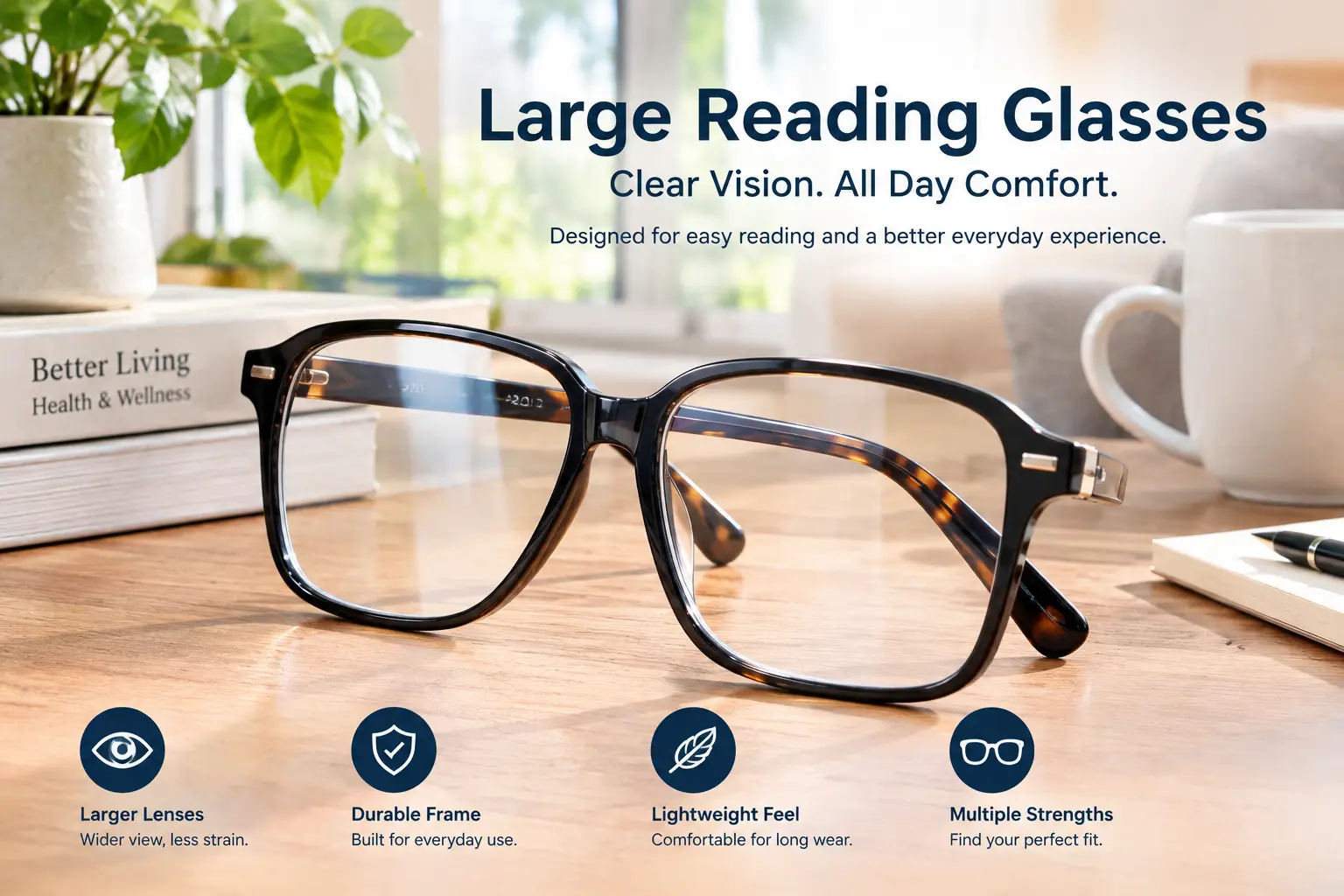
If your drugstore readers pinch your temples, leave red dents above your ears, or make you feel like you borrowed them from a grandchild, you’re not imagining things. Most off-the-rack cheaters are built around an “average” face that a lot of us simply don’t have. That’s exactly where large reading glasses come in: a wider frame, bigger lenses, and longer temples that fit comfortably and give you more usable lens to look through.
And the “usable lens” part matters more than people expect. With small readers, you end up hunting for the sweet spot, tilting your chin and craning your neck to keep a menu or a phone screen in focus. A taller, wider lens gives your eyes more room to scan a page without the edges of the frame getting in the way. For long reading sessions, crafts, or laptop work, that’s the difference between “fine for five minutes” and “comfortable all evening.”
Here’s the good news: large reading glasses are cheap to try, widely available on Amazon, and easy to size once you know three numbers (more on that below). The less-good news? Listings are packed with vague phrases like “fits big heads” that don’t tell you much on their own.
So this guide does the translating for you. You’ll find seven real options, from budget multi-packs to a genuinely extra-wide frame for big heads, plus a sizing walkthrough, a first-30-days routine, and honest notes on where marketing claims (looking at you, “blue light blocking”) outrun the evidence. The analysis is based on published frame measurements, manufacturer specs, and independent eye-health sources — not invented test results.
What Are Large Reading Glasses?
Large reading glasses are over-the-counter magnifying readers with an oversized frame: typically a total frame width of about 140 mm or more, lenses 54 mm wide or larger, and longer temple arms. They fit wider faces comfortably and give a bigger field of clear near vision.
That short definition hides a useful distinction. “Large” can describe two different things, and sellers use the word for both:
- Large for fit — the frame is physically wider so it doesn’t squeeze a broad face or a big head. This is what shoppers searching for reading glasses for big heads actually need.
- Large for style — the lenses are big and the shape is bold (think oversized square or cat-eye), but the overall frame width may be fairly ordinary. That’s the fashion side of oversized reading glasses.
Some frames deliver both; many only deliver one. Knowing which one you need saves you a return.
Underneath the frame, the optics are the same as any other readers: a simple plus-powered lens that helps with presbyopia, the gradual, age-related loss of close-focus ability that most people notice sometime in their 40s. Strength is measured in diopters (+1.00, +1.50, +2.00 and so on), and the right number depends on your eyes and how far away you hold your reading material — not on how big your frame is.
Quick Comparison: The 7 Best Large Reading Glasses at a Glance
| Product | Style & Fit | Pack | Approx. Price Range | Best for |
|---|---|---|---|---|
| Eyekepper 5-Pack Oversized Square Readers | Oversized square, spring hinges | 5 pairs | Under $25 | Eyekepper 5-Pack Oversized Square Readers: stashing pairs everywhere |
| MARE AZZURO Oversized Square Readers | Big square, spring hinges, extras | 1 pair | Around $15–$20 | MARE AZZURO Oversized Square Readers: high powers (up to +6.00) |
| OLOMEE Wide Reading Glasses 4-Pack | 143 mm wide, 54 mm lenses | 4 pairs | Under $25 | OLOMEE Wide Reading Glasses 4-Pack: men with wide faces on a budget |
| Fatheadz Aspect XXL | 151 mm wide, adjustable nose pads | 1 pair | Roughly $30–$50 | Fatheadz Aspect XXL: truly big heads |
| JM Oversized Square Readers | Oversized square, metal hinges | 1 pair | Under $20 | JM Oversized Square Readers: fashion-forward everyday wear |
| Eyekepper Oversized Progressive Readers | Large frame, no-line multifocus | 1 pair | Under $25 | Eyekepper Oversized Progressive Readers: screen + paper in one pair |
| Foster Grant Candra | Oversized acetate cat-eye | 1 pair | Around $20 | Foster Grant Candra: a name-brand statement frame |
Looking at the table, the split is clear: if your main problem is fit, the OLOMEE Wide Reading Glasses 4-Pack and the Fatheadz Aspect XXL are the only two here that publish hard frame-width numbers, and the Fatheadz Aspect XXL is the widest by a meaningful margin. If your main problem is budget and convenience, the multi-packs from Eyekepper 5-Pack Oversized Square Readers and OLOMEE Wide Reading Glasses 4-Pack spread the cost so thin that losing a pair stops being a crisis. Style-first shoppers will gravitate to the Foster Grant Candra or JM Oversized Square Readers.
💬 One click helps other shoppers make an informed choice too! 😊
Top 7 Large Reading Glasses: Expert Analysis
1. Eyekepper 5-Pack Oversized Square Readers — best value for stashing everywhere
The whole point of the Eyekepper 5-Pack Oversized Square Readers is abundance: five identical pairs in one strength, so there’s always a pair within arm’s reach.
Each pair uses a big square frame with spring hinges and scratch-resistant coated lenses, and the listing is explicit that all five pairs come in the single power you choose — not a confusing mixed set. In practice, that means one pair on the nightstand, one in the kitchen, one in the car, one at your desk, and a spare for the inevitable “where did I put them?” moment. Spring hinges matter here because they let the arms flex outward on a wider face instead of pressing inward.
Based on the specs, this is the pick for people who already know their strength and mainly want convenience. It’s less ideal if you need an exact width measurement, since the listing emphasizes an “oversized” look rather than publishing firm frame dimensions for every color. Eyekepper has been selling readers since 2015 and sells through Amazon’s fulfillment network, which simplifies returns if the fit is off.
The listing itself highlights hinge flexibility and a scratch-resistant, clear lens; a detailed, verifiable breakdown of recurring review complaints for this exact variant wasn’t available at the time of writing, so check the most recent reviews for fit comments from people with face shapes like yours.
Pros:
- ✅ Five same-strength pairs cut cost per pair dramatically
- ✅ Spring hinges ease pressure on wider faces
- ✅ Scratch-resistant coating helps lenses survive pockets and purses
Cons:
- ❌ Frame width isn’t clearly listed for every variant
- ❌ Budget build won’t feel as premium as acetate frames
Expect to pay under $25 for the set (check the current price) — outstanding value if you tend to misplace readers.
2. MARE AZZURO Oversized Square Readers — widest strength range here
The MARE AZZURO Oversized Square Readers stand out for one practical reason: the power range runs up to +6.00 on the listing, far beyond the +3.50 ceiling of many drugstore readers.
The frame is a big retro square with spring hinges and screws, and the brand bundles useful extras depending on the listing, such as a mini screwdriver, a glasses chain, a cleaning cloth, and a pouch. The screwdriver sounds trivial, but screw-hinged readers loosen over time, and a 10-second tightening every few weeks keeps the arms from wobbling. The brand also says the larger square lenses reduce the need to turn your neck to stay in focus, which is exactly the benefit of a bigger lens area.
This is a strong fit for people who’ve outgrown common strengths, or who need a high power for close hobby work like beading or model building. One honest caveat: the brand’s own women’s version warns small faces to choose carefully, which tells you these frames genuinely run big. A related MARE AZZURO women’s model is listed at just 19 grams, so the brand clearly prioritizes lightweight builds.
Reliable, detailed review-theme data for this specific listing couldn’t be verified at the time of writing, so weigh the most recent reviews for comments on hinge durability.
Pros:
- ✅ Powers listed up to +6.00 cover severe presbyopia
- ✅ Handy accessories like a screwdriver and chain in many listings
- ✅ Big square lenses widen the clear reading area
Cons:
- ❌ Screw hinges need occasional tightening
- ❌ Frames may overwhelm small or narrow faces
Typically around $15–$20 — very good value, especially for high-power buyers.
3. OLOMEE Wide Reading Glasses 4-Pack — best measured fit for wide faces
What makes the OLOMEE Wide Reading Glasses 4-Pack so useful is that it publishes real measurements instead of just saying “fits big heads.”
The listing gives a total frame width of 143 mm, temples of 143 mm, lenses 54 mm wide and 40.5 mm tall, and an 18 mm bridge. Those numbers let you compare against a pair you already own: if your current readers are 135 mm wide and pinch, an extra 8 mm across the front is noticeable relief. The 40.5 mm lens height is generous too, giving your eyes more vertical room when you glance down at a book. Powers run from +0.50 to +5.00, and each set includes four soft cases plus a cloth.
Based on the specs, these suit men with moderately wide faces who want a plain, lightweight black frame. The brand also notes the longer temples let you park the glasses on top of your head without them sliding off, a small but real everyday convenience. Truly oversized heads may still want the wider frame in the next entry.
The listing itself urges buyers to check the size before purchasing, and fit comments in the category generally come down to whether the published width matches your face.
Pros:
- ✅ Published 143 mm width takes the guesswork out of sizing
- ✅ Tall 40.5 mm lenses give a roomy reading zone
- ✅ Four pairs plus cases in one box
Cons:
- ❌ 143 mm may still be snug on XXL heads
- ❌ Plain styling won’t suit fashion-first buyers
Usually under $25 for four pairs — excellent value for measured, wide fit.
4. Fatheadz Aspect XXL — widest frame for truly big heads
When nothing else fits, the Fatheadz Aspect XXL is the frame that was designed from the ground up for large heads, not merely styled to look big.
The published numbers are the headline: a 151 mm (about 5.94-inch) frame width, 60 mm lenses, a 21 mm bridge, 150 mm temples, and a 34 mm lens height. Compared with the 143 mm OLOMEE Wide Reading Glasses 4-Pack, that’s an extra 8 mm across the face — roughly the gap between “a little snug” and “no pressure at all” for a very broad head. It’s a semi-rimless metal and plastic hybrid with spring hinges and adjustable nose pads, and the adjustable pads are a quiet win: you can fine-tune how high the lenses sit, which helps you look through the optical center.
Fatheadz has been making oversized eyewear since 2004, essentially the “big and tall” specialist of glasses. The trade-off is a shorter 34 mm lens height, so the reading zone is wide rather than tall, and there are fewer strength options — the listing mentions seven.
Independent coverage of the Fatheadz brand, mostly of its sunglasses, consistently credits it with a proper fit for large heads; model-specific review themes for the Aspect couldn’t be verified in detail.
Pros:
- ✅ 151 mm width is the widest frame in this lineup
- ✅ Adjustable nose pads fine-tune lens position
- ✅ Specialist brand focused solely on larger head sizes
Cons:
- ❌ Shorter lens height means less vertical reading area
- ❌ Costs more than multi-pack alternatives
Roughly $30–$50 (check the current price) — worth it if standard “large” frames still pinch.
5. JM Oversized Square Readers — trendiest look for everyday wear
The JM Oversized Square Readers are for people who want readers that look like a fashion choice rather than a medical accessory.
The frame is a big, bold square with sturdy metal hinges, and the lenses add a blue light filter and UV400 coating. The oversized profile gives you a large lens area for scanning a page, while the metal hinges are a durability upgrade over the plastic pins on some budget pairs. JM also sells a 0.00 (no magnification) version, which is handy if you want matching frames for style only.
Here’s what to weigh on the lens coatings: JM’s marketing ties its blue light filter to less eye strain and better sleep, but the American Academy of Ophthalmology doesn’t recommend blue light glasses for computer use (more on that in the features section below). So treat the filter as a neutral extra, not a reason to buy. The real value is the frame style and big lens area.
These suit women and men who want a statement frame at an entry-level price. If you need confirmed width measurements for a wide head, you’ll need to check the specific listing’s size chart first.
Detailed, verifiable review themes for this exact listing weren’t available at the time of writing, so read recent reviews for fit notes.
Pros:
- ✅ Bold oversized square style looks modern, not clinical
- ✅ Metal hinges feel sturdier than plastic pins
- ✅ Zero-power version available for matching style frames
Cons:
- ❌ Blue light claims aren’t backed by the AAO
- ❌ Frame dimensions need checking per listing
Typically under $20 — good value for a stylish daily pair.
6. Eyekepper Oversized Progressive Readers — one pair for screen and page
The Eyekepper Oversized Progressive Readers tackle a common frustration: regular readers make your laptop blurry because the screen sits farther away than a book.
These are no-line “multifocus” readers with three zones in one lens: a weaker area at the top, a middle zone for computer distance, and full strength at the bottom for close reading. A large frame is especially helpful with progressive-style lenses, because each zone gets more room — small frames can squeeze the zones into narrow bands that are frustrating to use. The lenses also carry a five-layer anti-reflective coating, which cuts glare from screens and overhead lighting.
Based on how progressive designs work, expect a learning curve of a few days: you’ll need to point your nose at what you want to see and move your eyes down for close work. They suit desk workers who bounce between documents and a monitor all day. They’re a poor choice for anyone who wants instant, no-thought reading, and they don’t replace prescription progressives if you need distance correction or have astigmatism.
Model-specific review themes couldn’t be verified in detail at the time of writing, so check recent reviews for comments on the adjustment period.
Pros:
- ✅ Three focus zones cover screen and print
- ✅ Large frame gives each zone more usable space
- ✅ Anti-reflective coating reduces screen glare
Cons:
- ❌ Takes several days to get used to
- ❌ Not a substitute for prescription progressives
Usually under $25 — strong value if you’d otherwise juggle two pairs.
7. Foster Grant Candra — name-brand oversized cat-eye style
The Foster Grant Candra brings a heritage American eyewear brand to the oversized trend, in a flattering cat-eye shape.
It’s made from acetate, a denser, more premium-feeling material than the injection-molded plastic common in multi-packs, with 53 mm lenses and a 16 mm bridge. Acetate typically holds its color and polish well and can be gently adjusted by an optician. The 53 mm lens width also tells you something honest: this is “large” in style, not an extra-wide fit. The cat-eye’s upswept top corners make it look oversized, but it’s not built for a very broad head.
That makes it best for women with average-to-slightly-wide faces who want readers that read as a fashion piece, and who value a recognizable brand’s consistency. If your issue is temple pressure, choose a measured wide frame instead.
Detailed, verifiable review themes for this specific colorway weren’t available at the time of writing; Foster Grant’s broader lineup is widely sold and generally well regarded, but check recent reviews for this model.
Pros:
- ✅ Acetate frame feels more premium than basic plastic
- ✅ Cat-eye shape adds flattering lift to the face
- ✅ Established brand with consistent quality control
Cons:
- ❌ 53 mm lenses mean it’s not truly extra-wide
- ❌ Single pair costs more than multi-pack alternatives
Around $20 at the time of writing (prices may vary) — fair value for a name-brand statement frame.
✨ Don’t miss the right fit for your face!
🔍 Take your reading comfort to the next level with this carefully curated lineup. Click a highlighted pick to check current pricing and availability. The right pair means fewer headaches, no pinching, and books you’ll actually enjoy finishing!
Getting Started: Your First 30 Days With Oversized Reading Glasses
New readers take a little adjusting, and oversized frames add a couple of quirks of their own. Here’s a practical routine.
Days 1–3: Confirm the strength
Hold a book or your phone where you naturally like to read, usually around 14–16 inches. Text should look sharp without leaning in or pushing it away. If you have to bring things closer, the strength is probably too high; if you still push things back, it’s too low. Remember that computer screens sit farther away, so a slightly weaker pair often works better there.
Days 4–10: Dial in the fit
A large frame should rest evenly on your nose, with the lenses roughly centered in front of your pupils. If the glasses slide, it’s usually the temples being too loose or too long, not the bridge. Frames with adjustable pads, like the Fatheadz Aspect XXL, can be tweaked; plastic frames can sometimes be gently adjusted by an optical shop.
Days 11–30: Build good habits
Big readers make it tempting to wear them while walking around. Don’t — everything past arm’s length will look blurry, and stairs get risky. Take them off (or peer over them) when you look up.
Common first-month mistakes
- Wiping lenses with a shirt tail instead of the included microfiber cloth
- Tossing readers loose into a bag without a case
- Assuming headaches mean “getting used to them” rather than the wrong strength
For long screen sessions, the American Academy of Ophthalmology recommends practical habits for digital devices such as regular breaks and adjusting screen brightness — these help more than any lens coating.
Real-World Scenarios: Which Pair Fits Your Life?
Specs make more sense when you picture real days. Here are three common profiles.
Profile 1: The big-and-tall office worker
Imagine a 52-year-old project manager with a 7 3/4 hat size who reads contracts on paper and spreadsheets on a 27-inch monitor for eight hours a day. Standard readers leave dents above his ears by lunch. Budget: up to $60.
Best match: the Fatheadz Aspect XXL for desk reading, because its 151 mm width is the only frame here that clearly clears a very broad head. For the monitor, a weaker strength — or trying the Eyekepper Oversized Progressive Readers — keeps the screen sharp without craning.
Profile 2: The misplace-everything retiree
Picture a 67-year-old who reads the paper at breakfast, recipes in the kitchen, and the TV guide in the evening, and who can never find her glasses. Budget: under $30, frequent daily use.
Best match: the Eyekepper 5-Pack Oversized Square Readers. Five identical pairs around the house solve the real problem, which isn’t optics — it’s logistics.
Profile 3: The style-conscious crafter
A 58-year-old quilter wants readers she won’t mind being photographed in, and does detailed needlework in the evenings. Budget: around $20–$40.
Best match: the Foster Grant Candra for everyday style, paired with a higher-power backup such as the MARE AZZURO Oversized Square Readers for close stitching, since fine handwork is usually done closer than book reading and often needs extra magnification.
The pattern across all three: identify the actual pain point — fit, logistics, or distance — before choosing a frame.
Problem → Solution: Fixing Common Large Reader Frustrations
Most complaints about large reading glasses fall into a handful of fixable categories.
Problem 1: “They still pinch my temples.”
Solution: Measure the pair that pinches, then buy something at least 6–8 mm wider. Moving from a typical ~135 mm frame to the 143 mm OLOMEE Wide Reading Glasses 4-Pack, or all the way to the 151 mm Fatheadz Aspect XXL, is the most reliable fix.
Problem 2: “They keep sliding down my nose.”
Solution: Oversized frames can be front-heavy. Look for spring hinges that grip gently, or adjustable nose pads. A retainer chain, like the one included with some MARE AZZURO Oversized Square Readers listings, also stops the slide-and-drop cycle.
Problem 3: “My laptop is blurry, but books are sharp.”
Solution: Your screen sits farther away than a book. Try a strength about 0.50 to 0.75 lower for computer work, or a multifocus design like the Eyekepper Oversized Progressive Readers.
Problem 4: “One eye sees better than the other.”
Solution: Over-the-counter readers use the same power in both lenses. If your eyes differ noticeably, or you have astigmatism, you need prescription readers from an eye doctor — no frame size fixes that.
Problem 5: “The lenses scratch too quickly.”
Solution: Store them in the case every time, rinse dust off before wiping, and use only microfiber. Multi-packs like the Eyekepper 5-Pack Oversized Square Readers also make a scratched pair cheap to retire.
How to Choose Large Reading Glasses
Choosing well takes about five minutes if you follow these steps in order:
- Find your strength first. Try readers at a store or use a printed diopter chart. Frame size never changes the power you need.
- Measure a pair that fits (or almost fits). Look inside the temple arm for three numbers: lens width, bridge width, and temple length. These are your baseline.
- Check total frame width. For wide faces, look for listings that publish 140 mm or more; if a listing doesn’t publish width, treat “fits big heads” as unverified.
- Match lens height to your task. Taller lenses (40 mm or more) suit book reading; wider but shorter lenses suit screen work.
- Choose the hinge type. Spring hinges flex outward and are kinder to broad faces than rigid hinges.
- Decide single pair or multi-pack. If you lose readers often, a pack beats a premium single pair every time.
- Ignore coating hype, keep useful extras. Anti-reflective and scratch-resistant coatings help; blue light filtering is optional at best.
The logic behind this order is simple: strength and fit are non-negotiable, while style and extras are preferences. Get the first two right and almost any frame on this list will serve you well. Get them wrong and even the most stylish pair ends up in a drawer.
Reading Glasses for Big Heads: Sizing Explained
Every pair of glasses has sizing printed inside the temple arm, usually in a format like “54□18-143.” That’s lens width, bridge width, and temple length in millimeters. For big heads, though, the most useful number — total frame width — is often missing from the arm, so you’ll need to rely on the listing or measure an existing pair across the front.
Here’s how the measured options in this guide compare:
| Product | Frame Width | Lens Width | Lens Height | Bridge | Temple | Best for |
|---|---|---|---|---|---|---|
| Fatheadz Aspect XXL | 151 mm | 60 mm | 34 mm | 21 mm | 150 mm | Fatheadz Aspect XXL: XXL heads |
| OLOMEE Wide Reading Glasses 4-Pack | 143 mm | 54 mm | 40.5 mm | 18 mm | 143 mm | OLOMEE Wide Reading Glasses 4-Pack: wide faces, tall reading zone |
| Foster Grant Candra | Not listed | 53 mm | Not listed | 16 mm | Not listed | Foster Grant Candra: average-to-wide faces, style |
The table highlights why published numbers matter. The Fatheadz Aspect XXL wins on width and temple length, so it’s the safer bet for truly large heads, but the OLOMEE Wide Reading Glasses 4-Pack actually offers the taller lens, making it better for book reading. The Foster Grant Candra‘s narrower bridge and 53 mm lens confirm it’s an oversized look, not an XXL fit.
A quick rule of thumb: longer temples (145–150 mm) help if the arms currently end before curving comfortably behind your ears. Wider bridges help if the frame sits too low and presses on the sides of your nose.
Wide Reading Glasses for Men: What Actually Fits
Men shopping for wide reading glasses for men tend to run into the same trap: a listing photo of a big, square frame that turns out to be ordinary width once it arrives. The shape looks masculine and oversized, but the front measures the same as a standard pair.
The fix is to shop by millimeters, not by adjectives. Among the options here, only the OLOMEE Wide Reading Glasses 4-Pack and the Fatheadz Aspect XXL publish full frame widths, which is why they top the list for men with broad faces. The MARE AZZURO Oversized Square Readers describe themselves as designed for wider faces and larger heads, and their retro square shape suits most men well, but confirm the size chart before ordering if you’re at the extreme end.
Beyond width, a few details make a real difference for men:
- Temple length: Larger heads often need longer arms to curve behind the ear properly. Arms that end too early press on the side of the head.
- Material weight: A wide frame in heavy material can feel front-heavy. Lightweight plastic or hybrid frames spread the load better.
- Adjustable nose pads: Especially useful for men with lower nose bridges, since they lift the frame so the lenses line up with your eyes.
A practical approach: buy one measured pair first. If it fits, reorder the same size in multiple colors or strengths, rather than gambling on a new brand each time.
Large Frame Reading Glasses for Women: Style Without Strain
For many women, large frame reading glasses for women are as much about style as comfort. Bold squares and cat-eyes have been fashion staples for years, and oversized readers let you follow the trend while seeing the page clearly.
The key is matching the frame’s shape to your goal. If you want a lifted, polished look, the Foster Grant Candra cat-eye does exactly that in premium acetate. If you prefer a modern, architectural square, the JM Oversized Square Readers deliver a strong statement at a low price. The Eyekepper 5-Pack Oversized Square Readers also come in colorful options, which is fun if you like to coordinate with outfits.
Here’s what to weigh beyond looks:
- Weight on the nose: Big acetate frames can feel heavier over a long evening of reading. Lightweight builds, like the 19-gram women’s frame from MARE AZZURO’s lineup, reduce pressure marks.
- Face proportion: If your face is narrow, a truly XXL frame can slide and look overwhelming. An oversized style with a moderate width often fits better.
- Makeup and lashes: Taller lenses sit farther from your cheeks and lashes, so they’re less likely to touch longer lashes or pick up foundation.
The takeaway: pick your shape for style, then confirm lens width and bridge size for comfort. You shouldn’t have to choose between looking good and reading comfortably.
Large Reading Glasses vs Standard and Half-Eye Readers
Large readers aren’t the only option, so it helps to see how they stack up against the alternatives.
| Type | Field of View | Comfort on Wide Faces | Looking Up Past Them | Best for |
|---|---|---|---|---|
| Large full-frame readers (e.g., OLOMEE Wide Reading Glasses 4-Pack) | Widest near zone | Excellent if measured | Must remove or peer over | Long reading sessions, wide faces |
| Standard readers | Moderate | Often pinches | Must remove | Occasional reading, average faces |
| Half-eye readers | Narrow strip | Varies | Easy — look over the top | Glancing between page and people |
| Prescription progressives | Full range, all distances | Custom fitted | No removal needed | Distance + near needs, astigmatism |
The comparison shows that large full-frame readers win on reading comfort and field of view, which is why they’re ideal for books, crafts, and extended screen time. Half-eyes are better if you constantly look up to talk to people, while prescription progressives remain the right answer when you also need distance correction or have unequal eyes. For simple presbyopia and a broad face, though, measured large readers like the OLOMEE Wide Reading Glasses 4-Pack or Fatheadz Aspect XXL are the most comfortable, affordable choice.
There’s also a middle path worth mentioning: over-the-counter multifocus readers like the Eyekepper Oversized Progressive Readers. They give you some of the range of prescription progressives at a fraction of the cost, but only work if both eyes need the same correction.
Features That Actually Matter (and Ones That Don’t)
Reader listings are packed with features. Here’s how to separate the useful from the marketing.
Features that genuinely matter
- Published measurements. The single most valuable “feature.” Without frame width, “fits big heads” is just a promise.
- Spring hinges. They let arms flex outward, relieving pressure on wider faces, and they reduce the chance of snapping a hinge when you pull glasses off one-handed.
- Anti-reflective coating. Cuts glare from screens and lamps, which genuinely improves comfort for evening reading.
- Scratch-resistant coating. Extends lens life, especially for readers that live in bags.
Features that matter less than the ads suggest
- Blue light blocking. Nearly every budget listing touts it. But the American Academy of Ophthalmology says there’s no scientific evidence that blue light from screens damages the eyes and does not recommend blue light glasses for computer use; screen strain comes mostly from blinking less. A filter won’t hurt, but don’t pay extra for it.
- “HD” lenses. Almost always just a marketing term for standard optical-grade plastic.
- “UV400” on clear readers. Useful for sunglasses outdoors; for indoor reading glasses, it’s rarely a deciding factor.
The takeaway: spend your attention on fit and coatings that reduce glare. For screen comfort, take regular breaks.
Safety, Regulations, and Standards
It’s reasonable to wonder whether a $4-per-pair multi-pack is safe to wear. Here’s what US rules actually say.
In the United States, eyeglass and sunglass lenses — including over-the-counter readers — are covered by an FDA impact-resistance requirement under 21 CFR 801.410. The rule requires manufacturers and importers to test a statistically significant sample of plastic lenses from each production batch using the “drop ball” test, and the FDA’s impact-resistant lens guidance explains that importers of finished eyeglasses count as manufacturers for this purpose. The classic test drops a 5/8-inch steel ball from 50 inches onto the lens. In practical terms, legitimate readers sold in the US are expected to resist shattering from everyday knocks.
What these rules don’t guarantee is optical perfection. Low-cost readers can vary slightly in how precisely the optical center lines up with your eyes. A few safety-minded habits help:
- Don’t drive or walk around in readers. Anything beyond arm’s length will be blurred.
- Don’t use readers as safety glasses. Impact-resistant is not the same as protective eyewear for power tools; use ANSI Z87.1-rated safety glasses for that.
- Watch for warning signs. Sudden vision changes, dark spots, or flashes of light aren’t presbyopia — see an eye doctor promptly.
Readers also don’t replace eye exams. Over-the-counter glasses correct focus, but they can’t catch conditions like glaucoma early. An exam every one to two years remains good practice after 40.
Long-Term Cost and Maintenance
Readers are cheap up front, but the real cost depends on how many pairs you buy, lose, and scratch over the years.
| Option | Approx. Upfront Cost | Pairs | Approx. Cost per Pair | Best for |
|---|---|---|---|---|
| Eyekepper 5-Pack Oversized Square Readers | Under $25 | 5 | Around $4–$5 | Eyekepper 5-Pack Oversized Square Readers: frequent losers |
| OLOMEE Wide Reading Glasses 4-Pack | Under $25 | 4 | Around $5–$6 | OLOMEE Wide Reading Glasses 4-Pack: wide fit on a budget |
| Fatheadz Aspect XXL | Roughly $30–$50 | 1 | $30–$50 | Fatheadz Aspect XXL: long-lasting XXL fit |
| Foster Grant Candra | Around $20 | 1 | Around $20 | Foster Grant Candra: a single stylish pair |
The numbers make an important point: multi-packs deliver the lowest cost per pair by far, which matters because presbyopia typically progresses, and you’ll likely step up your strength every couple of years until around your 60s. Cheap packs let you upgrade strength without feeling like you’re throwing money away. A single premium frame like the Fatheadz Aspect XXL makes more sense once your strength stabilizes, or if fit is the problem no budget pair solves.
For maintenance, a two-minute weekly routine goes a long way: rinse with lukewarm water and a drop of dish soap, dry with microfiber, and tighten any loose hinge screws. Always store readers in a case, lenses up. With that care, even budget pairs can last until your strength changes.
Common Mistakes to Avoid When Buying Large Reading Glasses
Most returns come from a handful of avoidable errors.
Mistake 1: Trusting “fits big heads” without numbers. It’s the most common trap. If a listing won’t tell you the frame width, compare against a pair you own or pick one that publishes measurements.
Mistake 2: Buying the strongest power “to be safe.” Overpowered readers force you to hold things uncomfortably close and can cause headaches. Buy the lowest strength that makes text clear at your normal distance.
Mistake 3: Using one strength for everything. Books, phones, and computers sit at different distances. Many people end up happiest with two strengths, or one multifocus pair.
Mistake 4: Confusing oversized style with oversized fit. A dramatic cat-eye with 53 mm lenses, like the Foster Grant Candra, looks big but isn’t extra-wide. Great for style, wrong for a very broad head.
Mistake 5: Paying extra for blue light filters. The evidence doesn’t support them for eye strain. Spend the difference on a better fit or a second strength instead.
Mistake 6: Skipping the eye exam. Readers fix focus, not eye health. If your eyes need different strengths, or you have astigmatism, you need prescription glasses.
Avoid these six mistakes and your first order is very likely to be the one you keep.
FAQs
❓ Where can I buy large reading glasses for men with big heads?
❓ Are oversized reading glasses worth buying in a multi-pack?
❓ What strength of large reading glasses should I buy for computer use?
❓ Can I return reading glasses on Amazon if they don't fit?
❓ Do cheap large reading glasses work as well as expensive ones?
Conclusion: Find the Pair That Fits Your Face and Your Day
The best large reading glasses aren’t the ones with the boldest marketing — they’re the ones that fit your face, match your strength, and suit how you actually read. Start with fit. If standard readers pinch, go straight to a measured frame: the OLOMEE Wide Reading Glasses 4-Pack at 143 mm for most wide faces, or the Fatheadz Aspect XXL at 151 mm when nothing else works.
If fit isn’t the issue and losing readers is, the Eyekepper 5-Pack Oversized Square Readers turn a daily annoyance into a non-event. High-power needs point to the MARE AZZURO Oversized Square Readers, while desk workers juggling paper and screens should look at the Eyekepper Oversized Progressive Readers. And for readers that double as a style statement, the Foster Grant Candra and JM Oversized Square Readers are easy to love.
Whatever you choose, keep three habits: measure before you buy, choose the lowest strength that makes text crisp, and keep up with regular eye exams. Readers are a simple tool, but a well-fitted pair can make every book, recipe, and screen feel easier.
🌟 Ready to read in comfort again?
📚 Pick the pair that matches your face and your routine, then click a highlighted product to check current pricing and availability. Your next great read deserves a clear, comfortable view!
Recommended for You
- Computer Progressive Glasses: 7 Best Picks to Beat Eye Strain 2026
- Anti Glare Reading Glasses: 7 Best Picks That Actually Work (2026)
- 7 Best Computer Glasses With Anti Glare Coating: Top Picks for 2026
Disclaimer: This post contains affiliate links. As an Amazon Associate, I earn from qualifying purchases made through these links, at no additional cost to you.
✨ Found this article helpful? Share it with someone who needs it! 💬🤗