
In This Article
Why Big Frame Reading Glasses Deserve a Second Look
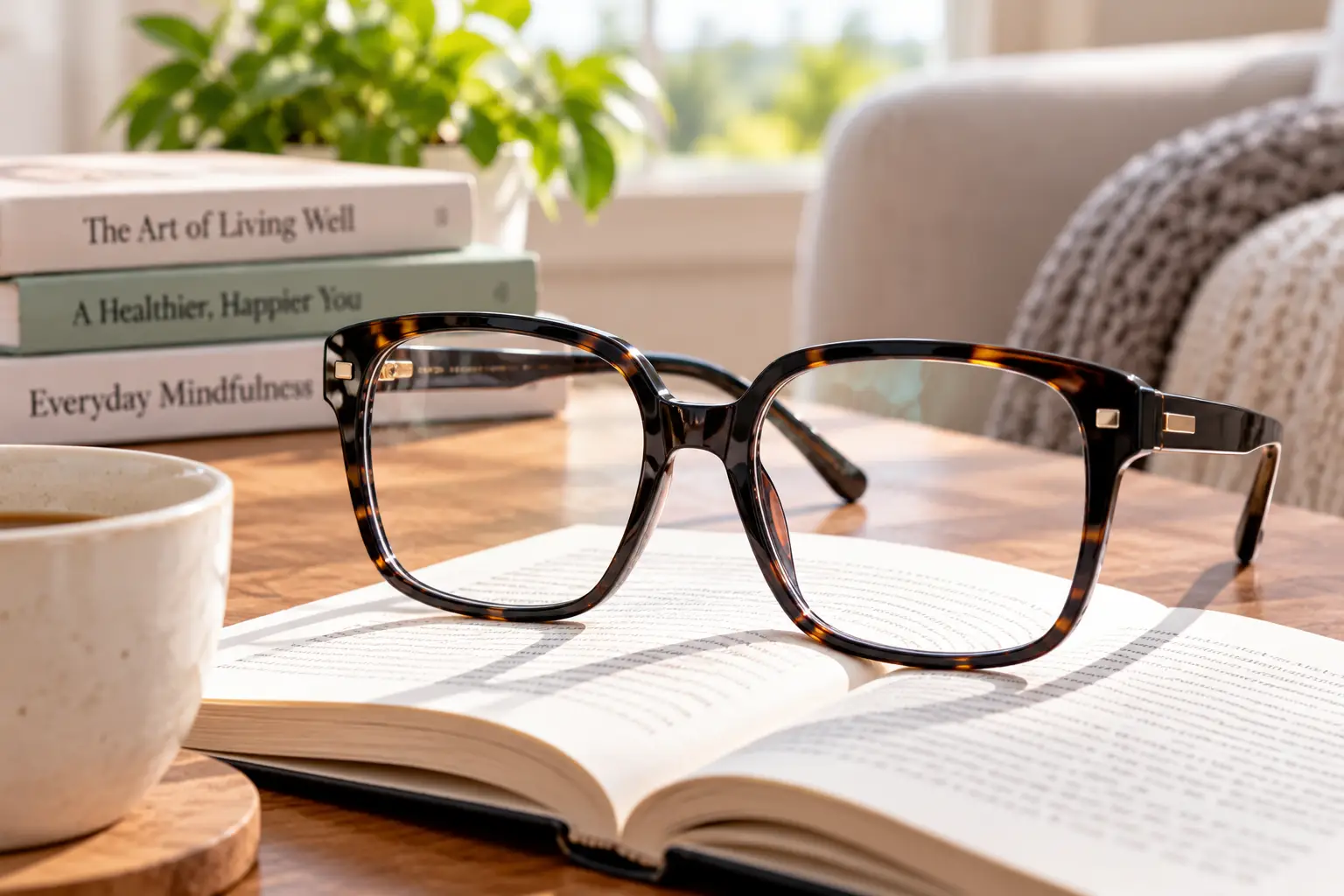
Ever slid a pair of drugstore readers onto your face, felt the temples squeeze like a vise, and watched the edge of the lens cut straight through the sentence you were trying to read? You’re in good company. Most off-the-rack readers are built around an “average” head, and a huge number of us simply aren’t average. That’s exactly the gap big frame reading glasses fill: wider fronts, taller lenses, and longer temples that give your eyes more usable magnified area and give your head a little breathing room.
The need behind all this is close to universal. The American Academy of Ophthalmology’s guide to presbyopia explains that most people begin noticing near-focus trouble shortly after 40, because the eye’s internal lens gradually stiffens. The Academy also points out that readers can be bought over the counter, while the ideal strength is best confirmed with an eye exam. In other words, millions of Americans end up shopping for cheaters — and many of them have wide faces, big heads, or simply love a bold look.
So how do you separate genuinely roomy big frame reading glasses from listings that just slap “oversized” in the title? For this 2026 guide, we compared real manufacturer spec sheets — frame width, lens width and height, bridge, and temple length — and summarized aggregated customer sentiment from retailer reviews. We didn’t run a lab test, and we won’t pretend we did. Instead, you’ll get honest, numbers-first analysis that translates millimeters into what you’ll actually feel on your face.
What Are Big Frame Reading Glasses?
Big frame reading glasses are non-prescription magnifying readers built on an oversized front — typically 140mm or wider, with lenses around 50mm across and 40mm or taller. The extra size widens your magnified field of view and eases pressure on broader faces, while keeping the same simple, fixed-power optics as standard readers.
Quick Comparison: Big Frame Reading Glasses at a Glance
Short on time? Here’s the cheat sheet. Frame width is the single most important number for fit, so it leads the table. All measurements come from manufacturer or retailer spec sheets; prices are approximate ranges at the time of writing and may vary, so always check the current price.
| Product | Frame width | Lens (W × H) | Standout feature | Price range | Best for |
|---|---|---|---|---|---|
| Caddis D28 (Wide) | 145mm | 52 × 43mm | Bio-based acetate, 5-barrel hinges | Around $100–$120 | Caddis D28: bold all-day statement |
| eyebobs Biff (Wide) | 144mm | 51 × 39mm | Powers up to +4.00 | Around $100 | eyebobs Biff: classic wide faces |
| MARE AZZURO Extra Large Square Readers | 144mm | 55 × 45mm | Powers up to +6.00 | Under $20 | MARE AZZURO Extra Large Square Readers: high magnification |
| OLOMEE Large Reading Glasses 4-Pack | 143mm | 54mm wide (height not listed) | Spring hinges, rubber arm tips | $15–$25 | OLOMEE Large Reading Glasses 4-Pack: big heads on a budget |
| Eyekepper 5-Pack Oversized Square | 140mm | 53 × 40mm | Five pairs, one power | $15–$35 | Eyekepper 5-Pack Oversized Square: a pair in every room |
| Eyekepper Oversized Multifocus 4-Pack | 139mm | 49 × 42mm | Progressive-style multifocus lens | $30–$40 | Eyekepper Oversized Multifocus 4-Pack: screen-plus-paper days |
| Peepers Limelight | 136mm | 50mm wide | Built-in blue light filter | $25–$35 | Peepers Limelight: oversized look, medium face |
Looking at the table above, the premium pair — Caddis D28 and eyebobs Biff — and the budget MARE AZZURO Extra Large Square Readers all land in the 144–145mm sweet spot, so you don’t have to spend $100 to get genuinely wide big frame reading glasses. What the extra money buys is acetate construction and sturdier hinges, not more width. Meanwhile, Peepers Limelight proves an important point: “oversized” sometimes describes the look rather than the fit, so medium faces can get the drama without the slide.
💬 One click helps other shoppers make an informed choice too! 😊
Top 7 Big Frame Reading Glasses for 2026: Expert Analysis
Every pick below is a real product sold on or orderable through amazon.com. For each one, you’ll see what the specs mean in daily life, who it suits, what reviewers consistently report, and where it falls short.
1. Caddis D28 — the boldest premium statement frame
If you want readers that look like designer eyewear rather than an emergency purchase, the Caddis D28 is the brand’s largest style, and it wears that size proudly.
It comes in three widths, and the Wide version measures 145mm across with 52mm × 43mm lenses, a 22mm bridge, and 145mm temples. In practice, that 43mm lens height means you can glance down at a menu without your eyes dropping below the magnified zone. The bio-based acetate front and 5-barrel industrial hinges are built for years of daily folding, and Caddis says its blue light filter is infused into the lens rather than coated on top.
Based on comparing the specs, this is the pair for someone who wears readers most of the day and wants one frame to last, not a drawer full of disposables. The wide 22mm bridge also suits broader noses that get pinched by budget frames.
Customer reviews on retailer pages tend to praise the sturdy frame and lens clarity, and many describe it as a look they’ll keep for years. Amazon-specific review volume varies by color, so check the listing for your shade.
Pros:
- ✅ Three widths, including a genuinely roomy 145mm Wide
- ✅ Tall lenses keep text magnified when you look down
- ✅ Industrial hinges built for heavy daily use
Cons:
- ❌ Chunky acetate feels heavier than plastic multipacks
- ❌ Premium price for a single pair
💲 Expect around $100–$120; worth it if you’ll wear one pair daily for years.
2. eyebobs Biff — the wide-face classic that skips gimmicks
The eyebobs Biff (the frame formerly sold as “Butch”) is the quiet workhorse here: a timeless square that simply fits wide heads.
Its Wide size measures 144mm, with 51mm × 39mm lenses, a 22mm bridge, and 145mm temples, while the Narrow size drops to 130mm. That two-size system matters because eyebobs labels anything over 140mm as Wide, so you’re not guessing from a vague “large” tag. Lenses are scratch-resistant and smudge-resistant, and powers run from 0.00 up to +4.00, covering most presbyopia stages.
What most buyers overlook is versatility: the same shape is offered as blue light glasses, sun readers, and progressive readers, so you can build a matching set later. It’s ideal for men and women who want understated big frame reading glasses that work with business clothes.
We couldn’t verify a large pool of Biff-specific reviews, so we won’t overstate it. At the brand level, eyebobs earns a strong reputation as a middle ground between budget and luxury eyewear, with frequent praise for lens quality and fit.
Pros:
- ✅ Clearly labeled Wide size takes the guesswork out
- ✅ Powers up to +4.00 for stronger needs
- ✅ Matching blue light and sun versions available
Cons:
- ❌ Limited model-specific review data to verify
- ❌ Costs as much as five budget multipacks
💲 Around $100; strong value if you want a refined, long-lasting wide fit.
3. MARE AZZURO Extra Large Square Readers — big fit, big magnification, small price
The MARE AZZURO Extra Large Square Readers deliver premium-level width at a fraction of the cost, plus magnification strengths most brands don’t offer.
On paper, it matches the expensive picks: 144mm frame width, 55mm × 45mm lenses, an 18mm bridge, and 145mm temples. Those 55mm lenses are the widest in this roundup, which translates into less head-turning when you scan a spreadsheet or a long recipe. Spring hinges flex outward so the frame doesn’t pinch, and powers run from +1.00 all the way to +6.00.
That +5.00 and +6.00 range is the real story. Here’s what to weigh: people with advanced presbyopia, or those doing very close craft work, often struggle to find high-power readers in a wide fit. This pair solves both problems at once, though anyone needing that much power should confirm it with an eye doctor first.
On one major retailer’s listing, it averages a little over 4 stars from a small pool of reviews, with comments centered on comfortable fit for wider faces. A small sample means you should read recent reviews before buying.
Pros:
- ✅ Widest lenses in this lineup at 55mm
- ✅ Rare +5.00 and +6.00 strengths in a wide frame
- ✅ Spring hinges reduce pinching on broad heads
Cons:
- ❌ Narrower 18mm bridge may sit high on wide noses
- ❌ Smaller review pool than the big multipack brands
💲 Typically under $20; outstanding value, especially for high magnification needs.
4. OLOMEE Large Reading Glasses 4-Pack — four roomy pairs for big heads
The OLOMEE Large Reading Glasses 4-Pack is built for one specific shopper: the guy whose readers always leave red marks above his ears.
Each pair measures 143mm wide with 54mm lenses and 145mm arms, and rubber-tipped temples with spring hinges help them stay put without clamping. Four identical-power pairs mean one lives on the nightstand, one in the car, one at your desk, and one in your jacket. OLOMEE also sells a blue light filtering version in the same large shape.
Based on comparing the specs, this is the most practical choice for men with big heads who lose readers constantly. The resin lenses are perfectly adequate for books and phones, but you’re buying fit and quantity here, not luxury optics.
Reviews consistently highlight that these finally fit larger heads, and the blue light version averages high ratings on retailer listings. Some roundups add a fair caution: if your face is extremely wide, measure your current frames before ordering.
Pros:
- ✅ 143mm width fits most big heads comfortably
- ✅ Rubber arm tips add grip without pressure
- ✅ Four pairs cover every room and bag
Cons:
- ❌ Lens height isn’t clearly published
- ❌ Lightweight plastic feels less premium than acetate
💲 Roughly $15–$25 for four pairs; excellent value per pair for big-head comfort.
5. Eyekepper 5-Pack Oversized Square — the best stash-everywhere value
The Eyekepper 5-Pack Oversized Square set is the answer to “where did I leave my glasses?” — five matching big frame readers in a single strength.
The spec sheet lists a 140mm frame width, 53mm × 40mm lenses, a 46mm overall frame height, and spring hinges, with polycarbonate frames and scratch-coated acrylic lenses. That 46mm frame height gives you a tall, bold square silhouette that reads as intentional eyewear rather than a drugstore afterthought. Because all five pairs share one power, you never grab the wrong strength from the kitchen drawer.
On paper, this means the ideal buyer has a moderately wide face and needs plenty of backups — think busy parents, frequent travelers, or anyone who sits on their glasses twice a month. Two numbers deserve attention, though: the 14mm bridge is narrow, and the roughly 138mm temples are shorter than the 145mm arms on our wider picks.
Roundups and reviews consistently mention compliments on the square shape and note that the temples sit straight without bowing outward. One retail listing shows very high average ratings, though from a modest number of reviews.
Pros:
- ✅ Five pairs at a very low cost per pair
- ✅ Tall square lenses give generous vertical coverage
- ✅ Spring hinges add flex and durability
Cons:
- ❌ Narrow 14mm bridge may pinch broader noses
- ❌ Shorter temples than the widest frames here
💲 Roughly $15–$35 depending on pack; unbeatable if you need many backups.
6. Eyekepper Oversized Multifocus 4-Pack — one lens for screen and page
The Eyekepper Oversized Multifocus 4-Pack tackles a modern problem: switching between a laptop at arm’s length and a phone in your hand all day.
Instead of a single magnification, these lenses use a no-line multifocus design with different zones for different distances, plus a 5-layer anti-reflective coating and blue light filtering. The frame measures 139mm wide with 49mm × 42mm lenses, a 53mm frame height, a 14mm bridge, and 140mm temples. That tall 53mm frame isn’t just style — multifocus lenses need vertical room so each zone has space to work.
Here’s what to weigh: progressive-style readers suit office workers who constantly glance between monitor and paperwork. However, every no-line lens has an adaptation period, and peripheral areas can feel soft at first. If you’ve never worn progressives, start with weekend use before committing to a full workday.
Review sentiment is more mixed than for single-vision picks; one retail listing averages around 4 stars. Positive comments focus on convenience, while lower ratings tend to reflect the learning curve that comes with any multifocus design.
Pros:
- ✅ Handles screen and reading distances in one lens
- ✅ Tall frame gives each focus zone room
- ✅ Anti-reflective coating helps under office lighting
Cons:
- ❌ Adjustment period for first-time progressive wearers
- ❌ Narrow bridge limits fit on very wide noses
💲 Around $30–$40 for four pairs; strong value for heavy multitaskers.
7. Peepers Limelight — oversized style for medium faces
The Peepers Limelight is the pick for anyone who loves the oversized look but has found truly wide frames sliding down their nose.
Its listed measurements — 136mm frame width, 50mm lens width, 21mm bridge, and 147mm arms — are moderate, yet the soft-square shape reads as bold and fashion-forward. The longer 147mm arms hook securely behind the ears, which helps prevent the slipping that plagues many oversized reading glasses for women. Peepers says its Blue Light Focus lenses filter part of the high-energy visible light in the 400–450nm range, and each pair ships with a canvas travel case.
Based on comparing the specs, this is the most realistic “big look” for smaller and medium faces. If your current readers measure under 135mm and feel fine, the Peepers Limelight gives you statement style without a sloppy fit.
On one major retailer’s listing, it averages around 4.5 stars. Across Peepers reviews more broadly, a recurring note is that some styles run large, so check measurements against your current glasses.
Pros:
- ✅ Bold oversized look without an oversized fit
- ✅ Long 147mm arms reduce slipping
- ✅ Travel case included with each pair
Cons:
- ❌ Too narrow for genuinely big heads
- ❌ Blue light filter adds cost with debated benefit
💲 Around $25–$35; good value for style-led buyers with medium faces.
Side-by-Side: The Fit Numbers That Decide Comfort
Width gets the headlines, but bridge and temple length decide whether big frame reading glasses stay comfortable past lunchtime. Here’s how the top 7 compare on the less obvious numbers.
| Product | Bridge | Temple | Max power listed | Review sentiment | Best for |
|---|---|---|---|---|---|
| Caddis D28 | 22mm | 145mm | Varies by size/color | Praised for durability | Caddis D28: wide noses, daily wear |
| eyebobs Biff | 22mm | 145mm | +4.00 | Strong brand reputation | eyebobs Biff: professional settings |
| MARE AZZURO Extra Large Square Readers | 18mm | 145mm | +6.00 | Positive, small sample | MARE AZZURO Extra Large Square Readers: high powers |
| OLOMEE Large Reading Glasses 4-Pack | Not listed | 145mm | +5.00 | Fits big heads well | OLOMEE Large Reading Glasses 4-Pack: big heads |
| Eyekepper 5-Pack Oversized Square | 14mm | ~138mm | +5.00 | Very positive, modest sample | Eyekepper 5-Pack Oversized Square: backups |
| Eyekepper Oversized Multifocus 4-Pack | 14mm | 140mm | Up to +3.50 seen | Mixed, learning curve | Eyekepper Oversized Multifocus 4-Pack: multitaskers |
| Peepers Limelight | 21mm | 147mm | Varies | Positive; some run large | Peepers Limelight: medium faces |
The pattern is clear: the two premium frames pair wide fronts with roomy 22mm bridges, while the Eyekepper sets save money partly through narrow 14mm bridges. If you have a broad nose, that single number matters more than any marketing claim. And if you need +5.00 or stronger, MARE AZZURO Extra Large Square Readers and OLOMEE Large Reading Glasses 4-Pack are the only wide options here that reach that range.
✨ Don’t miss these top-rated big frame picks!
🔍 Take your reading comfort to the next level with this carefully curated lineup. Click a highlighted pair to check current pricing and availability — the right fit means no more pinched temples or lenses that end mid-sentence!
Which Big Frame Readers Fit Your Life? Three Buyer Profiles
Specs only matter once they meet a real routine. Here are three example profiles — composites built from common buyer situations, not real customers — matched to the picks above.
🧰 The busy contractor with a big head
Picture a 54-year-old who reads invoices, tape measures, and texts all day, wears a large hat size, and loses readers weekly. Budget: about $25. The OLOMEE Large Reading Glasses 4-Pack wins here: 143mm of width, rubber-tipped arms that survive a truck cab, and four pairs spread between job site, truck, and home. If that buyer already needs +5.00 or more, the MARE AZZURO Extra Large Square Readers reach higher powers at a similar price.
💻 The accountant juggling screens and paper
Now imagine someone spending eight hours toggling between two monitors and printed statements, with a $40 budget. The Eyekepper Oversized Multifocus 4-Pack handles both distances without constant swapping. The trade-off is a week or two of adaptation, so it pays to start on weekends. Prefer single-vision clarity? The eyebobs Biff in a blue light version is the polished, wide-fit alternative.
📚 The style-first reader with a medium face
Finally, consider a 47-year-old who wants readers that look great at book club and in meetings but has a medium-width face. Budget: around $35. The Peepers Limelight delivers the oversized look with a 136mm fit that won’t slide. If that same buyer has a wider face and a bigger budget, the Caddis D28 is the statement frame that also fits.
Your First 30 Days With Big Frame Readers: Setup, Fixes, and Care
Amazon listings stop at the checkout button. Here’s what happens next — and how to fix the most common snags before they push you into a return.
Day 1: Run a 60-second fit check
- Center check: look straight ahead in a mirror; your pupils should sit near the middle of each lens, not hugging the inner edge.
- Pressure check: the temples should touch, not press, the sides of your head.
- Cheek check: smile wide — if the frame lifts off your nose, it’s resting on your cheeks.
Problem → Solution: the five most common complaints
- ⚠️ Sliding down your nose: add silicone ear grips or nose-pad stickers to plastic frames. Acetate frames like the Caddis D28 can be heat-adjusted by an optician, often at little or no cost.
- ⚠️ Headaches after an hour: the power may be too strong. Try one step lower (for example, +2.00 instead of +2.25) and get an eye exam if it persists.
- ⚠️ Blurry at the computer: readers are tuned for book distance. Monitors sit farther away, so many people do better with a slightly lower power — or a multifocus pair.
- ⚠️ Lashes brushing the lens: tall lenses sit closer to your face; a small nose-pad adjustment or a different bridge fit solves it.
- ⚠️ Scratches in month one: never wipe with your shirt, and never set glasses lens-down.
The simple care routine
Rinse lenses with lukewarm water, use a drop of lens cleaner, and dry with microfiber. Store them in a case — never on the dashboard, where heat can warp plastic frames. Do this weekly, and even a budget multipack can last well beyond its price.
How to Choose Big Frame Reading Glasses: 6 Steps
Choosing big frame reading glasses comes down to six numbers and decisions, in this order:
- Measure your current frame width. Hold a ruler across the front of a pair that fits, hinge to hinge. Under 130mm is narrow, 131–139mm is average, and 140mm or more is wide.
- Match the bridge to your nose. Broad noses need 20mm or more; narrow bridges (14–16mm) ride high and pinch.
- Check temple length. Big heads usually need 145mm or longer arms so the tips actually curve behind the ears.
- Confirm your power. Start with what an eye exam recommends; going too strong causes headaches, not sharper text.
- Pick single-vision or multifocus. Single-vision is sharpest for books; multifocus suits screen-plus-paper days.
- Decide between one great pair or many good ones. Acetate premium frames last; multipacks win if you misplace glasses.
Wide Reading Glasses for Big Heads: Reading the Numbers on the Temple
If you’ve ever wondered what “52-18-145” printed inside your glasses means, here’s the decoder: lens width, bridge width, and temple length, in millimeters. Wide reading glasses for big heads usually show a lens width of 52mm or more, a bridge of 18mm or more, and temples of 145mm.
One catch: overall frame width — the number that matters most for big heads — usually isn’t printed on the frame. eyebobs, for example, notes that you won’t find it on the glasses themselves, which is why its product pages list it separately. When a listing says “large” without a frame width, treat it as a style claim, not a fit promise.
A practical rule of thumb: add up lens width twice plus the bridge, then add roughly 10–15mm for the frame edges. A 55-18 frame like the MARE AZZURO Extra Large Square Readers lands right around its listed 144mm. That quick math lets you sanity-check any listing for wide reading glasses for big heads in seconds.
Oversized Reading Glasses for Men vs. Oversized Reading Glasses for Women
On Amazon, oversized reading glasses for men lean toward squares and rectangles in black or tortoise, usually 140–145mm wide, like the OLOMEE Large Reading Glasses 4-Pack. Oversized reading glasses for women more often feature cat-eye, soft-square, and round shapes with patterned temples, like the Peepers Limelight.
Here’s the surprise: “women’s” doesn’t mean smaller. Some MARE AZZURO women’s oversized listings run 146mm and even 153mm wide — wider than many men’s frames. The takeaway? Gender labels describe styling, not fit. A woman with a wide face can happily wear the eyebobs Biff, and a man who loves bold color can wear the Caddis D28, which the brand pitches to both. Shop the measurements first, then pick the vibe.
Big Frame Readers vs. Standard Readers vs. Prescription Glasses
| Factor | Big frame readers | Standard readers | Prescription glasses |
|---|---|---|---|
| Magnified field of view | Widest | Narrower | Depends on frame |
| Fit for wide heads | Built for it | Often pinches | Fitted by optician |
| Typical cost | $5–$120 per pair | $5–$30 per pair | Often $150+ |
| Corrects astigmatism or distance | No | No | Yes |
| Best for | Presbyopia only, wide faces | Presbyopia only, average faces | Multiple vision issues |
The table shows where big frame readers shine: if near-vision blur is your only issue, they offer prescription-level comfort at drugstore-level prices. However, if you also have astigmatism or need distance correction, readers can’t fix that — the AAO notes those cases often call for bifocals or progressive lenses. Readers are a tool, not a replacement for an eye exam.
Features That Actually Matter (and Ones That Don’t)
Listings for big frame reading glasses are packed with buzzwords. Here’s how to sort signal from noise.
✅ Worth paying attention to:
- Frame width, bridge, and temple length — they decide comfort more than any coating.
- Spring hinges — they flex outward on wide heads instead of snapping or clamping.
- Lens height of 40mm or more — it keeps text magnified when you look down.
- Scratch-resistant and anti-reflective coatings — useful under office lights and on frequently handled pairs.
❌ Mostly marketing:
- Blue light blocking claims. The American Academy of Ophthalmology’s take on blue light is blunt: there’s no scientific evidence that screen blue light damages your eyes, and the Academy doesn’t recommend blue light glasses for computer use. Screen discomfort is usually digital eye strain from blinking less. The fix is free — the 20-20-20 rule: every 20 minutes, look at something 20 feet away for 20 seconds.
- “HD” or “anti-fatigue” lenses with no measurable spec behind the phrase.
That doesn’t make the Peepers Limelight or Caddis D28 bad buys — you’re simply paying for style and build, so don’t pay extra expecting medical benefits.
Long-Term Cost: Multipacks vs. One Premium Pair
| Product | Price range | Pairs | Approx. cost per pair | Best for |
|---|---|---|---|---|
| Eyekepper 5-Pack Oversized Square | $15–$35 | 5 | About $3–$7 | Eyekepper 5-Pack Oversized Square: frequent losers |
| OLOMEE Large Reading Glasses 4-Pack | $15–$25 | 4 | About $4–$6 | OLOMEE Large Reading Glasses 4-Pack: big-head backups |
| Eyekepper Oversized Multifocus 4-Pack | $30–$40 | 4 | About $8–$10 | Eyekepper Oversized Multifocus 4-Pack: multitasking value |
| MARE AZZURO Extra Large Square Readers | Under $20 | 1 | Under $20 | MARE AZZURO Extra Large Square Readers: high-power budget |
| Peepers Limelight | $25–$35 | 1 | $25–$35 | Peepers Limelight: affordable style |
| eyebobs Biff / Caddis D28 | Around $100–$120 | 1 | $100–$120 | eyebobs Biff / Caddis D28: daily, long-term wear |
Run the math on daily wear and the gap shrinks fast: a $110 frame worn every day for three years works out to roughly 10 cents a day. Multipacks win when glasses get lost, crushed, or left in hotel rooms; premium acetate wins when one pair stays with you. Many readers end up with both — a premium daily pair plus a cheap multipack for the car and nightstand.
Safety, Regulations, and Standards for Readers
Over-the-counter readers sold in the US are regulated as medical devices, and their lenses must meet the FDA’s impact-resistance rule. Under 21 CFR 801.410, manufacturers test samples from each production batch by dropping a 5/8-inch steel ball from 50 inches onto the lens — the so-called drop ball test.
What that means for you:
- ✅ Reputable readers won’t shatter from everyday knocks.
- ⚠️ “Impact-resistant” isn’t “shatterproof” — the FDA’s own guidance stresses the difference.
- ⚠️ Readers aren’t safety eyewear. On a job site or in the workshop, look for ANSI Z87.1-marked safety glasses, available with built-in magnification.
- ⚠️ Never drive in full-lens readers; distance vision will blur.
One more safety note: sudden changes in near vision, double vision, or eye pain call for an eye doctor, not a stronger pair of readers.
Big Frame Reading Glasses FAQs
❓ Where can I buy big frame reading glasses for a large head?
❓ Are expensive reading glasses worth it compared to cheap readers?
❓ What strength of oversized reading glasses should I buy?
❓ Are cheap reading glasses from Amazon safe for your eyes?
❓ Can I get progressive lenses in big frame reading glasses?
Conclusion: Find the Big Frame Reading Glasses That Fit Your Face
The best big frame reading glasses aren’t the ones with “oversized” in the title — they’re the ones whose numbers match your head. Start with frame width (140mm or more for wide faces), then confirm a comfortable bridge and 145mm temples, and only then fall in love with a color.
If you want one premium pair to wear daily, the Caddis D28 delivers the boldest look with genuinely wide sizing, while the eyebobs Biff offers a quieter, professional alternative. On a budget, the MARE AZZURO Extra Large Square Readers match premium width and reach +6.00, and the OLOMEE Large Reading Glasses 4-Pack spreads big-head comfort across four pairs. Need lots of backups? The Eyekepper 5-Pack Oversized Square is hard to beat on cost per pair. Juggle screens and paper all day? The Eyekepper Oversized Multifocus 4-Pack is worth the learning curve. And if you love the oversized look but have a medium face, the Peepers Limelight gives you style without the slide.
Whatever you pick, remember that readers complement eye care rather than replace it. Get your eyes checked every couple of years, use the 20-20-20 rule at your desk, and treat your lenses kindly. Your future self — the one reading the fine print with ease — will thank you.
🎯 Ready to read comfortably again?
👓 Click any highlighted pair above to check current pricing and availability, and find the big frame readers that finally fit. Your eyes (and your temples) deserve it!
Recommended for You
- Computer Reading Glasses vs Reading Glasses: 7 Best Picks for 2026
- Blue Light Filter for TV: 7 Best Picks Worth It in 2026
- Clear Top Reading Glasses: 7 Best Picks That Actually Work (2026)
Disclaimer: This post contains affiliate links. As an Amazon Associate, I earn from qualifying purchases made through these links, at no additional cost to you.
✨ Found this article helpful? Share it with someone who needs it! 💬🤗