
In This Article
Introduction: Why Big Reading Glasses Are Worth a Closer Look
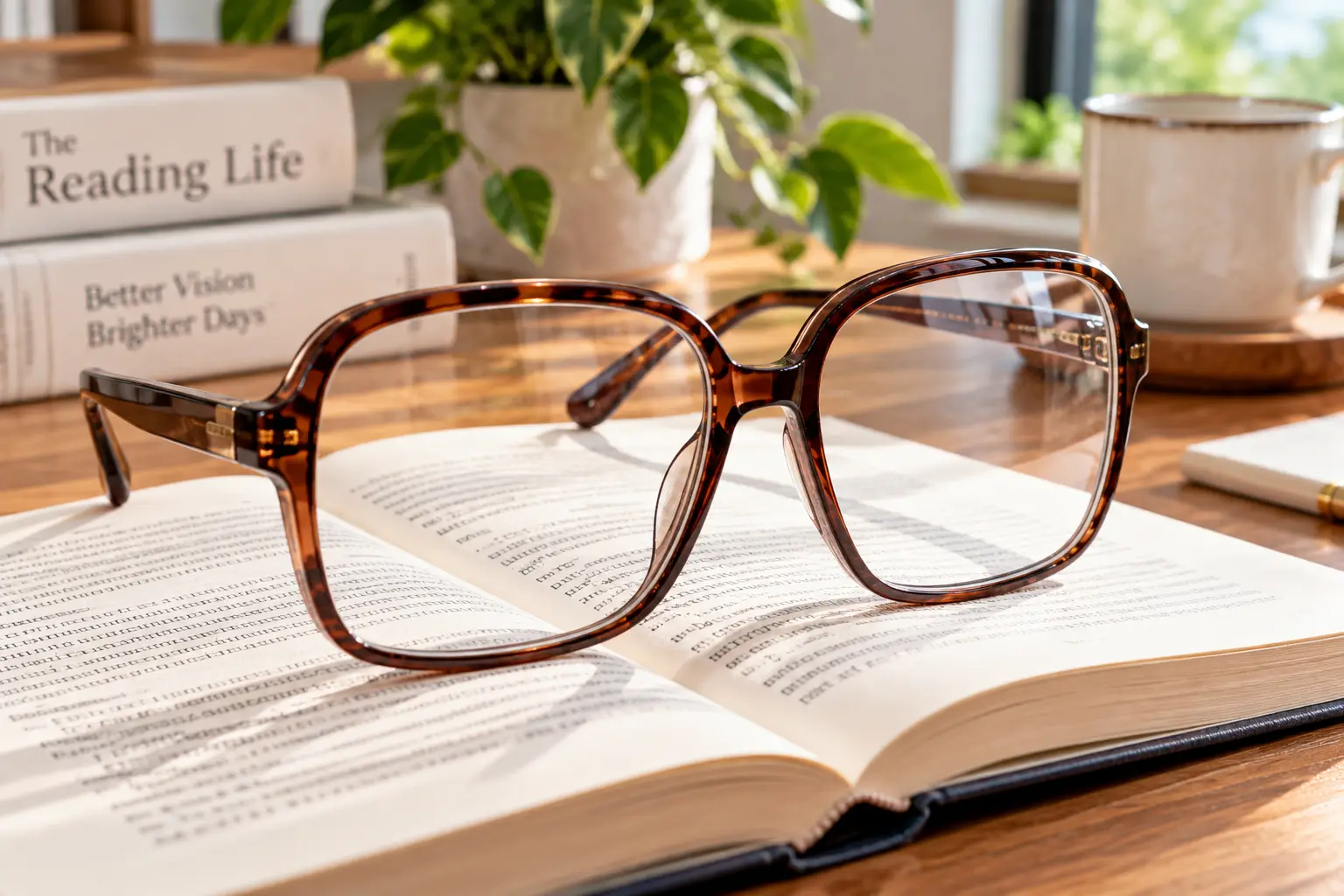
If you’ve ever caught yourself peering over the top of tiny drugstore readers — or tilting your head like a curious golden retriever just to read a recipe card — big reading glasses might be the upgrade you didn’t know you needed. Oversized readers aren’t only a fashion statement (although, yes, they look great). A taller, wider lens simply gives your eyes more magnified real estate, which means less bobbing, less hunting for the “sweet spot,” and less neck strain during long reading sessions.
Here’s the context. Nearly everyone develops presbyopia — the age-related loss of close-up focus — usually starting in their 40s. As the American Academy of Ophthalmology explains, the over-the-counter readers sold in drugstores are designed specifically for this condition, not for nearsightedness. That distinction matters, because it tells you exactly who big reading glasses are for: people whose distance vision is fine but whose arms have gotten “too short” for menus and phone screens.
The problem? Many budget readers run narrow — often around 130 mm across — which pinches wider faces and squeezes the usable lens area. That’s where large frame reading glasses, wide reading glasses for men, and statement oversized reading glasses for women come in.
In this guide, you’ll find seven real models available on amazon.com, compared by the numbers that actually predict comfort: frame width, lens width, lens height, bridge size, and strength range. Every pick gets honest analysis grounded in published specs and aggregated customer sentiment — no invented test stories, no fake quotes. You’ll also get a first-30-days setup guide, fixes for common annoyances, and a clear decision framework, so you can buy once and buy right. 👓
What Are Big Reading Glasses?
Big reading glasses are non-prescription magnifying readers built with an oversized frame — typically 138 mm or wider across the front — and larger lenses, often 50–62 mm wide and 40 mm or taller. They correct age-related near-vision blur (presbyopia) while offering a wider magnified field of view and a more comfortable fit for medium-to-wide faces.
In practice, “big” can mean two different things, and shoppers often mix them up:
- Wide fit: the overall frame width is generous (roughly 142–152 mm), so the temples don’t squeeze your head. This matters most for men with larger heads and anyone who gets “reader headaches” behind the ears.
- Oversized lens: the lens itself is tall and wide, so you can glance down at a book or up at a laptop without leaving the magnified zone. This matters most for all-day readers, crafters, and screen workers.
The best extra large readers deliver both. The worst deliver neither — they just use a chunky rim to look big while the actual glass stays small. The comparison below helps you tell the difference at a glance.
Quick Comparison: The 7 Best Big Reading Glasses at a Glance
| Model | Frame Width | Lens (W × H) | Strengths | Approx. Price | Best For |
|---|---|---|---|---|---|
| Eyekepper Oversized Square Readers | ~140 mm | 53 × ~40 mm | +0.00 to +3.50 (varies by listing) | Under $15 single; $15–$25 5-pack | Eyekepper Oversized Square Readers: budget backups |
| Peepers Center Stage | 139 mm | 51 mm wide | +1.00 to +4.00 | $25–$45 | Peepers Center Stage: stylish screen reading |
| OLOMEE Large Wide Readers (4-Pack) | 143 mm | 54 × 40.5 mm | +0.50 to +5.00 | $15–$25 per pack | OLOMEE Large Wide Readers (4-Pack): big heads on a budget |
| V.W.E. Extra Large 152mm Reader | 152 mm | 58 × 40 mm | +1.00 and up | $20–$35 | V.W.E. Extra Large 152mm Reader: widest faces |
| MARE AZZURO Extra Large Square Readers | 144 mm | 55 × 45 mm | +1.00 to +6.00 | $15–$30 | MARE AZZURO Extra Large Square Readers: high strengths |
| 2SeeLife Large Cat Eye Readers | Medium-wide | Check listing | +1.00 and up | $15–$25 | 2SeeLife Large Cat Eye Readers: feminine statement look |
| eyebobs Fare N Square | Wide fit | 51 × 35 mm | +0.00 to +4.00 | $70–$110 | eyebobs Fare N Square: premium acetate |
Prices are approximate ranges at the time of writing and change frequently — check the current price on Amazon.
Looking at the table, the V.W.E. Extra Large 152mm Reader is the clear outlier on width — a full 12 mm wider than the Peepers Center Stage, which is a meaningful difference if your current readers leave red marks at your temples. Meanwhile, the MARE AZZURO Extra Large Square Readers win on lens height (45 mm), which is the spec that keeps you inside the magnified zone when you glance down. If you want the biggest magnified area for the least money, the OLOMEE Large Wide Readers (4-Pack) hit a sweet spot of width, lens size, and per-pair cost.
💬 One click helps other shoppers make an informed choice too! 😊
Top 7 Big Reading Glasses: Expert Analysis
1. Eyekepper Oversized Square Readers — cheapest way into oversized lenses
The Eyekepper Oversized Square Readers prove that big reading glasses don’t need a big budget. One widely sold version lists a 53 mm lens width, 140 mm frame width, 45 mm frame height, 13 mm bridge, and 135 mm temples, with plastic frames and spring hinges.
What does that mean in practice? A 53 mm lens is noticeably wider than the 46–49 mm lenses common on drugstore racks, so reading across a full paperback line feels less like scanning through a keyhole. The 13 mm bridge, however, is on the narrow side — great for smaller noses, but people with a broad nasal bridge may find the glasses sit higher than expected.
Based on comparing the specs, these are best for budget-conscious buyers who want multiple pairs stashed around the house, in the car, and in a tote bag. They’re also available in 5-packs of a single strength, which is ideal if you’re chronically losing readers.
Customer sentiment summarized on the listing is generally positive about quality, color, and fit, and reviewers note the lenses are large enough to add stick-on bifocal segments. One caution: Eyekepper sells several “large” square models, and reviews on a smaller 48 mm version complain it isn’t truly oversized — so check the lens width before you click.
Pros:
- ✅ Genuinely wide 53 mm lens at a rock-bottom price
- ✅ Multi-pack options make losing a pair painless
- ✅ Lenses big enough for stick-on bifocal inserts
Cons:
- ❌ Narrow 13 mm bridge may sit high on broad noses
- ❌ Similar-looking Eyekepper listings vary in actual size
At under $15 for a single pair (or roughly $15–$25 for a 5-pack), this is the value benchmark every other pick has to beat.
2. Peepers Center Stage — the stylish oversized best seller
The Peepers Center Stage is the brand’s longtime best-selling oversized frame and a former pick on Oprah’s Favorite Things list — and it earns that fame with thoughtful engineering, not just looks. Retail listings put the frame width at 139 mm with a 51 mm eye size and a tall 55 mm frame height.
The blue-light version uses Peepers’ “Focus” lenses, which the brand says filter more than 40% of high-energy visible light in the 400–450 nm range, plus a seven-layer anti-reflective coating and dual anti-scratch coating. The anti-reflective layer is the feature that matters most here: fewer reflections from overhead lights and screens means crisper contrast, especially at night. The polycarbonate frame keeps weight down, and spring hinges forgive a slightly off fit.
Here’s what to weigh: at 139 mm, this is an “oversized look” rather than an extra-wide fit. It suits average-to-medium faces that want drama, not necessarily people with very wide heads. Strengths run from +1.00 to +4.00, and the same frame comes as reading sunglasses and progressives.
Verifiable sentiment is limited in what I could confirm, but brand-site reviews include repeat buyers replacing a pair after years of daily wear — a useful durability signal for a mid-priced reader.
Pros:
- ✅ Tall frame keeps you inside the magnified zone
- ✅ Anti-reflective coating sharpens screen and night reading
- ✅ Available as sunglasses and progressive readers
Cons:
- ❌ 139 mm width may still feel snug on wide heads
- ❌ Costs more than multi-pack alternatives per pair
Expect roughly $25–$45; solid value if you want one “hero” pair you’ll wear in public.
3. OLOMEE Large Wide Readers (4-Pack) — best value for big heads
The OLOMEE Large Wide Readers (4-Pack) are built for the guy (or gal) who’s tired of readers that feel like a vise. The listing specs a 143 mm frame width, 54 mm lens width, 40.5 mm lens height, 18 mm bridge, and 143 mm temples, in lightweight polycarbonate with spring hinges.
Those numbers translate nicely: the 18 mm bridge is roomier than most budget readers, so the frame sits lower and more naturally on a broader nose, while the 143 mm temples reach comfortably behind larger ears. The 54 mm lens keeps the magnified area generous for newspapers, spreadsheets, and instruction manuals.
Another quietly important detail: strengths run all the way from +0.50 to +5.00, including quarter steps up to +3.75. That fine granularity helps if you’re between common strengths, and the +4.50/+5.00 options are rare at this price.
Aggregated review sentiment on Amazon highlights fit — customers repeatedly mention the frames suit large heads and don’t pinch. Because you get four pairs plus soft cases and a cleaning cloth, the per-pair cost is often in the single digits.
Pros:
- ✅ 143 mm width fits larger heads without pinching
- ✅ Unusually broad strength range, up to +5.00
- ✅ Four pairs and cases make it great value
Cons:
- ❌ Basic plastic build won’t feel premium
- ❌ Understated styling lacks fashion flair
At roughly $15–$25 per 4-pack, it’s arguably the best cost-per-pair among true wide reading glasses for men.
4. V.W.E. Extra Large 152mm Reader — widest fit in this lineup
The V.W.E. Extra Large 152mm Reader is the answer when “large” still isn’t large enough. V.W.E. calls this its widest fitment: 152 mm across, with a 58 mm lens width, 40 mm lens height, 20 mm bridge, and 145 mm temples. The anti-blue/UV version lists an even wider 62 mm lens.
What most buyers overlook is how much that extra width changes comfort. Every millimeter your head exceeds a frame’s width turns into pressure at the temples; going from a 140 mm reader to 152 mm can be the difference between a two-hour headache and all-day wear. The metal front with plastic temples and an adjustable nose pad also allows fine-tuning that molded plastic frames can’t match.
This model is best for men with genuinely wide faces, anyone who wears readers for long workdays, and people who’ve tried “XL” drugstore readers without success. It ships with a hard case and microfiber cloth, and V.W.E. describes the frame as anti-allergen. A bifocal reading-sunglass variant exists for anglers and golfers.
Detailed aggregated review data wasn’t something I could verify for this exact listing, so treat fit claims cautiously — the spec sheet, not hype, is the strong argument here.
Pros:
- ✅ 152 mm width suits the largest heads
- ✅ Adjustable nose pads fine-tune how the frame sits
- ✅ Hard case included for protection
Cons:
- ❌ Too wide for average or narrow faces
- ❌ Metal-and-plastic mix feels less rugged than TR90
Around $20–$35 — excellent value if nothing else has ever fit comfortably.
5. MARE AZZURO Extra Large Square Readers — tallest lens, highest strengths
The MARE AZZURO Extra Large Square Readers stand out for two specs that matter to heavy readers: a tall 45 mm lens and a strength range stretching to +6.00. The published dimensions are a 144 mm frame width, 55 mm lens width, 18 mm bridge, and 145 mm temples.
Lens height is the underrated number in oversized reading glasses. When you look down at a book in your lap, your eyes drop toward the bottom of the lens; a short lens pushes you into the frame rim or above it into blur. At 45 mm, this is the tallest lens in the lineup, which should mean less chin-tucking and fewer “where did the words go?” moments.
The +5.00 and +6.00 options also serve a niche most brands ignore — people doing very fine close work or those with advanced presbyopia (after confirming with an eye doctor, since high strengths shorten your focal distance dramatically).
I could not verify a meaningful body of aggregated customer reviews for this model, so I’ll be honest: the case here rests on the dimensions and strength range, not on proven user consensus. Buy through a listing with easy returns.
Pros:
- ✅ 45 mm lens height keeps downward reading sharp
- ✅ Strengths up to +6.00 are genuinely rare
- ✅ 144 mm width fits most larger faces
Cons:
- ❌ Limited verifiable review history
- ❌ Bold square shape isn’t subtle
Typically $15–$30, a smart buy for high-strength needs.
6. 2SeeLife Large Cat Eye Readers — a feminine oversized statement
The 2SeeLife Large Cat Eye Readers bring the upswept “eye-lift” silhouette into a medium-wide fit. 2SeeLife builds much of its catalog around wider faces, and this model is marketed specifically for medium-to-wide faces, with spring hinges and a durable frame in tortoise and solid colors.
Why a cat-eye? The lifted outer corners visually widen the upper half of the frame, which can balance a rounder or fuller face while keeping the lens height reasonable for reading. The trade-off is that cat-eye lenses often taper at the lower outer corners — so the magnified zone narrows slightly where your eyes land when reading a phone held low. That’s worth knowing if you mostly read in bed.
The Amazon listing I reviewed did not surface full lens and frame measurements in the data I could access, so check the size chart on the product page and compare it against a pair you already own. That five-second habit prevents most return headaches.
Customer review sentiment for this specific model wasn’t verifiable in enough detail to summarize honestly. What is verifiable: 2SeeLife offers a dedicated wide-fit range and U.S. shipping, which suggests the brand takes sizing seriously.
Pros:
- ✅ Flattering cat-eye shape with oversized presence
- ✅ Designed for medium-to-wide faces
- ✅ Spring hinges add forgiveness in fit
Cons:
- ❌ Tapered corners slightly reduce low-reading area
- ❌ Measurements need confirming on the listing
At about $15–$25, it’s an affordable way to get oversized reading glasses for women with real personality.
7. eyebobs Fare N Square — premium acetate for wide faces
The eyebobs Fare N Square is the splurge pick — Italian-designed premium acetate, spring hinges, and optical-quality lenses with scratch-resistant and smudge-proof coatings. eyebobs rates it as best suited for wide faces, with a 51 mm lens width, 35 mm lens depth, 20 mm bridge, and 145 mm temples.
Acetate matters more than it sounds. Unlike injection-molded plastic, quality acetate can be heat-adjusted by an optician, so a slightly loose or tight temple can be tweaked for a near-custom fit. It also tends to hold its polish and color for years. The patterned frames are made to order, so tortoise and stripe patterns vary pair to pair.
Honest caveat: the 35 mm lens depth is shorter than several budget picks here, so this reads “wide and stylish” more than “maximum magnified area.” If lens height is your priority, the MARE AZZURO Extra Large Square Readers outperform it on paper. eyebobs’ Four Square style is a larger alternative, listing a 144 mm frame and 42 mm lens depth.
Review summaries on the brand’s site emphasize durability, style, and strong customer service — though at least one reviewer felt the “wide” label didn’t feel wide at all, a reminder that face shape matters as much as labels.
Pros:
- ✅ Premium acetate is adjustable and long-lasting
- ✅ Quality lens coatings resist scratches and smudges
- ✅ Distinctive patterns stand out in a good way
Cons:
- ❌ Shorter lens depth limits the magnified zone
- ❌ Several times the cost of budget alternatives
Usually $70–$110; worth it only if you value craftsmanship and adjustability.
Side-by-Side: Fit and Lens Specs Compared
| Model | Bridge | Temple Length | Lens Height | Frame Material | Best For |
|---|---|---|---|---|---|
| Eyekepper Oversized Square Readers | 13 mm | 135 mm | ~40 mm | Plastic | Eyekepper Oversized Square Readers: narrow noses |
| Peepers Center Stage | Check listing | Check listing | Tall frame (55 mm) | Polycarbonate | Peepers Center Stage: glare-free screens |
| OLOMEE Large Wide Readers (4-Pack) | 18 mm | 143 mm | 40.5 mm | Polycarbonate | OLOMEE Large Wide Readers (4-Pack): fine strength steps |
| V.W.E. Extra Large 152mm Reader | 20 mm | 145 mm | 40 mm | Metal + plastic | V.W.E. Extra Large 152mm Reader: adjustable nose pads |
| MARE AZZURO Extra Large Square Readers | 18 mm | 145 mm | 45 mm | Plastic/metal accents | MARE AZZURO Extra Large Square Readers: book-in-lap reading |
| eyebobs Fare N Square | 20 mm | 145 mm | 35 mm | Acetate | eyebobs Fare N Square: optician adjustments |
This second table explains why some big reading glasses feel better than others. Bridge size controls where the frame sits on your nose — the 20 mm bridges on the V.W.E. Extra Large 152mm Reader and eyebobs Fare N Square suit broader noses, while the Eyekepper Oversized Square Readers favor narrower ones. Temple length (143–145 mm on most picks) is what prevents that tugging sensation behind larger ears.
Getting Started: Your First 30 Days With Big Reading Glasses
A new pair of readers — especially oversized ones — takes a little adjustment. Here’s a practical plan that product listings won’t give you.
Days 1–3: Confirm your strength
Hold your usual reading material at your natural distance (about 14–16 inches). If text is crisp only when you lean in, the strength is too high; if you still push the page away, it’s too low. A slightly weaker pair is usually more comfortable for long computer sessions, since screens sit farther away than books.
Days 4–10: Learn the “chin-down” habit
Big reading glasses have more usable lens, but distance objects will still look blurry through them. Get used to looking over the frame to cross a room, rather than walking around with them on. Oversized frames make this trickier because more of your field of view is magnified — so take them off before stairs, full stop.
Days 11–20: Fine-tune the fit
If the glasses slide, the temples may need a gentle inward bend (acetate frames like the eyebobs Fare N Square can be heat-adjusted by any optician, often free). If they pinch, don’t force metal hinges — step up a size instead.
Days 21–30: Build a care routine
Rinse lenses under lukewarm water, apply a drop of mild dish soap, and dry with microfiber. Never use paper towels, shirt hems, or alcohol-heavy cleaners — they grind grit into coatings.
Common mistakes in the first month:
- ✅ Keep one pair per “zone” (nightstand, desk, car) instead of carrying one everywhere
- ❌ Don’t fold them lens-down on a table — that’s how coatings scratch
- ❌ Don’t wear them driving; readers blur the road
Real-World Scenarios: Matching the Right Pair to Your Life
Specs are useful, but decisions get easier when you picture actual people.
🧵 Linda, 58 — quilter and avid reader, $25–$45 budget
Linda reads novels in bed and spends hours on detailed quilting. She needs a tall lens for looking down at fabric, glare control for her lamp, and a look she enjoys. The Peepers Center Stage fits: its tall frame helps with downward work, and the anti-reflective coating cuts lamp glare. If she needs +4.50 or higher for fine stitching, the MARE AZZURO Extra Large Square Readers become the better tool.
💼 Marcus, 52 — accountant with a wide head, $20–$35 budget
Marcus wears readers eight hours a day across two monitors, and every drugstore pair gives him temple headaches. Width is the whole game here, so the V.W.E. Extra Large 152mm Reader is the logical first try. Its adjustable nose pads let him fine-tune height relative to his screens. Tip: for monitors, he might choose a strength 0.50 lower than his book strength.
🚗 Denise, 64 — retiree who loses everything, under $25
Denise misplaces readers daily. She doesn’t need premium acetate; she needs volume. A 4-pack of OLOMEE Large Wide Readers (4-Pack) or the 5-pack Eyekepper Oversized Square Readers gives her a pair in every room, the car, and her purse — for less than one designer frame.
The pattern across all three? Start with your face width and daily task, then choose style. People who reverse that order are the ones filling out return forms.
Problem → Solution: Fixing Common Oversized Reader Annoyances
Even great big reading glasses can cause small frustrations. Here are the five most common, with fixes.
1. “They slide down my nose.” Oversized lenses add front weight. Choose a frame with adjustable nose pads (like the V.W.E. Extra Large 152mm Reader), or try inexpensive silicone temple grips. A simple fit check also helps: you shouldn’t be able to slide more than a finger’s width between your face and the temple arm.
2. “I get headaches behind my ears.” This is almost always frame width, not lens strength. Move up to a 143–152 mm frame such as the OLOMEE Large Wide Readers (4-Pack).
3. “My eyes feel tired after an hour on the computer.” Your book strength may be too strong for screen distance. Try 0.25–0.50 less, and add an anti-reflective option like the Peepers Center Stage. Take regular breaks: every 20 minutes, look at something 20 feet away for 20 seconds.
4. “Everything looks blurry when I look up.” That’s normal — readers only focus up close. If you’re constantly taking them on and off, ask an eye care professional about progressive readers (Peepers offers the Center Stage frame as a progressive).
5. “The lenses scratched within weeks.” Store glasses in a case, lens-up, and clean with microfiber only. Premium coatings, like those on the eyebobs Fare N Square, resist scratching better — but no coating survives a pocket full of keys.
✨ Don’t miss these reader-friendly picks!
🔍 Take your reading comfort to the next level with this carefully curated lineup. Click a highlighted pair to check current pricing and availability. These picks will help you read longer, strain less, and finally find frames that fit!
How to Choose Big Reading Glasses
Choosing well comes down to a handful of measurable factors. Follow these steps in order:
- Confirm readers are right for you. OTC readers suit people with good distance vision. According to the American Optometric Association, presbyopia affects an estimated 128 million Americans, and while simple cases can be handled with OTC readers, left-right differences often call for a prescription.
- Measure your current frame width. Hold a comfortable pair against a ruler, hinge to hinge. Under 135 mm is narrow; 138–142 mm is medium; 143 mm and up is wide.
- Check lens width and height. Aim for 50 mm or wider and at least 38–40 mm tall for a genuinely oversized magnified zone.
- Match bridge size to your nose. Broader noses do better with 18–20 mm bridges; narrower noses with 13–16 mm.
- Pick your strength by task. Books at 14 inches need more power than a monitor at 24 inches.
- Choose frame material for your lifestyle. Budget plastic for backup pairs; polycarbonate or TR90 for lightness; acetate for adjustability and longevity.
- Add coatings only if you’ll use them. Anti-reflective helps almost everyone; blue-light filtering is optional.
Each step removes guesswork, and together they explain why a $20 pair can outperform a $100 pair if its numbers match your face.
Common Mistakes to Avoid When Buying Oversized Readers
Most return-worthy purchases of oversized reading glasses come from the same handful of errors.
Mistake 1: Trusting “oversized” in the title. Listing titles are keyword-stuffed. As seen with Eyekepper’s lineup, one “large” square model has a 48 mm lens while another has 53 mm. Always read the dimension line.
Mistake 2: Confusing a thick rim with a big lens. A chunky frame can look huge while the actual glass is modest. Lens width and height, not overall appearance, determine your magnified area.
Mistake 3: Buying the strongest strength “just in case.” Over-strong readers force you to hold material unnaturally close and can cause eye fatigue. Start low and step up.
Mistake 4: Ignoring the bridge. A bridge that’s too narrow makes the frame ride high, putting the bottom rim right in your reading line.
Mistake 5: Wearing readers as all-purpose glasses. They’re for near work only. Walking, driving, or taking stairs in readers is a fall risk.
Mistake 6: Skipping the eye exam. Readers fix a symptom, not the underlying eye health. Glaucoma and other conditions don’t announce themselves, so keep up with routine exams even if cheap readers seem to “work fine.”
Avoiding these six pitfalls alone will save most shoppers at least one return — and plenty of squinting.
Big Reading Glasses vs. Standard Readers vs. Prescription Glasses
How do big reading glasses stack up against the alternatives? Here’s a practical comparison.
| Option | Field of View | Fit Options | Cost | Best For |
|---|---|---|---|---|
| Big reading glasses | Wide, tall magnified zone | Wide fits common | $10–$110 | Long reading, wider faces |
| Standard drugstore readers | Narrower magnified zone | Mostly average widths | $5–$25 | Quick glances, backups |
| Half-frame “cheaters” | Small, bottom-only | Average | $10–$40 | Looking over frames often |
| Prescription readers/progressives | Customized | Fully fitted | $100–$400+ | Unequal eyes, astigmatism |
The key takeaway: big reading glasses occupy a middle ground — far more comfortable than standard readers for long sessions, far cheaper than prescription eyewear. Half-frames win only if you constantly look up and down between near and far. And if your eyes need different strengths or you have astigmatism, no OTC reader can fully replace a prescription pair.
For many people, the smartest setup is a hybrid: one quality oversized pair (such as the Peepers Center Stage) for serious reading, plus a multipack of OLOMEE Large Wide Readers (4-Pack) scattered around the house for quick tasks.
Wide Reading Glasses for Men: What Actually Fits
Men with larger heads have historically had a rough time with readers. Most drugstore racks are sized for average faces, which is why wide reading glasses for men deserve their own conversation.
Start with frame width. If your current readers leave dents or cause headaches, you likely need 143 mm or more. The OLOMEE Large Wide Readers (4-Pack) (143 mm) and MARE AZZURO Extra Large Square Readers (144 mm) cover most larger heads, while the V.W.E. Extra Large 152mm Reader serves the widest.
Then check temple length. Larger heads often need 143–150 mm temples, otherwise the arm ends before it curves around the ear, and the glasses slip forward. All three wide picks above list 143–145 mm.
Consider shape. Rectangular and square frames tend to complement broader jawlines and look proportional on larger faces. Very round or small frames can look undersized, which is part of why extra large readers in rectangular shapes dominate this category.
Think about your day. Tradespeople and hobbyists who bend over workbenches benefit from a tall lens; office workers benefit more from anti-reflective coatings and a slightly weaker screen strength.
A useful rule: when in doubt between two widths, choose the wider one. A frame that’s 2 mm loose can be tightened by a quick adjustment; a frame that’s 5 mm too narrow simply can’t be stretched into comfort.
Features That Actually Matter (and Ones That Don’t)
Marketing copy for large frame reading glasses throws a lot of features at you. Here’s what deserves your attention.
✅ Matters a lot:
- Accurate dimensions. Frame width, lens height, bridge, and temple length predict comfort better than any adjective.
- Spring hinges. They flex outward, easing pressure on wider heads and surviving one-handed removal. Every pick in this guide has them.
- Anti-reflective coating. Reduces glare from lamps and screens, improving contrast. The Peepers Center Stage uses a seven-layer version.
- Strength range. Quarter-step options (like +2.25 or +3.75) help people between common powers.
🤷 Matters less than you’d think:
- Blue-light filtering. Brands promote it heavily, but major eye-care organizations have not concluded that screen blue light damages eyes. It may be a comfort preference for some, not a medical necessity. Choose it if you like the tint, not out of fear.
- “HD” lenses. Often a marketing label with no standard definition.
- Vague “premium quality” claims. Look for specifics — material, coatings, and included case — instead.
⚠️ Easy to overlook:
- Return policy. Fit is personal. A generous return window is worth more than a fancy case.
Focusing on the first list and ignoring the fluff will get you better big reading glasses for less money.
Long-Term Cost and Maintenance
Price tags tell only part of the story. The real question is cost per comfortable year.
Budget multipacks like the Eyekepper Oversized Square Readers or OLOMEE Large Wide Readers (4-Pack) often land in single digits per pair. Their coatings wear faster and hinges loosen sooner, but because you have spares, a scratched pair is an inconvenience, not a crisis. Expect to replace them every year or so with heavy use.
Mid-range picks like the Peepers Center Stage cost more upfront but generally offer better coatings and more durable frames. With a case and careful cleaning, many users get multiple years of daily wear — which can make the per-year cost comparable to budget packs.
Premium acetate like the eyebobs Fare N Square carries the highest price, but acetate frames can be adjusted and refreshed by opticians, stretching their lifespan further.
Hidden costs to factor in:
- Your strength will likely increase every few years until your mid-60s, so a $110 pair may be outgrown before it wears out.
- Cleaning supplies (microfiber cloths and lens spray) are cheap but essential.
- Replacement cases matter; a crushed pair costs more than a $5 case.
The smart play: because presbyopia progresses, many buyers do best with affordable pairs now and a premium pair once their strength stabilizes.
Safety, Regulations, and Standards for Reading Glasses
Big reading glasses may be sold next to lip balm, but they are regulated eyewear in the United States. Knowing the basics helps you shop more confidently.
Impact resistance. Under 21 CFR 801.410, eyeglasses and sunglasses sold in the U.S. must be fitted with impact-resistant lenses capable of passing a standardized drop-ball test. Importantly, “impact-resistant” does not mean shatterproof — so readers are not safety glasses. If you use power tools or do yard work, wear ANSI Z87.1-rated safety eyewear instead (some styles fit over readers).
Medical device status. Magnifying spectacles are classified as medical devices, which means manufacturers and importers must register with the FDA and list their products. This is one reason reputable brands are worth favoring over mystery listings with no clear seller information.
UV protection. Reading sunglasses, such as the tinted versions of the Peepers Center Stage and V.W.E. Extra Large 152mm Reader, advertise UV400 or 100% UVA/UVB protection. For outdoor reading, confirm that claim on the listing — tint alone doesn’t block UV.
Driving. Never drive in full readers. They blur distance vision, which is exactly what you need behind the wheel. Bifocal sun readers are a safer outdoor option since the upper portion is unmagnified.
Eye exams. OTC readers don’t replace professional care. Schedule regular comprehensive exams, especially after 40.
FAQ: Big Reading Glasses
❓ Are big reading glasses better for computer work?
❓ What frame width counts as extra large readers?
❓ Can I wear oversized reading glasses if I have a small face?
❓ Do cheap large frame reading glasses damage your eyes?
❓ Are big reading glasses FSA or HSA eligible?
Conclusion: Find Big Reading Glasses That Fit Your Face and Your Life
The right big reading glasses aren’t about the biggest frame — they’re about the numbers that match your face and your daily routine. If you want maximum value, the OLOMEE Large Wide Readers (4-Pack) and Eyekepper Oversized Square Readers put genuinely wide lenses in every room for very little money. If you want one standout pair with glare-cutting lenses, the Peepers Center Stage is the stylish all-rounder. Men with the widest heads should go straight to the V.W.E. Extra Large 152mm Reader, high-strength readers should consider the MARE AZZURO Extra Large Square Readers, and anyone who values craftsmanship will appreciate the adjustable acetate of the eyebobs Fare N Square. For a feminine statement, the 2SeeLife Large Cat Eye Readers deliver personality at a budget price.
Whatever you choose, measure first, match lens height to your tasks, and remember that readers are regulated eyewear — the FDA’s guidance on magnifying spectacles explains the certification and registration rules behind every pair. Most importantly, pair your new readers with regular eye exams. Comfortable reading is wonderful; healthy eyes are essential.
✨ Ready to read comfortably again?
🔍 Take your reading setup to the next level with this carefully curated lineup of oversized reading glasses. Click a highlighted pick to check current pricing and availability. These picks will help you enjoy every page, screen, and recipe card — without the squint!
Recommended for You
- Computer Progressive Glasses: 7 Best Picks to Beat Eye Strain 2026
- Anti Glare Reading Glasses: 7 Best Picks That Actually Work (2026)
- 7 Best Computer Glasses With Anti Glare Coating: Top Picks for 2026
Disclaimer: This post contains affiliate links. As an Amazon Associate, I earn from qualifying purchases made through these links, at no additional cost to you.
✨ Found this article helpful? Share it with someone who needs it! 💬🤗