
In This Article
Why Large Frame Reading Glasses Are Worth a Second Look
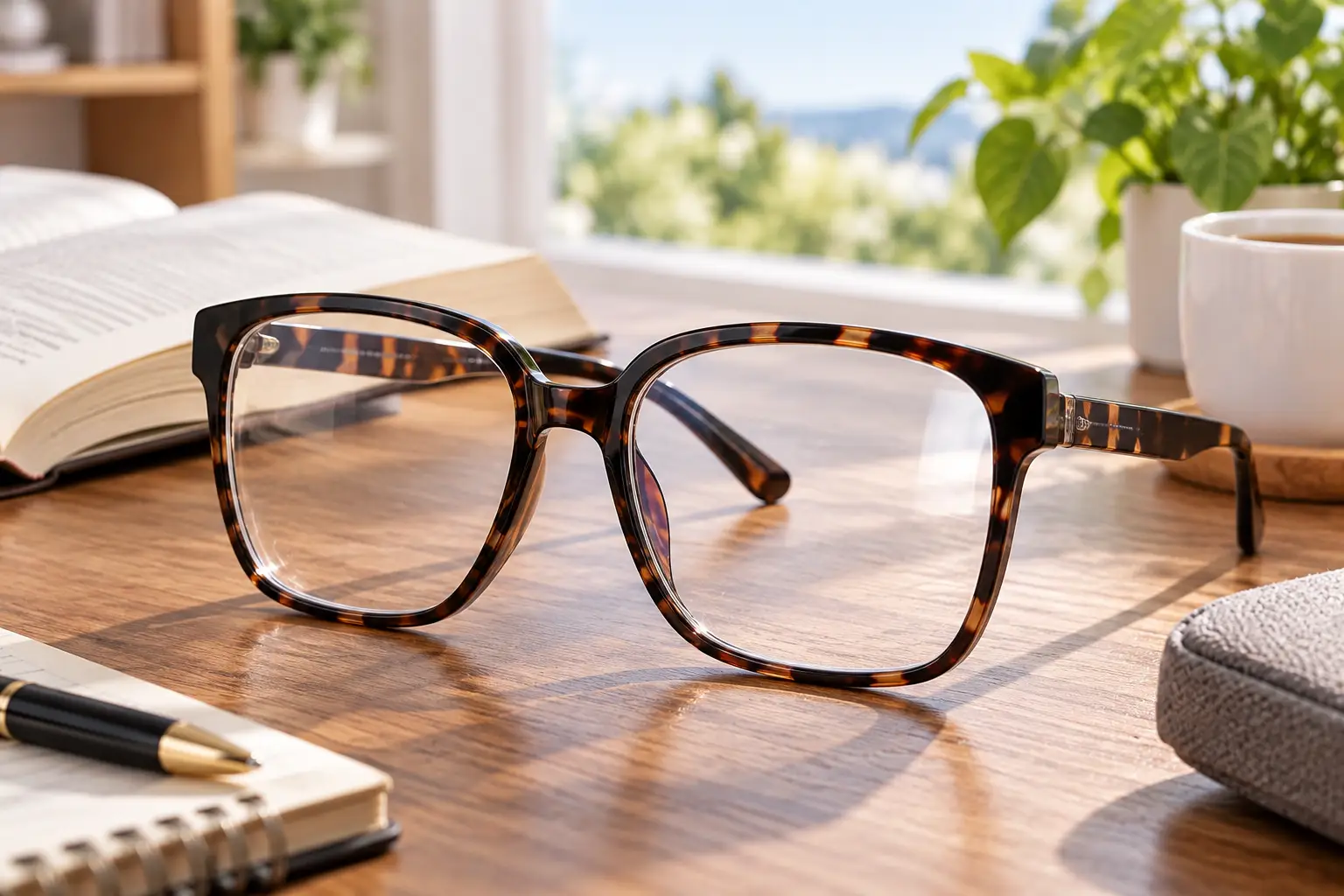
If you’ve ever squinted over a restaurant menu, nudged your readers down your nose to see the phone screen, or felt the temple arms of drugstore cheaters squeezing your head by lunchtime, you already know the problem. Most off-the-rack readers are built for an “average” face — roughly 125 to 135 mm wide — and a small lens that forces your eyes to hunt for the sweet spot. Large frame reading glasses fix both issues at once: a wider front that sits comfortably on bigger heads, and a taller, broader lens that gives you more usable magnified area.
That matters more than it sounds. According to the National Eye Institute’s overview of presbyopia, almost everyone develops age-related near-vision loss, usually after 45, and it keeps progressing until around 65. In other words, you’re likely to wear readers for two decades — so fit and field of view deserve more thought than a spin of the pharmacy rack.
In this 2026 guide, we compare seven real large frame reading glasses available on amazon.com, from budget multi-packs to a well-known statement frame. We didn’t wear-test these; instead, we worked from manufacturer spec sheets, published frame measurements, and whatever customer-review sentiment we could actually verify — and we tell you plainly where that data runs thin. You’ll also get a do-it-yourself fit guide, real-world buyer scenarios, and fixes for the most common fit problems.
What Are Large Frame Reading Glasses?
Large frame reading glasses are non-prescription magnifying readers built with a wider front (typically 138 mm or more), longer temples, and bigger lenses than standard readers. They’re designed for wide faces and bigger heads, or for anyone who wants a broader, taller field of clear near vision — often with a bolder, oversized look.
Quick Comparison: The 7 Best Large Frame Reading Glasses at a Glance
| Product | Frame Width | Strength Range | Standout Feature | Approx. Price | Best for |
|---|---|---|---|---|---|
| Peepers Center Stage | 139 mm | +1.00 to +4.00 | Aspheric lenses, 7-layer AR coating | $30–$45 | Peepers Center Stage: style-first everyday wear |
| OLOMEE Wide 4-Pack | 143 mm | +0.50 to +5.00 | 143 mm temples, 4 pairs | $15–$25 | OLOMEE Wide 4-Pack: big heads, men |
| MARE AZZURO Oversized | 141 mm | 0 to +6.00 | Lanyard and case included | $15–$20 | MARE AZZURO Oversized: high strengths on a budget |
| Eyekepper Oversized 5-Pack | ~138–140 mm (varies) | Up to +6.00 | Five pairs, one strength | $20–$30 | Eyekepper Oversized 5-Pack: stashing pairs everywhere |
| PEYEOISD Extra Large | Check listing | Multiple | Flexible TR-90 frame | $15–$25 | PEYEOISD Extra Large: screen-heavy days |
| QxAiVMin Oversized Metal | Check listing | Multiple | Metal frame, soft nose pads | $15–$25 | QxAiVMin Oversized Metal: adjustable fit |
| AEZUNI Oversized | Check listing | 0 to +6.00 | Biggest “statement” look | $12–$20 | AEZUNI Oversized: bold fashion on a budget |
Prices are approximate ranges at the time of writing and change often — check the current price on Amazon.
Reading the table, the first thing to notice is how narrow the real width gap is: the verified frames span only 139 to 143 mm, yet a 4 mm difference is exactly what separates “slightly snug” from “comfortable all day” on a wide head. The OLOMEE Wide 4-Pack wins on pure size, while the Peepers Center Stage is the only pick here with a published lens-coating stack you can compare against. For strong prescriptions above +4.00, the MARE AZZURO Oversized and Eyekepper Oversized 5-Pack are the only options that reach +6.00.
💬 One click on a highlighted name shows today’s price and sizes — and helps other shoppers make an informed choice too! 😊
Top 7 Large Frame Reading Glasses: Expert Analysis
1. Peepers Center Stage — the statement frame with serious lenses
The Peepers Center Stage is the rare oversized reader where the lens engineering is as deliberate as the look. It’s a soft-square, bold frame that Peepers calls its longtime best seller, and it has appeared on Oprah’s Favorite Things list.
Its published fit is 51-20-148, with a 139 mm frame width and a tall 55 mm frame height. In practice, that height is the real story: a taller lens lets you glance down at a book and up at a screen without bumping into the frame edge. The acrylic aspheric lenses are designed to reduce edge distortion, and the seven-layer anti-reflective coating cuts glare from overhead lighting — useful for anyone reading under kitchen or office LEDs. The Focus lenses also filter a portion of blue light (Peepers says more than 40% in the 400–450 nm range) and block UV.
Here’s what to weigh: at 139 mm, this is “large” rather than “XL,” so it suits average-to-wide faces better than genuinely big heads. It’s ideal for women who want one polished pair for work and errands. Peepers also sells the same frame in progressive and reading-sunglass versions, which is handy if you need distance and near vision in one lens.
We couldn’t access Amazon’s full review pages for this roundup; on the brand’s own site, the reviews we could see skew toward repeat buyers praising the style and durability.
Pros:
- ✅ Tall lens height means fewer “frame edge” moments
- ✅ Anti-reflective coating helps under harsh indoor lighting
- ✅ Available in progressive and sun-reader versions
Cons:
- ❌ Strengths top out at +4.00
- ❌ Not wide enough for truly big heads
Expect to pay around $30–$45; for a daily-wear frame with this lens spec, the value holds up well.
2. OLOMEE Wide 4-Pack — the widest verified fit for big heads
The OLOMEE Wide 4-Pack is built for one job — fitting heads that other readers pinch — and its numbers back that up.
OLOMEE publishes a 143 mm total frame width with 143 mm temples, a 54 mm lens width, 40.5 mm lens height, and an 18 mm bridge. Those long temples matter as much as the front: short arms press behind the ears on larger heads, which is where most “headache by 3 p.m.” complaints start. The lightweight polycarbonate frames and spring hinges flex outward instead of clamping, and strengths run from +0.50 to +5.00 in quarter-step increments up to +4.00.
Based on comparing the specs, this is the most logical first stop for men with wide faces or anyone whose current readers leave marks at the temples. The four-pair box (with four soft cases and a cloth) means you can leave pairs in the car, office, and nightstand. The trade-off is style: these are plain square frames, practical rather than fashion-forward.
We couldn’t verify a meaningful body of Amazon review sentiment for this specific listing, so treat the published measurements as your main decision tool — which, for fit, is honestly the best tool anyway.
Pros:
- ✅ Widest verified front and temples in this lineup
- ✅ Four pairs cover every room and bag
- ✅ Fine strength steps help you dial in comfort
Cons:
- ❌ Basic styling won’t satisfy fashion-focused buyers
- ❌ Multi-pack only, so no single-pair option here
Usually priced around $15–$25 for the set, the per-pair cost makes it the strongest value for big heads.
3. MARE AZZURO Oversized — high strengths without the high price
The MARE AZZURO Oversized stands out for covering strengths all the way to +6.00 in a fashion-forward oversized shape.
Its listed dimensions are a 141 mm frame width, 50 mm lens width, 37 mm lens height, 21 mm bridge, and 140 mm temples. That wide 21 mm bridge is worth noting: it lets the frame sit lower and more comfortably on broader noses, where narrow bridges tend to perch and slide. The frame uses an imported plastic, the lenses are aspherical acrylic, and the box includes a cloth, a pouch, and a glasses rope — small extras that genuinely reduce the “where did I put them?” problem.
On paper, the 37 mm lens height is shorter than the Peepers or OLOMEE, so this frame looks oversized mostly through width rather than height. It’s a good match for women who want a trendy big-frame look in stronger magnifications, which many brands simply don’t make. MARE AZZURO’s own lineup also includes chunkier 153 mm styles if you need even more width — check Amazon for current availability.
We couldn’t verify aggregated Amazon review sentiment for this exact listing at the time of writing.
Pros:
- ✅ Strengths reach +6.00 for advanced presbyopia
- ✅ Wide bridge sits better on broader noses
- ✅ Lanyard and pouch included at no extra cost
Cons:
- ❌ Shorter lens height than other oversized picks
- ❌ Brand-only warranty support, fewer retail backups
At roughly $15–$20, it’s excellent value, especially above +4.00.
4. Eyekepper Oversized 5-Pack — the “a pair in every room” solution
The Eyekepper Oversized 5-Pack is the most practical pick for people who constantly misplace readers.
Eyekepper’s large-frame square readers generally run about 138–140 mm wide with lenses in the 48–53 mm range, depending on the specific model, so check the listing before you buy. Each five-pack comes in one strength of your choice (not mixed powers), up to +6.00, with scratch-resistant coated lenses and spring hinges. Five identical-strength pairs mean the one on your nightstand matches the one in your glovebox — which sounds trivial until you’ve switched between two different powers and felt the eye strain.
This is a smart choice for budget-conscious households, crafters, or anyone who reads in several locations daily. The honest caveat: at roughly 139 mm, it’s “large” rather than “extra-large,” so big heads may still prefer OLOMEE.
Review sentiment on Eyekepper’s related large-frame listings is mixed but useful: buyers commonly note the lenses are big enough to add stick-on bifocals, while some shoppers on one women’s model felt it was less oversized than they expected.
Pros:
- ✅ Five matching pairs at one strength
- ✅ Strengths available up to +6.00
- ✅ Lenses roomy enough for stick-on bifocals
Cons:
- ❌ Sizing varies by model — double-check measurements
- ❌ Some buyers find it only moderately oversized
Typically around $20–$30 per pack, the per-pair value is hard to beat.
5. PEYEOISD Extra Large — a flexible frame for screen-heavy days
The PEYEOISD Extra Large targets readers who split time between books and screens, pairing an “Oprah-style” oversized shape with a flexible frame.
The maker says it uses a thickened TR-90 frame (a flexible nylon-based material), plus a blue light coating, UV400, and anti-reflective treatment, and it ships with a case and cloth. The TR-90 point is the one that actually matters day to day: TR-90 bends rather than snaps, so it tolerates being shoved into a bag or sat on better than brittle plastic. Treat the maker’s high blue-light-blocking percentage cautiously; ophthalmologists don’t consider screen blue light harmful (more on that below), so the anti-reflective coating is the more useful feature.
Here’s what to weigh: this is a good fit for anyone who’s hard on glasses, or who wants a light, bold frame for long laptop sessions. Because we couldn’t confirm published frame measurements for this listing, compare the size chart against your current readers before ordering.
We also couldn’t verify aggregated Amazon review sentiment for this listing at the time of writing.
Pros:
- ✅ TR-90 frame flexes instead of breaking
- ✅ Anti-reflective coating reduces screen glare
- ✅ Bold oversized style at a low price
Cons:
- ❌ Frame measurements need checking on the listing
- ❌ Blue light claims outpace the medical evidence
Around $15–$25, it’s a sensible value if durability matters most.
6. QxAiVMin Oversized Metal — adjustable nose pads for a custom fit
The QxAiVMin Oversized Metal is the only metal-frame pick here, and that changes how it fits.
It pairs an oversized square metal frame with soft, hypoallergenic nose pads, blue light and UV coatings, and a roomy PU case with a cloth. The nose pads are the practical win: unlike molded plastic bridges, adjustable pads can be bent slightly by you (or an optician) to raise, lower, or widen the fit. That’s a big deal for people with low nose bridges, whose plastic readers often rest on their cheeks.
Based on the design, it suits both men and women who want a thinner, retro-metal look instead of chunky acetate, and anyone whose readers constantly slip. QxAiVMin markets it specifically for big heads and big faces. As with PEYEOISD, confirm the listed measurements against a pair you already own.
We couldn’t verify aggregated Amazon review sentiment for this listing at the time of writing.
Pros:
- ✅ Adjustable nose pads fine-tune height and grip
- ✅ Slim metal look feels lighter visually
- ✅ Protective hard case included
Cons:
- ❌ Metal frames can bend out of alignment
- ❌ Published measurements not confirmed for this roundup
Priced around $15–$25, it’s good value for anyone who needs an adjustable fit.
7. AEZUNI Oversized — the boldest look on a tight budget
The AEZUNI Oversized is for shoppers who want the big-frame statement first and foremost.
AEZUNI markets it as a “super huge” square frame with high-definition lenses, sold in strengths from 0 to +6.00 in black, demi (tortoise), and other colors. Notably, the maker itself admits the frame is “a little heavy but durable” — an honest trade-off you should take seriously. Extra weight concentrates on the nose bridge, so this frame is better for sessions of an hour or two than for eight-hour workdays.
Here’s the analysis: if you want a dramatic, fashion-driven reader for book club, travel, or photos, this delivers the look at a very low price. If you need all-day comfort, the lighter OLOMEE Wide 4-Pack or PEYEOISD Extra Large are better bets. The 0.00 option also lets you match a non-magnifying “fashion” pair to your readers.
We couldn’t verify aggregated Amazon review sentiment for this listing at the time of writing, beyond the maker’s own description.
Pros:
- ✅ Most dramatic oversized silhouette in this list
- ✅ Wide strength range from 0 to +6.00
- ✅ Very low entry price
Cons:
- ❌ Heavier frame can tire the nose
- ❌ Measurements should be confirmed before buying
Usually around $12–$20, it’s great value as a style piece rather than an all-day workhorse.
Comparing the Top 7 by the Numbers
| Product | Lens Width | Lens Height | Bridge | Temple | Frame Material | Best for |
|---|---|---|---|---|---|---|
| Peepers Center Stage | 51 mm | ~55 mm frame height | 20 mm | 148 mm | Polycarbonate | Peepers Center Stage: tallest viewing area |
| OLOMEE Wide 4-Pack | 54 mm | 40.5 mm | 18 mm | 143 mm | Polycarbonate | OLOMEE Wide 4-Pack: widest fit |
| MARE AZZURO Oversized | 50 mm | 37 mm | 21 mm | 140 mm | Plastic | MARE AZZURO Oversized: broad noses |
| Eyekepper Oversized 5-Pack | 48–53 mm | varies | 12–14 mm | 135–140 mm | Plastic | Eyekepper Oversized 5-Pack: multi-room use |
| PEYEOISD Extra Large | See listing | See listing | See listing | See listing | TR-90 | PEYEOISD Extra Large: durability |
| QxAiVMin Oversized Metal | See listing | See listing | Adjustable pads | See listing | Metal | QxAiVMin Oversized Metal: low bridges |
| AEZUNI Oversized | See listing | See listing | See listing | See listing | Plastic | AEZUNI Oversized: style statement |
The measurements reveal a pattern that marketing copy hides: the OLOMEE Wide 4-Pack has the widest lens and longest usable temple among the budget picks, while the Peepers Center Stage trades a little width for the most vertical room. Meanwhile, the narrow 12–14 mm bridges on Eyekepper models explain why some buyers find them less roomy than the “oversized” label suggests — bridge width shapes how low and wide a frame sits.
How to Find Your Size and Strength at Home
You don’t need an optician’s office to shop smart — you need a ruler, a pair of readers you already own, and ten minutes.
Step 1: Read your current frame. Look inside a temple arm for three numbers like 51-20-145. That’s lens width, bridge width, and temple length in millimeters. Peepers notes that average frame widths fall around 125–135 mm, so anything that feels tight probably sits at the low end.
Step 2: Measure total frame width. Lay your readers face-down and measure hinge to hinge across the front. If they pinch, add 5–10 mm for your next pair; the 139–143 mm range in this guide covers most wide faces.
Step 3: Check your strength. Print a diopter reading chart and hold it at your normal reading distance (about 14 inches). The smallest line you read comfortably suggests your power. If you’re between two strengths, many people find the lower one easier for computer distance and the higher one better for fine print.
Step 4: Test in real life for the first week. Wear them for your usual tasks: phone, book, recipe, laptop. Mild adjustment is normal; persistent headaches, double vision, or nausea are not.
Step 5: Adjust, don’t suffer. A slightly loose temple can be warmed gently with a hair dryer and bent by hand on plastic frames — or ask any optical shop, which will often do it quickly.
⚡ One common first-month mistake: buying a single “strong” pair for everything. Screens usually sit farther away than books, so a second, slightly weaker pair can make laptop work far more comfortable.
Real-World Scenarios: Matching Readers to Real Lives
Specs only mean something when you apply them to an actual routine. Here are three common profiles and the reasoning behind each match.
Profile 1: The weekend woodworker with a big head
Mark, 58, wears a size 7⅝ cap and reads plans, tape measures, and phone manuals in his garage several times a week. Standard readers leave red marks above his ears within an hour. With a budget under $30, the OLOMEE Wide 4-Pack is the logical pick: the 143 mm front and 143 mm temples address the pressure points, and four pairs let him keep one in the shop, truck, kitchen, and bedside drawer. For sawdust-heavy work, he should still wear actual safety glasses — readers aren’t protective eyewear.
Profile 2: The style-conscious professional
Diane, 52, reads contracts on paper and a laptop all day and wants one pair she’s happy to wear in meetings. Budget is flexible, around $50. The Peepers Center Stage fits: the tall lens covers both paper and screen distances, and the anti-reflective coating helps under office lighting. If she’s also struggling with distance vision, the progressive version of the same frame is worth considering.
Profile 3: The avid reader with advanced presbyopia
Harold, 71, needs +5.00 for paperbacks and misplaces glasses constantly. His budget is tight. Many brands stop at +4.00, so the Eyekepper Oversized 5-Pack or the MARE AZZURO Oversized (both available up to +6.00) are among the few oversized options that work. The five-pack edges ahead because it solves the misplacing problem at the same time.
🔍 Ready to find your match?
✨ Whether you’re a big-head DIYer or a daily screen reader, one of these frames is built for your routine. Click any highlighted name to check current pricing, sizes, and strengths — clearer, more comfortable reading is one pair away! 👓
Problem → Solution: Fixing Common Fit Headaches
Even well-chosen large frame reading glasses can misbehave. Here’s how to solve the most frequent complaints.
Problem 1: They slide down your nose. This usually means the bridge is too wide or the frame is heavy. Solution: pick a lighter frame (the OLOMEE Wide 4-Pack or PEYEOISD Extra Large), add silicone ear grips, or choose a frame with adjustable pads like the QxAiVMin Oversized Metal.
Problem 2: They squeeze behind your ears. The temples are too short or angled too tightly. Solution: look for temples of 143 mm or longer and spring hinges, which flex outward instead of clamping.
Problem 3: The lenses rest on your cheeks when you smile. Common with low nose bridges and tall lenses. Solution: adjustable nose pads raise the frame; alternatively, a shorter lens like the MARE AZZURO Oversized (37 mm tall) sits higher.
Problem 4: Words blur at the edges. Cheap, flat lenses can distort toward the periphery — noticeable on big lenses. Solution: aspheric lenses, like those in the Peepers Center Stage, are designed to reduce this.
Problem 5: Your screen looks fuzzy but books look sharp. You’re wearing a strength tuned for 14 inches at a 20- to 25-inch screen distance. Solution: try a pair about +0.50 to +0.75 weaker for computer work, or consider progressive readers.
How to Choose Large Frame Reading Glasses
Use these seven steps as your buying checklist:
- Confirm the strength first. The right power matters more than the frame; the American Academy of Ophthalmology explains that readers can be bought without a prescription, but the ideal power should be determined by an eye exam.
- Measure your current frame width. If your readers pinch, target 139 mm or wider; true big heads should look at 143 mm and up.
- Check temple length. Longer temples (143–148 mm) wrap comfortably behind larger ears instead of pressing on them.
- Mind the bridge. A wider bridge (20–21 mm) sits better on broad noses; narrow bridges (12–14 mm) suit smaller noses but make frames sit higher.
- Prioritize lens height if you multitask. Taller lenses make glancing between desk and screen easier.
- Weigh frame material. Polycarbonate and TR-90 are light and forgiving; metal adjusts well; thick acetate-style plastic looks bold but adds weight.
- Match the quantity to your habits. If you misplace readers, a multi-pack beats one premium pair.
These steps work in order for a reason: the first three decide comfort, the middle three decide how the glasses perform, and the last one decides whether you’ll actually have them when you need them. Skip step one, and even the most comfortable frame will feel wrong.
Oversized Reading Glasses vs. Standard Readers
Oversized reading glasses aren’t just a fashion trend; they solve functional problems that standard drugstore readers create. Here’s how the two compare.
| Factor | Oversized Reading Glasses | Standard Readers | Best for |
|---|---|---|---|
| Frame width | 138–153 mm | 125–135 mm | Oversized: wide faces, big heads |
| Field of view | Wider and often taller | Narrow “sweet spot” | Oversized: reading documents, crafts |
| Weight | Can be heavier | Usually lighter | Standard: very long wear if frame is thick |
| Portability | Bulkier to carry | Slim, pocket-friendly | Standard: quick menu checks |
| Style | Bold, statement look | Understated | Depends on taste |
| Stick-on bifocals | Room to add them | Often too small | Oversized: DIY bifocals |
The table shows the core trade-off: oversized reading glasses win on comfort for wide heads and on viewing area, while standard readers win on weight and portability. For most people over 50 who read for more than a few minutes at a time, the larger field of view is the deciding factor — less head-bobbing to find the clear zone means less neck strain. If you mainly check labels and menus on the go, a slim standard pair in your pocket still makes sense.
That’s also why many readers end up owning both: oversized reading glasses at home and at the desk, and a slim folding pair in the bag. With budget multi-packs like the OLOMEE Wide 4-Pack or Eyekepper Oversized 5-Pack, that two-type strategy costs less than one designer frame.
Reading Glasses for Big Heads: What Actually Fits
If you’ve spent years shopping for reading glasses for big heads, you know “one size fits most” rarely includes you. The fix starts with three measurements, not a product label.
Wide Frame Reading Glasses: The Numbers That Matter
Wide frame reading glasses should list total frame width, temple length, and bridge width. As a practical rule, if standard 130 mm readers pinch, start at 139–143 mm. The OLOMEE Wide 4-Pack at 143 mm with 143 mm temples is the widest fully documented option in this guide, and the MARE AZZURO Oversized follows at 141 mm. Some specialist XL frames go past 150 mm for very large heads, so if 143 mm still feels snug, look for frames explicitly listed in that range.
Why Temple Length Matters as Much as Width
Many buyers focus only on the front, but reading glasses for big heads also need longer arms. Short temples end mid-ear and press on the bone behind it — the main source of afternoon headaches. Temples of 143–148 mm curve past the ear naturally.
Spring Hinges Are Your Safety Valve
Spring hinges let the arms flex outward a few degrees without stress. For wide heads, that extra give prevents both pressure and hinge breakage. Every pick in this guide mentions spring hinges or a flexible frame, but the TR-90 frame of the PEYEOISD Extra Large is especially forgiving.
Large Reading Glasses for Women (and Men): Style That Serves the Lens
Large reading glasses for women have become a genuine fashion category, not just a fit solution — and that’s good news, because a bigger frame also means a bigger lens.
Choosing by Face Shape
Soft-square frames like the Peepers Center Stage balance round and oval faces, adding structure without harsh angles. Sharper square frames like the AEZUNI Oversized or MARE AZZURO Oversized make a bolder statement and tend to flatter oval and heart-shaped faces. If your face is angular, a slightly rounded oversized frame softens the look.
Color and Material Choices
Tortoise and demi tones are the most forgiving across skin tones and wardrobes, while black reads as polished and professional. Metal frames like the QxAiVMin Oversized Metal look lighter and more vintage — a good choice if thick frames feel overwhelming on a petite face.
Men’s Oversized Options
For men, the best large readers tend to be simpler: matte black or tortoise squares with long temples. The OLOMEE Wide 4-Pack was designed with men’s larger faces in mind, and MARE AZZURO also makes a thicker, wider men’s style if you want a chunkier look.
The bottom line: large reading glasses for women and men should be chosen on measurements first and style second. A frame you love but can’t wear for an hour isn’t a bargain.
Features That Actually Matter (and Ones That Don’t)
Reading glasses listings are packed with claims. Here’s how to separate the useful from the noise.
✅ Features That Matter
- Accurate, consistent magnification. The core job. Stick to brands that offer fine strength steps (quarter diopters) so you can fine-tune.
- Anti-reflective coating. Reduces glare and reflections from lamps and screens, which genuinely improves contrast.
- Aspheric lens design. Helps keep text sharp toward the edges of larger lenses.
- Spring hinges or flexible frames. Improve comfort and extend frame life.
- Scratch-resistant coating. Keeps lenses clear longer, especially if you toss them in a bag.
❌ Features That Matter Less Than You’d Think
- Blue light blocking. This is the most over-marketed feature in the category. The American Academy of Ophthalmology does not recommend blue light-blocking glasses, noting that studies suggest they don’t improve digital eye strain symptoms. The discomfort you feel after screen time is mostly from blinking less. It’s not harmful to have a blue light coating, but don’t pay extra for it or rely on it.
- “HD” or “A-class” lens labels. These aren’t standardized terms; judge by lens type and coatings instead.
- Huge percentage claims. A listing promising 97% blue light blocking isn’t necessarily better at the actual job — magnifying text clearly.
What to Do Instead for Screen Comfort
Follow the 20-20-20 rule: every 20 minutes, look at something 20 feet away for 20 seconds. Keep your screen about an arm’s length away, and consider a slightly weaker pair of readers for computer work.
Long-Term Cost and Maintenance
The sticker price of large frame reading glasses is only part of the story. What matters is cost per year of comfortable use.
| Option | Approx. Upfront Cost | Pairs | Approx. Cost per Pair | Best for |
|---|---|---|---|---|
| Peepers Center Stage | $30–$45 | 1 | $30–$45 | Peepers Center Stage: one premium daily pair |
| OLOMEE Wide 4-Pack | $15–$25 | 4 | ~$4–$6 | OLOMEE Wide 4-Pack: lowest cost per pair |
| Eyekepper Oversized 5-Pack | $20–$30 | 5 | ~$4–$6 | Eyekepper Oversized 5-Pack: households, multiple rooms |
| MARE AZZURO Oversized | $15–$20 | 1 | $15–$20 | MARE AZZURO Oversized: strong single pair |
The per-pair math is striking: the multi-packs cost roughly a sixth as much per pair as a single premium frame. However, presbyopia usually progresses until your mid-60s, so you may need a stronger power every couple of years — which makes cheap multi-packs a smart hedge, since you won’t feel bad replacing them. A premium pair like the Peepers Center Stage makes the most sense once your strength stabilizes.
Simple Maintenance Habits
- Rinse lenses with lukewarm water and a drop of mild dish soap, then dry with a microfiber cloth; avoid paper towels and your shirt hem.
- Skip alcohol-based cleaners, which can degrade coatings over time.
- Store glasses in a case, lenses up — never face-down on a table.
- Tighten hinge screws every few months with a small eyeglass screwdriver.
- Keep glasses out of hot cars, where heat can warp plastic frames and stress coatings.
Safety, Regulations, and Standards
Reading glasses feel like a simple accessory, but in the U.S. they’re regulated as medical devices, which is reassuring.
FDA Impact-Resistance Requirements
Under federal rules, eyeglass and sunglass lenses sold in the U.S. must be impact resistant. The FDA’s guidance on impact-resistant lenses explains the “drop ball” test in 21 CFR 801.410, in which a 5/8-inch steel ball is dropped from 50 inches onto the lens. For over-the-counter plastic lenses, manufacturers may test statistically significant samples from each batch. Practically, that means readers from reputable sellers shouldn’t shatter from everyday bumps.
Readers Are Not Safety Glasses
Impact-resistant is not the same as protective eyewear. For power tools, yard work, or anything that throws debris, use safety glasses rated to ANSI Z87.1, or safety readers that combine magnification with that rating.
Readers Don’t Replace an Eye Exam
Over-the-counter readers use the same power in both lenses and assume your eyes are centered in the lens. If you have astigmatism, a big difference between your eyes, or sudden changes in near vision, see an eye doctor. Sudden blur, flashes, or distorted straight lines are worth an urgent appointment, not a stronger pair of readers.
Buying Smart on Amazon
Look for sellers who list full measurements, clear strength options, and return policies. Missing measurements are a yellow flag for any frame marketed as “oversized.”
Common Mistakes to Avoid When Buying Large Frame Reading Glasses
A few predictable errors account for most returns. Avoid these, and your first order is far more likely to be your last.
1. Trusting the word “oversized.” It isn’t a standard size. One listing’s “oversized” is another’s average. Always compare total frame width in millimeters.
2. Guessing your strength. Too strong a pair causes eye strain and headaches; too weak leaves you squinting. Use a printable diopter chart, or better yet, get an eye exam.
3. Ignoring weight. A dramatic frame like the AEZUNI Oversized looks great but can feel heavy after hours of wear. For all-day use, prioritize light materials.
4. Buying one pair for every distance. Book, phone, and laptop sit at different distances. A second, weaker pair for screens is often the cheapest comfort upgrade.
5. Forgetting the bridge. Width gets all the attention, but a mismatched bridge makes glasses slide or sit on your cheeks.
6. Skipping the return window. Wear new readers for several days before the return period ends, so you can still exchange them if the fit is wrong.
7. Paying extra for blue light blocking. As covered above, the evidence doesn’t support it for eye strain.
Frequently Asked Questions About Large Frame Reading Glasses
❓ Are large frame reading glasses good for big heads?
❓ What strength of reading glasses should I buy?
❓ Are oversized reading glasses heavier than regular readers?
❓ Can I put stick-on bifocals on large frame reading glasses?
❓ Do I need blue light blocking in my reading glasses?
Conclusion: Finding the Large Frame Reading Glasses You’ll Actually Wear
The best large frame reading glasses aren’t the biggest or the most expensive — they’re the ones that fit your face, your strength, and your routine. If you have a big head and want maximum comfort at minimum cost, the OLOMEE Wide 4-Pack is the most logical starting point, thanks to its 143 mm front and long temples. If you want one polished pair with strong lens engineering, the Peepers Center Stage delivers style and a tall viewing area. Strong prescriptions above +4.00 point toward the MARE AZZURO Oversized or Eyekepper Oversized 5-Pack, while the PEYEOISD Extra Large suits people who are rough on glasses, the QxAiVMin Oversized Metal fixes slipping frames with adjustable pads, and the AEZUNI Oversized wins on bold style for less.
Whatever you choose, measure first, confirm your strength, and don’t overpay for blue light claims. Presbyopia is a long journey, so give yourself the comfort of a frame that fits — and keep a spare within reach.
✨ Don’t miss these top picks!
🔍 Take your reading comfort to the next level with this carefully curated lineup. Click a highlighted item to check current pricing and availability. These picks will help you enjoy clear, comfortable reading at home, at work, and everywhere in between! 👓📚
Recommended for You
- Big Reading Glasses: 7 Best Oversized Picks That Truly Fit (2026)
- Large Reading Glasses: 7 Best Picks That Actually Fit (2026)
- Computer Screen Guard to Protect Eyes: 7 Honest Picks for 2026
Disclaimer: This post contains affiliate links. As an Amazon Associate, I earn from qualifying purchases made through these links, at no additional cost to you.
✨ Found this article helpful? Share it with someone who needs it! 💬🤗