
In This Article
Introduction: Is Your TV Keeping You Up at Night?
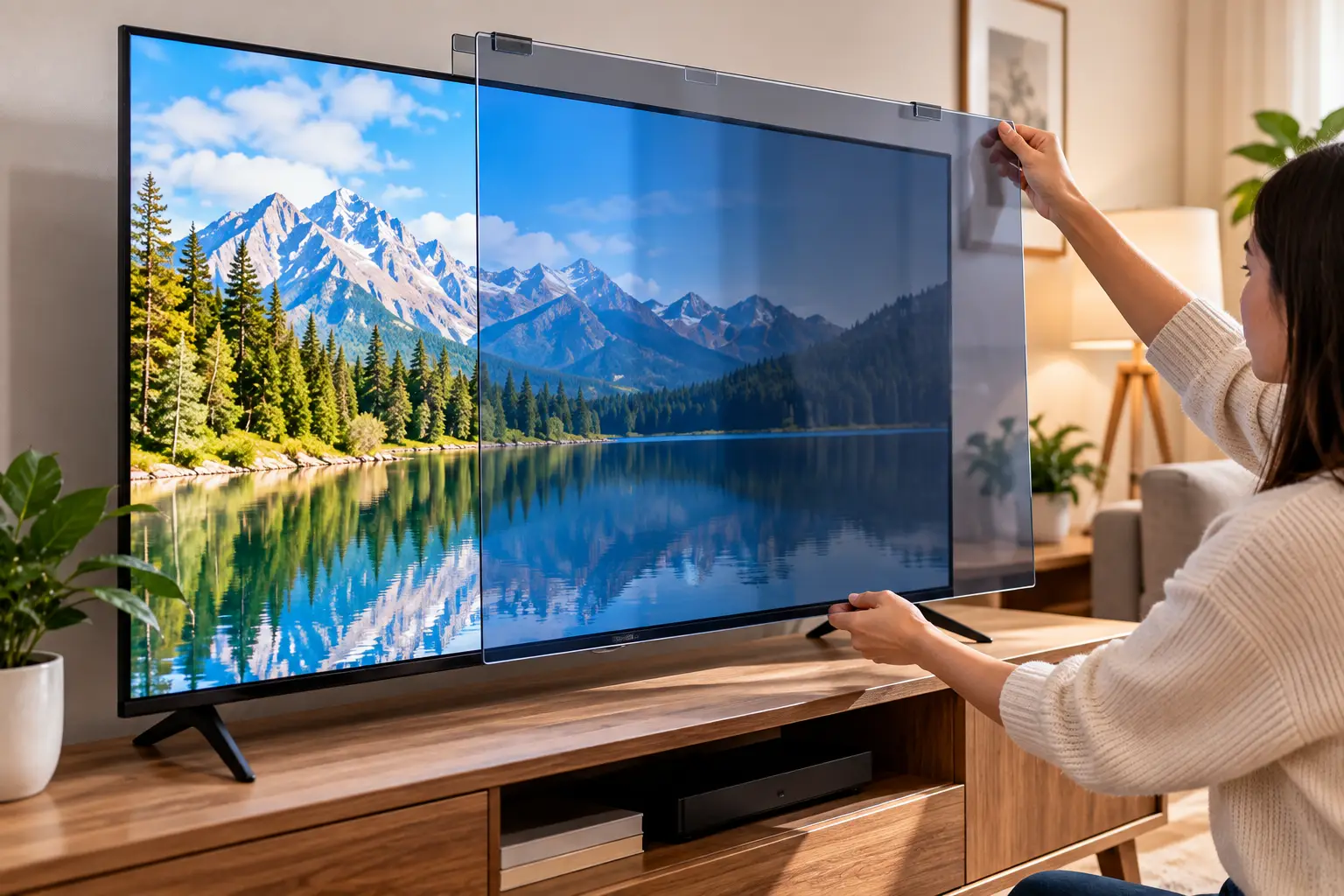
A blue light filter for tv is a transparent acrylic panel or film that sits in front of your television screen and absorbs part of the short-wavelength blue light (roughly 380–495 nm) the display emits. Most models also add scratch, impact, and sometimes glare protection, making them part eye-comfort accessory, part physical shield.
You finish dinner, the kids are in bed, and the TV becomes your nightly reward. Then 11 p.m. rolls around and your eyes feel tired but your brain feels wired. Sound familiar? That’s usually the moment people start searching for a blue light filter for tv — and it’s also the moment marketing gets loud. Listings promise to “block 100% of harmful blue light,” “prevent myopia,” and “help you sleep better.” Some of that is reasonable; some of it isn’t.
Here’s the honest framing this guide uses. Blue light is a slice of what scientists call high-energy visible light, and the sun delivers far more of it than any living room screen. The strongest evidence about screen blue light concerns evening timing — it can nudge your body clock — rather than eye damage. So a good anti blue light screen protector for tv is best understood as a comfort and protection upgrade, not a medical device.
That’s still worth something. A sturdy acrylic panel can save a $1,500 OLED from a flying toy controller, a matte film can tame window glare, and a warmer-tinted picture may feel easier on the eyes during a late-night binge. Below, you’ll find seven real products available on amazon.com, an honest breakdown of what each does well, installation and sizing advice, and a clear-eyed look at when the free settings already built into your TV are the smarter move.
Quick Comparison: The 7 Best Blue Light Filters for TV at a Glance
| Product | Type | Sizes Offered | Key Claim (per listing) | Approx. Price Range | Best for |
|---|---|---|---|---|---|
| VizoBlueX 55-Inch | Hanging acrylic panel | 32″–65″ family | Blocks UV + HEV 380–495 nm | Mid-range | VizoBlueX 55-Inch: living rooms with kids |
| VizoBlueX 31.5–32-Inch | Hanging acrylic panel | 31.5″–32″ | Blocks 380–480 nm | Budget | VizoBlueX 31.5–32-Inch: bedroom TVs |
| SaharaCase ZeroDamage Anti-Blue | Heavy-duty acrylic shield | 55″–86″ | Anti-blue + impact protection | Premium | SaharaCase ZeroDamage Anti-Blue: big, expensive TVs |
| BU 55-Inch Anti-Glare Film | Matte film | 55″ (other sizes) | Anti-glare + anti-blue | Mid-range | BU 55-Inch Anti-Glare Film: bright rooms, patios |
| JCSKY 55-Inch Matte Protector | Matte film | 55″ | Anti-glare, dustproof | Budget to mid | JCSKY 55-Inch Matte Protector: sunny living rooms |
| XRRX Frosted Matte Protector | Frosted matte film | 43″–65″ | Indoor/outdoor anti-glare | Budget to mid | XRRX Frosted Matte Protector: odd sizes, outdoor TVs |
| TYRHMY 55-Inch Anti-Glare | Matte film | 55″ | Reflection + blue light reduction | Budget | TYRHMY 55-Inch Anti-Glare: renters on a budget |
Looking at the table, the split is clear: the VizoBlueX 55-Inch and SaharaCase ZeroDamage Anti-Blue are rigid acrylic shields whose real superpower is protecting the panel, while the BU 55-Inch Anti-Glare Film, JCSKY 55-Inch Matte Protector, XRRX Frosted Matte Protector, and TYRHMY 55-Inch Anti-Glare are matte films built mainly to kill reflections. If your TV sits across from a window, a matte option solves a problem you actually see every day; if you have toddlers or a dog with a tail like a baseball bat, acrylic is the safer bet.
💬 One click helps other shoppers make an informed choice too! 😊
Top 7 Blue Light Filters for TV: Expert Analysis
1. VizoBlueX 55-Inch Blue Light TV Screen Protector — best all-rounder for family rooms
The VizoBlueX 55-Inch earns the top spot because it does two jobs at once: it filters short-wavelength light and physically shields your screen from knocks.
The panel measures about 48.4 x 28.5 inches and is made from multi-layer acrylic that roundups list at 7H hardness. In practice, 7H means everyday scuffs from a cleaning cloth or a toy car shouldn’t mark it — but a thrown remote will scratch the acrylic instead of your panel, which is exactly the trade you want. The listing claims it blocks UV and HEV light in the 380–495 nm range, and it hangs over the top bezel with a lip, so there’s no adhesive touching your TV.
Based on comparing the specs, this is the sweet spot for families with a 55-inch set in a shared living room. The glossy finish preserves 4K detail better than matte films, though it won’t reduce window reflections. Reviews consistently mention buyers purchasing it specifically for blue light filtering and noting careful packaging; a recurring complaint, however, is that some 55-inch orders arrived cracked in transit from certain sellers, so inspect the box immediately.
Pros:
- ✅ Doubles as a sturdy impact shield
- ✅ No-adhesive hanging lip installs in minutes
- ✅ Glossy finish keeps 4K images crisp
Cons:
- ❌ Does nothing to reduce window glare
- ❌ Shipping damage reported on some large orders
Expect a mid-range price, typically in the low-to-mid hundreds depending on size — check the current price, as it’s solid value if you want protection plus filtering.
2. VizoBlueX 31.5–32-Inch Blue Light Screen Protector — smartest pick for bedroom TVs
The VizoBlueX 31.5–32-Inch targets the screen most likely to affect your sleep: the small TV at the foot of your bed.
It’s a 28.5 x 17.1-inch hanging acrylic panel the brand markets for both monitors and TVs, with a claimed block of 380–480 nm light plus UV. Because a 32-inch TV is usually viewed from closer than a living room set, that blue light reduction arguably matters a bit more here; a smaller screen also means a lighter, cheaper panel that’s easy to lift off when you want accurate colors for a movie.
Here’s what to weigh: the bedroom is where evening light exposure is most relevant to your body clock, so this is where a filter has its most defensible use case. It also doubles nicely as a kid-room screen guard. On the flip side, it adds a faint tint — fine for TV, less ideal if you color-grade photos on the same display. Reviews for the VizoBlueX line consistently describe straightforward hanging installation; we couldn’t verify a large pool of US reviews for this exact size, so read the newest ones before ordering.
Pros:
- ✅ Ideal size for bedroom and dorm TVs
- ✅ Lightweight panel lifts off in seconds
- ✅ Works on 32-inch monitors too
Cons:
- ❌ Slight tint shifts colors on bright whites
- ❌ Fits only one narrow size range
It usually sits in the budget-friendly tier — around the lower end of acrylic panels — making it the best value entry point.
3. SaharaCase ZeroDamage Anti-Blue Light TV Screen Protector — heavy-duty armor for premium sets
The SaharaCase ZeroDamage Anti-Blue (model ZD-TV-AB-55 in the 55-inch size) is the one to consider when your TV costs more than your couch.
SaharaCase describes heavy-duty acrylic construction and compatibility with most 55-inch sets from Samsung, LG, Sony, VIZIO, TCL, Insignia, and others. The bigger story is the size range: versions exist for 65, 75, 77, 85, and 86-inch TVs — sizes most budget brands simply don’t make. If you own a 77-inch OLED, your realistic shortlist of anti-blue shields is very short, and this sits on it.
What most buyers overlook with this model is weight. Retail spec tables list the larger versions at well over 15 pounds, so you’ll want two people and a TV mount or stand rated comfortably above the combined load. Honest note on reviews: at the time of writing, product-level reviews for the anti-blue variant were thin or absent on some retailer listings, though the seller carries a strong overall rating across thousands of seller reviews. That means you’re buying the brand’s track record more than proven product feedback.
Pros:
- ✅ Sizes up to 86 inches available
- ✅ Thick acrylic built for real impacts
- ✅ Broad brand compatibility listed
Cons:
- ❌ Heavy panel needs two installers
- ❌ Few verifiable product-specific reviews yet
Expect premium pricing — the 55-inch has appeared around $165–$250 at major retailers, larger sizes considerably more — so it’s worth it mainly for high-end sets.
4. BU 55-Inch Anti-Glare Anti-Blue Light TV Film — glare killer for bright rooms
The BU 55-Inch Anti-Glare Film is built for the problem you notice first: reflections that turn your screen into a mirror.
The listing combines anti-glare, anti-blue light, and anti-scratch claims and markets the film for indoor or outdoor use. A matte surface works by scattering incoming light, so a window or lamp reflection becomes a soft, diffuse haze instead of a sharp bright patch. On paper, that means daytime viewing in a sunroom or covered patio becomes genuinely watchable.
The spec sheet doesn’t say this, but the physics of matte coatings does: scattering reflections also slightly softens the image and lifts black levels. On an OLED in a dark room, you’d notice. On an LED TV in a sunny family room, you probably won’t — and you’ll gain far more from killing glare than you’ll lose in sharpness. That makes this a better fit for daytime-heavy households than for movie purists. We couldn’t verify a meaningful pool of US reviews for this specific listing, so treat the blue light figures as manufacturer claims and check recent reviews before buying.
Pros:
- ✅ Dramatically cuts window and lamp reflections
- ✅ Rated for indoor and outdoor use
- ✅ Lighter and thinner than acrylic panels
Cons:
- ❌ Matte texture slightly softens fine detail
- ❌ Offers little protection from hard impacts
It has listed around $130 at some retailers, which is fair value if glare — not impact — is your main enemy.
5. JCSKY 55-Inch Matte Anti-Glare TV Screen Protector — budget glare control with dust resistance
The JCSKY 55-Inch Matte Protector offers matte glare reduction plus a dustproof claim at a friendlier price.
It measures 1221 x 689 mm (about 48 x 27 inches), and the listing stresses choosing the size based on the width of your TV’s frame rather than just the diagonal. That detail matters: modern narrow-bezel TVs vary by an inch or more at the same “55-inch” label, and a film that’s too wide overhangs while one that’s too narrow leaves a bright, unfiltered strip at the edge.
Based on comparing the specs, the JCSKY is a sensible pick for a living room that gets afternoon sun and a family that dusts the TV once a month at best. The listing’s “anti-myopia” language, however, deserves skepticism — there’s no good evidence that a TV film prevents nearsightedness, and you shouldn’t buy it for that reason. Buy it for glare and dust instead. Verifiable US review data for this listing is limited, so we can’t summarize a reliable consensus; check the most recent buyer photos for fit on narrow-bezel sets.
Pros:
- ✅ Matte finish tames afternoon sun glare
- ✅ Dust-resistant surface eases cleaning
- ✅ Clear sizing guidance by frame width
Cons:
- ❌ Health claims in listing are overstated
- ❌ Limited verified US review history
Typically priced in the budget-to-mid range — a good value if you want glare control without acrylic costs.
6. XRRX 43–65-Inch Frosted Matte TV Screen Protector — flexible sizing for odd setups
The XRRX Frosted Matte Protector stands out for its size range, spanning 43 to 65 inches in one product line.
The 55-inch version measures 1211 x 682 mm, and the “frosted” matte finish is marketed for both indoor and outdoor use, alongside anti-blue and dustproof claims. A frosted surface diffuses reflections more aggressively than a light matte — think of the difference between a sunglasses lens and frosted bathroom glass, just much subtler.
Here’s what to weigh: that stronger diffusion is excellent for a covered porch TV or a garage gym display, where sun glare is brutal and image fidelity matters less. In a dark home theater, though, it’s the wrong tool — the haze will dull contrast more than you’d like. The wide size range also makes it handy for households with several TVs, letting you standardize on one brand. As with other matte films here, we couldn’t verify a substantial body of US reviews, so the blue light percentages should be read as unverified manufacturer claims.
Pros:
- ✅ Wide 43–65-inch size range
- ✅ Strong diffusion for outdoor glare
- ✅ Good for multi-TV households
Cons:
- ❌ Frosted finish dulls dark-room contrast
- ❌ Blue light claims are unverified
Expect budget-to-mid pricing depending on size — strong value for patios and bright spaces.
7. TYRHMY 55-Inch Anti-Glare TV Screen Protector — low-cost entry for renters
The TYRHMY 55-Inch Anti-Glare is the no-commitment option for anyone curious about a filter without spending acrylic money.
It’s a matte anti-glare film marketed to reduce screen reflection and blue light and to relieve eye fatigue. For renters, the appeal is simple: a thin film attached to the bezel leaves no holes, no mounts, and nothing heavy to move when the lease ends.
Based on comparing the specs, the TYRHMY makes the most sense as an experiment. If you’ve never used a screen filter, this tells you cheaply whether you enjoy a matte, slightly warmer-looking picture. If you love it, great; if not, you’ve learned what to avoid before buying a premium shield. The “relieve eye fatigue” promise, however, should be kept in perspective: the American Academy of Ophthalmology says screen-related eye strain mostly comes from how we use screens — staring, blinking less — rather than the light itself. We couldn’t verify a reliable volume of US reviews for this listing.
Pros:
- ✅ Low-cost way to test a filter
- ✅ Renter-friendly, no mounting hardware
- ✅ Reduces reflections in bright rooms
Cons:
- ❌ Eye-fatigue claims outpace the evidence
- ❌ Thin film adds minimal impact protection
Usually among the most affordable options here — best value as a low-risk trial.
✨ Don’t miss these smart screen upgrades!
🔍 Take your movie nights to the next level with this carefully curated lineup. Click a highlighted item to check current pricing and availability. These picks will help you get a calmer, glare-free picture the whole family will enjoy!
How to Install a Blue Light Screen Protector for TV Without the Headaches
Installation is where most buyer regret happens, so here’s a practical first-day routine that listings rarely spell out.
Before it arrives
- ✅ Measure your TV’s visible frame width and height with a tape measure — not the diagonal. Compare those numbers to the panel’s stated dimensions.
- ✅ Check the top bezel depth. Hanging-lip panels like the VizoBlueX 55-Inch need a lip that clears the top edge; ultra-thin “wallpaper” style TVs may not give them enough to grip.
- ✅ Confirm your stand or wall mount weight rating. Acrylic adds real weight.
Unboxing day
- Inspect the box first. Large acrylic panels are fragile in transit. If the carton is crushed, photograph it before opening — this makes returns painless.
- Peel protective film in a dust-free spot. Both sides of acrylic panels usually ship with a peel-off layer. Remove it near the TV so the panel doesn’t collect dust en route.
- Two people, always. For anything 55 inches and up — especially the SaharaCase ZeroDamage Anti-Blue — one person lifts while the other guides the lip over the bezel.
- Center and check edges. Look for bright unfiltered gaps on either side. A half-inch gap is usually fine; a light strip you notice during dark scenes is not.
The first 30 days
- ✅ Clean with a dry or slightly damp microfiber cloth only. Ammonia-based glass cleaners can haze acrylic.
- ✅ Recalibrate your picture. A filter shifts color slightly, so bump your TV’s color temperature or brightness a notch to compensate.
- ✅ Watch for heat. Make sure vents on the TV’s back aren’t blocked; panels hang in front, so this is rarely an issue, but films wrapped over edges can be.
A common mistake in the first month is judging the filter on day one. Your eyes adapt to the slight tint within a few viewing sessions, so give it a week before deciding whether to keep it.
Which TV Blue Light Filter Fits Your Household? Three Real-World Scenarios
Specs only become meaningful when you match them to real lives. Here are three common situations and the reasoning behind each recommendation.
🧸 Scenario 1: The young family with a 55-inch living room TV
Budget: mid-range. Use: 4–6 hours a day, cartoons in the morning, adult shows at night.
The biggest risk here isn’t blue light — it’s a sippy cup or a wooden block hitting the screen. The VizoBlueX 55-Inch fits best because its acrylic absorbs impacts while adding some filtering for evening viewing. A cracked 55-inch panel typically means replacing the whole TV, so the shield effectively works as insurance. If the room also gets bright afternoon sun, reposition the TV or add curtains rather than stacking a matte film on top.
🌙 Scenario 2: The night-owl professional with a bedroom TV
Budget: low. Use: 1–2 hours nightly, usually right before sleep.
This is the strongest case for a filter’s blue light role. The VizoBlueX 31.5–32-Inch suits a small bedroom set, and pairing it with your TV’s warm or “eye comfort” picture mode gives you a double layer of evening-friendly color. Even better: set a sleep timer so the screen shuts off on its own.
☀️ Scenario 3: The sunroom or covered patio setup
Budget: budget to mid. Use: daytime sports and weekend gatherings.
Here glare dominates everything. The XRRX Frosted Matte Protector or the BU 55-Inch Anti-Glare Film will make a far bigger visible difference than any blue light percentage. Choose XRRX if your outdoor TV is an unusual size, BU if it’s a standard 55-inch. Skip glossy acrylic entirely — it would amplify the reflections you’re trying to escape.
Problem → Solution: Fixing Common Blue Light Filter Annoyances
Even a well-chosen filter can create small frustrations. Here are the most frequent ones and how to fix them.
Problem 1: “The picture looks yellowish.” ✅ Solution: That tint is how many filters reduce blue output. Open your TV’s picture settings and nudge the color temperature one step cooler, or raise color saturation slightly. You’ll recover most of the neutral look while keeping some evening warmth.
Problem 2: “I see reflections of myself on the panel.” ✅ Solution: Glossy acrylic, like the VizoBlueX 55-Inch or SaharaCase ZeroDamage Anti-Blue, reflects light the same way glass does. Dim lamps behind your seating position or swap to a matte film such as the JCSKY 55-Inch Matte Protector if reflections are constant.
Problem 3: “There’s a bright strip on one side.” ✅ Solution: The panel isn’t centered or is slightly undersized. Re-hang it, centering by eye during a dark scene. If the gap persists, the size is wrong — return it and reorder based on frame width, not diagonal.
Problem 4: “The image looks soft or hazy.” ✅ Solution: This is the matte trade-off with films like the XRRX Frosted Matte Protector. Lower the TV’s sharpness to neutral (over-sharpening exaggerates haze) and raise contrast a step. If you mainly watch in the dark, a glossy panel may suit you better.
Problem 5: “Dust keeps collecting between the panel and the screen.” ✅ Solution: Lift the panel off monthly, wipe both surfaces with microfiber, and re-hang. A quick monthly clean beats letting grit build up.
How to Choose a Blue Light Filter for TV: 6 Steps
Use this checklist in order — each step narrows your options so the decision basically makes itself.
- Identify your real problem. Glare, impact risk, or evening comfort? Glare points to matte film; impact risk points to acrylic; evening comfort can be solved by either — or by free TV settings.
- Measure frame width and height. Diagonal size is marketing; actual dimensions vary by bezel. Match the panel’s stated measurements within about half an inch.
- Pick a finish for your room’s lighting. Glossy preserves sharpness and deep blacks in dim rooms; matte wins in bright rooms. There’s no finish that does both perfectly.
- Check the mounting style. Hanging panels need a top bezel to grip; films typically attach at the edges. Very thin wall-hugging TVs may limit your options.
- Read the blue light claim skeptically. “Blocks 100%” usually refers to a narrow wavelength band, not all blue light — otherwise your picture would turn heavily amber. Treat percentages as marketing until verified by independent testing.
- Confirm weight and stability. Add the panel weight to your TV and confirm your stand or mount handles it with room to spare.
🛒 Ready to protect your screen and your evenings?
👉 Compare the highlighted picks above, check current pricing and sizes, and choose the one that matches your room — not just your screen size!
Hanging Acrylic Panel vs Matte Film: Which TV Blue Light Filter Type Wins?
Both formats are sold as anti blue light screen protector for tv products, but they solve different problems, and choosing the wrong format is the most common reason people return these products.
Hanging acrylic panels — like the VizoBlueX 55-Inch, VizoBlueX 31.5–32-Inch, and SaharaCase ZeroDamage Anti-Blue — are rigid sheets a few millimeters thick. Their headline benefit is impact protection: acrylic flexes and absorbs knocks that would crack an LCD or OLED panel. They’re also completely removable, which matters for movie nights when you want untouched color. The downside is their glossy surface, which reflects lamps and windows.
Matte films — like the BU 55-Inch Anti-Glare Film, JCSKY 55-Inch Matte Protector, XRRX Frosted Matte Protector, and TYRHMY 55-Inch Anti-Glare — are thinner, lighter, and cheaper. They earn their keep by diffusing reflections, but they give limited impact protection and can soften fine detail.
| Factor | Hanging Acrylic Panel | Matte Film | Built-In TV Warm Mode |
|---|---|---|---|
| Blue light reduction | Moderate (tint-based) | Mild to moderate | Adjustable, often strong |
| Glare reduction | ❌ None (can increase) | ✅ Strong | ❌ None |
| Impact protection | ✅ Strong | ⚠️ Minimal | ❌ None |
| Picture sharpness | ✅ Preserved | ⚠️ Slightly softened | ✅ Preserved |
| Cost | Mid to premium | Budget to mid | Free |
| Best for | Kids, pets, pricey TVs | Bright rooms, patios | Everyone at night |
The table reveals something listings won’t tell you: your TV’s warm or eye-comfort mode already handles evening blue light reduction for free, and it’s often adjustable. That means the real deciding factor for paying money is glare versus impact — matte for the former, acrylic for the latter. If you have both problems, prioritize the one that costs more when it goes wrong, which is usually a cracked screen.
Blue Light Blocking TV Screen vs Built-In Night Mode: Do You Need Both?
Most TVs sold in the last several years include picture modes that warm the color temperature — names vary by brand, such as “Eye Comfort,” “Warm,” or “Filmmaker”-style presets with warmer whites. These shift the picture away from blue in software, at zero cost, and you can schedule some of them to switch on in the evening.
So why buy a physical blue light blocking tv screen at all? Three legitimate reasons:
- ✅ Protection you can’t download. No software setting stops a toy from hitting the panel. Acrylic does.
- ✅ Glare you can’t adjust away. Software can’t change how light bounces off the glass; a matte film can.
- ✅ Set-and-forget for shared TVs. If family members keep switching picture modes back to “Vivid,” a physical filter stays put.
And here’s the case against relying on a filter alone. Research summarized by Harvard Health Publishing shows blue light at night suppresses melatonin more strongly than other colors, but it also notes that bright light of any color has some effect, and its practical advice centers on avoiding bright screens two to three hours before bed. In other words, a filter on a bright TV still leaves you watching a bright TV.
The smartest setup for most households is layered: use the TV’s warm mode after sunset, lower the brightness in a dark room, set a sleep timer, and add a physical filter only when protection or glare justifies it. That combination does more for your evenings than any single product promising to block “100%” of blue light.
Features That Actually Matter (and Ones That Don’t)
Listings for TV filters are crowded with numbers. Here’s how to separate useful specs from noise.
✅ Features that matter
- Exact panel dimensions. The single biggest predictor of satisfaction. A perfect filter in the wrong size is a useless filter.
- Material and thickness. Acrylic panels provide real impact protection; films don’t. If protection is your goal, this decides everything.
- Finish (glossy vs matte). This determines whether your room’s lighting works with or against you.
- Mounting method. A secure hanging lip or clean bezel attachment means no residue on your TV and easy removal.
- Packaging and return policy. For 55-inch-plus acrylic, transit breakage is a real reported risk. A hassle-free return policy is a genuine feature.
❌ Features that are mostly marketing
- “Blocks 100% of blue light.” Physically, a filter that removed all blue would turn your picture orange. These claims usually refer to a narrow band, like 380–400 nm, where TVs emit little to begin with.
- “Anti-radiation.” Modern LCD and OLED TVs don’t emit meaningful harmful radiation for a filter to block.
- “Prevents myopia.” There’s no good evidence a TV filter prevents nearsightedness in kids. Time outdoors and sensible screen habits are what eye doctors actually recommend.
- Hardness ratings above 7H. Useful for scratch resistance, but beyond that point the differences in daily use are small.
Based on comparing the specs across all seven products, the honest ranking of what to check is: size first, finish second, material third — and blue light percentages dead last.
Safety, Standards, and Kids: What Parents Should Know
A TV filter adds weight and changes your setup, so safety deserves a few minutes of thought — especially in homes with children.
TV tip-over risk
Adding a heavy acrylic shield to the front of a TV shifts its center of gravity forward. On a narrow stand, that slightly increases tip-over risk if a child pulls on the panel or climbs the furniture. The Consumer Product Safety Commission’s Anchor It! campaign recommends anchoring TVs and furniture to the wall, and that advice becomes even more relevant once you add a front-mounted panel. Anti-tip straps are inexpensive and take about 15 minutes to install.
Regulatory reality
Blue light screen protectors are not medical devices, and their health claims aren’t evaluated the way drug or device claims would be. That’s why you’ll see bold promises on listings with little independent verification. Treat eye-health claims as marketing, and treat the physical claims — dimensions, material, hardness — as the useful information.
Kid-specific tips
- ✅ Choose acrylic over film in playrooms; films provide minimal impact protection.
- ✅ Check that panel edges are smooth and the hanging lip doesn’t create a pinch point.
- ✅ Keep the TV’s own parental and sleep-timer settings in play; a filter doesn’t replace screen-time limits.
If a child regularly complains of eye discomfort, headaches, or squinting at the TV, that’s a reason to book an eye exam, not to buy a stronger filter. Vision problems that need correction won’t be fixed by tinting the screen.
Long-Term Cost and Maintenance of a Blue Light Filter for TV
A filter is a one-time purchase, but its value depends on how long it lasts and what it prevents.
| Product | Upfront Cost | Expected Lifespan (with care) | Main Value Driver | Best for |
|---|---|---|---|---|
| SaharaCase ZeroDamage Anti-Blue | Premium | Years | Protects a very expensive TV | SaharaCase ZeroDamage Anti-Blue: 65″+ OLED owners |
| VizoBlueX 55-Inch | Mid-range | Years | Impact shield + filtering | VizoBlueX 55-Inch: families |
| BU 55-Inch Anti-Glare Film | Mid-range | Moderate | Usable picture in bright light | BU 55-Inch Anti-Glare Film: sunrooms |
| TYRHMY 55-Inch Anti-Glare | Budget | Moderate | Cheap trial of matte viewing | TYRHMY 55-Inch Anti-Glare: renters |
Reading this table through a value lens, the premium SaharaCase ZeroDamage Anti-Blue only makes financial sense when the TV behind it is expensive enough that a single prevented crack pays for it many times over. For a mid-priced 55-inch set, the VizoBlueX 55-Inch delivers most of the same protective logic at a lower cost, while the TYRHMY 55-Inch Anti-Glare is about learning what you like before spending more.
Maintenance schedule
- ✅ Weekly: dry microfiber dusting.
- ✅ Monthly: lift acrylic panels off and clean both surfaces; check that films still sit flat at the edges.
- ✅ Yearly: inspect for yellowing or crazing (fine cracks). Cheap acrylic can yellow faster in direct sun.
The hidden cost to factor in is your own picture quality: if a filter makes you dislike watching your TV, it’s expensive no matter what it cost.
Common Mistakes to Avoid When Buying a TV Blue Light Filter
Most disappointments with these products are predictable. Here are the pitfalls worth dodging.
Mistake 1: Buying by diagonal size alone. Two “55-inch” TVs can differ by an inch or more in frame width. Always compare actual measurements to the listing — the JCSKY 55-Inch Matte Protector listing even says so explicitly.
Mistake 2: Expecting a filter to fix eye strain. As noted earlier, the American Academy of Ophthalmology links screen-related discomfort mainly to reduced blinking and long, unbroken viewing. Breaks and proper viewing distance help more than any coating.
Mistake 3: Putting glossy acrylic in a sun-filled room. You’ll trade a blue light benefit you can’t see for glare you can’t ignore. Bright rooms need matte.
Mistake 4: Putting a frosted film on an OLED home theater. Haze undermines the deep blacks you paid for. Use a glossy panel or no filter at all.
Mistake 5: Ignoring weight. Large acrylic shields like the SaharaCase ZeroDamage Anti-Blue are heavy. Check stand ratings and anchor the TV.
Mistake 6: Skipping the box inspection. With reports of large panels arriving cracked, open and check deliveries right away so returns stay simple.
Mistake 7: Believing “100% blocking” claims. A screen that blocked all blue light would look unwatchably orange. Read percentages as marketing, and judge products on fit, finish, and build.
FAQ: Blue Light Filters for TVs
❓ Where can I buy a blue light filter for tv in the US?
❓ How much does a good anti blue light TV screen protector cost?
❓ Do blue light screen protectors work on OLED and QLED TVs?
❓ Is a TV blue light filter better than blue light glasses?
❓ Can I return a TV screen protector if it doesn't fit?
Conclusion: Choose the Filter That Solves a Problem You Can See
The best blue light filter for tv is the one that fixes something real in your home. If you have kids, pets, or an expensive screen, a rigid acrylic shield like the VizoBlueX 55-Inch — or the SaharaCase ZeroDamage Anti-Blue for 65-inch-plus sets — offers protection you’ll appreciate the first time something goes flying. If your TV fights with a window, a matte film such as the BU 55-Inch Anti-Glare Film, JCSKY 55-Inch Matte Protector, or XRRX Frosted Matte Protector will transform daytime viewing. For the bedroom, the VizoBlueX 31.5–32-Inch pairs naturally with evening wind-down habits, and the TYRHMY 55-Inch Anti-Glare is a low-risk way to find out whether you like a filtered picture at all.
Just keep expectations honest. Screen blue light isn’t a proven eye-damage threat; its clearest effect is on your body clock at night. That means warm picture modes, lower brightness, sleep timers, and regular breaks do as much heavy lifting as any filter. Use a physical filter as the protection-and-glare upgrade it really is, and you’ll be happy with your purchase for years.
Measure carefully, choose your finish based on your room’s light, inspect the box on delivery, and anchor your TV. Do those four things and you’ll avoid nearly every regret buyers report.
🎯 Your calmer, safer screen starts here!
💡 Click any highlighted product above to compare sizes and check current pricing and availability — then enjoy movie nights that are easier on your eyes and your TV!
Recommended for You
- Blue Eyeglasses for Women: 7 Stunning Frames to Wear in 2026
- Ice Blue Eye Contacts: 7 Smart, Safe Essentials for 2026
- Blue Cosplay Contacts 2026: 7 Smart Picks for Safe, Stunning Eyes
Disclaimer: This post contains affiliate links. As an Amazon Associate, I earn from qualifying purchases made through these links, at no additional cost to you.
✨ Found this article helpful? Share it with someone who needs it! 💬🤗