In This Article
Red Light Goggles in 2026: Protection, Therapy, or Both?
Type “red light goggles” into Amazon and you’ll get two very different things on the same results page. Half the listings are protective eyewear that blocks red and near-infrared light while you sit in front of a therapy panel. The other half are wearable LED eye masks that emit red light onto the skin around your eyes. Same search, opposite jobs. 🤔
That confusion is exactly why so many buyers end up with the wrong pair. Someone shopping for crow’s-feet treatment orders $12 tanning shields, while someone with a 600W panel buys a glowing eye mask and wonders why their eyes still sting. This guide sorts it out.
What Is Red Light Goggles?
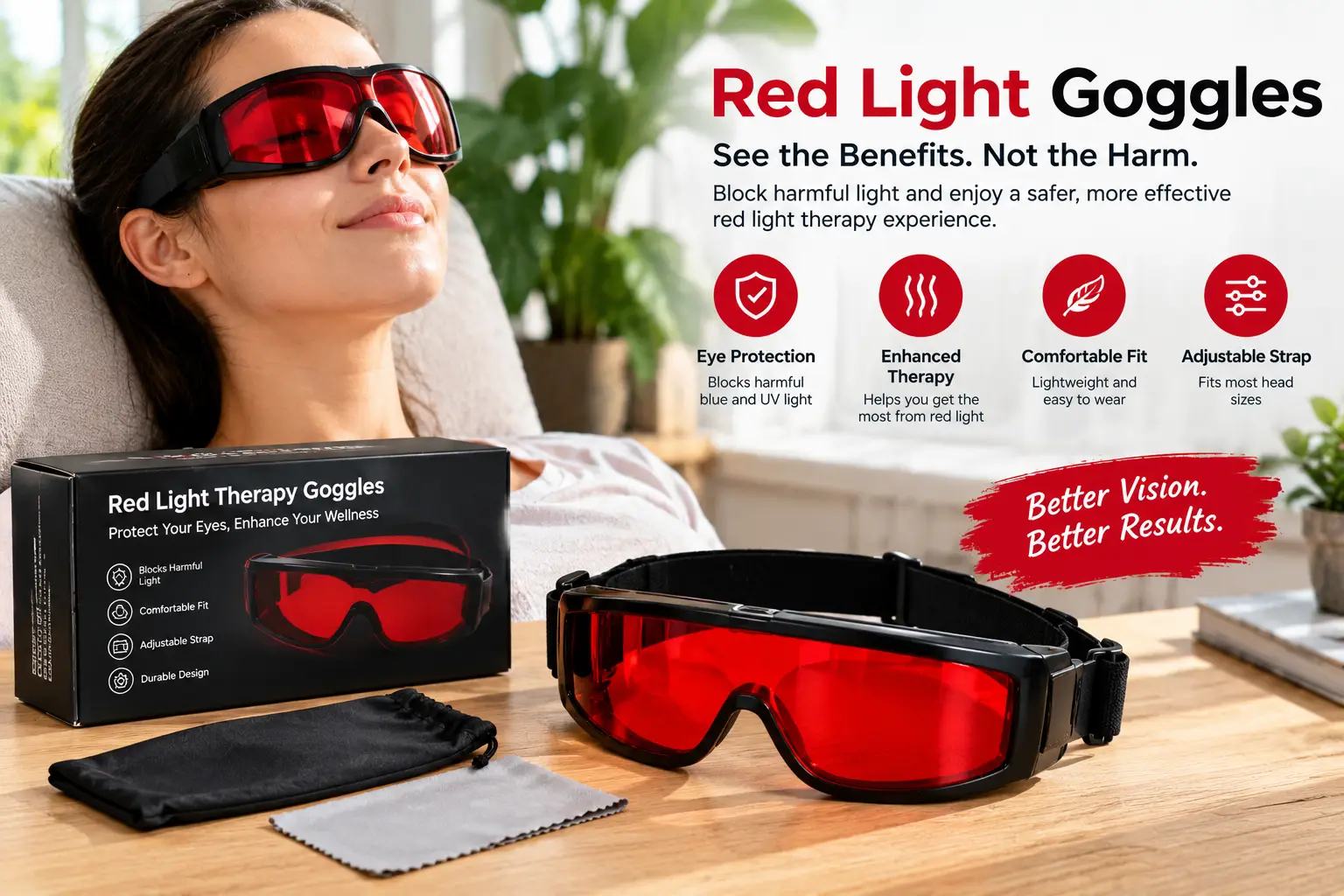
Red light goggles are eyewear designed for red light therapy. Protective red light goggles filter red (roughly 600-700nm) and near-infrared (700-900nm+) light to shield your eyes during panel or mask sessions. Therapeutic red light goggles are LED eye masks that deliver red and near-infrared light to the skin around the eyes for cosmetic goals like fine lines and puffiness.
Why the Distinction Matters
Red and near-infrared light is a real area of research, not just wellness marketing. A pilot study on 670nm photobiomodulation in aging eyes and AMD used a tightly controlled two-minute daily dose at a set irradiance, and even then the results were mixed. That’s the point worth holding onto: in eye science, dose and wavelength are everything, and consumer gadgets rarely publish either with clinical precision.
So in this guide, we cover both categories honestly:
- ✅ 4 protective pairs for anyone using a red light panel, mask, or salon bed
- ✅ 3 LED eye masks for anyone who wants targeted under-eye light therapy
- ✅ How to match optical density and wavelength to your device
- ✅ The safety lines you should never cross, especially with kids and laser-based devices
No invented test stories here. Every recommendation is built from published specs, manufacturer data, and the recurring themes in real customer reviews, with honest notes wherever information is thin.
Quick Comparison: Red Light Goggles at a Glance
Here’s the whole lineup in one view. The first four protect your eyes from therapy light; the last three deliver therapy light to the eye area.
| Product | Type | Wavelength / Filter | Price range | Best for |
|---|---|---|---|---|
| Super Sunnies Evo | Protective shield | UV-rated (99.9% UVB, 99% UVA) | Under $20 | Super Sunnies Evo: tanning + low-power masks |
| ULTREMA Red Light Therapy Glasses | Protective glasses | Listed 200-2000nm | Under $25 | ULTREMA Red Light Therapy Glasses: high-power panels |
| TAYLL Flexible Red Light Therapy Goggles | Protective shield | Listed 600-900nm | Under $30 | TAYLL Flexible Red Light Therapy Goggles: face-in-panel sessions |
| Mito Red IR5 Glasses (Extra Dark) | Protective glasses | 600-900nm, about 95% reduction | Around $25-$50 | Mito Red IR5 Glasses (Extra Dark): daily panel users |
| Swirise Red Light Therapy for Eyes | LED eye mask | 605/630/660/810nm | Around $100-$130 | Swirise Red Light Therapy for Eyes: budget under-eye care |
| CurrentBody Skin LED Eye Mask | LED eye mask | 605/633/660/830nm | Around $250 | CurrentBody Skin LED Eye Mask: puffiness + dark circles |
| iRESTORE Illumina Eye Mask | LED eye mask | 633/830nm, 180 LEDs | $250-$300 range | iRESTORE Illumina Eye Mask: fine lines, max power |
Prices are approximate ranges at the time of writing and change often. Check current pricing on Amazon.
Reading the table top to bottom, the price jump is enormous: protective red light goggles cost about as much as lunch, while LED eye masks are a genuine investment. The bigger insight is in the filter column, though. Super Sunnies Evo is rated for UV, not specifically for near-infrared, so it’s a comfort shield rather than a true NIR blocker. If you run a powerful panel, the ULTREMA Red Light Therapy Glasses or Mito Red IR5 Glasses (Extra Dark) are the safer match.
💬 One click helps other shoppers make an informed choice too! 😊
Top 7 Red Light Goggles: Expert Analysis
The picks below run from a $15 salon staple to a premium 180-LED eye mask. Each entry explains what the specs mean in practice, who should buy it, and what real reviews consistently say.
1. Super Sunnies Evo — cheapest pair worth owning
Super Sunnies Evo is the default answer when you need something on your face in the next two days for very little money. 🕶️
The flexible rubber frame and slim eye cups are designed to minimize the “raccoon eye” tan line, and the elastic headband adjusts across head sizes. The lenses block over 99.9% of UVB and over 99% of UVA, and the brand states compliance with the federal sunlamp eyewear rules in 21 CFR 1040.20. In practice, that makes them excellent tanning-bed protection, but notice what’s missing: no published near-infrared attenuation figure.
Based on comparing the specs, these suit people using a low-power LED face mask or a salon red light bed who mainly want to cut glare. If you stand inches from a high-output panel, treat them as a comfort layer, not certified NIR protection.
Customer reviews consistently praise the fit across small and large heads and the low price. The recurring complaint is that some light still leaks in around the sides, and a few buyers say the light still looked very bright.
Pros:
- ✅ Very low cost, often sold in multipacks
- ✅ Slim cups fit under many LED masks
- ✅ Flexible frame adjusts to most head sizes
Cons:
- ❌ No published near-infrared blocking rating
- ❌ Some side light leakage reported by users
💲 Typically under $20 for a single or multipack; unbeatable value for tanning and mask sessions, but not a high-power panel solution.
2. ULTREMA Red Light Therapy Glasses — broadest filter range on a budget
ULTREMA Red Light Therapy Glasses cover far more of the spectrum than tanning goggles, which is exactly what panel users need.
The listing claims filtration across 200-2000nm, spanning UV, visible red, and the near-infrared bands that therapy panels emit. Soft rubber side baffles block light from oblique angles, the gap that standard sunglasses leave wide open. Third-party roundups list the optical density in the OD 3+ range, though figures vary by source, so confirm the rating printed on your pair.
Here’s what to weigh: broad filtering means a strong darkening effect and altered color perception. That’s ideal for 10-20 minutes of facing a 300W+ panel, but frustrating if you want to read or scroll during sessions. Buyers with powerful home panels or gym red light booths get the most from these.
Reviews consistently describe strong light blockage and good side coverage. The common trade-off mentioned is how dark and color-shifted everything looks while wearing them.
Pros:
- ✅ Wide 200-2000nm listed filter range
- ✅ Rubber side shields block angled light
- ✅ Doubles as IPL session eyewear
Cons:
- ❌ Heavy tint makes reading difficult
- ❌ Optical density figures vary between sources
💲 Usually under $25; outstanding value for high-power panel users who prioritize blocking over visibility.
3. TAYLL Flexible Red Light Therapy Goggles — best for treating your face
TAYLL Flexible Red Light Therapy Goggles solve a problem the bulkier glasses create: they let light reach more of your face.
These are flexible eye-shield goggles with an adjustable head strap and a carry case, listed as blocking 600-900nm. That band lines up with the 630/660nm red and 810/850nm near-infrared diodes found in most consumer panels. Because the shields sit close to the eye, less of your cheeks, temples, and crow’s-feet area gets shadowed than with wraparound glasses.
On paper, this makes them the smartest pick for anyone doing red light therapy specifically for facial skin. The strap also stays put if you lie down under a panel. One honest caveat: we could not verify a published optical density figure for this flexible model, so check the product markings when it arrives.
We also couldn’t find enough verifiable independent reviews to summarize sentiment reliably, so judge it on its stated specs and Amazon’s current review page.
Pros:
- ✅ Small shields expose more facial skin
- ✅ Adjustable strap stays put lying down
- ✅ Listed band matches common panel diodes
Cons:
- ❌ No verified optical density figure found
- ❌ Limited independent review data available
💲 Typically under $30; good value if facial treatment is your main reason for using a panel.
4. Mito Red IR5 Glasses (Extra Dark) — most comfortable daily wear
Mito Red IR5 Glasses (Extra Dark) look like regular sunglasses, which is a bigger deal than it sounds when you use a panel every day.
Mito Red states the IR5 tint reduces red and near-infrared light (600-900nm) by about 95%, while the lighter IR3 version cuts about 80%. That two-tier choice is useful: IR5 for bright, close-range panels or light-sensitive eyes, IR3 if you want to see your phone. The wraparound lenses help limit side glare, and the brand positions them as lighter than goggle-style eyewear.
What most buyers overlook is that the stated 95% is a percentage reduction, not an OD figure. It’s meaningful protection, but OD 2 already equals 99% reduction, so stricter users may prefer a pair with a printed OD rating. For everyday panel users who value comfort, these hit a sweet spot.
Reviews on the brand’s own store are largely positive, with buyers calling them plenty dark; independent review volume is smaller, so weigh that accordingly.
Pros:
- ✅ Glasses-style frame, comfortable for daily use
- ✅ Two tint levels to match panel brightness
- ✅ Clear 600-900nm target band stated
Cons:
- ❌ Percentage rating, not a printed OD figure
- ❌ Less side sealing than flexible goggles
💲 Generally around $25-$50; fair value if comfort keeps you consistent with daily sessions.
5. Swirise Red Light Therapy for Eyes — best budget LED eye mask
Swirise Red Light Therapy for Eyes is the entry ticket into therapeutic red light goggles without a $250 commitment.
It uses four wavelengths: 605nm amber, 630nm red, 660nm deep red, and 810nm near-infrared, with roughly three-minute sessions according to Wareable’s comparison. Amber targets circulation and the look of puffiness, red and deep red target collagen and fine lines, and 810nm reaches slightly deeper tissue. That’s a broader wavelength mix than some masks costing twice as much.
The catch is what the spec sheet doesn’t say. Swirise doesn’t prominently publish irradiance for this mask, and dose drives results in light therapy. It’s best for beginners who want to test whether they’ll stick with a routine before upgrading.
Brand-level feedback on Trustpilot is mixed: many users report satisfaction with masks and panels, but some complain about NIR output on other Swirise products and slow return responses.
Pros:
- ✅ Four wavelengths at an entry-level price
- ✅ Short sessions fit busy routines
- ✅ Low-risk way to test the habit
Cons:
- ❌ Irradiance not clearly published
- ❌ Mixed customer-service feedback at brand level
💲 Usually around $100-$130; solid value for first-timers, provided you set realistic expectations.
6. CurrentBody Skin LED Eye Mask — best for puffiness and dark circles
CurrentBody Skin LED Eye Mask comes from one of the best-known names in at-home LED, and it’s built specifically for the under-eye zone.
It combines four wavelengths: amber 605nm for circulation and puffiness, red 633nm for radiance, deep red 660nm for collagen, and near-infrared 830nm for firmness. Sessions are short, around three minutes per the Wareable comparison. That multi-band design matters for dark circles, which often mix pigmentation, thin skin, and fluid retention, so one wavelength rarely addresses everything.
Based on comparing the specs, this suits buyers whose main complaint is a tired, puffy look rather than deep wrinkles. CurrentBody’s face masks carry FDA clearance; confirm the specific clearance status of the eye mask on the product page before buying if that matters to you.
We couldn’t verify a large pool of independent reviews specific to the eye mask, so check Amazon’s current ratings rather than relying on the brand’s face-mask reputation.
Pros:
- ✅ Four wavelengths targeting the under-eye zone
- ✅ Short three-minute sessions
- ✅ Established brand with US support
Cons:
- ❌ Premium price for a small treatment area
- ❌ Limited independent eye-mask review data
💲 Around $250; worth it if puffiness and dark circles are your main targets.
7. iRESTORE Illumina Eye Mask — most powerful eye mask here
iRESTORE Illumina Eye Mask is the pick when you want the strongest dose concentrated around your eyes.
It packs 180 LEDs at two wavelengths, 633nm red and 830nm infrared, running at a listed 32 mW/cm². That published irradiance is the standout detail; most budget masks never tell you. At that power, a five-minute session delivers a meaningful dose without long sit times. There’s no blue light, which is good news for the delicate eye area.
Here’s what to weigh: two wavelengths versus the four on the CurrentBody Skin LED Eye Mask. If fine lines and crow’s feet are your goal, the proven 633/830 pairing plus higher LED density is a strong argument. If puffiness is the issue, the amber band elsewhere may matter more. iRESTORE advertises “FDA cleared technology”; verify the clearance for this specific model.
Wareable ranked it best for fine lines and described it as the most powerful eye mask in its lineup. A dealer listing notes a 1-year warranty and a 100-day return window.
Pros:
- ✅ Published 32 mW/cm² irradiance
- ✅ 180 LEDs concentrated on the eye area
- ✅ Generous 100-day return window
Cons:
- ❌ No amber band for puffiness
- ❌ Highest price in this lineup
💲 In the $250-$300 range; the best value per milliwatt for serious fine-line routines.
✨ Don’t miss these exclusive deals!
🔍 Take your red light therapy routine to the next level with this carefully curated lineup. Click a highlighted item to check current pricing and availability. These picks will help you get safer, more consistent sessions and results you can actually see!
How to Use Red Light Therapy Goggles: Your First 30 Days
Buying the right pair is half the job. Using it correctly is the other half, and that’s where most first-month mistakes happen.
Week 1: Match the Eyewear to the Device
Before your first session, find your device’s wavelengths in the manual. Most panels list something like 630/660nm red plus 810/850nm near-infrared. Then check that your red light therapy goggles cover both bands. A pair that only lists UV protection, like Super Sunnies Evo, won’t tell you anything about 850nm.
Week 2: Build a Simple Routine ⚡
- Clean skin first. Lotions and sunscreen can reflect or absorb light before it reaches the skin.
- Put eyewear on before switching the device on. The brightest exposure often happens in the first second.
- Keep the distance the manual specifies. Halving the distance can sharply raise irradiance at your face.
- Start short. Begin at the low end of the recommended time, then build up.
- Close your eyes anyway. Eyelids add a small extra buffer, even behind goggles.
Weeks 3-4: Maintain and Adjust
Wipe lenses with a microfiber cloth after each session; sweat and skin oil haze the filter. Store glasses in a case, because scratches scatter light into your eyes. For LED eye masks like the iRESTORE Illumina Eye Mask, wipe the inner surface with a dry or lightly damp cloth and keep it charged so you don’t skip sessions.
Common First-Month Mistakes
- ❌ Using regular sunglasses (they’re built for daylight UV, not concentrated NIR)
- ❌ Peeking at the panel “just to check” it’s on
- ❌ Expecting visible skin changes in week one
- ❌ Doubling session time to “speed things up”
Real-World Scenarios: Which Red Light Goggles Fit Your Life?
Specs only matter when they meet a real routine. Here are three common buyer profiles and the reasoning behind each match.
🏋️ The Home Panel Enthusiast
You own a 300W+ panel, use it 5-6 times a week for 10-15 minutes, and mostly treat your back, knees, and face. Budget for eyewear: under $50.
Best match: Mito Red IR5 Glasses (Extra Dark) for daily comfort, with ULTREMA Red Light Therapy Glasses as a backup for close-range face sessions. Daily use rewards comfort, because eyewear you dislike is eyewear you skip. Keep the heavier broad-spectrum pair for when your face is inches from the diodes.
💆 The Skincare-First Commuter
You’re 38, commute 45 minutes each way, and your concern is crow’s feet and tired-looking eyes. You want results without a full face mask. Budget: up to $300.
Best match: iRESTORE Illumina Eye Mask if fine lines lead, CurrentBody Skin LED Eye Mask if puffiness and dark circles lead. Both run short sessions you can do while the coffee brews. The published 32 mW/cm² on the iRESTORE Illumina Eye Mask makes dosing more predictable.
🎓 The Cautious Beginner
You’re curious about red light therapy, have about $120, and aren’t sure you’ll stick with it.
Best match: Swirise Red Light Therapy for Eyes. It gives you a four-wavelength routine at roughly half the premium price. Use it consistently for eight weeks before judging results; if the habit sticks, you’ll know whether an upgrade is worth it.
Problem → Solution: Fixing Common Red Light Goggle Frustrations
Most complaints about red light goggles are fixable in minutes. Here are the ones that come up again and again in customer reviews and buyer questions.
Problem 1: “Light still leaks in from the sides.” ✅ Switch to a wraparound or flexible-shield design. TAYLL Flexible Red Light Therapy Goggles and the rubber side baffles on ULTREMA Red Light Therapy Glasses address exactly this. Turning the panel slightly off-axis also helps.
Problem 2: “Everything is too dark to see.” ✅ You may be over-protected for your device. A low-power face mask doesn’t need IR5-level tint; the lighter Mito Red IR3 version or flexible shields will feel far less claustrophobic.
Problem 3: “My eye mask feels too bright at startup.” ✅ Close your eyes before pressing the button, and position the mask fully before powering on. Some buyers wear thin flexible shields like Super Sunnies Evo under face masks for extra glare reduction.
Problem 4: “Goggles leave pale rings around my eyes.” ✅ That’s untreated skin, not a burn. Smaller eye cups expose more of the crow’s-feet area, which is why slim shields suit facial sessions.
Problem 5: “I’m not seeing results.” ✅ Check consistency first, then distance and session time. Skin-focused red light usually needs several weeks of regular use before changes are visible.
How to Choose Red Light Goggles
Choosing red light goggles comes down to seven questions, asked in this order.
- Protect or treat? Decide first whether you need eyewear that blocks light or a mask that emits it. Everything else follows from this.
- What wavelengths does your device emit? Protective eyewear must cover your device’s bands, usually 630-660nm and 810-850nm.
- What’s the optical density (OD)? OD 1 passes 10% of light, OD 2 passes 1%, and OD 3 passes 0.1%. Higher OD means stronger protection.
- Is the rating printed on the frame or lens? A rating only on the box is a marketing claim, not a durable spec.
- How close will your face be? Face-to-panel sessions need more protection than body-only sessions.
- Will you read during sessions? If yes, lighter tints or glasses-style frames beat dark shields.
- For masks: is irradiance published? A listed mW/cm² figure, like the iRESTORE Illumina Eye Mask provides, lets you reason about dose.
| Session type | Minimum protection to look for | Good match | Best for |
|---|---|---|---|
| Low-power LED face mask | Built-in eye shields or slim goggles | Super Sunnies Evo | Super Sunnies Evo: glare reduction |
| Body panel, face turned away | 600-900nm, OD 2+ or about 95% reduction | Mito Red IR5 Glasses (Extra Dark) | Mito Red IR5 Glasses (Extra Dark): daily comfort |
| Face-to-panel treatment | 600-900nm, slim shields | TAYLL Flexible Red Light Therapy Goggles | TAYLL Flexible Red Light Therapy Goggles: facial skin access |
| High-power panel or IPL | Broad range, OD 3+ | ULTREMA Red Light Therapy Glasses | ULTREMA Red Light Therapy Glasses: maximum blocking |
The pattern is simple: protection should scale with how much light reaches your eyes, not with how much you paid for the device. A 1,000W panel paired with $12 UV goggles is the most common mismatch we see in buyer questions. Moving up one row in this table is cheap insurance.
Red Light Goggles vs. Sunglasses vs. Closed Eyes
Plenty of people ask whether they can skip purpose-built eyewear. Here’s how the three options compare.
| Option | Blocks red light | Blocks near-infrared | Side coverage | Best for |
|---|---|---|---|---|
| Purpose-built red light goggles | Yes (rated) | Yes (rated) | Usually good | ULTREMA Red Light Therapy Glasses: any panel session |
| Regular sunglasses | Partially | Not reliably | Poor | Outdoor daylight only |
| Closed eyes alone | Partially | Poorly | None | Very brief, low-power exposure |
The weak spot for both sunglasses and closed eyelids is near-infrared. NIR at 810-850nm is invisible, so your eyes don’t trigger the squint reflex that protects you from bright visible light. That’s the core argument for rated eyewear: it protects against the part of the spectrum you can’t sense.
Red Light Glasses for Eyes: What the Science Actually Says
Here’s where honesty matters most. Red light aimed at the retina is a medical treatment area, not a skincare trend.
In a study of 42 eyes with dry AMD published in Acta Ophthalmologica, multiwavelength light at 590, 670, and 790nm improved visual acuity and contrast sensitivity after three weeks of treatment. In November 2024, the FDA authorized the Valeda Light Delivery System, an in-clinic photobiomodulation device, for vision loss in dry AMD.
But notice the context. These are controlled clinical protocols with measured doses under specialist supervision. None of the products in our top 7 are intended to treat eye disease, and LED eye masks are designed for the skin around the eyes. If you have AMD, glaucoma, or diabetic retinopathy, talk to your ophthalmologist before using any red light device near your eyes.
Safety, Regulations, and Standards 🛡️
US rules for this category are patchier than most shoppers assume.
What’s Regulated
- Tanning eyewear must meet federal UV protection requirements, which is why Super Sunnies Evo advertises FDA compliance.
- LED masks marketed for wrinkles typically go through FDA 510(k) clearance. “FDA cleared technology” on a box doesn’t always mean that exact model was cleared, so verify.
- Laser safety eyewear is evaluated against ANSI Z136 standards with printed OD ratings.
The Children and Myopia Warning
Repeated low-level red light therapy for childhood myopia is popular overseas. However, University of Houston researchers reported in JAMA Ophthalmology that some laser-based red light myopia devices reached ANSI safety limits within seconds, far shorter than recommended treatment times. Never use any red light device on a child’s eyes without an eye-care professional’s direction.
Who Should Check With a Doctor First
People on photosensitizing medications, anyone with a history of seizures triggered by light, and anyone with existing retinal disease.
Long-Term Cost and Value
The sticker price is only part of the story; what matters is cost per session over a year.
| Product | Approx. upfront cost | Sessions/year (typical) | Rough cost per session | Best for |
|---|---|---|---|---|
| Super Sunnies Evo | Under $20 | 150+ | Pennies | Super Sunnies Evo: lowest total cost |
| Mito Red IR5 Glasses (Extra Dark) | $25-$50 | 250+ | Under $0.20 | Mito Red IR5 Glasses (Extra Dark): daily panel users |
| Swirise Red Light Therapy for Eyes | $100-$130 | 150+ | Under $1 | Swirise Red Light Therapy for Eyes: budget masks |
| iRESTORE Illumina Eye Mask | $250-$300 | 150+ | Under $2 | iRESTORE Illumina Eye Mask: long-term routines |
Protective goggles are almost free per use, so the only real long-term cost is replacement after scratches or a stretched strap. Eye masks look expensive, yet a premium mask used 3-4 times a week for a year drops to a couple of dollars per session. That’s well below the per-visit cost of in-office light treatments. The real waste is a mask that sits in a drawer, which is why consistency should drive your choice.
Common Mistakes to Avoid When Buying Red Light Goggles
- ❌ Buying by name alone. “Red light therapy glasses” can mean blocking glasses or LED glasses. Read what the product actually does.
- ❌ Ignoring near-infrared. A pair that blocks only UV or visible red leaves 850nm exposure unaddressed.
- ❌ Trusting “blocks 100%” claims. Look for a printed OD figure instead.
- ❌ Over-darkening for a weak device. Maximum tint on a small mask just makes sessions miserable.
- ❌ Assuming eye masks treat eye disease. They’re cosmetic devices for the surrounding skin.
FAQ: Red Light Goggles
❓ Do I really need red light goggles for a red light therapy panel?
❓ Can I use tanning bed goggles for red light therapy?
❓ Are red light therapy glasses safe to wear while looking at a screen?
❓ How long until a red light eye mask shows results?
❓ Is a red light eye mask worth it compared to a full face mask?
Conclusion: Pick the Right Job First
The best red light goggles are the ones that match what you’re actually doing. If you sit in front of a panel, you need eyewear that blocks red and near-infrared light. If you want to soften crow’s feet or brighten tired eyes, you need a mask that delivers it. Mixing up those two jobs is the single most common buying mistake in this category.
For protection, Mito Red IR5 Glasses (Extra Dark) offer the best balance of comfort and coverage for daily panel users, while ULTREMA Red Light Therapy Glasses give maximum blocking for high-power setups. TAYLL Flexible Red Light Therapy Goggles are the smart choice when your face is the treatment target, and Super Sunnies Evo remains the cheapest sensible option for tanning and low-power masks.
For treatment, the iRESTORE Illumina Eye Mask leads on published power, the CurrentBody Skin LED Eye Mask covers the widest range of under-eye concerns, and Swirise Red Light Therapy for Eyes is the low-risk way to start.
Whatever you choose, keep the safety lines firm: verify wavelength coverage, look for printed ratings, and never use red light devices on a child’s eyes or on eye disease without professional guidance. Do that, and red light therapy becomes a calm, consistent part of your routine. 🔋
🛒 Ready to protect your eyes and upgrade your routine?
👉 Click any highlighted product above to check today’s price and availability on Amazon, and start your next session with the right red light goggles on your face!
Recommended for You
- Red Lens Glasses: 7 Best Picks for Deeper Sleep in 2026
- What reading glasses do i need? 7 Proven Picks + Chart (2026)
- Reading Glasses for Small Faces: 7 Best Picks That Fit (2026)
Disclaimer: This post contains affiliate links. As an Amazon Associate, I earn from qualifying purchases made through these links, at no additional cost to you. This article is for informational purposes only and is not medical advice.
✨ Found this article helpful? Share it with someone who needs it! 💬🤗