In This Article
What reading glasses do i need? Start Here Before You Buy
You’re holding your phone at arm’s length. The restaurant menu has become a blurry suggestion. The pill bottle might as well be written in invisible ink. If that sounds familiar, you’re not alone — and you’ve probably typed some version of “what reading glasses do i need” into a search bar at 11 p.m. while squinting at the screen.
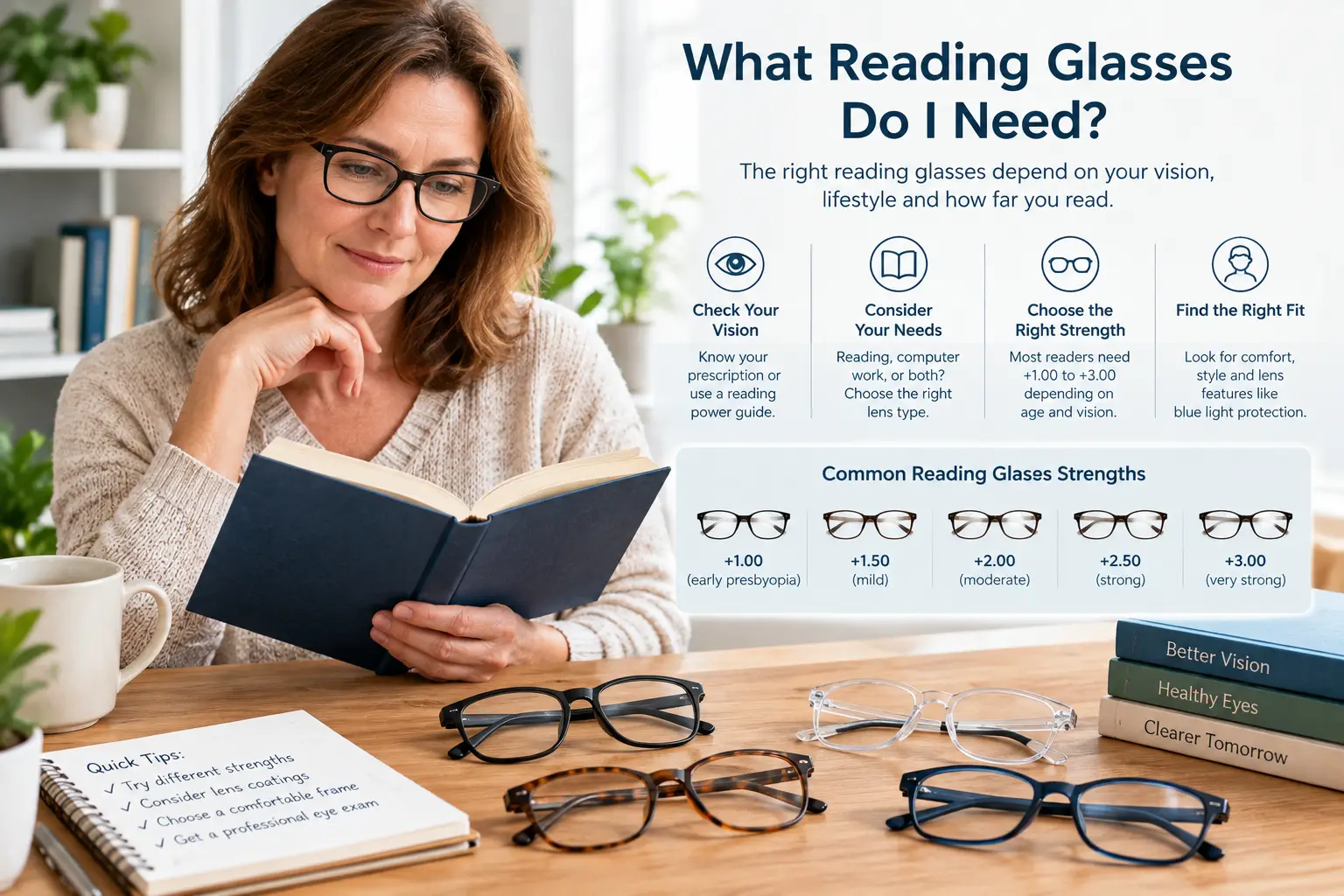
Here’s the reassuring part: this is almost always presbyopia, the normal, age-related stiffening of the eye’s natural lens. The American Academy of Ophthalmology explains that most people start noticing it shortly after 40, and that if presbyopia is your only vision issue, a simple pair of readers may be all you need. In other words, you don’t have to overthink it — but you do have to pick the right strength, because a +1.25 and a +2.50 feel like two completely different worlds.
The tricky part is that the drugstore rack and the Amazon search results both throw dozens of numbers, frame shapes, and buzzwords at you: blue light, multifocus, anti-fog, armless, premium acetate. Most of that matters far less than three things: the right diopter, the right type of lens for how you actually read, and a frame that stays comfortable for more than ten minutes.
So instead of guessing, this guide answers the question what reading glasses do i need step by step. You’ll get a reading glasses strength chart by age, a free 10-minute home test, seven real Amazon picks analyzed honestly (no fake reviews, no invented “I tested this” stories), and the red flags that tell you it’s time to see an eye doctor instead of buying another pair.
Quick answer: what reading glasses do i need?
✅ Most adults need +1.00 to +1.50 in their early-to-mid 40s, +1.75 to +2.25 in their 50s, and +2.50 or higher after 60. Choose the lowest strength that lets you read comfortably at your usual distance, and get a comprehensive eye exam to rule out other problems.
Quick Comparison: 7 Reading Glasses Worth Your Money in 2026
Before we dig into strengths and testing, here’s the at-a-glance view of the seven pairs analyzed in this guide. Prices are approximate ranges at the time of writing — always check the current price on Amazon, since readers are repriced constantly.
| Product | Lens type | Standout trait | Approx. price | Best for |
|---|---|---|---|---|
| Foster Grant Men’s Tatum 2-Pack | Single-vision | Two pairs, classic rectangle | $15–$25 | Foster Grant Men’s Tatum 2-Pack: first-time buyers who want a spare |
| Gaoye Blue Light Reading Glasses Value Pack | Single-vision, blue-light tint | Multi-pair value pack | Under $25 | Gaoye Blue Light Reading Glasses Value Pack: stashing pairs in every room |
| ThinOptics Readers + Pod Case | Single-vision, armless | Sticks to your phone | $20–$40 | ThinOptics Readers + Pod Case: menus, receipts, quick glances |
| Foster Grant Sawyer Multi Focus | Progressive (3 zones) | Reading + screen + room in one lens | $25–$40 | Foster Grant Sawyer Multi Focus: desk workers juggling screen and paper |
| Foster Grant Joey Anti-Fog Blue Light | Single-vision, anti-fog | Fog-resistant coating | $20–$35 | Foster Grant Joey Anti-Fog Blue Light: kitchens, masks, cold mornings |
| Peepers Nature Walk Soft Square | Single-vision, blue-light options | Fashion-forward frames | $25–$45 | Peepers Nature Walk Soft Square: style-first readers |
| eyebobs Biff | Single-vision (narrow & wide fits) | Premium acetate, sized by face | $80–$100 | eyebobs Biff: all-day comfort and durability |
Looking at the table, the real split isn’t price — it’s how you read. If you only need help with print for short bursts, the budget single-vision pairs (Foster Grant Men’s Tatum 2-Pack, Gaoye Blue Light Reading Glasses Value Pack) are hard to beat. If you bounce between a monitor and paperwork all day, the Foster Grant Sawyer Multi Focus solves a problem that no single-vision reader can, while the eyebobs Biff costs roughly four times more mainly because of frame materials and fit, not stronger optics.
💬 One click helps other shoppers make an informed choice too! 😊
Top 7 Reading Glasses: Expert Analysis for Every Strength and Budget
Every pick below is a real product listed on amazon.com. The commentary is based on comparing published specs, Amazon’s own listing badges, and aggregated customer feedback from cited review sources — not on invented hands-on tests. Where review data couldn’t be verified, we say so.
1. Foster Grant Men’s Tatum 2-Pack — easiest low-risk first pair
If you’re still asking yourself what reading glasses do i need, a two-pack from the biggest name in drugstore readers is the lowest-stakes way to find out. The Foster Grant Men’s Tatum 2-Pack gives you two classic rectangular frames in one strength, which in practice means one pair lives by the bed and one goes in the car or desk drawer — the single best habit for people who constantly misplace readers.
The rectangle shape is the safest bet for most face types and keeps a wide reading area at the bottom of the lens, where your eyes naturally drop when you look at a book. Based on comparing it with single-pair Foster Grant models, you’re trading premium frame materials for convenience and redundancy, which is exactly the right trade when you’re still dialing in your strength.
On verifiable signals: at the time of research, Amazon flagged this two-pack as an Amazon’s Choice “Overall Pick,” a badge Amazon reserves for items rated 4+ stars, purchased often, and returned infrequently. We couldn’t independently verify detailed sentiment beyond that badge.
Pros:
- ✅ Two identical pairs reduce the “where are my glasses” hunt
- ✅ Classic rectangle shape suits most faces
- ✅ Low return rate signaled by Amazon’s Overall Pick badge
Cons:
- ❌ Basic frame materials, not built for heavy daily abuse
- ❌ Both pairs share one strength, so mixing is impossible
💲 Typically around $15–$25 for the pair — excellent value for testing your strength without commitment.
2. Gaoye Blue Light Reading Glasses Value Pack — most pairs per dollar
The Gaoye Blue Light Reading Glasses Value Pack is built around one idea: put readers everywhere. Sold in strengths such as +1.0 and +1.5 and marketed as “professional” computer readers with blue-light protection, it’s the kind of multipack you scatter across the kitchen, nightstand, office, and glovebox.
What the listing doesn’t tell you is that blue-light filtering is not a medical benefit — the American Academy of Ophthalmology does not recommend blue-light glasses for eye strain (more on that below). So treat the tint as neutral, and judge this pack purely on magnification and quantity. For budget-conscious buyers or anyone who sits, reads, and forgets, that’s a perfectly rational purchase.
Verifiable signal: Amazon labeled Gaoye readers a “Best Seller in Reading Glasses” at the time of research. Detailed, independently aggregated review sentiment wasn’t available to us, so weigh the badge as a popularity signal, not a quality guarantee.
Pros:
- ✅ Multiple pairs for the price of one name-brand reader
- ✅ Ideal for testing two nearby strengths around the house
- ✅ Best Seller badge shows strong buyer demand
Cons:
- ❌ Blue-light claim adds little proven eye-health value
- ❌ Lesser-known brand with limited published quality data
💲 Usually under $25 for the pack — the best per-pair value on this list if you need quantity.
3. ThinOptics Readers + Pod Case — always in your pocket
The ThinOptics Readers + Pod Case answers a different question: not which strength, but where are they when I need them? These are armless, ultra-thin readers that clamp onto the bridge of your nose and slide into a slim case you can stick to your phone.
The key spec is the flexible Nitinol (nickel-titanium) bridge paired with polycarbonate lenses, offered in strengths from roughly +1.00 to +2.50. In practice, that means superb portability and impact-resistant lenses — but zero temple support, so the nose bridge does all the work. That’s great for a menu, a receipt, or a price tag; it’s tiring for a novel.
Aggregated feedback is consistent: reviewers on Trustpilot and long-running tech blogs praise the thinness and the case, while a recurring complaint is that the nose piece pinches during longer wear or breaks after months of use, and some buyers with smaller nose bridges report a poor fit.
Pros:
- ✅ Ultra-slim case rides on your phone or keys
- ✅ Polycarbonate lenses resist shattering
- ✅ Perfect backup for quick reading moments
Cons:
- ❌ Nose pinch makes long reading sessions uncomfortable
- ❌ Fit can be poor on small or low nose bridges
💲 Around $20–$40 depending on case style — great value as a second pair, poor value as your only pair.
4. Foster Grant Sawyer Multi Focus — one pair for screen and page
The Foster Grant Sawyer Multi Focus is a progressive reader: instead of one magnification, the lens blends three zones — Foster Grant describes them as reading, computer, and “interacting” distances. That solves the classic single-vision frustration of a crisp book and a blurry monitor.
Here’s what most buyers overlook: progressive readers assume your eyes are roughly balanced and that the zone heights line up with your pupils. When they do, the experience is seamless. When they don’t, you’ll find yourself tilting your head to hunt for the sharp spot. The reading power printed on the box is the strongest zone at the bottom, so order the same number you’d use for a book.
Aggregated reviews on Foster Grant’s Multi Focus line praise the value and the convenience of not swapping glasses, while a meaningful minority report an adjustment period, mixed clarity at the top of the lens, or even mild nausea with progressives in general.
Pros:
- ✅ Covers book, laptop, and room distances in one lens
- ✅ Far cheaper than prescription progressive lenses
- ✅ Cuts constant on-off swapping at a desk
Cons:
- ❌ Adjustment period; some wearers never adapt
- ❌ Narrower clear zones than single-vision readers
💲 Roughly $25–$40 — strong value if you work at a computer, overkill if you only read in bed.
5. Foster Grant Joey Anti-Fog Blue Light — clear lenses when steam hits
The Foster Grant Joey Anti-Fog Blue Light targets a surprisingly common annoyance: readers fogging up over a hot pot, a cup of coffee, or a face mask. Its round frame and anti-fog treatment are designed for exactly those moments.
On paper, anti-fog coatings work by spreading condensation into a thin, even film instead of tiny light-scattering droplets — which is why your view stays usable rather than milky. The trade-off is that coatings wear down over time, especially if you clean them with paper towels or harsh household sprays, so gentle cleaning matters more here than on uncoated readers.
We couldn’t verify a substantial body of model-specific reviews for the Joey at the time of writing, so we can’t summarize customer sentiment honestly. What is verifiable is that it belongs to Foster Grant’s established anti-fog blue-light line sold on Amazon.
Pros:
- ✅ Anti-fog coating helps in kitchens and cold weather
- ✅ Round frame offers a softer, modern look
- ✅ Backed by a long-established reader brand
Cons:
- ❌ Coatings degrade with rough cleaning
- ❌ Limited verified review data for this specific model
💲 Typically $20–$35 — fair value if fog is a daily problem for you.
6. Peepers Nature Walk Soft Square — readers you’ll actually want to wear
The Peepers Nature Walk Soft Square is for anyone who hates the idea that readers have to look like a drugstore afterthought. Peepers by PeeperSpecs leans hard into patterns, colors, and softer square shapes, and the brand markets blue-light options and sustainable materials.
Why does style matter for vision? Because the best reading glasses are the ones you actually put on. Plenty of people squint through menus rather than wear frames they find unflattering. A soft square works well on round and oval faces, and the slightly deeper lens gives you more vertical room for reading than ultra-narrow half-eyes.
We couldn’t verify detailed review sentiment specific to this model. Treat the Peepers name as a style-led choice, and check the listing’s current rating and lens-height measurement before buying.
Pros:
- ✅ Distinctive, fashion-forward frame designs
- ✅ Soft square shape flatters many face types
- ✅ Brand emphasizes sustainable materials
Cons:
- ❌ Pricier than plain readers with similar optics
- ❌ Model-specific review data is limited
💲 Around $25–$45 — reasonable if style is what gets you to wear them.
7. eyebobs Biff — premium fit for all-day wear
The eyebobs Biff sits at the top of this list on price because eyebobs builds readers more like prescription frames. The brand uses Italian-designed premium acetate, flexible spring hinges, and optical-quality lenses, and sells the Biff in narrow and wide fits, with strengths from 0.00 up to +4.00.
That sizing detail is the real story. Cheap readers come in one width, so they slide down small faces and squeeze wide ones. Choosing narrow vs wide means the lenses sit centered in front of your pupils, which matters for comfort during hours of reading. Acetate also holds adjustments better than thin injection-molded plastic.
Aggregated sentiment from review roundups praises eyebobs’ bold styling and durability, but Amazon review counts are small and mixed by model — one Biff Wide listing showed just under 4 stars from a couple dozen ratings at the time of research.
Pros:
- ✅ Narrow and wide fits for a properly centered lens
- ✅ Acetate frames and spring hinges built to last
- ✅ Wide strength range up to +4.00
Cons:
- ❌ Costs several times more than mass-market readers
- ❌ Smaller, mixed Amazon review base
💲 Usually $80–$100 — worth it only if you wear readers for hours every day.
🌟 Ready to Stop Squinting? Find Your Perfect Pair Today!
🔍 You now know what separates a $15 backup from a $90 all-day reader. Click a highlighted pick to check current pricing and available strengths — and enjoy menus, labels, and bedtime books in crisp focus again!
How to Find Your Strength at Home in 10 Minutes 🏠
If you want a practical answer to “what strength reading glasses do I need” before spending a dime, this home test gets you remarkably close. It mirrors the logic of the diopter cards on drugstore racks.
Step-by-step home test
- Measure your real reading distance. Sit the way you normally read and measure from your eyes to the page or phone. Most people land between 14 and 16 inches; desktop screens sit farther, around 20 to 26 inches.
- Print a reading glasses strength chart. Brands such as Foster Grant publish free printable diopter charts designed to be read at about 14 inches. Print at 100% scale — “fit to page” shrinks the text and skews results.
- Use good, even light. Daylight or a bright lamp behind your shoulder. Dim light makes everyone “need” a stronger lens.
- Read without glasses first. Find the smallest line you can read comfortably — not just barely.
- Note the diopter beside that line. That printed number (+1.25, +1.75, etc.) is your starting strength.
- Confirm with two strengths. If you can, try that strength and the one 0.25 below. Choose the weaker one if both feel comfortable.
- Do a 10-minute comfort check. Read a real page. Headaches, a pulling sensation, or text that only sharpens when you lean in are signs you’re over- or under-powered.
Common mistakes in the first 30 days
- ⚡ Buying the strongest pair “to be safe” — too much power shortens your clear range and can feel like a fishbowl.
- ⚡ Walking around in readers — single-vision readers blur everything beyond arm’s length, which is a real trip hazard on stairs.
- ⚡ Using your phone strength for your monitor — the screen is farther away and usually needs about 0.50 to 0.75 less power.
- ⚡ Skipping cleaning — smudges cost more clarity than a quarter-diopter mistake.
Real-World Scenarios: Which Reader Fits Your Life?
Numbers help, but your routine decides the winner. Here are three typical buyer profiles and the reasoning behind each match.
👩💼 Dana, 47, project manager — 8+ hours at a laptop
Dana’s books are fine at +1.25, but her monitor blurs whenever she wears them. A single-vision reader forces constant on-off swapping. The Foster Grant Sawyer Multi Focus in +1.25 is the logical first try, because the lower zones cover paperwork and the middle zone handles the screen. Budget: roughly $25–$40. If progressives make her dizzy after a two-week trial, she’d switch to a dedicated computer-distance pair about 0.50 weaker.
👨🍳 Mike, 55, home cook and weekend fisherman — reads labels, recipes, and tackle
Mike needs about +2.00, but only in short bursts, often in steamy kitchens or on a windy dock. The Foster Grant Joey Anti-Fog Blue Light suits the stove, while the ThinOptics Readers + Pod Case stays on his phone for the boat. Total spend: roughly $40–$75 for two highly specialized tools instead of one compromise.
👵 Linda, 66, avid reader — two novels a week
At +2.50 and reading for hours daily, comfort trumps everything. The eyebobs Biff in a narrow fit keeps the optical center aligned with her eyes, and acetate frames hold their shape through years of daily use. She keeps a Gaoye Blue Light Reading Glasses Value Pack as backups around the house. Annual cost averages out lower than repeatedly replacing broken cheap pairs.
Problem → Solution: Fixing the Most Common Reader Frustrations 🔧
Even the right strength can feel wrong if something else is off. These are the complaints readers mention most, with fixes that don’t require a new purchase every time.
Problem 1: Headaches after 20 minutes. ✅ Solution: You’re likely over-powered or holding text too close. Drop 0.25 diopter, or move the page back an inch or two. If headaches persist with any strength, book an eye exam — this is a classic sign of uneven eyes or uncorrected astigmatism.
Problem 2: The book is sharp, but the laptop is blurry. ✅ Solution: Different distances need different powers. Add a second, weaker pair for screens, or try a progressive like the Foster Grant Sawyer Multi Focus.
Problem 3: Readers keep sliding down your nose. ✅ Solution: The frame is too wide for your face. Look for sized fits like the narrow eyebobs Biff, or frames with adjustable nose pads.
Problem 4: One eye sees clearly, the other doesn’t. ✅ Solution: Off-the-shelf readers use the same power in both lenses. A noticeable difference between eyes means you need a prescription, not a stronger reader.
Problem 5: Lenses fog when you cook or wear a mask. ✅ Solution: Choose an anti-fog lens like the Foster Grant Joey Anti-Fog Blue Light, and clean it with lens spray and microfiber — never paper towels.
Reading Glasses Strength by Age: The Chart Most Guides Oversimplify 📊
Age is the single best predictor of where to start, because presbyopia progresses on a fairly predictable curve. The reading glasses strength by age chart below combines ranges published by optical retailers and health resources; treat it as a starting point, not a prescription.
| Age | Typical starting strength | What it usually feels like | Best for |
|---|---|---|---|
| 40–44 | +0.75 to +1.25 | Menus and phone text need more light | Light readers, a Foster Grant Men’s Tatum 2-Pack test run |
| 45–49 | +1.25 to +1.75 | Arm’s-length reading becomes a habit | Books, newspapers, basic screen work |
| 50–59 | +1.75 to +2.25 | Fine print is hard without help | Daily reading, a Foster Grant Sawyer Multi Focus for desks |
| 60+ | +2.50 to +3.00 and up | Close focus largely gone | Long reading sessions, the eyebobs Biff for comfort |
The chart’s biggest blind spot is your existing eyesight. Someone who is mildly farsighted may need more than their age column suggests, while someone mildly nearsighted may need less — or read fine by just taking their distance glasses off. That’s why two 50-year-olds can need very different readers, and why the at-home test above beats the chart on its own.
How to Choose: what reading glasses do i need in 7 Steps
When people ask how to choose reading glasses, the answer comes down to a short, ordered checklist. The AAO’s eyeglasses guide notes that readers are single-vision lenses you can buy over the counter, and that you’ll likely need to update your strength as your lens keeps stiffening between 40 and 60.
- Confirm it’s presbyopia only. If distance vision is also blurry, or one eye is clearly worse, see an eye doctor first.
- Find your strength. Use the age chart as a starting point, then refine it with the printable chart test.
- Match strength to distance. Books and phones need full power; monitors usually need 0.50–0.75 less.
- Pick a lens type. Single-vision for reading only, progressive for mixed distances, half-eyes for glancing over the top.
- Check fit numbers. Lens width, bridge, and temple length (in millimeters) matter more than the photo.
- Prioritize comfort features. Spring hinges, light weight, and a frame wide enough for your face.
- Buy a backup. A cheap second pair prevents the “forgot my glasses” squint.
Common Mistakes to Avoid When Buying Reading Glasses ❌
Most bad reader purchases aren’t caused by bad products — they’re caused by a mismatch between the product and the person. These are the pitfalls worth avoiding.
Mistake 1: Treating readers as a substitute for an eye exam. Readers fix focusing, not disease. The AAO recommends a baseline comprehensive eye exam by age 40, because conditions like glaucoma can start silently in midlife.
Mistake 2: Choosing by frame, then accepting whatever strength is in stock. It’s tempting to grab the pair that looks best and “make it work.” Strength comes first; style is the tiebreaker.
Mistake 3: Assuming stronger is safer. Over-powered readers force you to hold text unnaturally close and shrink your sharp zone.
Mistake 4: Ignoring lens height. Very short lenses look sleek but leave less room to drop your eyes for reading.
Mistake 5: Using one pair for everything. A single +2.00 can’t serve a book, a laptop, and a car dashboard. Two inexpensive pairs at different strengths often beat one expensive compromise.
Mistake 6: Never re-checking. Many people move up a step every few years until about 60, when presbyopia tends to stabilize.
OTC Readers vs Progressive Readers vs Prescription Glasses
The question isn’t only what strength you need — it’s whether off-the-shelf readers are the right category at all. Here’s how the three main options compare.
| Option | Corrects | Typical cost | Main limitation | Best for |
|---|---|---|---|---|
| Single-vision OTC readers | Near vision only, same power both eyes | Under $25 to around $100 | Blurs distance; no astigmatism correction | Balanced eyes, reading-only tasks — e.g., Foster Grant Men’s Tatum 2-Pack |
| OTC progressive readers | Near + intermediate | Around $25–$60 | Fixed zone heights; adaptation period | Desk workers — e.g., Foster Grant Sawyer Multi Focus |
| Prescription glasses | Distance, near, astigmatism, unequal eyes | Often several hundred dollars | Exam and higher cost | Anyone with uneven eyes or distance blur |
The takeaway: OTC readers win on price and convenience only when your two eyes need roughly the same correction and nothing else is going on. As the AAO points out, OTC glasses can’t handle nearsightedness or astigmatism because those prescriptions vary too much from person to person. If either applies to you, a prescription isn’t a luxury — it’s the only option that actually works.
Features That Actually Matter (and Ones That Don’t)
Marketing copy on reader listings is loud. Here’s the honest cut.
✅ Features that matter
- Correct diopter — everything else is secondary.
- Frame width that fits your face — keeps the optical center in front of your pupils.
- Spring hinges — absorb the constant on-off and extend frame life.
- Polycarbonate or quality acrylic lenses — impact resistance and clarity.
- Adequate lens height — more vertical room for reading.
🤔 Features that matter less than you think
Blue-light filtering is the big one. The American Academy of Ophthalmology states that there’s no scientific evidence screen light damages the eyes, and it does not recommend blue-light-blocking glasses for computer use; several studies found they don’t improve digital eye strain. Screen discomfort mostly comes from blinking less, so the 20-20-20 rule (every 20 minutes, look 20 feet away for 20 seconds) helps more than any tint. That doesn’t make blue-light readers bad — just don’t pay extra expecting medical protection.
Anti-fog coatings, by contrast, solve a real, situational problem. Lighted readers and fold-flat designs are niche conveniences: great if they match your life, irrelevant otherwise.
Reading Glasses for Heavy Screen Users 💻
If you spend most of your day at a computer, the classic advice — “just get readers” — often backfires. Here’s why: most people read books at about 14–16 inches, but monitors sit at 20–26 inches. A pair tuned for print will make your screen look soft and push you to lean in, which is how neck and shoulder strain sneak up on you.
There are three good strategies:
- A dedicated computer pair. Take your book strength and subtract roughly 0.50 to 0.75. A Gaoye Blue Light Reading Glasses Value Pack in a lower strength works as an inexpensive desk-only pair.
- Progressive readers. The Foster Grant Sawyer Multi Focus blends reading and screen zones so you don’t swap glasses all day.
- Prescription office lenses. If you also need distance correction, an eye doctor can prescribe lenses optimized for intermediate and near work.
Whichever route you choose, raise your monitor so the top line sits at or slightly below eye level, and keep lighting even to avoid glare.
Safety, Regulations, and Standards You Should Know ⚖️
Reading glasses look simple, but in the U.S. they are regulated medical devices. Under federal rules, the FDA requires that eyeglass and sunglass lenses be impact resistant: 21 CFR 801.410 describes the “drop ball” test, in which a 5/8-inch steel ball is dropped from 50 inches onto the lens. Manufacturers of non-prescription lenses must test a statistically significant sample from each production batch.
What does that mean for you? Readers from established sellers on amazon.com should meet this baseline — but “impact resistant” is not “shatterproof.” Readers are not safety glasses, so don’t use them for power tools, yard work, or sports. If you need magnification for workshop tasks, look for safety-rated eyewear with built-in reading segments.
Two other safety notes matter more than most shoppers realize:
- Never drive or walk stairs in full-lens readers. Distance blur is intentional, not a defect.
- Sudden vision changes are not a reader problem. Flashes, floaters, double vision, a curtain over your sight, or rapid strength changes need prompt medical attention.
Long-Term Cost and Maintenance: What Readers Really Cost Over 5 Years
The sticker price is only part of the story. Since most people go up a strength every few years and lose or break pairs along the way, a five-year view is more realistic.
| Strategy | Typical 5-year spend | What you get | Best for |
|---|---|---|---|
| Budget multipacks | Roughly $40–$80 | Many pairs, easy replacements | Gaoye Blue Light Reading Glasses Value Pack households |
| Mid-range single pairs | Roughly $60–$120 | Better frames, a few strength updates | Foster Grant Sawyer Multi Focus desk users |
| Premium readers | Roughly $160–$300 | Durable acetate, refit-friendly | eyebobs Biff all-day readers |
The math surprises people: premium readers only pay off if you actually keep them. If you lose glasses regularly, cheap multipacks win by a mile. If you read for hours daily and baby your gear, the eyebobs Biff can cost less per hour of comfortable reading than a string of broken bargain pairs.
Simple maintenance routine
- Rinse lenses with lukewarm water before wiping, so grit doesn’t scratch.
- Use lens spray and a microfiber cloth — never paper towels or your shirt.
- Store them in a case, lenses up, away from car dashboards and hot windowsills.
- Tighten loose hinge screws every few months with an eyeglass screwdriver.
FAQ: What reading glasses do i need?
❓ Can I buy reading glasses on Amazon without a prescription?
❓ Is +1.25 or +1.50 better for a first pair?
❓ Are cheap reading glasses as good as expensive ones?
❓ Should I buy progressive readers or two separate pairs?
❓ What reading glasses do i need for a computer screen?
Conclusion: Your Clear-Vision Game Plan
So, what reading glasses do i need? For most people, the honest answer is simpler than the shopping results suggest: start with the strength your age and the printable chart point to, choose the lowest power that feels comfortable at your real reading distance, and match the lens type to how you actually spend your day.
If you’re new to readers, a low-risk two-pack like the Foster Grant Men’s Tatum 2-Pack or a multipack like the Gaoye Blue Light Reading Glasses Value Pack lets you experiment without regret. If screens rule your life, the Foster Grant Sawyer Multi Focus is the smartest single upgrade. For grab-and-go moments, the ThinOptics Readers + Pod Case rides along on your phone; for steamy kitchens, the Foster Grant Joey Anti-Fog Blue Light keeps things clear; for style, the Peepers Nature Walk Soft Square makes readers fun; and for hours of daily reading, the eyebobs Biff earns its premium through fit and durability.
Just remember the one rule no product can replace: readers correct focusing, not eye disease. Pair your new glasses with a comprehensive eye exam, especially if one eye differs from the other or your distance vision is blurry too. Do that, and you’ll be back to effortless menus, labels, and late-night chapters in no time. 📖
🚀 Take the Next Step Toward Effortless Reading!
✨ Don’t settle for squinting another day. Click any highlighted pick above to check current pricing, available strengths, and frame sizes — and give your eyes the comfortable, crisp focus they deserve!
Recommended for You
- Purple Prescription Contacts: 7 Stunning Picks for 2026
- Best Online Progressive Eyeglasses: 7 Top Picks for 2026
- Night Sunglasses for Driving: 7 Smart Picks + 1 Hard Truth (2026)
Disclaimer: This post contains affiliate links. As an Amazon Associate, I earn from qualifying purchases made through these links, at no additional cost to you. This article is for general information only and is not medical advice; consult an eye care professional about your vision.
✨ Found this article helpful? Share it with someone who needs it! 💬🤗