
In This Article
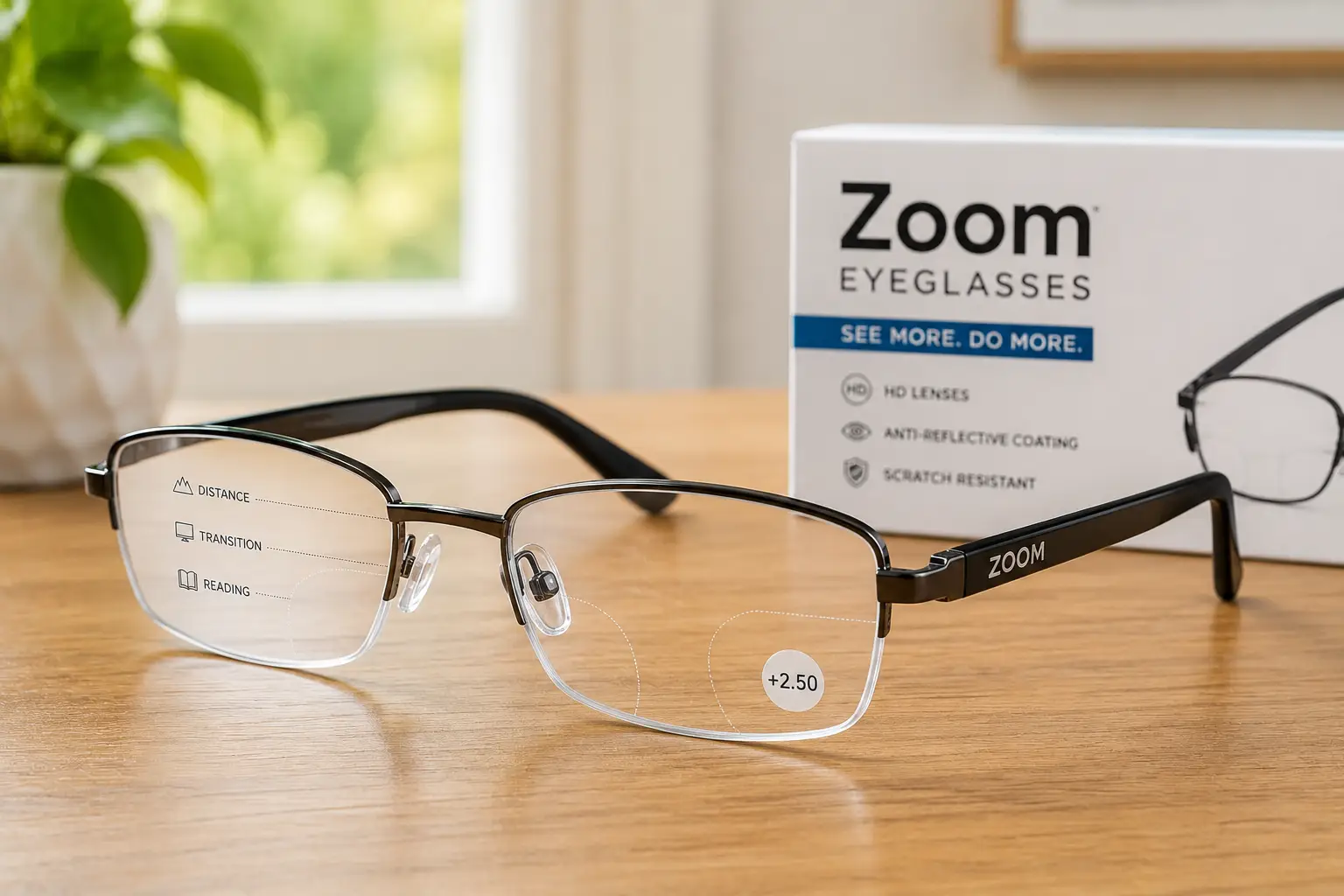
If you’ve ever dug through three different pairs of readers looking for the one that doesn’t blur your phone screen, zoom eyeglasses were built for exactly that headache. Zoom eyeglasses are non-prescription glasses with a lens mechanism — usually a side dial — that lets you change the magnification power yourself, instead of being locked into one fixed strength. Turn the dial, and the same pair can shift from light reading strength to a stronger setting for fine print, all without a trip to the optometrist.
That single feature is why searches for zoom eyeglasses, dial vision glasses, and adjustable focus reading glasses have climbed steadily as more people manage presbyopia — the natural, age-related loss of near-focus ability that the American Academy of Ophthalmology explains affects nearly everyone eventually. For a lot of buyers, one adjustable pair genuinely does replace three or four fixed-power readers scattered around the house, car, and office.
We’re not going to pretend every pair of zoom eyeglasses performs identically, though. Below, you’ll find a real, sourced comparison of seven models actually sold in the US on Amazon — from budget dial-vision readers under $20 to the more refined SlideLens design from Eyejusters — along with honest analysis of who each one fits, what the aggregated customer feedback says, and where a fixed-power pair might still serve you better. This article contains affiliate links; as an Amazon Associate, purchases made through them may earn a small commission at no extra cost to you.
Quick Comparison: 7 Zoom Eyeglasses at a Glance
| Zoom Eyeglasses | Adjustment Range | Price Range | Best For |
|---|---|---|---|
| Eyejusters Self-Adjustable Glasses (Stainless Steel) | +0.50D to +4.00D | $100–$120 | Durability and daily all-day wear |
| Eyejusters Self-Adjustable Glasses (Oxford Edition) | +0.50D to +4.00D | $85–$95 | Balanced comfort and lens precision |
| Vepiant Flex Focal Adjustable Glasses | 0D to +3.50D | Under $20 | First-time budget buyers |
| YIMI Flex Focal Adjustable Glasses | 0D to +3.50D | $15–$20 | Simple backup pair |
| Ouolipraa Flex Focal Adjustable Glasses | 0D to +4.00D | $20–$30 | Widest budget-tier range |
| AQOYNQ Auto Focus Glasses (2-Pack) | 0D to +3.50D | $20–$30 | Households that need two pairs |
| AOLEKS Adjustable Focus Reading Glasses | 0D to +3.50D | Under $20 | Screen work with blue-light filtering |
Looking at this table, the split is pretty clean: Eyejusters Self-Adjustable Glasses (Stainless Steel) and Eyejusters Self-Adjustable Glasses (Oxford Edition) use a different, patented SlideLens mechanism with independently tunable lenses, which is why they sit at a noticeably higher price than the dial-vision competitors. The remaining five all use variations of the same rotating-dial “flex focal” design common on Amazon, so the real differentiators between them come down to diopter range, blue-light coating, and build quality rather than the underlying technology. If you only remember one thing from this table, remember that a wider diopter range (like the Ouolipraa Flex Focal Adjustable Glasses‘ 0D to +4.00D spread) matters most if your near-vision needs have changed a lot recently or vary by task.
💬 Ready to stop juggling readers? Compare current pricing on today’s top pick below.
Top 7 Zoom Eyeglasses: Expert Analysis
1. Eyejusters Self-Adjustable Glasses (Stainless Steel) — most durable frame in this lineup
If you’re hard on your glasses — tossing them in a bag, sitting on them, leaving them on a dashboard — the stainless steel frame is the reason to pick this pair over the plastic Oxford Edition.
Eyejusters uses what the company calls SlideLens technology: two overlapping lens elements slide against each other when you turn a hidden dial, shifting the effective power from +0.50D to +4.00D. Each eye adjusts independently, which matters in practice because it’s common to have slightly different near-vision needs in each eye — something a one-size-fits-both-eyes dial pair simply can’t accommodate. The stainless steel construction also means the hinges hold their tension far longer than the flexible plastic arms on budget dial glasses.
Who it’s for: people who want one adjustable pair to survive years of daily use, and who don’t mind paying a premium for it. Reviewers and independent write-ups (including a hands-on piece from Core77) consistently describe the dial adjustment as smooth and genuinely functional rather than gimmicky, though a few note the “sealed dial” mechanism takes a minute to locate the first time. Reviews consistently report strong satisfaction with focus precision but a smaller number mention the price is hard to justify if you only need readers occasionally.
Pros:
- ✅ Independently adjustable lenses for each eye
- ✅ Stainless steel frame resists bending over time
- ✅ Anti-scratch coated lenses hold up to daily handling
Cons:
- ❌ Costs several times more than dial-vision alternatives
- ❌ Not suitable for distance vision or driving
In the $100 to $120 range at the time of writing, this is the priciest pick here — but for buyers who wear readers most of the day, the value math often works out over a couple of years of avoiding replacement readers.
2. Eyejusters Self-Adjustable Glasses (Oxford Edition) — lightest premium option
The Oxford Edition trades the steel frame for optician-grade plastic, and the weight difference is immediately noticeable if you wear glasses for hours at a stretch.
It shares the same +0.50D to +4.00D SlideLens range and independent per-eye adjustment as the stainless steel version, so the core “dial in your exact strength” experience doesn’t change — what you’re paying for here is frame material and finish. Spring hinges let the arms flex slightly rather than snapping, which reduces stress on the frame when you take the glasses on and off one-handed, a small detail that matters more than it sounds like once you’re doing it dozens of times a day.
Who it’s for: buyers who want Eyejusters’ precision but prioritize all-day comfort and a lower weight over maximum ruggedness. Aggregated customer sentiment across retailer reviews frequently praises how “invisible” the dials are once set, with a common complaint in customer reviews being that the plastic frame shows scuffs more visibly than the steel edition after months of use.
Pros:
- ✅ Noticeably lighter than the steel frame version
- ✅ Same precise, independently adjustable lens power
- ✅ Spring hinges reduce everyday wear on the frame
Cons:
- ❌ Plastic frame shows cosmetic wear faster than steel
- ❌ Premium price compared to dial-vision readers
Expect to pay around $85 to $95 at the time of writing — a meaningful step down from the steel edition while keeping the same lens technology, which makes this the better value pick between the two Eyejusters options for most people.
3. Vepiant Flex Focal Adjustable Glasses — best entry point for first-time buyers
For someone who’s never tried adjustable-focus glasses and doesn’t want to spend $90 to find out if they even like the concept, this is the low-risk way in.
This model uses the more common rotating-dial mechanism found across most budget zoom eyeglasses: a discreet knob on each temple arm slides the lens elements to change power from 0D up to +3.50D. What that range means in practice is you can dial down to almost no correction for casual glancing at a phone and dial up toward the top end for genuinely small print, all on the same pair. The frame is a lightweight resin, which keeps the glasses comfortable but also means they flex more than the Eyejusters’ options under repeated adjustment.
Who it’s for: presbyopia beginners in their 40s who need mild correction and want to test whether adjustable glasses fit their routine before committing to a pricier pair. Reviews consistently report that the dial mechanism is easy to learn within the first few uses, though a common complaint in customer reviews is that the resin frame feels less premium than drugstore reading glasses at a similar price.
Pros:
- ✅ Low price makes it a low-risk first try
- ✅ Simple, learnable dial adjustment on each side
- ✅ Lightweight resin frame is comfortable for hours
Cons:
- ❌ Frame material feels less substantial than pricier options
- ❌ Maximum +3.50D power may not suit stronger prescriptions
At under $20 at the time of writing, the value-for-money case here is straightforward: it’s a legitimate way to sample the zoom-eyeglasses category without a big financial commitment.
4. YIMI Flex Focal Adjustable Glasses — simplest backup pair for the house
Every household with a presbyopic reader eventually loses a pair of glasses in the couch cushions. This one is priced to be the backup you don’t feel bad about misplacing.
Mechanically, it’s close to the Vepiant model — a hidden dial on each temple arm adjusts lens power across a comparable 0D to roughly +3.50D range, letting each eye be tuned individually. The nose pads are shaped specifically to reduce pressure points, which matters more than it sounds like for anyone who’s ever had a pair of cheap readers leave marks on the bridge of their nose after a long reading session. Frame arms are flexible plastic designed to resist snapping under mild stress, a detail aimed squarely at the “sat on my glasses” scenario.
Who it’s for: buyers stocking a second, third, or fourth pair for the car, nightstand, or office desk rather than a single everyday pair. Aggregated review sentiment tends to be positive on comfort and value, with a common complaint in customer reviews being that the dial requires a firmer touch than some buyers expect from watching online demos.
Pros:
- ✅ Comfortable, low-pressure nose pad design
- ✅ Flexible arms resist breaking under light stress
- ✅ Priced well for buying multiple backup pairs
Cons:
- ❌ Dial adjustment needs a firmer touch than some expect
- ❌ Limited color and frame-style options
In the $15 to $20 range at the time of writing, this is one of the cheapest ways to keep a spare adjustable pair in every room without overspending.
5. Ouolipraa Flex Focal Adjustable Glasses — widest adjustment range in the budget tier
If your near-vision needs have shifted noticeably in the past year or two — a common presbyopia pattern — this model’s wider dial range gives you more room to grow into without replacing the glasses.
Where most budget dial-vision glasses top out around +3.50D, this model extends to +4.00D, matching the ceiling of the pricier Eyejusters models while keeping the simpler rotating-dial mechanism. In practical terms, that extra half-diopter of headroom is meaningful for buyers whose presbyopia is progressing, since it means one pair can keep pace with a changing prescription for longer before you need to size up. Each lens adjusts independently, following the same left/right dial pattern as the other flex-focal models in this list.
Who it’s for: buyers in their late 40s to 50s whose near-vision correction needs are still increasing and who want a single pair with room to adjust upward over time. Reviews consistently report satisfaction with the extended range, while a smaller number of reviewers note the dials sit slightly more exposed than on some competing designs, which can lead to accidental bumps.
Pros:
- ✅ Extended +4.00D ceiling matches premium options
- ✅ Independent left/right adjustment for each eye
- ✅ Good fit for progressing presbyopia over time
Cons:
- ❌ Dials are more exposed and can shift if bumped
- ❌ Frame styling is limited to a few basic looks
Priced between $20 and $30 at the time of writing, it’s a smart middle ground for anyone who wants Eyejusters-level range without the Eyejusters-level price tag.
6. AQOYNQ Auto Focus Glasses (2-Pack) — best for households that need two pairs
Two adults in the same house, both needing readers, rarely need the exact same strength — and this two-pack format solves that math directly instead of forcing you to buy two separate single listings.
Each pair in the set uses the standard rotating-dial adjustment from 0D up to roughly +3.50D, and both pairs include a blue-light-filtering coating aimed at reducing digital eye strain from phone and computer screens. That coating won’t eliminate screen fatigue on its own, but combined with regular breaks it’s a genuinely useful add-on for anyone who reads primarily on backlit devices rather than paper. The gray colorway keeps both pairs neutral enough that they don’t look mismatched sitting side by side on a kitchen counter.
Who it’s for: couples, roommates, or multi-generational households where more than one person needs adjustable readers and wants to split a single order. A common complaint in customer reviews is that the blue-light tint is faint enough that some buyers wonder if it’s doing anything at all, while praise tends to focus on the value of getting two working pairs for one moderate price.
Pros:
- ✅ Two working pairs for one household order
- ✅ Blue-light coating aimed at screen-heavy days
- ✅ Neutral gray frame suits most face shapes
Cons:
- ❌ Blue-light effect is subtle, not dramatic
- ❌ Both pairs share the same limited style
Expect to pay between $20 and $30 for the full two-pack at the time of writing, which works out to a genuinely strong per-pair cost if you need multiples anyway.
7. AOLEKS Adjustable Focus Reading Glasses — best for screen-first daily use
If most of your near-vision strain comes from a laptop or phone rather than paper books, this is the pick built with that specific use case in mind.
The dial mechanism mirrors the other budget entries here — 0D to roughly +3.50D, adjusted independently per eye — but AOLEKS pairs it with an anti-blue-light lens coating as a standard feature rather than an upsell, which keeps the price competitive with non-coated alternatives. In practice, that means you’re not paying extra to get screen-friendly glasses; it’s baked into the base price. The frame uses a fairly standard rectangular shape that reads as more “regular glasses” and less “obviously adjustable,” which some buyers specifically look for.
Who it’s for: remote workers, students, and anyone whose near-vision demands are mostly digital-screen-based rather than print-based. Reviews consistently report that the blue-light coating pairs well with the adjustable power for reducing end-of-day eye fatigue, though a common complaint in customer reviews is that the strongest +3.50D setting can feel like it’s near the edge of the lens’s clearest focal zone for some wearers.
Pros:
- ✅ Blue-light coating included at no extra cost
- ✅ Understated frame style looks like regular glasses
- ✅ Good match for screen-heavy daily routines
Cons:
- ❌ Top-end +3.50D setting isn’t as sharp as mid-range settings
- ❌ Doesn’t include a hard protective case
At under $20 at the time of writing, this is one of the better value picks specifically for people whose near-vision fatigue comes from screens rather than printed pages.
Getting Started: Adjusting and Caring for Your Zoom Eyeglasses
The single biggest mistake new buyers make with zoom eyeglasses is dialing the power up too far, too fast. Start at the lowest setting and increase gradually while looking at your actual target text — not a wall or empty page — since the “right” strength is the one where your specific reading material looks sharp without eye strain, not the highest number the dial offers.
Adjust one eye at a time on models with independent dials, closing the opposite eye while you tune each side; this avoids your brain compensating for one blurry lens by leaning on the other, which is a common reason people think their zoom eyeglasses “don’t work” when really only one side is properly calibrated. Re-check your setting every few months, especially in the first year of wearing adjustable glasses, since presbyopia typically progresses gradually and your ideal dial position may creep upward over time.
For care, treat the dial mechanism gently — it’s a moving part, and forcing it past its stop point is the most common cause of early failure. Store zoom eyeglasses in a hard case rather than a pocket or bag when not in use, since the exposed dials on budget flex-focal models are more vulnerable to snagging or shifting than a sealed fixed-power lens. Clean lenses with a microfiber cloth and lens spray rather than tissue or clothing, which can introduce fine scratches over months of daily wiping — a detail that matters more on adjustable lenses, since their moving optical elements sit closer to the surface than a standard single-piece lens.
Real-World Scenarios: Who Should Buy Which Zoom Eyeglasses
Not every zoom eyeglasses buyer has the same routine, so matching the product to the use case matters more than chasing the “best” pair in the abstract.
Consider a 46-year-old office worker who just started noticing blurry text on spreadsheets but still reads paperbacks fine at night. Their presbyopia is mild and screen-focused, which points toward the AOLEKS Adjustable Focus Reading Glasses — the built-in blue-light coating and lower price fit someone who isn’t ready to invest heavily in something they may only need part-time.
Compare that to a 58-year-old retiree who reads for hours daily, has stronger correction needs, and wants one durable pair rather than a drawer of readers. The wider range and steel build of the Eyejusters Self-Adjustable Glasses (Stainless Steel) suit that frequency and durability requirement, even at a higher price, because the cost amortizes over years of near-daily use.
And picture a household with two adults in their 50s, both needing readers but at different strengths, on a tight budget. The AQOYNQ Auto Focus Glasses (2-Pack) solves that directly — two adjustable pairs, one order, each person dialing in their own setting — without paying twice for two separate single-pair listings.
How to Choose Zoom Eyeglasses
- Confirm it’s presbyopia, not something else. Blurry near vision can also signal early cataracts or other conditions, so a baseline eye exam is worth doing before you rely on over-the-counter adjustable glasses long-term.
- Check the diopter range against your likely needs. If your prescription need is still increasing, favor a wider range like the +4.00D ceiling on the Ouolipraa Flex Focal Adjustable Glasses rather than a pair that tops out lower.
- Decide if independent per-eye adjustment matters to you. Most people have slightly uneven vision between eyes, so models that tune each lens separately — which is every pair in this list — generally fit better than a single shared dial.
- Weigh frame material against your handling habits. If you’re rough on glasses, a steel frame outlasts flexible resin; if weight matters more, lightweight plastic wins.
- Consider whether blue-light filtering is worth it for you. It’s most useful for screen-heavy routines and adds little value if your near-vision demands are mostly print-based.
- Set a realistic budget band. Budget dial-vision pairs cover casual and backup use well; the higher SlideLens-style options make more sense for daily, all-day wear.
- Read the aggregated reviews for your shortlist, not just the star rating. A 4.3-star average with dozens of comments about the dial being stiff tells you more than the number alone.
Common Mistakes to Avoid When Buying Zoom Eyeglasses
The most frequent mistake is treating zoom eyeglasses as a replacement for an eye exam rather than a convenience upgrade to correction you already know you need. Adjustable glasses are excellent for presbyopia specifically; they are not a diagnostic tool, and the American Optometric Association notes that presbyopia can complicate or mask other vision conditions that a comprehensive exam would catch.
A second common error is buying based on the highest advertised diopter number rather than the number you’ll actually use. Most first-time buyers land somewhere between +1.00D and +2.50D, so a pair advertised at “up to +4.00D” isn’t automatically the better fit if your real need is mild.
Third, buyers often skip the fine print on distance-vision limitations. None of the products in this list — and no zoom eyeglasses currently sold as OTC readers — are appropriate for driving or correcting distance nearsightedness or farsightedness; they’re built for near work only.
Finally, plenty of buyers assume a lower price always means lower quality, and skip genuinely good budget options like the Vepiant Flex Focal Adjustable Glasses as a result. In this category, price differences mostly reflect frame material and mechanism refinement, not whether the core adjustable-focus concept works.
Zoom Eyeglasses vs. Traditional Reading Glasses
| Factor | Zoom Eyeglasses | Traditional Fixed-Power Readers |
|---|---|---|
| Number of pairs needed | Often just one | Frequently two or more strengths |
| Adjusting to changing eyesight | Turn the dial | Buy a new pair |
| Upfront cost per pair | Higher | Lower |
| Independent per-eye correction | Yes, on most models | Rare, unless custom-fit |
| Best for uneven prescriptions | Strong fit | Poor fit |
The core trade-off is upfront cost versus long-term flexibility: a single pair of Vepiant Flex Focal Adjustable Glasses at under $20 can realistically replace two or three separate fixed-power readers that would otherwise cost a similar combined amount. Where traditional readers still win is simplicity and predictability — there’s no dial to accidentally bump out of position, which matters for buyers who find any moving mechanism more fuss than it’s worth. For most presbyopia sufferers whose needs vary by task or continue to shift over a few years, the adjustability tips the value equation in favor of zoom eyeglasses.
✨ Compare today’s prices across all 7 zoom eyeglasses picks and pick the one that matches your routine!
What to Expect: Everyday Performance
On paper, a 0D to +4.00D range sounds abstract, so here’s what it translates to in daily use. At the low end (0D to +1.00D), you’re looking at glasses that barely correct anything — useful for glancing at a phone screen or menu in decent light. The +1.50D to +2.50D middle band is where most presbyopia correction actually lives for people in their mid-40s to mid-50s, covering books, printed documents, and most screen work comfortably. Above +3.00D, you’re in territory typically needed by people further into presbyopia progression, or for genuinely small print like medication labels or fine-print contracts.
What the spec sheet doesn’t say, but aggregated reviews reveal, is that dial-vision glasses take a short adaptation period — most buyers report needing a few days of occasional readjustment before landing on their exact comfortable setting and leaving it alone. Lighting also matters more than most buyers expect: the same diopter setting that feels sharp under a bright reading lamp can feel slightly soft in dim ambient light, since your pupil dilation changes your depth of field regardless of the lens power.
Zoom Eyeglasses for Presbyopia and Aging Eyes
Presbyopia isn’t a disease — it’s a near-universal part of aging, and the American Academy of Ophthalmology notes that nearly everyone experiences some degree of it by their 50s. For this specific audience, zoom eyeglasses solve a practical problem that fixed-power readers don’t: presbyopia typically worsens gradually over several years, meaning the “right” strength today may not be right in 18 months.
That progression is exactly why a wide-range option like the Ouolipraa Flex Focal Adjustable Glasses or the Eyejusters Self-Adjustable Glasses (Stainless Steel) tends to serve older adults better over time than a narrower-range budget pair — you’re less likely to outgrow the top of the dial. For seniors managing other age-related eye changes alongside presbyopia, it’s worth pairing any OTC adjustable glasses with the routine comprehensive exams eye care professionals recommend, since conditions like cataracts or macular changes can mimic or compound presbyopia symptoms and won’t be caught by a reading-glasses dial alone.
Long-Term Cost and Maintenance
Run the math over a realistic three-year window and the adjustable-glasses value case gets clearer. A typical presbyopia progression might mean buying a new fixed-power pair every 12–18 months as your eyes change, which for budget drugstore readers can add up to $60–$100 over three years even before accounting for lost or broken pairs along the way.
A single pair of zoom eyeglasses in the $20–$30 range, by contrast, can often absorb that same progression simply by turning the dial further, meaning your total three-year cost may land lower even before factoring in the convenience of not re-shopping every time your prescription shifts. The math shifts further in favor of adjustable glasses for anyone who currently owns multiple fixed-strength pairs for different tasks (computer, book, hobby work), since one dial-vision pair can consolidate all of those into a single purchase.
Maintenance costs stay low across this category — replacement is typically the only “maintenance” needed, since these aren’t repairable prescription frames. Budget dial-vision pairs in the $15–$30 range have a shorter expected lifespan (dial mechanisms wear with heavy daily use) than the Eyejusters SlideLens options, which is worth weighing against the lower upfront cost if you expect years of daily wear.
Safety, Regulations, and Standards for Zoom Eyeglasses
Non-prescription reading glasses, including zoom eyeglasses, are classified and regulated in the US as over-the-counter ophthalmic devices, and lenses sold for this purpose are expected to meet the FDA’s impact-resistance testing requirements under 21 CFR 801.410, the same drop-ball impact standard applied to other nonprescription eyewear. This is a baseline safety standard, not a quality guarantee — it addresses lens breakage risk, not optical precision or comfort.
Because zoom eyeglasses are near-vision-only correction, they carry the same practical safety limitation as any OTC reader: they are not appropriate for driving, operating machinery, or any activity requiring accurate distance vision, since none of the diopter adjustment on any product in this category applies to far-focus correction. If you notice persistent headaches, double vision, or eye strain that doesn’t improve with a properly dialed-in pair, that’s a signal to see an eye care professional rather than keep adjusting the dial — those symptoms can indicate an issue beyond simple presbyopia that OTC adjustable glasses aren’t designed to address.
Frequently Asked Questions
❓ What exactly are zoom eyeglasses?
❓ Can zoom eyeglasses replace a prescription?
❓ Are zoom eyeglasses safe to wear all day?
❓ How much do good zoom eyeglasses cost?
❓ Do zoom eyeglasses wear out faster than regular readers?
Conclusion
Zoom eyeglasses solve a genuinely common problem: needing different near-vision strength for different tasks, or watching that ideal strength shift as presbyopia progresses, without buying a new pair of readers every time. Across the seven real products compared here, the split comes down to how much you value refinement and durability versus upfront price — the Eyejusters Self-Adjustable Glasses (Stainless Steel) and Eyejusters Self-Adjustable Glasses (Oxford Edition) lead on build quality and precision, while budget dial-vision options like the Vepiant Flex Focal Adjustable Glasses, YIMI Flex Focal Adjustable Glasses, Ouolipraa Flex Focal Adjustable Glasses, AQOYNQ Auto Focus Glasses (2-Pack), and AOLEKS Adjustable Focus Reading Glasses each carve out a specific niche, from widest range to screen-friendly blue-light filtering to household two-packs.
There’s no single universal “best” here — the right zoom eyeglasses depend on how often you’ll wear them, how much your prescription is likely to change, and whether you’re buying one pair or outfitting a whole household. What all seven share is the core advantage over traditional readers: one pair, dialed to fit the moment, instead of a drawer full of options you have to guess between. Whichever pair fits your situation, check current availability and pricing before you buy, since stock and pricing on these Amazon listings can shift.
Recommended for You
- Computer Screen Cover for Eyes: 7 Best Options to Reduce Screen Glare in 2026
- Can I Wear Blue Light Glasses All the Time? 7 Honest Picks (2026)
- 7 Best Blue Tortoise Shell Glasses of 2026 (Honest Buyer’s Guide)
Disclaimer: This post contains affiliate links. As an Amazon Associate, I earn from qualifying purchases made through these links, at no additional cost to you.
✨ Found this article helpful? Share it with someone who needs it! 💬🤗v