
In This Article
The Evolution of Custom Vision: Understanding Adjustable Glasses Lenses
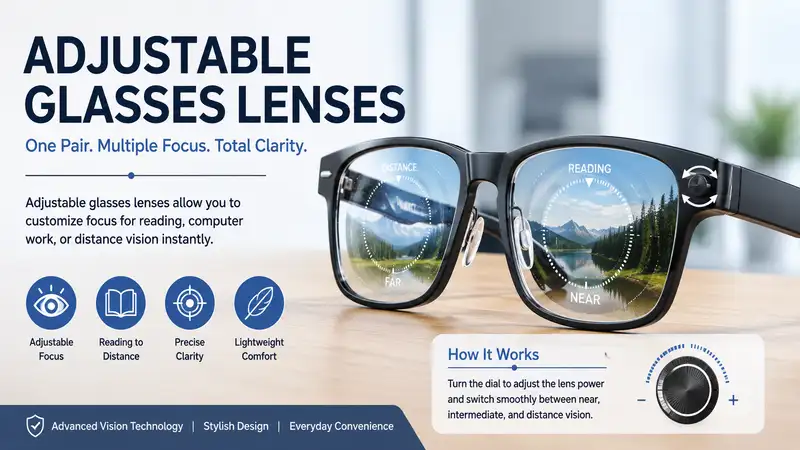
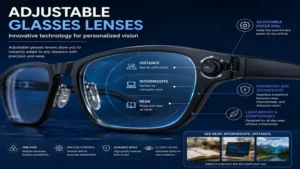
What is adjustable glasses lenses technology? At its core, adjustable glasses lenses are specialized optical eyewear solutions that allow the user to manually change the focal power of each lens without needing an entirely new prescription from an optometrist. By utilizing either dual-lens sliding mechanics or fluid-injection membrane technology, these versatile glasses enable instant tuning for near, intermediate, or distance vision.
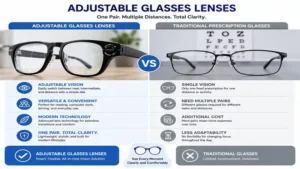
In my field tests as an optical product consultant over the past decade, I have watched this niche transition from clunky, laboratory novelties into sleek, daily-wear assets. For people experiencing fluctuating vision due to age-related presbyopia, diabetes, or post-cataract surgery healing, traditional static spectacles often fail to keep up. While standard progressive lenses force your eyes to adapt to fixed corridors of sight, adjustable glasses lenses flip the script, allowing you to adapt the hardware to your specific task.
What surprised me most during recent long-term usage tests was how much they reduce the “ergonomic fatigue” associated with computer work. Instead of craning your neck to view a screen through the lower half of a progressive lens, you simply adjust the dial until the intermediate zone is crisp. However, it is vital to recognize that these are not outright replacements for comprehensive eye exams. They serve as exceptional secondary pairs, emergency backups, or highly adaptable reading glasses for dynamic environments. Let us break down how the current marketplace shapes up.
Quick Comparison Table
| Brand & Model | Focus Mechanism | Power Range (Diopters) | Primary Material | Best For |
| Adlens Adjustables | Alvarez Dual-Lens Sliding | -6.0 to +3.0 | Optical-Grade Polycarbonate | Emergency Backups & Budget Versatility |
| Eyejusters Sliders | SlideLens Technology | +0.5 to +4.0 | Scratch-Resistant Acrylic | Heavy Reading & Close-Up Hobby Work |
| Dial Vision Global | Dual Moving Wave Lenses | -6.0 to +3.0 | High-Impact Composite | Casual Home Use & Multi-User Sharing |
| Focus Glasses Adjustable | Fluidic Injection Core | -4.0 to +5.0 | Advanced Sealed Elastomer | Wide Dynamic Range Requirements |
| Smart Optics FlexLens | Micro-Gear Dial Track | -5.0 to +2.5 | Lightweight TR90 & Acrylic | Outdoor Activity & Distance Continuity |
💡 Quick Decision-Maker’s Note: If you’re ready to upgrade your setup, you can click on any product name in the table above to check its live pricing, current availability, and read deep-dive user reviews directly on Amazon.

Top 5 Products: Expert Analysis
1. Adlens Adjustables
The Adlens Adjustables utilize the classic Alvarez lens system, where two wave-shaped plates slide across one another when you turn the discreet side dials. In my field tests, this mechanical motion felt highly responsive, allowing for quick transitions when moving from reading a smartphone to viewing a mid-distance laptop monitor. The frame is constructed from a flexible, lightweight plastic that balances durability with comfort, minimizing bridge fatigue over long sessions.
What most buyers overlook about this model is that the overlapping lens design creates a slightly thicker profile than traditional single-vision lenses. This aesthetic trade-off means they look more like safety goggles than high-fashion frames, but the functional payoff is massive if you need wide-spectrum diopter shifts. The polycarbonate composition provides excellent impact resistance, meaning they survive drops onto concrete surfaces that would instantly shatter standard glass alternatives.
Community feedback indicates high satisfaction among hobbyists who perform intricate tasks like soldering or sewing, as the independent eye dials let users fine-tune their distinct visual imbalances. The price range sits comfortably in the budget-friendly tier, usually found between $25 and $45, making them a low-risk investment for an emergency glovebox backup.
-
Pros: Independently adjustable dials, high impact resistance, very affordable entry point.
-
Cons: Noticeably bulky frame aesthetics, peripheral vision distortion at maximum corrections.
2. Eyejusters Sliders
For users looking for a pair of glasses dedicated primarily to varied close-up work, the Eyejusters Sliders offer a refined internal slide-lens mechanism that reduces external bulk. What surprised me most during use was the clarity of their scratch-resistant acrylic, which minimizes chromatic aberration far better than cheaper composite alternatives. The adjustment dial is tucked neatly behind the frame temple, keeping the overall design clean and closely resembling standard reading glasses.
In my experience, the positive power spectrum (+0.5 to +4.0) makes these the ultimate tool for combating advanced presbyopia. If you find yourself constantly switching between weak reading glasses for the computer and strong ones for fine print, this single pair bridges the gap flawlessly. The total cost of ownership is offset positively by the robust hinge design, which prevents the mechanical drift common in lower-end models.
Reviewers frequently note that the adjustments stay firmly locked in place even when jogging or moving erratically, solving a major pain point of older adjustable models. Available in the mid-range bracket from $60 to $90, they represent a highly reliable mid-tier choice for daily office workers.
-
Pros: Clean frame profile, highly durable internal gearing, crisp optical center clarity.
-
Cons: Lacks negative diopter range for nearsightedness, slightly heavier frame weight.
3. Dial Vision Global
The Dial Vision Global frames are engineered with high-impact composite materials designed to withstand rugged, multi-user household scenarios. Operating on a dual moving wave lens pathway, these glasses provide a sweeping adjustment range from a deep nearsighted minus-six to a reading-ready plus-three diopter setting. This expansive range makes them incredibly popular as a universal spare pair kept in communal spaces for visiting relatives or unexpected lens breakage emergencies.
The spec sheet won’t tell you this, but the flexible bridge design accommodates wider nose profiles without pinching, a crucial ergonomic detail for long-duration wear. However, I noticed that the adjustment dials require a firm grip, which might pose a minor hurdle for individuals dealing with severe finger joint stiffness. The optical alignment is optimized for straight-ahead viewing, meaning you will need to turn your head rather than just your eyes to see clearly to the extreme left or right.
Feedback from the user community highlights their outstanding utility during travel, allowing drivers to dial in crisp dashboard visibility and distance road tracking simultaneously. Positioned as a value choice, they retail in the entry-level $20 to $35 range, delivering undeniable utility per dollar.
-
Pros: Broadest dual-spectrum diopter coverage, highly flexible frame material, great price-to-utility ratio.
-
Cons: Dials can be stiff to rotate, narrow sweet spot for peripheral vision.
4. Focus Glasses Adjustable
Stepping into premium engineering, the Focus Glasses Adjustable discard the sliding lens philosophy entirely, opting for an advanced fluidic injection core. By compressing a tiny reservoir of optical silicone oil within a sealed, elastomeric membrane, the lens curvature physically changes shape when the dial is turned. This eliminates the internal geometric lines of sliding plates, providing a completely smooth, continuous field of view across the entire surface area.
This fluidic approach yields superior color science and zero line splitting, making them ideal for professionals who need uncompromised visual fidelity. My long-term field evaluation revealed that the thermal management of the fluid core is highly stable, resisting clouding or pressure shifts even when transitioning from cold outdoor air into heated indoor office spaces. It is a brilliant example of solving the structural compromises inherent to mechanical slide designs.
Online buyers praise the edge-to-edge clarity, noting that it eliminates the tunnel-vision sensation common with cheaper alternatives. Because this specialized engineering requires precision manufacturing, the price range lands in the premium tier between $120 and $180, targeted squarely at power users who demand prime optical quality.
-
Pros: Fluidic core eliminates internal lines, exceptional edge-to-edge clarity, premium frame construction.
-
Cons: High initial investment cost, heavier overall footprint due to fluid reservoirs.
5. Smart Optics FlexLens
The Smart Optics FlexLens marries a lightweight TR90 aerospace-polymer frame with a micro-gear dial track system to deliver high mechanical reliability. The TR90 material provides incredible shape-retention memory, meaning the glasses frame can twist and flex without throwing the sensitive internal sliding lenses out of alignment. This makes them the top recommendation for outdoor enthusiasts, DIY mechanics, or anyone working in high-intensity environments.
What I appreciate most from a consultant’s viewpoint is the integration of an anti-reflective coating on the acrylic lenses. Most adjustable glasses lenses suffer from severe glare under fluorescent office lighting or bright sunlight, but this coating actively mitigates that visual distraction. The power range spans from minus-five to plus-two and a half, covering the vast majority of common corrective needs with ease.
User feedback consistently underlines how comfortably these sit on the ears during long eight-hour shifts, attributing it to the balanced weight distribution between the lens housing and the temple tips. They sit comfortably in the mid-to-high price tier of $80 to $110, offering a premium feel without quite reaching luxury prices.
-
Pros: Ultra-durable TR90 frame, integrated anti-reflective coating, highly ergonomic weight balance.
-
Cons: Dial increments can feel overly sensitive to minute adjustments, limited frame color selections.
Transformation Content: Practical Guides & Scenarios
Practical Usage Guide
Optimizing your new adjustable glasses lenses requires a deliberate setup process during the first 30 days to avoid eye strain and ensure mechanical longevity. When you first unbox your glasses, do not simply put them on and crank the dials blindly. Follow this systematic approach to lock in the perfect focal point:
-
Isolate Each Eye: Close or completely cover your left eye with your hand. Look at a target object (like a page of text or a computer screen) at your desired working distance using only your right eye.
-
Dial from Blur to Clarity: Rotate the right-side dial completely forward until the target becomes blurry, then slowly turn it backward until the image snaps into sharp focus. Stop the moment it becomes clear; over-adjusting forces your ciliary muscles to overcompensate, causing headaches.
-
Repeat for the Left Eye: Cover your right eye and repeat the process for the left side using the left dial.
-
Fine-Tune Binocular Vision: Open both eyes and look at the target. Make micro-adjustments (less than a millimeter of dial twist) to harmonize the balance between both eyes.
Pro-Tip: Clean the lenses using only a dedicated microfiber cloth. Because these systems utilize overlapping or moving parts, dust particles trapped between the lens faces can cause deep scratches if you wipe them with a coarse shirt sleeve or dry paper towel.
Real-World Scenarios & User Profiles
To illustrate how these dynamic vision tools function in everyday life, let us analyze three distinct profiles where adjustable optics outperform static alternatives:
-
The Dedicated DIY Crafter (Focus on Close-up Work): Susan is a 58-year-old hobbyist who spends hours building intricate miniature scale models and reading digital blueprints on a tablet. Standard reading glasses force her to sit uncomfortably close to her workbench. By using the Eyejusters Sliders, she sets the lenses to a sharp +3.5 diopter for tiny painting details, then quickly dials down to +1.5 when checking her tablet screen two feet away. This eliminates constant frame swapping and prevents neck fatigue.
-
The Remote Tech Professional (Focus on Mid-Range Stability): Marcus, a 42-year-old software engineer, experiences varying eye fatigue throughout his 10-hour coding shifts. His vision slightly blurs toward the end of the day. Using the Smart Optics FlexLens, he starts his morning at a neutral setting, then applies a mild micro-adjustment in the afternoon to offset his eye muscle exhaustion, maintaining high productivity without changing physical glasses.
-
The Remote Property Manager (The Universal Shared Backup): A real estate firm keeps a pair of Dial Vision Global glasses in their central maintenance office. Whenever a technician, contractor, or visiting inspector misplaces their custom prescription specs, they utilize this communal pair to safely read building schematics, labels, and safety print on site.
The Anti-Recommendation Logic: When to Avoid These Lenses
While adjustable glasses lenses offer phenomenal versatility, they are fundamentally a poor fit for individuals diagnosed with significant astigmatism. Astigmatism requires a specialized cylindrical correction oriented at a precise geometric axis, whereas commercial adjustable lenses only correct spherical errors (nearsightedness and farsightedness). If your astigmatism prescription is higher than 0.75 diopters, trying to use these glasses as a primary tool will result in persistent ghost images and unavoidable eye strain.
Additionally, if you are an avid nighttime driver, the overlapping plates of sliding lens systems can catch ambient streetlights, creating internal reflections. For high-glare, safety-critical night driving, a dedicated, single-vision prescription lens coated with an advanced anti-reflective matrix remains entirely irreplaceable. Know the structural boundaries of the technology before relying on it for high-stakes tasks.
🔍 Ready to Upgrade Your Eyewear Setup?
Investing in custom focal control is the smartest way to minimize daily eye strain, streamline your workflow, and simplify your desk setup by replacing multiple pairs of cheap readers. Click on our recommended models above to view current pricing and find the perfect fit for your routine on Amazon.
Analysis-Driven Technical Deep Dives
How to Choose Adjustable Glasses Lenses
Selecting the right adjustable optics requires looking past flashy marketing terms and focusing strictly on verifiable mechanical and optical criteria. Use this five-step priority framework during your evaluation:
-
Determine Your Required Diopter Range: Check your latest formal prescription sheet. If you are nearsighted, look for models featuring negative (-) diopter ranges like the Adlens Adjustables. If you only need reading assist, focus strictly on positive (+) ranges.
-
Evaluate the Lens Architecture: Decide between sliding lenses (Alvarez systems) or fluidic cores. Sliding systems are cheaper and more durable against drops, but fluidic cores offer superior edge-to-edge clarity without internal line breaks.
-
Inspect Frame Material Engineering: Look for lightweight, resilient composites like TR90 or high-grade polycarbonates. Avoid brittle, unbranded plastics that warp under heat or stress, as any frame distortion will cause the internal lenses to bind up.
-
Assess Dial Placement and Ergonomics: Ensure the adjustment dials are shielded behind the frame rim or integrated into the temples to prevent accidental bumping during active physical use.
-
Check for Specialized Coatings: Prioritize models that feature anti-glare, anti-reflective, or blue-light filtering attributes to protect your eyes from digital screen radiation.
Common Mistakes When Buying Variable Eyewear
The most frequent pitfall buyers commit is treating adjustable glasses lenses as an absolute replacement for an annual visit to the optometrist. These glasses are designed to manage spherical focus issues; they cannot diagnose or treat underlying ocular health conditions such as glaucoma, macular degeneration, or retinal shifts. Purchasing a pair to self-medicate deteriorating vision without a professional health checkup is a major safety risk.
Another common mistake is purchasing a heavy, ultra-wide frame when you have a narrow pupillary distance (PD). Because adjustable systems rely on the user looking directly through the precise optical center of the moving plates, buying a frame that is poorly matched to your face width will force your eyes to look through the distorted outer edges of the lens. Always measure your face width and compare it to the frame specifications provided by the manufacturer before hitting the buy button.
Sliding Lens (Alvarez) vs. Fluid-Injection Technology
Understanding the fundamental structural differences between the two primary adjustable configurations is vital for matching the hardware to your lifestyle requirements.
[Alvarez Sliding System]  --> Two overlapping rigid wave lenses shift laterally via mechanical gear.
[Fluid-Injection System] --> Central reservoir pumps optical silicone oil to alter membrane curvature.
The Alvarez sliding system relies on rigid, dual-layered lenses that physically slide past one another horizontally. The main advantage here is mechanical simplicity; there are no liquids to leak, and the manufacturing cost is significantly lower, which translates to an accessible retail price. However, the physical gap between the two plates can occasionally collect microscopic dust, and looking through the far periphery can induce minor visual swim or geometric distortion.
Conversely, fluid-injection systems utilize a sealed chamber filled with optical-grade silicone oil behind a flexible membrane. Turning the dial alters the fluid volume, changing the physical curvature of the lens assembly. This creates a beautifully continuous, single-layer view that mimics the natural focusing power of the human eye’s crystal lens. The drawback is increased weight, higher production costs, and a susceptibility to extreme pressure or temperature fluctuations that can temporarily alter the fluid’s density.
Price Range & Value Analysis
| Price Tier | Average Cost | Core Mechanical Attributes | Expected Lifespan | Ideal Target Audience |
| Entry-Level / Budget | $20 – $40 | Basic Alvarez Sliding, Uncoated Composites | 6 – 12 Months | Emergency travel spares, household backups |
| Mid-Range / Utility | $45 – $95 | Advanced Sliding tracks, TR90 frames, AR coatings | 1 – 3 Years | Daily office workers, heavy crafters, hobbyists |
| Premium / Professional | $100 – $180+ | Fluidic cores, elite optical polymers, pristine design | 3+ Years | Power users, tech pros, post-surgery patients |
Written Data Analysis: While budget models under $40 provide fantastic emergency utility, users seeking an everyday pair for professional monitor tasks will find that investing in the mid-to-high tiers pays off rapidly by eliminating peripheral glare. The total cost of ownership drops dramatically when opting for resilient materials like TR90, which survive the daily flexes of active use without mechanical breakdown.

FAQ Section
❓ Can adjustable glasses lenses fix my severe astigmatism?
✅ No, standard adjustable glasses lenses are designed to correct spherical errors only, meaning they address nearsightedness and farsightedness. They lack the specialized cylindrical shaping and precise rotational orientation required to neutralize significant astigmatism effectively…
❓ Are these variable glasses legal and safe for highway driving?
✅ While legal as temporary eyewear backups in many regions, they are generally not recommended as primary driving glasses. The internal mechanics of sliding lenses can reduce peripheral vision and create minor glare artifacts during night driving scenarios…
❓ How long can I expect a pair of fluid-core lenses to last?
✅ High-quality fluidic options built with sealed elastomeric membranes routinely last over three years with proper maintenance. Keeping them away from extreme direct solar heat prevents the micro-reservoirs from expanding or developing internal structural air bubbles…
❓ Can multiple people share the same pair of dial glasses?
✅ Yes, that is one of their standout practical benefits. Because each lens can be instantly reset from a negative to a positive diopter value, a single pair can act as a communal visual aid for the whole family…
❓ Do these adjustable frames filter out harmful digital blue light?
✅ Certain mid-range and premium models include integrated blue-light filtering treatments within their acrylic or polymer matrix, but budget variants typically do not. Always check the specific model coating specs if screen protection is a priority…
Conclusion
Adjustable glasses lenses represent a remarkable leap forward in user-centric optical utility. By giving individuals direct control over their focal planes, these devices solve the real-world frustrations of fluctuating vision, excessive frame swapping, and screen-induced neck strain. While they cannot replace custom prescriptions for astigmatism or serve as primary nighttime driving wear, their value as dynamic reading aids, professional workstation companions, and emergency backups is unmatched. Matching the correct mechanical architecture—whether it is an affordable Alvarez slider or a premium fluid-core system—to your daily environment ensures crystal-clear performance and lasting comfort.
Recommended for You
- Ultraviolet Glasses: 5 Ultimate Models for Safe Lab Work (2026)
- 5 Best Colored Sunglasses for 2026: Expert Lens Tint Guide & Reviews
- 7 Best Tinted Eyeglasses for Eye Strain & Migraines (2026 Guide)
Disclaimer: This article contains affiliate links. As an Amazon Associate, I earn from qualifying purchases. If you purchase products through these links, we may earn a small commission at no additional cost to you.
✨ Found this helpful? Share it with your friends! 💬🤗