In This Article
Introduction: Why a Red Lens Might Be Your Easiest Sleep Upgrade
It’s 10:47 p.m. You promised yourself lights-out by ten, yet here you are — one more episode, one more scroll, every overhead LED in the house blazing like a stadium. Sound familiar? You’re not alone, and that’s exactly why the humble red lens has quietly become one of the most searched sleep accessories on amazon.com.
What Is a Red Lens?
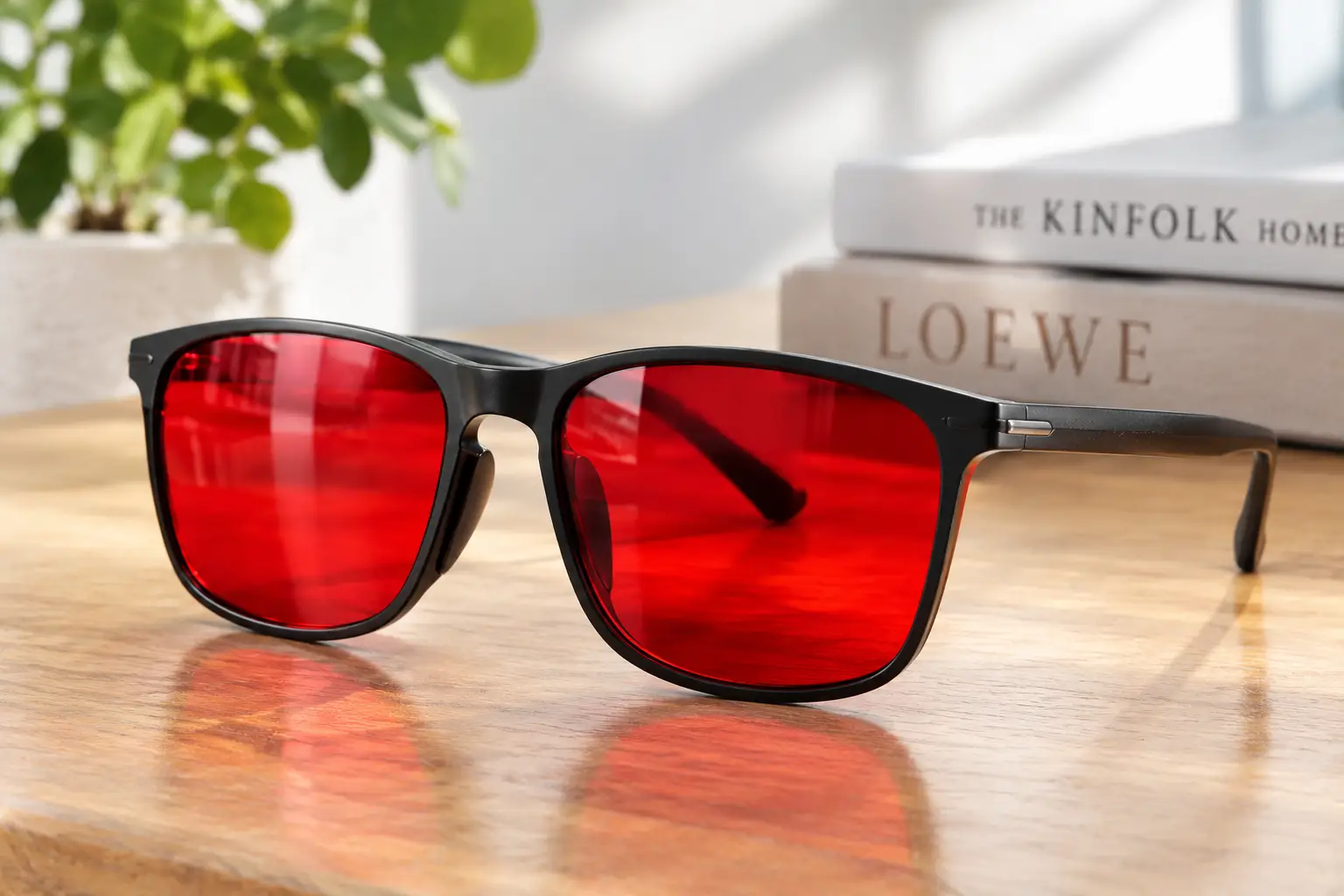
A red lens is a deep red–tinted eyeglass lens (or light filter) that removes most short-wavelength light before it reaches your eyes. In sleep glasses, a red lens typically targets blue and green light — roughly 400–550 nm — the part of the spectrum most tied to evening melatonin suppression.
Why does that matter? According to Harvard Health Publishing’s overview of blue light and sleep, light of any kind can suppress melatonin, but blue light at night does it more powerfully, while red light is far less likely to shift your circadian rhythm. In other words, a red lens doesn’t make your evening darker so much as it makes it biologically quieter.
A quick note on scope: “red lens” on Amazon covers everything from fashion sunglasses to astronomy flashlights. This guide focuses on red lens glasses for evening wear and sleep — the category where your money and your sleep are most at stake — and a later section covers the other red lens gear so you can tell them apart.
Finally, full transparency: we did not personally wear-test these glasses. Instead, this guide synthesizes manufacturer spec sheets, published research, and the review themes we could actually verify, then translates all of it into plain-English advice. Where something can’t be verified, we say so.
Quick Comparison: Red Lens Glasses at a Glance
| Product | Blocking Claim (Brand) | Style | Price Range | Best for |
|---|---|---|---|---|
| TrueDark Twilights Classic | 99% blue, green, violet | Wraparound + foam seal | $120–$160 | TrueDark Twilights Classic: maximum blackout |
| BON CHARGE Sleep+ | 100% at 400–550 nm | Acetate everyday frame | $90–$140 | BON CHARGE Sleep+: style + strong blocking |
| SafetyBlue Sleep Savior Deluxe | 99.9% blue, 99.7% green | Padded, head strap | $50–$80 | SafetyBlue Sleep Savior Deluxe: travel, reading in bed |
| TIJN Sleep Glasses | 99.9% blue/green | TR90 square frame | $15–$30 | TIJN Sleep Glasses: first-time buyers |
| Goiteia RedEase Fit Over Glasses | 100% at 380–550 nm | Fit-over wraparound | $20–$35 | Goiteia RedEase Fit Over Glasses: prescription wearers |
| Murddoa Sleep Reading Glasses | 99.9% blue/green | Readers (magnified) | $25–$35 | Murddoa Sleep Reading Glasses: bedtime book lovers |
| Vbewo Professional Sleep Glasses | 99.9% blue light | 2-pack, AR-coated | $20–$30 (pair) | Vbewo Professional Sleep Glasses: couples, households |
Looking at the table above, the real split isn’t price — it’s coverage. The TrueDark Twilights Classic and SafetyBlue Sleep Savior Deluxe are built to seal out light leaking around the edges, while the BON CHARGE Sleep+ bets on a frame you’d actually wear at the dinner table. Budget buyers should notice that the TIJN Sleep Glasses and Vbewo Professional Sleep Glasses make similar headline claims for a fraction of the cost, but publish less detailed spectral data to back them up.
💬 One click helps other shoppers make an informed choice too! 😊
Top 7 Red Lens Sleep Glasses: Expert Analysis
1. TrueDark Twilights Classic — darkest wraparound blackout pick
If your goal is to make your living room feel like a campsite after sunset, the TrueDark Twilights Classic is the most uncompromising red lens in this lineup. TrueDark states the deep red lens blocks 99% of blue, green, and violet light, plus 99% of UVA/UVB, and the sport-style frame adds a full-coverage foam barrier. That foam matters more than it sounds: ceiling fixtures sit above your eyes, and standard frames let that light sneak in from the top and sides.
The frame is polycarbonate with flexible TR90 arms, measuring 142 mm wide with a 65 × 40 mm lens and a 20 mm bridge. On paper, the 120 mm arms are shorter than the 135–145 mm common on everyday frames, so larger heads should check fit. TrueDark itself recommends wearing them indoors 30–60 minutes before bed and explicitly says they’re not for driving or outdoor nighttime activity.
Who is it for? Night-shift workers, new parents doing 3 a.m. feedings, and anyone who’s tried amber lenses and felt they “didn’t do enough.” We couldn’t verify a large independent body of customer reviews for this exact listing, so treat star counts cautiously; the recurring trade-off in coverage of deep red wraparounds is that they’re very dark, which makes reading small print take some adjustment.
Pros:
- ✅ Foam seal blocks light leaking from above and sides
- ✅ Brand-stated 99% blue, green, and violet blocking
- ✅ Flexible TR90 arms comfortable enough to lie down in
Cons:
- ❌ Sporty goggle look isn’t for social evenings
- ❌ Shorter arms may pinch larger heads
Expect to pay in the $120–$160 range — premium, but justified if total blackout is your priority; check the current price before buying.
2. BON CHARGE Sleep+ — strongest blocking in a normal-looking frame
The BON CHARGE Sleep+ (the brand was formerly called BLUblox and rebranded in 2022) proves a red lens doesn’t have to look like lab equipment. Its signature Sleep+ lens is rated to block 100% of blue and green light from 400 to 550 nm — the most aggressive published cutoff among the premium picks here.
Frames are handcrafted acetate with spring hinges, and the medium fit measures 53 mm lens, 17 mm bridge, and 140 mm arms. What that means in practice: these sit like regular glasses, so you’re far more likely to keep them on through dinner, TV, and dishes — and consistency is where the habit actually pays off. The Amazon listing notes the frames are designed and manufactured in Australia, and the brand’s own store also sells prescription and reader versions.
Who is it for? Style-conscious buyers who want near-total blocking without the goggle aesthetic. The honest caveat: the 100% claim comes from the brand, and without a seal around the edges, a bright ceiling light can still reach your eyes from the side.
Independent blog reviews of the brand are generally enthusiastic, but many of those blogs earn commissions, so we weigh them lightly. We couldn’t verify a meaningful sample of independent Amazon reviews for the exact Sleep+ listing.
Pros:
- ✅ Brand-stated 100% blocking across 400–550 nm
- ✅ Acetate frame looks like everyday eyewear
- ✅ Prescription and reader options via the brand
Cons:
- ❌ Open sides let overhead light leak in
- ❌ Pricier than budget pairs with similar headline claims
Typically priced between $90 and $140 at the time of writing — strong value if you’ll actually wear them every night.
3. SafetyBlue Sleep Savior Deluxe — padded, strap-on comfort for travel
The SafetyBlue Sleep Savior Deluxe is the red lens you can fall asleep in without waking up with a bent frame. Its standout feature is a padded interior plus a soft, interchangeable head strap, which SafetyBlue says keeps the glasses in place even against a travel pillow.
SafetyBlue publishes unusually specific numbers: 0.1% blue light transmittance (99.9% blocked from 450–495 nm), 0.3% green transmittance (99.7% blocked from 495–570 nm), and full UV blocking from 280–400 nm. That green figure extends to 570 nm — wider than most competitors’ stated 550 nm cutoff — which, on paper, means even less of the alerting mid-spectrum gets through.
Who is it for? Frequent flyers fighting jet lag, people who read in bed with a lamp on, and shift workers sleeping during daylight hours. The brand is clear that these are not prescription lenses and not driving glasses.
Real review data is thin, so we’ll be precise about what we found: one retailer reviewer noted they let some light in but remove blue and green well, and an independent roundup observed that Sleep Savior frames sit tighter than wide-armed models, so they may press lenses against your face if worn over glasses.
Pros:
- ✅ Published transmittance figures for blue and green light
- ✅ Padded strap design stays put lying down
- ✅ Green blocking extends to 570 nm per brand specs
Cons:
- ❌ Snug fit isn’t ideal over prescription frames
- ❌ Strap design looks clinical outside the bedroom
Usually falls in the $50–$80 range — a fair middle ground between budget pairs and premium brands.
4. TIJN Sleep Glasses — best budget entry into red lens habits
The TIJN Sleep Glasses (the “Max Protect” red lens version, model 000893) are the cheapest way to find out whether a red lens routine sticks before you spend serious money. The listing pairs a lightweight TR90 frame with dual anti-reflective coatings and claims 99.9% blue and green blocking.
TR90 is a flexible nylon-based material, so these bend rather than snap when you fall asleep on the couch with them on — a genuinely useful trait at this price. Dual AR coatings cut the reflections of lamps and screens bouncing off the back of the lens, which reduces that “looking through a fishbowl” effect common to cheap tinted glasses.
Here’s what most buyers overlook: the listing’s own wording mixes the 99.9% blue-green claim with a narrower description of filtering light between 450 and 500 nm. That inconsistency doesn’t mean the glasses don’t work; it means you shouldn’t assume full green blocking to 550 nm without testing (we explain a simple at-home test in the FAQ).
The model has ranked among the top sellers in Amazon’s Computer Blue Light Blocking Glasses category, and a third-party roundup praised its frame and coatings. Rankings shift constantly, though, so read recent reviews for fit complaints before ordering.
Pros:
- ✅ Very low cost for a full red lens
- ✅ Flexible TR90 frame survives couch naps
- ✅ Dual AR coatings reduce lens glare
Cons:
- ❌ Spectral claims are inconsistent within the listing
- ❌ No side or top light seal
Generally under $30, often in the $15–$30 range — outstanding value as a low-risk experiment.
5. Goiteia RedEase Fit Over Glasses — best for prescription wearers
The Goiteia RedEase Fit Over Glasses solve the most common red lens frustration: “I wear glasses already, now what?” Instead of stacking two pairs awkwardly, this oversized wraparound slides over most prescription frames.
Goiteia claims 100% blocking of blue and green light from 380 to 550 nm, with polycarbonate lenses, a dual-layer anti-reflective coating, and an oil-resistant finish. The measurements tell the fit story: 58 mm lens width, 45 mm lens height, 17 mm bridge, and long 150 mm arms. Those long arms and tall lenses are what let them clear a typical prescription frame, while the wraparound shape adds side and top protection that regular red lens glasses lack.
Who is it for? Anyone with a prescription who doesn’t want to pay for custom red lenses — and, honestly, light-sleepers who like the extra side coverage even without prescription glasses. Goiteia also sells a variant with detachable nose pads, so it can be worn alone, plus a flip-up clip-on version if you’d rather attach the red lens to your existing frames.
From the review data we could verify, an independent roundup found the wide temple arms fit comfortably over slim prescription frames. Bulkier frames may not fit underneath, so measure your own glasses (width and height) against the specs above first.
Pros:
- ✅ Fits over most slim prescription frames
- ✅ Wraparound shape blocks side and top light
- ✅ Brand-stated blocking from 380 to 550 nm
Cons:
- ❌ Oversized look is purely functional
- ❌ Thick prescription frames may not fit underneath
Typically in the $20–$35 range — excellent value compared with ordering prescription red lenses.
6. Murddoa Sleep Reading Glasses — magnified red lens for bedtime readers
The Murddoa Sleep Reading Glasses combine two things many over-40 readers juggle at night: reading magnification and a red lens filter in a single pair. They’re sold in multiple magnification strengths, including a 0.00 version for people who don’t need readers.
The listing describes polycarbonate lenses with an anti-reflective coating and a compact 50 mm lens width. The practical upside is obvious if you’ve ever balanced drugstore readers under a blue-blocker: one pair, no stacking, no pressure marks on your nose. The listing’s own claims vary slightly — 99.9% in the headline, 100% in the bullet points — so treat the exact percentage as approximate.
Who is it for? Paper-book and e-ink readers with presbyopia who wind down with a chapter before bed. One thing the spec sheet doesn’t say: under a deep red lens, red ink and red highlights on white paper can nearly disappear, because the lens passes red light almost as freely as white. That’s harmless for novels but annoying for marked-up work documents.
We couldn’t verify a meaningful body of independent customer reviews for this listing, so check recent Amazon reviews for comments on magnification accuracy, which matters as much as the tint.
Pros:
- ✅ Magnification and red lens in one pair
- ✅ Available in multiple reader strengths, including 0.00
- ✅ Anti-reflective coating reduces lamp glare
Cons:
- ❌ Blocking claims vary within the listing
- ❌ Smaller 50 mm lens offers less side coverage
Usually priced around $25–$35 — good value for readers who’d otherwise buy two pairs.
7. Vbewo Professional Sleep Glasses — two-pack value for couples
The Vbewo Professional Sleep Glasses come as a two-pack, which quietly solves a real problem: the best red lens is the one within arm’s reach when you need it. Keep one pair by the couch and one on the nightstand, or share the set with a partner so you’re both winding down on the same schedule.
The listing highlights red lenses with 99.9% blue light blocking, dual anti-reflective coatings, and UV protection. Notice what’s not clearly quantified: green light. Because the headline focuses on blue light, buyers who want maximum green blocking should treat these as a lighter-duty option than the BON CHARGE Sleep+ or SafetyBlue Sleep Savior Deluxe.
Who is it for? Couples, roommates, and households where pairs constantly go missing. They’re also a reasonable pick for the 3 a.m. bathroom trip — slip them on before you hit the light switch, and you avoid a blast of bright white light.
Honest disclosure: we couldn’t verify detailed independent review data or published spectral charts for this two-pack. That doesn’t make it a bad buy at this price, but it makes it a “trust, then verify” purchase — run the simple green-light test in our FAQ when they arrive.
Pros:
- ✅ Two pairs for roughly the price of one
- ✅ Dual AR coatings for clearer evening viewing
- ✅ Handy as backup or shared pairs
Cons:
- ❌ Green-light blocking isn’t clearly specified
- ❌ Limited verifiable spectral or review data
Typically in the $20–$30 range for the pair — strong value per pair, as long as you test them on arrival.
Head-to-Head: Specs, Fit, and Price Ranges Compared
| Product | Stated Range Blocked | Frame Material | Light Leak Protection | Price Range | Best for |
|---|---|---|---|---|---|
| TrueDark Twilights Classic | Blue, green, violet (99%) | Polycarbonate + TR90 | Excellent (foam seal) | $120–$160 | TrueDark Twilights Classic: shift workers |
| BON CHARGE Sleep+ | 400–550 nm (100%) | Acetate | Low (open sides) | $90–$140 | BON CHARGE Sleep+: everyday style |
| SafetyBlue Sleep Savior Deluxe | 450–570 nm (99.7–99.9%) | Padded frame + strap | Very good | $50–$80 | SafetyBlue Sleep Savior Deluxe: travel |
| TIJN Sleep Glasses | Claims vary in listing | TR90 | Low | $15–$30 | TIJN Sleep Glasses: trying it out |
| Goiteia RedEase Fit Over Glasses | 380–550 nm (100%) | TR90 | Good (wraparound) | $20–$35 | Goiteia RedEase Fit Over Glasses: Rx wearers |
| Murddoa Sleep Reading Glasses | Blue/green (99.9–100%) | Not specified | Low | $25–$35 | Murddoa Sleep Reading Glasses: readers |
| Vbewo Professional Sleep Glasses | Blue (99.9%) | Not specified | Low | $20–$30 (pair) | Vbewo Professional Sleep Glasses: households |
Two patterns jump out. First, the brands that publish wavelength-specific data — BON CHARGE Sleep+, SafetyBlue Sleep Savior Deluxe, and Goiteia RedEase Fit Over Glasses — give you more to hold them accountable to than listings that only quote a percentage. Second, light-leak protection varies more than lens tint does, which is why the TrueDark Twilights Classic can outperform an equally dark lens in a bright kitchen.
✨ Don’t miss these sleep-friendly picks!
🔍 Take your evening wind-down to the next level with this carefully curated red lens lineup. Click a highlighted product name to check current pricing and availability — the right pair can help you build calmer, screen-friendly evenings the whole family can enjoy! 🌙
How to Use Red Lens Glasses: Your First 30 Days
Buying red lens glasses is the easy part. Using them in a way that actually changes your evenings takes a little structure. Here’s a practical plan built around what the research and manufacturers recommend.
Week 1: Set the timing
Start by wearing your red lens glasses for about two hours before your target bedtime. That window isn’t random: in a small randomized trial published in the Journal of Psychiatric Research, adults with insomnia symptoms wore amber blue-blocking lenses for two hours before bed and showed improved insomnia scores and longer measured sleep compared with clear placebo lenses. That study used amber lenses, not red, and only 14 people, so treat it as encouraging rather than definitive.
Week 2: Close the loopholes
The most common mistake is taking the glasses off “just for a second” — to brush your teeth under bright bathroom lights, or to read a text. Keep them on until lights-out. If you wake at night, put them on before touching the light switch.
Week 3: Pair with good light hygiene
A red lens works best as part of a broader routine: dim overhead lights after dinner, switch lamps to warm bulbs, and enable your phone’s night mode. Glasses are a backstop, not a substitute.
Week 4: Evaluate honestly
Keep a simple sleep diary: lights-out time, how long it felt to fall asleep, and morning energy on a 1–10 scale. After 30 days, compare against your usual nights. If nothing changed, consider whether the issue is stress, caffeine, or a medical sleep problem worth discussing with your doctor.
Maintenance from day one
Clean lenses with a microfiber cloth and lens spray — never paper towels, which scratch AR coatings. Store them in a hard case; red lens glasses tend to live on couches, which is exactly where they get sat on.
Which Red Lens Glasses Fit Your Life? Three Real-World Profiles
Specs only matter in context. Here’s how the decision plays out for three common types of buyers.
Profile 1: The night-shift nurse
Situation: Works 7 p.m.–7 a.m. three nights a week, drives home after sunrise, and needs to sleep from roughly 9 a.m. to 4 p.m. Budget: Up to $160. Frequency: Several times a week.
Best match: TrueDark Twilights Classic for wearing indoors after getting home, paired with blackout curtains. The foam seal matters most here, because daytime bedrooms leak light around every edge. The critical caveat: never wear any red lens while driving, so the glasses go on after arriving home, not in the car. Ordinary sunglasses handle the morning commute.
Profile 2: The late-night remote worker and gamer
Situation: Wraps up work at 7 p.m., games or streams until 11 p.m., struggles to fall asleep before 1 a.m. Budget: $30–$100. Frequency: Nightly.
Best match: Start with the TIJN Sleep Glasses to test tolerance — gaming through a deep red lens is a big visual change, and some people hate it. If the habit sticks after a month, upgrade to the BON CHARGE Sleep+ for a frame comfortable enough for long sessions. Realistically, this profile may also do well with an amber lens until the final hour, then switching to red (see our red vs amber section).
Profile 3: The 58-year-old evening reader
Situation: Wears +2.00 readers, reads paperbacks in bed for 45 minutes nightly under a bedside lamp. Budget: Under $40. Frequency: Nightly.
Best match: Murddoa Sleep Reading Glasses in the matching magnification — one pair instead of stacking readers under a filter. If you already wear full prescription glasses rather than readers, the Goiteia RedEase Fit Over Glasses are the more flexible choice.
Red Lens Problems Solved: Fixes for the Most Common Complaints
Even the best red lens glasses come with a learning curve. Here are the five complaints that come up most often in buyer discussions and brand FAQs — and how to fix each.
Problem 1: “Everything looks too dark — I keep bumping into things.”
Solution: Deep red lenses cut overall brightness noticeably. Keep a dim lamp on rather than turning off all lights, and clear walkways before you put the glasses on. If it’s still uncomfortable, an amber lens for the first hour and red for the final hour is a reasonable compromise.
Problem 2: “Light still leaks in around the edges.”
Solution: Switch to wraparound or sealed designs like the TrueDark Twilights Classic or Goiteia RedEase Fit Over Glasses, or reposition lamps so light comes from below eye level rather than above.
Problem 3: “They give me a headache or pressure behind the ears.”
Solution: Check arm length against your head size. Short-armed frames (around 120 mm) can pinch; longer arms (140–150 mm) distribute pressure better. TR90 frames can also be gently warmed and adjusted by an optician.
Problem 4: “I can’t tell colors apart on screen.”
Solution: That’s expected — and partly the point. A red lens removes blue and green, so color-coded charts, maps, and games become hard to read. Save color-critical tasks for earlier in the evening.
Problem 5: “I’m not sure they’re blocking anything.”
Solution: Look at a pure green image or a green LED through the lenses. A strong red lens should make green appear nearly black. If it still glows green, your pair isn’t blocking much green light.
How to Choose a Red Lens: 6-Step Buyer’s Checklist
Shopping by star rating alone is how people end up with a pretty red tint that does very little. Use these steps instead:
- Decide your goal first. Sleep support needs blocking through the green range (~550 nm); fashion or astronomy needs something entirely different.
- Demand wavelength numbers, not just percentages. “Blocks 99.9% of blue light” means little without a range. Look for figures like “400–550 nm.”
- Match the frame to your eyesight. Prescription wearers should choose a fit-over model or a brand offering Rx red lenses; readers should consider magnified red lens readers.
- Prioritize light-leak protection. Wraparound shapes or foam seals matter more in brightly lit homes than a 0.1% difference in lens rating.
- Check comfort specs. Frame width, arm length, and material (TR90 or acetate) decide whether you’ll wear them for two hours or two minutes.
- Set a realistic budget. Under $30 is fine for testing the habit; $90 and up buys better frames, clearer data, and often prescription options.
Red Lens vs Amber Lens: Which Tint Should You Wear?
This is the debate that splits the sleep-glasses world. Both lens colors aim to reduce melatonin-disrupting light in the evening; they just draw the line in different places.
| Lens Type | Typical Blocking | Visual Comfort | Best for |
|---|---|---|---|
| Red lens | Blue + most green (to ~550 nm or beyond) | Darkest, strongest color distortion | Final 1–2 hours before bed, night wakings |
| Amber lens | Most blue, partial green | Brighter, easier to read and watch TV | Early evening, people new to blue blockers |
| Clear “blue light” lens | Small share of blue | Almost no change | Daytime screen use (limited evidence) |
| Phone/computer night mode | Reduces screen blue only | No glasses needed | A free first step; doesn’t touch room lighting |
The table shows a clear trade-off: the more light a lens removes, the less pleasant it is to see through. Red lens advocates such as TrueDark and BON CHARGE argue that green light also matters, so they block it almost completely. Swanwick, maker of the amber Night Swannies, takes the opposite view: its own FAQ says its lenses block roughly 80% of green light, argues blue light is far more important, and acknowledges that no study has directly compared full blue-green blocking with blue-only blocking.
So which is right? Honestly, the evidence can’t settle it yet. A major Cochrane review of 17 randomized trials found that blue-light filtering spectacles probably make little difference to eye strain, and that the effect on sleep remains unclear — though many lenses studied filtered only a modest share of blue light, unlike deep red or amber sleep lenses.
A practical rule: if you can tolerate red, use it for the final hour or two before bed. If red feels oppressive, a good amber lens you’ll actually wear beats a red one sitting in a drawer.
Features That Actually Matter (and Ones That Don’t)
Red lens listings are crowded with buzzwords. Here’s how to separate signal from noise.
Features that matter
- A stated wavelength range. “400–550 nm” or “450–570 nm” tells you what’s filtered. It’s the single most useful spec.
- Coverage. Wraparound shapes, foam seals, and tall lenses reduce light leaking from above — where most household lighting lives.
- Anti-reflective coating on the back surface. Lamps behind you reflect off the inside of a lens straight into your eyes; AR coatings cut that.
- Comfortable materials. TR90 bends instead of breaking; acetate feels premium and adjusts well at an optician’s.
- Rx or fit-over options. If you need correction, this decides everything else.
Features that matter less than marketing suggests
- “Gaming” branding. It describes the target audience, not the filter.
- Tiny percentage differences. 99.7% versus 99.9% matters far less than whether light floods in around the frame.
- “Clinically proven” without a citation. If a listing doesn’t name the study, assume you can’t evaluate the claim.
- Brand-commissioned studies. Swanwick, for example, cites a SleepScore Labs study reporting sleep improvements; that’s useful context, but company-funded results aren’t the same as independent trials.
Bottom line: buy the data and the fit, not the adjectives.
Common Mistakes to Avoid When Buying Red Lens Glasses
Most red lens disappointments trace back to a handful of predictable errors.
Mistake 1: Buying fashion sunglasses for sleep
Plenty of trendy red-tinted sunglasses are designed for style and UV protection, not for blocking green light. A light rose tint may look red yet pass most of the spectrum that matters at night.
Mistake 2: Ignoring your prescription
Stacking a regular red lens pair over prescription glasses is uncomfortable and leaks light. Choose a fit-over design, clip-ons, or prescription red lenses from a brand that offers them.
Mistake 3: Expecting a sleeping pill
Red lens glasses reduce one input — evening light. They don’t fix caffeine at 4 p.m., stress, or untreated sleep apnea. Persistent insomnia deserves a conversation with a doctor.
Mistake 4: Wearing them too briefly
Putting them on five minutes before bed after four hours of bright light misses the point. Brands generally suggest anywhere from 30 minutes to three hours; most landing near one to two.
Mistake 5: Wearing them to drive
Deep red lenses distort color perception and dim the scene. Several brands in this guide explicitly state their glasses are not for driving — take that seriously.
Mistake 6: Trusting rankings over specs
Best-seller badges reflect sales volume, not spectral performance. A top-ranked listing with vague claims can underperform a lesser-known pair with published wavelength data.
Red Lens Gear Beyond Glasses: Flashlights, Headlamps, and Sunglasses
Search “red lens” on Amazon and you’ll find far more than sleep glasses. Knowing the difference saves you from buying the wrong thing.
Red lens flashlights and headlamps
Astronomers, hunters, pilots, and sea-turtle volunteers use red light to see without wrecking their dark-adapted night vision. The physics is related to sleep glasses — your low-light vision is less sensitive to red — but the products are different. The Celestron Night Vision Red Headlamp, for example, is red-only, with brand-stated output of 1 lumen on low and 4 lumens on high, up to 100 hours on low, and a tilt of up to 45°. Dedicated astronomy lamps like the Apertura Ember go as dim as 0.3 lumens. For existing flashlights, snap-on accessories like the Streamlight 85115 red flip lens convert compatible Streamlight models to red output. The key spec here is dimness control, not blocking range.
Red lens sunglasses
Red or rose-tinted sunglasses are mostly a style choice. For outdoor use, prioritize UV400 or “100% UV protection” labeling. Don’t expect them to function as sleep glasses.
Red lens safety glasses
On job sites, red-mirror or red-tinted safety eyewear should carry an ANSI Z87.1 marking — the US standard for occupational impact protection. Laser-viewing glasses with red lenses serve yet another purpose: they make red laser lines easier to see.
The takeaway: “red lens” is a color, not a category. Always confirm the product’s purpose before comparing specs.
Safety, Standards, and What the Science Really Says
Red lens glasses are low-risk, but an honest guide should separate what’s established from what’s marketing.
What’s well supported
Evening light — especially blue light — affects your internal clock. Even the American Academy of Ophthalmology acknowledges that blue light influences circadian rhythm and that heavy late-night screen exposure can make it harder to fall asleep.
What’s not supported
The same AAO guidance says there’s no scientific evidence that blue light from digital devices damages your eyes, and the Academy doesn’t recommend blue light-blocking eyewear for computer use. So if a listing promises to “protect your retina” from your phone, be skeptical. The strongest case for a red lens is evening light management, not eye protection.
Practical safety rules
- Never drive in deep red or amber sleep glasses.
- Mind trip hazards. Dimmed vision plus stairs at night is a real risk, particularly for older adults.
- Kids: Some brands make children’s sizes, but talk with your pediatrician before using sleep glasses with children.
- Medical conditions: If you have migraine, bipolar disorder, or a diagnosed sleep disorder, involve your doctor rather than self-treating with tinted lenses.
Standards worth knowing
Sleep glasses aren’t held to a dedicated federal performance standard for blue-green blocking, which is why brand claims vary so widely. For sunglasses, look for UV400 labeling; for workplace eyewear, ANSI Z87.1. For sleep claims, published spectral data is your best available proof.
Long-Term Cost and Maintenance
Red lens glasses are cheap compared with most sleep products — but cost per night is the fairer way to judge them.
| Tier | Example | Price Range | Est. Cost per Year* | Best for |
|---|---|---|---|---|
| Budget | TIJN Sleep Glasses | $15–$30 | ~$8–$15 | TIJN Sleep Glasses: testing the habit |
| Mid-range | SafetyBlue Sleep Savior Deluxe | $50–$80 | ~$25–$40 | SafetyBlue Sleep Savior Deluxe: travel comfort |
| Premium | BON CHARGE Sleep+ | $90–$140 | ~$45–$70 | BON CHARGE Sleep+: nightly long-term wear |
*Assumes roughly two years of nightly use with reasonable care; your mileage will vary.
Spread over two years, even the premium tier works out to well under 20 cents per night, while the budget tier costs about a penny or two. The real hidden cost is replacement: cheap frames lost under couch cushions or snapped in half add up, which is partly why the Vbewo Professional Sleep Glasses two-pack can make financial sense.
Maintenance that extends lens life
- Rinse dust off before wiping, so grit doesn’t scratch the AR coating.
- Use lens-safe spray, not household glass cleaner.
- Never leave glasses on a hot car dashboard; heat can warp frames and damage coatings.
- Tighten hinge screws every few months on acetate frames.
- Replace pads or straps on models like the SafetyBlue Sleep Savior Deluxe when they compress.
FAQ: Red Lens Glasses
❓ Are expensive red lens glasses worth the extra money?
❓ Can I get prescription red lens glasses?
❓ Can I drive while wearing red lens glasses?
❓ How can I test whether my red lens glasses block green light?
❓ Are red lens glasses safe for kids?
Conclusion: Finding the Right Red Lens for Your Nights
A red lens won’t fix every sleepless night — and anyone who tells you otherwise is selling something. What it can do is remove one of the most common modern sleep disruptors, bright evening light, without forcing you to give up your screens, your books, or your Netflix queue.
If you want maximum blackout and don’t mind the look, the TrueDark Twilights Classic is the most thorough option here. If style and consistency matter more, the BON CHARGE Sleep+ offers the strongest published blocking in a frame you’ll happily wear at the dinner table. Travelers and in-bed readers should look at the SafetyBlue Sleep Savior Deluxe, while prescription wearers get the most flexibility from the Goiteia RedEase Fit Over Glasses. Readers with presbyopia will appreciate the two-in-one convenience of the Murddoa Sleep Reading Glasses, and households on a budget can’t go far wrong testing the waters with the TIJN Sleep Glasses or the Vbewo Professional Sleep Glasses two-pack.
Whichever pair you choose, the habit matters more than the price tag: wear them consistently for an hour or two before bed, dim your house lights, keep them on until lights-out, and never wear them behind the wheel. Give it 30 days, track how you feel, and let your own sleep diary be the final judge.
🌙 Ready to reclaim your evenings?
🛒 Pick the red lens pair that fits your routine, click its highlighted name to check current pricing and availability, and start your 30-day wind-down tonight. Your future, well-rested self will thank you! ✨
Recommended for You
- What reading glasses do i need? 7 Proven Picks + Chart (2026)
- Reading Glasses for Small Faces: 7 Best Picks That Fit (2026)
- Purple Prescription Contacts: 7 Stunning Picks for 2026
Disclaimer: This post contains affiliate links. As an Amazon Associate, I earn from qualifying purchases made through these links, at no additional cost to you.
✨ Found this article helpful? Share it with someone who needs it! 💬🤗