In This Article
Black Prescription Contacts: The Look Everyone Wants, the Rules Few People Know
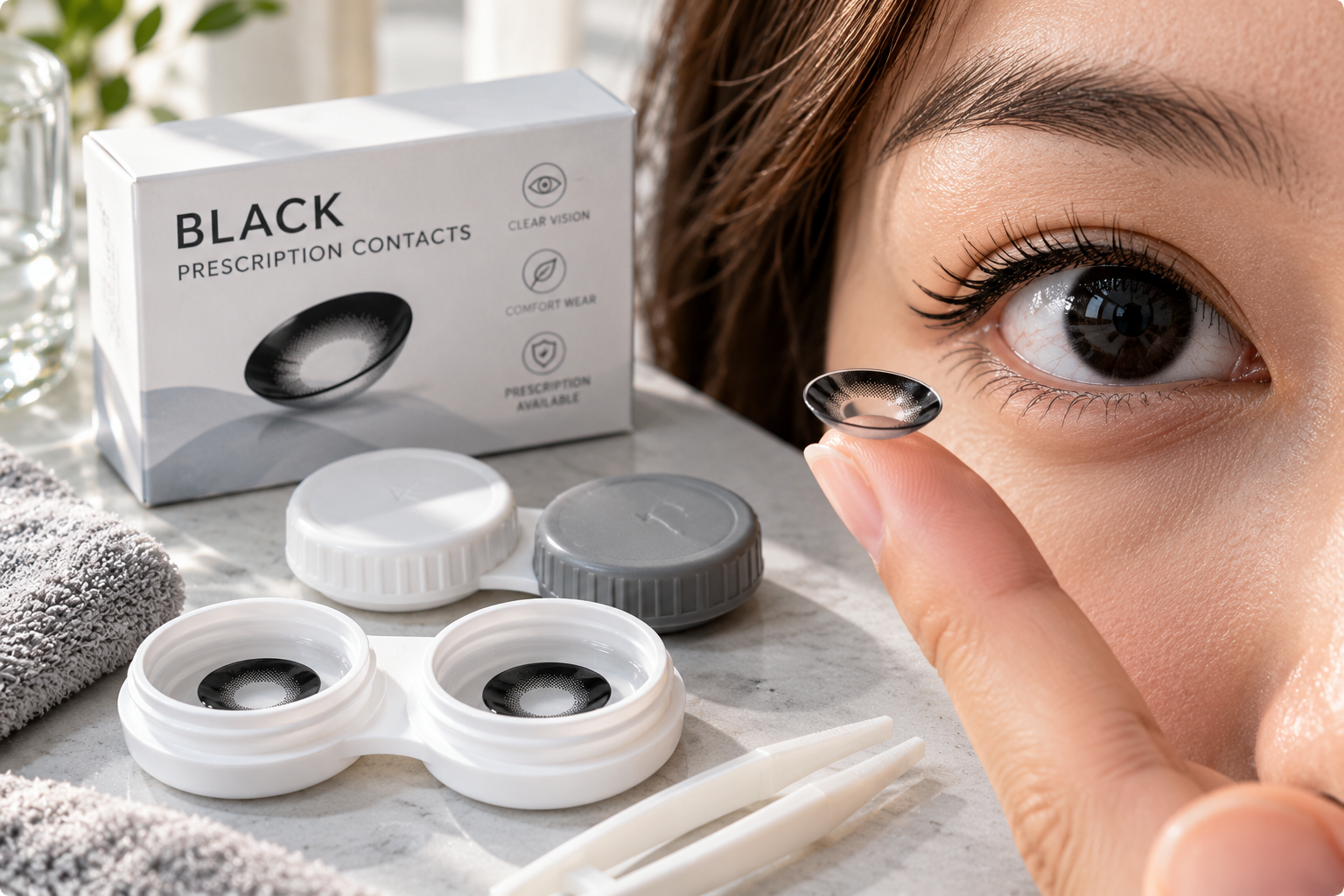
Black prescription contacts sit at a strange crossroads. Half the people searching for them want a subtle, everyday deepening of dark brown eyes. The other half want a full horror-movie stare for Halloween, cosplay, or a stage role. Both groups share one problem: the internet is crowded with cheap “one-size-fits-all” black lenses that are illegal to sell in the United States and genuinely risky to wear.
Here’s the part most shopping guides skip. In the U.S., every contact lens, even a purely decorative one with zero vision correction, is a regulated medical device. You need a valid prescription, and any legitimate seller must verify it before shipping. So the real question isn’t “where can I grab black prescription contacts fast?” It’s “which black lenses are actually cleared, sold through verified channels, and right for my eyes and my plans?”
This guide answers exactly that. We compared seven real options, from daily lenses with a dark limbal ring to 22 mm full-sclera blackout lenses, using published spec sheets and aggregated customer feedback from a prescription-verifying U.S. retailer. You’ll get honest trade-offs, realistic price ranges, a first-30-days care plan, and the mistakes that send people to urgent care every October.
One honest note up front: the lenses themselves are not legitimately sold on Amazon (more on why below). Where we link to Amazon, it’s for care products such as solutions, cases, and rewetting drops, which you’ll need no matter which lens you choose.
Disclosure: This article contains affiliate links. We may earn a commission at no extra cost to you.
What Are Black Prescription Contacts?
Black prescription contacts are FDA-regulated contact lenses that add black or very dark pigment to the eye, either as a dark limbal ring, an opaque black iris, or full coverage of the iris and white of the eye, and that are fitted and sold only against a valid contact lens prescription, with or without vision correction.
That definition covers more ground than most people expect. “Prescription” here refers to the fit (base curve and diameter) and the brand approved by your eye doctor, not only the power. A plano lens with no correction still needs a prescription. The FDA’s consumer guidance on colored and decorative lenses is blunt about it: decorative lenses aren’t cosmetics, aren’t over-the-counter merchandise, and aren’t “one size fits all.”
In practice, you’ll find three families:
- ✅ Dark-ring enhancers — translucent lenses that add a dark limbal ring and depth without hiding your natural iris.
- ✅ Opaque dark-tint lenses — denser pigment in deep brown or gray that shifts the overall eye color darker.
- ✅ Blackout and black sclera contacts — theatrical lenses with opaque black pigment over the iris, or over the iris and white of the eye.
Quick Comparison: Black Prescription Contacts at a Glance
| Lens | Black Effect | Replacement | Approx. Price Range | Best For |
|---|---|---|---|---|
| 1-Day Acuvue Define | Dark limbal ring, natural | Daily | $55–$85 per 30-pack | 1-Day Acuvue Define: everyday “darker, sharper” eyes |
| Air Optix Colors | Opaque brown/gray shades | Monthly | $95–$140 per 6-pack | Air Optix Colors: full-time wear, widest power range |
| FreshLook ColorBlends | Blended dark shades | Two-week | $70–$90 per 6-pack | FreshLook ColorBlends: budget reusable color |
| FreshLook One-Day | Soft gray tint | Daily | $25–$50 per 10-pack | FreshLook One-Day: occasional wear, no cleaning |
| Black Out | Opaque black iris | 1 lens, 12-month | $20–$30 per lens | Black Out: Halloween and costume events |
| Black Wolf | Black with colored ring | 1 lens, 12-month | $20–$30 per lens | Black Wolf: creature and werewolf looks |
| Black Sclera | Full-eye black, 22 mm | 1 lens, 12-month | $95–$160 per lens | Black Sclera: demon, alien, stage FX |
Looking at the table, the split is obvious: the first four lenses are everyday optical products from major manufacturers, while the last three are theatrical lenses built for a few hours of wear at a time. If you want darker eyes at work, 1-Day Acuvue Define or Air Optix Colors make far more sense than any blackout lens. If you want people at a party to step back, only Black Out, Black Wolf, or Black Sclera will deliver that effect.
💬 One click helps other shoppers make an informed choice too! 😊
Top 7 Black Prescription Contacts: Expert Analysis
1. 1-Day Acuvue Define — darkest natural-looking everyday option
1-Day Acuvue Define doesn’t paint your iris black; it outlines it. Johnson & Johnson’s design adds a darker limbal ring around the edge of the iris plus a translucent light pattern inside, and the Accent style is the one that leans darkest.
On paper, the specs favor comfort: a 58% water etafilcon A hydrogel, a 14.2 mm diameter, an 8.5 base curve, and powers from roughly -9.00 to +1.00. Pigments are sealed between lens layers, so color doesn’t sit directly against your cornea. It also blocks a meaningful share of UV (around 97% UVB and 81% UVA, per retailer specs), which matters if you wear lenses outdoors daily.
Who is it for? Anyone with dark brown eyes who wants a crisper, more “defined” look in daylight without anyone asking, “Are those contacts?” It’s not for people who want truly black eyes; the effect is subtle by design.
Reviews on a prescription-verifying U.S. retailer consistently praise all-day comfort and natural-looking enhancement, with a few wearers noting a short adjustment period.
Pros:
- ✅ Daily disposable, so no cleaning routine
- ✅ Sealed pigment and built-in UV blocking
- ✅ Looks natural even in close conversation
Cons:
- ❌ No true black or blackout effect
- ❌ Daily-wear cost adds up quickly
Expect roughly $55–$85 per 30-pack; it’s good value for occasional wear and expensive for daily use.
2. Air Optix Colors — best for full-time wear and high prescriptions
Air Optix Colors is the workhorse of colored contacts, and its darker shades (Brown, Grey, Sterling Grey) are the closest mainstream option to a “dark iris” look on brown eyes.
The headline spec is breathability. It’s a lotrafilcon B silicone hydrogel with an oxygen transmissibility of about 138 Dk/t, versus roughly 25 for typical colored hydrogels. In plain English, far more oxygen reaches your cornea, which is why it’s the most sensible pick if you’ll wear dark lenses ten hours a day. Powers run from about -8.00 to +6.00, the widest range here, including farsighted prescriptions most colored lenses ignore.
Based on comparing the specs, this is the lens for people who want darker eyes as a lifestyle rather than a costume. The trade-off is that it’s a monthly lens, so you’re committing to a nightly cleaning routine.
Aggregated reviews highlight natural-looking color and comfort, with a minority noting the lenses need a gentle touch during insertion and removal.
Pros:
- ✅ Highest oxygen flow in this lineup
- ✅ Covers both nearsighted and farsighted powers
- ✅ Twelve shades, including several dark options
Cons:
- ❌ No UV blocking listed in the specs
- ❌ Monthly lenses demand disciplined nightly care
Plan on around $95–$140 per six-pack (a six-month supply per eye), which makes it the best long-term value for full-time wearers.
3. FreshLook ColorBlends — budget-friendly reusable dark color
FreshLook ColorBlends blends three colors in a single lens, which helps darker shades look less flat on brown eyes.
It’s a 55% water hydrogel on a two-week replacement schedule, sold in six-packs. What that means in practice: one box covers about three months for one eye, and the higher water content can feel soft at first but may dry out faster in air-conditioned offices. Because it’s a hydrogel rather than a silicone hydrogel, it delivers less oxygen than Air Optix Colors, so it’s better suited to moderate daily hours than marathon wear.
Here’s what to weigh: this is the cheapest reusable route to a darker eye color with a recognizable brand behind it. If your doctor already fits you well in FreshLook, you may not need a refit.
Customer feedback is mixed in a predictable way. Many reviewers love the vivid, true-to-picture color; others mention dryness and needing drops after several hours.
Pros:
- ✅ Three-tone blend reads more natural
- ✅ Lower box price than monthly silicone lenses
- ✅ Widely stocked by verified online retailers
Cons:
- ❌ Lower oxygen flow than silicone hydrogel
- ❌ Some wearers report afternoon dryness
Expect around $70–$90 per six-pack, solid value if your eyes tolerate hydrogel.
4. FreshLook One-Day — easiest option for weekends and events
FreshLook One-Day is the “no commitment” pick: open a fresh pair, wear it, throw it away.
Its Grey shade is the darkest of four colors and works as a cool, smoky darkener on lighter eyes; on very dark brown eyes the change is subtle. The lens is a 69% water nelfilcon A hydrogel with a 13.8 mm diameter and powers from plano to about -6.00. No cleaning, no case, no solution, which removes the single biggest source of contact lens infections: poor hygiene.
Based on comparing the specs, this is the right choice if you wear colored lenses two or three times a month. It’s the wrong choice if you need plus powers (none offered) or want a dramatic black effect.
Aggregated reviews cite a “barely there” feel and quick delivery; common complaints are colors appearing lighter or darker than pictured and late-day dryness.
Pros:
- ✅ Zero cleaning or storage routine
- ✅ Ten-packs suit occasional wearers well
- ✅ Soft, high-water material feels light
Cons:
- ❌ No plus powers for farsighted wearers
- ❌ Gray effect is mild on dark eyes
Roughly $25–$50 per ten-pack before rebates; great for occasional use, poor value for daily wear.
5. Black Out — classic all-black iris for Halloween
Black Out is what most people picture when they search for black eyes: an opaque black ring over the iris that blends into the pupil.
It’s a polymacon lens with 38% water, a 14.5 mm diameter, an 8.8 base curve, and powers from plano to -6.00. One lens lasts up to 12 months with proper care. The low water content and opaque pigment mean less oxygen than any everyday lens above, so this is a few-hours-at-a-time lens, not an all-day one.
Who is it for? Vampire, possessed, and dark-fantasy costumes where you need the effect to read from across a room. Who should skip it: anyone farsighted (no plus powers) or anyone with astigmatism.
Reviews are strongly positive about the look and price; one recurring, useful warning is that you see only through the clear pupil zone, so driving is a bad idea.
Pros:
- ✅ Dramatic effect at a low price
- ✅ Available in common nearsighted powers
- ✅ One lens lasts a full year
Cons:
- ❌ Narrower field of view while worn
- ❌ Final sale: no returns or exchanges
At around $20–$30 per lens, it’s the best value for a true black look, as long as you treat it as event wear.
6. Black Wolf — black with an eerie colored ring
Black Wolf takes the blackout idea and adds a colored ring around the iris, creating a predatory, animal-like stare.
Specs mirror Black Out: polymacon, 38% water, 14.5 mm diameter, 8.8 base curve, and a slightly deeper power range down to -7.00. The practical difference is purely aesthetic. The colored ring gives the eye a focal point, which photographs better under stage lights than solid black, where eyes can look like empty holes in low light.
On paper, this is the smarter costume lens for photos and cosplay judging, while Black Out suits haunted houses and dim parties. The same short-wear rules apply.
Reviews on the verifying retailer are uniformly positive, mentioning comfort for long event days and fast delivery; the review pool is small, so treat it as encouraging rather than conclusive.
Pros:
- ✅ More character than plain black
- ✅ Powers down to -7.00
- ✅ Low cost for a twelve-month lens
Cons:
- ❌ Niche look outside costume settings
- ❌ Small number of verified reviews
Expect around $20–$30 per lens, excellent value for a signature costume piece.
7. Black Sclera — full-eye blackout for serious FX
Black Sclera is the most extreme option: a 22 mm lens that covers the iris and most of the white of the eye in opaque black.
That diameter changes everything. Compared with 14.5 mm lenses, a 22 mm lens rests on far more of the eye’s surface, so professional fitting and strict time limits matter more. Powers run from -6.00 to +4.00, which is rare for theatrical lenses and great news for farsighted wearers. It’s made to order (roughly 8–10 weeks), and at the time of writing, the retailer we checked listed it as temporarily unavailable.
Who is it for? Experienced lens wearers doing demon, alien, or film-grade looks. Who should skip it: first-time lens wearers and anyone needing the lenses next week.
The handful of reviews praise the effect and fit, with one cosplayer noting it was the only place they found their prescription. With so few reviews, we can’t verify long-term comfort patterns.
Pros:
- ✅ Most dramatic effect available legally
- ✅ Includes plus and minus powers
- ✅ Twelve-month lens life
Cons:
- ❌ Long made-to-order wait times
- ❌ Highest price and highest fitting demands
Plan on roughly $95–$160 per lens; worth it only if the full-eye effect is central to your look.
✨ Don’t miss these carefully chosen picks!
🔍 Take your look to the next level with this curated lineup. Click a highlighted lens to check current pricing and availability through a retailer that verifies your prescription. These picks will help you get striking, safe results you’ll actually enjoy wearing!
Detailed Spec Comparison
| Lens | Material / Water | Diameter | Power Range | Oxygen & UV Notes | Best For |
|---|---|---|---|---|---|
| 1-Day Acuvue Define | Hydrogel, 58% | 14.2 mm | about -9.00 to +1.00 | UV blocking | 1-Day Acuvue Define: daily subtle darkening |
| Air Optix Colors | Silicone hydrogel, 33% | 14.2 mm | about -8.00 to +6.00 | ~138 Dk/t | Air Optix Colors: all-day wear |
| FreshLook ColorBlends | Hydrogel, 55% | 14.5 mm | minus powers and plano | Standard hydrogel | FreshLook ColorBlends: value reusable |
| FreshLook One-Day | Hydrogel, 69% | 13.8 mm | plano to about -6.00 | ~26 Dk/t | FreshLook One-Day: occasional use |
| Black Out | Polymacon, 38% | 14.5 mm | plano to -6.00 | Short-wear lens | Black Out: costume nights |
| Black Wolf | Polymacon, 38% | 14.5 mm | plano to -7.00 | Short-wear lens | Black Wolf: photo-ready FX |
| Black Sclera | Hydrogel, 38% | 22 mm | -6.00 to +4.00 | Short-wear lens | Black Sclera: full-eye FX |
The spec table makes the oxygen story hard to ignore: Air Optix Colors is in a different league for long wear, while all three theatrical lenses share a low-water polymacon-style build that suits a few hours, not a workday. Farsighted readers should note that only Air Optix Colors, 1-Day Acuvue Define (to +1.00), and Black Sclera offer plus powers. Nobody here offers toric correction for astigmatism.
The Amazon Question: Why Legit Black Prescription Contacts Aren’t Sold There
If you’ve searched Amazon for black contacts, you’ve probably seen listings. Here’s the honest picture. Federal law requires every contact lens seller to obtain a copy of your prescription or verify it with your prescriber before shipping, and that applies to decorative lenses too. The American Optometric Association has repeatedly reported noncompliant decorative lens sellers to Amazon, and Amazon has removed them under its medical device policy. New listings keep appearing anyway, often marketed as “no prescription needed.”
That phrase alone is the red flag. A lens sold without verification may be counterfeit, unsterile, or never cleared by the FDA at all, and it was never fitted to your eye’s curvature. The FDA has documented corneal ulcers and other serious injuries tied to unprescribed decorative lenses.
So where should you buy? Your eye doctor’s office, or an online retailer that asks for your prescriber’s details and verifies before shipping. All seven lenses in this guide were sourced from a retailer that follows that process.
Where Amazon does shine is the care side. Solutions, cases, and rewetting drops are legitimately sold there, and they’re the part of lens ownership people most often cut corners on. The next section shows exactly what to buy and why.
Your First 30 Days: A Practical Wear-and-Care Guide
Getting the lens is step one. Keeping your eyes healthy in it is where most problems start or stop.
Week 1: Build tolerance
- ✅ Start with 2–3 hours of wear, then add an hour daily if comfortable.
- ✅ Practice insertion and removal before any event, never the night of.
- ✅ Insert lenses before makeup; remove them before taking makeup off.
Weeks 2–4: Lock in the routine
For reusable lenses (Air Optix Colors, FreshLook ColorBlends, and all three theatrical lenses), cleaning is non-negotiable. Two systems are worth knowing:
- Clear Care Plus Cleaning & Disinfecting Solution — a hydrogen peroxide system that deep-cleans and comes with its own neutralizing case. The catch: never put peroxide directly in your eye; it must neutralize for the full time on the label (usually six hours).
- Biotrue Multi-Purpose Solution — simpler for daily rubbing, rinsing, and storage, and gentle for most soft lenses.
Ask your eye doctor which system suits your specific lens, especially for theatrical lenses, whose package inserts can differ from mainstream brands.
Add Blink Contacts Lubricant Eye Drops (formulated for use with lenses) for late-day dryness, and replace your lens case at least every three months. Old cases harbor biofilm that solution can’t fully clear.
The rules that never bend
- ❌ Never rinse lenses or cases with tap water.
- ❌ Never sleep, shower, or swim in these lenses.
- ❌ Never share lenses, even with a sibling.
CDC guidance on decorative contact lens safety reinforces these habits, and they’re the difference between a fun look and a painful infection.
Which Black Lens Fits Your Life? Three Real-World Scenarios
Scenario 1: Maya, 27, marketing coordinator, -3.50 in both eyes. She wants her dark brown eyes to look more defined on video calls and at weekend brunches, about four days a week, budget around $60 a month. Best fit: 1-Day Acuvue Define. The dark limbal ring gives definition on camera without looking costume-like, and dailies remove cleaning from a busy schedule. If her budget tightens, Air Optix Colors in Brown cuts annual cost sharply in exchange for nightly care.
Scenario 2: Jordan, 19, college student, -5.00, two Halloween parties and one haunted-house shift. Budget: under $70 total. Best fit: Black Out. Two lenses land comfortably within budget, last a year, and match his power. He should order early, test-wear at home, and avoid driving to the haunted house with lenses in, given the narrow clear zone.
Scenario 3: Priya, 34, cosplayer, +2.50, competes at three conventions a year. She wants a full-eye demon effect and has worn lenses for a decade. Best fit: Black Sclera. It’s one of the few theatrical lenses offering plus powers. The catch is timing: made-to-order delivery means ordering two to three months before her first convention, with a fitting appointment first. For photo-heavy days where she wants more expression, Black Wolf could be a backup if her doctor approves a minus or plano workaround.
Notice the pattern: frequency of wear decides the category, prescription decides the shortlist, and the calendar decides whether a made-to-order lens is realistic.
Problem → Solution: Fixing Common Black Lens Headaches
Problem 1: “My vision looks dim or tunnel-like.” Opaque black lenses leave only the pupil zone clear, and in dim rooms your pupil expands beyond it. Solution: wear Black Out or Black Wolf in well-lit settings, skip driving, and take them out early at dark venues.
Problem 2: “My eyes feel dry by mid-afternoon.” Higher-water hydrogels like FreshLook ColorBlends and FreshLook One-Day can lose moisture in air conditioning. Solution: use lens-compatible rewetting drops and ask your doctor whether Air Optix Colors suits you better for long days.
Problem 3: “The color looks different than the photo.” Reviews of several brands mention this. Lighting, your natural iris, and pigment density all change the result. Solution: ask for a trial pair during your fitting before ordering a full supply, especially since theatrical lenses are often final sale.
Problem 4: “My exact power isn’t offered.” Theatrical lenses have limited ranges, and none offer astigmatism correction. Solution: never round your prescription yourself. Ask your doctor whether plano lenses plus glasses work for your event, or switch to a design that covers your power.
Problem 5: “My lens case smells or looks cloudy.” That’s biofilm. Solution: replace the case, switch to fresh solution daily, and never top off old solution.
How to Choose Black Prescription Contacts
- Start with an eye exam and fitting. Your base curve, diameter, and corneal health determine which lenses are even safe for you; no shade is worth a bad fit.
- Decide how often you’ll wear them. Daily or weekly wear points to everyday brands; a few events a year points to theatrical lenses.
- Pick the effect level. Dark ring, dark opaque color, black iris, or full sclera; each step up adds drama and reduces comfort and visibility.
- Match your prescription. Check plus powers, high minus powers, and astigmatism needs against each lens’s range before falling in love with a design.
- Check oxygen and wear time. For long days, silicone hydrogel wins; for theatrical lenses, plan short sessions.
- Buy only from a verifying seller. If a store doesn’t ask for your prescriber, walk away.
- Budget for care products. Solution, cases, and drops are part of the true cost.
The American Academy of Ophthalmology’s guidance on costume and cosplay contact lens safety echoes the same order of priorities: fit and prescription first, look second.
Black Sclera Contacts vs. Blackout Contacts vs. Dark-Ring Enhancers
These three categories get lumped together, but they behave very differently on the eye.
Dark-ring enhancers like 1-Day Acuvue Define are standard-size, breathable, and designed for full days. The trade-off is subtlety: friends notice “something different,” not black eyes.
Blackout contacts like Black Out and Black Wolf sit at the same 14.5 mm size as many everyday lenses but use opaque pigment. They’re manageable for most experienced wearers for a few hours, with reduced low-light visibility as the main compromise.
Black sclera contacts like Black Sclera jump to 22 mm. That’s a fundamentally bigger lens resting on more of your eye, which raises the stakes on fit, wear time, and hygiene. Peripheral awareness can feel different, and inserting a lens that large takes practice.
| Option | Safety Profile | Realism / Drama | Typical Wear Time | Best For |
|---|---|---|---|---|
| FDA-cleared Rx lenses from verifying sellers | Fitted, sterile, traceable | Natural to dramatic | Per doctor’s guidance | Air Optix Colors or Black Out, depending on goal |
| Unverified “no Rx needed” online lenses | Unknown material and fit | Often dramatic | Not advisable | Nobody; avoid |
| Dark eyeliner and makeup only | No contact with cornea | Moderate | All day | Anyone unable to wear lenses |
The table shows why the legal route almost always wins: it’s the only option combining real drama with traceable safety. If lenses aren’t right for you, smart makeup is a perfectly respectable alternative, and it never scratches a cornea.
Safety, Regulations, and Standards
The legal framework is clear. In 2005, Congress amended federal law to classify all contact lenses, including cosmetic and colored ones, as restricted medical devices requiring a prescription. The Federal Trade Commission’s Contact Lens Rule then governs how sellers verify prescriptions, and the FTC updated that rule in 2020; its announcement of the final amendments lays out the obligations for prescribers and sellers.
What this means for you as a buyer:
- ✅ Your eye doctor must give you a copy of your contact lens prescription.
- ✅ An online seller must either receive a copy or verify it with your prescriber. Retailers note that if a properly submitted verification request gets no response within eight business hours, the order can proceed under the rule.
- ✅ The prescription names a specific brand and parameters, so you can’t legally swap brands based on color alone.
A 2014 AOA consumer survey found that of people who had worn decorative lenses, roughly half bought them illegally. That gap between the law and real behavior is exactly why every Halloween brings fresh FDA warnings.
If you experience pain, redness, light sensitivity, or blurred vision while wearing any lens, remove it and contact an eye care professional promptly. Problems with decorative lenses can also be reported to the FDA.
Common Mistakes to Avoid When Buying Black Colored Contacts
Mistake 1: Treating them like makeup. Black colored contacts are medical devices. Buying from a costume shop or a “no prescription” website skips the fit check that prevents abrasions and ulcers.
Mistake 2: Using your glasses prescription. Eyeglass prescriptions lack base curve, diameter, and brand. They’re not interchangeable.
Mistake 3: Ordering a week before Halloween. Prescription verification takes time, and made-to-order lenses like Black Sclera can take two months or more.
Mistake 4: Ignoring final-sale policies. Theatrical lenses such as Black Out and Black Wolf are often non-returnable. A trial fitting first protects your wallet.
Mistake 5: Wearing theatrical lenses all day. They’re built for events. Ten hours in a low-water opaque lens is asking for trouble.
Mistake 6: Driving in blackout lenses. Reviewers and retailers alike warn that visibility narrows, especially at night.
Mistake 7: Skipping the follow-up visit. If anything feels off after the first wear, go back. Fit can be adjusted; damaged corneas take longer to heal.
Long-Term Cost and Maintenance
The sticker price on a box rarely tells you what a year of wear actually costs. Here’s a rough annual estimate for both eyes, based on current retailer price ranges at the time of writing; rebates, insurance, and FSA/HSA funds can lower these numbers.
| Lens | Lenses Needed per Year (Both Eyes) | Estimated Annual Lens Cost | Care Products Needed | Best For |
|---|---|---|---|---|
| 1-Day Acuvue Define (daily wear) | 24 boxes | roughly $1,300–$2,000 | None | 1-Day Acuvue Define: occasional users, not daily |
| Air Optix Colors | 2 boxes | roughly $190–$280 | Solution + case | Air Optix Colors: best value for frequent wear |
| FreshLook ColorBlends | 8 boxes | roughly $560–$720 | Solution + case | FreshLook ColorBlends: moderate budgets |
| Black Out / Black Wolf | 2 lenses | roughly $40–$60 | Solution + case | Black Out / Black Wolf: yearly events |
| Black Sclera | 2 lenses | roughly $190–$320 | Solution + case | Black Sclera: dedicated FX wearers |
Two takeaways stand out. First, 1-Day Acuvue Define is only affordable if you wear it occasionally; as a daily lens, it’s the most expensive habit on this list. Second, the theatrical lenses are surprisingly cheap per year, but only because you wear them a handful of times; their real cost is in fitting and care, not the lens.
Add an eye exam and fitting fee, which varies widely by practice and insurance, plus around $40–$80 a year in solution, cases, and drops for reusable lenses.
Black Prescription Contacts for Dark Brown Eyes
Most guides assume you’re starting with light eyes. If your natural iris is already dark brown, the strategy flips.
Translucent enhancers barely register on very dark eyes, so FreshLook One-Day in Grey may look like nothing at all. Instead, choose based on what “darker” means to you:
- ✅ Sharper, deeper, more defined: 1-Day Acuvue Define adds a dark limbal ring that makes dark eyes look larger and crisper without changing color.
- ✅ Uniform near-black: a dark opaque shade like Air Optix Colors in Brown or Grey evens out lighter flecks and creates a more solid, deep tone.
- ✅ Truly black: only blackout designs like Black Out deliver jet black, and they look unmistakably theatrical.
For brown-eyed wearers, the biggest win is often definition rather than color. A dark ring on an already dark iris creates contrast against the white of the eye, which reads as “striking” rather than “costume.” Bring photos of the look you want to your fitting; it helps your doctor recommend the right style faster.
Features That Actually Matter (and Ones That Don’t)
Matters a lot:
- ✅ Oxygen transmissibility (Dk/t). It determines how long you can comfortably wear the lens. Air Optix Colors at about 138 versus roughly 25 for typical colored hydrogels is a real, felt difference.
- ✅ Diameter. 14.2–14.5 mm lenses behave like everyday contacts; a 22 mm lens like Black Sclera is a different category entirely.
- ✅ Power range. It’s the fastest way to rule lenses in or out.
- ✅ Replacement schedule. Daily lenses trade cost for hygiene simplicity.
Matters less than marketing suggests:
- ❌ “Natural-looking” claims. Every brand says it; your iris and lighting decide.
- ❌ Shade names. “Grey” in one brand can look darker than “Black” effects in photos; judge by pigment type (translucent vs. opaque), not names.
- ❌ Water content alone. High water can feel soft initially but dry faster; material and fit matter more.
The spec sheet won’t tell you this, but reviews across brands reveal a pattern: the most satisfied wearers chose based on how often they’d wear the lens, not on which shade looked best online.
FAQ: Black Prescription Contacts
❓ Can I buy black prescription contacts without a prescription?
❓ Are black sclera contacts safe to wear?
❓ How much do black prescription contacts cost?
❓ Can I get black colored contacts for astigmatism?
❓ How long can I wear blackout contacts in one day?
Conclusion: Go Dark, Stay Safe
Black prescription contacts can absolutely deliver the look you want, whether that’s a subtle, defined everyday gaze or a full-eye blackout that stops a party. The trick is matching the category to your life. For daily wear, Air Optix Colors offers the best balance of breathability, power range, and long-term value, while 1-Day Acuvue Define gives dark eyes natural definition with zero cleaning. FreshLook ColorBlends and FreshLook One-Day fill the budget and occasional-use gaps.
For costumes and FX, Black Out remains the best-value black iris, Black Wolf photographs with more character, and Black Sclera is the showstopper, if you plan months ahead.
Whatever you choose, the non-negotiables stay the same: get fitted, buy only from a seller that verifies your prescription, and treat lens care as part of the look. The CDC’s decorative lens guidance is a good final checklist before your first wear. Your eyes are the one costume piece you can’t replace.
🖤 Ready for your darkest look yet?
👁️ Book your fitting, grab your care kit, and click a highlighted lens to check current pricing and availability. Your safest, most striking eyes are just a prescription away!
Recommended for You
- best sunglasses for driving day and night: 7 Honest Picks for 2026
- Glare Proof Sunglasses: 7 Best Picks That Actually Work (2026)
- UV Light Safety Glasses: 7 Best Picks That Truly Protect in 2026
Disclaimer: This post contains affiliate links. As an Amazon Associate, I earn from qualifying purchases made through these links, at no additional cost to you. This article is for general information only and is not medical advice; always consult a licensed eye care professional before wearing any contact lens.
✨ Found this article helpful? Share it with someone who needs it! 💬🤗