In This Article
Glare Proof Sunglasses: Why Squinting Is Optional in 2026
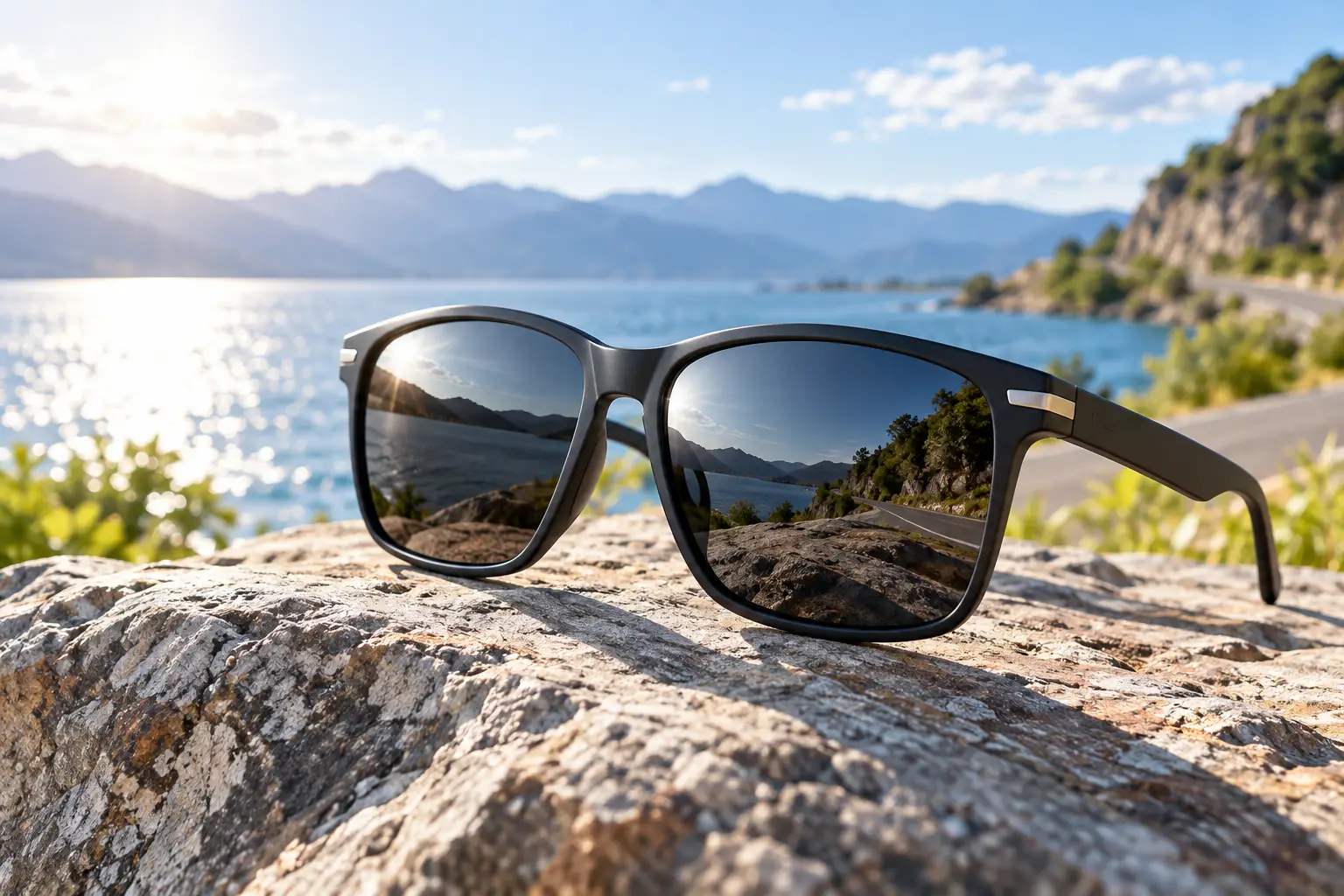
You know the moment. You’re merging onto the highway at 5 p.m., the sun bounces off the car ahead, and for half a second the whole lane turns into a white smear. Or you’re on a dock, staring at water that looks like hammered aluminum, wondering where the fish went. That isn’t just “bright light.” It’s glare, and it behaves very differently from ordinary sunlight. Regular tinted lenses simply dim everything, glare included. Glare proof sunglasses go after the reflection itself.
The phrase “glare proof” is a marketing shorthand, so let’s be honest from the start: no lens makes glare vanish in every situation. What good polarized lenses do is filter out the horizontally reflected light that bounces off roads, water, snow, and car hoods, which is the light that makes you squint. According to Harvard Health Publishing’s overview of polarized sunglasses, polarized lenses reduce glare from horizontal surfaces, ease eye strain, and help you pick out details, but they don’t replace UV protection on their own and aren’t meant for night driving.
What Is Glare Proof Sunglasses?
Glare proof sunglasses are sunglasses with polarized lenses: a built-in filter that blocks horizontally oriented light reflecting off flat surfaces like water, pavement, and windshields. The best pairs combine polarization with 100% UVA/UVB (UV400) protection, so you get sharper contrast, less squinting, and less eye fatigue outdoors.
In this guide, you’ll find seven real pairs available on amazon.com, from under-$35 budget picks to premium glass lenses, plus practical advice on lens colors, fit, driving, and care. Every recommendation is based on published specs, brand lens technology, and recurring themes in customer reviews, not on hype.
Quick Comparison: Glare Proof Sunglasses at a Glance
| Product | Lens Tech | Price Range | Best for |
|---|---|---|---|
| Costa Del Mar Tuna Alley 580G | 580G polarized glass | $250–$300 | Costa Tuna Alley: anglers and boaters wanting max clarity |
| Maui Jim Hookipa | PolarizedPlus2 | $200–$280 | Maui Jim Hookipa: lightweight all-day driving and travel |
| Smith Guide’s Choice | ChromaPop polarized (glass or poly) | $200–$280 | Smith Guide’s Choice: larger faces, sight fishing |
| Oakley Holbrook Prizm Polarized | Prizm polarized polycarbonate | $170–$230 | Oakley Holbrook: active everyday wear |
| Ray-Ban RB2132 New Wayfarer Polarized | Polarized green lens | $170–$230 | Ray-Ban New Wayfarer: classic style, city driving |
| KastKing Huzzah | TAC polarized | $20–$35 | KastKing Huzzah: budget water sports |
| KALIYADI Polarized 3-Pack | TAC polarized UV400 | $20–$35 (3 pairs) | KALIYADI 3-Pack: backups for car, bag, and beach |
Looking at the table, the real split isn’t brand versus brand; it’s lens material and optical precision. The three premium picks (Costa Tuna Alley, Maui Jim Hookipa, Smith Guide’s Choice) invest in color-enhancing lens tech and coatings, while the KastKing Huzzah and KALIYADI 3-Pack deliver basic polarization at a fraction of the cost. If you lose sunglasses every summer, the budget tier makes more sense than you’d think; if you stare at water or highway for hours, the premium optics earn their keep.
💬 One click helps other shoppers make an informed choice too! 😊
Top 7 Glare Proof Sunglasses: Expert Analysis
Prices below are ranges at the time of writing; prices may vary, so check the current price on Amazon before buying.
1. Costa Del Mar Tuna Alley 580G — sharpest view on open water
The Costa Del Mar Tuna Alley 580G is built for people who spend hours facing reflective water and want the clearest possible view through it. 🎣
Costa’s 580 lens technology is designed to filter harsh yellow light around the 580-nanometer wavelength while boosting reds, blues, and greens. In practice, that means colors underwater (weed edges, sand flats, the flash of a fish) look more separated instead of blending into one murky tone. The “G” stands for glass: Costa’s LightWave glass is marketed as about 20% thinner and 22% lighter than average polarized glass, which matters because standard glass lenses can feel heavy on your nose by the end of a long day. The Tuna Alley itself is a large frame (listed in a 62 size), so it covers more of your field of view and blocks side glare.
Based on comparing the specs, this is the pick for serious anglers, boaters, and anyone with a medium-to-large face who prioritizes optical clarity over weight. If you have a narrow face, the big frame may slide or feel oversized.
Customer reviews consistently praise the clarity and scratch resistance of the glass lens; the most common complaints involve the price and the heft compared with polycarbonate frames.
Pros:
- ✅ Glass lens resists scratches better than plastic
- ✅ Color-enhancing 580 tech sharpens underwater contrast
- ✅ Large frame blocks glare from the sides
Cons:
- ❌ Heavier than polycarbonate alternatives
- ❌ Too large for narrow or small faces
Expect to pay roughly $250 to $300; for daily water use, it’s premium money that buys genuinely premium optics.
2. Maui Jim Hookipa — lightest premium pair for long drives
The Maui Jim Hookipa strips away the bulk: a rimless design that almost disappears on your face. 🚗
Every Maui Jim lens uses PolarizedPlus2 technology, which the brand says removes 99.9% of horizontal glare and blocks 100% of UVA and UVB rays. Maui Jim also applies an anti-reflective coating on the back of the lens, which cuts the “bounce-back” glare that happens when the sun is behind you, a detail most cheap sunglasses skip entirely. The rimless build keeps weight down, so you’re less likely to get pressure marks on your nose during a four-hour road trip. Maui Jim sunglasses also carry the Skin Cancer Foundation’s Seal of Recommendation.
Here’s what to weigh: rimless frames give you an unobstructed field of view (no frame edge cutting into your peripheral vision), but the lens edges are exposed. Toss them loose in a bag, and you’ll regret it.
Reviews commonly highlight how light and comfortable the Hookipa feels and how vivid colors look; some buyers note the rimless design feels more delicate than a full frame.
Pros:
- ✅ Rimless build feels nearly weightless on long drives
- ✅ Backside anti-reflective coating reduces rear glare
- ✅ Vivid but natural color enhancement
Cons:
- ❌ Exposed lens edges need careful handling
- ❌ Less wraparound coverage than sport frames
Usually found between $200 and $280, it’s excellent value for drivers who wear sunglasses daily.
3. Smith Guide’s Choice — best fit for larger faces
The Smith Guide’s Choice is a wide, wraparound pair that outdoor reviewers repeatedly single out for both performance and big-face comfort. 🌊
Smith’s ChromaPop polarized lenses use a filter that targets the wavelengths where colors overlap, so edges and textures look crisper. On water, that translates into spotting structure and movement faster; on a trail, it means roots and rocks pop out from shadows. The frame wraps around the face and adds side shields, which blocks peripheral glare (the kind that sneaks in when the sun is low and to one side). You can choose glass for maximum clarity or polycarbonate for lighter weight and better impact resistance.
On paper, this is the most “purpose-built” frame in the list. It’s ideal for anglers, kayakers, and anyone with a wider head who finds most sunglasses pinch at the temples. Outdoor Life named it its best overall polarized pair and notes it fits larger faces best, which matches the general review consensus.
Buyers frequently praise the coverage and contrast; a common caution is that the frame looks oversized on smaller faces.
Pros:
- ✅ Wraparound shape with side shields blocks peripheral glare
- ✅ ChromaPop lenses add strong contrast outdoors
- ✅ Choice of glass or polycarbonate lens
Cons:
- ❌ Looks and feels big on small faces
- ❌ Sporty look isn’t for office or dressy wear
In the $200 to $280 range, it’s a smart buy if fit has been your biggest problem with sunglasses.
4. Oakley Holbrook Prizm Polarized — best all-rounder for active days
The Oakley Holbrook Prizm Polarized blends a casual, square silhouette with the athletic DNA Oakley is known for. 🏃♂️
The frame is made from Oakley’s O Matter material, a lightweight, flexible nylon-based compound that handles being pushed onto your head or dropped on a car seat without snapping. Prizm polarized lenses tune color and contrast for outdoor light, so shadows on a trail or curbs on a bright sidewalk read more clearly. Oakley’s Plutonite polycarbonate lens material filters UV and holds up well against impact, an important point if you bike, run, or play pickup basketball in your shades.
What most buyers overlook: the Holbrook comes in standard and XL sizes, and the wrong size changes everything. Check the lens width before ordering.
Reviews consistently mention comfortable all-day fit and strong glare reduction. The recurring warning in customer feedback concerns counterfeits from third-party sellers, so buy from Oakley’s official storefront or Amazon-fulfilled listings.
Pros:
- ✅ Flexible, lightweight frame survives everyday abuse
- ✅ Impact-resistant polycarbonate lens suits sports
- ✅ Casual style works off the trail too
Cons:
- ❌ Knockoffs are common on third-party listings
- ❌ Lens scratches more easily than glass
Typically between $170 and $230, it’s strong value for one pair that handles commutes and weekends.
5. Ray-Ban RB2132 New Wayfarer Polarized — classic style meets real glare control
The Ray-Ban RB2132 New Wayfarer Polarized is the “I want to look good and see well” pick. 😎
The New Wayfarer is a slightly smaller, softer take on the original Wayfarer, which makes it more comfortable for average and smaller faces. The polarized green lens is Ray-Ban’s signature tint; green-based lenses keep colors close to natural while still cutting brightness, which is why they’re popular for city driving where you need to read traffic lights accurately. It’s sold in several sizes (the 55 mm version is the most common), so it’s easy to dial in fit.
Based on comparing the specs, the Ray-Ban isn’t the most technical lens here, and it doesn’t wrap around your face, so side glare can creep in when the sun is low. But for everyday wear, from coffee runs to commuting, it covers the basics with timeless style. Ray-Ban offers crystal and polycarbonate lens variants, so check the listing for the lens material if weight or impact resistance matters to you.
Reviews generally praise the look, build, and glare reduction, while some buyers flag counterfeit listings and say the frame can feel snug for wide faces.
Pros:
- ✅ Timeless style works almost anywhere
- ✅ Green polarized lens keeps colors natural
- ✅ Multiple sizes for a better fit
Cons:
- ❌ Flat front lets in some side glare
- ❌ Fakes are widespread outside official listings
At around $170 to $230, you’re partly paying for the name, but the optics hold up.
6. KastKing Huzzah — best budget pick for water sports
The KastKing Huzzah proves you don’t need to spend triple digits to cut water glare. 🚣
KastKing is a fishing gear brand, and the Huzzah is designed with that use in mind: a wraparound sport frame and TAC (tri-acetate cellulose) polarized lenses rated for UV400 protection. TAC is the standard material in affordable polarized sunglasses; it filters glare effectively but doesn’t match the optical precision or scratch resistance of premium glass or high-end polycarbonate. In real terms, you’ll still see into shallow water and cut road glare, just with less color “pop” than a Costa or Smith.
This is the pair to buy if you fish, kayak, or paddleboard and don’t want to cry when your sunglasses fall overboard. It’s also a smart trial pair if you’ve never worn polarized lenses and want to see how you like them.
Customer reviews commonly praise the value and glare reduction for the price; recurring complaints involve lens scratches over time and a less refined fit.
Pros:
- ✅ Real polarized glare reduction at a low price
- ✅ Wraparound shape blocks side light
- ✅ Low-stakes pair for boats and beaches
Cons:
- ❌ Lenses scratch more readily than premium options
- ❌ Optics less crisp than glass lenses
Usually between $20 and $35, it’s outstanding value-for-money for casual water use.
7. KALIYADI Polarized 3-Pack — best value for “I always lose my sunglasses”
The KALIYADI Polarized 3-Pack solves a different problem: having a decent pair wherever you are. 🛍️
You get three pairs of polarized sunglasses with UV400 protection, often in different frame colors or styles depending on the listing. One goes in the car visor, one in your gym bag, one at the beach house. The lenses are TAC polarized, so glare reduction is genuine, but you shouldn’t expect the color-tuning or anti-reflective backside coatings of a premium lens. Frames are lightweight plastic with basic hinges.
Here’s the honest take: a three-pack won’t feel like a luxury product, and it isn’t trying to. Its value is redundancy. If you tend to sit on, lose, or forget sunglasses, three “good enough” polarized pairs may protect your eyes more often than one expensive pair sitting at home.
Reviews consistently call it strong value for the money; the most common complaints mention hinges loosening over time and a fit that runs on the smaller side for some buyers.
Pros:
- ✅ Three polarized pairs for the price of one budget pair
- ✅ UV400 protection on every pair
- ✅ Light and comfortable for casual wear
Cons:
- ❌ Hinges may loosen with heavy use
- ❌ Fit may run small for wide faces
Typically in the $20 to $35 range for all three, it’s hard to beat on pure value.
✨ Don’t miss these top-rated glare fighters!
🔍 Take your outdoor comfort to the next level with this carefully curated lineup. Click a highlighted product to check current pricing and availability. These picks will help you see clearer, squint less, and enjoy every sunny drive and beach day! ☀️
Getting Started: Your First 30 Days With Glare Proof Sunglasses
New polarized sunglasses come with a short adjustment curve. Here’s how to make the first month go smoothly. ✅
Week 1: Check fit and authenticity
- Test the polarization. Hold your new pair in front of a phone or laptop screen and tilt your head 90 degrees. If the screen darkens or goes black, the lens is genuinely polarized.
- Check fit. The frame shouldn’t touch your cheeks when you smile, and your eyelashes shouldn’t brush the lens. If the frame slides down when you look at your feet, it’s too wide.
- Verify authenticity. For the Ray-Ban New Wayfarer, Oakley Holbrook, and Costa Tuna Alley, look for etched lens markings (Costa etches “580G” or “580P” on the lens) and compare against the brand’s own product pages.
Weeks 2–3: Learn the quirks
You’ll notice that some phone screens, gas pump displays, and car dashboard readouts look dim or show rainbow patterns. That’s normal with polarized lenses, not a defect. You may also see faint patterns in tempered car windows. Tilt your head slightly, or simply get used to it.
Week 4: Build a care routine
- Rinse lenses with water before wiping to remove grit (dry wiping causes most scratches).
- Use a microfiber cloth, never your T-shirt.
- Store them in the case, not on the dashboard, where heat can warp frames and damage coatings.
- Never use paper towels, glass cleaner, or ammonia-based sprays on coated lenses.
Common first-month mistakes
Wearing them at night, leaving them in a hot car, and putting them face-down on a table are the three fastest ways to ruin a good pair. Avoid those, and even the budget KastKing Huzzah will last far longer than you’d expect.
Real-World Scenarios: Matching Glare Proof Sunglasses to Your Life
Specs only matter when they line up with how you actually live. Here are three common buyer profiles and the reasoning behind each match.
Profile 1: The Weekend Angler
Situation: Fishes lakes and inshore saltwater two to three times a month, spends four to six hours on the water per trip, budget up to $300.
Best match: Costa Del Mar Tuna Alley 580G or Smith Guide’s Choice.
Why: On water, glare reduction isn’t comfort; it’s information. Color-enhancing lenses help you separate weed beds, drop-offs, and moving fish. Glass lenses also hold up better to salt spray wiping. If your face is on the larger side, the Smith Guide’s Choice fits better; if you want maximum clarity and don’t mind weight, choose the Costa Tuna Alley. Keep a KastKing Huzzah as a backup in the tackle box.
Profile 2: The Daily Commuter
Situation: Drives 40 to 90 minutes a day, often into a rising or setting sun, budget $150 to $280.
Best match: Maui Jim Hookipa.
Why: Long drives reward low weight, and the backside anti-reflective coating helps when sunlight hits from behind. Its rimless design also leaves your side vision unobstructed, which matters for checking blind spots. If you prefer a classic look, the Ray-Ban New Wayfarer is a stylish alternative.
Profile 3: The Busy Family
Situation: Two adults, frequent beach and park trips, sunglasses that get sat on, lost, or “borrowed,” budget under $50 total.
Best match: KALIYADI Polarized 3-Pack.
Why: Redundancy beats perfection here. Three UV400 polarized pairs mean someone always has protection. Add one sturdier pair, like the Oakley Holbrook, for whoever drives most.
Problem → Solution: Fixing Common Polarized Lens Annoyances
Even great glare proof sunglasses come with quirks. Here’s how to solve the five most common ones.
Problem 1: “I can’t read my phone or car display.”
Solution: Polarized lenses can black out LCD screens at certain angles. Tilt your phone slightly or turn it to landscape. For pilots, crane operators, or anyone who must read digital displays constantly, non-polarized UV400 lenses may be the safer choice.
Problem 2: “There’s still glare when the sun is behind me.”
Solution: That’s bounce-back glare reflecting off the inside of the lens. Choose a lens with a backside anti-reflective coating, such as the Maui Jim Hookipa.
Problem 3: “Light sneaks in from the sides.”
Solution: Flat-front frames leak peripheral light. Switch to a wraparound shape like the Smith Guide’s Choice or KastKing Huzzah, or add a brimmed hat.
Problem 4: “My lenses get scratched within months.”
Solution: Polycarbonate and TAC lenses scratch more easily than glass. Rinse before wiping, always use the case, or upgrade to a glass lens like the Costa Tuna Alley 580G.
Problem 5: “My sunglasses give me a headache.”
Solution: Poor-quality lenses can have optical distortion. Look through the lens at a straight line (a door frame) and move your head slowly; if the line bends or warps, the lens has distortion. Also check fit: pressure behind the ears is a common headache trigger. If headaches persist, talk to an eye care professional.
Glare Proof Sunglasses Compared: Specs, Lenses, and Value
| Product | Lens Material | Frame Style | Side Coverage | Best for |
|---|---|---|---|---|
| Costa Tuna Alley 580G | Glass | Large, full-rim | High | Costa Tuna Alley: offshore and lake fishing |
| Maui Jim Hookipa | PolarizedPlus2 | Rimless | Medium | Maui Jim Hookipa: commuting and travel |
| Smith Guide’s Choice | Glass or polycarbonate | Wraparound with side shields | Very high | Smith Guide’s Choice: sight fishing, big faces |
| Oakley Holbrook | Polycarbonate | Square, full-rim | Medium | Oakley Holbrook: sports and daily wear |
| Ray-Ban New Wayfarer | Crystal or polycarbonate variants | Classic square | Low | Ray-Ban New Wayfarer: style-first city use |
| KastKing Huzzah | TAC | Sport wrap | High | KastKing Huzzah: budget water sports |
| KALIYADI 3-Pack | TAC | Assorted | Low–medium | KALIYADI 3-Pack: backups everywhere |
The pattern here is clear: side coverage and lens material, not logos, determine how “glare proof” a pair feels in real use. The Smith Guide’s Choice and KastKing Huzzah both win on peripheral coverage, despite a huge price gap, while the Ray-Ban New Wayfarer trades coverage for style. If you’re choosing between two pairs, ask which one blocks light from the angle that bothers you most.
How to Choose Glare Proof Sunglasses
Use these seven steps to narrow your options quickly:
- Confirm true polarization. Not every “anti-glare” label means polarized. Look for “polarized” explicitly, then test it with a screen.
- Demand 100% UV protection. Polarization handles glare; UV400 or 100% UVA/UVB protection handles invisible radiation. You need both.
- Pick a lens color for your environment. Gray keeps colors true for driving; brown and amber boost contrast in variable light; green mirror suits inshore water; blue mirror handles bright open ocean.
- Choose lens material by lifestyle. Glass offers top clarity and scratch resistance; polycarbonate is lighter and impact-resistant; TAC is budget-friendly.
- Prioritize coverage. Wraparound or larger frames block more stray light, which is especially important near water and snow.
- Get the fit right. Measure your current glasses (lens width, bridge, and temple length are printed inside the arm) and match them.
- Buy from trusted sellers. Counterfeits are common for big brands; stick to official brand storefronts or listings shipped and sold by Amazon.
If you want to understand the physics behind step 1, the Wikipedia article on polarizers explains how polarizing filters selectively absorb light based on its orientation, which is exactly the principle polarized sunglass lenses rely on.
Polarized Sunglasses vs. Regular Tinted Sunglasses
Plenty of shoppers assume darker equals better. It doesn’t. Polarized sunglasses and regular tinted sunglasses solve different problems, and confusing the two is the most common buying mistake in this category.
A regular tinted lens reduces the overall amount of light reaching your eyes. Glare gets dimmer, but so does everything else, so the reflection still dominates your view. Polarized sunglasses use a filter oriented to block horizontally reflected light specifically, which is why the surface of a lake suddenly looks transparent and the glint off a car hood disappears.
| Feature | Polarized Sunglasses | Regular Tinted Sunglasses | Clear Anti-Reflective Glasses |
|---|---|---|---|
| Cuts reflected glare | ✅ Strongly | ⚠️ Only dims it | ❌ Reduces lens reflections only |
| Improves contrast on water/roads | ✅ Yes | ❌ Limited | ❌ No |
| Works with LCD screens | ⚠️ Can black out some screens | ✅ Yes | ✅ Yes |
| Safe for night driving | ❌ No | ❌ No | ✅ Yes |
| Best for | Costa Tuna Alley, Maui Jim Hookipa: water, driving, snow | Casual sun, pilots, screen-heavy work | Night driving and screen use |
The takeaway is simple: polarized sunglasses are the clear winner for daytime outdoor glare, but regular tints still have a place for screen-heavy jobs. Note that “anti-reflective” coatings on clear glasses solve a completely different problem (reflections on the lens itself) and shouldn’t be confused with polarized protection.
Polarized Sunglasses for Driving: What Works and What to Avoid
Driving is where glare turns from annoying to dangerous. Sun reflecting off wet pavement, a windshield ahead, or a light-colored road can momentarily hide brake lights, pedestrians, or lane lines. Good polarized sunglasses for driving reduce those reflections so your eyes don’t constantly react to bright flashes.
What works:
- Gray or brown lenses. Gray keeps color perception neutral, so traffic lights look the way they should; brown adds contrast on overcast days.
- Medium tint. Very dark lenses can be a problem when you drive into tunnels or shaded streets.
- Backside anti-reflective coatings. These reduce reflections from sunlight behind you, which the Maui Jim Hookipa offers.
- Lightweight frames. You’ll forget you’re wearing the Maui Jim Hookipa or Oakley Holbrook after an hour; heavy glass frames can feel tiring on long trips.
What to avoid:
- Polarized lenses at night. No sunglasses improve night vision; they only reduce the light you need.
- Heavily mirrored, very dark lenses for everyday commuting, especially in changeable weather.
- Ignoring dashboard readability. Some head-up displays and digital clusters dim through polarized lenses; test before a long trip.
Polarized sunglasses for driving are one of the best low-cost safety upgrades you can make, but treat them as a daytime tool only.
Anti Glare Sunglasses: Features That Actually Matter (and Ones That Don’t)
The phrase “anti glare sunglasses” gets slapped on everything from premium glass to $8 gas-station shades. Here’s how to separate the useful features from the marketing.
✅ Features that actually matter
- Polarization quality. Brands like Maui Jim publish specific glare-reduction claims; budget TAC lenses vary more. Test with a screen.
- UV400 / 100% UVA-UVB. Non-negotiable for any pair.
- Lens material. Glass for clarity and scratch resistance, polycarbonate for impact safety.
- Backside anti-reflective coating. It sounds technical, but it fixes a real problem.
- Coverage and fit. A perfect lens in a loose frame still lets in glare.
❌ Features that matter less than you’d think
- “HD” lenses. It’s a marketing term with no standardized definition.
- Mirror finishes for driving. Mirrors reduce light and look great, but they don’t make polarization stronger.
- Extreme darkness. Darker isn’t more anti-glare; polarization does the glare work, tint controls overall brightness.
- Blue-light-blocking claims on sunglasses. Outdoor sunlight dwarfs screen blue light; UV protection is the bigger priority.
In short, the best anti glare sunglasses don’t need the most buzzwords. They need verified polarization, full UV protection, and a frame that actually fits.
Sunglasses for Glare and Eye Strain: Who Benefits Most
Glare doesn’t affect everyone equally. If you’re shopping for sunglasses for glare and eye strain, it helps to know whether you’re in a high-benefit group.
Drivers and commuters
Daily exposure to reflections from cars and pavement makes drivers prime candidates. The Maui Jim Hookipa and Ray-Ban New Wayfarer are comfortable, everyday choices.
Anglers, boaters, and beachgoers
Water is one of the strongest glare sources. The Costa Tuna Alley 580G and Smith Guide’s Choice pair coverage with color enhancement; the KastKing Huzzah is the budget fallback.
Light-sensitive people
Many people with light sensitivity find bright reflections uncomfortable and tiring. Polarized lenses reduce the reflected component of that light, which can make outdoor time more comfortable. If light sensitivity is new, severe, or accompanied by pain, see an eye care professional before assuming sunglasses are the fix.
Older adults
As eyes age, glare sensitivity often increases and recovery from bright flashes may take longer. A lightweight frame, a gray or brown lens, and generous coverage help.
Snow sports and high-altitude hikers
Snow reflects a large share of sunlight, and UV intensity rises at altitude. Wraparound polarized frames with full UV protection are the priority; dedicated glacier glasses are better for extreme conditions.
The common thread: the more time you spend facing reflective surfaces, the more you’ll notice the difference.
Common Mistakes to Avoid When Buying Glare Proof Sunglasses
Most disappointing purchases come down to a handful of predictable mistakes.
- Assuming dark lenses are polarized. Tint and polarization are separate features. A very dark non-polarized lens can still let glare dominate your view.
- Skipping the UV check. Polarization alone doesn’t block UV. Look for “UV400” or “100% UVA/UVB” on the label or listing.
- Buying the wrong size. Too wide, and light floods in from the sides; too narrow, and temples pinch. Use the measurements printed inside your current frames.
- Picking a lens color for style alone. A blue mirror looks great but is designed for bright open water, not shady forest trails or overcast commutes.
- Ignoring counterfeits. Popular models like the Ray-Ban New Wayfarer and Oakley Holbrook are frequently faked. A suspiciously low price is a red flag.
- Overspending for casual use. If you mostly wear sunglasses on short errands, the KALIYADI 3-Pack or KastKing Huzzah may give you 80% of the benefit for a fraction of the cost.
- Underspending for heavy use. If you’re on the water every weekend, a premium lens like the Costa Tuna Alley 580G pays off in clarity, durability, and less eye fatigue.
Avoid these, and you’ll end up with glare proof sunglasses that match how you actually spend your time.
Safety, Regulations, and Standards
Sunglasses sold in the US fall under a mix of voluntary standards and federal rules. Understanding them helps you judge quality beyond brand names.
ANSI Z80.3
The main US standard for nonprescription sunglasses is ANSI Z80.3, developed through The Vision Council. As the ANSI blog’s overview of Z80.3 explains, the current 2025 edition covers UV protection, luminous transmittance (how much light gets through), traffic signal recognition, and the durability of frames and lenses. Compliance is voluntary, but reputable brands often reference it.
FDA impact requirements
Sunglasses are regulated as medical devices in the US, and lenses must pass the FDA’s impact-resistance test under 21 CFR 801.410. That’s a baseline, not a guarantee of sports-grade protection.
Safety glasses are different
If you need polarized protection on a job site, look for ANSI/ISEA Z87.1-rated polarized safety glasses. Regular fashion or sport sunglasses aren’t certified for work hazards.
Practical safety checklist ✅
- Look for “UV400” or “100% UVA/UVB” labeling.
- Choose polycarbonate or Trivex lenses for sports and active kids.
- Avoid very dark lenses for driving in variable light.
- Never use regular sunglasses to look at the sun or a solar eclipse; that requires ISO 12312-2 eclipse viewers.
Long-Term Cost and Maintenance
A $25 pair and a $280 pair can end up costing about the same per year, depending on how long each one lasts and how often it gets lost.
Cost-per-year math
| Product | Typical Price Range | Realistic Lifespan* | Approx. Cost per Year | Best for |
|---|---|---|---|---|
| KALIYADI 3-Pack | $20–$35 (3 pairs) | 1–2 years | $10–$35 | KALIYADI 3-Pack: loss-prone households |
| KastKing Huzzah | $20–$35 | 1–2 years | $10–$35 | KastKing Huzzah: rough water use |
| Oakley Holbrook | $170–$230 | 3–5 years | $35–$75 | Oakley Holbrook: daily active wear |
| Costa Tuna Alley 580G | $250–$300 | 4–6+ years | $40–$75 | Costa Tuna Alley: frequent anglers |
*Lifespan estimates are illustrative, based on typical care and use; actual durability depends heavily on how you treat your sunglasses.
The math shows that premium pairs aren’t automatically expensive if you keep them for years, especially glass lenses that resist scratching. Budget pairs win when loss, not wear, is the main reason you replace sunglasses.
Maintenance that extends lifespan
- Rinse with lukewarm water before wiping; grit is the number one scratch culprit.
- Use a mild, lens-safe cleaner and a microfiber cloth.
- Tighten hinge screws once or twice a year with an eyeglass screwdriver.
- Keep them out of hot cars, which can warp frames and damage lens coatings.
- Check manufacturer warranties and lens replacement options; some premium brands offer repairs or replacement lenses, which is cheaper than a new pair.
FAQ: Glare Proof Sunglasses
❓ Are glare proof sunglasses worth the money?
❓ What is the best lens color for glare proof sunglasses?
❓ Can I get prescription glare proof sunglasses?
❓ Do cheap polarized sunglasses work as well as expensive ones?
❓ How long do polarized sunglasses last?
Conclusion: Choose the Glare Proof Sunglasses That Fit Your Life
The best glare proof sunglasses aren’t the darkest, the flashiest, or even the most expensive. They’re the pair with genuine polarization, full UV protection, and a fit that blocks light from the angles you actually face every day.
If you spend serious time on the water, the Costa Del Mar Tuna Alley 580G delivers the clearest optics in this lineup, while the Smith Guide’s Choice is the go-to for larger faces and sight fishing. Daily drivers will appreciate the light, coated lenses of the Maui Jim Hookipa. For one versatile pair that handles workouts and weekends, the Oakley Holbrook Prizm Polarized is hard to beat, and style-first buyers can trust the Ray-Ban RB2132 New Wayfarer Polarized. On a budget, the KastKing Huzzah and KALIYADI Polarized 3-Pack prove that real glare reduction doesn’t have to cost much.
Before you buy, run through the checklist: polarization, UV400, lens color, material, coverage, fit, and a trusted seller. And keep regular eye exams on your calendar; the American Optometric Association’s guidance on choosing sunglasses notes that sunglasses that don’t meet standards may fall short on UV protection regardless of how dark they look.
🌞 Ready to stop squinting for good?
👓 Pick the pair that matches your days, from open water to rush hour. Click any highlighted product to check current pricing and availability, and give your eyes the clear, comfortable view they deserve!
Recommended for You
- Colored Eyeglass Lenses: 7 Best Tints That Actually Work (2026)
- Tinted Eyeglass Lenses: 7 Best Picks That Actually Work (2026)
- Glasses Tinting: 7 Best Options + Proven DIY Guide (2026)
Disclaimer: This post contains affiliate links. As an Amazon Associate, I earn from qualifying purchases made through these links, at no additional cost to you.
✨ Found this article helpful? Share it with someone who needs it! 💬🤗