In This Article
Why Blue Polarized Sunglasses Deserve a Spot in Your Bag
Picture a bright July afternoon on the lake. The water looks like a sheet of hammered tinfoil, you’re squinting so hard your forehead aches, and you can’t see a thing below the surface. That’s glare — and it’s exactly the problem blue polarized sunglasses were built to solve.
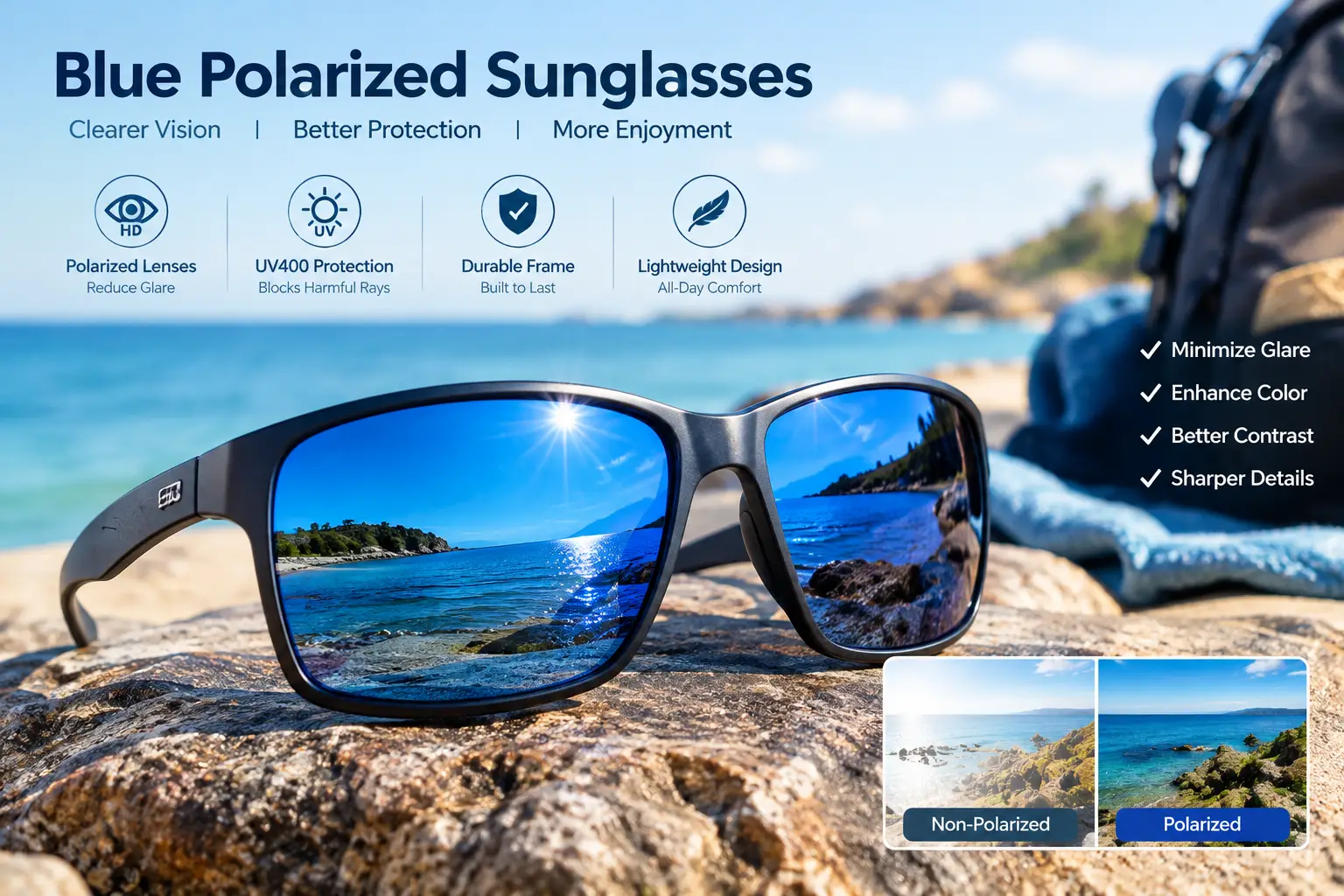
But here’s the twist most shoppers miss: the “blue” in blue polarized sunglasses usually isn’t what you look through. On the best models, the blue is a mirror coating on the outside of a gray or neutral lens. The world doesn’t turn blue; it simply gets calmer, crisper, and a lot less blinding. That one detail changes how you should shop, and it’s why a $15 pair and a $300 pair can look nearly identical on a product page yet behave completely differently on the water.
What Are Blue Polarized Sunglasses?
Blue polarized sunglasses combine a polarizing filter, which blocks horizontally reflected glare from water, roads, and sand, with a blue mirror coating or blue-tinted lens. The mirror reflects a share of intense light before it reaches your eyes, making them best suited to bright, open, high-glare environments.
One important caveat before we dive in: polarization and UV protection are two separate features. As the American Academy of Ophthalmology’s sunglasses guidance points out, polarized lenses cut glare, not UV — so the label you really want is “100% UV protection” or “UV400,” in addition to polarization.
In this guide, we compare seven real models available on amazon.com, from a budget backup pair to premium glass lenses built for offshore anglers. You’ll get honest analysis grounded in published specs and aggregated customer reviews, plus practical advice on care, fit, and choosing the right lens for your life.
Quick Comparison: The Best Blue Polarized Sunglasses at a Glance
| Product | Lens Type | Frame Style | Approx. Price Range | Best For |
|---|---|---|---|---|
| Costa Fantail Pro (Blue Mirror 580G) | Polarized glass, gray base + blue mirror | Medium-large sport-lifestyle | $270–$320 | Costa Fantail Pro — offshore fishing |
| Maui Jim Peahi (Blue Hawaii) | PolarizedPlus2, Neutral Grey base + blue flash mirror | Oversized wrap, 65mm | $250–$350 | Maui Jim Peahi — large faces, max coverage |
| Oakley Holbrook Prizm Sapphire Polarized | Prizm polarized, 12% VLT | Classic square, 57mm | $180–$240 | Oakley Holbrook — everyday style |
| Oakley Radar EV Path Prizm Sapphire Polarized | Prizm polarized shield, 12% VLT | Sport shield | $210–$280 | Oakley Radar EV Path — cycling and running |
| Smith Lowdown 2 (ChromaPop Polarized Blue Mirror) | ChromaPop polarized, 14% VLT | Retro medium fit | $190–$240 | Smith Lowdown 2 — all-day comfort |
| Knockaround Fast Lanes Sport Polarized | Polycarbonate polarized, aqua/blue mirror | Rectangular, medium | $30–$45 | Knockaround Fast Lanes — beach and casual |
| SUNGAIT Ultra Lightweight Rectangular Polarized | TAC polarized, blue mirror option | Metal rectangle | $12–$25 | SUNGAIT — budget backup pair |
Reading the table top to bottom, the big jump isn’t just price — it’s lens engineering. The Costa Fantail Pro and Maui Jim Peahi use advanced color-management lens systems aimed at all-day water use, while the Oakley Holbrook, Oakley Radar EV Path, and Smith Lowdown 2 sit in a mid-premium band where contrast-enhancing lens tech is the main selling point. The Knockaround Fast Lanes and SUNGAIT pairs deliver the core benefit — polarization plus UV400 — at a fraction of the cost, trading away optical refinement and coating durability.
💬 One click helps other shoppers make an informed choice too! 😊
Top 7 Blue Polarized Sunglasses: Expert Analysis
1. Costa Fantail Pro — the open-water angler’s benchmark
The Costa Fantail Pro with Blue Mirror 580G lenses is designed for one job above all: helping you read bright, open water for hours without fatigue. It’s the slimmer sibling of Costa’s Blackfin Pro, bringing the same PRO Series fishing-focused upgrades in a less bulky frame.
The 580G lens is real polarized glass, and Costa’s 580 technology is engineered to absorb high-energy blue light and filter harsh yellow wavelengths. In practice, that selective filtering tends to make blues and greens look richer and edges look sharper — useful when you’re trying to spot a color change over a reef or a shadow on the flats. Costa’s C-WALL coating adds scratch resistance, which matters more than it sounds once salt crystals and sand start grinding on your lenses.
Based on comparing the specs, this is the pick for serious saltwater anglers and boaters who spend full days under direct sun. The blue mirror over a gray base is notably dark, so it’s a bright-light lens, not a dawn-and-dusk lens.
Customer reviews consistently praise the optical clarity of Costa’s glass lenses; the most common trade-off buyers mention is weight compared with polycarbonate frames.
Pros:
- ✅ Genuine polarized glass delivers excellent optical clarity
- ✅ Scratch-resistant coating suits sandy, salty environments
- ✅ Slimmer than the Blackfin Pro for medium-to-large faces
Cons:
- ❌ Glass lenses add weight versus polycarbonate
- ❌ Too dark for low-light mornings or overcast days
Expect to pay roughly $270 to $320 (check the current price) — steep, but justified if fishing is your main use case.
2. Maui Jim Peahi — maximum coverage for bigger faces
The Maui Jim Peahi in Blue Hawaii is a wraparound built for people who want glare blocked from every angle, including the sides. With a 65mm oversized lens, it’s one of the most protective frames in this lineup.
Maui Jim’s Blue Hawaii lens applies a blue flash mirror to the outside of its PolarizedPlus2 Neutral Grey lens. The brand says PolarizedPlus2 wipes out 99.9% of glare and blocks 100% of UV while boosting color. What that means in real life: a dark, neutral view that keeps colors natural instead of washing everything in brown or green. Depending on the listing, the Peahi comes with SuperThin Glass or lighter polycarbonate-based lenses — check the variant, since that affects both clarity and weight.
Who’s it for? Drivers, boaters, and anyone with a larger face who hates light leaking in around the edges. The wrap shape is the main reason to choose it over flatter frames.
Aggregated reviews are strongly positive on lens clarity and comfort, with several owners praising the peripheral coverage. However, some reviewers report lens scratching on non-glass versions, and a few mention the rubberized frame finish peeling or getting sticky over time.
Pros:
- ✅ Wraparound shape blocks side glare effectively
- ✅ Neutral gray base keeps colors natural
- ✅ Excellent fit for larger and wider faces
Cons:
- ❌ Too big for narrow or small faces
- ❌ Some owners report frame coating wear over time
Typically priced between $250 and $350 depending on lens material — a premium buy that pays off mainly for larger faces.
3. Oakley Holbrook Prizm Sapphire Polarized — everyday classic with sport-grade optics
The Oakley Holbrook Prizm Sapphire Polarized (model OO9102-F055 in matte black) blends a mid-century square silhouette with Oakley’s modern lens tech. It’s the pair you can wear to brunch and then onto a boat without looking like you raided a pro cycling team.
Prizm Sapphire is a 12% light transmission lens, which places it firmly in bright-sun territory. Prizm’s job is to fine-tune specific wavelengths to boost contrast, while Oakley’s HD Polarized layer is designed to remove reflected glare without the haze cheaper polarizing films can introduce. Practically speaking, you get punchy contrast on sunny days — the asphalt, water, and foliage look more defined — but you’ll want a lighter pair for cloudy afternoons.
Our analysis suggests the Oakley Holbrook is ideal for everyday drivers and casual outdoor fans who want one premium pair that looks good everywhere. It’s also available in larger XL sizing and a smaller Holbrook S version, which helps if the standard 57mm feels off.
Reviews consistently highlight its sharp optics and durable O Matter frame; recurring complaints center on price and the fact that scratched lenses aren’t covered by Oakley’s warranty.
Pros:
- ✅ Timeless square design suits most outfits
- ✅ Prizm lens adds strong contrast in bright sun
- ✅ Multiple sizes available for better fit
Cons:
- ❌ 12% VLT is too dark for overcast days
- ❌ Lens scratches aren’t covered by warranty
Usually found in the $180 to $240 range — solid value for a premium everyday pair.
4. Oakley Radar EV Path Prizm Sapphire Polarized — built to stay put when you sweat
The Oakley Radar EV Path with Prizm Sapphire Polarized lenses is a performance shield for people who move fast. Its taller lens extends your upper field of view, which matters when you’re in a head-down cycling position and need to see the road ahead.
Like the Oakley Holbrook, it uses a 12% VLT Prizm Sapphire lens, but in a single-shield design. That’s a meaningful difference: a shield gives you an unbroken field of view with no bridge in the way and blocks wind and debris better. Oakley’s Unobtainium earsocks and nose pads are designed to grip harder as you sweat, so the glasses stay put on bumpy descents or tempo runs.
Who should buy it? Road cyclists, triathletes, and runners who train in bright sun. If you mostly drive or lounge, the sporty look is probably more than you need.
Aggregated feedback from riders consistently mentions stability and contrast as the main strengths. The most common caveat is that the polarized version can make some bike computer and phone screens harder to read at certain angles — a known side effect of polarization.
Pros:
- ✅ Shield lens offers an unobstructed field of view
- ✅ Grippy materials keep the frame stable when sweaty
- ✅ Tall lens suits aggressive riding positions
Cons:
- ❌ Polarization can dim some device screens
- ❌ Sporty style looks out of place off the bike
Expect roughly $210 to $280 — worth it for frequent athletes, overkill for casual use.
5. Smith Lowdown 2 ChromaPop Polarized Blue Mirror — retro looks, modern contrast boost
The Smith Lowdown 2 in Matte Black with ChromaPop Polarized Blue Mirror lenses looks like it could be from 1962 — which is exactly the point. Underneath that vintage silhouette sits genuinely modern lens tech.
The lens is a gray base with a deep blue mirror at 14% VLT, a little brighter than the Oakley Sapphire lenses. ChromaPop targets the wavelengths where the eye confuses blue-green and red-green, which tends to make colors read cleaner and edges crisper. Smith adds anti-reflective and hydroleophobic coatings, so sweat and fingerprints wipe off more easily. The bio-based Evolve frame, megol nose pads, and AutoLock hinges round out a frame built for all-day comfort.
Who’s it for? Commuters, travelers, and casual anglers who want premium optics without the sporty look. The medium fit and 4-base curve make it a natural choice for average-sized faces.
Reviews frequently praise how light the frame feels and how well the nose pads hold. Some buyers wish the hard case were included in every package, since certain listings ship with only a microfiber bag.
Pros:
- ✅ Classic look with modern contrast-boosting lenses
- ✅ Non-slip nose pads keep frames in place
- ✅ Easy-clean lens coatings resist smudges
Cons:
- ❌ Medium fit may feel narrow on larger heads
- ❌ Some listings include only a soft pouch
Typically between $190 and $240 — strong value for premium lenses in a versatile frame.
6. Knockaround Fast Lanes Sport Polarized — fun colors at a near-impulse price
The Knockaround Fast Lanes Sport Polarized proves you don’t need to spend a car payment to get legitimate glare reduction. Several colorways pair polarized aqua or blue mirrored lenses with playful, beachy frames.
The lenses are polycarbonate, UV400-rated, and described as FDA-approved impact resistant, with a lightweight frame of roughly 22 grams. The Sport version adds rubber nose pads to cut down on slipping and bouncing during a jog. In practical terms, that’s a pair you can toss in a beach bag, lend to a friend, or leave in the cup holder without anxiety.
Based on the specs, it’s best for casual beachgoers, people who constantly lose sunglasses, and anyone wanting a second “beater” pair. Note that not every Knockaround model is polarized, so double-check the listing.
Aggregated reviews consistently call out value as the top strength; reviewers often describe them as comfortable and good-looking for the price. Common complaints mention basic materials and a fit that can feel small on larger faces.
Pros:
- ✅ Polarized and UV400 at a very low price
- ✅ Lightweight frame with grippy nose pads
- ✅ Huge range of fun frame colors
Cons:
- ❌ Optics lack premium contrast enhancement
- ❌ Frame may feel snug on larger faces
Usually in the $30 to $45 range — excellent value for a casual or backup pair.
7. SUNGAIT Ultra Lightweight Rectangular Polarized — the budget backup that punches up
The SUNGAIT Ultra Lightweight Rectangular Polarized sunglasses are among the most widely reviewed budget polarized pairs on Amazon, and the blue mirror option gives you the look of a premium pair for pocket change.
The frame uses a lightweight aluminum-magnesium alloy at around 25 grams, with spring hinges and adjustable silicone nose pads. Lenses are polarized TAC film with UV400 protection, and the 62mm lens width provides decent coverage. In practice, TAC polarized lenses do the core job — killing road and water glare — but won’t match the color precision or scratch resistance of glass or premium polycarbonate.
Who’s it for? Budget shoppers, drivers who want a glovebox pair, and anyone curious whether blue mirrored lenses suit them before spending more.
The listing carries a high average rating across tens of thousands of ratings (check the current figure on Amazon). Review summaries consistently praise comfort and value, while recurring complaints include lenses occasionally popping out of the frame, a flimsy case, and pressure behind the ears from the metal temples.
Pros:
- ✅ Very affordable entry into polarized lenses
- ✅ Lightweight metal frame with adjustable nose pads
- ✅ Includes cloth, pouch, and mini screwdriver
Cons:
- ❌ Lenses can loosen from the frame over time
- ❌ Coatings scratch more easily than premium lenses
Generally priced between $12 and $25 — unbeatable as a backup, but not a lifetime pair.
Detailed Spec Comparison of the Top 7
| Product | Lens Material | Published VLT | Fit | Best For |
|---|---|---|---|---|
| Costa Fantail Pro | Polarized glass (580G) | Dark, bright-sun lens | Medium-large | Costa Fantail Pro — saltwater fishing |
| Maui Jim Peahi | Glass or lightweight lens (varies) | Dark, bright-sun lens | Large, wrap | Maui Jim Peahi — driving, boating |
| Oakley Holbrook | Plutonite-based Prizm polarized | 12% | Medium (S/XL available) | Oakley Holbrook — daily wear |
| Oakley Radar EV Path | Prizm polarized shield | 12% | Medium sport | Oakley Radar EV Path — cycling |
| Smith Lowdown 2 | Carbonic polarized (glass option exists) | 14% | Medium | Smith Lowdown 2 — commuting, travel |
| Knockaround Fast Lanes | Polycarbonate polarized | Not published | Medium | Knockaround Fast Lanes — beach days |
| SUNGAIT | TAC polarized | Not published | Medium-wide | SUNGAIT — glovebox backup |
This table reveals a clear dividing line: the mid- and premium-tier brands publish their light-transmission data, while budget brands generally don’t. That transparency matters, because VLT tells you whether a lens suits a cloudy morning or a blazing noon. If you need precise light control, the Smith Lowdown 2 and the two Oakleys give you numbers to work with; the Knockaround Fast Lanes and SUNGAIT ask you to take “polarized and UV400” on faith.
Getting Started: Your First 30 Days With Blue Mirrored Lenses
Mirror coatings are the most delicate part of blue mirrored polarized sunglasses, so the habits you build in the first month will decide how good your lenses look a year from now.
🧼 Clean them the right way from day one
Rinse first, wipe second. Sand and salt act like sandpaper, so run your lenses under lukewarm fresh water before touching them. Then use a drop of mild dish soap or a lens cleaner and dry with the included microfiber cloth. Never use paper towels, your T-shirt, or household glass cleaner — ammonia-based products can attack mirror and anti-reflective coatings.
🔍 Run the polarization check
Test your new pair the day it arrives. Look at your phone screen or laptop, then tilt your head 90 degrees. If the screen darkens dramatically, the polarizing filter is working. This takes five seconds and is especially worth doing with budget pairs.
🚗 Learn the dashboard quirk
Polarized lenses can make some car displays, ATM screens, and phone screens look dim or blotchy at certain angles. That’s not a defect. Tilt the screen or your head slightly, and plan for it before using your pair for navigation-heavy drives.
☀️ Store them like you mean it
Heat is a quiet killer. A car dashboard in summer can soften frame materials and stress lens coatings. Use a hard case whenever the pair isn’t on your face, and keep it out of direct sun.
⚠️ Common first-month mistakes
- Setting glasses lens-down on a table
- Pushing them up onto your head, which stretches the hinges
- Wearing them for night driving — polarized lenses reduce light you need after dark
Real-World Scenarios: Matching the Right Pair to Your Life
Specs only matter when they meet real life. Here are three common buyer profiles and the reasoning behind each recommendation.
🎣 Profile 1: The weekend saltwater angler
Budget: $250–$350. Use: 6–8 hours on open water, two or three weekends a month. This buyer faces the harshest glare scenario possible — direct overhead sun reflecting off a moving surface. The Costa Fantail Pro is the best fit here because its glass lens offers excellent clarity and a scratch-resistant coating that holds up to salt spray. If the angler has a larger face or spends more time running the boat than casting, the Maui Jim Peahi wrap shape blocks more side glare. For these buyers, the cost per day of use over several seasons makes the premium price far easier to justify.
🚴 Profile 2: The early-morning road cyclist
Budget: $200–$280. Use: 5 days a week, 1–3 hours, often in full sun. Stability and field of view matter more than style. The Oakley Radar EV Path shield gives an unbroken view and grips when sweaty. One caution: if this rider starts before sunrise, a 12% lens is too dark for the first hour, so a clear or photochromic backup lens makes sense.
🏖️ Profile 3: The family beach-day planner
Budget: under $50 per pair. Use: weekends, vacations, pool days. Sunglasses in this household get sat on, buried in sand, and lost. The Knockaround Fast Lanes Sport or the SUNGAIT pair provide genuine polarization and UV400 protection at a price where losing one doesn’t ruin anyone’s day. Buy two pairs rather than one expensive one.
🤔 Problem → Solution quick fixes
- Problem: Eyes feel strained after an hour. Solution: Your lens may be too dark for the conditions; try a lighter VLT like the Smith Lowdown 2 at 14%.
- Problem: Light leaks in from the sides. Solution: Choose a wrap frame such as the Maui Jim Peahi.
- Problem: Glasses slide down when you sweat. Solution: Look for rubberized nose pads like those on the Oakley Radar EV Path or Knockaround Fast Lanes Sport.
✨ Don’t miss these standout picks!
🔍 Take your time outdoors to the next level with this carefully curated lineup. Click a highlighted item to check current pricing and availability. These picks will help you see clearer, squint less, and enjoy every sunny day with the whole family!
How to Choose Blue Polarized Sunglasses
Use these seven steps to narrow your options quickly and confidently.
- Confirm UV400 or 100% UV protection. Polarization handles glare; UV protection protects your eye health. You need both, and the label should say so explicitly.
- Check the base tint, not just the mirror. A blue mirror on a gray base keeps colors natural, while a fully blue-tinted lens shifts colors and can reduce contrast. For most uses, gray-base blue mirrors are the better choice.
- Match the VLT to your conditions. Lenses around 10–15% VLT suit bright sun and open water; anything darker is overkill for city driving on cloudy days.
- Pick a lens material for your lifestyle. Glass offers top clarity and scratch resistance but adds weight. Polycarbonate and similar plastics are lighter and more impact resistant, which suits sports and kids.
- Get the fit right. Lens width, bridge width, and temple length decide whether light leaks in and whether the frame pinches. Compare measurements against a pair you already like.
- Consider your activity. Fishing and boating favor dark, mirrored, wraparound designs; cycling favors shields; daily wear favors classic shapes.
- Think about warranty and replacement lenses. Premium brands often sell replacement lenses, which can extend the life of an expensive frame for much less than a new pair.
The thread running through all seven steps is honesty about your actual use. Most people overbuy darkness and underbuy fit — and a slightly lighter lens in a frame that fits beats the “ultimate” lens that slides down your nose.
Polarized Sunglasses With Blue Lenses vs. Other Lens Colors
Shoppers often assume lens color is purely cosmetic. It isn’t. When comparing polarized sunglasses with blue lenses against other popular options, the differences show up in color perception, contrast, and best-use conditions.
| Lens Option | How Colors Look | Contrast | Best Conditions | Best For |
|---|---|---|---|---|
| Blue mirror on gray base | Natural, true-to-life | Moderate-high | Very bright, open sun | Costa Fantail Pro, Maui Jim Peahi — offshore and beach |
| Green mirror on copper/brown base | Warmer, boosted greens | High | Inshore water, mixed light | Inshore fishing, golf |
| Plain gray polarized (no mirror) | Neutral | Moderate | General daily use | Driving, everyday wear |
| Non-polarized tinted lenses | Neutral or tinted | Lower in glare | Low-glare settings | Screen-heavy tasks, skiing |
The table shows why blue mirrors dominate offshore fishing gear: deep, open water is the brightest environment you’ll encounter, and a mirror on a gray base cuts intensity without distorting colors. However, for inshore or shallow-water fishing where you need to spot structure, a green or copper-based lens may give you more contrast. Non-polarized lenses still have a role — particularly when you need to read LCD screens.
Why the mirror matters
A mirror coating reflects part of the incoming light before it enters the lens, which lowers the overall brightness reaching your eye. It also hides your eyes from others, which some anglers and drivers appreciate. The drawback is durability: mirror coatings show scratches more readily than plain lenses, so care habits matter more.
Blue-tinted vs. blue-mirrored
A true blue-tinted lens tints the whole world blue. It can look stylish, but it tends to reduce contrast and can make it harder to judge traffic lights or subtle color differences. Unless you’re buying purely for fashion, stick with a blue mirror over a neutral base.
Features That Actually Matter (and Ones That Don’t)
Sunglasses marketing is full of buzzwords. Here’s how to separate meaningful features from fluff.
✅ Features that matter
UV400 or 100% UV protection. Non-negotiable. Without it, darker lenses can actually be worse than no sunglasses, because your pupils dilate behind the tint and let in more UV.
Real polarization. Some cheap lenses claim polarization without delivering it. The screen-tilt test described earlier exposes fakes in seconds.
Optical quality. Premium lenses minimize distortion, so straight lines stay straight. Cheaper lenses can create subtle warping that causes eye fatigue over long periods.
Fit and coverage. A great lens in a poorly fitting frame lets light leak around the edges, undermining everything you paid for.
❌ Features that matter less than you’d think
“HD” labels. Without published VLT or optical-class data, “HD” is just marketing.
Very dark lenses for daily use. Darker isn’t better for city driving or overcast days — it’s just darker.
Frame weight claims below a gram or two. Fit and nose-pad design affect comfort far more than tiny weight differences.
🔬 The science of why polarization works
Glare happens when sunlight reflects off flat surfaces like water or a road, becoming partially horizontally polarized. At a specific reflection angle — known as Brewster’s angle — that reflected light becomes almost completely polarized. A vertically oriented polarizing filter blocks much of that horizontal light while letting useful vertical and scattered light through. That’s why polarized lenses can make the surface of a lake seem to “disappear” so you can see below.
Blue Polarized Sunglasses for Fishing
If you search for blue polarized sunglasses for fishing, you’ll find blue mirrors recommended almost everywhere — and for good reason. Offshore anglers deal with intense, direct light reflecting off deep blue water for hours at a time, and blue mirror lenses are built for exactly that.
Offshore vs. inshore: why it matters
Offshore water is deep, open, and brilliantly lit. A blue mirror over a gray base lowers intensity while keeping colors realistic, helping you spot birds, debris lines, and fish breaking the surface. Inshore and on the flats, though, many guides prefer green or copper-based lenses because they boost contrast against sandy or grassy bottoms. If you split your time evenly, consider owning two lens colors rather than compromising on one.
What to prioritize for fishing
- Lens material: Glass, like the Costa Fantail Pro 580G, offers excellent clarity and scratch resistance.
- Coverage: Wraparound frames like the Maui Jim Peahi block side glare from water.
- Retention: Use a leash or retainer; sunglasses and boat decks are not friends.
A practical fishing tip
Mirror coatings and salt spray don’t mix well. After every trip, rinse your blue polarized sunglasses for fishing under fresh water before wiping them. This one habit can dramatically extend coating life.
Reviews from anglers frequently emphasize that the clarity gap between budget and premium lenses becomes most obvious after several hours on the water. Eye fatigue, not first impressions, is the real test.
Blue Mirror Sunglasses for Men, Women, and Families
The search for blue mirror sunglasses for men often leads to big, sporty frames — but fit matters more than labels. Here’s how to think about different wearers.
👨 Larger faces
The Maui Jim Peahi and the Costa Fantail Pro suit wider faces well. The Oakley Holbrook also offers an XL size. When shopping blue mirror sunglasses for men with broader heads, focus on total frame width and temple length rather than the “men’s” label.
👩 Smaller and medium faces
The Smith Lowdown 2 has a slimmer sibling, the Lowdown Slim 2, designed for smaller faces, and the Oakley Holbrook comes in a smaller “S” version. The Knockaround Fast Lanes also suits medium faces well.
👨👩👧 Kids and teens
Kids’ eyes are especially vulnerable to UV, and they’re also brutal on sunglasses. Prioritize impact-resistant polycarbonate lenses, UV400 labeling, and low prices. Adult budget models may be too large for young children, so look for kid-specific sizing.
🎯 The unisex reality
Most of the models in this guide are effectively unisex. Your face width, nose bridge, and activity matter far more than whether a listing says “men’s” or “women’s.” When in doubt, measure a pair you already love and compare.
Long-Term Cost and Maintenance
The sticker price tells only half the story. To understand true value, think in terms of cost per year of use.
| Product | Approx. Price Range | Realistic Lifespan (with care) | Approx. Cost per Year | Best For |
|---|---|---|---|---|
| Costa Fantail Pro | $270–$320 | 4–6 years | ~$50–$80 | Costa Fantail Pro — frequent anglers |
| Oakley Holbrook | $180–$240 | 3–5 years | ~$40–$80 | Oakley Holbrook — daily wearers |
| Smith Lowdown 2 | $190–$240 | 3–5 years | ~$40–$80 | Smith Lowdown 2 — commuters |
| Knockaround Fast Lanes | $30–$45 | 1–2 years | ~$15–$45 | Knockaround Fast Lanes — casual use |
| SUNGAIT | $12–$25 | ~1 year | ~$12–$25 | SUNGAIT — backups |
These lifespan figures are estimates based on typical use and care, not manufacturer guarantees. Still, the math shows something useful: for daily wearers, premium pairs often land in a similar per-year cost range as budget pairs that need frequent replacement — while delivering better optics every single day. For occasional users, though, budget options remain the smarter financial call.
Maintenance that saves money
- Replacement lenses: Oakley and other premium brands sell replacement lenses for many popular frames, which can revive a scratched pair for much less than a new one.
- Warranties: Many premium warranties cover manufacturing defects but not scratched lenses or accidental damage. Read the fine print.
- Screws and hinges: Tighten loose hinge screws early; the mini screwdriver included with the SUNGAIT is genuinely useful.
Safety, Regulations, and Standards
Sunglasses sold in the US aren’t just fashion accessories — they’re regulated as medical devices. Understanding the basics helps you shop more confidently.
FDA impact-resistance rule
Under federal regulation 21 CFR 801.410, sunglasses must be fitted with impact-resistant lenses. The reference test drops a 5/8-inch steel ball from 50 inches onto the lens, which must not fracture. When a brand like Knockaround advertises “FDA-approved impact-resistant lenses,” this drop-ball standard is what it’s referring to.
UV labeling
Look for “UV400” or “100% UV protection” on the label or listing. Polarization alone does not provide UV protection. If you doubt a pair’s claim, many optical shops can check it with a UV light meter.
Activities where polarization may not help
Polarized lenses can make LCD screens harder to read, which matters for pilots, boaters reading marine electronics, and drivers relying on dashboard displays. Some eye-care experts also caution against polarized lenses for certain snow sports, where seeing icy patches is important.
Buying from reputable sellers
Counterfeit premium sunglasses are a known problem online. On Amazon, check that the seller is the brand itself or an authorized retailer, especially for Costa, Maui Jim, Oakley, and Smith. Warranties often require proof of purchase from an authorized dealer.
Common Mistakes to Avoid When Buying Blue Polarized Sunglasses
Even savvy shoppers trip over these pitfalls.
❌ Assuming “blue” means you’ll see blue
As explained earlier, most quality blue polarized sunglasses use a blue mirror over a gray or neutral base. If you actually want a blue-tinted view, that’s a fashion choice, not a performance one.
❌ Ignoring VLT
Buying a 12% lens for a rainy-region commute is like wearing a parka in July. Match the darkness to where you’ll actually wear them.
❌ Skipping the fit check
Width, bridge, and temple measurements matter. A pair that slides down your nose or pinches your temples will spend more time in a drawer than on your face.
❌ Trusting “polarized” without testing
Budget listings sometimes overpromise. Do the screen-tilt test as soon as your pair arrives, and return it if polarization isn’t working.
❌ Buying counterfeits to save money
Deals that look too good to be true on premium brands often are. Fake lenses may lack proper UV protection, which is worse than no sunglasses at all.
❌ Neglecting the mirror coating
Mirror coatings are more delicate than they look. Wiping them dry, using paper towels, or leaving them on a hot dashboard shortens their lifespan dramatically.
✅ The smart approach
Decide on your main activity, confirm UV400 and polarization, choose your VLT, and then pick the frame that fits. In that order, the choice becomes surprisingly easy.
FAQ: Blue Polarized Sunglasses
❓ Are blue polarized sunglasses good for driving?
❓ Are cheap blue polarized sunglasses worth buying?
❓ Which brand makes the best blue mirror polarized sunglasses for fishing?
❓ Can I get blue polarized sunglasses with prescription lenses?
❓ Do blue mirror lenses scratch easily?
Conclusion: Find the Pair That Fits Your Sun
Choosing blue polarized sunglasses comes down to matching lens engineering to the way you actually spend time outside. If you fish offshore or spend long days on bright water, the Costa Fantail Pro and Maui Jim Peahi deliver the clarity, coverage, and durability that make their premium prices make sense. For everyday style with serious optics, the Oakley Holbrook and Smith Lowdown 2 strike a smart balance. Athletes who need stability and an unbroken field of view will appreciate the Oakley Radar EV Path.
On a budget? The Knockaround Fast Lanes Sport and SUNGAIT pairs prove that real polarization and UV400 protection don’t have to be expensive — just understand that you’re trading away coating durability and optical refinement.
Whatever you choose, remember the three non-negotiables: confirmed UV protection, working polarization, and a frame that genuinely fits your face. Get those right, and your blue polarized sunglasses will turn squint-inducing glare into a clearer, calmer, more colorful view of the world. For a deeper look at whether polarization protects your eyes, Consumer Reports’ explainer on polarized sunglasses is a helpful, no-nonsense read.
✨ Ready to upgrade your view?
🔍 Take your outdoor days to the next level with this carefully curated lineup. Click a highlighted pair to check current pricing and availability. These picks will help you enjoy glare-free sunshine the whole family will love!
Recommended for You
- Computer Monitor Screen Cover: 7 Best Picks Worth Buying in 2026
- Safety Glasses with Lights: 7 Best Picks for 2026 (Avoid Duds)
- Rimless Sunglasses Men: 7 Best Lightweight Picks for 2026
Disclaimer: This post contains affiliate links. As an Amazon Associate, I earn from qualifying purchases made through these links, at no additional cost to you.
✨ Found this article helpful? Share it with someone who needs it! 💬🤗