In This Article
Blue Frame Sunglasses: Why This Color Is Having a Moment
Black frames are safe. Tortoise is polite. But blue frame sunglasses? They walk into the room and start a conversation. 😎
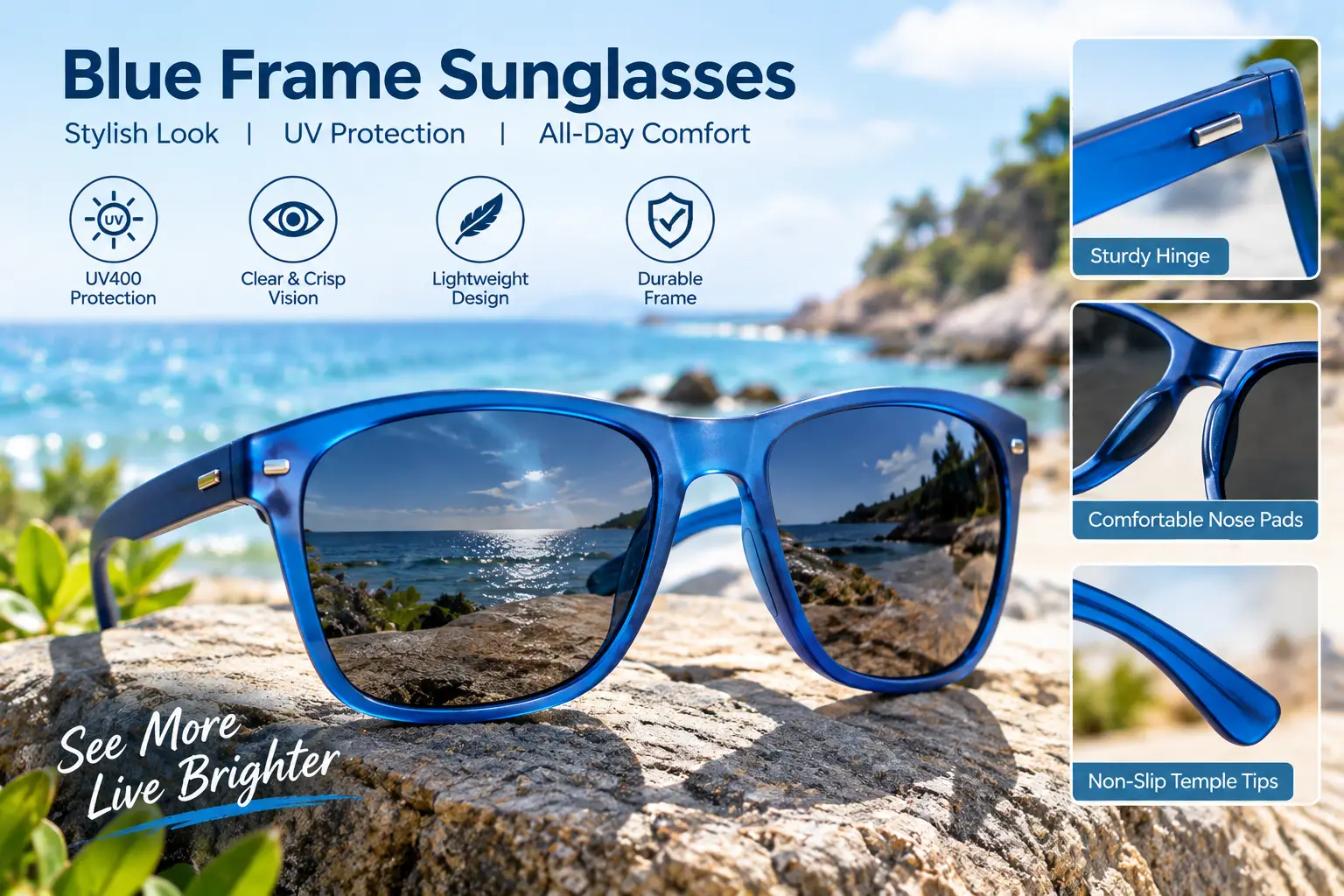
Blue frame sunglasses are sunglasses whose frame—the front, temples, or both—comes in a blue finish, from transparent ice blue and cobalt to matte navy and midnight. They pair that color with standard sun lenses (gray, green, brown, or blue mirror) and should still block 99-100% of UVA and UVB rays.
That last part matters more than the color. According to the American Academy of Ophthalmology’s sunglasses guidance, what you should look for first is a label promising 99-100% UVA/UVB (or UV400) protection—and darker lenses don’t automatically block more UV. In other words, your frame color is the fun part; the lens spec is the non-negotiable part.
So why choose blue frame sunglasses at all? A few honest reasons:
- ✅ Blue is a “neutral with personality.” It flatters most skin tones and works with denim, khaki, white, and gray—the backbone of most American summer wardrobes.
- ✅ It photographs well. Blue reads clean against sky, water, and sand, which is exactly where you’ll be wearing these.
- ✅ The category has real range. You’ll find blue sunglasses for men and women at nearly every price tier, from sweat-proof running shades in the $25 range to glass-lens fishing frames north of $300.
In this guide, we compare seven real models you can find on Amazon, translate spec-sheet jargon into everyday meaning, summarize what real customer reviews consistently say, and walk you through fit, care, and safety. No invented “I wore these for a month” stories—just careful analysis you can actually use.
Quick Comparison: Blue Frame Sunglasses at a Glance
| Model | Frame Finish | Lens Type | Price Range | Best for |
|---|---|---|---|---|
| Ray-Ban Original Wayfarer RB2140 | Transparent blue acetate | Non-polarized (most blue colorways) | ~$160-$210 | Ray-Ban Original Wayfarer RB2140: timeless everyday style |
| Ray-Ban Justin RB4165 | Matte “rubber” blue | Gradient gray | ~$140-$195 | Ray-Ban Justin RB4165: casual, wider faces |
| Oakley Holbrook | Matte transparent blue | Prizm Deep Water Polarized | ~$200-$250 | Oakley Holbrook: active lifestyle + boating |
| Costa Reefton Pro | Matte midnight blue | 580G polarized glass, blue mirror | ~$290-$320 | Costa Reefton Pro: serious offshore anglers |
| Maui Jim Liquid Sunshine | Translucent navy | PolarizedPlus2, Blue Hawaii | ~$250-$300 | Maui Jim Liquid Sunshine: color clarity, travel |
| Knockaround Premiums | Pool blue | Sunset mirror (polarized or not) | ~$30-$60 | Knockaround Premiums: budget beach days |
| goodr OG | Blue-on-blue | Polarized, blue | ~$25-$35 | goodr OG: running and workouts |
Prices are approximate ranges at the time of writing and change often—check the current price on Amazon.
Looking at the table, the split is clear: the two Ray-Bans are style-first, the Oakley Holbrook, Costa Reefton Pro, and Maui Jim Liquid Sunshine are optics-first, and the Knockaround Premiums and goodr OG are value-first. If you want one pair that does everything reasonably well, the Oakley Holbrook sits right in the middle of that triangle.
💬 One click helps other shoppers make an informed choice too! 😊
Top 7 Blue Frame Sunglasses for 2026: Expert Analysis
1. Ray-Ban Original Wayfarer RB2140 — the timeless blue classic
The Ray-Ban Original Wayfarer RB2140 takes a shape that’s been around since 1952 and gives it a fresh coat of blue—most notably in the “True Blue” capsule, which pairs a transparent blue acetate frame with color-matched lenses.
What the specs mean in practice: Acetate is a plant-based plastic that’s polished rather than painted, so the blue lives inside the material instead of sitting on top—meaning it won’t chip off the way coated frames can. Ray-Ban’s classic lenses absorb about 85% of visible light, which lands in Category 3 territory: right for bright, everyday sun, not for high-altitude glaciers.
Who it’s for: If you want blue frame sunglasses that read as “classic with a twist” rather than “sporty,” this is the safest bet. The trapezoid shape (wider at the top) softens square and oval faces. Based on comparing sizes, the standard 50mm suits small-to-medium faces; larger faces should look at the 54mm version or the Ray-Ban Justin RB4165 below.
What reviews say: Aggregated feedback consistently praises the build quality and iconic look, while the most common complaint is fit—the 50mm size runs snug on wider heads. Shoppers also frequently warn about counterfeits from third-party sellers, so buy from the official Ray-Ban storefront or Amazon directly.
Pros:
- ✅ Color is part of the acetate, not a coating
- ✅ Instantly recognizable, genuinely timeless shape
- ✅ Multiple sizes and blue colorways available
Cons:
- ❌ Most transparent-blue versions aren’t polarized
- ❌ Snug fit for wider faces in 50mm
Value verdict: Expect roughly $160-$210 depending on colorway—fair for a frame you’ll realistically wear for a decade.
2. Ray-Ban Justin RB4165 — Wayfarer DNA with a bigger, softer fit
The Ray-Ban Justin RB4165 is essentially the Wayfarer’s laid-back younger sibling: slightly larger rectangular lenses and a matte, rubber-feel finish that looks great in blue.
What the specs mean in practice: The “rubber blue” finish (colorway 6813/11 pairs it with gradient gray lenses) gives a soft-touch, non-glossy look that hides fingerprints far better than shiny acetate. The gradient lens is darker at the top and lighter at the bottom, so you can glance down at your phone or dashboard without lifting your shades. Ray-Ban’s own description lists the frame as nylon-based, which tends to be lighter than thick acetate.
Who it’s for: Medium-to-wide faces who found the Wayfarer pinchy, and anyone who wants blue sunglasses for men or women that feel casual rather than retro. It’s also prescription-ready through Ray-Ban, which matters if you wear glasses.
What reviews say: Reviews consistently highlight comfort and the “less precious” matte look. The recurring caveat: the rubberized coating can show wear at the hinges and edges after heavy use, so it ages differently than polished acetate.
Pros:
- ✅ Roomier fit than the Original Wayfarer
- ✅ Gradient lens works well for driving and screens
- ✅ Matte finish hides smudges and scuffs
Cons:
- ❌ Rubber-feel coating can wear over years
- ❌ Gradient lenses aren’t ideal for direct water glare
Value verdict: Usually in the $140-$195 range—slightly cheaper than the Wayfarer, with a more forgiving fit.
3. Oakley Holbrook — the best all-rounder for active days
The Oakley Holbrook blends a mid-century square silhouette (complete with metal rivets) with Oakley’s performance lens tech—and the Matte Transparent Blue with Prizm Deep Water Polarized combo is one of the best-looking blue frames on the market.
What the specs mean in practice: The frame is O Matter, a lightweight, stress-resistant material that won’t fatigue your nose bridge on long days. The lenses are Plutonite polycarbonate, which is inherently impact-resistant. Oakley says its HDPolarized lenses filter 99% of reflected glare, and the Prizm Deep Water tint is tuned for water—it boosts contrast so you can read surface texture and see slightly below it.
Who it’s for: Weekend boaters, paddleboarders, and anyone who wants polarized blue frame sunglasses that still look fine at a brewery afterward. Oakley also offers prescription lenses for the Holbrook (roughly +2.00 to -3.00).
What reviews say: Aggregated sentiment focuses on lens clarity—buyers moving up from cheaper shades frequently say the contrast difference is obvious. The most common gripe is that the standard size can feel small on larger heads; Oakley’s Holbrook XL exists for exactly that reason.
Pros:
- ✅ Prizm lens adds real contrast on water
- ✅ Lightweight O Matter frame for all-day wear
- ✅ Prescription options available
Cons:
- ❌ Standard size runs small for big heads
- ❌ Blue colorway availability rotates by season
Value verdict: Expect around $200-$250 for polarized versions—strong value given the lens tech.
4. Costa Reefton Pro — built for long days on open water
The Costa Reefton Pro in Matte Midnight Blue with Blue Mirror 580G lenses is the most serious “tool” on this list. Named after a famous New Zealand fishing town, it’s an extra-large frame designed for anglers.
What the specs mean in practice: The PRO upgrades read like a checklist of fishing-day annoyances solved: sweat channels and eyewire drains (sweat doesn’t pool on the lens), Hydrolite rubber and adjustable nose pads (they stay put when you’re wet), and top hooding plus side shields (less light sneaking in from the edges). The 580G lenses are real glass—Costa claims they’re 20% thinner and 22% lighter than average polarized glass—and the blue mirror sits on a gray base with roughly 10% light transmission, meaning it’s built for bright, full sun offshore.
Who it’s for: Offshore anglers, boat captains, and people with larger heads (the lenses measure 63mm). It’s overkill for café hopping.
What reviews say: Reviews repeatedly praise the glass clarity and the way the frame stays planted. The common criticisms are weight compared with plastic lenses and the size—smaller faces often report it feels oversized.
Pros:
- ✅ Glass lenses resist scratches and look razor-sharp
- ✅ Side shields block peripheral glare
- ✅ Adjustable pads keep it put when wet
Cons:
- ❌ Too large for small faces
- ❌ Glass lenses add weight versus polycarbonate
Value verdict: Around $290-$320—expensive, but justified if you’re on the water weekly.
5. Maui Jim Liquid Sunshine — color clarity in a light navy frame
The Maui Jim Liquid Sunshine (model B601-03 in Translucent Navy with Blue Hawaii lenses) is the pick for people who care most about how the world looks through the lens.
What the specs mean in practice: Maui Jim pairs a nylon frame with its MauiPure lens material, which keeps the overall pair very light—handy on long flights or all-day sightseeing. PolarizedPlus2 is Maui Jim’s patented approach to polarization with color enhancement, and the Blue Hawaii mirror is designed for bright, direct sunlight. The medium fit suits most average faces.
Who it’s for: Travelers and beachgoers who want premium optics without the bulk of a fishing frame. The translucent navy is subtler than bright cobalt, so it’s an easy entry point if you’re nervous about loud colors.
What reviews say: Aggregated sentiment consistently describes Maui Jim lenses as vivid and comfortable for long wear. The recurring complaint is price, along with the reminder that blue mirror coatings show scratches more visibly than plain lenses.
Pros:
- ✅ Excellent color and contrast enhancement
- ✅ Very lightweight for all-day comfort
- ✅ Subtle navy is easy to style
Cons:
- ❌ Premium price for a nylon frame
- ❌ Mirror coating shows scratches more readily
Value verdict: Typically in the $250-$300 range at the time of writing—worth it if lens quality is your top priority.
6. Knockaround Premiums — the best budget blue that doesn’t feel cheap
The Knockaround Premiums in Pool Blue with Sunset mirrored lenses proves you don’t need to spend triple digits to get fun, functional blue frame sunglasses.
What the specs mean in practice: You get UV400 protection—the same UV standard the AAO recommends—plus FDA-compliant impact-resistant lenses. The Premiums frame is a slightly wider, more accommodating version of Knockaround’s Classics, with an 18mm bridge and 143mm arms, which works for most medium faces. You can choose polarized or non-polarized lenses, so read the listing carefully.
Who it’s for: Budget shoppers, beach-bag backups, and anyone prone to sitting on their sunglasses. At this price, losing a pair is annoying, not tragic.
What reviews say: Reviews consistently describe Knockarounds as a good bargain with fun colors and a sturdier feel than flimsy gas-station shades. The occasional complaint points to inconsistent lens clarity compared with premium brands.
Pros:
- ✅ UV400 protection at a budget price
- ✅ Broad fit works for most faces
- ✅ Polarized and non-polarized options
Cons:
- ❌ Optics not as crisp as premium lenses
- ❌ Mirror coating scratches with careless storage
Value verdict: Usually $30-$60—arguably the best value per wear on this list.
7. goodr OG — no-slip blue shades for runners
The goodr OG in the blue-on-blue “Falkor’s Fever Dream” colorway is built for one job: staying on your face while you sweat.
What the specs mean in practice: The frame uses a grip coating that reduces slipping when you’re sweaty, and the snug, lightweight build limits bounce while running. Every OG is polarized with UV400 protection, which is rare at this price. The “medium noggin” fit suits most average heads.
Who it’s for: Runners, cyclists, gym-to-errand people, and anyone who wants playful blue sunglasses for men or women without overthinking it.
What reviews say: Aggregated feedback is enthusiastic about personality, comfort, and price. The honest flip side: some reviewers say the polarization isn’t on par with premium brands, and a handful report the frame coating peeling or bubbling—most often on lighter-colored frames.
Pros:
- ✅ Grip coating genuinely limits slipping
- ✅ Polarized and UV400 at a low price
- ✅ Very lightweight for running
Cons:
- ❌ Optical clarity trails premium lenses
- ❌ Some reports of coating wear over time
Value verdict: Around $25-$35—hard to beat as a dedicated workout pair.
✨ Don’t miss these top-rated blue frame picks!
🔍 Take your summer style to the next level with this carefully curated lineup. Click a highlighted product name to check current pricing and availability. These picks will help you see clearly and look sharp all season long!
Getting Started: Your First 30 Days With New Blue Frame Sunglasses
New sunglasses are like new shoes: the first month decides whether you’ll love them. Here’s a practical routine that works for any pair on this list.
Week 1 – Verify and adjust. Check the UV label or listing (UV400 or 100% UVA/UVB). Then check fit: the frame shouldn’t touch your cheeks when you smile, and the temples should hug without leaving red marks. Acetate frames like the Ray-Ban Original Wayfarer RB2140 can be heat-adjusted by an optician—most shops will do it free or for a small fee. Don’t try it with a hair dryer at home.
Week 2 – Build the case habit. Most scratches happen in pockets, cup holders, and bags. Every time the shades come off, they go into the case. The Costa Reefton Pro glass lenses are scratch-resistant, but the mirror coating isn’t invincible.
Week 3 – Clean correctly. Rinse with lukewarm water first to remove grit, then use a drop of lens cleaner or mild dish soap and dry with microfiber. Never wipe dry lenses with your shirt—that’s how you sand down a mirror coating.
Week 4 – Test your use case. Wear them where you bought them for: on the water, the trail, or behind the wheel. If you notice dark patches on your phone screen or car display, that’s polarization at work—normal, not a defect.
Common first-month mistakes:
- ❌ Leaving shades on a hot dashboard (frames can warp)
- ❌ Pushing them up on your head daily (stretches the hinges)
- ❌ Cleaning with paper towels or tissues
Real-World Scenarios: Matching Blue Frame Sunglasses to Your Life
Specs only matter in context, so here are three realistic profiles.
Scenario 1: The weekend boater on a mid-range budget
Budget: ~$250. Use: Saturdays on a lake, occasional fishing, daily commute.
The Oakley Holbrook with Prizm Deep Water Polarized is the natural fit. The polarized lens cuts surface glare so you can read the water, the Plutonite lens shrugs off accidental drops, and the look is understated enough for Monday morning. The Costa Reefton Pro would be better offshore, but it’s pricier and bulkier than this profile needs.
Scenario 2: The marathon trainee who loses sunglasses constantly
Budget: under $40. Use: 4-5 runs per week, mostly mornings.
Get the goodr OG. The grip coating handles sweat, it’s polarized, and at roughly $25-$35 you can own a backup pair. If you’d rather have a slightly more “everyday” look, the Knockaround Premiums are a close second, though they’re not designed specifically to prevent bounce.
Scenario 3: The style-first traveler
Budget: up to $300. Use: city walks, beach days, travel photos.
Choose between the Ray-Ban Original Wayfarer RB2140 (iconic, fashion-forward) and the Maui Jim Liquid Sunshine (lighter, better lens). Here’s what to weigh: if photos and outfits matter most, go Ray-Ban; if comfort over a 10-hour sightseeing day matters most, go Maui Jim.
Problem → Solution: Fixing Common Blue Frame Sunglasses Issues
Problem 1: “They keep sliding down my nose.” Solution: Look for grip coatings (goodr OG) or adjustable nose pads (Costa Reefton Pro). For acetate frames, an optician can tighten the temple bend behind your ears.
Problem 2: “I can’t see my phone or dashboard screen.” Solution: That’s polarization clashing with LCD screens. A gradient, non-polarized lens like the Ray-Ban Justin RB4165 avoids it—or simply tilt your head slightly.
Problem 3: “My blue frame looks faded after one summer.” Solution: Painted or coated frames fade faster under UV and sunscreen. Color-through materials like the acetate in the Ray-Ban Original Wayfarer RB2140 or translucent nylon hold color better. Wipe sunscreen residue off the frame daily.
Problem 4: “The mirror coating is scratched.” Solution: Unfortunately, mirror scratches can’t be polished out. Prevention is everything: case habit, rinse-before-wipe, and no shirt cleaning. Some premium brands offer paid lens replacement programs—check the warranty terms before you buy.
Problem 5: “They give me a headache.” Solution: Cheap lenses with optical distortion are a common culprit, as is a frame pressing on your temples. Have the fit adjusted first; if headaches continue, upgrade the lens quality.
How to Choose Blue Frame Sunglasses (7 Steps)
- Confirm UV protection first. Look for UV400 or 100% UVA/UVB. Color and price say nothing about UV blocking.
- Pick your lens category. Category 2 for mixed light, Category 3 for most bright days, Category 4 only for extreme glare (and never for driving).
- Decide on polarization. Essential for water and snow glare; optional for city wear. More on this below.
- Choose your blue. Transparent blue reads playful, matte navy reads professional, bright cobalt reads sporty.
- Match frame size to face width. Check lens width (in mm), bridge, and temple length against a pair you already like.
- Choose material for your lifestyle. Acetate for style and adjustability, nylon or O Matter for lightness and durability, grip-coated plastic for sports.
- Check the warranty and seller. Buy from the brand’s official storefront to avoid counterfeits and keep warranty coverage.
The Wikipedia overview of sunglasses is a helpful primer on lens tints, coatings, and how different lens colors change contrast if you want to go deeper on step 2.
Blue Frame Sunglasses Specs Compared: Head-to-Head
| Model | Frame Material | Lens Material | Polarized | Fit | Best for |
|---|---|---|---|---|---|
| Ray-Ban Original Wayfarer RB2140 | Acetate | Ray-Ban classic lens | Usually no (blue versions) | Small-medium | Ray-Ban Original Wayfarer RB2140: style |
| Ray-Ban Justin RB4165 | Nylon-based injected | Gradient lens | No (6813/11) | Medium-wide | Ray-Ban Justin RB4165: driving, screens |
| Oakley Holbrook | O Matter | Plutonite polycarbonate | Yes | Medium | Oakley Holbrook: all-rounder |
| Costa Reefton Pro | Injected frame, Hydrolite | 580G glass | Yes | Extra-large | Costa Reefton Pro: offshore fishing |
| Maui Jim Liquid Sunshine | Nylon | MauiPure | Yes | Medium | Maui Jim Liquid Sunshine: travel |
| Knockaround Premiums | Plastic | Polycarbonate (impact-resistant) | Optional | Medium | Knockaround Premiums: budget backup |
| goodr OG | Grip-coated plastic | Polycarbonate | Yes | Medium | goodr OG: running |
Reading across, lens material is the biggest quality divider: glass (Costa Reefton Pro) offers top clarity and scratch resistance but adds weight, while polycarbonate options (Oakley Holbrook, goodr OG) trade a little clarity for impact resistance and lightness. Note also that the two Ray-Bans are the only picks where polarization is typically absent in blue colorways—great for screens, weaker on water.
Features That Actually Matter (and Ones That Don’t)
Marketing copy loves buzzwords. Here’s how to sort them.
Features that genuinely matter
- UV400 / 100% UVA-UVB: Non-negotiable. It’s the actual eye-health feature.
- Lens material: Glass = clarity and scratch resistance; polycarbonate = impact resistance and lightness. Choose based on your activity.
- Fit and coverage: Larger lenses and wraparound shapes reduce UV sneaking in from the sides. The Costa Reefton Pro side shields are a real benefit, not a gimmick.
- Color-through frame material: On blue frame sunglasses especially, acetate or tinted nylon keeps its color much longer than paint.
Features that matter less than you think
- Lens darkness: A very dark lens isn’t necessarily more protective. In fact, dark lenses without UV protection can be worse than none, because your pupils dilate behind them.
- “Blue light blocking” claims on sunglasses: Some lenses (like Costa’s 580) are designed to absorb high-energy visible light, which can improve contrast—but for sun protection, UV blocking is what eye doctors emphasize.
- Brand logos: A bigger logo doesn’t mean better optics. The AAO notes that inexpensive pairs labeled 100% UV-blocking can protect as well as pricey ones.
What most buyers overlook is the hinge. Metal-reinforced hinges (Ray-Ban, Oakley, Costa) generally survive daily open-close cycles better than molded plastic hinges on bargain frames.
Blue Frame Sunglasses vs Black and Tortoise Frames
| Factor | Blue Frames | Black Frames | Tortoise Frames | Best for |
|---|---|---|---|---|
| Style impact | Bold but versatile | Neutral, classic | Warm, vintage | Blue: standing out |
| Hides wear | Matte blue hides well; glossy shows scuffs | Hides most wear | Pattern hides scratches | Tortoise: low maintenance |
| Skin-tone match | Flattering on most tones | Universal | Best on warm tones | Blue/black: versatility |
| Outfit pairing | Great with denim, white, gray | Goes with anything | Earthy palettes | Black: formal wear |
The takeaway: blue frames offer the best balance of personality and versatility, while black remains the default for formal settings. If you already own a black pair, a blue frame adds genuine variety rather than redundancy.
Transparent Blue Sunglasses vs Matte Navy Finishes
Transparent blue sunglasses—like the “True Blue” Ray-Ban Original Wayfarer RB2140 or the Matte Transparent Blue Oakley Holbrook—let light pass through the frame, so they look lighter and more summery. The trade-off: dirt and sunscreen residue show inside the hinges and nose area, so they need more frequent cleaning.
Matte navy finishes, like the Costa Reefton Pro midnight blue or the Maui Jim Liquid Sunshine translucent navy, read darker and more grown-up. They’re easier to wear with business-casual outfits and show less grime. If you’re unsure, navy is the “starter blue”; transparent blue is the “statement blue.”
Polarized Blue Frame Sunglasses: Do You Actually Need Polarization?
Polarized blue frame sunglasses use a filter that blocks horizontally reflected light—the harsh glare bouncing off water, wet roads, snow, and car hoods. It’s a comfort and safety feature, not a UV feature; the AAO is clear that polarization cuts glare but doesn’t add UV protection on its own.
You’ll benefit most from polarization if you:
- 🚤 Spend time on or near water (boating, fishing, paddleboarding)
- 🚗 Drive a lot, especially on wet roads or in low-sun hours
- ⛷️ Ski, snowboard, or hike above the tree line
You might skip it if you:
- 📱 Constantly read phone screens, car displays, or ATM screens outdoors (polarization can black them out at certain angles)
- ✈️ Are a pilot—many aviation instruments are hard to read through polarized lenses
From our lineup, the Oakley Holbrook, Costa Reefton Pro, Maui Jim Liquid Sunshine, and goodr OG are polarized; the Knockaround Premiums come either way; and most blue Ray-Ban Original Wayfarer RB2140 and Ray-Ban Justin RB4165 colorways are not.
A quick home test: look at an LCD screen while tilting your head 90 degrees. If the screen darkens significantly, the lens is polarized.
Blue Sunglasses for Men and Women: Fit and Face-Shape Advice
Good news: blue is one of the most unisex frame colors out there. The difference is mostly in shape and size, not color.
Blue sunglasses for men
Men’s faces are often wider, so frame width matters. The Costa Reefton Pro (extra-large, 63mm lenses) and the Ray-Ban Justin RB4165 in 55mm suit broader faces. For a sharp, structured look, the square Oakley Holbrook adds angles to round faces. Matte navy is the most office-friendly option.
Blue sunglasses for women
Many women find standard men’s frames too wide, which causes slipping. The Ray-Ban Original Wayfarer RB2140 in 50mm and the goodr OG medium fit are reliable choices for narrower faces. Transparent and lighter blues look particularly fresh with summer dresses and white denim.
Face-shape quick guide
- Round face: Angular frames (Oakley Holbrook, Ray-Ban Justin RB4165)
- Square face: Softer trapezoid shapes (Ray-Ban Original Wayfarer RB2140)
- Oval face: Lucky you—almost everything works
- Heart-shaped face: Frames wider at the bottom or rounded styles balance a broader forehead
Pro tip: write down the three numbers printed inside the temple of sunglasses you already like (e.g., 54-16-145). That’s your best sizing shortcut.
Long-Term Cost and Maintenance
The sticker price is only half the story. Here’s a cost-per-wear view.
| Model | Approx. Price | Realistic Lifespan* | Rough Cost/Year | Best for |
|---|---|---|---|---|
| goodr OG | ~$25-$35 | 1-2 years | ~$15-$35 | goodr OG: low-risk sport pair |
| Knockaround Premiums | ~$30-$60 | 1-3 years | ~$10-$60 | Knockaround Premiums: backup pair |
| Oakley Holbrook | ~$200-$250 | 4-6 years | ~$35-$60 | Oakley Holbrook: daily driver |
| Ray-Ban Original Wayfarer RB2140 | ~$160-$210 | 5-10 years | ~$16-$40 | Ray-Ban Original Wayfarer RB2140: long-term style |
| Costa Reefton Pro | ~$290-$320 | 5+ years | ~$55-$65 | Costa Reefton Pro: frequent anglers |
*Lifespan estimates assume regular use and reasonable care; they’re analytical estimates, not manufacturer guarantees.
The pattern is interesting: a well-cared-for Ray-Ban Original Wayfarer RB2140 can cost less per year than a cheap pair you replace every summer. Budget picks win only if you genuinely lose or break sunglasses often—which, to be fair, is a lot of us.
Maintenance checklist:
- ✅ Tighten hinge screws every few months with a tiny eyeglass screwdriver
- ✅ Rinse off salt water and chlorine the same day
- ✅ Store in a hard case, not a soft pouch, when traveling
- ✅ Register your warranty if the brand offers it
Safety, Regulations, and Standards
In the US, sunglasses are regulated by the FDA as medical devices, and that comes with a real safety rule: lenses must be impact-resistant. Under 21 CFR 801.410, lenses in eyeglasses and sunglasses generally must withstand a standardized impact test, commonly called the “drop ball test”—a 5/8-inch steel ball dropped from 50 inches. Manufacturers and importers must test a statistically significant sample from each production batch.
What this means for you:
- Impact-resistant isn’t shatterproof. The FDA’s guidance on impact-resistant lenses stresses this distinction. For sports with flying objects, look for sport-specific or safety-rated eyewear.
- Polycarbonate is the safest everyday choice for active use because it’s inherently tough. Glass lenses, like those on the Costa Reefton Pro, are treated to pass impact testing but are heavier.
- Labels matter. Reputable brands like Knockaround Premiums explicitly list FDA-compliant impact-resistant lenses—a good sign at any price.
- ANSI Z80.3 is the US voluntary standard for nonprescription sunglasses, covering optical quality and UV transmittance. Not every brand advertises it, but it’s a plus when listed.
Kids deserve special attention: their lenses transmit more UV to the retina, so make sure kids’ blue frame sunglasses carry the same UV400 label as yours—not “toy” sunglasses.
Common Mistakes to Avoid When Buying Blue Frame Sunglasses
1. Buying on color alone. That gorgeous cobalt means nothing if the listing doesn’t confirm UV400 protection. Always read the lens specs first.
2. Ignoring frame width. A frame that’s too wide slips; too narrow pinches and causes headaches. Compare the measurements to a pair you already own.
3. Assuming dark lens = more protection. It doesn’t. The AAO is explicit that darkness and UV protection are separate things.
4. Polarizing everything. If you work outdoors with tablets or screens, a polarized lens can be a daily frustration. Match the lens to your routine.
5. Buying from random third-party sellers. Counterfeit Ray-Ban, Oakley, and Costa sunglasses are common online. Stick to the official brand storefront on Amazon or Amazon itself, and check that warranty coverage applies.
6. Forgetting about sunscreen. Sunscreen and bug spray can dull frame finishes and damage some coatings. Wipe frames daily in summer.
7. Skipping the case. The number-one killer of mirror lenses isn’t drops—it’s keys and coins in your bag.
🌊 Ready to find your perfect blue?
👉 Click any highlighted pick above to check today’s price and colorway availability—your new favorite shades are one click away!
FAQ: Blue Frame Sunglasses
❓ Are blue frame sunglasses good for everyday wear?
❓ Which blue frame sunglasses are best for fishing?
❓ Do cheap blue frame sunglasses protect your eyes?
❓ Can I get prescription blue frame sunglasses?
❓ Do blue frames fade in the sun?
Conclusion: Find the Blue That Fits Your Life
Blue frame sunglasses hit a rare sweet spot: they’re expressive enough to feel fresh and versatile enough to wear every day. The trick is choosing the right kind of blue for the right kind of day.
Here’s the short version:
- 😎 Style first: the Ray-Ban Original Wayfarer RB2140 for timeless cool, or the Ray-Ban Justin RB4165 for a roomier, more casual fit.
- 🌊 Water and performance: the Oakley Holbrook as an all-rounder, the Costa Reefton Pro for serious offshore days, and the Maui Jim Liquid Sunshine for lightweight color clarity.
- 💸 Value and sport: the Knockaround Premiums for budget beach days and the goodr OG for sweaty runs.
Whatever you choose, follow the order that eye doctors recommend: UV protection first, fit second, and frame color third. Then add a hard case, a microfiber cloth, and a simple cleaning routine, and your new blue frame sunglasses can last for years. Polarized blue frame sunglasses are worth it for water and driving; non-polarized pairs make life easier with screens.
The best pair isn’t the most expensive one—it’s the one you’ll actually wear, protect, and love grabbing on your way out the door. 💙
✨ Your perfect pair of blue frame sunglasses is waiting!
🔍 Explore the seven picks above, compare colorways, and click any highlighted product to check current pricing and availability. Step into summer with clear eyes and serious style!
Recommended for You
- Computer Monitor Screen Cover: 7 Best Picks Worth Buying in 2026
- Safety Glasses with Lights: 7 Best Picks for 2026 (Avoid Duds)
- Rimless Sunglasses Men: 7 Best Lightweight Picks for 2026
Disclaimer: This post contains affiliate links. As an Amazon Associate, I earn from qualifying purchases made through these links, at no additional cost to you.
✨ Found this article helpful? Share it with someone who needs it! 💬🤗