In This Article
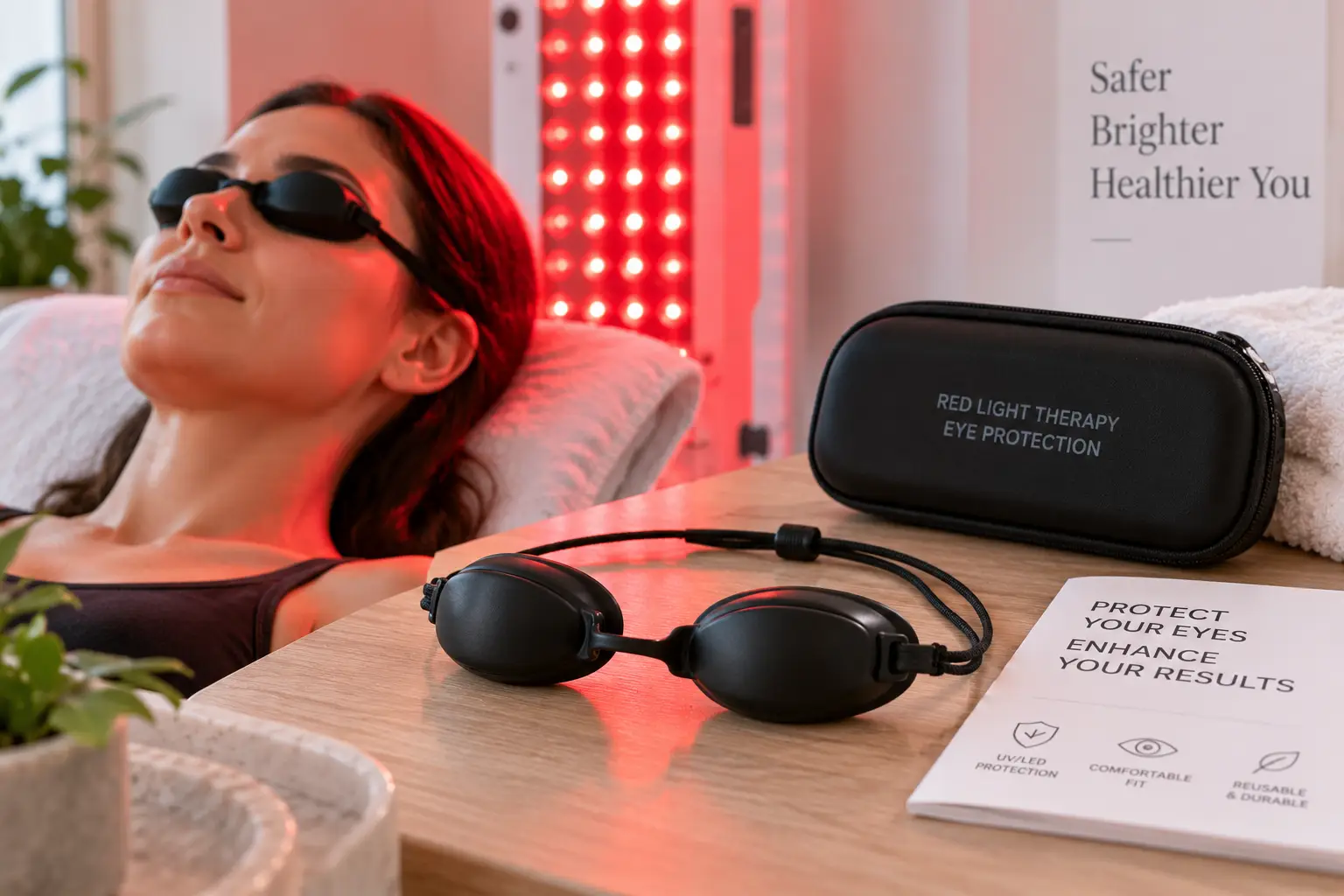
If you’ve added a red light panel, a handheld wand, or an LED face mask to your routine, you’ve probably wondered whether you actually need eye protection or if that’s just marketing fluff. Eye protection for red light therapy refers to specialized glasses, goggles, or opaque shields designed to block or attenuate the specific red (600-660nm) and near-infrared (800-900nm) wavelengths these devices emit, reducing glare and eye strain during sessions. It’s a fair question, and it deserves a real answer instead of a sales pitch.
Here’s the honest picture: most consumer-grade red and near-infrared devices operate at intensities well below what’s needed to injure the eye during brief, correctly-distanced use. But “generally low-risk” isn’t the same as “no precautions needed,” especially with high-power panels, close-range facial masks, or extended sessions. Manufacturers themselves are split — some include eyewear by default with their higher-output models, others leave it optional. That inconsistency is exactly why so many shoppers end up confused and searching for straightforward, trustworthy guidance.
This guide breaks down seven real products you can actually buy, from budget blackout shields to clinical-grade goggles, and explains what separates a good pair from one that just looks the part. We’ll also cover how to choose based on your specific device and habits, common mistakes people make, and what the research and regulatory bodies actually say about wavelength safety. As an Amazon Associate, this article contains affiliate links, and we’ll flag that clearly again below — but our priority here is giving you enough real information to make your own call.
Quick Comparison: Best Eye Protection for Red Light Therapy at a Glance
| Product | Style | Wavelength Coverage | Price Range | Best For |
|---|---|---|---|---|
| Hooga Red Light Therapy Protective Glasses | Tinted glasses | 200-1000nm | Around $25 | Daily panel users wanting broad coverage |
| FUIART Red Light Therapy Glasses | Tinted glasses | 600-900nm | Under $20 | First-time buyers on a tight budget |
| Super Sunnies UV Eye Protection Goggles | Opaque eyecups | Blocks visible light entirely | Under $15 | Wearing under a face mask |
| Mito Red Light Glasses IR5 (Extra Dark) | Tinted glasses | 600-900nm | Between $30 and $45 | Adjustable comfort across device intensities |
| BlockBlueLight Red Light Therapy Glasses | Tinted glasses | 600-900nm | Between $50 and $70 | Sensitive eyes or existing eye conditions |
| NoIR Insight Red Light Therapy Glasses | Certified safety eyewear | Multiple filter options | Between $60 and $120 | Frequent, high-intensity sessions |
| P-Shield Patient Laser Safety Glasses | TPU clinical goggles | 190-10,600nm (OD7+) | Between $35 and $55 | Estheticians and med-spa professionals |
Looking at this table, you’ll notice a clear split between tinted glasses that let some light through for orientation and opaque options that block everything. The Hooga Red Light Therapy Protective Glasses and Mito Red Light Glasses IR5 sit in the sweet spot most home users land on — wide coverage without total blackout. Meanwhile, professionals running multiple clients through sessions daily tend to gravitate toward the P-Shield Patient Laser Safety Glasses or NoIR Insight Red Light Therapy Glasses for their broader certified spectrum coverage and durability under repeated use.
💬 Found a pick you like already? Check current availability and pricing before your next session — stock and prices shift often.
Top 7 Eye Protection Options for Red Light Therapy: Expert Analysis
We researched real specs, brand claims, and aggregated customer feedback for each of these picks. None of the “opinions” below come from us personally testing these products — they’re grounded in comparing published specifications and genuine review patterns, which is exactly the kind of honest analysis that should guide a purchase like this.
1. Hooga Red Light Therapy Protective Glasses — widest wavelength coverage for the price
The standout feature here is sheer range: Hooga’s glasses are rated across a 200nm to 1000nm band, meaning they’re built to handle UV, full-spectrum red, and near-infrared in a single pair. That’s unusually broad for a sub-$30 product, and it matters if you own more than one type of light therapy device rather than a single panel.
The lenses use 1.8mm polycarbonate, which is thick enough to resist scratching from regular handling and impact-resistant enough for daily use, while a 10% light transmittance rate keeps enough visibility to move around your treatment space without total darkness. At just 13 grams, the frame won’t leave the pressure marks that heavier plastic goggles often do during 15-20 minute sessions.
Based on comparing the specs against pricier competitors, this is one of the better values in the category — you’re getting laser-safety-adjacent wavelength coverage without laser-safety pricing. It’s best suited to people running full-body panels at home who want one pair of glasses that works whether they’re doing a red-only session or a red-plus-NIR combo.
Reviews consistently report that these fit comfortably over prescription glasses and that the frame holds up over months of near-daily use, though a handful of buyers with narrower faces mention the arms run slightly wide.
Pros:
- ✅ Covers an unusually wide 200-1000nm wavelength range
- ✅ Scratch-resistant polycarbonate lenses built to last
- ✅ Ultra-lightweight 13g frame for long sessions
Cons:
- ❌ Arms may fit loosely on narrower face shapes
- ❌ 10% transmittance is dimmer than some tinted alternatives
At around $25, this is solidly mid-value: you’re not paying clinical-grade prices, but you’re also not settling for a flimsy budget shield.
2. FUIART Red Light Therapy Glasses — most budget-friendly entry point
The distinguishing benefit is right there in the price tag: this is one of the most accessible ways to add any dedicated eye protection to your routine, and it comes with a hard case so the lenses don’t end up scratched in a junk drawer between sessions.
FUIART’s glasses target the 600-900nm range in two lens options — a green tint that blocks around 80% of light and a black tint that blocks closer to 95%. In practice, that means the green pair suits people who want to stay oriented in a bright room, while the black pair suits anyone doing a close-range facial treatment who wants maximum attenuation. The brand also markets these for tanning and IPL use, which tells you the lens material is built to handle more than just LED red light.
What most buyers overlook with an entry-level product like this is that “budget” doesn’t have to mean “ineffective” — the wavelength range matches what pricier competitors advertise, even if the build quality and warranty support won’t match a specialty brand.
Reviews indicate that comfort and fit are generally solid for average face shapes, and several buyers mention using the green lenses specifically to double as light-sensitivity relief for migraines, separate from red light sessions.
Pros:
- ✅ Genuinely low price point for dedicated eyewear
- ✅ Two tint options for different light-blocking needs
- ✅ Includes a protective case for storage
Cons:
- ❌ Frame materials feel less premium than specialty brands
- ❌ Fit can feel uneven if you sit at an angle to the light
Priced under $20, this is the easiest way to add protection without committing much money, making it a smart first purchase before you know your preferences.
3. Super Sunnies UV Eye Protection Goggles — best for wearing under a face mask
The distinguishing benefit is form factor: instead of glasses with arms, these are small, flexible eyecups on an elastic strap, originally built for tanning beds, that reviewers have found fit neatly underneath LED face masks where regular glasses simply won’t sit.
These eyecups are made of soft, flexible rubber that molds to the eye socket rather than resting on the bridge of your nose, and they’re rated to block over 99.9% of UV-B and 99% of UV-A light. While that spec is written for tanning applications, the practical takeaway for red light users is that the cups block essentially all visible light reaching the eye, which is the simplest possible way to guarantee zero direct exposure during a mask-based session.
Here’s what to weigh: because these are opaque rather than wavelength-filtered like glasses, you lose all visibility, which some people find disorienting for longer stand-alone panel sessions but which isn’t an issue at all when you’re lying down under a face mask anyway.
Reviews from people specifically using these with red light face masks report that they slide into the mask’s eye openings easily and stay in place, with several buyers calling out that they solved the problem of intense light leaking through closed eyelids during mask treatments.
Pros:
- ✅ Compact eyecup design fits under LED face masks
- ✅ Blocks essentially all visible light, not just a filtered percentage
- ✅ Inexpensive two-pack pricing
Cons:
- ❌ Total blackout means no visibility for stand-alone sessions
- ❌ Not designed with red-light-specific wavelength marketing
At under $15 for a two-pack, this is an easy, low-commitment add-on if your primary device is a wearable mask rather than a panel.
4. Mito Red Light Glasses IR5 (Extra Dark) — best adjustable attenuation
The distinguishing benefit is choice: Mito sells these in two attenuation levels — IR3 (Dark), which cuts roughly 80% of light, and IR5 (Extra Dark), which cuts around 95% — so you can match the lens to how intense your specific device actually is instead of getting a one-size-fits-all filter.
Both versions target the 600-900nm band that covers the red and near-infrared wavelengths most home devices use, and the company is explicit that regular sunglasses don’t cut it here because near-infrared light penetrates far more than visible light, even through thin barriers like eyelids. The frame is built slim and lightweight rather than bulky like industrial safety goggles, which is a meaningful comfort upgrade if you’re used to heavier eyewear.
Based on comparing the specs, the ability to pick your attenuation level is the real differentiator — someone using a low-power handheld wand a few inches from their face has very different needs than someone sitting in front of a high-output full-body panel, and Mito’s two-tier system acknowledges that instead of forcing a single compromise.
Reviews describe the fit as comfortable for extended wear and note that the lenses resist scratching better than cheaper alternatives, though a few buyers wished the IR3 option let in slightly more light for orientation in dim rooms.
Pros:
- ✅ Two attenuation levels to match different device intensities
- ✅ Slim, comfortable frame for longer sessions
- ✅ HSA/FSA-eligible for many buyers
Cons:
- ❌ Extra Dark version can feel too dim in low-light rooms
- ❌ Premium build pushes the price above basic tinted options
In the $30 to $45 range, this sits at fair mid-tier value for the flexibility of choosing your own darkness level.
5. BlockBlueLight Red Light Therapy Eye Protection Glasses — best for sensitive eyes
The distinguishing benefit is consistency of attenuation: these glasses are built specifically to block roughly 80% of light across the 600-900nm range, a middle-ground percentage designed to be comfortable for daily use without the near-total blackout of clinical goggles.
BlockBlueLight built its brand around blue-light filtering research before expanding into red-light-specific eyewear, and that background shows in the attention to lens consistency — the frames are designed to sit evenly on the face so you don’t get the “one eye darker than the other” effect that can happen with cheaper, poorly-fitted frames when you tilt your head. What that means in practice: less inconsistent glare, and less temptation to squint or adjust mid-session.
The spec sheet doesn’t say this outright, but reviews suggest this pair is a common recommendation among people managing pre-existing light sensitivity or eye conditions who want a filter reliable enough to trust daily, not just occasionally.
Reviews consistently mention effective filtering, with one recurring theme being that buyers with genuine eye health concerns specifically chose this brand for the added confidence its more rigorous marketing and lens consistency provide, even though it costs more than entry-level alternatives.
Pros:
- ✅ Reliable 80% attenuation across the key therapy wavelengths
- ✅ Even lens tint reduces inconsistent glare between eyes
- ✅ Brand built around light-filtering research and consistency
Cons:
- ❌ Priced higher than comparable tinted alternatives
- ❌ 80% block may feel insufficient for very high-output panels
Between $50 and $70, you’re paying a premium for consistency and brand trust rather than dramatically different wavelength coverage than cheaper options.
6. NoIR Insight Red Light Therapy Glasses — best for frequent, high-intensity use
The distinguishing benefit is certification: NoIR has built its business on certified laser safety eyewear for medical, industrial, and research use, and its red-light-specific line carries that same rigor, including staff who can help match a specific filter to a specific device’s stated wavelength output.
Where this brand pulls ahead of general consumer glasses is customization at the point of sale — rather than a single fixed attenuation level, NoIR offers multiple lens options so a buyer running a high-output panel daily, or someone with a documented eye sensitivity, can choose a filter rated appropriately rather than hoping a generic percentage is enough. That level of specificity is uncommon outside of clinical-grade suppliers.
What most buyers overlook with certified eyewear like this is that you’re not just paying for the lens material — you’re paying for a company that stands behind wavelength-specific performance claims with an actual product line built for safety compliance, not just a marketing tagline borrowed from the beauty industry.
Reviews and professional buyers frequently cite responsive customer service when choosing between filter options, and multiple sources note this brand is often recommended by practitioners advising patients with more serious light sensitivity, though this segment of buyers is smaller than the general consumer market.
Pros:
- ✅ Certified laser-safety pedigree, not just consumer marketing
- ✅ Multiple filter options matched to device intensity
- ✅ Strong reputation among practitioners and frequent users
Cons:
- ❌ Higher price point than general consumer red-light glasses
- ❌ More options can feel overwhelming for casual users
Running between $60 and $120 depending on the lens chosen, this is a premium pick that earns its price for daily, high-intensity, or medically-advised use.
7. P-Shield Patient Laser Safety Glasses — best for professional and clinical settings
The distinguishing benefit is breadth of protection: these TPU goggles are rated for OD7+ protection across an enormous 190nm to 10,600nm range, meaning they’re engineered to handle laser, IPL, and LED light-based treatments in the same clinical session, not just one wavelength band.
Constructed from soft, flexible thermoplastic polyurethane rather than rigid plastic, these goggles are designed to conform to different face shapes, which matters enormously in a med-spa or dermatology setting where the same pair may be reused across multiple patients in a single day. The adjustable head strap and included storage case round out a design clearly built for a professional workflow rather than a single home user’s nightstand drawer.
Here’s what to weigh: for a home user with one red light panel, this level of broad-spectrum protection is arguably more than you need, and the clinical branding reflects a price and design built around practices, not individuals. But for anyone running IPL, laser, or LED treatments back-to-back on clients, the versatility of one product covering all three modalities is a genuine time and cost saver.
Reviews from medical spa and dermatology practice buyers highlight the comfortable TPU fit for repeated all-day use and appreciate not needing separate eyewear for each treatment type offered in a practice.
Pros:
- ✅ Broad OD7+ protection covering laser, IPL, and LED
- ✅ Soft, adjustable TPU fit for repeated use
- ✅ Comes with a storage case for practice settings
Cons:
- ❌ Overbuilt and unnecessary for casual single-device home use
- ❌ Marketed and priced primarily toward professional buyers
In the $35 to $55 range, this delivers strong value specifically for clinics and estheticians, less so for someone who only owns a single home panel.
✨ Don’t miss these exclusive deals!
🔍 Take your red light therapy eye protection to the next level with this carefully curated lineup. Click a highlighted item to check current pricing and availability. These picks will help you protect your vision while still getting the full benefit of every session.
Getting Started: How to Use Red Light Therapy Eye Protection the Right Way
Buying the right glasses is only half the equation — using them correctly is what actually protects your eyes. Start by checking your device’s manufacturer guidelines before your first session; some panels specify a minimum safe distance (often 6 to 12 inches) at which eye protection becomes optional rather than required, and ignoring that distance is one of the most common first-30-days mistakes.
For the first week, treat your eyewear like any new piece of gear: put it on before you turn the device on, not after, since even a brief unprotected flash at close range can cause temporary afterimages or discomfort. If you’re using a facial mask rather than a panel, fit your eyecups or glasses before sealing the mask against your face, checking for gaps at the temples where light commonly leaks in.
Maintenance is simple but easy to neglect. Wipe polycarbonate lenses with a microfiber cloth rather than paper towels, which can introduce fine scratches that reduce optical clarity over time. Store glasses in a case between sessions instead of tossing them in a drawer with other gear, and inspect the lens tint every few months for fading, since prolonged exposure to intense light and UV can slowly degrade some coatings.
A final tip worth repeating: if you ever feel warmth, excessive brightness, or genuine discomfort during a session even while wearing eye protection, stop and reassess your distance or session length rather than pushing through it.
Real-World Scenarios: Matching Eye Protection to Your Routine
Not everyone needs the same setup, so it helps to see how different habits map to different picks. Consider three common profiles.
The budget-conscious beginner, testing red light therapy for the first time with a small handheld device used 10 minutes a few times a week, doesn’t need clinical-grade eyewear yet. The FUIART Red Light Therapy Glasses or Super Sunnies UV Eye Protection Goggles cover the basics affordably while this person figures out whether the habit sticks.
The daily home user running a full-body panel for 15-20 minutes most days represents the largest segment of red light therapy buyers, and this is where broad-coverage, comfortable daily-wear options like the Hooga Red Light Therapy Protective Glasses or Mito Red Light Glasses IR5 earn their higher price relative to entry-level picks — comfort over months of near-daily use matters more here than it does for occasional users.
The frequent user with a documented eye sensitivity, or the practitioner running treatments on multiple clients per day, has genuinely different needs. For an individual managing existing eye conditions, the reliable, consistent filtering of BlockBlueLight Red Light Therapy Eye Protection Glasses or the certified, customizable options from NoIR Insight Red Light Therapy Glasses are worth the added cost. For a med-spa or dermatology practice, the multi-modality coverage of P-Shield Patient Laser Safety Glasses solves a genuinely different problem: outfitting staff for laser, IPL, and LED treatments without buying three separate types of eyewear.
How to Choose the Best Eye Protection for Red Light Therapy
Here’s a straightforward framework for narrowing down your options, based on the factors that actually matter rather than marketing language.
- Match the wavelength range to your device. Check your panel or mask’s spec sheet for its stated wavelengths (commonly 630-660nm and 810-850nm), and confirm your eyewear’s coverage overlaps that range rather than assuming any “red light glasses” label is sufficient.
- Consider your session distance and intensity. Devices used within 6 inches of the face, or high-output professional panels, generally call for more attenuation than a full-body panel used from several feet away, a principle consistent with how low-level laser therapy researchers and manufacturers generally frame exposure risk.
- Decide between tinted glasses and opaque shields. Tinted glasses preserve some visibility for orientation; opaque eyecups block everything, which suits face-mask users or anyone who prefers total darkness during a session.
- Check comfort features for your session length. Frame weight, nose bridge fit, and whether the glasses sit comfortably over prescription lenses all matter more the longer and more frequently you use your device.
- Weigh certified versus consumer-grade options. If you have a diagnosed eye condition or photosensitivity, a certified option with documented filter ratings is worth the added cost over a general consumer product.
- Factor in reusability across other treatments. If you also use IPL, tanning beds, or other light-based treatments, a broader-spectrum option can replace multiple single-purpose products.
- Read the return policy before buying. Fit varies a lot by face shape, and a flexible return window protects you if a specific frame doesn’t work for your face.
The general principles around occupational eye protection, including how the OSHA eye and face protection standard frames risk-based decision-making for light radiation exposure in workplace settings, are a useful mental model even for home use: match the level of protection to the actual intensity and duration of exposure, rather than either ignoring the issue or over-buying industrial gear you don’t need.
Common Mistakes to Avoid When Buying Red Light Therapy Glasses
A handful of avoidable mistakes show up again and again in customer reviews and forum discussions. Skipping wavelength verification tops the list — buyers assume any glasses labeled for “light therapy” will work with their specific device, then discover the coverage doesn’t actually match their panel’s output range.
Another common misstep is assuming regular sunglasses are close enough. Standard sunglasses are built to filter visible glare and UV, not the near-infrared wavelengths that many red light devices emit, and near-infrared light can penetrate further into tissue than visible light without triggering the same instinctive squint response, which is exactly why dedicated eyewear exists in the first place.
Buyers also frequently overlook fit until after purchase, ordering based on price alone and then discovering a frame gaps at the temples or presses uncomfortably on the bridge of the nose during longer sessions. Reading fit-specific feedback in reviews, not just wavelength specs, avoids this.
Finally, a subtler mistake: treating a single pair of glasses as permanent. Lens coatings and tints can degrade with heavy use over months or years, and continuing to rely on a scratched, faded pair well past its useful life quietly reduces the actual protection you’re getting.
Red Light Therapy Glasses vs. Blackout Masks vs. Bare Eyes
It’s worth directly comparing your three realistic options rather than assuming specialized glasses are automatically necessary in every scenario.
| Approach | Visibility During Use | Protection Level | Comfort for Long Sessions | Best For |
|---|---|---|---|---|
| Tinted red light glasses (e.g., Hooga, Mito) | Partial — enough to orient | Wavelength-specific, moderate to high | Generally high | Regular panel users |
| Opaque blackout shields (e.g., Super Sunnies) | None | Blocks essentially all visible light | High under face masks | Mask-based treatments |
| Closed eyes, no eyewear | Full darkness, no barrier | Minimal — light penetrates eyelids | Free, no gear needed | Very brief, low-intensity, distant sessions only |
The table makes the trade-off clear: closing your eyes without any barrier costs nothing but offers the least protection, since near-infrared and even red light can pass through closed eyelids at close range, especially with higher-output devices. Tinted glasses like the Hooga Red Light Therapy Protective Glasses strike a middle ground that most daily users prefer because they let you stay oriented in the room. Opaque options like Super Sunnies UV Eye Protection Goggles remove the most light entirely but sacrifice all visibility, which is a non-issue if you’re lying still under a mask anyway.
What to Expect: Everyday Comfort and Performance
Translating specs into real-world experience matters more than the numbers alone. A glasses pair rated for 80% attenuation, for example, will noticeably dim a bright panel without making the room feel dark — you’ll still see shapes and movement clearly, just without the harsh glare. A 95% attenuation pair, by contrast, can feel closer to sunglasses worn indoors at dusk, which some users find disorienting for the first few sessions before they adjust.
Weight and pressure points become more noticeable the longer your sessions run. A 13-gram frame like Hooga’s disappears after the first few minutes for most people, while heavier goggle-style products can leave temporary marks on the bridge of the nose during 20-minute sessions, particularly for people who also wear glasses underneath. If you already wear prescription lenses, prioritize options explicitly marketed to fit over glasses rather than assuming any frame will work.
Temperature and fogging rarely come up with red light therapy specifically, since these are low-heat LED devices rather than hot equipment, but TPU goggles like the P-Shield Patient Laser Safety Glasses can feel slightly warmer against the skin during longer clinical sessions than lightweight polycarbonate frames.
Long-Term Cost and Maintenance of Red Light Therapy Eyewear
Thinking about total cost of ownership rather than sticker price alone changes the calculation for a lot of buyers. A $15 pair replaced every few months due to scratching or fading can cost more over two years than a single $50 pair built with more durable materials and a protective case included from the start.
| Tier | Typical Price Range | What You Get | Value Verdict |
|---|---|---|---|
| Budget (e.g., FUIART, Super Sunnies) | Under $20 | Basic wavelength coverage or blackout, simple frames | Good for testing the habit, may need replacing sooner |
| Mid-range (e.g., Hooga, Mito Red Light IR5, BlockBlueLight) | $25 to $70 | Durable lenses, comfortable frames, some customization | Best long-term value for regular daily users |
| Professional (e.g., NoIR Insight, P-Shield) | $35 to $120+ | Certified ratings, multi-modality coverage, clinical-grade build | Justified for practitioners or documented sensitivity, overkill for casual home use |
The middle tier consistently offers the best long-term value for the average home user: you’re paying enough for genuine durability and comfort without funding certification overhead you don’t need. Professional-tier options only pay for themselves if you’re using them across multiple treatment types or with clients, while budget options make sense mainly as a low-risk way to establish the habit before upgrading. Maintenance costs stay low across all tiers as long as you store lenses in a case and clean them with a microfiber cloth rather than letting them rattle around loose in a bag.
Safety, Regulations, and Standards for Red Light Therapy Eye Protection
Understanding the regulatory landscape helps put the eye-protection question in context. Most consumer red light therapy devices in the US are marketed under the FDA’s general wellness policy for low-risk devices, which applies to products intended for general wellness use that present a low safety risk, rather than requiring the more rigorous 510(k) clearance process reserved for devices making specific disease-treatment claims. Some higher-output devices do pursue FDA clearance for specific indications, and those tend to be the same devices most likely to include eyewear standards or recommendations in their documentation.
On the eyewear side, non-laser optical radiation products, including many LED panels, are commonly evaluated against the IEC 62471 photobiological safety standard, which assigns light sources a risk group from RG0 (no photobiological hazard) up to RG3 (hazardous even for momentary exposure) based on how quickly a user would reach an exposure limit under normal viewing conditions. A device rated in a low-risk group generally requires less stringent eye protection than one rated higher, which is part of why manufacturer-specific guidance matters more than a blanket rule for every device on the market.
For anyone with an existing eye condition, documented light sensitivity, or who takes medication known to increase photosensitivity, it’s worth checking in with an eye care professional before starting a regular light therapy routine, rather than relying solely on general consumer guidance; resources from the National Eye Institute are a solid starting point for general eye health questions. Being cautious here costs nothing and can catch an individual risk factor that generic product marketing simply isn’t built to account for.
Features That Actually Matter (and Ones That Don’t)
Cutting through marketing language: wavelength coverage matching your device’s actual output matters enormously, while vague claims like “clinically proven” without a specific standard or percentage attached matter very little. A pair that clearly states it blocks 80% or 95% of light across a named nanometer range gives you something concrete to compare; a pair that just says “protects your eyes” without specifics doesn’t.
Lens material genuinely affects longevity — polycarbonate resists scratching better than basic plastic, and that translates into years rather than months of reliable use. Frame weight matters for comfort during longer sessions but has zero bearing on actual protection level, so don’t pay a premium for an ultralight frame if the wavelength coverage doesn’t match your needs.
On the other hand, cosmetic details like lens color (beyond its functional tint density) and trendy frame shapes don’t affect performance at all, and “FDA-cleared” branding on the eyewear itself is often less meaningful than it sounds, since most red-light eyewear falls under general consumer product categories rather than medical device classification. Focus your comparison on documented wavelength range, attenuation percentage, and lens material — everything else is largely personal preference.
Frequently Asked Questions
❓ What is the best eye protection for red light therapy?
❓ Do you really need glasses for red light therapy?
❓ Can regular sunglasses replace red light therapy goggles?
❓ How much should red light therapy eye protection cost?
❓ Is it safe to close your eyes instead of wearing goggles?
Conclusion
Choosing eye protection for red light therapy doesn’t have to be complicated once you separate the marketing noise from the factors that actually matter: wavelength coverage matched to your device, an attenuation level suited to your session distance and intensity, and a fit comfortable enough that you’ll actually wear it every time. Whether that ends up being the budget-friendly FUIART Red Light Therapy Glasses, the broad-coverage Hooga Red Light Therapy Protective Glasses, or a certified option like NoIR Insight Red Light Therapy Glasses for more demanding use, the underlying principle is the same: match the protection to the actual exposure, not to whichever product has the flashiest packaging.
Red light therapy itself continues to be studied for a range of wellness applications, and the consumer device market shows no signs of slowing down. Taking eye safety seriously now, with real products backed by real specifications, means you can keep enjoying your sessions with genuine peace of mind rather than a nagging question in the back of your head every time you turn the panel on.
🌟 Ready to protect your eyes and get the most out of every session?
🔍 Browse the picks above, check current pricing on the ones that fit your routine, and add a pair to your next red light therapy setup. Your future self — and your eyes — will thank you.
Recommended for You
- 7 Best Glasses to Help With Night Driving for Clearer Vision
- 7 Best Navy Blue Color Block Hoodies to Buy in 2026
- High Index Reading Glasses: 7 Best Thin-Lens Picks for 2026
Disclaimer: This post contains affiliate links. As an Amazon Associate, I earn from qualifying purchases made through these links, at no additional cost to you.
✨ Found this article helpful? Share it with someone who needs it! 💬🤗