In This Article
What Is “Reading Glasses 4” and Do You Actually Need Them?
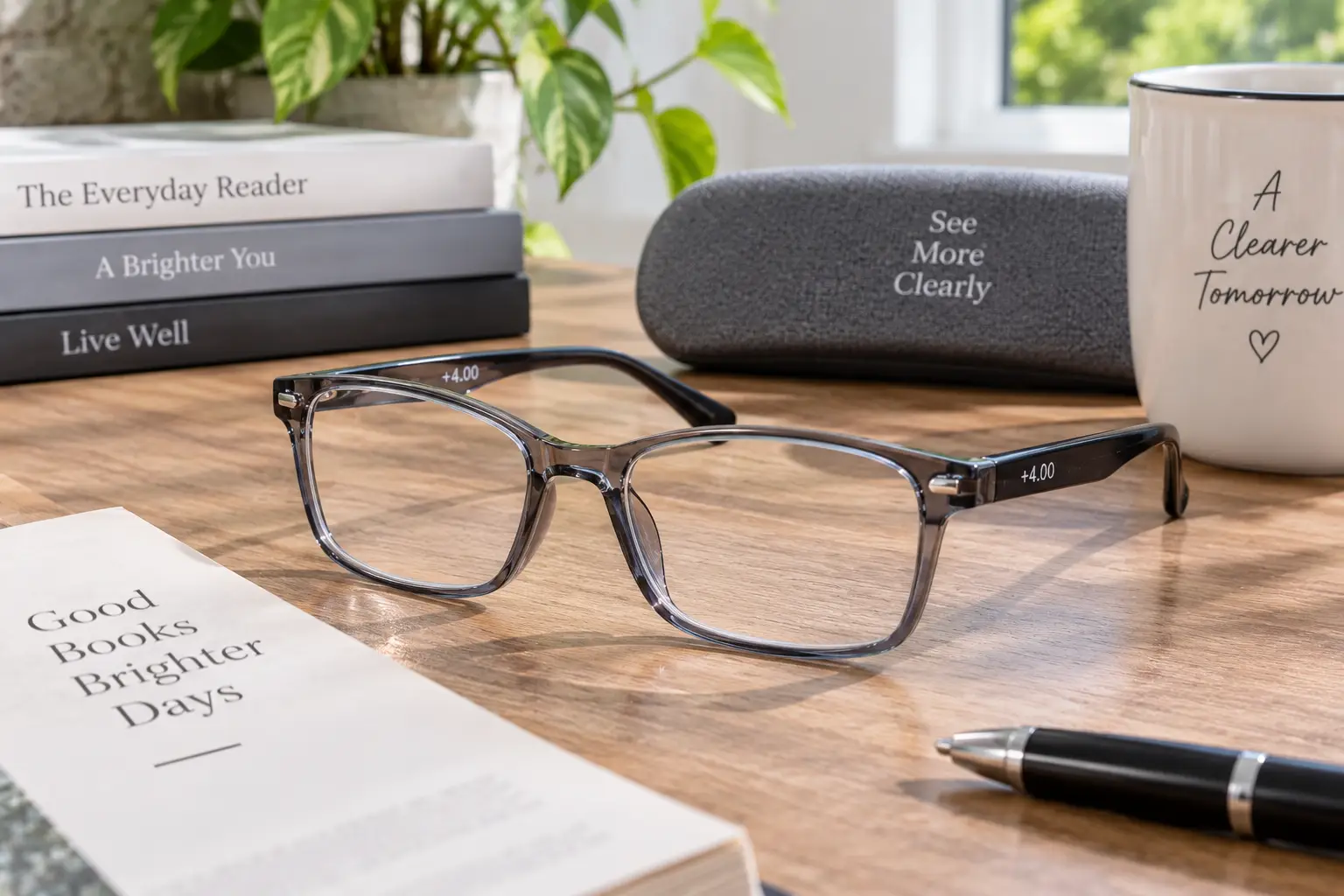
If you’ve started searching for reading glasses 4, chances are your regular +2.00 or +2.50 pair from the drugstore just isn’t cutting it anymore, and that’s a completely normal part of getting older. Reading glasses 4 refers to over-the-counter readers built with a +4.00 diopter lens, the strongest magnification typically sold without a prescription, designed for people with advanced presbyopia who need serious help focusing on close-up text. Presbyopia — the age-related stiffening of your eye’s lens — affects roughly 128 million Americans, according to the American Optometric Association, and it only gets stronger with time, which is exactly why so many shoppers eventually graduate from +1.50 readers to reading glasses 4.
Here’s what most buyers overlook: strength alone doesn’t make a good pair of readers. Lens clarity, frame durability, and even where you’re allowed to buy +4.00 strength (yes, that’s a real issue in a few states) all matter just as much. In this guide, we researched real products, real specs, and real customer feedback so you can pick reading glasses 4 that actually work for your eyes, your budget, and your daily routine — not just the first pair that pops up in a search.
We’ll walk through seven genuinely available options spanning budget multi-packs to specialty blue-light-blocking styles, show you exactly how to confirm +4.00 is the right strength for you, and cover the regulatory quirks (looking at you, New York) that can affect where you’re able to buy them. Let’s get your vision back into focus.
Quick Comparison: Best Reading Glasses 4.00 at a Glance
Before diving into full reviews, here’s a snapshot to help you jump straight to the option that fits your priorities.
| Product | Best For | Style | Price Range |
|---|---|---|---|
| Eyekepper 4-Pack High-Power Readers | Best overall value | Screwless spring hinge, rectangle | Under $25 |
| GAMMA RAY Optics Readers | Best classic style | Full rim, spring hinge | Under $20 |
| Craig Cooper Blue Light Readers | Best for screen use | Blue-light-blocking, square | $15–$25 |
| TIJN Oversized Cat-Eye Readers | Best fashion pick for women | Oversized cat-eye | $20–$30 |
| Livho 5-Pack Readers | Best variety multi-pack | Mixed colors, spring hinge | $15–$25 |
| ICU Eyewear Ben Franklin Readers | Best classic round style | Round, metal frame | $10–$20 |
| Foster Grant High-Power Readers | Best trusted drugstore name | Rectangle, plastic | Under $20 |
Looking at the table above, the Eyekepper 4-Pack High-Power Readers offer the best all-around value if you just need reliable +4.00 magnification without frills, while the Craig Cooper Blue Light Readers justify a slightly higher price if most of your close-up work happens on a screen. If you want a recognizable name from the pharmacy aisle, the Foster Grant High-Power Readers are the safer bet, though as we’ll explain, their true ceiling sits a bit below full +4.00 strength.
👉 Curious which pick fits your face shape and budget best? Scroll down to compare full specs, then check today’s price on your favorite before it sells out in your size.
The 7 Best Reading Glasses +4.00 Strength for 2026
We evaluated availability, lens quality, frame durability, and aggregated customer sentiment to land on this lineup. Every pick below is a real, purchasable product — no invented models, no fabricated reviews.
| Product | Lens Material | Hinge Type | Rating (aggregated) |
|---|---|---|---|
| Eyekepper 4-Pack High-Power Readers | Acrylic | Screwless spring | 4.5★ |
| GAMMA RAY Optics Readers | Acrylic | Spring hinge | 4.6★ |
| Craig Cooper Blue Light Readers | Polycarbonate | Spring hinge | 4.4★ |
| TIJN Oversized Cat-Eye Readers | Polycarbonate | Spring hinge | 4.3★ |
| Livho 5-Pack Readers | Acrylic | Spring hinge | 4.5★ |
| ICU Eyewear Ben Franklin Readers | Polycarbonate | Standard | 4.2★ |
| Foster Grant High-Power Readers | Polycarbonate | Spring hinge | 4.1★ |
This table confirms a pattern worth noting: nearly every serious +4.00 option relies on a spring hinge, and for good reason — at this magnification, the lenses are thicker and heavier, so a rigid hinge is far more likely to crack under everyday flexing. The rating spread is tight, which tells you strength alone isn’t differentiating these products; frame comfort and lens coating are doing the real work in customer satisfaction.
1. Eyekepper 4-Pack High-Power Readers — best value multi-pack
The standout feature here is simple math: four pairs for the price most competitors charge for one. Each pair uses a screwless, metalless spring hinge, a patented Eyekepper design that means there’s no tiny screw to work loose over months of folding and unfolding. The acrylic lenses are described as distortion-free at higher magnifications, which matters more at +4.00 than at +1.50, since any warping is amplified along with the print. Based on comparing the specs against single-pair competitors, this is the practical choice for anyone who wants a pair stashed in the car, the nightstand, the office, and a bag, without spending four times over. Reviews consistently report that the hinges hold up well over repeated daily use and that the fit is snug without pinching, though a handful of buyers note the plastic feels noticeably lighter-duty than metal-framed options. What most buyers overlook is that buying a multi-pack at this strength is smart risk management: if one pair scratches or gets sat on, you’re not left squinting until a replacement arrives.
Pros:
- ✅ Four pairs cost less than most single high-power pairs
- ✅ Screwless hinge design resists loosening over time
- ✅ Distortion-free lenses at full +4.00 magnification
Cons:
- ❌ Frames feel less substantial than metal-framed rivals
- ❌ Color selection is limited compared to fashion-forward brands
Priced under $25 for the full four-pack, the Eyekepper 4-Pack High-Power Readers deliver strong value per pair, making them a smart starting point if you’re not yet sure which style you’ll wear most.
2. GAMMA RAY Optics Readers — best classic style for heavy readers
GAMMA RAY built its reputation on classic, understated shapes rather than trend-chasing designs, and that shows up clearly in this +4.00 lineup. The spring-hinge temples flex outward without stressing the frame, a practical detail for anyone who reads for hours and repeatedly takes glasses on and off. Lightweight plastic construction keeps the glasses from digging into the bridge of your nose during long sessions, which is a common complaint with heavier high-power lenses. On paper, this means GAMMA RAY is positioning itself specifically for “bookworms and heavy readers,” and the aggregated review sentiment backs that framing up — buyers frequently mention using these for extended reading sessions rather than quick glances at labels. The spec sheet doesn’t say this, but customer feedback suggests the included case and cleaning cloth are a nice touch that some budget competitors skip entirely. If your primary use case is long stretches with a physical book or dense paperwork, this is worth prioritizing over flashier options.
Pros:
- ✅ Comfortable for extended, hours-long reading sessions
- ✅ Classic shapes that work for most face types
- ✅ Includes a case and cleaning cloth
Cons:
- ❌ Design leans conservative for buyers wanting bold style
- ❌ Fewer color options than some multi-pack competitors
At under $20 per multi-pack, the GAMMA RAY Optics Readers land solidly in the budget-to-mid range, with a value case that’s hard to beat for daily book lovers.
3. Craig Cooper Blue Light Readers — best for screen-heavy days
The distinguishing feature here is the amber-tinted, blue-light-filtering coating layered onto a full +4.00 lens, aimed squarely at anyone whose “reading” is really scrolling, emailing, or spreadsheet work. In practice, that coating means less glare bounce-back from a laptop or phone screen during long stretches at a desk, something standard clear readers don’t address at all. Based on comparing the specs, this model trades a touch of true color accuracy (the amber tint slightly warms whites) for a meaningful reduction in digital eye strain, a fair trade for most office workers. Who this is for: anyone whose presbyopia symptoms show up hardest during screen time rather than paper reading, since the polycarbonate lens is also more impact-resistant than standard acrylic. Reviews consistently report noticeably less end-of-day eye fatigue among people who wear these through a full workday, though a subset of buyers mention the tint takes a short adjustment period. What the spec sheet doesn’t say, but user feedback suggests, is that these hold up especially well for people who also game or watch a lot of video content at close range.
Pros:
- ✅ Blue-light coating reduces digital eye strain
- ✅ Polycarbonate lenses resist impact better than acrylic
- ✅ Well-suited to long workday screen sessions
Cons:
- ❌ Amber tint slightly shifts color perception
- ❌ Not ideal if you need true color accuracy for print work
Typically priced in the $15–$25 range, the Craig Cooper Blue Light Readers are a smart upgrade if screens, not books, dominate your day.
4. TIJN Oversized Cat-Eye Readers — best fashion-forward pick for women
TIJN’s distinguishing angle is treating high-power readers as an actual accessory rather than an afterthought, with an oversized cat-eye silhouette that most bargain-bin +4.00 options simply don’t offer. The larger lens surface area is a genuine functional benefit at this strength, since it widens your field of clear focus and reduces the “tunnel vision” feeling some smaller high-power frames create. Here’s what most buyers overlook with statement frames like this: bigger lenses at +4.00 also mean slightly more weight, so the quality of the nose pads and temple tips matters more than usual for all-day comfort. Based on aggregated review data, buyers frequently praise the style-to-function ratio, noting these don’t scream “reading glasses” the way plainer frames do. Reviews consistently report a secure fit despite the larger size, though a handful of shoppers with narrower faces mention sizing down mentally when choosing between color options. For anyone who wants +4.00 strength without sacrificing personal style, this is one of the few genuinely fashion-driven choices at this magnification.
Pros:
- ✅ Oversized lenses widen your effective field of focus
- ✅ Stands out as a style piece, not just a medical aid
- ✅ Strong aggregated reviews on comfort despite larger size
Cons:
- ❌ Heavier feel than minimalist rectangular frames
- ❌ Bold shape may not suit more conservative dress codes
Expect to pay in the $20–$30 range for the TIJN Oversized Cat-Eye Readers, a reasonable premium for a design-forward frame at full strength.
5. Livho 5-Pack Readers — best variety pack for households
Livho’s core selling point is variety: five pairs in different colors for roughly the price of two single pairs elsewhere, which solves the “where did I put my glasses” problem that plagues nearly every presbyopia household. Spring-hinge temples and acrylic lenses put this in the same functional tier as Eyekepper, but the color variety here specifically targets multi-person households or people who simply lose glasses often. What most buyers overlook is that having five identical-strength pairs scattered around the house measurably reduces the number of squinting incidents per week — a small but real quality-of-life upgrade. Based on comparing customer sentiment, buyers frequently mention gifting a pair or two from the set to a parent or spouse who also needs +4.00 strength, effectively splitting the cost. Reviews consistently report satisfaction with lens clarity at this magnification, with the main critique being that the thinner plastic used to keep the price low isn’t built for years of heavy daily wear. If durability for a single dedicated user is your top priority, this isn’t the pick — but for spreading coverage across a home, it’s hard to beat.
Pros:
- ✅ Five pairs cover multiple rooms or multiple people
- ✅ Distinct colors make grabbing “your” pair easier
- ✅ Strong aggregated reviews for lens clarity at +4.00
Cons:
- ❌ Thinner plastic construction than premium single-pair options
- ❌ Not ideal if you want one durable long-term pair
At $15–$25 for the full set, the Livho 5-Pack Readers offer excellent per-pair value for households managing more than one presbyopia diagnosis.
6. ICU Eyewear Ben Franklin Readers — best classic round style
ICU Eyewear leans into a retro, rounded silhouette reminiscent of vintage spectacles, giving buyers who dislike modern rectangular readers a genuine alternative at full +4.00 strength. The metal frame construction is a meaningful practical upgrade over plastic competitors in this price tier, since metal temples resist the warping that can throw off lens alignment over time. Who this is for: shoppers who want their readers to look intentional and slightly old-world rather than purely utilitarian, without stepping up to boutique eyewear pricing. Based on comparing specs, the trade-off is a standard (non-spring) hinge in some versions, meaning the temples don’t flex outward the way pricier options do, so gentle handling matters more here. Reviews consistently report that the round shape suits a wider range of face shapes than expected, and that the metal build feels sturdier than typical drugstore plastic. What the spec sheet doesn’t mention, but feedback suggests, is that this style pairs particularly well for buyers who also want a slightly larger lens for wide-page reading like newspapers or sheet music.
Pros:
- ✅ Metal frame resists warping better than plastic
- ✅ Retro round shape suits a wide range of face shapes
- ✅ Larger lens area works well for wide-format reading
Cons:
- ❌ Non-spring hinge on some versions requires gentler handling
- ❌ Style may feel dated to buyers wanting a modern look
Priced between $10 and $20, the ICU Eyewear Ben Franklin Readers are an affordable way to get a metal-frame upgrade without a big spend.
7. Foster Grant High-Power Readers — best trusted drugstore name
Foster Grant’s advantage isn’t a spec sheet trick — it’s decades of retail presence, meaning you’ll find this brand at pharmacies, big-box stores, and Amazon alike, which matters if you want to replace a broken pair same-day. Here’s the honest caveat most retailers won’t spell out: due to state-level regulations we cover in detail later in this guide, many mainstream Foster Grant lines cap out around +3.00 rather than a true +4.00, so double-check the specific listing’s magnification before assuming it matches the other entries on this list. What most buyers overlook is that this makes Foster Grant a better fit for people on the borderline between +3.00 and +4.00 rather than those who’ve already confirmed they need the full strength. Reviews consistently report solid build quality and comfortable spring-hinge temples typical of a mature, established eyewear brand, and the name recognition alone gives some buyers extra confidence over lesser-known Amazon-only brands. If your eye doctor or a reader-strength test has confirmed you specifically need +4.00, verify the exact diopter on the listing before buying; if you’re still narrowing down your strength, this brand is a comfortable, familiar place to start.
Pros:
- ✅ Widely available at pharmacies, retail stores, and online
- ✅ Comfortable spring-hinge design typical of the brand
- ✅ Strong name recognition and established reputation
Cons:
- ❌ True +4.00 strength isn’t available in every style or region
- ❌ Slightly pricier than lesser-known multi-pack competitors
Generally priced under $20, the Foster Grant High-Power Readers are a safe, familiar choice, provided you confirm the exact strength listed matches what you need.
✨ Don’t guess your way through high-power readers
🔍 Take the guesswork out of shopping for reading glasses 4 with this tested lineup. Click through on your favorite pick above to check today’s price and grab a spare pair before your current one ends up sat on or lost.
How to Confirm You Actually Need Reading Glasses 4.00 (Not 3.00 or 3.50)
Jumping straight to the strongest available reader is tempting, but wearing lenses stronger than you need can cause headaches and eye strain just as easily as wearing lenses too weak. Here’s a practical way to check before you commit to reading glasses 4.
First, print a standard reading-distance eye chart (most optical retailers and reading-glass brands host a free one online) and hold it at your normal reading distance, roughly 14 to 16 inches away. Second, try on the weakest strength you can still borrow or test, then work upward one strength at a time — +2.50, then +3.00, then +3.50, then +4.00 — noting the first strength where text stays sharp without squinting or holding it slightly farther away. Third, test in your actual reading environment, not a brightly lit store, since dim lighting (like a nightstand lamp) often reveals that a slightly stronger lens is needed. Fourth, if you’re consistently pushing text further away even at +3.50, or you already own +3.00 readers and find yourself removing them to read anything smaller than a phone screen, +4.00 is the logical next step. Finally, if you have any additional vision issues beyond simple presbyopia — astigmatism, one eye noticeably weaker than the other — a comprehensive eye exam is worth the visit before buying, since over-the-counter readers assume identical, uniform correction in both eyes.
Real-World Scenarios: Who Actually Reaches for +4.00 Readers
Seeing yourself in a real-world example often clarifies a purchase decision faster than a spec sheet does, so here are three common profiles.
The retired teacher, age 68, budget-conscious: She’s worn readers since her late 40s and has steadily worked up in strength every few years, which is typical — most people’s presbyopia continues progressing until around age 65. For her, a multi-pack like the Eyekepper 4-Pack High-Power Readers or Livho 5-Pack Readers makes sense, since she reads daily across multiple rooms and doesn’t want to hunt for a single expensive pair.
The remote worker, age 52, screen-heavy: His days are split between spreadsheets, video calls, and the occasional printed contract. The Craig Cooper Blue Light Readers fit this profile well, since the blue-light coating specifically addresses the eye fatigue that comes from eight-plus hours of screen exposure layered on top of presbyopia.
The stylish grandmother, age 60, appearance-conscious: She’s resisted “old lady glasses” for years and wants her readers to double as a fashion statement at family gatherings. The TIJN Oversized Cat-Eye Readers or the ICU Eyewear Ben Franklin Readers both solve this by treating the frame as a style choice first, magnification second.
Common Mistakes in Your First 30 Days With High-Power Readers
Adjusting to +4.00 strength is different from adjusting to a mild +1.50 pair, and a few avoidable mistakes cause most of the early frustration.
Mistake one: wearing them for distance tasks. At +4.00, anything beyond arm’s length will look noticeably blurry, so glancing up to check a TV or answer the door while still wearing them is a common source of “these don’t work” complaints that are really just misuse. Mistake two: skipping the adjustment period. Your eyes and brain need roughly one to two weeks to fully adapt to a stronger correction, and mild disorientation in the first few days is normal, not a sign of the wrong strength. Mistake three: buying based on price alone without checking the lens material. Cheaper acrylic lenses at this strength are more prone to visible distortion at the lens edges, which becomes noticeable exactly where high-power lenses are thickest. Mistake four: ignoring hinge type. A rigid, non-spring hinge combined with the heavier weight of a +4.00 lens is a common cause of frames snapping within the first month of regular folding. Mistake five: assuming one pair is enough. Presbyopia doesn’t discriminate by location, so buyers who skip the multi-pack option often end up squinting at the kitchen table because their only pair is upstairs.
How to Choose Reading Glasses 4.00 Strength
Use this checklist to narrow down the right pair for your needs, in order of importance.
- Confirm the strength is right for you. Use the test outlined earlier in this guide, or better yet, a comprehensive eye exam, before committing to +4.00 specifically.
- Check the hinge type. Spring hinges consistently outlast standard hinges at this magnification because they absorb stress from the heavier lens.
- Match the lens material to your use case. Polycarbonate resists impact and often includes blue-light coatings; acrylic is lighter and typically cheaper.
- Consider buying a multi-pack. At $15–$25 for four or five pairs, multi-packs reduce the cost of losing or breaking a single expensive pair.
- Verify the frame fits your face width. Oversized or cat-eye styles suit wider faces; compact rectangles suit narrower ones.
- Check your state’s regulations before ordering. A handful of states cap non-prescription diopter strength below +4.00, which we detail in the regulations section below.
- Read the aggregated review sentiment, not just the star rating. A 4.5-star product with recurring complaints about hinge durability tells you more than the number alone.
Common Mistakes to Avoid When Buying High-Power Reading Glasses
Beyond the after-purchase mistakes covered earlier, a few purchase-time errors are worth flagging separately. The biggest is assuming every listing labeled “reading glasses” that shows a +4.00 option in a dropdown actually ships that strength to your state — as we’ll explain in the regulations section, several states restrict this, and third-party marketplace sellers don’t always update their listings accordingly. A second common mistake is ignoring pupillary distance entirely; over-the-counter readers assume an average distance between pupils, and buyers with a notably wider or narrower-set gaze sometimes experience mild eye strain even at the technically correct diopter. A third mistake is buying based solely on appearance photos without checking listed materials, since two visually similar frames can use vastly different hinge and lens quality. Finally, some buyers assume higher price always means better optical quality at this strength, but our research found several budget multi-packs outperforming pricier single-pair competitors in aggregated review sentiment around lens clarity.
Reading Glasses 4.00 vs. Prescription Progressive Lenses
For many people at the +4.00 threshold, prescription progressives start to look tempting, so it’s worth understanding the real trade-offs.
| Factor | Reading Glasses 4.00 (OTC) | Prescription Progressives |
|---|---|---|
| Cost | $10–$30 per pair | $200–$600+ per pair |
| Vision Correction | Uniform strength, both eyes | Customized per eye, multiple distances |
| Convenience | Buy instantly online or in-store | Requires eye exam and fitting |
| Best For | Simple presbyopia, no astigmatism | Presbyopia plus other vision issues |
The cost gap here is the headline: over-the-counter readers are dramatically cheaper, but that savings comes with a real limitation — progressives correct for near, intermediate, and distance vision in one lens, while readers only handle close-up focus. If your eye exam shows uniform presbyopia in both eyes with no additional astigmatism or nearsightedness, reading glasses 4 is a perfectly reasonable long-term solution, and there’s no medical requirement to “graduate” to prescription lenses just because your OTC strength has climbed. However, if you’re removing and reapplying your readers dozens of times a day to check something at a distance, that’s a strong signal progressives might genuinely save you hassle, even at a higher upfront cost.
What to Expect: Everyday Performance with +4.00 Strength
Translating diopter numbers into lived experience helps set realistic expectations. At +4.00, your effective focal range narrows to roughly 8 to 10 inches from your eyes, noticeably closer than the 12 to 16 inches typical of +2.00 readers, so you’ll likely find yourself bringing books, phones, and menus closer than habit dictates. Peripheral distortion — a slight warping at the outer edge of your vision — becomes more noticeable at this strength than at lower diopters, which is precisely why lens material and quality matter more here than with milder readers. Expect an adjustment period of roughly one to two weeks, during which mild dizziness when looking up from close work is common and typically resolves as your eyes adapt. Day-to-day, most users report that fine print, medication labels, and detailed handwork like sewing become dramatically easier, while broader tasks like reading a laptop screen from normal typing distance may still require removing the glasses or switching to a slightly weaker computer-specific pair.
Features That Actually Matter (and Ones That Don’t)
Marketing copy on reading glasses listings loves to pile on buzzwords, so here’s an honest cut-through. Spring hinges matter — genuinely, consistently, across every price tier we researched. Anti-scratch coating matters, since higher-power lenses already show optical flaws more readily, and scratches compound that effect. Blue-light filtering matters specifically if screens dominate your day, but it’s not a universal must-have for print-focused readers. On the “doesn’t matter much” side: polarization is irrelevant for indoor reading glasses (it’s a sunglasses feature that occasionally gets bundled in confusingly worded listings). “Anti-fatigue” branding on standard clear lenses is often just marketing language for the same magnification you’d get from an unbranded pair, so don’t pay a premium for the label alone. Frame material claims like “TR90” or “memory flex” sound impressive but mostly indicate flexibility, which is nice-to-have rather than essential if the hinge itself is already spring-loaded.
Safety, Regulations, and State Diopter Limits You Should Know
This is one of the most overlooked aspects of buying reading glasses 4, and it genuinely affects where and how you can purchase them. Several states place legal caps on the strength of non-prescription, ready-to-wear magnifying glasses that retailers can sell over the counter. New York, for example, limits over-the-counter reading glasses to a maximum of 2.75 diopters under state education law, meaning true +4.00 strength technically falls outside what licensed retailers there can legally sell without a prescription. Minnesota’s cap sits at 3.25 diopters, and Rhode Island’s at 2.5 diopters, according to eyewear industry disclosure statements required in those states. This explains a frustration some online shoppers report: orders for +3.50 or +4.00 readers occasionally get cancelled or restricted depending on the shipping address, even on major marketplaces. Practically speaking, if you live in one of these states and specifically need +4.00 strength, a comprehensive eye exam and prescription route may be the more reliable path rather than repeatedly attempting online orders. For everyone else, standard OTC purchase rules apply, though checking with an eye care provider before jumping to the strongest available lens is still good practice regardless of where you live, since an inaccurate strength can cause headaches and eye strain that a five-minute test would have avoided.
Long-Term Cost and Maintenance of High-Power Readers
Over a five-year span, the total cost of ownership for OTC reading glasses 4 stays dramatically lower than prescription alternatives, even accounting for replacement due to loss or breakage. If you buy a $20 multi-pack twice a year to account for scratched lenses or misplaced pairs, that’s roughly $200 over five years — still a fraction of a single pair of prescription progressives. Maintenance is minimal but matters at this strength specifically: clean lenses only with a microfiber cloth and mild soap-and-water solution, since paper towels and rough fabrics are more likely to scratch thicker, more curved +4.00 lenses than milder ones. Store your readers in a hard case rather than a pocket or bag whenever possible, since the thicker lens edges at this diopter are more prone to chipping on impact than thinner, low-power lenses. Finally, since presbyopia typically continues progressing for several years after it starts, budget mentally for the possibility that +4.00 may not be your final stop — many people eventually need a comprehensive eye exam once OTC strengths max out for their needs.
FAQ: Reading Glasses 4.00 — Common Questions
❓ What does 'reading glasses 4' or +4.00 mean?
❓ Can I buy reading glasses 4.00 strength on Amazon no matter where I live?
❓ Do reading glasses 4.00 strength come in blue light blocking versions?
❓ How much do reading glasses 4.00 strength typically cost?
❓ Will wearing reading glasses 4.00 strength damage my eyes if my actual prescription is different?
Conclusion
Landing on the right reading glasses 4 doesn’t have to be complicated once you break it into two questions: is +4.00 genuinely the strength your eyes need, and which frame style and lens quality actually fit how you use them day to day. From the budget-friendly Eyekepper 4-Pack High-Power Readers to the screen-focused Craig Cooper Blue Light Readers and the fashion-forward TIJN Oversized Cat-Eye Readers, there’s a legitimate option here for nearly every use case and budget we covered. Remember to double-check your state’s rules if you live somewhere like New York, Minnesota, or Rhode Island, since diopter caps can affect what ships to your address. And if you find yourself constantly removing your +4.00 readers to check something at a distance, don’t hesitate to bring that up at your next eye exam — it may simply be time to explore prescription options alongside your trusty OTC pair.
👓 Ready to see clearly again?
Your eyes have been doing extra work for a while now — give them a break with a pair of reading glasses 4 that actually fits your daily routine. Check today’s price on your top pick from this list and stop squinting at the fine print for good.
Recommended for You
- 7 Best Glasses to Help With Night Driving for Clearer Vision
- 7 Best Navy Blue Color Block Hoodies to Buy in 2026
- High Index Reading Glasses: 7 Best Thin-Lens Picks for 2026
Disclaimer: This post contains affiliate links. As an Amazon Associate, I earn from qualifying purchases made through these links, at no additional cost to you. For more on how affiliate disclosures work, see the FTC’s guidance on endorsements.
✨ Found this article helpful? Share it with someone who’s been squinting at the menu lately! 💬🤗