In This Article
Why Eyeglasses for Dry Eyes Deserve a Spot in Your Routine
You’ve tried the drops. You’ve tried the humidifier. You’ve tried blinking on purpose like a lighthouse. And still, by 3 p.m., your eyes feel like they’ve been dusted with sand. If that sounds familiar, eyeglasses for dry eyes might be the most underrated tool you haven’t tried yet.
What Are Eyeglasses for Dry Eyes?
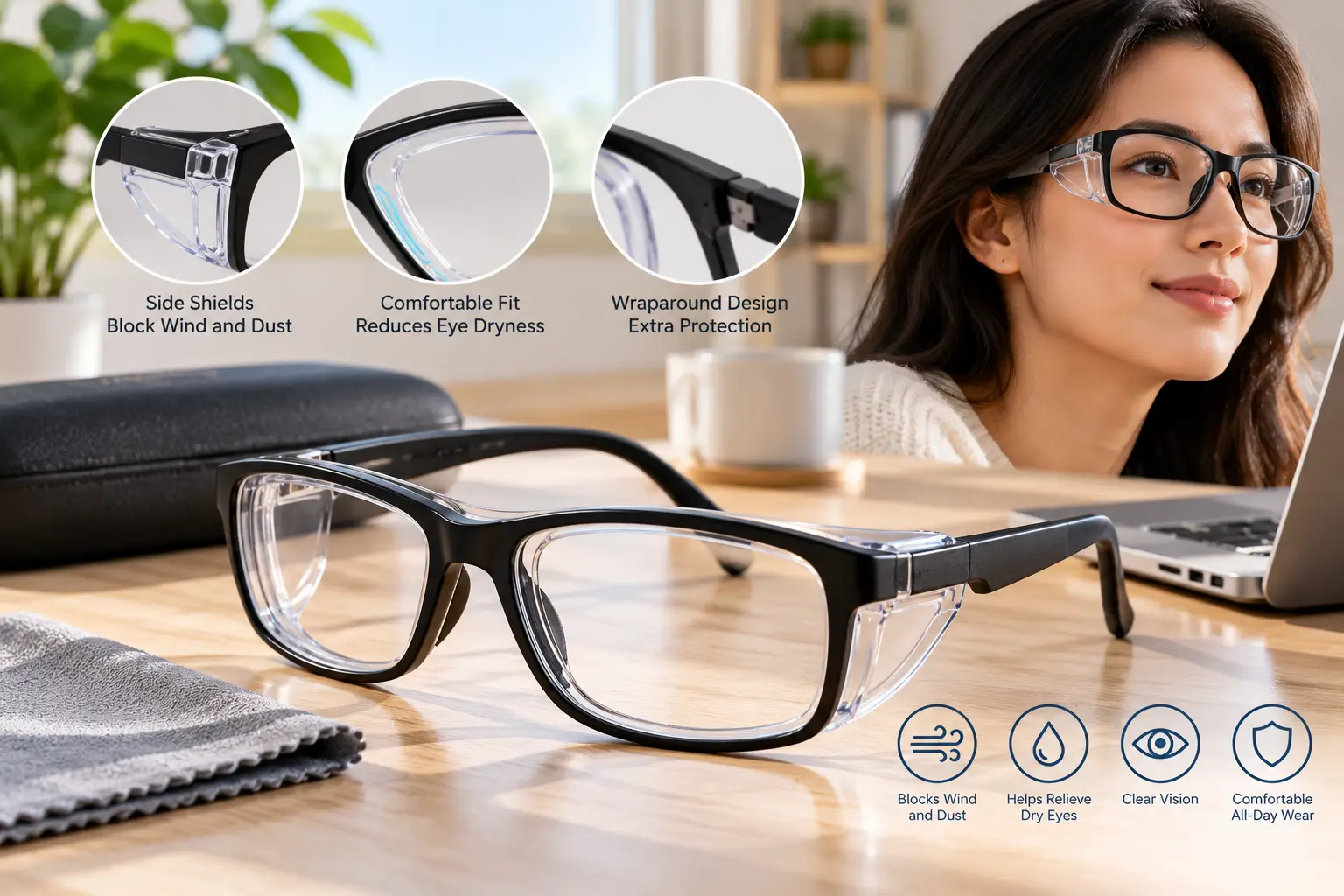
Eyeglasses for dry eyes — often called moisture chamber glasses — are frames fitted with a soft silicone or foam seal that surrounds each eye. The seal blocks wind, drafts, and dust while trapping the humidity your eyes naturally release, which slows tear evaporation and keeps the eye surface more comfortable for longer.
That’s the textbook answer. The practical answer is simpler: they turn the air directly in front of your eyes into a calmer, more humid microclimate. Air conditioning in the office, the car’s heater blasting at your face, a breezy bike ride — all of these pull moisture off your eyes, and a good pair of dry eye glasses puts a physical barrier in the way.
Dry eye is far from rare. According to the NIH Office of Research on Women’s Health, causes often overlap — computer use, contact lens wear, eye surgery, and low humidity can all trigger or worsen it, and the condition becomes more common after age 50. That’s exactly why a drug-free, low-maintenance option is so appealing.
One important note before we dive in: moisture chamber glasses manage symptoms; they don’t cure the underlying condition. Think of them as a seatbelt rather than an engine repair. If your symptoms are persistent or severe, an eye doctor should be part of the plan.
In this guide, you’ll find seven real models available (or orderable) through amazon.com, a side-by-side comparison, setup tips for your first month, and the honest trade-offs most product pages skip.
Quick Comparison: 7 Best Eyeglasses for Dry Eyes at a Glance
| Product | Type | Face Size | Seal | Approx. Price Range | Best for |
|---|---|---|---|---|---|
| Ziena Kai | Optical-style moisture chamber | Small–Medium | Removable silicone eyecup | $150–$240 | Ziena Kai: discreet all-day wear for smaller faces |
| Ziena Marina | Optical-style moisture chamber | Medium–XL | Removable silicone eyecup | $150–$240 | Ziena Marina: office plus outdoors, larger faces |
| 7eye AirShield Cape | Sport wrap | Medium–Large | Removable foam AirShield | $100–$180 | 7eye AirShield Cape: best all-rounder, Rx fitting |
| 7eye AirShield Panhead | Sport wrap | Large–XL | Removable foam AirShield | $100–$180 | 7eye AirShield Panhead: riders and big frames |
| Wiley X AirRage | Sport wrap (Climate Control) | Small | Removable Facial Cavity Seal | $100–$160 | Wiley X AirRage: narrow faces, active use |
| Yourga Dry Eyes Relief Eyeglasses | Budget moisture chamber | Medium | Fixed silicone-style chamber | Under $40 | Yourga Dry Eyes Relief Eyeglasses: screen-time trial |
| RSVP International Onion Goggles | Foam-seal goggle | Most faces | Deep foam seal | Under $35 | RSVP International Onion Goggles: testing the concept cheaply |
Prices are approximate ranges at the time of writing and vary by lens option and seller — check the current price on Amazon.
Looking at the table, the split is clear: the two Ziena frames are the only ones that genuinely pass for regular eyeglasses, which matters if you plan to wear them in meetings. The 7eye AirShield Cape and Wiley X AirRage trade a sportier look for deeper wind protection, while the RSVP International Onion Goggles and Yourga Dry Eyes Relief Eyeglasses let you find out whether a moisture chamber helps you before spending three figures.
💬 One click helps other shoppers make an informed choice too! 😊
Top 7 Eyeglasses for Dry Eyes: Expert Analysis
Each pick below was chosen based on real spec sheets, fit data published by specialist dry eye retailers, and the recurring themes in customer reviews. No product here is presented as “tested by me” — instead, you’ll get honest analysis of what the specs and the review record actually suggest.
1. Ziena Kai — most discreet for smaller faces
The Ziena Kai is the pair you can wear to a job interview without anyone suspecting it’s a medical device. Its removable eyecup is made of soft, latex-free silicone that sits inside a slim optical-style frame, so from a few feet away it reads as ordinary glasses.
The frame is among the smallest in the Ziena lineup, which is aimed at small-to-medium faces. Adjustable nose pads and bendable temple tips matter more than they sound: a moisture chamber only works when the cup actually touches the skin around your eye, and those two adjustments are how you close the gaps. Because the eyecup pops out, you can also wear the frame as regular glasses on days when your eyes feel fine.
Based on comparing the specs, the Ziena Kai is best for office workers, teachers, and anyone with mild-to-moderate dry eye who refuses to look “goggly.” If you have a broad face, though, skip ahead to the Ziena Marina.
Customer reviews on specialist dry eye retailer sites are consistently strong, with buyers frequently describing much less tearing and dabbing during outdoor walks. A minor recurring note is that some frame colors look different in person than in photos.
Pros:
- ✅ Looks like normal eyeglasses at a glance
- ✅ Removable silicone cup adds day-to-day flexibility
- ✅ Adjustable nose pads help perfect the seal
Cons:
- ❌ Too small for wide or large faces
- ❌ Premium price compared with sport frames
Expect roughly $150–$240 depending on lenses — a premium, but justified if all-day discretion is your top priority.
2. Ziena Marina — best optical look for larger faces
The Ziena Marina brings the same discreet silicone-cup concept to a roomier medium-to-extra-large frame. Think of it as the Ziena Kai‘s bigger sibling, with a bolder, more contemporary shape.
Like the Kai, it uses a removable silicone moisture chamber plus adjustable nose pads and bendable temples. In practice, the larger lens area gives you a wider field of view, which helps if you switch between a monitor, a second screen, and paperwork all day. Specialist retailers sell it with clear, tinted, and photochromic options, so one pair can cover the office and the commute.
Here’s what to weigh: if you have Sjögren’s, rheumatoid arthritis, or another condition that causes aqueous-deficient dry eye, a single pair you can wear indoors and out removes a lot of friction from your routine. That’s where the Ziena Marina shines — it’s the most versatile “one pair for everything” pick in this lineup.
Reviews from buyers with Sjögren’s and other autoimmune conditions are largely positive, and some report preferring it over their regular progressives. A few note that the seal depends heavily on getting the fit right at the ears.
Pros:
- ✅ Fits medium to extra-large faces comfortably
- ✅ Photochromic lens options suit indoor-outdoor wear
- ✅ Discreet styling for professional settings
Cons:
- ❌ Seal quality depends on careful fit adjustment
- ❌ Replacement eyecups are an added ongoing cost
At roughly $150–$240, the Ziena Marina is strong value if it replaces two separate pairs of glasses.
3. 7eye AirShield Cape — best all-round sport frame
The 7eye AirShield Cape is a frequent first recommendation from specialist dry eye retailers for a reason: it fits most medium-to-large faces and balances protection with peripheral vision.
Its signature feature is the removable AirShield foam eyecup, which fills the space between the frame and your face. That foam blocks wind, dust, and pollen far more aggressively than silicone, which is why it’s a favorite for driving with the vent on and walking on windy days. Extendable temples can be curved downward for a snug hold, and retailers single it out as one of the better AirShield models for fitting prescription lenses.
Based on the specs, the 7eye AirShield Cape suits people whose dry eye flares mostly outdoors or in moving air. It looks sportier than a Ziena frame, so it’s less ideal for formal workplaces.
Aggregated reviews are overwhelmingly positive on comfort and seal, with users noting relief in wind. The most common caveat is cosmetic: several reviewers admit the look can resemble swim goggles up close.
Pros:
- ✅ Foam seal blocks wind better than silicone
- ✅ Good peripheral vision for a sealed frame
- ✅ Widely recommended for prescription lens fitting
Cons:
- ❌ Sporty look stands out indoors
- ❌ Foam eyecup wears out and needs replacing
Typically $100–$180 depending on lens choice — arguably the best performance-per-dollar in this list.
4. 7eye AirShield Panhead — best for riders and large faces
The 7eye AirShield Panhead is the largest AirShield frame, built for large to extra-large faces and anyone who rides a motorcycle or bike.
Spec sheets list ANSI Z87.1 safety compliance, shatter-resistant lenses, 100% UVA/UVB protection, and 360° bend-to-fit arms. Translated into real life: the lenses can take an impact from flying debris, and the arms can be shaped so the frame stays sealed when you turn your head at speed. Its close wraparound shape also covers the areas above and below the eye socket, where gaps often appear on smaller frames.
If you’ve ever tried a “one size fits all” dry eye frame and felt it pinch your temples, the 7eye AirShield Panhead is the honest answer. Smaller faces should look elsewhere, because a frame that’s too large leaves the same gaps you’re trying to close.
Review sentiment highlights the wraparound coverage and helmet compatibility. Feedback on AirShield models generally notes that lens clarity expectations at this price vary, and a minority of buyers report eyecups loosening over time.
Pros:
- ✅ ANSI Z87.1 rated for impact protection
- ✅ Wraparound shape covers above and below eyes
- ✅ Bend-to-fit arms secure a moving seal
Cons:
- ❌ Too large for small or narrow faces
- ❌ Unmistakably athletic styling
At $100–$180, it’s excellent value for riders who’d otherwise need both safety glasses and dry eye protection.
5. Wiley X AirRage — smallest sealed sport frame
The Wiley X AirRage solves a common frustration: most sealed sport frames are simply too big for narrow faces. It’s the smallest frame in Wiley X’s Climate Control series.
Published dimensions — about 131.7 mm hinge-to-hinge, an 18 mm bridge, and 61 x 37 mm lenses — confirm it’s built for smaller profiles. The removable Facial Cavity Seal is a soft foam gasket that fills the gap between frame and skin, and the frame is Rx-ready with high-velocity impact protection. The package includes a zippered clamshell case, a cleaning cloth, and a leash cord.
Here’s what most buyers overlook: specialist retailers note that Wiley X foam seals are generally somewhat shallower than 7eye’s AirShield. That makes the Wiley X AirRage a touch less “humid” than the 7eye AirShield Cape, but also less fog-prone and less goggle-like. It’s a smart pick for women, teens, and men with slim faces who cycle, ski, or work outdoors.
Verifiable customer reviews specifically on dry eye use are limited, so treat this one as a fit-driven recommendation rather than a review-driven one.
Pros:
- ✅ Genuinely sized for narrow faces
- ✅ Impact-rated and prescription-ready frame
- ✅ Shallower seal reduces fogging
Cons:
- ❌ Less moisture retention than deeper foam seals
- ❌ Limited dry eye-specific review data
Around $100–$160 — fair value if your face has been “too small” for every other sealed frame.
6. Yourga Dry Eyes Relief Eyeglasses — budget screen-time trial
The Yourga Dry Eyes Relief Eyeglasses are one of the more visible budget moisture chamber options on Amazon, combining a built-in eye chamber with blue light–filtering lenses aimed at computer and phone use.
The idea is appealing: an inexpensive frame with an integrated chamber that you can wear at your desk. In practice, the depth and fit of that chamber matter enormously, and budget frames often aren’t adjustable the way Ziena or 7eye frames are. On the blue light angle, keep expectations realistic — current research hasn’t established blue light filters as a dry eye treatment, so the moisture chamber, not the lens tint, is what you’re really buying.
The Yourga Dry Eyes Relief Eyeglasses make the most sense as a low-risk experiment for screen workers with mild symptoms. If they help noticeably, that’s a strong signal a better-fitting premium pair would help even more.
Review sentiment is genuinely mixed: some buyers report being able to work for hours longer without discomfort, while a recurring complaint is that the chamber isn’t deep enough to seal on all faces, and that near-identical frames appear under other brand names.
Pros:
- ✅ Very low cost of entry
- ✅ Designed with desk and screen work in mind
- ✅ Indoor and outdoor versions available
Cons:
- ❌ Shallow chamber may not seal on every face
- ❌ Not adjustable and not prescription-friendly
Usually under $40 — fair value as a trial, but not a long-term substitute for a properly fitted pair.
7. RSVP International Onion Goggles — cheapest way to test the concept
Yes, these are kitchen goggles. And yes, specialist dry eye retailers openly recommend the RSVP International Onion Goggles as a way to “test the concept” before investing in premium eyeglasses for dry eyes.
The reason is simple: they have a deep foam seal, slightly tinted fog-free lenses, and a unisex shape that fits most faces. That deep seal creates a surprisingly effective moisture chamber for reading, TV, or working at home. An optometrist quoted by All About Vision notes that some people with dry eyes wear onion goggles to shield their eyes from air conditioning, dust, and wind.
Based on comparing the specs, this is the right first step if you aren’t sure whether moisture chamber glasses will help you at all. The big limitation: they don’t fit over prescription glasses, and they look exactly like what they are.
Review themes are positive for value and seal depth, with dry eye users describing them as a good “no-commitment” trial; a few mention that the fit isn’t perfect on every face.
Pros:
- ✅ Deep foam seal traps humidity well
- ✅ Fog-free lenses for comfortable reading
- ✅ Lowest-cost way to try a moisture chamber
Cons:
- ❌ Won’t fit over prescription eyeglasses
- ❌ Not something you’ll wear in public
Typically under $35 — outstanding value as a diagnostic tool for your own eyes.
Side-by-Side Specs of the Top 7
| Product | Rx-Ready | Seal Depth | Lens Options | Safety Rating | Best for |
|---|---|---|---|---|---|
| Ziena Kai | Yes (via optical lab) | Medium (silicone) | Clear, tinted, photochromic | Not marketed as safety eyewear | Ziena Kai: discreet office wear |
| Ziena Marina | Yes (via optical lab) | Medium (silicone) | Clear, tinted, photochromic | Not marketed as safety eyewear | Ziena Marina: one pair for everything |
| 7eye AirShield Cape | Yes | Deep (foam) | Clear, tinted, polarized, photochromic | Shatter-resistant | 7eye AirShield Cape: windy commutes |
| 7eye AirShield Panhead | Yes | Deep (foam) | Clear or tinted | ANSI Z87.1 | 7eye AirShield Panhead: riders |
| Wiley X AirRage | Yes | Shallow–medium (foam) | Multiple tints | High-velocity rated | Wiley X AirRage: narrow faces |
| Yourga Dry Eyes Relief Eyeglasses | No | Shallow | Blue light–filtering | Not specified | Yourga Dry Eyes Relief Eyeglasses: trial run |
| RSVP International Onion Goggles | No | Deep (foam) | Lightly tinted, fog-free | Not specified | RSVP International Onion Goggles: concept test |
The pattern here is that seal material drives most of the experience. Foam (7eye, Wiley X, RSVP) blocks moving air best but looks sportier and needs replacing; silicone (Ziena Kai, Ziena Marina) is more discreet and easier to clean but slightly less windproof. If you need prescription correction, the budget options drop out immediately, which narrows the realistic choice to five frames.
✨ Don’t miss these comfort-first picks!
🔍 Take your dry eye relief to the next level with this carefully curated lineup. Click a highlighted item to check current pricing and availability. The right pair can help you get through long workdays, windy drives, and screen marathons with eyes that actually feel comfortable!
Your First 30 Days with Moisture Chamber Glasses
Buying the right pair is only half the job. How you wear them in the first month decides whether they end up on your face or in a drawer.
Week 1: Fit before function
Start by checking the seal in a mirror. Look for daylight gaps at the outer corners and under the eyes — those are the two most common leak points. On Ziena frames, adjust the nose pads first, then gently bend only the rubber tips of the temples. On 7eye and Wiley X frames, curve the bendable arms until the foam touches evenly without pressing.
Week 2: Build wear time gradually
Wear them for 1–2 hours during your worst trigger — usually screen time or driving. Notice whether you reach for drops less often. Many people find the effect obvious within a session; others need a few days to notice a pattern.
Week 3: Track, don’t guess
Keep a simple note on your phone: hours worn, drops used, and a 1–10 comfort score at the end of the day. After a week of data, you’ll know whether the glasses are genuinely helping or whether you need a different seal type.
Week 4: Maintenance habits
- ✅ Wipe silicone cups daily with mild soap and water; they collect skin oils and makeup.
- ✅ Let foam cups air-dry fully; never put them away damp.
- ✅ Store the frame in its case so the seal doesn’t get crushed or deformed.
Common first-month mistakes: cranking the fit too tight (which causes pressure headaches), wearing them only on “bad days” (so you never see the cumulative benefit), and quitting after one foggy morning. Fogging is fixable — see the troubleshooting section below.
Real-World Scenarios: Matching Dry Eye Glasses to Your Life
Specs only mean something in context. Here are three common profiles and the pick that fits each.
Profile 1: The remote software developer
Maria, 38, works 9–10 hours a day across two monitors in an air-conditioned apartment. Her symptoms are mild-to-moderate and worst after lunch. Budget: flexible, but she wants to test first.
Best path: Start with the RSVP International Onion Goggles for two weeks while working. If her afternoon comfort improves noticeably, upgrade to the Ziena Kai or Ziena Marina for video calls. The logic is simple: she only pays premium prices once she’s confirmed the concept works for her eyes.
Profile 2: The weekend motorcyclist with a prescription
Dan, 54, wears progressives, rides most weekends, and gets streaming, irritated eyes even behind his helmet visor. Budget: around $200 before lenses.
Best path: The 7eye AirShield Panhead. It’s sized for his large face, ANSI Z87.1 rated, and Rx-ready, so one frame handles both safety and dryness. His optician can confirm whether his progressive prescription works well in a wrap frame.
Profile 3: The retiree with Sjögren’s
Linda, 67, has aqueous-deficient dry eye, a smaller face, and wants one pair for gardening, errands, and reading. Budget: moderate.
Best path: The Ziena Kai with photochromic lenses gives her a discreet indoor look and outdoor tint in one frame. If she gardens in strong wind, a backup Wiley X AirRage offers a deeper seal for those days.
The takeaway: match the seal type to your trigger environment, then match the frame to your face size. Style comes third — but it matters, because you won’t wear what you don’t like.
Problem → Solution: Fixing Fogging, Gaps, and Pressure
Even great dry eye glasses come with quirks. Here are the five most common problems and how to solve them.
1. Lenses fog up. Fogging means the chamber is working — it’s holding humidity — but too much heat and moisture are building up. Choose vented frames like the 7eye AirShield Cape, use an anti-fog lens cleaner, and lift the frame for a few seconds when you move from cold air into a warm room.
2. Air leaks at the outer corners. This is usually a sizing issue. If you have a narrow face in a large frame, no adjustment will fix it — switch to the Ziena Kai or Wiley X AirRage. For a minor gap, silicone ear grips (sold as accessories for Ziena frames) can cinch the fit.
3. Pressure marks or headaches. You’ve over-tightened the fit. The seal should touch, not squeeze. Loosen the temple bend slightly and reposition the nose pads.
4. The foam cup feels grimy or flattened. Foam is a consumable. Replace it on the manufacturer’s recommended schedule — sooner if it no longer springs back after being pressed.
5. Vision feels “off” with your prescription. Wrap frames can introduce distortion for higher prescriptions. Ask an optician whether your prescription suits a curved lens, or choose a flatter optical-style frame like the Ziena Marina.
How to Choose Eyeglasses for Dry Eyes
Use these seven steps to narrow the field quickly.
- Identify your main trigger. Wind and moving air call for deep foam seals; indoor screen work can be handled by discreet silicone cups.
- Measure your face size honestly. Check your current frame’s width (often printed inside the temple). A frame that’s too large can’t seal, no matter how good the design.
- Decide on prescription needs early. If you need correction, limit yourself to Rx-ready frames and budget for lens costs.
- Pick the right seal material. Foam blocks air best but wears out; silicone is cleaner and more discreet but slightly less windproof.
- Choose lenses for your environment. Clear for indoors, photochromic for mixed use, polarized for driving glare.
- Consider where you’ll wear them. If appearance at work matters, optical-style frames will see far more daily use.
- Check replacement part availability. Seals wear out, so confirm you can buy replacement eyecups for your chosen model.
These steps matter because the most common reason people abandon moisture chamber glasses isn’t that they don’t work — it’s that the chosen pair was the wrong size, the wrong style, or the wrong seal for their daily life.
Moisture Chamber Glasses vs. Regular Glasses, Wraparound Sunglasses, and Goggles
Regular eyeglasses already offer some protection: the lens blocks air coming straight at you. But air easily flows around the sides, top, and bottom, so humidity never builds up. Wraparound sunglasses cut more side airflow but still leave gaps. Full goggles seal perfectly but are impractical for daily life.
| Option | Air Blocking | Humidity Retention | Everyday Wearability | Best for |
|---|---|---|---|---|
| Regular eyeglasses | Low | Minimal | Excellent | Vision correction only |
| Wraparound sunglasses | Moderate | Low | Good outdoors | Glare, light wind |
| Moisture chamber glasses (Ziena Marina, 7eye AirShield Cape) | High | Moderate–high | Good | Ziena Marina and 7eye AirShield Cape: daily dry eye management |
| Sealed goggles (RSVP International Onion Goggles) | Very high | High | Poor in public | RSVP International Onion Goggles: home use, concept testing |
The table shows why moisture chamber designs exist: they sit in the sweet spot between “comfortable to wear all day” and “actually traps humidity.” Regular frames and sunglasses simply can’t build a humid microclimate because air keeps moving through the gaps. Goggles do it best, but few people will wear them to the grocery store.
There’s also a cost angle. Artificial tears are an ongoing purchase, and many users of moisture chamber glasses report reaching for drops less often once their chamber fits well. That doesn’t mean you should stop prescribed treatment — but it can make your routine simpler and cheaper.
Features That Actually Matter (and Ones That Don’t)
Marketing language around dry eye glasses can be noisy. Here’s how to filter it.
Features that matter
- Seal depth and contact. The single biggest factor. A cup that touches your skin evenly is worth more than any lens coating.
- Adjustability. Bendable temples and adjustable nose pads let you tune the seal to your face.
- Replaceable eyecups. Seals degrade. A frame with replaceable cups, like the Ziena Kai or 7eye AirShield Cape, has a much longer useful life.
- Rx compatibility. If you need correction and can’t wear contacts comfortably (common with dry eye), this is non-negotiable.
- Venting or anti-fog treatment. Directly affects whether you’ll keep wearing them in temperature changes.
Features that matter less than you’d think
- Blue light filtering. It may help with glare preference, but current evidence doesn’t support blue light filters as a dry eye treatment. The seal is doing the real work.
- “Medical grade” labels on budget frames. Without a clear standard behind the claim, it tells you little about how well the chamber seals.
- Extreme tint darkness indoors. Darker isn’t better inside; it can make you squint, which doesn’t help.
Glasses for Dry Eyes for Computer Users and Office Workers
If your symptoms peak at your desk, you’re not imagining it. People tend to blink less when focusing on screens, and office HVAC systems keep air moving and dry. Those two factors combined make the workplace one of the toughest environments for tear film stability.
For office use, glasses for dry eyes need to be discreet, comfortable for 8+ hours, and compatible with your screen prescription. That points strongly toward the Ziena Kai (smaller faces) and the Ziena Marina (larger faces). Both use a silicone cup that’s less conspicuous than foam, and the cup can be removed for meetings where you’d rather not wear it.
A few practical tweaks make a big difference:
- ✅ Position your monitor slightly below eye level so your eyelids cover more of the eye surface.
- ✅ Point desk fans and HVAC vents away from your face.
- ✅ Use the 20-20-20 habit: every 20 minutes, look 20 feet away for 20 seconds — and blink fully.
- ✅ Wear your moisture chamber glasses during your longest focus blocks, not just when symptoms flare.
If you’re budget-constrained, the Yourga Dry Eyes Relief Eyeglasses can serve as a low-cost trial at your desk. Just don’t judge the entire category on a frame that may not seal well on your face.
Dry Eye Sunglasses for Driving, Cycling, and Outdoor Life
Outdoors is where dry eye sunglasses earn their keep. Wind speed, sun glare, pollen, and dust all accelerate tear evaporation — and squinting into the sun makes everything feel worse.
For driving, choose polarized or photochromic lenses in a frame with moderate wrap. The 7eye AirShield Cape is a strong fit here: it offers good peripheral vision, which matters when checking mirrors and blind spots. Avoid very dark tints for night driving entirely — sealed frames with clear lenses are the only safe choice after dark.
For cycling and motorcycling, impact protection becomes a priority. The 7eye AirShield Panhead is ANSI Z87.1 rated, and the Wiley X AirRage carries high-velocity protection for smaller faces. Both have slim temples designed to fit under helmets.
For hiking, gardening, and beach days, photochromic lenses in an optical-style frame like the Ziena Marina give you flexibility as light changes, without the athletic look.
One often-missed tip: carry a microfiber cloth. Sealed frames trap humidity, and a quick wipe during temperature changes keeps your vision clear without breaking the seal for long.
Long-Term Cost and Maintenance
The sticker price is only part of the story. To compare value fairly, factor in replacement seals, lens upgrades, and how long each frame realistically lasts.
Premium frames like the Ziena Kai and Ziena Marina cost more upfront, but replacement silicone eyecups are sold separately (specialist retailers list them in roughly the $30–$40 range), so a single frame can last years. Foam seals on the 7eye AirShield Cape, 7eye AirShield Panhead, and Wiley X AirRage are cheaper to replace but wear out faster, especially with daily use and sweat.
Budget options like the RSVP International Onion Goggles and Yourga Dry Eyes Relief Eyeglasses have no meaningful replacement-parts ecosystem — when they wear out, you replace the whole thing. That’s fine at their price, but it means they aren’t a long-term plan if you need all-day wear.
Prescription lenses add the biggest variable. Depending on your prescription and lens type, lenses can cost more than the frame itself. If you need correction, get a quote from your optician before buying.
Finally, check whether your health savings account (HSA) or flexible spending account (FSA) covers moisture chamber glasses. Industry sources note they’re commonly claimed, but eligibility depends on your plan and sometimes a letter of medical necessity — confirm with your plan administrator before assuming coverage.
Safety, Standards, and What the Research Says
Moisture chamber glasses aren’t a fad — they’ve been part of dry eye management for decades, and the research is supportive, if modest in scale.
A 2016 study in Optometry and Vision Science of 30 dry eye subjects found that moisture chamber spectacles improved ocular comfort and tear film stability, describing them as a safe, promising option for people in adverse environments. More recently, a 2023 study published in BMC Ophthalmology examined moisture chamber goggles for dry eye after SMILE and FS-LASIK surgery, explaining that they slow tear evaporation by raising local humidity and reducing airflow.
Clinical guidelines also recognize them. Summaries of the TFOS DEWS II management approach list moisture chamber spectacles as a tear conservation option, particularly for evaporative dry eye, alongside measures like humidifying the air and adjusting airflow at work.
On safety standards:
- ANSI Z87.1 is the US standard for occupational and educational eye protection. Frames like the 7eye AirShield Panhead list this rating, which matters if you’ll ride, work with tools, or play sports.
- UV protection claims (100% UVA/UVB) matter for outdoor frames; look for them explicitly on the listing.
- Latex-free materials matter if you have sensitive skin or allergies; Ziena eyecups are marketed as latex-free silicone.
The honest bottom line: moisture chamber glasses are best understood as an adjunct. Ophthalmologists interviewed by EyeWorld have stressed that they don’t treat underlying causes like meibomian gland dysfunction or inflammation, so they work best alongside the treatment plan your eye doctor recommends.
Common Mistakes to Avoid When Buying Dry Eye Glasses
Buying the wrong size. This is the number one reason moisture chamber glasses “don’t work.” Measure your current frames and compare against published fit ranges before ordering.
Expecting them to replace treatment. They reduce evaporation; they don’t fix gland dysfunction, inflammation, or low tear production. Keep seeing your eye doctor.
Choosing a sport frame for an office job. If you won’t wear them at your desk because of how they look, you won’t get the benefit. Match style to the place you’ll actually wear them.
Ignoring prescription compatibility. Many people buy a non-Rx frame and then realize they can’t see their screen. Decide this first.
Skipping the trial step. Spending $200+ before knowing whether a moisture chamber helps you is a gamble. The RSVP International Onion Goggles make an inexpensive test.
Overvaluing blue light claims. Pay for the seal, not for the lens marketing.
Forgetting replacement seals. A frame without available replacement eyecups has a short lifespan. Confirm parts availability before buying.
FAQ About Eyeglasses for Dry Eyes
❓ Are moisture chamber glasses worth the money?
❓ Can I get prescription lenses in dry eye glasses?
❓ Do glasses for dry eyes help at night?
❓ Which dry eye sunglasses are best for driving?
❓ How often should I replace the eyecup or foam seal?
Conclusion: Finding the Right Eyeglasses for Dry Eyes
Dry eye is exhausting precisely because it never fully goes away — it hums in the background of your workday, your commute, and your weekends. The good news is that the right pair of eyeglasses for dry eyes can make that background noise a lot quieter, without adding another bottle to your nightstand.
Here’s the short version. If you want discreet, all-day wear, the Ziena Kai (smaller faces) and Ziena Marina (larger faces) are the most office-friendly options available. If wind, driving, or outdoor activity is your trigger, the 7eye AirShield Cape is the best all-rounder, the 7eye AirShield Panhead suits riders and large faces, and the Wiley X AirRage finally gives narrow faces a sealed sport frame that fits. And if you’re not sure the concept works for you yet, the RSVP International Onion Goggles or Yourga Dry Eyes Relief Eyeglasses let you find out for very little money.
Whatever you choose, fit is everything. Measure your face, adjust the seal patiently during your first few weeks, and pair your glasses with the care plan your eye doctor recommends. Comfortable eyes aren’t a luxury — they’re what lets you focus on everything else.
🌟 Ready to give your eyes a break?
👓 Pick the pair that fits your face and your daily triggers, then click a highlighted product to check current pricing and availability on Amazon. Your future self — the one reading comfortably at 4 p.m. — will thank you!
Recommended for You
- Computer Reading Glasses vs Reading Glasses: 7 Best Picks for 2026
- Blue Light Filter for TV: 7 Best Picks Worth It in 2026
- Clear Top Reading Glasses: 7 Best Picks That Actually Work (2026)
Disclaimer: This post contains affiliate links. As an Amazon Associate, I earn from qualifying purchases made through these links, at no additional cost to you.
✨ Found this article helpful? Share it with someone who needs it! 💬🤗