
In This Article
Why Narrow Eyeglass Frames Deserve a Closer Look in 2026
If your glasses slide down your nose every time you look at your phone, or the arms seem to wave goodbye somewhere past your ears, you’re probably not the problem. Your frames are. Most mass-market eyewear is sized around an “average” adult head, and anyone with a slimmer face, a small pupillary distance, or a low nose bridge ends up wearing something built for someone else.
That’s exactly where narrow eyeglass frames come in. These are frames with a shorter overall front width, smaller lens widths (often somewhere in the mid-40s to about 51 mm), and sometimes shorter lens heights and temple arms. The payoff is a pair that stays put, keeps your eyes centered in the optical sweet spot, and doesn’t make your face look like it’s peeking out from behind a windshield.
But “narrow” isn’t a single measurement, and that’s where shoppers trip up. A frame can be narrow side to side (great for slim faces), narrow top to bottom (the sleek rectangle look), or both. Each version solves a different problem, and each has trade-offs — especially if you wear progressive lenses.
In this guide, we compare seven real frames you can find on amazon.com, from classic Ray-Ban acetate to lightweight Oakley alloy to budget reading glasses. You’ll get plain-English explanations of what the numbers on your temple arm mean, a fit troubleshooting guide, scenario-based picks, and honest notes on what customer reviews do (and don’t) tell you.
No fluff, no invented test drives — just spec-sheet analysis, real review sentiment where we could verify it, and practical advice to help you choose narrow eyeglass frames that actually fit.
What Are Narrow Eyeglass Frames?
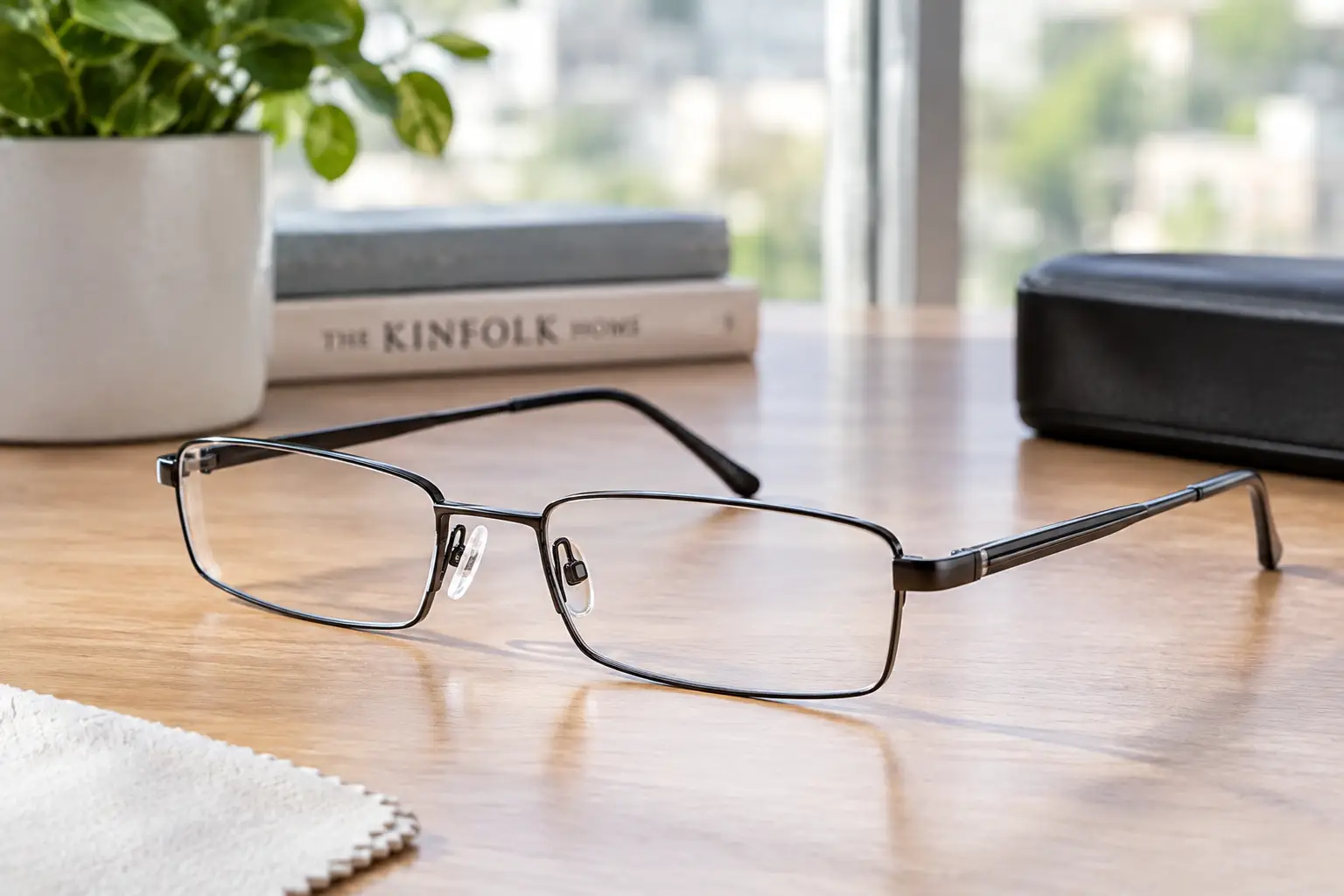
Narrow eyeglass frames are glasses built with a smaller total front width, compact lens widths, and often a tighter bridge and shorter temples, so they sit securely on slim or petite faces. Some “narrow” styles also have a short lens height, creating a slim rectangular profile that suits many face shapes.
That’s the short answer. The longer one: the entire modern system of eyewear sizing (you can skim the history of how eyeglasses evolved if you’re curious) boils down to three numbers stamped on the inside of your temple arm — something like 50-17-140. The first is lens width, the second is bridge width, and the third is temple length, all in millimeters. Some brands add a fourth: lens height.
Here’s how those numbers translate for a narrow fit:
- 🔍 Lens width: narrow-fit frames commonly land in the mid-40s to about 51 mm, versus 53-57 mm for standard adult sizes.
- 👃 Bridge width: 16-18 mm suits most narrow noses; wider bridges tend to let the frame drop.
- 👂 Temple length: 135-140 mm often fits smaller heads better than 145-150 mm arms.
- 📏 Lens height: under about 30 mm reads as a “slim” rectangle — stylish, but it matters for progressives.
Keep these four numbers in mind; every recommendation below leans on them.
Quick Comparison: Narrow Eyeglass Frames at a Glance
Before diving into the full breakdowns, here’s a snapshot of the seven frames we analyzed. Sizes are the narrowest commonly listed option we could verify; price ranges reflect what we saw at the time of writing and may vary.
| Frame | Narrowest Size (mm) | Lens Height | Material | Price Range | Best for |
|---|---|---|---|---|---|
| Ray-Ban RX5228 | 50-17-140 | ~34.5 mm | Acetate | ~$150-$210 | Ray-Ban RX5228: classic everyday wear |
| Oakley OX8046 Airdrop | 51-18-143 | ~31 mm | O Matter/propionate | ~$140-$200 | Oakley OX8046 Airdrop: active lifestyles |
| Ray-Ban RX5154 Clubmaster Optics | 49-21-140 | ~36 mm | Acetate + metal | ~$160-$220 | Ray-Ban RX5154 Clubmaster Optics: retro style, narrow faces |
| Ray-Ban RX6238 | 55-17-150 | ~33 mm | Metal | ~$140-$200 | Ray-Ban RX6238: slim-profile metal look |
| Oakley OX3217 Socket 5.0 | 53 mm lens | Not verified | C-5 alloy | ~$160-$240 | Oakley OX3217 Socket 5.0: lightweight metal comfort |
| Eyekepper Quality Half-Rim Readers | 53-17-140 | 31 mm | Metal | ~$10-$20 | Eyekepper Quality Half-Rim Readers: budget readers |
| Eyekepper 5-Pack Half-Eye Readers | 47-22-140 | 24 mm | Metal | ~$15-$25 | Eyekepper 5-Pack Half-Eye Readers: spare readers everywhere |
Looking at the table, the Ray-Ban RX5154 Clubmaster Optics and Ray-Ban RX5228 are the true side-to-side narrow options for full-time prescription wear, while the Ray-Ban RX6238 is “narrow” mainly in height — its 55 mm lens and 150 mm temples make it better for average-width faces that want a slim look. On the budget end, the two Eyekepper models trade prescription flexibility for low cost, which makes sense only if you need simple magnifiers.
💬 One click helps other shoppers make an informed choice too! 😊
Top 7 Narrow Eyeglass Frames: Expert Analysis
Each pick below includes what the specs mean in practice, who the frame suits, what verifiable feedback says, and a value verdict. We didn’t physically test these frames; the analysis draws on published measurements, brand specs, and aggregated review sentiment where it exists.
1. Ray-Ban RX5228 — best all-round narrow acetate frame
The Ray-Ban RX5228 earns its spot because it’s offered in a genuinely small 50 mm lens size, which many famous frames skip.
At 50-17-140, with a lens height around 34-35 mm, it sits in the sweet spot for slimmer faces: narrow enough to stay centered, yet tall enough to accommodate most progressive designs. The acetate construction is plant-derived and generally considered hypoallergenic, and acetate holds its shape well once an optician heat-adjusts it — a big deal when you’re fine-tuning a narrow fit.
Based on comparing the specs, this is the frame we’d point most first-time narrow-fit buyers toward. It’s squared but softened, so it adds structure to round and oval faces without the heaviness of chunky retro styles. If your face is very small (think a total face width under about 125 mm), even the 50 mm size may feel a touch wide, so check your current frame’s numbers first.
On Amazon, reviews are split across many colors and sizes, so we couldn’t verify a consistent review pool for the 50 mm version specifically. Retailer listings consistently describe it as a regular-to-small fit, which matches the measurements.
Pros:
- ✅ True small 50 mm size is widely listed
- ✅ Lens height works with most progressive lenses
- ✅ Acetate adjusts well for a custom fit
Cons:
- ❌ Needs prescription lenses fitted separately
- ❌ Acetate front is heavier than metal alternatives
Expect roughly $150-$210 for the frame alone; for a brand-name frame that truly fits narrow faces, it’s solid long-term value.
2. Oakley OX8046 Airdrop — lightest-feeling pick for active days
The Oakley OX8046 Airdrop is built for people whose glasses have to survive the gym bag, the job site, and the weekend hike.
Its smallest listed size is 51-18-143 with a lens height of about 31 mm, and at least one optical retailer tags that size as a “narrow” fitting. It’s made from Oakley’s O Matter/propionate materials; one retailer claims it’s about 25% lighter and twice as strong as the older Oakley Servo — treat that as a marketing figure, not an independent test. Unobtainium earsocks are designed to grip more when you sweat, which is exactly what stops glasses from creeping down a narrow nose.
Here’s what to weigh: that 31 mm lens height gives a sleek, sporty rectangle, but it’s on the lower edge for progressive lenses. Single-vision wearers get the best experience here. The 143 mm temples are a bit long for very small heads, though the grippy tips offset some of that.
Aggregated retailer feedback we could find leans toward comfort and light weight, but we couldn’t verify a large, consistent Amazon review set for this exact size and color.
Pros:
- ✅ Grippy earsocks help frames stay in place
- ✅ Narrow 51 mm size option exists
- ✅ Lightweight, impact-resistant material
Cons:
- ❌ Short lens height limits progressive lens options
- ❌ Sporty styling won’t suit formal settings
Typically around $140-$200 at the time of writing; very good value if you need durability more than dressiness.
3. Ray-Ban RX5154 Clubmaster Optics — narrowest lens width in the lineup
The Ray-Ban RX5154 Clubmaster Optics offers a 49 mm lens size, the smallest lens width among the prescription frames here.
The browline design pairs an acetate top with a thin metal lower rim, and the 49-21-140 size produces a total width of roughly 135 mm. What most buyers overlook is the 21 mm bridge: that’s wider than typical narrow frames, which is great if you have a broader nose bridge on a slim face, but it can let the frame sit low on very narrow noses. The lens is roughly 36 mm tall, leaving generous room for progressive corridors.
Who’s it for? Anyone who wants personality without bulk. The heavy brow draws the eye upward, which can visually balance a long, narrow face — a trick stylists often recommend. It’s also a strong choice for progressive wearers who want a small frame without sacrificing reading area.
We couldn’t verify aggregated Amazon review sentiment for the 49 mm listing specifically, since reviews blend sizes; broader retailer feedback we found focuses on the iconic look rather than fit specifics.
Pros:
- ✅ 49 mm lens width suits slim faces
- ✅ Tall lens works well with progressives
- ✅ Browline style balances long faces
Cons:
- ❌ 21 mm bridge may sit low on narrow noses
- ❌ Bold look isn’t everyone’s taste
Usually in the $160-$220 range; fair value for a style icon that genuinely comes in a small size.
4. Ray-Ban RX6238 — slim-profile metal rectangle
The Ray-Ban RX6238 delivers the “narrow rectangle” look in lightweight metal rather than a small overall size.
On Ray-Ban’s own spec sheet, the 55-17 size has a lens height of about 33 mm, 150 mm temples, and a “Petite” face-coverage label, meaning the lens front covers less of your face vertically. Adjustable nose pads and spring hinges are the real stars: pads let an optician raise or narrow the fit on your nose, and spring hinges flex around your head instead of pinching.
On paper, this means the Ray-Ban RX6238 suits average-width faces that want a minimal, slim profile, and people who’ve struggled with acetate frames sliding because their nose bridge is low. It’s less ideal for genuinely small heads: 150 mm temples can extend past the ear, although a skilled optician can often bend temple tips to compensate.
Amazon offers several listings (including bundles), which scatters reviews; we couldn’t verify a consistent aggregated sentiment, so check the reviews on the specific listing you choose.
Pros:
- ✅ Adjustable nose pads fix low-bridge slipping
- ✅ Spring hinges add comfort and durability
- ✅ Slim metal profile looks professional
Cons:
- ❌ 55 mm width is too wide for very small faces
- ❌ Long 150 mm temples may need adjustment
Roughly $140-$200 at the time of writing; good value if your priority is a sleek look with adjustable comfort.
5. Oakley OX3217 Socket 5.0 — premium lightweight metal comfort
The Oakley OX3217 Socket 5.0 focuses on comfort for people who wear their glasses 14+ hours a day.
Oakley builds it from C-5 alloy, a blend of five metals designed to be strong yet light, paired with acetate temple stems. The “Three-Point Fit” means the frame touches only your nose and behind your ears — nothing presses on your temples or cheeks, which is a common complaint when a standard frame is squeezed onto a narrow face. Air-filled silicone nose pads and Unobtainium earsocks add grip without hard pressure points.
Based on comparing the specs, this is our pick for all-day computer workers and drivers who want the stability of a sport brand in a cleaner, office-ready shape. The Amazon listing we found shows a 53 mm lens size, so it suits slim-to-average faces rather than very petite ones. We couldn’t verify the lens height from a reliable source, so confirm it before ordering progressives.
Aggregated Amazon review sentiment wasn’t verifiable for this specific listing, so treat any fit claims as spec-based.
Pros:
- ✅ Three-point fit avoids temple pressure
- ✅ Air-filled nose pads cushion narrow bridges
- ✅ C-5 alloy keeps weight down
Cons:
- ❌ Lens height not clearly published
- ❌ Priciest frame in this lineup
Expect around $160-$240; worth it if comfort during long wear is your top priority.
6. Eyekepper Quality Half-Rim Readers — best budget narrow readers
The Eyekepper Quality Half-Rim Readers give you a narrow-fit reader for a fraction of a designer frame’s cost.
The published specs are refreshingly complete: 53 mm lens width, 31 mm lens height, 17 mm bridge, 140 mm temples, and a 138 mm total frame width, with aspheric lenses and spring hinges. The listing itself labels the head size as narrow to medium, which matches those numbers. Aspheric lenses are flatter than basic spherical ones, which typically means less distortion toward the edges.
Who’s it for? Anyone with presbyopia who doesn’t need a custom prescription — for example, equal strength in both eyes and no astigmatism correction. These aren’t a substitute for prescription glasses, but they’re great as a desk, car, or bedside pair.
Reviews consistently describe them as good value, well-made for normal use, and nice-looking; some buyers mention using them for reading specifically to avoid the narrow side vision of their progressive lenses.
Pros:
- ✅ Complete, published measurements make sizing easy
- ✅ Spring hinges and aspheric lenses at budget price
- ✅ Includes a hard zipper case
Cons:
- ❌ Fixed magnification only, no custom prescription
- ❌ Standard 62 mm optical center may not match small PDs
Usually around $10-$20 at the time of writing, making them outstanding value for simple reading needs.
7. Eyekepper 5-Pack Half-Eye Readers — most compact, most affordable
The Eyekepper 5-Pack Half-Eye Readers are the smallest frames here, built to perch low on the nose so you can look over them.
Specs list a 47 mm lens width, a very short 24 mm lens height, a 22 mm bridge, 140 mm temples, and a 132 mm total width, with the brand noting measurements may vary by 1-3 mm. The half-eye design is the classic “look down to read, look up over the top to see across the room” style. That 24 mm height is intentionally tiny, which is exactly why it works: there’s no distance zone to get in your way.
Who’s it for? Readers who lose glasses constantly and want spares in the kitchen, car, office, and nightstand. The 22 mm bridge is relatively wide, so they’ll sit lower on the nose — which is the intended half-eye position anyway.
Customer feedback on fit is genuinely mixed: some reviewers find them comfortable, while others report they run too small and narrow in width. That’s useful to know — they’re for slim faces, not a universal fit.
Pros:
- ✅ Five pairs for one low price
- ✅ Very compact half-eye design
- ✅ Easy over-the-top distance viewing
Cons:
- ❌ Reviewers split on whether they’re too small
- ❌ Stamped metal feels less premium
Typically around $15-$25 for the pack; excellent value per pair if the compact size suits you.
✨ Found your frame? Don’t wait on it!
🔍 Take your eyewear upgrade to the next level with this carefully curated lineup. Click a highlighted frame to check current pricing and availability. The right fit means clearer vision and fewer nose-bridge adjustments all day long!
Head-to-Head: Full Comparison of the Top 7 Frames
Now let’s compare the details that decide daily comfort: bridge style, hinge type, and progressive compatibility.
| Frame | Bridge Style | Hinges | Progressive-Friendly? | Best for |
|---|---|---|---|---|
| Ray-Ban RX5228 | Molded acetate | Standard | Yes (~34.5 mm height) | Ray-Ban RX5228: slim faces needing progressives |
| Oakley OX8046 Airdrop | Saddle bridge | Standard | Limited (~31 mm) | Oakley OX8046 Airdrop: sport and single vision |
| Ray-Ban RX5154 Clubmaster Optics | Adjustable pads | Standard | Yes (~36 mm) | Ray-Ban RX5154 Clubmaster Optics: small lens width + progressives |
| Ray-Ban RX6238 | Adjustable pads | Spring | Usually (~33 mm) | Ray-Ban RX6238: low nose bridges |
| Oakley OX3217 Socket 5.0 | Silicone pads | Standard | Check height | Oakley OX3217 Socket 5.0: long-hours comfort |
| Eyekepper Quality Half-Rim Readers | Nose pads | Spring | No (fixed readers) | Eyekepper Quality Half-Rim Readers: desk reading |
| Eyekepper 5-Pack Half-Eye Readers | Nose pads | Standard | No (fixed readers) | Eyekepper 5-Pack Half-Eye Readers: spare readers |
This table exposes the biggest hidden decision: bridge type. Molded acetate bridges, like the one on the Ray-Ban RX5228, look clean but can’t be adjusted much, whereas the adjustable pads on the Ray-Ban RX6238 and Ray-Ban RX5154 Clubmaster Optics let an optician fix slipping in minutes. If you need progressives, the Ray-Ban RX5154 Clubmaster Optics offers the most vertical room, while the Oakley OX8046 Airdrop is best reserved for single-vision lenses.
How to Choose Narrow Eyeglass Frames
Picking the right pair is mostly a measurement exercise. Follow these steps:
- Read your current frame’s numbers. Look inside a temple arm for something like 50-17-140. If that pair fits well, stay within 2-3 mm of those numbers.
- Measure your face width. Hold a ruler across your face at temple level. Your total frame width should be about equal to or slightly wider than your face; frames narrower than your face can make it look pinched.
- Know your pupillary distance (PD). Your pupillary distance — the space between your pupils — should line up with the optical centers of your lenses. Narrow faces often have smaller PDs, so a smaller lens width helps keep your eyes centered.
- Match the bridge to your nose. A narrow or low nose bridge often does better with adjustable nose pads or a 16-18 mm bridge.
- Check temple length. If standard arms extend well past your ears, look for 135-140 mm temples.
- Confirm lens height for progressives. Aim for roughly 30 mm or more if you wear multifocals (more on that below).
- Choose material for your routine. Acetate adjusts beautifully; metal and alloys stay lighter; sport materials handle abuse.
The takeaway: glasses for narrow faces aren’t about a label — they’re about numbers that match your face.
Getting the Fit Right: Your First 30 Days With Narrow Glasses Frames
Buying the frame is step one. Making narrow glasses frames feel invisible takes a few small habits.
🛠️ Week 1: Get a professional adjustment
Frames bought online almost never arrive perfectly fitted. Take them to a local optician; many will adjust frames for free or a small fee, even if you didn’t buy from them. Acetate frames like the Ray-Ban RX5228 can be heat-molded at the temples, while pad-arm frames like the Ray-Ban RX6238 can have pads pinched inward for narrow noses.
👓 Week 2: Watch for pressure points
Red marks on your nose or behind your ears after a few hours are a sign something’s off. Minor pressure is normal at first, but persistent soreness usually means the temples are too tight or the pads are misaligned.
🧼 Weekly maintenance schedule
- ✅ Rinse lenses under lukewarm water before wiping to avoid grinding in dust
- ✅ Use a drop of dish soap, not paper towels or your shirt
- ✅ Check hinge screws monthly; tiny screws loosen faster on lightweight frames
- ✅ Store in a hard case — a narrow frame bent even slightly will slide more
❌ Common first-month mistakes
Many people push glasses up with one hand at the corner, slowly twisting the frame out of alignment. Use both hands on the temples when taking glasses off. Also, never leave acetate frames on a car dashboard; heat can loosen the fit you just had adjusted.
By day 30, a well-fitted narrow frame should stay in place when you look down at your phone without a single nudge.
Real-World Scenarios: Matching Petite Eyeglass Frames to Your Life
Specs are easier to apply when you picture real routines. Here are three buyer profiles and how the picks line up.
💼 Profile 1: The office worker with a slim face and progressives
Budget: $150-$250 for the frame. Use: 8-10 hours of screen time, daily. A slim face (around 125-130 mm) plus progressive lenses is one of the trickiest combinations, because small frames often don’t leave enough height for the reading zone. The Ray-Ban RX5154 Clubmaster Optics in 49 mm is the standout: narrow width, roughly 36 mm of lens height. The Ray-Ban RX5228 in 50 mm is a quieter alternative.
🏃 Profile 2: The active commuter who’s tired of slipping glasses
Budget: under $200. Use: cycling, walking, and gym sessions most days. Sweat plus a narrow nose equals constant readjusting. The Oakley OX8046 Airdrop in the 51 mm size, with grippy earsocks, fits this life best, provided the prescription is single vision. If a cleaner metal look is preferred for the office, the Oakley OX3217 Socket 5.0 keeps the grip-focused design.
📚 Profile 3: The retiree who just needs readers
Budget: under $30. Use: reading, crosswords, recipes, several times daily. If an eye exam confirms simple over-the-counter readers are appropriate, the Eyekepper Quality Half-Rim Readers handle focused reading, while the Eyekepper 5-Pack Half-Eye Readers scatter spares around the house.
Notice the pattern: lens height and lifestyle often matter more than brand.
Problem → Solution: Fixing Common Fit Issues With Glasses for Narrow Faces
Even well-chosen frames can misbehave. Here are the most common complaints and how to solve them.
😣 Problem 1: Glasses keep sliding down your nose
Solution: The bridge is too wide for your nose. Choose frames with adjustable nose pads, like the Ray-Ban RX6238, and have an optician narrow the pads. Silicone pads, as on the Oakley OX3217 Socket 5.0, add friction too.
👂 Problem 2: Arms stick out past your ears
Solution: Temples are too long. Look for 135-140 mm arms, or ask an optician to re-bend the temple tips. The Oakley OX8046 Airdrop‘s grippy tips help mask small mismatches.
🤕 Problem 3: Pressure headaches at the temples
Solution: The frame front is too narrow for your head, or the temples are bent inward too sharply. A three-point-fit design like the Oakley OX3217 Socket 5.0 avoids side pressure; otherwise, go up one lens-width size.
👀 Problem 4: Blurry reading zone with progressives
Solution: Lens height is too short, so the reading portion got cut off. Switch to a taller lens, like the Ray-Ban RX5154 Clubmaster Optics, and have the fitting height measured by an optician.
😬 Problem 5: Your face looks “pinched”
Solution: The frame is narrower than your face. Move up 1-2 mm in lens width until the frame roughly lines up with the widest part of your face.
Narrow Frames for Progressive Lenses: What You Need to Know
This is the question that trips up more buyers than any other. Progressive lenses blend distance, intermediate, and near vision into one lens without a visible line. That gradual transition needs vertical space — and narrow frames, especially the sleek rectangles, often don’t have much.
Retailers set their own minimums, but many look for a lens height of roughly 27-30 mm or more before they’ll fit progressives, and some prefer taller. Below that, the reading zone gets squeezed, and you’ll find yourself tilting your head back to read text messages.
Here’s how our picks stack up for narrow frames for progressive lenses:
- ✅ Ray-Ban RX5154 Clubmaster Optics (~36 mm): the most comfortable progressive fit in the lineup.
- ✅ Ray-Ban RX5228 (~34.5 mm in 50 mm size): a reliable, discreet choice.
- ⚠️ Ray-Ban RX6238 (~33 mm): workable for many progressive designs.
- ⚠️ Oakley OX8046 Airdrop (~31 mm): borderline; better for single vision.
- ❓ Oakley OX3217 Socket 5.0: confirm the height with your lens provider first.
A practical tip: modern “short-corridor” progressive designs exist specifically for smaller frames, but the corridor still has limits. If you love a very slim frame, some wearers keep a dedicated pair of readers — like the Eyekepper Quality Half-Rim Readers — for long reading sessions, which matches what some Amazon reviewers describe doing.
Narrow Rectangle Glasses vs. Standard and Oversized Frames
Oversized frames have dominated trends for years, so it’s fair to ask whether narrow rectangle glasses are the smarter buy. It depends on your face, your prescription, and how you use your glasses.
| Factor | Narrow Frames | Standard Frames | Oversized Frames | Best for |
|---|---|---|---|---|
| Fit on slim faces | Excellent | Fair | Poor | Narrow frames |
| Lens thickness (strong Rx) | Thinner edges | Moderate | Thicker edges | Narrow frames |
| Weight | Lightest | Moderate | Heaviest | Narrow frames |
| Progressive room | Varies by height | Good | Excellent | Standard/oversized |
| Peripheral view | Smaller | Moderate | Largest | Oversized frames |
The table makes the trade-off clear: narrow frames win on fit, weight, and cosmetic lens thickness, while larger frames win on field of view and progressive room. For strong prescriptions, smaller lenses generally mean thinner, lighter edges — a real benefit for high myopes. If you’re a progressive wearer, choose a narrow-width frame with generous height, like the Ray-Ban RX5154 Clubmaster Optics, to get the best of both worlds.
Style-wise, narrow rectangles look polished and modern, especially in metal like the Ray-Ban RX6238. They also tend to lengthen the look of round faces. Oversized frames, by contrast, can swallow a petite face. Standard frames remain the safe middle ground, but only if your measurements are genuinely average.
Features That Actually Matter (and Ones That Don’t)
Eyewear marketing loves buzzwords. Here’s what deserves your attention when shopping for narrow eyeglass frames.
✅ Features that matter
- Adjustable nose pads: the single most useful feature for narrow or low bridges. They’re why the Ray-Ban RX6238 fixes sliding better than molded-bridge frames.
- Spring hinges: they flex around your head instead of pinching, and they tolerate one-handed removal better.
- Published lens height: if a listing doesn’t give it and you wear progressives, that’s a red flag.
- Grippy temple tips: Oakley’s earsocks on the Oakley OX8046 Airdrop and Oakley OX3217 Socket 5.0 genuinely help with slippage.
- Multiple size options: a model offered in two or three sizes (like the Ray-Ban RX5228) is far more likely to fit.
❌ Features that matter less than advertised
- “Blue light” demo lenses: demo lenses get replaced with your prescription anyway.
- Unisex vs. men’s/women’s labels: fit is about measurements, not gender tags.
- “Ultra-light” claims without weights: without a number in grams, it’s just marketing.
Focus on geometry first, then finish and branding. A beautiful frame that slides isn’t a bargain.
Common Mistakes to Avoid When Buying Narrow Eyeglass Frames
Even careful shoppers make these slip-ups. Avoid them and you’ll dodge most returns.
1. Shopping by the “narrow” label alone
Retailers define “narrow” differently. One brand’s “petite” is another’s “standard.” Always compare actual millimeters instead of labels.
2. Ignoring lens height
A frame can be perfectly narrow in width but too short for progressives. Check that fourth number, or ask the seller.
3. Forgetting the bridge
A wide bridge on a narrow frame, like the 21 mm bridge on the Ray-Ban RX5154 Clubmaster Optics, can still slide on a slim nose. Pad-arm frames give you more room for error.
4. Assuming readers fit like prescription glasses
Over-the-counter readers like the Eyekepper Quality Half-Rim Readers have fixed optical centers. If your PD is much smaller than the one listed, you may notice eye strain. Readers also can’t correct astigmatism or different strengths between eyes.
5. Skipping the adjustment
A frame bought online is a starting point, not a finished fit. Budget for a quick optician visit.
6. Choosing too narrow
Frames narrower than your face make it look pinched and can press on your temples. Narrow should mean “matched,” not “tiny.”
Long-Term Cost and Maintenance
The sticker price on a frame is only part of the story. Lenses, adjustments, and replacements add up, and small frames can actually save you money in some areas.
| Cost Factor | Designer Frame (e.g., Ray-Ban RX5228) | Sport Frame (e.g., Oakley OX8046 Airdrop) | Budget Readers (e.g., Eyekepper Quality Half-Rim Readers) | Best for |
|---|---|---|---|---|
| Frame cost | ~$150-$210 | ~$140-$200 | ~$10-$20 | Readers for low upfront cost |
| Prescription lenses | Extra, varies widely | Extra, varies widely | Not applicable | Frames for true Rx needs |
| Typical lifespan | Several years with care | Several years, impact-resistant | Often shorter | Oakley OX8046 Airdrop for rough use |
| Adjustability | High (acetate) | Moderate | Low | Ray-Ban RX5228 for custom fit |
Looking at total cost of ownership, prescription lenses often cost as much as the frame, or more, so a durable frame you’ll reuse for new lenses delivers better long-term value. Smaller lenses can also keep lens costs down for strong prescriptions, since high-index upgrades are sometimes less necessary. Budget readers win on upfront cost, but they’re a supplement, not a replacement, for prescription eyewear.
Maintenance-wise, plan for a yearly check of screws and pads, occasional pad replacement on metal frames (inexpensive at most optical shops), and a hard case. These small habits keep narrow glasses frames aligned, which matters more on a slim fit where a few millimeters of stretch can mean slipping.
Safety, Regulations, and Your Prescription Rights
Buying frames on Amazon and getting lenses elsewhere is legal and common in the US, and federal rules help make it possible. Under the FTC’s Eyeglass Rule, optometrists and ophthalmologists must give you a copy of your eyeglass prescription after a refractive eye exam at no extra cost, and they can’t require you to buy glasses from them to get it. Updated requirements finalized in 2024 also call for prescribers to get a signed confirmation that you received the prescription.
Why does this matter for narrow eyeglass frames? Because you’ll often buy the frame from one seller and lenses from another optical lab. With your written prescription in hand, you can shop around freely.
A few practical safety notes:
- ⚠️ PD isn’t always on the prescription. Some prescribers don’t include pupillary distance, so ask for it or have an optician measure it; it’s essential for centering lenses in small frames.
- ⚠️ Readers aren’t a medical fix. Over-the-counter readers like the Eyekepper 5-Pack Half-Eye Readers are convenient, but they don’t replace a comprehensive eye exam, which can catch conditions beyond simple focusing problems.
- ⚠️ Impact resistance: US prescription lenses are required to meet FDA impact-resistance standards; for sports, ask your lens provider about polycarbonate or Trivex.
- ⚠️ Authenticity: buy branded frames from the brand’s official Amazon storefront or authorized sellers to ensure warranty support.
FAQ: Narrow Eyeglass Frames
❓ What size frames should I get for a narrow face?
❓ Can I buy narrow eyeglass frames on Amazon and add my own lenses?
❓ Are narrow rectangle glasses still in style in 2026?
❓ Are Ray-Ban or Oakley frames better for narrow faces?
❓ Do cheap readers work for petite faces?
Conclusion: Find Narrow Eyeglass Frames That Actually Fit
The best narrow eyeglass frames aren’t the smallest frames you can find — they’re the ones whose numbers match your face. Once you know your lens width, bridge, temple length, and (if you wear progressives) lens height, the choice gets surprisingly simple.
For most slim faces that need an everyday prescription pair, the Ray-Ban RX5228 in its 50 mm size is the safest all-rounder. If you wear progressives and want the narrowest lens width here, the Ray-Ban RX5154 Clubmaster Optics gives you both small width and generous height. Active wearers will appreciate the grip of the Oakley OX8046 Airdrop, while all-day screen workers may prefer the pressure-free Oakley OX3217 Socket 5.0. Want a sleek metal rectangle with adjustable pads? The Ray-Ban RX6238 delivers, as long as your face isn’t very petite.
And if you just need simple readers, the Eyekepper Quality Half-Rim Readers and Eyekepper 5-Pack Half-Eye Readers keep costs low — just remember they’re not a substitute for a real eye exam.
Whatever you choose, budget for a quick optician adjustment. A few minutes of fine-tuning turns a good frame into one you’ll forget you’re wearing.
🎯 Ready to stop pushing your glasses up your nose?
👓 Click any highlighted frame above to check current pricing, available sizes, and colors. Compare the measurements to your current pair, pick your perfect fit, and enjoy clearer, more comfortable vision every single day!
Recommended for You
- Big Reading Glasses: 7 Best Oversized Picks That Truly Fit (2026)
- Large Reading Glasses: 7 Best Picks That Actually Fit (2026)
- Computer Screen Guard to Protect Eyes: 7 Honest Picks for 2026
Disclaimer: This post contains affiliate links. As an Amazon Associate, I earn from qualifying purchases made through these links, at no additional cost to you.
✨ Found this article helpful? Share it with someone who needs it! 💬🤗