In This Article
Why Light Responsive Lenses Deserve a Spot in Your Gear Bag in 2026
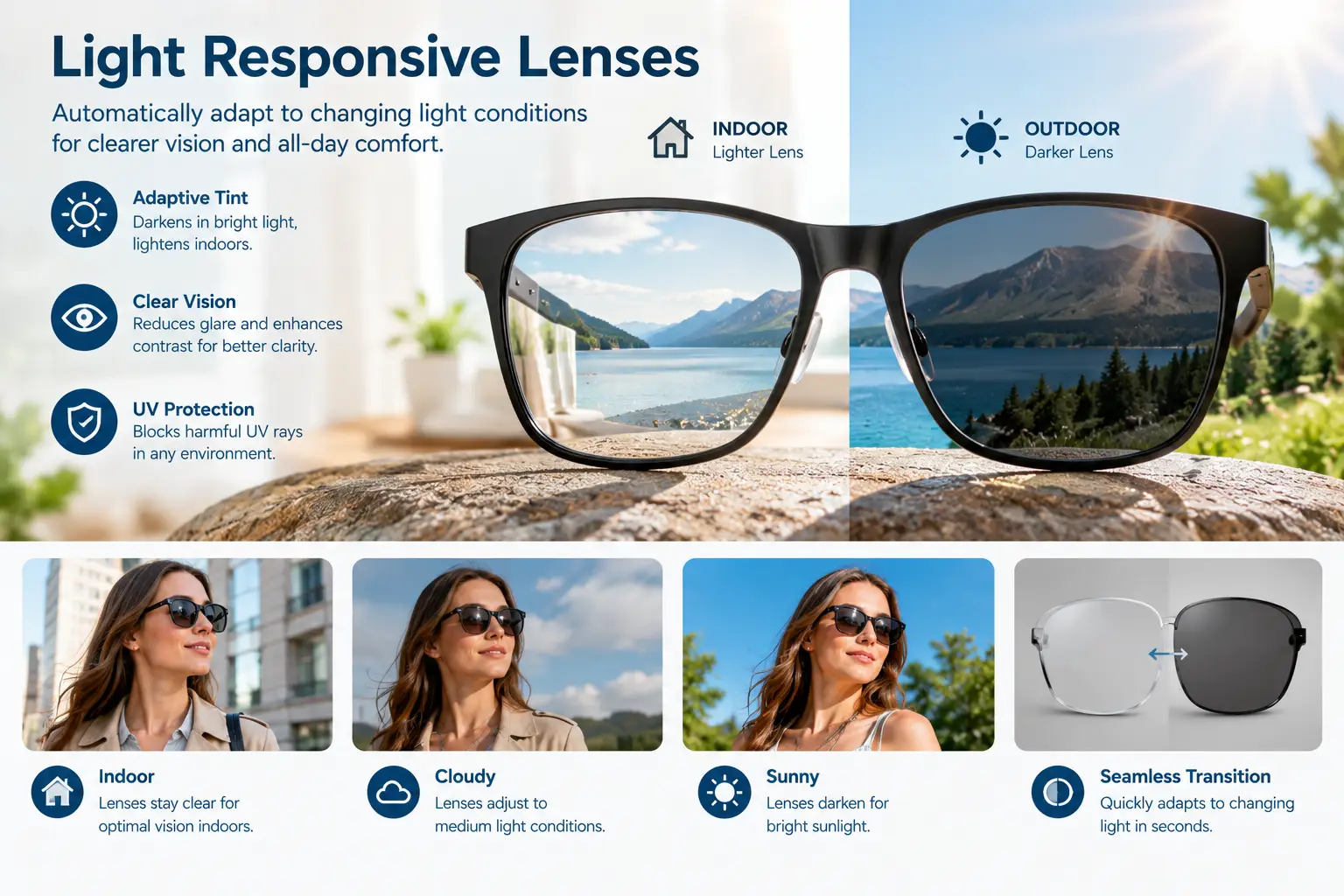
Light responsive lenses are eyeglass or sunglass lenses that automatically darken when exposed to ultraviolet (UV) light and fade back toward clear when the UV goes away. They let one pair handle dawn, noon, shade, and indoors, while blocking UVA and UVB rays in every state — no lens swapping required.
That’s the textbook answer. The real-world answer is more interesting, because light responsive lenses are not all built the same. Some start almost perfectly clear and stop at a medium tint. Others never go fully clear but get as dark as a dedicated pair of sunglasses. Some react in seconds; some take a leisurely minute. And a $30 pair from a direct-to-consumer brand can behave very differently from a $250 pair with a lifetime photochromic warranty.
What Are Light Responsive Lenses, Exactly?
The technology has been around since the 1960s, starting with glass lenses that used silver halide crystals. Today, most photochromic lenses rely on organic molecules embedded in plastic that physically change shape under UV exposure, then relax back when the UV fades. The overview of photochromic lens chemistry on Wikipedia explains a detail most buyers never hear: the fade-back process is thermal, so these lenses tend to get darker in cold weather and a bit lighter in heat.
In this guide, you’ll find seven real pairs available (or orderable) on amazon.com, from budget cycling shades to premium performance eyewear and a lifestyle classic. Every recommendation is based on published spec sheets, independent review coverage, and aggregated customer sentiment — not invented hands-on claims. You’ll also get practical setup tips, problem-solving advice, and a buyer framework so you pick the right pair the first time.
Quick Comparison: Light Responsive Lenses at a Glance
Before diving into the details, here’s the short version. VLT (visible light transmission) tells you how much light gets through: a higher number means a lighter lens.
| Product | Lens VLT Range (Manufacturer/Listing) | Approx. Price Range | Best for |
|---|---|---|---|
| Tifosi Rail Clarion Fototec | ~14%–64% | $75–$95 | Tifosi Rail Clarion Fototec: best value performance shield |
| Julbo Density REACTIV | ~17%–75% (1-3 Light Amplifier) | $230–$260 | Julbo Density REACTIV: premium all-day versatility |
| Oakley Flak 2.0 XL Photochromic | Clear to ~23% (retailer listing) | $200–$260 | Oakley Flak 2.0 XL Photochromic: dawn-to-dusk riders |
| Smith Wildcat ChromaPop Photochromic | ~12%–67% | $220–$260 | Smith Wildcat ChromaPop Photochromic: trail contrast |
| Ray-Ban Wayfarer Clear Evolve | Clear to grey | $200–$260 | Ray-Ban Wayfarer Clear Evolve: everyday style |
| KAPVOE K9408 | ~85%–15% | $25–$40 | KAPVOE K9408: budget pick with Rx insert |
| ROCKBROS Photochromic Cycling Sunglasses | ~83%–21% | $20–$40 | ROCKBROS Photochromic Cycling Sunglasses: first-time testers |
Looking at the table, the biggest divide isn’t price — it’s where each lens starts. The Oakley Flak 2.0 XL Photochromic, KAPVOE K9408, and ROCKBROS Photochromic Cycling Sunglasses begin near clear, which makes them far more useful at dusk, while the Tifosi Rail Clarion Fototec and Smith Wildcat ChromaPop Photochromic trade low-light clarity for a darker, more sunglass-like ceiling. If you ride or run into the evening, prioritize the top VLT number; if you live somewhere relentlessly sunny, prioritize the bottom one.
💬 One click helps other shoppers make an informed choice too! 😊
Top 7 Light Responsive Lenses: Expert Analysis
1. Tifosi Rail Clarion Fototec — best value in a premium-feel shield
The Tifosi Rail Clarion Fototec is the pair that proves you don’t need to spend $250 to get a trustworthy photochromic shield. According to Tifosi’s lens data, the Clarion Red Fototec lens shifts between roughly 14% and 64% VLT (some reviewers cite 74% at the light end), and independent testers weighed the frame at around 32 grams.
In practice, that range means the lens behaves like a light sport tint on cloudy mornings and a genuine sunglass at midday. The Grilamid TR90 frame flexes rather than snaps, and the hydrophilic rubber nose and temple pads get tackier as you sweat — useful on climbs when glasses usually slide. The Clarion coating is hydrophobic, so rain and sweat bead off instead of smearing.
Based on comparing the specs, this is the smartest buy for road cyclists, gravel riders, and trail runners who mostly go out in daylight. It is not a night lens: the clear end never reaches true clear.
Aggregated review coverage is consistently positive about comfort and value, while a recurring complaint is that the transition is slower and the light end less clear than pricier competitors. Some owners also mention that swapping lenses takes more effort than expected.
Pros:
- ✅ Wide, useful daylight VLT range for the price
- ✅ Light TR90 frame with grippy, sweat-friendly contact points
- ✅ Hydrophobic coating keeps rain and sweat under control
Cons:
- ❌ Never gets fully clear for night use
- ❌ Transition speed trails premium photochromic lenses
Typically priced in the $75–$95 range, the Tifosi Rail Clarion Fototec delivers the best performance-per-dollar in this lineup.
2. Julbo Density REACTIV — widest-feeling range with a lifetime photochromic warranty
The Julbo Density REACTIV is the pick for people who want one pair that genuinely covers everything from overcast mornings to bright afternoons. Julbo lists its REACTIV 1-3 Light Amplifier lens at roughly 75% to 17% VLT, and the brand also offers a REACTIV 0-3 High Contrast version that reviewers measured at around 87% to 15%.
Here’s what that means: at 75%, you can still read shadows under tree cover; at 17%, you have a real category-3 sunglass. Julbo says each REACTIV lens is made from Trivex with the photochromic formula injected directly into the lens rather than applied as a surface coating, which matters for scratch resilience over years of use. The brand also backs the photochromic technology with a lifetime warranty — rare in this category.
Honest analysis: this is the best choice for multi-sport athletes, Nordic skiers, and anyone who hates carrying backup lenses. The oversized, semi-frameless design gives a huge field of view without feeling heavy.
Reviews consistently praise the optics and quick transitions. A recurring note from testers is that in bright-but-flat light, the lens can settle at a fairly dark tint, slightly reducing contrast.
Pros:
- ✅ Very wide VLT range covers dawn through midday
- ✅ Trivex lens with photochromic formula built into the material
- ✅ Lifetime warranty on the photochromic technology
Cons:
- ❌ Premium price puts it out of casual-buyer territory
- ❌ Can sit too dark in bright overcast conditions
Expect to pay roughly $230–$260; the warranty alone makes the Julbo Density REACTIV a strong long-term value.
3. Oakley Flak 2.0 XL Photochromic — starts clear, ideal for dawn and dusk
The Oakley Flak 2.0 XL Photochromic (model OO9188-16, Steel frame with Clear to Black Iridium Photochromic lens) stands out because it starts fully clear. That makes it one of the few performance frames here you can wear confidently before sunrise.
Key specs: a 59 mm lens width, 12 mm bridge, and 133 mm temples, with Oakley’s O Matter frame and Unobtainium nosepads and earsocks that get grippier when wet. The Plutonite polycarbonate lens blocks 100% of UVA, UVB, and UVC, and one retailer lists its darkened transmission at roughly 23%. The 8.75 base curve wraps to block wind and side glare, while Oakley’s High Definition Optics are designed to meet ANSI standards for optical clarity and impact resistance.
On paper, this means commuters and early-morning cyclists get a safety-glass-style clear lens at 6 a.m. and a medium sunglass by 10 a.m. The trade-off: at 23%, it’s not as dark as a dedicated category-3 lens in blazing desert sun.
We couldn’t verify a large pool of customer reviews specific to this photochromic variant, so weigh it on specs. The Flak 2.0 XL frame family itself is widely documented for its secure fit and prescription compatibility through Oakley Authentic Prescription Lenses.
Pros:
- ✅ Truly clear starting point for low-light starts
- ✅ Secure, sweat-friendly Unobtainium contact points
- ✅ Prescription-compatible frame from a major brand
Cons:
- ❌ Darkest state is lighter than dedicated sunglasses
- ❌ Limited model-specific review data to verify
Generally found in the $200–$260 range, the Oakley Flak 2.0 XL Photochromic is best value for riders who start early.
4. Smith Wildcat ChromaPop Photochromic — goggle-level coverage with color contrast
The Smith Wildcat ChromaPop Photochromic combines Smith’s contrast-boosting ChromaPop filter with a photochromic lens, a pairing aimed squarely at mountain bikers and skiers. An independent review lists the lens at roughly 12%–67% VLT, shifting from category 3 down to category 1.
Why does that matter? ChromaPop filters are designed to sharpen the separation between colors, which helps you pick out roots, rocks, and ruts in mottled forest light. The frame uses TR90 and TPU (the same material family Smith uses in goggles), with Megol temples and two-position nosepads for a non-slip fit. The package also includes a secondary clear lens — a smart inclusion, since the photochromic lens doesn’t reach clear.
Based on comparing the specs, this is the pick for aggressive trail riders who want goggle-like coverage without goggle heat. For road commuters or anyone riding into darkness, the clear backup lens becomes essential.
Reviewers describe the vision in mixed trail conditions as among the best they’ve used, but note it becomes limiting in very dark woods. Some REI customer reviews mention fragile arms and imperfect fit under certain helmets.
Pros:
- ✅ ChromaPop contrast helps read terrain in dappled light
- ✅ Goggle-style coverage with sunglass-level airflow
- ✅ Spare clear lens included for dark conditions
Cons:
- ❌ Photochromic lens doesn’t go fully clear
- ❌ Some users report arm durability and helmet-fit issues
Usually in the $220–$260 range, the Smith Wildcat ChromaPop Photochromic is worth it for serious trail riders.
5. Ray-Ban Wayfarer Clear Evolve — everyday style that transitions quietly
The Ray-Ban Wayfarer Clear Evolve (RB2140 901/5F, 50 mm) is the only pure lifestyle pick here, built for people who want light responsive lenses that look like normal glasses at the office and sunglasses at lunch. Ray-Ban describes the lens as shifting from clear to grey in changing light.
The key features translate simply: the classic acetate Wayfarer frame, “crystal” (glass) lenses with a front-side anti-reflective treatment, and 100% UV filtering. Glass offers excellent optical clarity and scratch resistance, but it’s heavier than polycarbonate and less impact-resistant — worth knowing if you’re active. Ray-Ban also sells Transitions-branded versions of the Wayfarer, and notes that photochromic performance is influenced by temperature, UV exposure, and lens material.
Honest take: this is for style-first buyers, city walkers, and people who want one pair for errands and patio dinners. It’s not a sports frame, and the flat front won’t block side glare like a wraparound.
We could not verify a meaningful set of customer reviews for this specific photochromic variant, so treat it primarily as a design and brand-heritage choice backed by clear manufacturer specs.
Pros:
- ✅ Iconic frame looks natural indoors and outdoors
- ✅ Glass lenses resist scratches and look crisp
- ✅ Anti-reflective treatment cuts distracting reflections
Cons:
- ❌ Heavier glass is less suited to sports
- ❌ Flat front leaves more side glare than wraps
Expect roughly $200–$260; the Ray-Ban Wayfarer Clear Evolve is good value if style drives your decision.
6. KAPVOE K9408 — budget pick with a built-in prescription insert
The KAPVOE K9408 is the most practical low-cost option for glasses wearers, because it ships with a myopia (prescription) frame insert your optician can fill. KAPVOE’s listing states the lens moves from roughly 85% down to 15% VLT.
That spread is surprisingly wide for the price: near-clear at dawn, properly dark at noon. The frame is TR90 with a polycarbonate lens, flexible temples, and a single photochromic lens rather than a stack of swappable tints. For budget buyers, that single lens is a feature — fewer parts to lose.
Here’s what to weigh: budget photochromic lenses often transition more slowly and have less refined optics at the edges than premium lenses. Still, for commuters, casual cyclists, and anyone testing whether they even like light responsive lenses, this is a sensible entry point.
The listing has built a large Amazon review base, and a third-party roundup reported that sentiment was largely positive around fit and auto-tinting. As with many budget listings, a minority of owners raise questions about long-term durability; if UV protection is critical, having the lenses checked by an optician is a smart step.
Pros:
- ✅ Near-clear to dark range at a budget price
- ✅ Prescription insert included for glasses wearers
- ✅ Light TR90 frame suits most face shapes
Cons:
- ❌ Edge optics less refined than premium lenses
- ❌ Long-term durability varies across owner reports
Usually in the $25–$40 range, the KAPVOE K9408 is outstanding value for new photochromic users.
7. ROCKBROS Photochromic Cycling Sunglasses — lowest-risk way to try photochromic
The ROCKBROS Photochromic Cycling Sunglasses (ASIN B0BKL7QYWC) are the cheapest serious entry point in this guide, designed for riders who want to test the concept without committing big money. ROCKBROS lists the lens at 83% transmittance clear and 21% when darkened.
Translated: the lens starts light enough for early commutes and settles at a medium-dark tint at midday — darker than the Oakley Flak 2.0 XL Photochromic, lighter than the Tifosi Rail Clarion Fototec. ROCKBROS offers several photochromic variants on Amazon, with listed weights between about 22 and 32 grams, TR90 frames, and some versions bundled with a myopia insert and hard case.
Honest analysis: these suit beginners, kids’ first sport glasses (ROCKBROS sells youth versions), and backup pairs for your car or bike bag. Serious athletes will notice the optical gap against premium lenses in contrast and edge sharpness.
Aggregated customer feedback generally highlights comfort and clarity for the price. A recurring note is that the lenses darken only under direct UV, so they stay light in shade and behind glass — expected physics, but it surprises first-time buyers.
Pros:
- ✅ Very low price to try photochromic tech
- ✅ Lightweight TR90 frame options down to about 22 g
- ✅ Useful clear-to-medium range for commuting
Cons:
- ❌ Darkest state won’t satisfy bright-sun purists
- ❌ Several similar variants can confuse shoppers
At roughly $20–$40, the ROCKBROS Photochromic Cycling Sunglasses are hard to beat as a low-risk trial.
Side-by-Side Specs: What the Numbers Really Mean
| Product | Lens Material | Starts Near Clear? | Rx Option | Best for |
|---|---|---|---|---|
| Tifosi Rail Clarion Fototec | Polycarbonate | No (~64%) | Via optician/inserts | Tifosi Rail Clarion Fototec: daylight road and gravel |
| Julbo Density REACTIV | Trivex | Mostly (~75%) | Julbo RxLab | Julbo Density REACTIV: multi-sport, all-day |
| Oakley Flak 2.0 XL Photochromic | Plutonite polycarbonate | Yes | Oakley Authentic Rx | Oakley Flak 2.0 XL Photochromic: pre-dawn starts |
| Smith Wildcat ChromaPop Photochromic | Polycarbonate + ChromaPop | No (~67%) + clear spare | Limited | Smith Wildcat ChromaPop Photochromic: technical trails |
| Ray-Ban Wayfarer Clear Evolve | Glass (“crystal”) | Yes | Ray-Ban Rx program | Ray-Ban Wayfarer Clear Evolve: office-to-street |
| KAPVOE K9408 | Polycarbonate | Yes (~85%) | Myopia insert | KAPVOE K9408: budget Rx wearers |
| ROCKBROS Photochromic Cycling Sunglasses | Polycarbonate | Yes (~83%) | Insert on some versions | ROCKBROS Photochromic Cycling Sunglasses: first-timers |
This table reveals a pattern the price tags hide: premium brands tend to optimize for contrast and optical precision, while budget brands optimize for range on paper. The KAPVOE K9408 actually lists a wider range than the Smith Wildcat ChromaPop Photochromic, but range isn’t the same as optical quality or transition speed. For most buyers, the right move is to decide whether you need a clear starting point first, then pick the best optics you can afford within that group.
✨ Don’t miss these top-rated light responsive lenses!
🔍 Take your outdoor days to the next level with this carefully curated lineup. Click a highlighted pick to check current pricing and availability. These choices will help you see clearly from sunrise to sunset — without ever swapping glasses!
Getting Started: Your First 30 Days With Light Responsive Lenses
New light responsive lenses can feel strange at first, mostly because they don’t behave like the fixed-tint sunglasses your brain expects. A short break-in routine makes a big difference.
Day 1: Run a “window test.” Step outside into direct sun for two minutes, then walk indoors and time how long the lens takes to clear. Fade-back is usually much slower than darkening — often a few minutes for full recovery. Knowing your pair’s rhythm prevents the classic mistake of walking into a dim store wearing semi-dark lenses.
Week 1: Learn your conditions. Wear them in three situations: bright midday, open shade, and an overcast day. Note how dark they get in each. Because activation depends on UV rather than visible brightness, a hazy summer day can darken them more than you’d guess, while a bright room lit by LEDs won’t darken them at all.
Week 2: Dial in fit. Adjust nosepads and temples so the lens sits close to your face without touching lashes. Wraparound frames like the Julbo Density REACTIV or Smith Wildcat ChromaPop Photochromic rely on close fit for glare blocking.
Ongoing maintenance:
- ✅ Rinse off dust and salt with lukewarm water before wiping
- ✅ Clean with a microfiber cloth and lens-safe spray, never paper towels
- ✅ Store in the case — leaving them on a sunny dashboard bakes the lens and frame
Common first-month mistakes: assuming they’ll darken inside your car (they usually won’t fully — more on that below), leaving them in hot vehicles, and judging performance on a cold morning versus a hot afternoon. Remember the chemistry: cold lenses get darker and clear more slowly; hot lenses stay lighter.
Real-World Scenarios: Matching the Right Pair to Your Day
Specs make more sense when you attach them to a real routine. Here are three common buyer profiles and the reasoning behind each match.
The Pre-Dawn Commuter
You ride 8 miles to work starting at 6:15 a.m., return around 5:30 p.m., and your budget is flexible but not unlimited. Half your ride happens in low light. You need a lens that starts clear, darkens moderately, and protects your eyes from grit.
Best match: the Oakley Flak 2.0 XL Photochromic. Its clear starting state works in dim light, and the wraparound 8.75 base curve blocks wind and debris. Budget alternative: the KAPVOE K9408, which also starts near clear and costs a fraction as much.
The Weekend Trail Rider
You mountain bike Saturday and Sunday, mostly under trees with bright clearings. Budget: up to about $260. You care about seeing roots and rocks more than about looking sleek at a café.
Best match: the Smith Wildcat ChromaPop Photochromic. ChromaPop contrast helps in dappled light, and the included clear lens covers dark forest days. If you ride exposed desert or alpine trails instead, the Julbo Density REACTIV gives you a lighter top end with similar darkness at midday.
The Everyday Glasses Wearer
You wear prescription glasses daily, commute by train, and spend lunch outdoors. You want one pair that looks normal in meetings. Budget: moderate, and style matters.
Best match: the Ray-Ban Wayfarer Clear Evolve frame through Ray-Ban’s prescription program, or have your optometrist fit a Transitions-style lens into your own frame. For weekend sports, add the KAPVOE K9408 with its prescription insert as an inexpensive second pair.
Problem → Solution: Fixing Common Photochromic Frustrations
Even great light responsive lenses have quirks. Most complaints fall into a handful of predictable categories, and nearly all have a practical fix.
Problem 1: “They don’t darken in my car.” Solution: Modern windshields filter most UV, which is what triggers standard photochromic molecules. For driving, keep a dedicated pair of polarized sunglasses in the car, or ask your optician about lenses specifically engineered to activate behind a windshield.
Problem 2: “They take forever to clear when I go inside.” Solution: This is normal thermal behavior, and it’s slower when the lens is cold. Give it a few minutes, or slide them up briefly when entering dim spaces. Premium lenses like the Julbo Density REACTIV are marketed as faster-transitioning, which matters if you move in and out often.
Problem 3: “They’re too dark in winter.” Solution: Cold boosts darkening. If you ski or ride in cold sun, a slightly lighter range like the Oakley Flak 2.0 XL Photochromic may feel more balanced than a lens that bottoms out near 12%.
Problem 4: “They’re not dark enough on hot beach days.” Solution: Heat speeds up the fade-back reaction, so lenses run lighter in high temperatures. For extended beach or water time, a polarized fixed-tint lens is the better tool.
Problem 5: “My lenses stopped changing as much.” Solution: Photochromic molecules gradually fatigue with years of UV exposure and heat. Store your pair in a case, avoid hot dashboards, and consider brands with long warranties, like Julbo’s lifetime REACTIV coverage.
How to Choose Light Responsive Lenses
Choosing well comes down to matching the lens behavior to your day. Follow these steps in order:
- Map your light conditions. List where you actually wear glasses: dawn rides, midday hikes, office time. If more than a quarter of your use is in low light, you need a lens that starts near clear.
- Check the full VLT range, not just the dark end. A lens rated 14%–64% and one rated 85%–15% suit completely different users. The top number decides low-light usability; the bottom decides bright-sun comfort.
- Confirm 100% UVA/UVB protection. The American Academy of Ophthalmology’s guidance on photochromic lenses notes UV protection is one of their core advantages — make sure the listing states it explicitly.
- Pick the right lens material. Polycarbonate and Trivex are light and impact-resistant; glass is crisp and scratch-resistant but heavier and more fragile.
- Decide on prescription needs early. Some frames accept direct prescription lenses; others rely on inserts. Inserts are cheaper but add a second optical layer.
- Think about driving separately. Most photochromic lenses won’t fully darken behind a windshield, so drivers may need a second pair.
- Weigh warranty and replacement costs. Premium lenses cost more upfront but often come with longer guarantees and replacement lens programs.
Photochromic Sunglasses vs Polarized and Fixed-Tint Lenses
Photochromic sunglasses solve a different problem than polarized or fixed-tint lenses, and understanding the difference saves you from buying the wrong tool.
| Lens Type | Adapts to Light? | Cuts Reflected Glare? | Works Behind Windshield? | Best for |
|---|---|---|---|---|
| Photochromic sunglasses | Yes | Only if also polarized | Usually limited | Mixed light, all-day wear |
| Polarized fixed tint | No | Yes | Yes | Driving, water, snow glare |
| Standard fixed tint | No | No | Yes | Consistently bright sun |
| Interchangeable lens kit | Manually | Depends on lens | Depends on lens | Tinkerers, varied sports |
The takeaway: photochromic sunglasses are the best “set it and forget it” solution for changing light, but they don’t replace polarized lenses for water or windshield glare. Many experienced buyers own both — a photochromic pair for sports and commuting, plus polarized shades for driving and fishing.
Fixed-tint sunglasses still win on consistency: they’re exactly as dark in your car as on a mountaintop. But that consistency becomes a liability the moment you ride into a tunnel or under heavy tree cover. Interchangeable kits split the difference, but stopping to swap lenses mid-ride is precisely the hassle light responsive lenses were designed to eliminate. The American Academy of Ophthalmology’s overview of recommended sunglass types is a helpful companion if you’re deciding whether polarized, mirrored, or photochromic features matter most for your eyes.
Transition Lenses for Drivers: What Works Behind the Windshield
“Transition lenses” has become a generic term for photochromic eyewear, much like people say “Kleenex” for tissues. Transitions is actually a specific brand from Transitions Optical, but the driving issue applies to nearly all photochromic lenses.
Here’s the core problem: most car windshields are laminated glass that blocks the bulk of UV light. Since standard photochromic molecules respond to UV, transition lenses often stay only lightly tinted in the car, even on a blinding afternoon. That’s the single most common disappointment in customer reviews across this category.
What should drivers do?
- ✅ Keep polarized sunglasses in the car. Polarization specifically targets glare reflected off roads, hoods, and wet pavement.
- ✅ Ask about windshield-activating lenses. Some prescription photochromic products are designed to darken partially behind glass by responding to visible light as well as UV. Your optometrist can explain the options.
- ✅ Don’t rely on sport photochromics for driving. Pairs like the Tifosi Rail Clarion Fototec or ROCKBROS Photochromic Cycling Sunglasses are optimized for open-air use.
For night driving, the rule is simple: no tinted lens should be worn after dark, and even a lens that looks “clear” may still absorb some light at its lightest state. Choose true clear lenses for night driving.
Photochromic Cycling Glasses: Features That Actually Matter (and Ones That Don’t)
Photochromic cycling glasses are the most competitive corner of this market, and marketing copy can make every feature sound essential. Here’s how to separate signal from noise.
Features that actually matter
- Starting VLT: If you ride at dawn, dusk, or under trees, the light end of the range matters more than anything else.
- Coverage and base curve: Wraparound shields like the Tifosi Rail Clarion Fototec and Julbo Density REACTIV block wind that causes tearing at speed.
- Grip materials: Hydrophilic rubber that gets tackier when wet keeps glasses stable on climbs.
- Ventilation and anti-fog: Fogging when you stop at a light is a safety issue, not a comfort issue.
- Helmet compatibility: Some wide frames bump helmet brims; check reviews for your helmet style.
Features that matter less than advertised
- “Polarized” on cycling glasses: Polarization can make it harder to read wet patches and some screens; many cyclists prefer non-polarized photochromic lenses.
- Huge accessory bundles: Extra pouches and straps are nice but don’t change how you see.
- “Military-grade” or vague durability claims: Look for a recognized standard instead, like ANSI Z87.1 for safety eyewear.
For budget photochromic cycling glasses like the KAPVOE K9408 and ROCKBROS Photochromic Cycling Sunglasses, the core features are there; the difference shows up mainly in optical refinement and transition speed.
Light Adaptive Glasses: Long-Term Cost and Value
Light adaptive glasses cost more than basic sunglasses upfront, but the real question is cost over three to five years.
| Scenario | Upfront Cost Range | What You Replace | Best for |
|---|---|---|---|
| Budget photochromic (KAPVOE K9408, ROCKBROS Photochromic Cycling Sunglasses) | $20–$40 | Whole pair when worn out | Casual users, backups |
| Mid-price shield (Tifosi Rail Clarion Fototec) | $75–$95 | Replacement lenses available | Regular riders on a budget |
| Premium performance (Julbo Density REACTIV, Smith Wildcat ChromaPop Photochromic, Oakley Flak 2.0 XL Photochromic) | $200–$260 | Lenses or warranty claims | Frequent athletes |
| Separate sunglasses + clear glasses | $60–$300 combined | Two pairs to maintain | Fixed routines |
The numbers suggest a clear pattern: if you’d otherwise buy two pairs (clear and tinted), a mid-price photochromic shield like the Tifosi Rail Clarion Fototec usually pays for itself quickly. Premium pairs make sense when you’ll use them several times a week for years, especially with the lifetime photochromic warranty on the Julbo Density REACTIV.
Hidden costs matter too. Budget lenses may lose responsiveness faster, and replacement lenses for premium frames can be pricey. Factor in prescription inserts, protective cases, and lens cleaning supplies. And remember the performance decay issue: photochromic molecules gradually fatigue, so any pair used daily will eventually respond less dramatically. Buying from a brand with replacement lenses or a warranty turns that from a total loss into a routine maintenance cost.
Safety, Regulations, and Standards for Light Responsive Lenses
In the US, sunglasses and eyeglasses are regulated as medical devices, and the FDA requires them to use impact-resistant lenses. Under 21 CFR 801.410, lenses must survive a drop-ball test in which a 5/8-inch steel ball falls 50 inches onto the lens without fracturing. That applies to photochromic lenses just as it does to fixed-tint ones.
Beyond that federal baseline, a few standards are worth recognizing on product listings:
- ANSI Z80.3: The US standard for nonprescription sunglasses and fashion eyewear, covering optical quality and UV transmittance.
- ANSI/ISEA Z87.1: The occupational safety standard for high-impact protective eyewear. Look for a “Z87+” marking if you need work-rated protection — most sport sunglasses are not Z87-rated.
- UV400: A common label meaning the lens blocks wavelengths up to 400 nanometers, covering UVA and UVB.
What does this mean in practice? Brand-name performance eyewear typically publishes its compliance details; budget listings sometimes don’t. If you buy an inexpensive pair and depend on it for UV protection, an optician can verify UV blocking with a simple meter in a few seconds.
One more safety point: never wear tinted light responsive lenses for night driving, and be cautious with dark photochromic lenses when entering tunnels or garages, since fade-back isn’t instant.
Common Mistakes to Avoid When Buying Light Responsive Lenses
Most regrets with light responsive lenses come from mismatched expectations rather than bad products. Here are the most frequent pitfalls:
Mistake 1: Buying on the dark end alone. A lens that reaches 12% sounds impressive, but if it never goes lighter than about 65%, it won’t help on dawn rides.
Mistake 2: Expecting instant fade-back. Darkening is fast; clearing is slower. If you frequently move between bright outdoors and dim indoors, prioritize premium lenses known for quicker transitions.
Mistake 3: Expecting car performance. As covered above, windshields block most UV. Buy for open-air use and plan separately for driving.
Mistake 4: Ignoring fit. Even perfect optics fail if the frame slips or leaves gaps. Check lens width, bridge, and temple measurements — the Oakley Flak 2.0 XL Photochromic publishes them clearly, which makes online buying safer.
Mistake 5: Skipping the prescription question. If you need correction, confirm whether the frame supports direct Rx lenses or only an insert before you buy.
Mistake 6: Treating all “photochromic” labels as equal. Material, dye formulation, and coating quality vary widely. Compare VLT ranges, read aggregated reviews for transition complaints, and favor brands that publish specs.
FAQ: Light Responsive Lenses
❓ Are light responsive lenses worth the money?
❓ Can I buy light responsive lenses with a prescription on Amazon?
❓ Do cheap photochromic sunglasses really block UV?
❓ How long do light responsive lenses keep working?
❓ Are light responsive lenses safe for night driving?
Conclusion: Finding the Light Responsive Lenses That Fit Your Life
Light responsive lenses are one of those rare upgrades that remove a daily annoyance entirely: no more swapping glasses at the door, no more squinting after the sun pops out, no more carrying a spare lens in your jersey pocket. But the “best” pair depends on how your day actually looks.
If you want the best overall value, the Tifosi Rail Clarion Fototec delivers a proven daylight range at a mid-level price. For premium all-day versatility and peace of mind, the Julbo Density REACTIV and its lifetime photochromic warranty are hard to top. Early risers should look at the Oakley Flak 2.0 XL Photochromic, trail riders at the Smith Wildcat ChromaPop Photochromic, and style-first buyers at the Ray-Ban Wayfarer Clear Evolve. On a tight budget, the KAPVOE K9408 and ROCKBROS Photochromic Cycling Sunglasses let you try the technology for less than a nice lunch for two.
Whatever you choose, remember the three rules: check the full VLT range, confirm UV protection, and plan separately for driving. Get those right, and your eyes will thank you from sunrise to sunset.
🌞 Ready to stop swapping glasses?
👉 Pick the pair that matches your routine, click a highlighted product to check current pricing and availability, and enjoy clear, comfortable vision in every kind of light — starting with your very next ride, run, or stroll!
Recommended for You
- Big Reading Glasses: 7 Best Oversized Picks That Truly Fit (2026)
- Large Reading Glasses: 7 Best Picks That Actually Fit (2026)
- Computer Screen Guard to Protect Eyes: 7 Honest Picks for 2026
Disclaimer: This post contains affiliate links. As an Amazon Associate, I earn from qualifying purchases made through these links, at no additional cost to you.
✨ Found this article helpful? Share it with someone who needs it! 💬🤗