In This Article
Screens are basically a permanent fixture in front of your face now — laptop in the morning, phone at lunch, TV at night — and it makes sense that you’re wondering whether blue light filter contact lenses can take some of that visual load off your eyes. Here’s the short, honest answer: yes, these lenses exist, they use additives baked into the lens material to absorb a slice of high-energy visible light (HEVL) in the 380-460 nanometer range, and some models filter meaningfully more than others. What they are not is a miracle fix for digital eye strain — more on that shortly.
This guide walks through seven real, currently available blue light filter contact lenses, from budget daily disposables to premium silicone hydrogel dailies built specifically for heavy screen use. You’ll get honest analysis grounded in real spec sheets and aggregated customer feedback, a breakdown of who each lens actually suits, and a framework for choosing between blue light filtering contacts and simply pairing your regular contacts with a pair of blue light glasses. As always with anything going in your eyes, treat this as a starting point for a conversation with your eye doctor, not a replacement for one.
Affiliate Disclosure: This post contains affiliate links. As an Amazon Associate, I earn from qualifying purchases made through these links, at no additional cost to you.
What Is Blue Light Filter Contact Lens Technology?
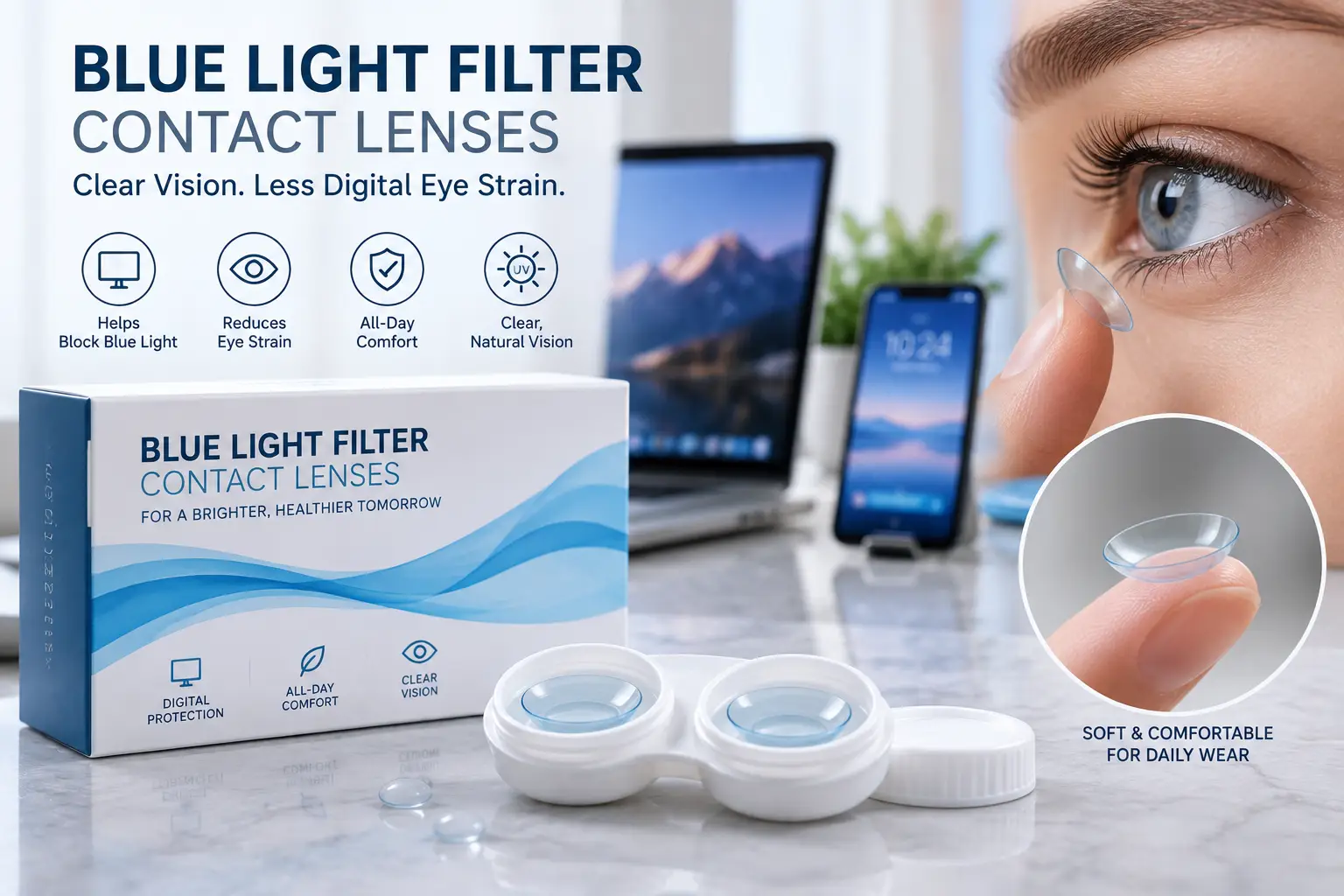
Blue light filter contact lenses are soft contact lenses manufactured with a light-absorbing tint or additive built directly into the lens material, designed to reduce the amount of blue-violet, high-energy visible light that reaches the retina — typically filtering somewhere between 15% and 60% depending on the brand, versus roughly 0% for a standard clear lens.
That range is wide on purpose: some lenses use a subtle static filter, while photochromic designs adapt to ambient lighting and filter more in bright conditions. According to Greenwich Eye’s explainer on blue light contact lens options, filtration for adaptive lenses can range from about 15% indoors to more than 50% outdoors, while static filters hold steady at whatever percentage the manufacturer engineered into the lens.
Quick Comparison: Blue Light Filter Contact Lenses at a Glance
| Product | Wear Schedule | Blue Light Filter | Best For | Price Range |
|---|---|---|---|---|
| Acuvue Oasys MAX 1-Day | Daily | ~60% (OptiBlue) | Overall best for screen-heavy days | $35-$45 / 30-pack |
| Acuvue Oasys MAX 1-Day for Astigmatism | Daily | ~60% (OptiBlue) | Astigmatism + screen time | $40-$55 / 30-pack |
| Acuvue Oasys MAX 1-Day Multifocal for Astigmatism | Daily | ~60% (OptiBlue) | Presbyopia + astigmatism combo | $75-$90 / 30-pack |
| Acuvue Oasys with Transitions | Biweekly | Adaptive, light-responsive | Indoor/outdoor light swings | $40-$55 / 6-pack |
| Biofinity Energys | Monthly | Digital Zone Optics filter | Best value for regular wearers | $30-$50 / 6-pack |
| TopVue Blue Blocker | Daily | ~16% | Budget-friendly daily option | $15-$25 / 30-pack |
| Chromaview Blue Safe | Varies (check pack) | Manufacturer-stated filter | Lowest-cost entry point | $10-$20 / 10-pack |
Looking at the table, the split is pretty clean: the Acuvue Oasys MAX 1-Day family sits at the top for filtration strength and all-day moisture retention, Biofinity Energys is the sweet spot if you don’t want to deal with a fresh lens every single day, and TopVue Blue Blocker and Chromaview Blue Safe are where you land if you’re testing the waters before committing to a pricier daily habit. None of these prices are locked in — check the current price on the retailer’s page before you buy, since contact lens pricing shifts with promotions and pack size.
💬 Ready to stop guessing and start comparing? Scroll down to see exactly which lens fits your prescription, budget, and screen habits.
Top 7 Blue Light Filter Contact Lenses for 2026
1. Acuvue Oasys MAX 1-Day — highest blue-violet filtration on the market
The Acuvue Oasys MAX 1-Day currently holds the strongest published blue-violet light filtration rate of any mainstream contact lens, and that alone makes it the default recommendation for anyone whose day is dominated by screens. It’s built from senofilcon A silicone hydrogel and combines two proprietary technologies: TearStable, which distributes a wetting agent throughout the entire lens rather than just the surface, and OptiBlue, which filters roughly 60% of blue-violet light in the 400-500nm range. In practice, that TearStable distribution matters more than it sounds — most tear-evaporation complaints with daily lenses show up in the last few hours of wear, and a lens engineered to slow that process is directly addressing the dryness that heavy screen use makes worse (staring at a display cuts your blink rate, and fewer blinks means faster tear evaporation). This lens is best suited to people who wear contacts most days of the week and spend 6+ hours in front of a screen, since the premium price only pays off with regular use. Reviews consistently report strong all-day comfort and reduced end-of-day dryness compared to older Acuvue dailies, though a recurring theme in feedback is that the cost per box runs higher than competing daily disposables. Some wearers also note a faint blue-green tint in the packaging (helpful for handling) that has no effect on actual color perception once the lens is on the eye.
Pros:
- ✅ Highest published blue-violet filtration rate available
- ✅ TearStable technology reduces end-of-day dryness
- ✅ Class 1 UV protection built into every lens
Cons:
- ❌ Priced above most daily disposable competitors
- ❌ Daily replacement adds up for infrequent wearers
Expect to pay somewhere in the $35-$45 range for a 30-pack, or roughly $100-$130 for a 90-day supply — check the current price before ordering, since promotions shift often. For anyone wearing contacts 5+ days a week at a screen, the comfort-per-dollar math tends to work out favorably despite the higher sticker price.
2. Acuvue Oasys MAX 1-Day for Astigmatism — same filtration, built for a toric prescription
The Acuvue Oasys MAX 1-Day for Astigmatism takes the same TearStable and OptiBlue combination from the standard Oasys MAX and adds an Eyelid Stabilized Design with four stability zones to keep the lens correctly oriented despite a toric power. That stability detail is the whole story for astigmatism wearers — a toric lens that rotates even slightly causes blur that non-astigmatic wearers never have to think about, so the engineering here is solving a real, specific problem rather than just repackaging the spherical version. Based on comparing the spec sheet to the standard Oasys MAX, the material, water content, and blue-violet filtration are functionally identical; the difference is purely in the optical design that handles cylinder and axis correction. This is the lens to reach for if you’ve been told you need a toric lens and don’t want to give up blue-violet filtering to get it, since a lot of budget astigmatism lenses skip the blue light additive entirely. Aggregated reviews for the Oasys MAX astigmatism line echo the standard version’s comfort scores, with wearers specifically calling out that the lens holds its orientation well during exercise and screen work alike — a common complaint with older toric dailies is rotation after blinking hard or looking down at a phone, and that issue shows up far less here.
Pros:
- ✅ Four-zone stabilization keeps toric correction locked in place
- ✅ Same ~60% blue-violet filtration as the standard Oasys MAX
- ✅ Daily disposable convenience with no cleaning routine
Cons:
- ❌ Costs more than a non-blue-light toric daily lens
- ❌ Limited cylinder/axis parameter range compared to specialty toric labs
Pricing typically lands between $40 and $55 per 30-pack, reflecting the added cost of toric manufacturing on top of the blue-violet filter — always confirm the current price for your specific cylinder and axis, since toric pricing can vary by parameter.
3. Acuvue Oasys MAX 1-Day Multifocal for Astigmatism — the rare lens that handles three problems at once
The Acuvue Oasys MAX 1-Day Multifocal for Astigmatism launched in mid-2025 as Johnson & Johnson Vision’s answer to a genuinely narrow but real need: correcting astigmatism, managing presbyopia, and filtering blue-violet light in a single daily lens. It layers Pupil Optimized Design (tuned to how pupil size shifts with age) on top of the Eyelid Stabilized Design and the familiar TearStable/OptiBlue combination, aiming for stable near, intermediate, and distance vision without sacrificing the digital-strain features. What that combination means practically is that this lens is solving a stacking problem — most multifocal torics on the market simply don’t offer blue-violet filtering at all, forcing wearers to choose between clear near vision and screen comfort. This is squarely a lens for wearers in their mid-40s and up who already need reading correction, also have astigmatism, and spend real time on screens; outside that specific overlap, it’s overbuilt and overpriced for what you need. Manufacturer-reported clinical trial data cited by retailers put all-day comfort satisfaction around 92% of wearers, and while that figure comes from the brand rather than an independent source, it’s consistent with the comfort profile of the rest of the Oasys MAX Max family in aggregated customer reviews.
Pros:
- ✅ Only major daily lens combining toric, multifocal, and blue-violet filtering
- ✅ Pupil Optimized Design tailors near/far balance to age-related pupil changes
- ✅ Blink Stabilized Design maintains lens position during normal eye movement
Cons:
- ❌ The most expensive lens on this list by a meaningful margin
- ❌ Narrow use case — overkill if you don’t need both toric and multifocal correction
Given the layered technology, this lens runs $75-$90 for a 30-pack in most listings — a real premium, but one that’s easy to justify if you’d otherwise be buying two separate specialty lenses to cover the same needs. Prices may vary by retailer, so check the current price before committing to a full supply.
4. Acuvue Oasys with Transitions — the adaptive option that reacts to your environment
The Acuvue Oasys with Transitions takes a fundamentally different approach than the OptiBlue lenses above: instead of a fixed blue-violet filter, it uses light-responsive photochromic technology that darkens in bright light and returns to a near-clear state indoors, filtering blue-violet light continuously across both settings rather than at one static rate. According to Greenwich Eye’s overview of blue-light-filtering options, this was the first Acuvue lens family to offer blue light filtering, predating the OptiBlue line. Here’s what the spec sheet doesn’t say outright: the adaptive tint is really solving glare and light sensitivity outdoors as much as it’s addressing screen-related blue light, which makes it a different tool than a lens purpose-built for indoor monitor use. This is the pick for someone who moves between bright outdoor light and dim indoor rooms all day — commuters, outdoor workers who also do desk work, or anyone who’s noticed eye strain shifting environments rather than just staring at one screen. It’s a biweekly reusable lens rather than a daily, so the cost-per-wear is lower if you’re diligent about cleaning, but that also means it’s not the right choice if you want a fresh, no-maintenance lens every single day. Aggregated reviews are generally positive on the light-adaptive comfort, with the most common critique being that the transition speed indoors-to-outdoors (and back) isn’t instant.
Pros:
- ✅ Adapts blue-violet filtering to actual ambient light conditions
- ✅ Biweekly wear lowers cost-per-day versus daily disposables
- ✅ Reduces outdoor glare in addition to indoor screen glare
Cons:
- ❌ Requires nightly cleaning and case maintenance, unlike daily disposables
- ❌ Transition speed between light levels isn’t instantaneous
A 6-lens box (a roughly 3-month supply per eye with biweekly replacement) typically falls in the $40-$55 range — check the current price, since biweekly lens pricing structures vary more by retailer than daily lens pricing does.
5. Biofinity Energys — the reusable monthly built around Digital Zone Optics
The Biofinity Energys takes a different technical route to the same goal: instead of leading with a marketed blue light filtration percentage, it centers on a Digital Zone Optics lens design paired with CooperVision’s patented Aquaform Technology, which retains water within the lens matrix to fight the dryness caused by reduced blink rate during screen use. What that means in practice is this lens is optimized as much for the dryness side of digital eye strain as the light-filtering side — and reviewers who’ve switched from standard Biofinity report noticeably less end-of-day dryness during long work sessions, which tracks with what CooperVision’s own materials claim about the design. As a monthly reusable, this is the most cost-effective option on this list for someone who wears contacts daily and doesn’t want the ongoing expense of daily disposables; it’s the natural pick for existing Biofinity wearers who want a blue-light-aware upgrade without switching brands or wear schedules entirely. The tradeoff is the same one every reusable lens carries: nightly cleaning, a case you need to replace every three months per CDC guidance, and a higher risk of eye infection if that routine gets skipped. Aggregated customer sentiment is strongest on comfort during long wear stretches, with the most common complaint being that the “digital” marketing angle undersells how much of the improvement is really about moisture retention rather than blue light per se.
Pros:
- ✅ Lowest cost-per-day of any reusable lens on this list
- ✅ Aquaform Technology specifically targets screen-related dryness
- ✅ Wide power range covers higher prescriptions
Cons:
- ❌ Requires a disciplined nightly cleaning routine
- ❌ Blue light filtration percentage isn’t independently published by the manufacturer
A 6-lens box (about a 3-month supply per eye) generally runs $30-$50, making this one of the more budget-friendly options for regular wearers once you factor in the extended wear schedule — as always, check the current price at your preferred retailer.
6. TopVue Blue Blocker — an accessible daily for wearers who just want to try the category
The TopVue Blue Blocker is a daily disposable hydrogel lens (55% water content) built around Aqua Safety Shield Layers technology for comfort, with a published blue light absorption rate of about 16% in the 400-450nm range plus a built-in UV filter. That filtration number is meaningfully lower than the Acuvue Oasys MAX line’s roughly 60%, and that’s worth being upfront about — this lens is a lighter-touch option, not a direct competitor to the premium daily lenses above. Where it earns its spot on this list is accessibility: it’s a genuinely lower-cost daily disposable for someone who wants to test whether blue light filtering makes any subjective difference before committing to pricier lenses, without a long-term reusable-lens cleaning routine to manage. Based on comparing the hydrogel material to the silicone hydrogel used in the Acuvue lenses above, oxygen permeability is lower, which can matter for wearers who are sensitive to end-of-day redness or who wear lenses for extended stretches. It’s a reasonable starter lens for light-to-moderate contact wearers, less ideal for anyone doing 10+ hour wear days regularly. Reviews are limited compared to the major US brands above since TopVue has a smaller US footprint, so treat any sentiment here as a smaller sample size than the Acuvue and Biofinity lines.
Pros:
- ✅ Genuinely budget-friendly for a blue-light-filtering daily lens
- ✅ Built-in UV filter alongside the blue light additive
- ✅ No cleaning routine required (daily disposable)
Cons:
- ❌ Filtration rate is meaningfully lower than premium competitors
- ❌ Hydrogel material offers less oxygen permeability than silicone hydrogel options
Expect a 30-pack to land in the $15-$25 range, making it one of the cheaper ways to try a blue-light-filtering daily lens without a big financial commitment — confirm the current price before ordering, since availability through US resellers can fluctuate.
7. Chromaview Blue Safe — the lowest-cost entry point for a first prescription trial
Chromaview Blue Safe contact lenses are positioned as an everyday-wear, clear (not cosmetically tinted) prescription lens marketed specifically around reducing eye strain from screen-emitted blue light, sold in 10-lens packs across a range of prescription strengths. As the most budget-oriented lens on this list, it’s the pick for someone who wants to test the basic concept of a blue-light-filtering lens at the lowest possible cost before deciding whether to invest in a premium daily like the Oasys MAX line. Here’s the honest caveat: unlike the Acuvue and CooperVision entries above, Chromaview doesn’t publish a specific filtration percentage or name a proprietary filtering technology the way OptiBlue or Digital Zone Optics do, which makes it harder to evaluate on a like-for-like technical basis — treat this as a functional, budget-tier option rather than a lab-verified filtration leader. What most buyers overlook with entry-tier lenses like this one is that the smaller pack size (10 lenses versus 30 or 90) changes the cost-per-wear math more than the sticker price suggests, so it’s worth comparing price-per-lens rather than price-per-box against the other options here. This is best suited to occasional wearers or anyone dipping a toe into blue-light-filtering lenses for the first time, and less suited to daily, all-day wearers who’ll burn through 10-packs quickly.
Pros:
- ✅ Lowest price point of any lens on this list
- ✅ Small 10-pack size lowers the barrier to trying the category
- ✅ Available across a range of prescription strengths
Cons:
- ❌ No independently published blue light filtration percentage
- ❌ Smaller packs mean a higher per-lens cost long-term
Pricing generally falls in the $10-$20 range per 10-pack depending on prescription strength — check the current price for your specific power, since specialty prescriptions can run higher.
Blue Light Filter Contacts vs. Standard Contacts + Blue Light Glasses
A comparison worth having honestly, since it’s the question most people are actually trying to answer before they buy: is it better to get blue-light-filtering contacts, or just keep your regular contacts and add a pair of blue light glasses over them?
| Factor | Blue Light Filter Contacts | Standard Contacts + Blue Light Glasses |
|---|---|---|
| Convenience | Filtering built in, nothing extra to wear | Extra pair of glasses to carry and remember |
| Filtration control | Fixed by lens choice, can’t be removed | Glasses can be taken off anytime |
| Cost over time | Built into your existing lens budget | Added upfront cost for glasses |
| Best For | People who forget to bring glasses along | People who already own blue light glasses |
Looking at the comparison, the deciding factor usually isn’t the technology at all — it’s whether you’ll actually remember and want to wear a second pair of glasses on top of your contacts every day. If the honest answer is “probably not,” a blue-light-filtering contact lens removes that friction entirely. If you already own blue light glasses and like them, there’s genuinely no strong reason to switch your whole contact lens routine just to consolidate the filtering into one product.
✨ Found the comparison helpful? Skip the friction and go straight to a lens that filters blue light automatically — no extra glasses required.
How to Choose Blue Light Filter Contact Lenses
- Start with your actual screen time, not marketing claims. If you’re on a screen under 3-4 hours a day, a mid-tier or budget option like TopVue or Chromaview covers the basics without overpaying for filtration you won’t notice.
- Check whether you need toric or multifocal correction first. Your prescription type narrows the field faster than blue light filtration does — there’s no point comparing filtration percentages on lenses that don’t even match your astigmatism or presbyopia needs.
- Decide between daily and reusable based on your routine honestly. If you’ve ever skipped cleaning a lens case, a daily disposable removes that risk entirely, even if it costs more per month.
- Compare filtration technology, not just percentages. A published number like OptiBlue’s ~60% is useful, but Digital Zone Optics-style designs that target dryness solve a related problem that pure filtration doesn’t.
- Factor in material and oxygen permeability. Silicone hydrogel (like the Acuvue lenses here) transmits more oxygen than standard hydrogel (like TopVue), which matters more the longer you wear lenses each day.
- Price per lens, not per box. A 10-pack that looks cheap can cost more per lens than a 90-pack once you do the math — always divide total price by lens count.
- Confirm with your eye doctor before switching. Any change in lens material or design, blue light filtering or not, should go through a fitting check to confirm comfort and corneal health.
What to Expect: Everyday Performance
Translating the spec sheets into lived experience: most wearers of the higher-filtration lenses (Acuvue Oasys MAX line) report the biggest subjective difference is reduced glare and fewer halos or starbursts around bright light sources at night, rather than a dramatic reduction in eye strain itself. That distinction matters because it lines up with what the filtration technology is actually built to do — scatter reduction from blue-violet wavelengths — rather than the broader “eye strain relief” claims that show up in a lot of consumer marketing. Reviews consistently report that dryness improvements (from TearStable or Aquaform-style hydration tech) are noticed more clearly than the blue light filtering itself, since dryness is a sensation you feel directly while light filtration works quietly in the background. If your primary complaint is burning, gritty eyes by 6 p.m., a lens’s hydration technology may end up mattering more to your day-to-day comfort than the blue light filtration percentage on the box.
Common Mistakes to Avoid When Buying Blue Light Filter Contact Lenses
Avoiding these keeps you from spending money on the wrong lens or, worse, damaging your eyes:
- Buying based on filtration percentage alone. A 60% filter on a lens that doesn’t fit your prescription type (toric, multifocal) is useless — match the correction type first.
- Skipping the eye doctor fitting when switching brands. Base curve and diameter differ between manufacturers even at the “same” power; an unfit lens can cause discomfort regardless of its blue light features.
- Expecting blue light filtering to fix a screen-habit problem. No lens replaces regular breaks, proper screen distance, or the 20-20-20 rule (every 20 minutes, look at something 20 feet away for 20 seconds).
- Ignoring the wear schedule that fits your lifestyle. A daily disposable bought because it filters more blue light is a bad deal if you then skip days and waste lenses, or a reusable lens you don’t clean properly.
- Assuming all “blue light” contacts filter the same amount. As this guide shows, published rates range from about 15% to 60% — always check the specific number rather than assuming the category is uniform.
Real-World Scenarios: Which Lens Fits Your Situation
The remote software developer, 8+ hours on dual monitors daily, no astigmatism. Budget allows for premium, comfort is the top priority. The Acuvue Oasys MAX 1-Day is the clear fit here — the combination of the highest filtration rate and TearStable’s all-day moisture retention directly addresses the two biggest complaints from heavy screen users: glare and end-of-day dryness.
The college student on a tight budget, moderate screen time between classes and studying. Cost matters more than maximizing filtration percentage. TopVue Blue Blocker or Chromaview Blue Safe make sense here — both let a first-time blue-light-lens wearer test the category without a large financial commitment, and moderate screen time doesn’t demand premium-tier filtration.
The 48-year-old marketing manager with astigmatism and early presbyopia, screens all day plus regular reading. This is the narrow use case the Acuvue Oasys MAX 1-Day Multifocal for Astigmatism was built for — it’s the only lens on this list handling all three needs (toric correction, near-vision support, and blue-violet filtering) in one daily disposable, and the premium price reflects genuinely solving a harder problem than the other entries.
Problem → Solution: Fixing Common Digital Eye Strain Complaints
- Problem: Eyes feel dry by mid-afternoon. Solution: prioritize hydration technology (TearStable in the Acuvue Oasys MAX 1-Day line, or Aquaform in Biofinity Energys) over filtration percentage alone, and add the 20-20-20 rule.
- Problem: Halos or starbursts around headlights at night. Solution: a higher blue-violet filtration lens like the Acuvue Oasys MAX 1-Day is specifically designed to reduce this type of light scatter.
- Problem: Contacts feel fine at work but uncomfortable outdoors. Solution: consider Acuvue Oasys with Transitions, since its adaptive tint responds to bright outdoor light rather than filtering at one fixed rate.
- Problem: Budget doesn’t stretch to premium daily lenses. Solution: Biofinity Energys offers a lower cost-per-day through monthly reuse, or start with TopVue Blue Blocker to test the category cheaply.
- Problem: Uncertainty about whether blue light filtering even helps. Solution: keep expectations realistic (see the Safety section below) and focus lens choice on comfort and fit first, filtration second.
Long-Term Cost and Maintenance
Total cost of ownership varies more by wear schedule than by brand. A daily disposable like the Acuvue Oasys MAX 1-Day means no solution, no case, and no cleaning time — but the recurring cost of a fresh lens every day adds up over a year more than a monthly option. A reusable lens like Biofinity Energys trades that convenience for a lower per-day cost, offset by the ongoing expense of multipurpose solution (generally $10-$20 per month) and the discipline of replacing your case every three months, per CDC recommendations. Budget dailies like TopVue Blue Blocker and Chromaview Blue Safe sit in between: daily convenience at a lower price point, though the lighter-weight hydrogel material in some budget lenses may need more frequent doctor check-ins if you notice increased redness or discomfort over long wear days. Whichever route you take, factor in at least one annual eye exam — a cost that’s non-negotiable regardless of which lens you choose, and one that catches prescription changes and corneal health issues before they become bigger problems.
Safety, Evidence, and What the Research Actually Shows
This is the section where honesty matters most, so here it is directly: the evidence that blue light filtering meaningfully reduces digital eye strain is genuinely mixed, and you deserve to know that before spending money based on filtration percentage alone. A 2023 Cochrane Database of Systematic Reviews analysis of 17 randomized controlled trials found little evidence that blue-light-filtering lenses reduce visual fatigue compared to standard lenses, and could not draw firm conclusions about sleep or long-term retinal health effects. That finding is consistent with the American Academy of Ophthalmology’s public position that there’s no scientific evidence screen-emitted light causes lasting eye damage, and that the Academy doesn’t recommend special eyewear specifically for computer use.
None of that means these lenses are pointless — the hydration technology paired with blue light filtering in lenses like the Acuvue Oasys MAX 1-Day and Biofinity Energys addresses dryness through a separate, better-evidenced mechanism, and reduced glare/halos at night is a real, commonly reported benefit even where broader “eye strain” claims are shakier. The honest framing: choose a blue-light-filtering lens for comfort and glare reduction, not as a medically proven shield against screen damage. On the regulatory side, remember that the FDA regulates all contact lenses, blue light filtering or not, as Class II or Class III medical devices requiring a valid prescription — never buy lenses, of any kind, without one.
Getting Started: Your First 30 Days With Blue Light Filter Contacts
- Get fitted, don’t self-diagnose your base curve. Even switching within the same brand’s product lines can mean a different fit — book a fitting appointment before ordering a full supply.
- Follow CDC hand-washing and lens-handling basics from day one. According to CDC guidance on contact lens wear and care, washing and drying hands before handling lenses and never sleeping in daily-wear lenses meaningfully lowers infection risk.
- Track how your eyes feel at three points: midday, evening, and the next morning. This tells you more about whether the lens is actually working for you than any marketing claim about filtration percentage.
- Don’t judge glare or halo reduction in the first few days. Give your eyes at least a full week to adjust to a new lens material before deciding whether the blue-violet filtering is noticeable.
- Replace your case on schedule if you chose a reusable lens. Every three months, per CDC recommendations, regardless of how clean it looks.
- Pair the lens with actual screen habits, not instead of them. Keep using the 20-20-20 rule and adjust your screen brightness to match room lighting — the lens is a complement to good habits, not a replacement for them.
FAQs
❓ Do blue light filter contact lenses actually reduce eye strain?
❓ How much do blue light filter contact lenses cost?
❓ Can I wear blue light filter contact lenses every day?
❓ Are blue light filter contacts better than blue light glasses?
❓ Do blue light filter contacts block UV rays too?
Conclusion
Blue light filter contact lenses are a real, legitimate product category — not a gimmick — but they solve a narrower problem than the marketing around them sometimes suggests. If your priority is reducing glare and halos while getting genuine all-day moisture, the Acuvue Oasys MAX 1-Day family (including the astigmatism and multifocal-toric versions) delivers the strongest published filtration alongside real hydration technology, at a premium price that mostly makes sense for heavy, daily screen users. If you’d rather spread the cost over a month and don’t mind a cleaning routine, Biofinity Energys is the more economical reusable option, with its Digital Zone Optics design tackling screen-related dryness directly. And if you just want to try the category without a big financial commitment, TopVue Blue Blocker and Chromaview Blue Safe are reasonable, low-cost entry points. Whichever you choose, keep your expectations grounded in the actual evidence, keep a valid prescription and regular eye exams in the loop, and treat the lens as one part of a broader digital eye health routine — not a replacement for one.
Recommended for You
- Blue LED Lamp: 7 Best Blue Light Therapy Picks for Clear Skin (2026)
- 7 Best Mens Blue Eyeglass Frames of 2026 (Style + Value Guide)
- Navy Blue Glasses: 7 Best Picks & Buying Guide (2026)
Disclaimer: This post contains affiliate links. As an Amazon Associate, I earn from qualifying purchases made through these links, at no additional cost to you.
✨ Found this article helpful? Share it with someone who spends way too much time staring at a screen! 💬🤗