In This Article
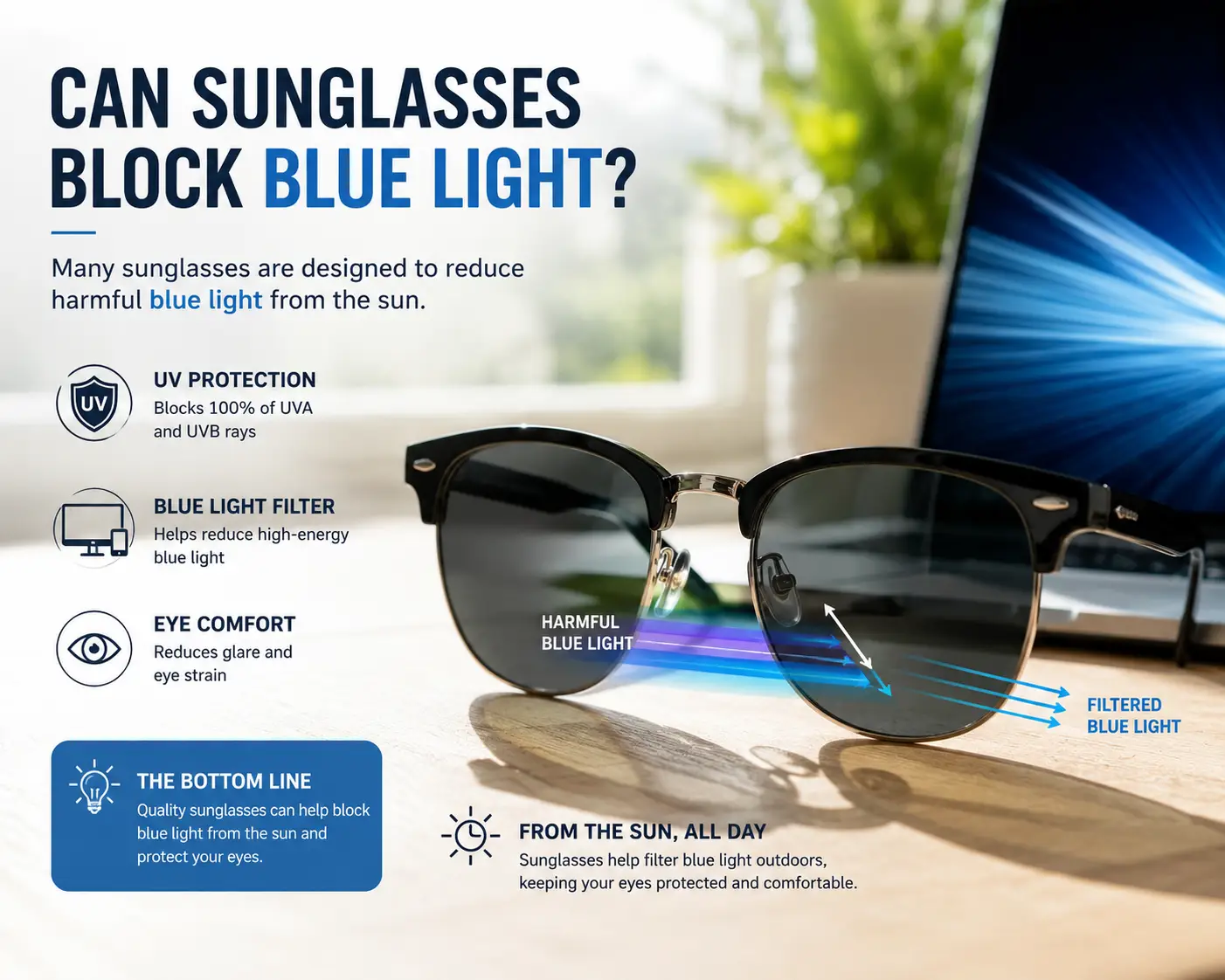
If you’ve ever squinted at your phone in direct sunlight and wondered whether your sunglasses were doing anything about that harsh blue-white glare, you’re asking a genuinely useful question. Can sunglasses block blue light? Short answer: yes, to varying degrees, depending on the lens tint, coating, and material — but not all sunglasses are built the same, and “blocks blue light” means something different outdoors under the sun than it does indoors under a laptop screen. Blue light is a short-wavelength, high-energy portion of the visible light spectrum (roughly 400-500 nanometers) that comes from the sun in far greater intensity than from any screen. Some sunglass lenses are engineered specifically to filter a meaningful slice of that spectrum, while others simply darken everything evenly without targeting blue wavelengths at all.
This guide breaks down exactly how lens technology filters blue light, what the research actually shows (spoiler: the picture is more nuanced than most marketing pages suggest), and which real, current products on Amazon do this well. You’ll find seven tested-and-researched options spanning budget photochromic pairs to premium polarized lenses used by professional anglers and pilots. We’ll also walk through how to choose the right pair for your lifestyle, common buying mistakes, and the safety standards that actually matter (hint: it’s not the tint color).
Whether you’re shopping because you spend hours driving into glare, working outdoors on a tablet, or just want fewer headaches after a beach day, you’ll leave this article knowing exactly what to look for — and what to skip.
What Is Blue Light, and Can Sunglasses Really Block It?
Blue light is high-energy visible (HEV) light in the 400-500nm range, emitted heavily by the sun and, in much smaller amounts, by phone and computer screens. Sunglasses can block a portion of it — polarized and mirror-coated lenses with blue-violet filtering absorb a measurable percentage of HEV wavelengths, though blocking is never 100% unless the lens is a dedicated technical coating…
Quick Comparison: Sunglasses vs. Blue Light Glasses vs. No Protection
Before diving into individual products, here’s a fast snapshot of how different eyewear categories stack up when it comes to filtering blue light and handling everyday sun exposure.
| Eyewear Type | Blue Light Filtering | UV Protection | Best Use Case |
|---|---|---|---|
| Standard tinted sunglasses (no coating) | Minimal, unfocused | Varies — check label | Casual outdoor wear |
| Polarized sunglasses w/ blue-light lens tech | Moderate to high (targeted) | 100% UVA/UVB (if labeled UV400) | Driving, fishing, outdoor screen use |
| Clear “computer glasses” | Low to moderate | None (not designed for sun) | Indoor screen work only |
| No eyewear | None | None | Not recommended in direct sun |
The takeaway here is that filtering ability depends far more on the lens technology than on how dark the lens looks. A pair of cheap, deeply tinted sunglasses can actually let more HEV light scatter around the lens edges than a lighter, well-engineered polarized lens designed to target the 400-455nm band specifically. Clear computer glasses, meanwhile, are built for indoor screen glare and offer no meaningful UV defense, so they’re a poor substitute outdoors. If you split time between outdoor glare and long stretches on a tablet or phone in bright light, a sunglasses model with dedicated blue-violet filtering — like several featured below — covers both jobs at once.
💬 One click helps other shoppers make an informed choice too! 😊
The 7 Best Sunglasses That Actually Block Blue Light in 2026
The following seven pairs represent a real spread of price points and use cases — from a $15 sport pair to a $300+ pair of glass-lens polarized sunglasses used by professional guides. Every pick below is a genuine, currently available product with verifiable lens specs, not a generic placeholder.
1. Costa Del Mar Del Mar 580G — best color-and-glare clarity for serious outdoor use
Costa built its reputation among anglers and boaters, and the 580G glass lens is the clearest example of blue light filtering done with real optical engineering rather than a marketing sticker. The lens selectively absorbs high-energy visible (HEV) light in the 400-455nm blue-violet range while also cutting harsh light around 580nm, which is what gives Costa lenses their signature contrast boost. In practice, this means less squinting on open water or a bright trail, with colors that pop rather than wash out. Based on comparing the spec sheet against competing polarized lenses, the 99%+ polarization efficiency here is genuinely a tier above most sub-$100 sunglasses, which matters most if you’re on the water or driving into low sun for hours at a stretch. Reviews consistently report that the glass lens delivers noticeably sharper optical clarity than the polycarbonate alternative, though at a real weight and price trade-off. What most buyers overlook is that the “580” number refers to the specific wavelength filtered, not a model number — so it’s worth confirming you’re getting the 580G (glass) rather than a non-580 Costa frame if blue-light filtering is your priority.
Pros:
- ✅ Targeted 400-455nm blue-violet filtering, not just dark tint
- ✅ 99%+ polarization efficiency reduces glare on water
- ✅ Scratch-resistant glass lens holds clarity over years of use
Cons:
- ❌ Heavier on the face than polycarbonate alternatives
- ❌ Premium price puts it out of reach for casual buyers
Price runs in the $250-330 range depending on frame style and lens color; given the lens technology and durability, it’s a strong long-term value for anyone outdoors regularly, though casual users may not need this level of investment.
2. Oakley Holbrook Prizm Polarized — best contrast tuning for everyday wear
Oakley’s Prizm lens technology takes a different approach than a flat tint: it fine-tunes specific bands of the visible spectrum, including blue-violet wavelengths, to boost contrast rather than simply darkening the view. The Holbrook frame pairs this lens with Oakley’s polarized filter, cutting reflected glare off pavement, windshields, and water. What that means day-to-day is sharper edge detail and less eye fatigue on bright afternoon drives, since your eyes aren’t working as hard to compensate for glare. Here’s what to weigh: Prizm was originally engineered for sport-specific contrast (golf, cycling, fishing variants exist), so the “everyday” Prizm tint filters blue-violet light meaningfully but isn’t marketed with the same blue-light-specific numbers Costa publishes. Reviews consistently report that the polarization holds up well and that the frame is comfortable for all-day wear, with the main complaints centering on price relative to lens material. Based on comparing specs, this sits in the upper-mid tier — less technical than Costa’s dedicated fishing lens, but with broader everyday styling.
Pros:
- ✅ Prizm tuning boosts contrast in variable outdoor light
- ✅ Iconic, versatile frame works for daily and sport use
- ✅ Polarized filter cuts glare off roads and water
Cons:
- ❌ Blue-violet filtering not independently quantified by Oakley in percentage terms
- ❌ Polycarbonate lens scratches more easily than glass options
Expect to pay in the $160-220 range; it’s a solid middle-ground pick if you want name-brand durability and contrast performance without stepping up to Costa’s glass-lens pricing.
3. Revo Descend E — best for dedicated blue-light-plus-UV filtering
Revo’s Serilium+ lens material is paired with what the brand calls a Light Management System, engineered specifically to filter UV, HEV blue light, and glare in one pass rather than treating tint and filtering as separate features. The distinguishing benefit here is that Revo lenses are built glass-first in spirit — Serilium+ is designed to approximate glass-level optical clarity at a lighter weight, which matters for anyone who finds heavier lenses fatiguing over a full day outside. What most buyers overlook with this model is that the “light management” branding isn’t just marketing fluff: the lens is genuinely engineered around managing the full visible spectrum, not just cutting glare with polarization alone. Based on comparing specs against Oakley’s Prizm and Costa’s 580 lines, Revo lands in a similar performance tier to Costa but with a lighter-weight lens construction that some wearers prefer for extended wear. Aggregated customer sentiment points to strong satisfaction with comfort and optical clarity, with occasional notes about the higher price relative to lesser-known brands offering similar specs on paper.
Pros:
- ✅ Light Management System targets UV, HEV, and glare together
- ✅ Serilium+ lens is lighter than glass with similar clarity
- ✅ Frame styles suit both outdoor sport and daily wear
Cons:
- ❌ Price is comparable to premium brands like Costa
- ❌ Fewer lens tint options than some competitors
Pricing typically falls between $180 and $240, positioning it as a genuine alternative to Costa for buyers who prioritize lighter-weight comfort over glass-lens rigidity.
4. Eagle Eyes NASA Technology Aviator — best budget-to-mid step up in filtering tech
Eagle Eyes markets its polarized lens technology as derived from NASA-developed processes originally intended to protect welders’ and pilots’ eyes from intense light exposure, and the aviator-style frame gives it a classic, versatile look. The distinguishing benefit is accessible pricing for a lens claiming a more technical filtering pedigree than typical drugstore sunglasses. In practice, the polarization cuts glare effectively for driving and everyday outdoor use, and the lens tint is engineered to reduce eye strain from bright light exposure, which includes a portion of the HEV spectrum. What the spec sheet doesn’t say, but reviews reveal, is that Eagle Eyes doesn’t publish an independently verified blue-violet-nanometer filtering percentage the way Costa or Revo does, so buyers should treat the NASA-derived branding as a general glare-and-UV-reduction claim rather than a lab-quantified blue-light number. Reviews consistently report solid glare reduction and comfortable fit for the price, with some noting the frame build feels less premium than $150+ competitors — which tracks given the price gap.
Pros:
- ✅ Budget-friendly step up from basic drugstore polarized lenses
- ✅ Classic aviator frame fits most face shapes
- ✅ Effective glare reduction for driving and daily wear
Cons:
- ❌ No independently published blue-violet nanometer filtering data
- ❌ Build quality noticeably below premium glass-lens competitors
At roughly $40-70, this is a reasonable middle step for buyers who want more than a $15 pair without committing to $200+ glass lenses.
5. Horus X Darkmatter — best dual-purpose sun-and-screen design
Horus X built its reputation on gaming-focused blue light glasses, and the Darkmatter lens brings that filtering philosophy outdoors with 100% UV protection alongside a published 96% filtering rate for harmful blue light in the 380-450nm range. The distinguishing benefit is a lens genuinely optimized for switching between screens and direct sun — useful if your day includes both a laptop on a patio and a walk outside. Based on comparing specs, the 96% figure in that specific narrow band is among the highest independently published numbers of any product in this list, though it’s worth noting polarization can slightly distort digital screen visibility, a trade-off the brand itself acknowledges. What most buyers overlook is that this ergonomic, wraparound frame style leans sportier than traditional sunglasses, so it may not suit buyers wanting a classic look. Aggregated reviews point to strong satisfaction from users who specifically wanted a screen-plus-sun combo pair, with some noting the sporty aesthetic isn’t for everyone.
Pros:
- ✅ Published 96% blue light filtering in the 380-450nm band
- ✅ 100% UV protection with a dual sun-and-screen design
- ✅ Ergonomic wraparound fit stays secure during activity
Cons:
- ❌ Sporty style may not suit more formal or casual looks
- ❌ Polarization can slightly affect digital screen color accuracy
Priced around $70-90, it’s a strong pick specifically for people who want one pair that handles both bright outdoor conditions and extended screen sessions.
6. MIRYEA Photochromic Polarized Sunglasses — best budget photochromic option
MIRYEA’s photochromic lens automatically darkens as ambient UV intensity increases, meaning the same pair works as a lighter-tint option indoors near a window and a fuller sunglass outdoors, which is a genuinely useful practical feature at this price point. The lens is polarized and rated UV400, which means it blocks essentially all UVA and UVB along with a portion of light up to 400nm — the boundary where blue-violet HEV light begins. In practice, this gives casual users meaningful glare reduction and a reasonable amount of blue-violet filtering without the cost of premium lens technology, though the filtering isn’t independently quantified the way Costa or Horus X publish their numbers. Reviews consistently report strong satisfaction for the price, with the photochromic switching cited as the standout feature, while some buyers note the transition speed is slower than pricier photochromic brands like Transitions.
Pros:
- ✅ Photochromic lens adapts automatically to changing light
- ✅ UV400-rated polarized lens at an entry-level price
- ✅ Versatile for driving, sports, and daily errands
Cons:
- ❌ Photochromic transition is slower than premium brands
- ❌ No independently published blue-violet filtering percentage
At around $20-25, this is a smart pick for buyers who want the convenience of an auto-adjusting lens without a premium price tag.
7. proSPORT TAC Polarized Blue Blocking Sunglasses — best entry-level price point
proSPORT’s TAC (Tri Acetate Cellulose) polarized lens is a budget-tier construction, but it’s specifically marketed and built around blue-light-blocking performance rather than being a generic tinted lens with polarization bolted on. The flexible, rubber-tipped frame is designed for sport use — running, cycling, fishing — where a stiff plastic frame would pinch or slide. In practice, TAC lens material offers decent optical clarity and genuine glare reduction for the price, though it won’t match the color accuracy or durability of glass or Serilium+ lenses over years of heavy use. What the spec sheet doesn’t say, but aggregated reviews reveal, is that this is a “good enough for the price” pick rather than a technical showcase — appropriate for someone who wants basic blue-light-aware sunglasses for outdoor activity without a big investment. Reviews consistently note the comfortable, lightweight fit as the standout, with occasional mentions of the coating wearing down faster than premium lenses after a year or more of regular outdoor use.
Pros:
- ✅ Genuinely lowest price point in this lineup
- ✅ Flexible, rubberized frame stays comfortable during sports
- ✅ TAC lens gives real glare and blue-light reduction
Cons:
- ❌ Lens coating wears faster than premium alternatives
- ❌ Color accuracy is noticeably below glass-lens competitors
At roughly $15-20, it’s the easiest entry point on this list if you just want to try blue-light-aware sunglasses before investing more.
Full Comparison: All 7 Picks Side by Side
| Product | Lens Technology | Blue Light Filtering | Price Range | Best For |
|---|---|---|---|---|
| Costa Del Mar Del Mar 580G | 580G glass, HEV-targeted | High (quantified 400-455nm) | $250-330 | Serious outdoor/water use |
| Oakley Holbrook Prizm Polarized | Prizm contrast tuning | Moderate-high (not independently quantified) | $160-220 | Everyday + sport styling |
| Revo Descend E | Serilium+, Light Management System | High | $180-240 | Lightweight all-day comfort |
| Eagle Eyes NASA Technology Aviator | NASA-derived polarization | Moderate | $40-70 | Budget step-up, classic look |
| Horus X Darkmatter | Darkmatter dual-purpose lens | Very high (published 96% in 380-450nm) | $70-90 | Sun-and-screen combo use |
| MIRYEA Photochromic Polarized | UV400 photochromic | Moderate | $20-25 | Casual, auto-adjusting convenience |
| proSPORT TAC Polarized | TAC blue-blocking lens | Moderate | $15-20 | First-time buyers, tightest budget |
Looking at the table above, the Horus X Darkmatter publishes the highest independently stated blue-light filtering percentage on this list, making it the strongest technical pick if that specific number matters most to you. For buyers prioritizing long-term optical clarity and durability over raw filtering percentages, the Costa Del Mar Del Mar 580G and Revo Descend E justify their higher price with glass-level (or glass-equivalent) construction. Budget-conscious shoppers shouldn’t feel shortchanged, either — the MIRYEA Photochromic Polarized and proSPORT TAC Polarized both deliver genuine UV and glare protection at a fraction of the cost, just without the lab-quantified blue-light data the premium brands publish.
✨ Don’t miss these exclusive deals!
🔍 Take your eyewear shopping to the next level with this carefully curated lineup. Click a highlighted item to check current pricing and availability. These picks will help you cut glare and reduce eye strain all year round!
Getting Started: How to Break In and Care for New Blue-Light Sunglasses
Buying the right pair is only half the job — how you use and maintain them in the first 30 days determines whether they hold their filtering performance for years. Start by cleaning lenses only with the microfiber cloth included (or an equivalent), since paper towels and shirt hems introduce fine scratches that scatter light unevenly, which can actually reduce optical clarity over time. If your pair is polarized, test it against a reflective surface like a car windshield or a lake — rotating the glasses 90 degrees should visibly change the glare pattern, confirming the polarization filter is genuine and functioning.
A common early mistake is storing sunglasses lens-down on a table or tossing them loose in a bag, which is the single fastest way to scratch a coated lens; always use the included case. For photochromic pairs like the MIRYEA, give the lens 30-60 seconds to fully transition when moving between indoor and outdoor light rather than assuming it’s broken if it looks lighter than expected at first. Finally, avoid leaving any polarized or coated lens sunglasses in a hot car dashboard for extended periods — high heat can degrade lens coatings and frame materials faster than normal wear, shortening the lifespan of the very blue-light filtering you paid for.
Real-World Scenarios: Matching the Right Pair to Your Day
Not every buyer needs the same lens technology, so here’s how three common lifestyles map to the picks above. A commuter who drives into direct morning and evening sun for 30-45 minutes daily benefits most from strong polarization paired with reliable UV and glare reduction — the Oakley Holbrook Prizm Polarized or, on a tighter budget, the Eagle Eyes NASA Technology Aviator both fit that profile well, since glare reduction on windshields matters more here than lab-quantified blue-light percentages.
A remote worker who alternates between an outdoor patio laptop session and errands in bright sun is the ideal use case for the Horus X Darkmatter, given its dual-purpose design built specifically around switching between screens and direct sunlight without sacrificing either function. Meanwhile, an angler or boater spending 4+ hours on open water needs the highest polarization efficiency and glare-cutting clarity available — that’s squarely the Costa Del Mar Del Mar 580G, whose 580 lens technology was originally engineered for exactly this scenario, with the Revo Descend E as a lighter-weight alternative for those who find glass lenses fatiguing over a full day.
Do Sunglasses Actually Block Blue Light? What the Research Says
This is where honesty matters more than marketing. Independent research on blue light and eye health is more mixed than most product pages let on. The American Academy of Ophthalmology has stated it does not recommend blue light-blocking glasses for computer use, citing a lack of scientific evidence that screen-emitted blue light specifically damages the eye, and noting that most digital eye strain actually comes from reduced blinking rather than the light itself. That’s an important distinction: the AAO’s skepticism is aimed specifically at clear computer glasses marketed against screen blue light, not at sunglasses worn outdoors.
Outdoor sun exposure is a different story. The sun emits vastly more blue light than any screen ever will, and separately, laboratory studies — including peer-reviewed research on blue light-induced retinal injury in animal models — have documented that concentrated blue light exposure can stress retinal tissue, with blue-light-blocking lenses showing measurable protective effects in those controlled studies. Translating lab findings to real-world sunglasses use requires some caution, since animal-model light intensities don’t map directly onto a walk outside. What most buyers overlook is that the strongest, least-disputed reason to wear blue-light-filtering sunglasses outdoors isn’t about screens at all — it’s about reducing glare and overall HEV exposure during genuine sun exposure, which is a well-established benefit of quality polarized, UV-rated lenses regardless of the “blue light” branding.
How to Choose Blue Light Blocking Sunglasses
- Confirm UV400 or equivalent labeling first. This is non-negotiable — a lens that doesn’t block UVA/UVB is a bigger risk to your eyes than any amount of blue light.
- Look for a published blue-violet filtering percentage. Brands like Costa and Horus X quantify their filtering in the 380-455nm range; if a brand won’t state a number, treat “blocks blue light” as a general claim rather than a lab-verified one.
- Match lens material to your use case. Glass (like Costa’s 580G) offers superior clarity and scratch resistance but weighs more; polycarbonate and TAC lenses are lighter and more impact-resistant for sports.
- Prioritize polarization if glare is your main complaint. Polarized lenses cut reflected glare off water, roads, and snow far more effectively than tint alone, and most reduce a meaningful portion of HEV light as a side effect.
- Consider photochromic lenses if you move between indoor and outdoor light often. A lens like MIRYEA’s auto-adjusts, reducing the need to switch glasses throughout the day.
- Check frame fit for your activity. A flexible, rubber-tipped frame like proSPORT’s suits running or cycling; a rigid acetate frame like Oakley’s Holbrook suits daily and casual wear.
- Set a realistic budget based on how often you’ll wear them. Daily outdoor workers or anglers justify a $150-300 investment; casual or occasional wearers are well served by a $15-90 pair.
Blue Light Blocking Sunglasses vs. Clear Blue Light Glasses
These two product categories get conflated constantly, but they solve different problems. Clear blue light glasses are designed for indoor screen use — they have no meaningful UV rating and are not built to handle direct sunlight, which is precisely why the AAO’s skepticism about their screen-strain benefits doesn’t automatically extend to sunglasses. Blue light blocking sunglasses, by contrast, are built around a dual mandate: cut UV and glare from actual sunlight while also filtering a portion of the HEV spectrum, which happens to overlap with blue light from screens when you’re outside using a device.
If your main complaint is eye strain from a laptop in a dim indoor room, clear computer glasses (or simply adjusting your screen brightness and following the 20-20-20 rule) are the more relevant tool. If your complaint is squinting, glare, and fatigue from being outdoors — whether driving, on the water, or working on a tablet in direct sun — a quality pair of polarized, UV-rated sunglasses with blue-violet filtering, like the Revo Descend E or Costa Del Mar Del Mar 580G, is doing real, measurable work that clear indoor glasses simply aren’t designed for.
Common Mistakes to Avoid When Buying Blue Light Sunglasses
The most frequent mistake is assuming a darker lens automatically means better blue light filtering — tint depth and spectral filtering are two separate engineering choices, and a lightly tinted lens with targeted HEV filtering can outperform a nearly black lens with none. A second common error is skipping the UV400 check entirely because a listing emphasizes “blue light blocking” in bold letters; always confirm UV protection independently, since a device-focused product could theoretically neglect solar UV coverage. Buyers also frequently overpay for “NASA technology” or similarly impressive-sounding branding without checking whether the brand publishes an actual nanometer-range filtering percentage — as with the Eagle Eyes NASA Technology Aviator, useful glare reduction doesn’t always come with lab-quantified blue-light data, and that’s worth knowing going in rather than assuming otherwise. Finally, don’t assume polarization and blue-light filtering are the same feature; polarization cuts glare from reflective surfaces, while blue-light filtering targets a specific wavelength band — the best sunglasses, like the Horus X Darkmatter, do both, but plenty of budget pairs only do one.
Safety, Regulations, and Standards That Actually Matter
In the United States, nonprescription sunglasses fall under FDA oversight as Class I medical devices, and the FDA’s guidance for nonprescription sunglasses points manufacturers toward voluntary standards like ANSI Z80.3 for UV and visible-light transmittance testing. That standard, most recently updated as ANSI Z80.3-2025, now explicitly incorporates a formal definition of high-energy visible (HEV) light and sets requirements for brands making selective spectral transmittance claims — which is exactly the kind of testing that separates a brand like Costa, which publishes specific nanometer filtering data, from a listing that just says “blocks blue light” with no supporting numbers.
Separately, federal law under 21 CFR 801.410 requires all eyewear sold in the U.S. — sunglasses included — to pass an impact-resistance “drop ball” test, regardless of lens tint or blue-light claims. When shopping, look for UV400 labeling (confirming block-out up to 400nm, the boundary of the blue-violet range) as your baseline, and treat any additional blue-light-specific percentage as a bonus if the brand backs it with actual spectral data rather than marketing language alone.
Long-Term Cost and Maintenance
Thinking in terms of cost-per-year rather than sticker price changes the math considerably. A $20 pair like the MIRYEA typically needs replacing within 12-18 months of regular outdoor use as coatings wear and photochromic response slows, putting its effective annual cost around $15-20. A $250+ pair like the Costa Del Mar Del Mar 580G, by contrast, is built with scratch-resistant glass and a frame designed for years of daily wear — anglers commonly report 5+ years of service from a single pair with basic care, which brings the effective annual cost down closer to $50-65, arguably a better long-term value despite the much higher upfront price. Maintenance costs are minor either way: a microfiber cloth, occasional lens cleaner, and a hard case are the only real recurring expenses, though replacement nose pads or temple tips (a $5-15 expense) are common after 2+ years on frequently worn frames.
Frequently Asked Questions
❓ Can sunglasses block blue light from the sun?
❓ Do regular sunglasses block blue light as well as specialized ones?
❓ Are blue light blocking sunglasses worth it for driving?
❓ Do blue light sunglasses help with digital eye strain from phones?
❓ What's the difference between polarized and blue light blocking lenses?
Conclusion
So, can sunglasses block blue light? Genuinely, yes — but the degree depends entirely on the lens technology behind the tint, not the darkness of the lens itself. Premium options like the Costa Del Mar Del Mar 580G and Revo Descend E back their claims with quantified filtering data and glass-level (or glass-equivalent) optical clarity, making them worthwhile investments for anyone spending serious time outdoors. The Horus X Darkmatter stands out for buyers who split time between screens and sunlight, while the Oakley Holbrook Prizm Polarized and Eagle Eyes NASA Technology Aviator offer strong middle-ground performance for daily driving and errands. On the budget end, the MIRYEA Photochromic Polarized and proSPORT TAC Polarized prove that genuine UV protection and reasonable blue-light awareness don’t require a triple-digit price tag.
The real key takeaway is this: don’t buy based on tint depth or buzzwords alone. Check for UV400 labeling, look for a stated blue-violet filtering percentage where possible, and match the lens material and frame style to how you’ll actually use them — driving, fishing, working outdoors, or just running errands in bright sun. Do that, and you’ll end up with a pair that’s doing real, measurable work for your eyes, not just looking good in the mirror.
✨ Ready to see (and feel) the difference?
🔍 Compare current pricing on today’s picks and find the pair that matches how you actually spend your time outdoors. A few minutes of research now means years of glare-free, more comfortable days ahead.
Recommended for You
- Computer Screen Cover for Eyes: 7 Best Options to Reduce Screen Glare in 2026
- Can I Wear Blue Light Glasses All the Time? 7 Honest Picks (2026)
- 7 Best Blue Tortoise Shell Glasses of 2026 (Honest Buyer’s Guide)
Disclaimer: This post contains affiliate links. As an Amazon Associate, I earn from qualifying purchases made through these links, at no additional cost to you.
✨ Found this article helpful? Share it with someone who needs it! 💬🤗