In This Article
Do TV Emit Blue Light? The Short, Honest Answer
You finish a long day, flop on the couch, and queue up “just one more episode.” Two hours later you’re wide awake, staring at the ceiling, wondering whether the glowing rectangle across the room is to blame. So, do TV emit blue light? Yes, every modern TV does. The real question is how much, whether it matters, and what you can do about it without trading in your movie nights.
Here’s the twist most “blue light” marketing skips: the answer splits into two very different stories. ⚡ For your eyes, the evidence is reassuring. The American Academy of Ophthalmology explains that blue light from screens doesn’t damage your eyes, and screen exposure is tiny compared with the sun. For your sleep, the story is more nuanced: bright, blue-rich light in the evening can nudge back the release of melatonin, the hormone that tells your body it’s bedtime.
That’s why this guide does two jobs. First, it explains what TV blue light actually is, which panel types emit more of it, and what the certifications on TV boxes really mean. Second, it reviews seven real products, from a sub-$20 pair of amber glasses to a top-rated 2026 OLED TV, and tells you honestly which ones solve a real problem and which ones mostly solve a marketing problem.
You’ll also find setup tips, buyer scenarios, and a few free settings changes that often beat anything you can buy. 🛋️ No scare tactics, no invented testimonials, just what the specs, independent tests, and aggregated reviews actually show.
What Is TV Blue Light?
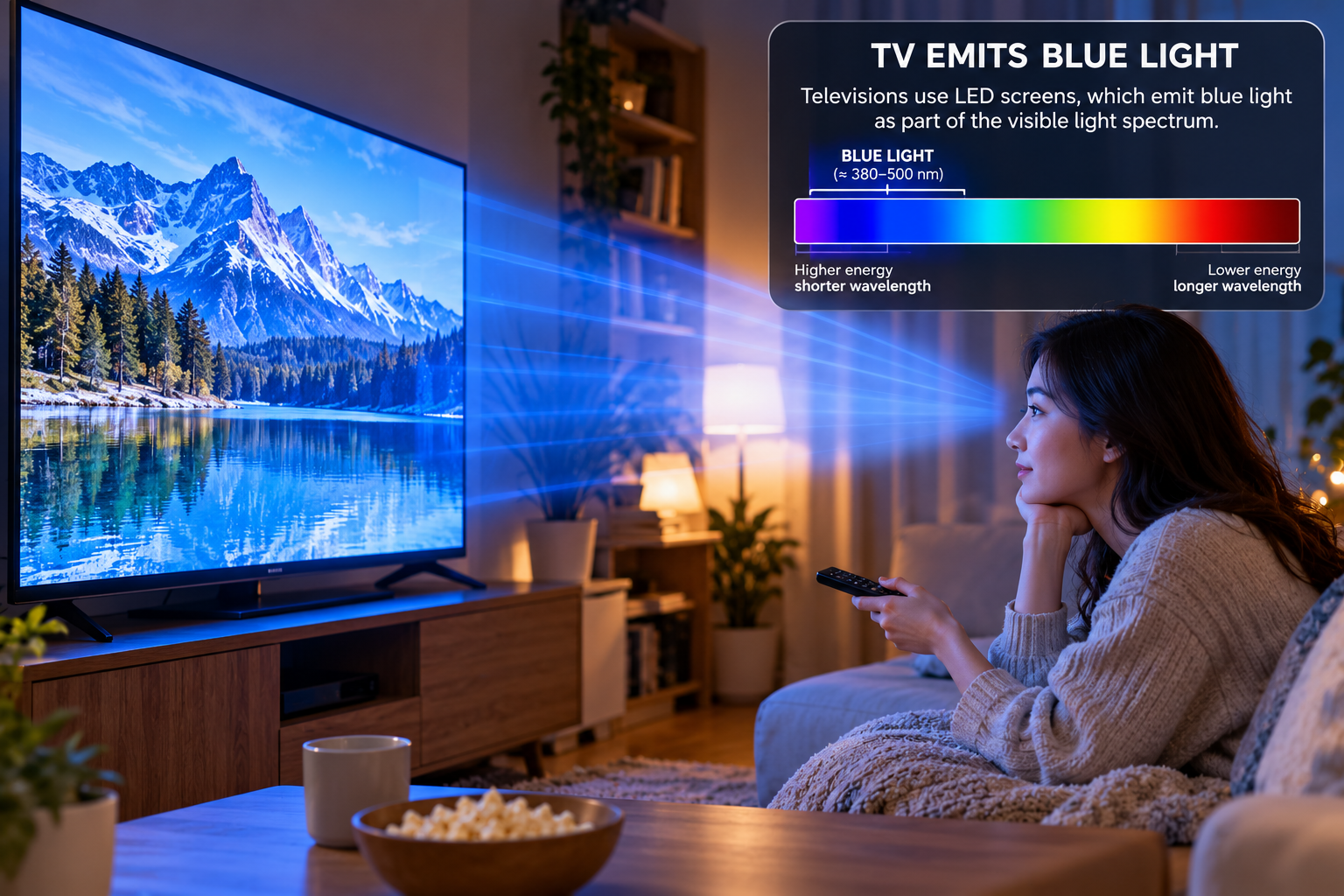
TV blue light is the short-wavelength, high-energy visible (HEV) light, roughly 400 to 500 nanometers, that a television emits as part of its picture. Most LED-LCD TVs generate all their light from blue LEDs, so blue makes up a large share of their output. OLED panels typically emit noticeably less.
That last point is not hand-waving. Independent lab measurements of dozens of sets found that standard LED TVs peak around 446 to 448 nm, right inside the band researchers flag as most biologically active. In plain English: the TV isn’t hurting your retina, but a bright, cool-toned picture at 11 p.m. is sending your brain a “daytime” signal. 🌙
Quick Comparison: 7 Ways to Manage TV Blue Light
| Product | Type | Price range | Main benefit | Best for |
|---|---|---|---|---|
| LG C6 OLED | OLED TV | About $1,400–$3,700 | Certified low blue light panel | Buying a new TV anyway |
| Samsung S90F OLED | OLED TV | About $1,000–$3,500 | OLED contrast, vivid color | Samsung households, gamers |
| MediaLight Mk2 Flex | Bias light | About $60–$100 | Reduces contrast strain | Dark-room viewers |
| Govee TV Backlight 3 Lite | Smart backlight | About $70–$110 | Warm ambient glow, screen sync | Fun, budget upgrade |
| SaharaCase Anti-Blue Light TV Screen Protector | Filter panel | About $100–$450 by size | Physical filter + scratch guard | Homes with kids or pets |
| Swanwick Night Swannies | Amber glasses | About $70–$90 | Strong evening blue filtering | Style-conscious night owls |
| Uvex Skyper S1933X | Amber glasses | Under $20 | ~98% blue blocking, cheap | Budget sleep experiments |
Looking at the table above, the cheapest fix is also one of the most effective for sleep: amber glasses like the Uvex Skyper S1933X filter far more blue light than any clear screen film. If you’re already shopping for a TV, though, the LG C6 OLED removes the problem at the source. The middle of the list, bias lighting, targets comfort rather than melatonin, which is a different (and often overlooked) goal.
💬 One click helps other shoppers make an informed choice too! 😊
Top 7 Products for TV Blue Light: Expert Analysis
The seven picks below fall into three groups: TVs that emit less blue light by design, lighting that makes viewing more comfortable, and filters or glasses that cut blue light between the screen and your eyes. Each one is assessed on real specs, independent reviews, and aggregated buyer sentiment.
1. LG C6 OLED — lowest blue light at the source
If you’re replacing a TV anyway, the LG C6 OLED tackles blue light where it starts: the panel. LG’s 2026 mid-range OLED uses LG Display’s WOLED panel in the 42- to 65-inch sizes, and that panel family has the strongest third-party blue light credentials in the TV world. In 2025, UL Solutions verified LG Display’s OLED panels under the Eyesafe Display Requirements 3.0, a standard that scores circadian-stimulating blue light, not just total blue output.
What this means in practice: you get an OLED’s perfect blacks and wide viewing angles, plus a spectrum that’s less blue-heavy than a typical LED-LCD at the same brightness. Each pixel also lights itself, so there’s no backlight flicker to worry about. Reviewers measured the C6 as brighter and more refined than the already excellent C5, and it supports 4K at 120Hz for consoles.
Who it’s for: movie lovers and gamers who want a top-tier picture and appreciate the eye-comfort bonus. Who should skip it: anyone with a working TV hoping to fix sleep. A $1,500 purchase is a poor sleep remedy when a $15 pair of glasses works better at night.
Aggregated review sentiment from major outlets is consistently strong on picture quality and smart features; the most repeated criticism is the built-in audio.
Pros:
- ✅ Panel family verified for low blue light emissions
- ✅ Flicker-free, self-lit pixels with perfect blacks
- ✅ Excellent for gaming and dark-room movies
Cons:
- ❌ Expensive if blue light is your only concern
- ❌ Built-in speakers are average for the price
💰 Price range: roughly $1,400 for the 42-inch to the $2,700 range for 65 inches at launch, often lower during seasonal sales; check the current price. Great value for buyers who need a new TV.
2. Samsung S90F OLED — vivid QD-OLED color for Samsung fans
The Samsung S90F OLED is Samsung’s mid-range 2025 OLED, and it remains one of the strongest alternatives to LG’s C-series in 2026. Its headline feature is a QD-OLED panel in most sizes, which pairs self-lit pixels with quantum dots for unusually bright, saturated color.
Here’s the detail most buyers overlook: the S90F ships with different panel types depending on size and region. Some sizes use a WOLED panel similar to LG’s, while others use Samsung’s QD-OLED. That matters for blue light, because the published UL and Eyesafe verifications discussed above belong to LG Display panels. If certified low blue light is your priority, confirm the exact model code and look for a certification mark on the listing rather than assuming.
In everyday use, any OLED still avoids the blue-backlight-everywhere design of LED-LCDs, so dark scenes emit very little light at all. Independent testing describes the S90F as excellent in dark rooms and fast in Game Mode, though it lacks the anti-glare filter of Samsung’s flagship.
Aggregated buyer reviews praise the picture and responsiveness; several summaries advise buying from authorized sellers to avoid shipping issues.
Pros:
- ✅ Gorgeous, highly saturated HDR color
- ✅ Outstanding black levels and gaming performance
- ✅ Frequently discounted now that it’s a 2025 model
Cons:
- ❌ Panel type varies by size and region
- ❌ Reflective screen in bright rooms
💰 Price range: about $1,000 to $3,500 depending on size, with frequent deals; prices may vary. Strong value if you find the size you want discounted.
3. MediaLight Mk2 Flex — pro-grade bias light for eye comfort
The MediaLight Mk2 Flex doesn’t reduce your TV’s blue light at all, and that’s exactly why it’s worth understanding. It’s a bias light: an LED strip on the back of the TV that softly lights the wall behind it, so your eyes aren’t constantly adjusting between a bright screen and a pitch-black room.
The specs explain why enthusiasts swear by it. The strip is calibrated to 6500K (D65), the same white point your TV is calibrated to, with a color rendering index of 98 or higher. In practice, that means the glow behind the screen won’t tint the picture or make blacks look gray. Home-theater reviewers note that the right amount of bias light even makes dark scenes appear deeper, because your pupils don’t open as wide.
Who it’s for: anyone who watches in a dark room and ends a movie with tired, achy eyes. It’s a comfort tool, not a sleep tool; a 6500K light is neutral-cool, so it won’t help melatonin.
Aggregated reviews from AV publications are consistently positive, highlighting even light output and an included dimmer; the 2024 Mk2 v2 refresh improved consistency along the strip.
Pros:
- ✅ Accurate 6500K light preserves picture quality
- ✅ Noticeably reduces dark-room eye fatigue
- ✅ USB-powered and simple to install
Cons:
- ❌ Doesn’t reduce blue light or help sleep
- ❌ Pricier than generic LED strips
💰 Price range: roughly $60 to $100 depending on length; check current pricing. Excellent value for serious viewers.
4. Govee TV Backlight 3 Lite — fun ambient glow on a budget
The Govee TV Backlight 3 Lite (model H6099) is the playful cousin of a bias light. A small camera clipped to the top of your TV reads the colors on screen, and an RGBICW LED strip behind the set mirrors them onto the wall in real time.
Two features matter for eye comfort. First, the “W” in RGBICW means it has dedicated white LEDs, so you can run it as a plain warm-white backlight instead of a light show. Second, the app includes white-balance and per-zone brightness controls. Set it to a warm, dim white in the evening and you get a gentle ambient glow without adding more cool light to the room.
The camera’s fisheye correction is improved over older Govee kits, but reviewers note it sometimes misses action near the top and bottom edges. Some buyers also dislike the camera sitting on the bezel.
Who it’s for: casual viewers, gamers, and families who want a fun upgrade under $110. Purists who calibrate their TVs should pick the MediaLight Mk2 Flex instead.
Aggregated buyer feedback says setup takes some camera fiddling, but most are happy once it’s calibrated.
Pros:
- ✅ Screen-sync lighting feels immersive
- ✅ Dedicated white LEDs allow warm, calm settings
- ✅ Affordable with frequent discounts
Cons:
- ❌ Not color-accurate like a true bias light
- ❌ Top-mounted camera bothers some owners
💰 Price range: about $70 to $110 depending on TV size; prices may vary. Solid value for an entertainment upgrade.
5. SaharaCase Anti-Blue Light TV Screen Protector — physical filter plus damage guard
The SaharaCase Anti-Blue Light TV Screen Protector (ZeroDamage line) is a rigid acrylic panel that hangs over the front of your TV with straps, rather than sticking to the glass. It’s sold in sizes from 32 to 77 inches and beyond, and it does double duty: a blue light filter and a shield against flying toys and dog noses.
Let’s be precise about what it can and can’t do. The manufacturer says its multilayer coating filters blue, UV, and HEV light. The UV claim matters little, because TVs emit essentially no UV in the first place. And a clear filter can only remove a modest slice of blue light without visibly yellowing the picture, which is why clear lenses and films generally filter far less than amber glasses. The listing’s language about preventing serious eye conditions isn’t backed by the eye-care evidence, so treat it as marketing.
Where this product genuinely earns its keep is physical protection. A cracked 65-inch panel costs far more than the shield. If you have toddlers, a playroom TV, or a rowdy game night crowd, that’s real value.
Aggregated reviews of hang-on TV filters in this category praise easy installation and scratch protection; recurring complaints are added glare and straps that don’t fully secure the bottom edge.
Pros:
- ✅ Protects the screen from impacts and scratches
- ✅ No adhesive, so it removes cleanly
- ✅ Wide range of sizes, up to 77 inches
Cons:
- ❌ Modest blue reduction compared with amber glasses
- ❌ Adds reflections and can soften the picture
💰 Price range: from around $100 for small sizes to over $400 for 77-inch versions; check the current price. Worth it for protection, less so for blue light alone.
6. Swanwick Night Swannies — stylish amber glasses for evenings
Swanwick Night Swannies are amber-orange glasses designed to be worn for one to two hours before bed. Unlike clear “blue light glasses,” their tinted lenses filter most of the blue band, which is the category the sleep research actually studies.
The build is a cut above typical blue blockers: cellulose acetate frames, spring hinges, and CR-39 lenses with anti-reflective coating on both sides. In practice, that means they’re comfortable enough to wear through a whole movie and look like regular eyewear rather than lab goggles. There’s also a Fitover version for people who wear prescription glasses.
An honest note on the evidence: Swanwick cites a company-sponsored SleepScore Labs validation study in which participants reported falling asleep faster and measured more deep sleep. That’s encouraging, but it’s not an independent clinical trial. Broader research on amber lenses is mixed, with the most benefit seen in people who already struggle with sleep timing.
Who it’s for: night owls who love evening TV, care about style, and want a ritual that signals wind-down time. Expect everything to look orange; colors on screen will be distorted.
Aggregated customer sentiment is broadly positive, with many reviewers saying they feel sleepy sooner when watching TV at night.
Pros:
- ✅ Filters the blue band sleep research focuses on
- ✅ Comfortable, good-looking frames
- ✅ Fitover option for prescription wearers
Cons:
- ❌ Distorts on-screen colors significantly
- ❌ Costly compared with safety-style amber glasses
💰 Price range: about $70 to $90; prices may vary. Fair value if you’ll actually wear them nightly.
7. Uvex Skyper S1933X — cheapest serious blue blocker
The Uvex Skyper S1933X is technically safety eyewear from Honeywell, but it has a cult following among sleep enthusiasts. Its SCT-Orange lens is rated to absorb about 98% of blue light, which is in the same league as premium amber glasses for a fraction of the cost.
The wraparound shape is a hidden advantage. Standard straight-temple frames let blue light sneak in from the sides, while the Skyper’s curved design and adjustable temples hug the face. It also has an anti-fog coating and polycarbonate lenses, so it doubles as legitimate eye protection for DIY projects.
The trade-off is obvious the moment you put them on: they look like shop goggles, and everything turns deeply orange. Blues on screen may look greenish. For a pre-bed TV session, that’s usually a fine compromise; for color-critical viewing, it isn’t.
Who it’s for: anyone who wants to test whether evening blue light affects their sleep before spending more. If it works for you, you can stay here or upgrade to Swanwick Night Swannies for style.
Aggregated buyer reviews repeatedly highlight that these filter much more than cheap clear “blue light” glasses; the most common complaints are the look and a loose fit on small faces.
Pros:
- ✅ Blocks about 98% of blue light
- ✅ Wraparound design limits side leakage
- ✅ Extremely affordable; multipacks available
Cons:
- ❌ Industrial look isn’t for everyone
- ❌ Heavy orange tint distorts colors
💰 Price range: typically under $20 per pair; check current pricing. Outstanding value.
✨ Find your best fix tonight!
🔍 Not sure which one fits your living room? Click any highlighted product above to check current pricing and availability, and start enjoying calmer, cozier evenings in front of the TV.
Full Comparison of the Top 7 Picks
| Product | Reduces blue light? | Helps sleep? | Eye comfort | Price range | Best for |
|---|---|---|---|---|---|
| LG C6 OLED | Yes, at the panel | Slightly | High | $1,400–$3,700 | New TV buyers |
| Samsung S90F OLED | Yes vs. LED-LCD | Slightly | High | $1,000–$3,500 | Gamers, color lovers |
| MediaLight Mk2 Flex | No | No | High | $60–$100 | Dark-room movie fans |
| Govee TV Backlight 3 Lite | No (warm mode adds ambience) | Minor | Medium | $70–$110 | Families, fun setups |
| SaharaCase Anti-Blue Light TV Screen Protector | Modestly | Minor | Medium | $100–$450 | Kids and pets at home |
| Swanwick Night Swannies | Strongly | Most likely | Medium | $70–$90 | Stylish night owls |
| Uvex Skyper S1933X | Strongly | Most likely | Medium | Under $20 | Budget testers |
This table reveals a pattern that marketing rarely admits: the products that help sleep most are the cheapest and least glamorous. The Uvex Skyper S1933X and Swanwick Night Swannies filter at your eyes, so they work on any TV. The OLED TVs reduce blue light more gently all day long, while bias lights like the MediaLight Mk2 Flex solve comfort, not melatonin.
💬 One click helps other shoppers make an informed choice too! 😊
How to Reduce Blue Light From Your TV Tonight (Free Settings First)
Before you buy anything, spend ten minutes in your TV’s picture menu. These free changes often do more than a filter panel, and they work on any brand.
- Switch to a warm picture mode. Look for “Movie,” “Cinema,” “Filmmaker Mode,” or “Calibrated.” These presets aim for a 6500K white point, which is noticeably less blue than the “Vivid” or “Standard” modes many TVs ship in. Store demo modes often run far cooler.
- Set color temperature to “Warm.” Most TVs offer Cool, Standard, and Warm (sometimes Warm 1 and Warm 2). Warm 2 shifts the whole picture toward amber. It looks odd for a day or two, then your eyes adapt.
- Turn on the eye-comfort or night mode. LG, Samsung, Sony, TCL, and Hisense all include a version, often called “Eye Comfort Mode” or similar. It automatically warms colors in the evening.
- Lower the brightness after dark. Total light matters as much as color. Dropping backlight or OLED brightness from 100 to around 40 at night cuts blue output proportionally.
- Disable energy-saving “auto brightness” quirks. Some ambient sensors raise brightness unpredictably; set a fixed nighttime level instead.
📺 Common mistakes in the first 30 days: switching back to Vivid because warm modes look “yellow” at first, forgetting that streaming apps sometimes reset picture modes, and placing a bright bias light directly in your line of sight. Give your eyes a week before judging. Most people find warm modes more natural once they stop comparing them side by side with the store-floor look.
Real-World Scenarios: Which Fix Fits Your Evenings?
Not every household has the same problem, so here are three common profiles and the honest best match.
🛏️ The bedroom binge-watcher
You watch a 43-inch LED TV in bed for an hour or two most nights and struggle to fall asleep. Budget: under $50. Best match: the Uvex Skyper S1933X, worn for the last 90 minutes before lights out, plus the warm picture settings above. If the glasses help and you want something you’d wear in front of a partner, upgrade to Swanwick Night Swannies. Skip the screen protector here; it filters far less and costs more.
🎬 The home-theater fan
You watch movies in a dark living room three or four nights a week, and your eyes feel tired after long films. Budget: around $100. Best match: the MediaLight Mk2 Flex, set dim enough that it barely registers. It reduces the bright-screen, black-room contrast that causes fatigue, and it won’t harm your calibrated picture. If you’re due for a new TV within a year, put the money toward the LG C6 OLED instead.
👨👩👧 The busy family room
Kids watch cartoons after school, the dog sleeps by the TV stand, and evenings are chaotic. Budget: $150 to $300. Best match: a properly sized SaharaCase Anti-Blue Light TV Screen Protector for physical protection, combined with a strict “screens off an hour before bedtime” routine. The Govee TV Backlight 3 Lite in warm-white mode adds a calming glow for family movie nights.
Problem → Solution: Fixing Common TV Viewing Complaints
Problem 1: “I can’t fall asleep after evening TV.” Solution: turn on night mode, lower brightness, and wear amber glasses such as the Uvex Skyper S1933X for the final hour. Also consider content: a tense thriller is more stimulating than a cooking show, whatever the light spectrum.
Problem 2: “My eyes ache after a long movie.” Solution: this is usually contrast and dryness, not blue light. Add bias lighting like the MediaLight Mk2 Flex, sit at a comfortable distance, and remember to blink. Long screen sessions reduce blink rate, which dries the eyes.
Problem 3: “The TV looks harsh and blue in my dark room.” Solution: switch from Vivid to Filmmaker Mode or Movie mode and set color temperature to Warm. On a new purchase, an OLED like the LG C6 OLED starts from a lower blue baseline.
Problem 4: “My toddler keeps poking the screen.” Solution: a hang-on shield such as the SaharaCase Anti-Blue Light TV Screen Protector prevents expensive damage; any blue reduction is a bonus.
Problem 5: “Blue light glasses didn’t do anything.” Solution: check the lens. Clear or barely tinted lenses filter only a small fraction of blue light. Amber-orange lenses like Swanwick Night Swannies are the type studied for sleep.
Does TV Blue Light Affect Sleep?
It can, but less dramatically than headlines suggest. Your internal clock relies on light-sensitive cells in the retina that respond most strongly to blue wavelengths. When they detect bright, blue-rich light in the evening, they signal the brain to delay melatonin release. Harvard Health has summarized research showing blue light suppresses melatonin more strongly than other colors, which is why evening exposure gets so much attention.
Now for the context. A TV across the room delivers much less light to your eyes than a phone held 12 inches from your face. Distance matters enormously, because light intensity drops quickly as you move away. So a TV at 8 feet is a gentler sleep disruptor than scrolling in bed.
The content matters too. Sleep researchers point out that an exciting game, a cliffhanger, or work email is mentally activating regardless of color. In other words, part of what keeps you awake is simply not winding down.
The practical takeaway: if evening TV seems to push back your bedtime, combine three levers. Lower brightness, warm the picture, and wear amber glasses such as the Uvex Skyper S1933X during the last hour. Then give yourself 30 to 60 screen-free minutes before sleep. That stack addresses light intensity, spectrum, and mental stimulation at once.
Is Blue Light From TV Harmful to Your Eyes?
No, not according to current evidence. The American Academy of Ophthalmology states there’s no scientific evidence that screen blue light damages the retina or causes macular degeneration. The lab studies that raised alarms used light far more intense than any TV produces, often on cells or animals, not people watching a sitcom.
So why do your eyes feel tired after a movie marathon? The usual culprits are mundane. You blink less while focused on a screen, which dries the eye surface. A bright screen in a dark room forces constant pupil adjustment. And uncorrected vision problems, like mild farsightedness, make focusing harder over time.
Interestingly, one Korean study of 98 adults found that watching a version of a film with reduced blue light lowered reported eye fatigue, with the clearest effect in farsighted viewers. It’s a single study, and it doesn’t show damage from ordinary TVs, but it suggests that comfort, not harm, is where blue reduction may help.
That’s why comfort fixes look different from sleep fixes. For tired eyes, bias lighting like the MediaLight Mk2 Flex, a sensible viewing distance, and regular breaks beat any filter. For sleep, amber lenses lead. And if eye discomfort persists, see an optometrist; an updated prescription often solves it.
OLED vs. LED: Do OLED TVs Emit Less Blue Light?
Yes, measurably. Most LED-LCD TVs create all their light with blue LEDs, then convert part of it into green and red using phosphors or quantum dots. That design leaves a strong blue spike. In RTINGS’ spectral measurements of 83 TVs, LED models emitted a large share of their blue light inside the range researchers consider most biologically active.
OLED panels work differently. Each pixel produces its own light, and LG Display’s panels have been rated by UL at 36% on its low blue light scale, compared with roughly 70% to 80% for conventional LCDs (lower is better).
| Display type | Blue light profile | Black levels | Flicker risk | Best for |
|---|---|---|---|---|
| LG C6 OLED (WOLED) | Low, third-party verified | Perfect | None (self-lit) | Eye-comfort-minded buyers |
| Samsung S90F OLED (mostly QD-OLED) | Lower than LED-LCD | Perfect | None (self-lit) | Color and gaming fans |
| Typical LED-LCD | High blue spike | Good to very good | Possible with PWM dimming | Bright rooms, tight budgets |
| Projector | Reflected, not direct light | Varies | Varies | Large-screen theaters |
The table shows why OLED earns its reputation, but keep perspective. The difference is real, yet modest compared with simply lowering brightness at night. A dim LED TV in Movie mode can be gentler than an OLED blasting Vivid mode. Choose OLED for picture quality first and treat lower blue light as a welcome bonus.
How to Choose a TV Blue Light Solution
Use these seven steps to avoid paying for the wrong fix:
- Name your real goal. Sleep, eye comfort, and screen protection need different products. Most disappointments come from mixing them up.
- Try free settings first. Warm color temperature, night mode, and lower brightness cost nothing and work on every TV.
- For sleep, filter at the eyes. Amber glasses like the Uvex Skyper S1933X cut far more blue light than clear films.
- Check the tint. If a “blue light” lens looks nearly clear, it filters relatively little. Orange-amber is the evidence-supported category for evenings.
- For dark-room fatigue, add bias light. Pick a 6500K, high-CRI strip such as the MediaLight Mk2 Flex.
- Buying a TV? Look for verifiable certifications. UL, TÜV Rheinland, or Eyesafe marks should be checkable, not just printed on the box.
- Size screen protectors exactly. Measure your TV diagonally and confirm the mounting method fits your stand or wall mount.
Safety, Regulations, and Standards Explained
TV boxes are increasingly covered in eye-care badges, so it helps to know which ones carry weight.
✅ UL Solutions low blue light ratings grade displays as Platinum, Gold, Silver, or Bronze. Platinum requires blue emissions below 40% of the total blue wavelength range. LG Display’s third-generation OLED panels earned Platinum.
✅ Eyesafe Display Requirements 3.0, verified by UL, add circadian scoring. Displays receive a circadian protection factor (CPF) and retinal protection factor (RPF); LG Display panels scored CPF 60 and RPF 40.
✅ TÜV Rheinland Eye Comfort certification tests flicker, blue light content, and image quality under the ISO 9241-307 framework.
✅ IEC photobiological safety sets the “risk exempt” threshold that ordinary TVs already meet.
What these badges don’t prove: that a product improves your sleep or prevents eye disease. In the US, the FTC requires health claims in advertising to be truthful and backed by competent evidence, so be skeptical of accessories promising to prevent “chronic eye injuries.” You can usually verify UL marks through UL’s online directory before buying.
Common Mistakes to Avoid When Buying Blue Light Products
❌ Buying clear glasses for sleep. Lightly tinted lenses filter a small fraction of blue; for evening use, amber is the tested option.
❌ Wearing blue blockers all day. Daytime blue light helps keep you alert and anchors your body clock. Save amber lenses for the evening.
❌ Trusting “blocks 99% of harmful light” claims blindly. Ask: 99% of which wavelengths? Many claims refer only to UV, which TVs barely emit.
❌ Ignoring brightness. A filter on a TV stuck at maximum brightness may still deliver more light than an unfiltered TV turned down.
❌ Upgrading the TV to fix sleep. An OLED is a great picture upgrade, but evening habits matter far more for falling asleep.
TV Blue Light and Kids: What Parents Should Know
Children’s eyes let through more light than adult eyes, and research summarized by the Sleep Foundation suggests kids may be more sensitive to light-related melatonin suppression. That doesn’t make TVs dangerous, but it does make bedtime routines more important.
Practical steps: end screen time 60 minutes before bed, keep TVs out of bedrooms where possible, and use warm picture modes in the evening. Amber safety glasses like the Uvex Skyper S1933X are sized for adults and often fit poorly on small faces, so routines usually work better than eyewear for young kids. In a playroom, the SaharaCase Anti-Blue Light TV Screen Protector mainly earns its keep by protecting the screen from toys.
FAQ: TV Blue Light, Filters, and Glasses
❓ Do blue light screen protectors for TVs actually work?
❓ Which TV brand emits the least blue light in 2026?
❓ Does night mode on a TV reduce blue light?
❓ Are cheap amber glasses as good as expensive ones for watching TV?
❓ Is it bad to fall asleep with the TV on?
Conclusion: Watch Smarter, Not Less
So, do TV emit blue light? Absolutely, and LED-LCD sets emit more of it than OLEDs. But the evidence points to a calm, practical response rather than panic. Screen blue light isn’t damaging your eyes, and tired eyes usually come from dryness, contrast, and focus rather than color. Sleep is where blue light deserves real attention, especially during the last hour or two of your evening.
The smartest plan starts free: switch to a warm picture mode, enable night mode, and lower brightness after dark. If you still struggle to fall asleep, the Uvex Skyper S1933X is the most cost-effective experiment you can run, and Swanwick Night Swannies make the habit more comfortable and stylish. Watch in a dark room? The MediaLight Mk2 Flex will make long movies easier on your eyes, while the Govee TV Backlight 3 Lite adds fun ambience on a budget.
Shopping for a new TV? The LG C6 OLED combines a superb picture with verified low blue light emissions, and the Samsung S90F OLED is a strong alternative if you confirm the panel type. For homes with kids or pets, the SaharaCase Anti-Blue Light TV Screen Protector is primarily insurance for your screen.
Whatever you choose, the habit matters most: dim the lights, warm the picture, and give your brain a screen-free wind-down. 🌙
✨ Ready for better evenings in front of the TV?
🔍 Pick the fix that matches your goal, click a highlighted product to check current pricing and availability, and enjoy cozier movie nights with calmer, more restful sleep for the whole family!
Recommended for You
- Blue Cosplay Contacts 2026: 7 Smart Picks for Safe, Stunning Eyes
- Black Prescription Contacts: 7 Safe & Legal Picks for 2026
- Titanium Reading Glasses: 7 Best Lightweight Picks for 2026
Disclaimer: This post contains affiliate links. As an Amazon Associate, I earn from qualifying purchases made through these links, at no additional cost to you.
✨ Found this article helpful? Share it with someone who needs it! 💬🤗