In This Article
Why a Blue Light Test Image Is the Fastest Truth Check for Your Glasses
You paid for “blue light blocking” glasses. The box says so, the listing says so, and the little cleaning cloth practically shouts it. But here’s the uncomfortable question: do they actually do anything? A blue light test image answers that in about 30 seconds, for free, using the screen you’re reading this on.
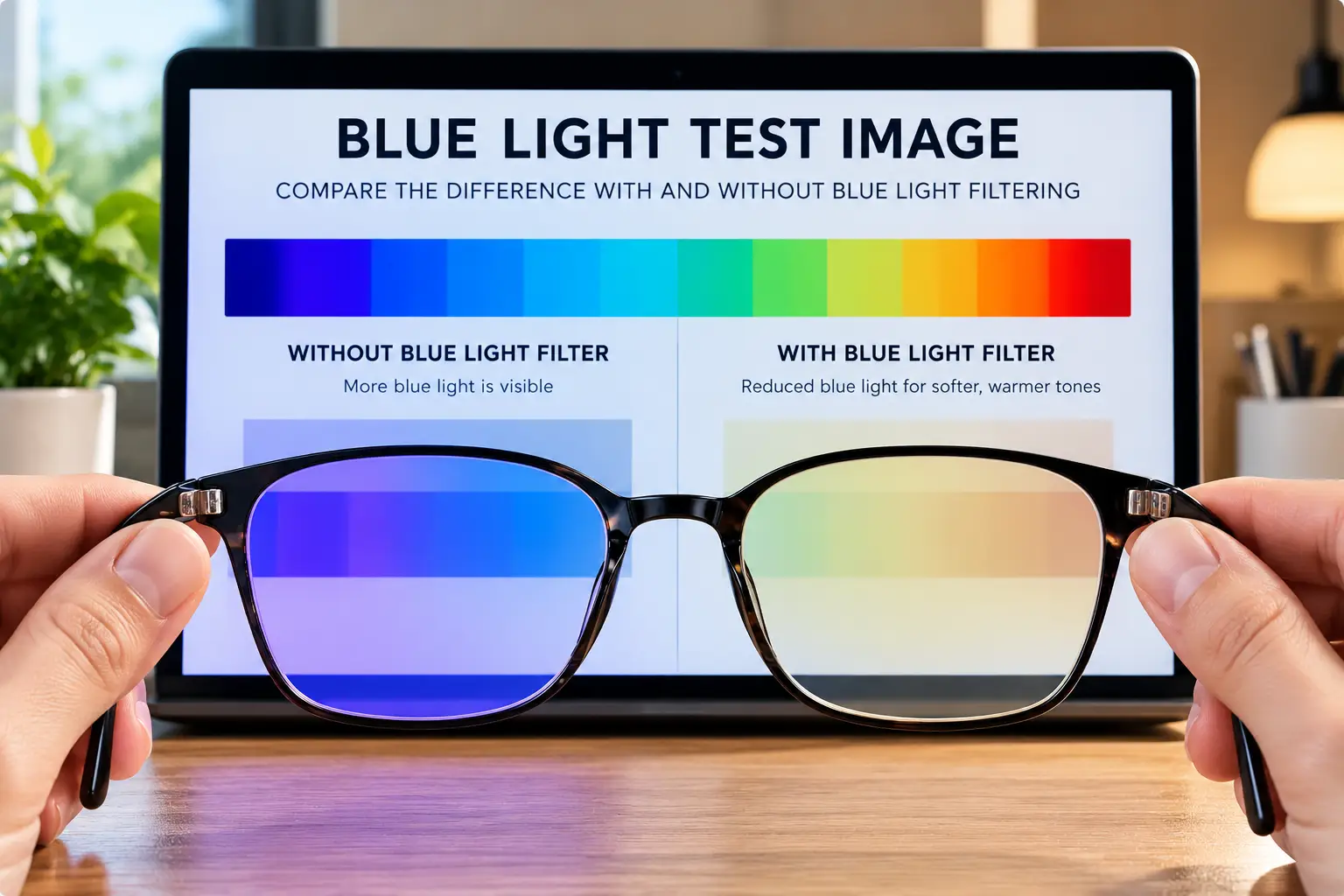
The idea is simple. Pull up an image with pure blue, green, and red areas, look at it without your glasses, then look again with them on. Lenses that genuinely filter blue light will make the blue areas look noticeably darker, duller, or even close to black. Lenses that only claim to filter blue light will leave that blue patch looking almost exactly the same.
That matters because the blue light glasses market is crowded with near-identical clear lenses, and there’s no single mandatory US standard defining what “blocks blue light” has to mean. Some lenses filter a sliver of the spectrum; others knock out nearly all of it. A blue light test image won’t give you a lab-grade percentage, but it instantly separates “barely filters anything” from “seriously filters,” which is the distinction most buyers actually need.
There’s a real reason people care, too. Research summarized by Harvard Health Publishing on blue light and sleep describes an experiment where blue light suppressed melatonin for roughly twice as long as green light of similar brightness. That’s why evening-focused buyers often want lenses that pass a blue light test image with flying colors, while daytime screen users usually prioritize color accuracy instead.
In this guide, you’ll learn exactly how a blue light glasses test works, what your results really mean, and which seven products (six pairs of glasses plus one serious measuring tool) make the most sense in 2026. We’ll be honest about the science, too — including where the evidence for blue light glasses is weaker than the marketing suggests.
What Is a Blue Light Test Image?
A blue light test image is a simple on-screen graphic — usually solid blue, green, and red blocks or overlapping RGB circles — used to check whether glasses filter blue light. Viewed through effective lenses, the blue sections look darker or nearly black, while weak filters leave blue largely unchanged.
Most versions are built on the RGB color model, the same red-green-blue system your monitor uses to create every color you see. Because a “pure blue” pixel on your screen is produced almost entirely by the display’s blue subpixels, it’s an ideal target: if your lenses remove blue wavelengths, there’s very little left for your eyes to see in that patch. That’s the whole trick, and it’s why the RGB blue light test is the most popular at-home method.
Quick Comparison: 7 Picks to Check With a Blue Light Test Image
| Product | Lens Type | Claimed Blue Filtering | What You’ll See on a Test Image | Price Range | Best For |
|---|---|---|---|---|---|
| Uvex Skyper S1933X | SCT-Orange | 98%+ (400–500 nm, per maker) | Blue goes near-black | Under $15 | Budget evening use |
| Night Swannies Classic | Orange | 99%+ (400–500 nm, per maker) | Blue goes near-black | Around $70–$120 | Stylish sleep routine |
| Gunnar Intercept (Amber) | Amber | 65% (GBLF 65) | Blue clearly dimmed | Around $50–$80 | Gamers, long sessions |
| Felix Gray Roebling | Near-clear | ~50% of full range (per maker) | Subtle dimming | Around $95–$150 | Office color accuracy |
| TIJN Blue Light Blocking Glasses | Clear | Not specified as a % | Little to slight change | Under $20 | Trying the category cheaply |
| TIJN Red Lens Blue Light Blocking Glasses | Red | Broad blue + blue-green | Blue and much green vanish | Budget tier | Late-night wind-down |
| Linshang LS108H | Meter (not glasses) | Measures transmittance | Gives numbers, not colors | A few hundred dollars | Verifying any lens |
Looking at the table, the pattern is obvious: the stronger the tint, the more dramatic the blue light test image result. The Uvex Skyper S1933X and Night Swannies Classic will both turn the blue patch almost black, while the Felix Gray Roebling and TIJN Blue Light Blocking Glasses trade visible results for natural color. The Linshang LS108H sits in its own category — it’s what you’d buy if you wanted numbers instead of an eyeball test.
💬 One click helps other shoppers make an informed choice too! 😊
Top 7 Blue Light Test Image Picks: Expert Analysis
1. Uvex Skyper S1933X — strongest filtering for the least money
The Uvex Skyper S1933X is the classic “does it actually work?” answer, and it passes a blue light test image more decisively than almost anything near its price. Honeywell’s SCT-Orange lens is specified to absorb more than 98% of blue light in the 400–500 nm range, which in practice means the blue patch on a test image turns dark and murky the moment you put these on.
It’s also ANSI Z87+ rated with an anti-fog coating and a ratcheting lens angle, because it’s genuinely industrial safety eyewear. That means it’s tougher than most fashion frames, and it wraps around your face to block light leaking in from the sides — something flat-front frames can’t do.
Based on comparing the specs, this is the right pick for anyone who wants maximum evening filtering on a tiny budget, or who wants to test whether blue light blocking helps their routine before spending more. It’s not for daytime color work: everything turns orange.
Reviews consistently report two things: the filtering is unmistakable (users note blue objects look greenish or dark) and the look is, frankly, “safety goggle.” Several reviewers also mention the whole world taking on a strong orange cast.
Pros:
- ✅ Filters nearly all blue light per published specs
- ✅ Wraparound shape blocks side light leakage
- ✅ Impact-rated and anti-fog for durability
Cons:
- ❌ Industrial look won’t suit everyone
- ❌ Heavy color distortion rules out daytime work
At typically under $15, the Uvex Skyper S1933X delivers the best filtering-per-dollar in this lineup by a wide margin.
2. Night Swannies Classic — sleep-focused filtering with real style
The Night Swannies Classic aims at the same job as the Uvex — serious evening filtering — but in a frame you’d actually wear in front of other people. Swanwick says its orange lenses block over 99% of blue light between 400 and 500 nm, based on third-party lab testing the brand cites.
The frames are acetate with spring hinges, and the lenses carry anti-glare coating on both sides. On paper, that double-sided anti-reflective layer matters more than it sounds: it cuts the distracting reflections you’d otherwise see from lamps behind you, which is a common complaint with cheap tinted lenses.
Here’s what to weigh: you’re paying several times more than the Uvex Skyper S1933X for similar filtering. What the extra money buys is design, comfort, and a fitover option for prescription wearers. If you’ll actually wear them nightly because they look good, that’s real value.
Customer sentiment is broadly positive on style and on making screen time feel calmer before bed; some reviewers note the standard size can sit over smaller prescription frames. Brand-affiliated SleepScore Labs data reports faster sleep onset, but it’s company-associated research, so treat it as encouraging rather than definitive.
Pros:
- ✅ Near-total filtering in a fashionable frame
- ✅ Double-sided anti-glare coating reduces reflections
- ✅ Fitover and prescription options available
Cons:
- ❌ Costs far more than equally strong safety glasses
- ❌ Orange tint still distorts colors heavily
Expect around $70–$120 depending on frame and lens option — fair value if style is what gets you to wear them.
3. Gunnar Intercept (Amber) — the balanced middle ground for gamers
The Gunnar Intercept (Amber) sits right in the middle of the filtering spectrum, and that’s exactly its appeal. Gunnar rates it GBLF 65, meaning the amber lens filters about 65% of blue light, plus 100% of UV.
On a blue light test image, expect the blue block to look clearly dimmer but not black. The lens is 58 mm wide, the frame weighs about 33 grams, and it uses anti-reflective coatings front and back. In everyday terms, that light weight matters for multi-hour sessions, where heavier frames start pressing on your nose.
What most buyers overlook with this model is the tint choice: the same frame comes in Clear (GBLF 35), Amber (GBLF 65), and Amber Max (GBLF 98). That makes it a smart pick if you want one familiar frame and plan to pick a tint by task. For gamers and coders who want contrast without a full orange world, Amber is the sweet spot.
Reviews generally describe the glasses as comfortable and helpful for long sessions, while a recurring theme is that the amber tint takes some getting used to. A few users mention lens reflections in certain lighting.
Pros:
- ✅ Meaningful filtering without extreme color shift
- ✅ Lightweight frame for long gaming sessions
- ✅ Multiple tint strengths in the same frame
Cons:
- ❌ Amber tint needs an adjustment period
- ❌ Prescription versions raise the cost significantly
At around $50–$80 for non-prescription versions, the Gunnar Intercept (Amber) offers solid mid-range value.
4. Felix Gray Roebling — near-clear lenses for color-accurate work
The Felix Gray Roebling is built for people who’d never wear orange lenses to a meeting. Instead of a coating that reflects blue light, Felix Gray says it embeds a filtering pigment into the lens itself.
The brand states its lenses filter over 50% of the full blue range and roughly 90% of the highest-energy wavelengths, and about 30% at 455 nm, a wavelength where screens emit a lot of blue. Translated: on a blue light test image, you’ll see subtle dimming, not dramatic darkening. The lens also blocks 100% of UVA/UVB and includes anti-glare coating.
Based on comparing the specs, this is a daytime office lens. Designers, photo editors, and anyone presenting on screens get comfort without the color distortion that makes amber or orange lenses unusable for that work. Just don’t expect it to pass a blue light test image the way an orange lens does — that’s not its job.
We couldn’t verify a robust set of aggregated customer reviews for this specific frame during research, so we’re not summarizing sentiment here. The filtering figures above are the brand’s own claims, not independent measurements.
Pros:
- ✅ Nearly clear lens preserves true colors
- ✅ Filtering built into the lens material
- ✅ Polished frame suits professional settings
Cons:
- ❌ Subtle results on a blue light test image
- ❌ Premium price for moderate filtering
At around $95–$150, the Felix Gray Roebling is worth it only if color accuracy and style top your list; check amazon.com for current frame availability.
5. TIJN Blue Light Blocking Glasses — the cheapest way to try the category
The TIJN Blue Light Blocking Glasses are among the most widely sold budget pairs on Amazon, offered in dozens of frame shapes and colors. They’re the default “I’ll try it” purchase.
The clear-lens versions use polycarbonate with UV400 protection and lightweight TR-90 frames on many models. What the listings don’t give you is a specific blue-filtering percentage — and that’s exactly why a blue light test image is so useful here. Expect little to slight change on the blue patch, which is typical for clear coated lenses.
Here’s the honest framing: these are a fine comfort and style purchase, and a cheap way to see whether you even like wearing glasses at a screen. They’re not the right choice if your goal is meaningfully cutting blue light at night. Independent lab work on clear coated lenses (covered later) found reductions in the range of roughly a quarter, not a majority.
Aggregated sentiment on budget blue light glasses like these is generally positive about price, comfort, and variety of styles, with recurring complaints about glare, frame fit, and lens quality. One third-party reviewer also noted a visible tint on some versions.
Pros:
- ✅ Very low price lowers buyer risk
- ✅ Huge range of frame styles and colors
- ✅ Lightweight frames for all-day wear
Cons:
- ❌ No published blue-filtering percentage
- ❌ Weak results on a blue light test image
At typically under $20, the TIJN Blue Light Blocking Glasses offer low-risk value as a starter or backup pair.
6. TIJN Red Lens Blue Light Blocking Glasses — maximum wind-down filtering
The TIJN Red Lens Blue Light Blocking Glasses take the opposite approach from the clear TIJN pair. The red-tinted lens is designed to filter a broader range of blue and blue-green light, creating a deep warm tone for evening screen use.
The listing specifies dual anti-reflective coatings, a 51-20-140 square frame with spring hinges, and a 41 mm lens height. Most tellingly, the maker itself warns the lenses aren’t suitable for driving or color-critical work. That honesty is useful: it tells you this is a bedtime tool, not an all-day lens.
On a blue light test image, red lenses usually do something orange lenses don’t: they darken the green patch too, because green sits close to the melatonin-sensitive part of the spectrum. Based on comparing lens types, that’s why some sleep-focused users prefer red over orange for the last hour before bed.
Verified review volume for this specific red-lens model was limited during our research, so we can’t responsibly summarize customer sentiment. What’s verifiable is the design intent and the maker’s own usage warnings.
Pros:
- ✅ Filters blue and much blue-green light
- ✅ Dual anti-reflective coatings cut glare
- ✅ Budget-friendly entry into red-lens filtering
Cons:
- ❌ Not suitable for driving or color work
- ❌ Limited verified customer feedback so far
Sitting in the budget tier, the TIJN Red Lens Blue Light Blocking Glasses are good value for anyone strictly focused on pre-sleep use.
7. Linshang LS108H — turn your guess into a measurement
The Linshang LS108H isn’t glasses at all — it’s a desktop light transmittance meter, and it’s the upgrade path once a blue light test image stops being precise enough.
Linshang describes the LS108H as a desktop instrument using ultraviolet, infrared, and visible light sources with a parallel light path design, so it can measure thicker materials like lenses and glass. It also features real-time self-calibration. In practice, you place a lens in the slot and get a percentage reading instead of a “looks darker to me” judgment.
One important caveat: the LS108H reports UV, visible, and IR transmittance, not a dedicated 400–500 nm blue number. Linshang lists a separate LS108 blue-violet tester specifically for eyeglass lenses, so if blue filtering is your only goal, compare both listings before buying. This tool makes sense for opticians, small eyewear sellers, reviewers, or very skeptical shoppers.
Consumer-level reviews are sparse because this is primarily professional equipment; we couldn’t verify aggregated sentiment, so we won’t invent any.
Pros:
- ✅ Gives numeric readings instead of visual guesses
- ✅ Handles thick materials like lenses
- ✅ Self-calibration supports repeatable results
Cons:
- ❌ Not a dedicated blue-band meter
- ❌ Overkill for a single pair of glasses
At a few hundred dollars (check the current price), the Linshang LS108H is only good value if you test lenses regularly.
Detailed Comparison of the Top 7
| Product | Weight / Build | UV Protection | Glare Control | Color Accuracy | Best For |
|---|---|---|---|---|---|
| Uvex Skyper S1933X | Wraparound polycarbonate, ANSI Z87+ | Yes | Anti-fog | Very low | Max filtering on a budget |
| Night Swannies Classic | Acetate, spring hinges | Yes | Double-sided AR | Very low | Nightly routine with style |
| Gunnar Intercept (Amber) | ~33 g, polymer | 100% UV | Front + back AR | Moderate | Gaming and coding |
| Felix Gray Roebling | Premium acetate | 100% UVA/UVB | AR coating | High | Design and office work |
| TIJN Blue Light Blocking Glasses | TR-90 (many models) | UV400 | Varies by model | High | First-time buyers |
| TIJN Red Lens Blue Light Blocking Glasses | Plastic, spring hinges | Not specified | Dual AR | Very low | Last hour before bed |
| Linshang LS108H | Desktop meter | Measures UV | N/A | N/A | Verifying any lens |
The trade-off here is almost perfectly linear: every step up in filtering strength costs you color accuracy. The Gunnar Intercept (Amber) is the only pick that lands in the middle on both, which is why it’s the safest “one pair for everything” choice. If you want two pairs, pairing the Felix Gray Roebling for daytime with the Uvex Skyper S1933X for evenings covers both needs for less than many single premium pairs.
How to Use a Blue Light Test Image: Step-by-Step
Here’s how to test blue light glasses at home properly — because a sloppy test gives you a misleading result.
Before you start
- ✅ Turn off Night Shift, Night Light, f.lux, or any “eye comfort” mode. These warm your screen and will make every lens look like it’s working.
- ✅ Set your screen brightness to around 70–100%. Dim screens hide differences.
- ✅ Turn off nearby warm lamps if you can; ambient light tints your perception.
Running the test
- Open a pure RGB image. Search for an RGB color circle or a simple red/green/blue block image. Full-screen it.
- Look without glasses for 10 seconds. Note how bright and saturated the blue looks.
- Put the glasses on and look at the same spot from the same distance. Don’t tilt your head; lens angles change reflections.
- Compare the blue patch, then the green patch. Strong filters darken blue dramatically; red and some orange lenses darken green too.
- Repeat with half-on glasses. Hold the glasses so one lens covers the blue area and the other side is bare. Seeing both at once makes the difference far easier to judge than switching back and forth.
Reading your results
- Blue goes black or very dark: strong filtering (orange/red territory).
- Blue looks clearly dimmer or slightly teal: moderate filtering (amber).
- Blue looks almost identical: weak filtering — typical of many clear lenses.
Common first-month mistakes
People often test once, in bad conditions, and draw a permanent conclusion. Others confuse a blue reflection on the lens surface with “proof” the glasses work — a reflection only shows a coating exists, not how much light gets through. Retest any new pair in the first week, ideally side by side with a pair you trust, like a cheap orange lens as your “control.”
Which Pair Fits Your Life? Three Real-World Scenarios
Scenario 1: The night-owl student (budget under $20, 3+ hours of screens after 9 p.m.) Maya studies late and scrolls after. Her priority is filtering, not looks, since she’s alone at her desk. The Uvex Skyper S1933X is the obvious fit: it delivers near-total filtering at the lowest price in this guide. If she later wants something she’ll wear on video calls, a clear backup like the TIJN Blue Light Blocking Glasses keeps the total spend tiny.
Scenario 2: The remote designer (budget around $150, 8 hours a day, color matters) Jordan edits photos and builds brand assets. Any orange tint makes his work wrong. The Felix Gray Roebling is the only pick here that preserves color while offering some filtering. He should accept that it will look modest on a blue light test image — and pair it with smart screen habits (breaks, brightness matched to the room) rather than expecting the lens to do everything.
Scenario 3: The competitive gamer (budget around $80, 4–6 hours most evenings) Alex wants contrast and comfort without turning the game into a sunset. The Gunnar Intercept (Amber) hits the balance at 65% filtering, and if Alex later decides late-night sessions need more, the same frame comes in Amber Max. For the final hour before sleep, adding the TIJN Red Lens Blue Light Blocking Glasses as a dedicated wind-down pair is a cheap upgrade.
The lesson across all three: match the lens to when you use screens, not just how much. Daytime work rewards clarity; nighttime use rewards stronger filtering.
✨ Don’t miss these carefully chosen picks!
🔍 Take your screen setup to the next level with this curated lineup. Click a highlighted product to check current pricing and availability — the right pair can make your evenings feel calmer and your workdays easier on the eyes!
Problem → Solution: When Your Blue Light Test Image Results Look Wrong
Problem 1: “My expensive clear glasses barely change the blue patch.” That’s usually accurate, not a broken test. Clear lenses filter a minority of blue light. If you bought them for sleep, switch to an orange option like the Night Swannies Classic for evenings and keep the clear pair for daytime.
Problem 2: “Every pair I try seems to work.” Check your display settings — a warm screen mode makes everything look filtered. Disable it and retest at high brightness.
Problem 3: “The blue patch looks purple, not dark.” Some screens produce blue with a bit of red mixed in. Try a second test image and compare against a trusted orange lens like the Uvex Skyper S1933X as a reference.
Problem 4: “The blue light test card says they work, but the screen test says they don’t.” Many blue light test card and pen kits use a violet beam near 405 nm. As one manufacturer guide points out, a lens can block that violet light well while doing much less against typical screen blue. Trust the screen test for screen-use questions.
Problem 5: “I want a real number, not my eyes’ opinion.” Ask the seller for a spectral transmittance report, or use a meter like the Linshang LS108H — understanding its band limitations.
How to Choose Blue Light Glasses Using a Blue Light Test Image
Choosing well comes down to matching filtering strength to your real goal. Follow these steps:
- Define the goal first. Sleep wind-down needs strong orange or red filtering; daytime comfort favors clear or amber. Mixing these up is the most common buying error.
- Ask for numbers with a wavelength range. “Blocks 90%” means nothing without “of 400–450 nm” or “of 400–500 nm” attached. Range matters as much as percentage.
- Run a blue light test image the day the glasses arrive. It’s your free verification inside the return window.
- Check the coating, not just the tint. Anti-reflective coating on both sides reduces glare, which affects comfort as much as filtering does.
- Consider fit and weight. A 33-gram frame like the Gunnar Intercept (Amber) feels very different from heavier acetate after four hours.
- Match color accuracy to your job. Designers and editors should avoid strong tints during work hours.
- Budget for two pairs if needed. One clear daytime pair plus one cheap orange evening pair often beats a single expensive compromise.
Independent measurements back up step 2. A peer-reviewed analysis of blue light transmission through spectacle lenses found that clear lenses with a blue-blocking coating cut transmission across 400–500 nm by roughly a quarter compared with standard lenses — a real but modest effect, and exactly the kind of difference that looks subtle on a blue light test image.
Blue Light Test Image vs Blue Light Test Card vs Spectrum Report
Each blue light filter test answers a slightly different question, and confusing them is how people end up with misleading conclusions.
A blue light test image shows how your lenses affect the actual light your screen emits. That’s its big strength: it tests the real-world scenario. Its weakness is subjectivity — your eyes adapt, and screens differ.
A blue light test card (often bundled with a small violet flashlight) is great for demos. Shine the beam through the lens and the card’s fluorescent area stays dark if the light is blocked. The catch: those beams typically sit near 405 nm, at the violet edge of the spectrum, so they mostly prove UV/violet protection rather than screen blue protection.
A spectrum report is a graph of transmittance across wavelengths, usually from a spectrophotometer. It’s the most objective option, but it depends on trusting whoever produced it.
| Method | Cost | What It Proves | Accuracy | Best For |
|---|---|---|---|---|
| Blue light test image | Free | Effect on real screen light | Low–moderate | Everyone, first check |
| Blue light test card + pen | Low | Violet/near-UV blocking | Narrow | Quick demos |
| Spectrum report | Free if provided | Full wavelength profile | High | Comparing brands |
| Meter (e.g., Linshang LS108H) | A few hundred dollars | Numeric transmittance | High (within its bands) | Pros, frequent testers |
The smartest approach is layering: run the free blue light test image first, then ask for a spectrum report before paying premium prices. Test cards are fine for fun, but they shouldn’t be your deciding factor for screen glasses.
Features That Actually Matter (and Ones That Don’t)
Matters: the wavelength range of filtering. Blue light spans roughly 400–500 nm. A lens strong at 400–420 nm but weak at 450–480 nm may look impressive on a pen test and disappointing on a blue light test image, since screens emit heavily in the 450s.
Matters: tint strength for your timing. Orange and red lenses suit evenings; clear and amber suit work hours. This single choice determines more of your experience than brand does.
Matters: anti-reflective coating. Reflections from overhead lights and windows are a well-known contributor to screen discomfort. Double-sided AR coating, as on the Night Swannies Classic and Gunnar Intercept (Amber), is worth paying for.
Matters: fit and weight. Glasses you take off after 40 minutes filter nothing.
Doesn’t matter much: a dramatic blue reflection on the lens. That purple-blue sheen shows a coating exists, not how effective it is.
Doesn’t matter much: vague “medical” language. Phrases like “doctor recommended” without specifics tell you nothing measurable.
Doesn’t matter much: the included test card. It’s a demo tool; your own blue light test image is more relevant to screen use.
Matters more than people think: UV protection. Indoors it’s minor, but if you’ll wear the glasses outside, UV400 coverage is a genuine plus.
Common Mistakes to Avoid When Buying Blue Light Glasses
Mistake 1: Buying clear lenses for sleep. If your main concern is evening light, a clear pair will likely disappoint. Orange or red is the tool for that job.
Mistake 2: Skipping the arrival test. Amazon’s return window is your safety net. Run a blue light test image in the first days, not after the window closes.
Mistake 3: Trusting percentages without wavelengths. “99% blue light blocked” may refer to a narrow violet band. Always ask “across what range?”
Mistake 4: Testing with Night Shift on. It’s the single most common reason a blue light glasses test gives a false positive.
Mistake 5: Expecting glasses to fix eye strain alone. Digital eye strain is driven heavily by focusing effort, reduced blinking, glare, and posture. The 20-20-20 habit (every 20 minutes, look 20 feet away for 20 seconds) costs nothing.
Mistake 6: Wearing strong tints while driving. Orange and red lenses distort traffic-signal colors. The maker of the TIJN Red Lens Blue Light Blocking Glasses explicitly warns against driving with them.
Mistake 7: Overpaying for filtering you can get cheaper. If raw filtering is the goal, the Uvex Skyper S1933X matches or approaches premium orange lenses for a fraction of the price.
Long-Term Cost and Maintenance
Blue light glasses aren’t a one-time purchase in practice. Coatings wear, frames loosen, and many people end up owning two pairs.
Cost over two years (non-prescription, estimated):
| Setup | Upfront Range | Likely Replacements | Two-Year Range | Best For |
|---|---|---|---|---|
| Uvex Skyper S1933X only | Under $15 | Maybe 1 | Under $30 | Pure evening filtering |
| TIJN Blue Light Blocking Glasses + Uvex Skyper S1933X | Under $35 | 1 | Around $35–$70 | Day + night on a budget |
| Gunnar Intercept (Amber) | Around $50–$80 | Rarely | Around $50–$100 | One-pair balance |
| Felix Gray Roebling + Night Swannies Classic | Around $165–$270 | Rarely | Around $165–$300 | Premium day + night |
The budget combos win on value, but the premium pairs tend to hold up longer and look better, which affects whether you actually wear them. For most people, the second row — a cheap clear daytime pair plus a cheap orange evening pair — is the best cost-to-benefit setup.
Maintenance tips that protect coatings:
- ✅ Rinse lenses with lukewarm water before wiping to remove grit.
- ✅ Use a microfiber cloth; paper towels and shirts scratch AR coatings.
- ✅ Avoid household glass cleaners with ammonia, which can degrade coatings.
- ✅ Store in a case, never lens-down on a desk.
- ✅ Re-run a blue light test image every few months; heavy scratching can affect clarity and comfort.
Safety, Evidence, and Standards
It’s worth being clear about what the science says, because marketing often runs ahead of it.
The most rigorous summary so far is a 2023 Cochrane systematic review on blue-light filtering spectacle lenses, which pooled randomized controlled trials and concluded that these lenses may not reduce short-term eye strain from computer use compared with standard lenses. Effects on sleep were unclear, and there was no evidence that they protect the retina. The review covered 17 trials, and its authors called for better long-term studies.
So why buy them at all? Because “unclear” isn’t “disproven,” and the mechanism for evening light affecting melatonin is well established in sleep research. Strong orange and red lenses filter far more than the clear lenses most trials studied, so many buyers reasonably treat them as a low-risk, low-cost evening experiment. Just keep expectations realistic.
Standards and regulations to know (US):
- ANSI Z87.1: the impact standard for safety eyewear. The Uvex Skyper S1933X carries the Z87+ high-impact mark — useful if you’ll also wear them for DIY or yard work.
- FDA registration: non-prescription eyewear sellers may register as medical device importers. Registration is not FDA approval of effectiveness — an important distinction when reading listings.
- No mandatory “blue light blocking” definition: there’s no federal standard defining how much a lens must filter to use the phrase, which is exactly why independent checks like a blue light test image matter.
- Driving: strongly tinted lenses can distort signal colors; avoid them behind the wheel, especially at night.
If you have ongoing eye discomfort, headaches, or vision changes, see an optometrist or ophthalmologist. Uncorrected vision, dry eye, and focusing problems are common, treatable causes that no filter will fix.
FAQs
❓ Can a blue light test image tell me the exact percentage blocked?
❓ Are cheap blue light glasses on Amazon worth buying?
❓ Which blue light glasses pass the RGB blue light test best?
❓ Do blue light glasses work over contact lenses?
❓ Should I buy a blue light test card kit before buying glasses?
Conclusion
A blue light test image is the simplest consumer-protection tool in the blue light glasses world: free, fast, and surprisingly revealing. In 30 seconds it tells you whether your lenses are serious filters or mostly a coating with good marketing — and that’s information most product listings won’t give you clearly.
The right pick depends on when you use screens. For evening filtering on a budget, the Uvex Skyper S1933X is hard to beat. If you want the same strength in a frame you’ll happily wear, the Night Swannies Classic delivers. Gamers and long-session coders will find the best all-around balance in the Gunnar Intercept (Amber), while designers who can’t tolerate tint should look at the Felix Gray Roebling. First-time buyers can start cheaply with the TIJN Blue Light Blocking Glasses, night owls can add the TIJN Red Lens Blue Light Blocking Glasses, and anyone testing lenses regularly can graduate to the Linshang LS108H.
Whatever you choose, keep expectations honest: current research doesn’t show that blue light filtering alone fixes eye strain, and the evidence on sleep is still unsettled. Combine the right lenses with smart habits — warmer screens at night, regular breaks, and an eye exam when symptoms persist — and test every new pair the day it arrives.
🚀 Ready to see the difference for yourself?
👓 Pick the pair that fits your routine, run the blue light test image the moment it arrives, and enjoy screen time that feels a lot more comfortable. Click a highlighted product to check current pricing and availability!
Recommended for You
- Blue Cosplay Contacts 2026: 7 Smart Picks for Safe, Stunning Eyes
- Black Prescription Contacts: 7 Safe & Legal Picks for 2026
- Titanium Reading Glasses: 7 Best Lightweight Picks for 2026
Disclaimer: This post contains affiliate links. As an Amazon Associate, I earn from qualifying purchases made through these links, at no additional cost to you.
✨ Found this article helpful? Share it with someone who needs it! 💬🤗