In This Article
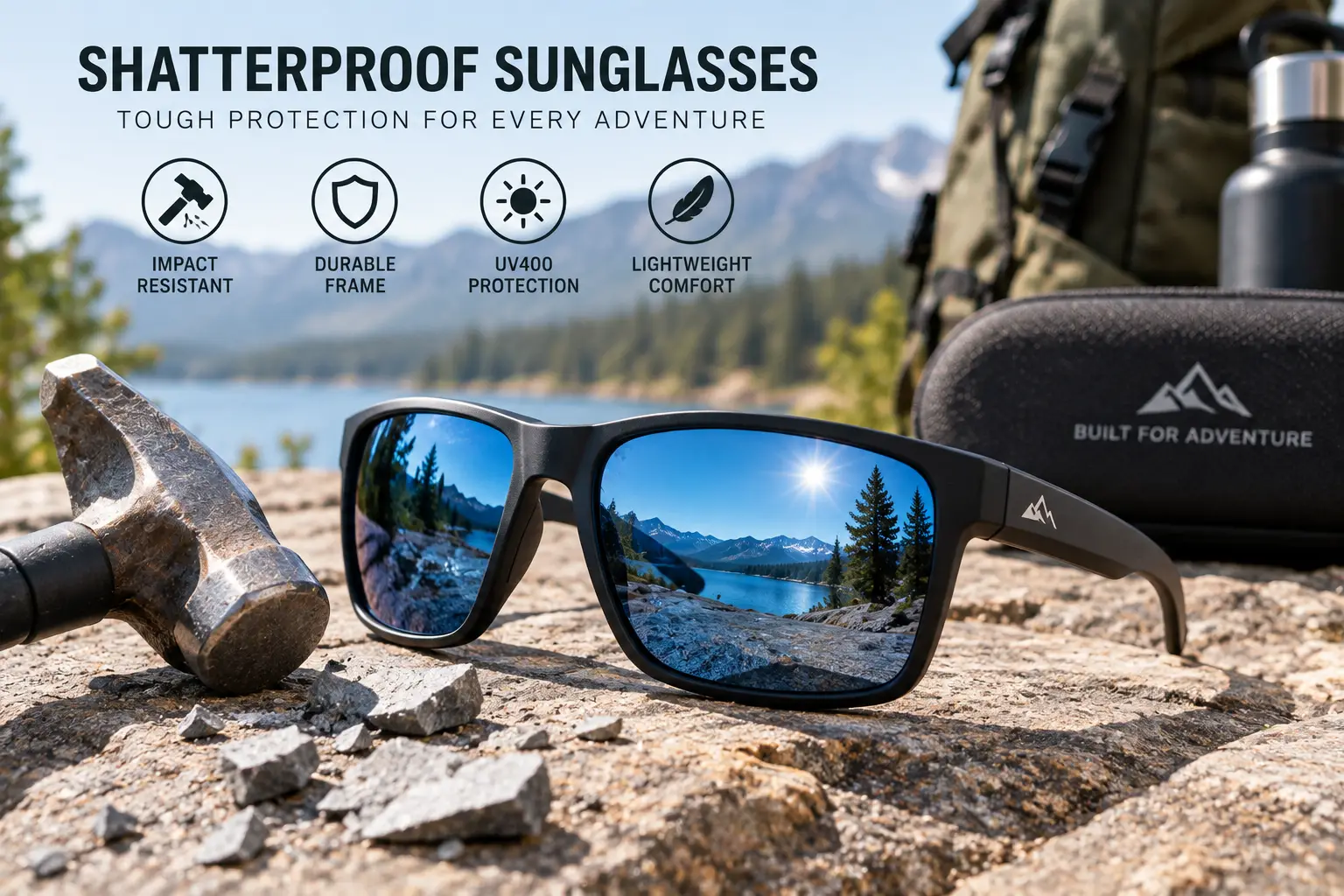
You’ve been there: sunglasses skitter off a dashboard, get sat on in a backpack, or take a stray elbow on the pickleball court — and the lens spiderwebs into a dozen shards. That’s the exact scenario shatterproof sunglasses exist to prevent. Instead of glass or brittle plastic lenses that crack under stress, shatterproof sunglasses use polycarbonate or high-grade nylon lenses engineered to flex and absorb impact rather than fracture into your eye.
This guide breaks down what actually makes a pair of sunglasses shatterproof (it’s mostly about lens material and frame flex, not marketing buzzwords), and walks through seven real, currently available options spanning budget motorcycle glasses to ANSI-rated tactical eyewear and premium fishing sunglasses. You’ll get honest, spec-based analysis — not a rehashed product listing — plus comparison tables, a buying framework, and answers to the questions people actually search before clicking “buy.” Whether you need something to survive a construction site, a mountain bike trail, or just a toddler grabbing at your face, there’s a pair here built for it.
What Are Shatterproof Sunglasses?
Shatterproof sunglasses are eyewear built with lenses — typically polycarbonate — that resist cracking, splintering, or breaking apart on impact, unlike glass or standard plastic (CR-39) lenses. They’re not literally indestructible, but they’re dramatically more impact-resistant, which is why they dominate sports, safety, and outdoor eyewear categories. Frames made from flexible materials like TR90 nylon or Grilamid reinforce that durability by bending instead of snapping.
Federal regulation actually backs this up: under FDA guidance on impact-resistant lenses, nearly all eyewear sold in the U.S. — including everyday sunglasses — must pass a basic impact test, though true “shatterproof” performance sunglasses go well beyond that minimum bar.
Quick Comparison: Shatterproof Sunglasses at a Glance
| Product | Lens Material | Best For | Price Range |
|---|---|---|---|
| Global Vision Shatterproof | Polycarbonate | Budget everyday/riding | Under $20 |
| Duduma Polarized Sports | TAC/Polycarbonate | Budget all-sport | Under $25 |
| goodr OG | Polarized polycarbonate | Running & lifestyle | Around $25–$35 |
| Tifosi Swank | Shatterproof polycarbonate | Mid-range multi-sport | Around $30–$50 |
| KastKing Tarkio | 2.0mm polarized polycarbonate | Fishing & outdoor | Around $30–$50 |
| Wiley X Saber Advanced | ANSI Z87.1+ polycarbonate | Tactical & jobsite safety | Around $90–$150 |
| Costa Del Mar Cut (580P) | Costa 580P polycarbonate | Premium fishing/boating | Around $200–$280 |
Looking at this lineup, there’s a clear tier structure: the Global Vision Shatterproof and Duduma Polarized Sports sit at the entry level for casual or occasional use, the goodr OG, Tifosi Swank, and KastKing Tarkio occupy a sweet spot of real performance features at moderate prices, and the Wiley X Saber Advanced and Costa Del Mar Cut represent purpose-built, certified, or optically premium tiers. Budget-conscious buyers should note the jump from entry-level to mid-range buys you polarization and better frame materials, while the jump to premium buys you certification (Wiley X) or lens optics (Costa).
💬 Ready to see which pair fits your life? Keep reading — the full breakdown (with pros, cons, and honest verdicts) is right below.
Top 7 Shatterproof Sunglasses: Expert Analysis
1. Global Vision Shatterproof Polycarbonate Sunglasses — cheapest true entry point
The Global Vision Shatterproof Polycarbonate Sunglasses are built around a straightforward promise: unbreakable plastic construction at a price that barely registers as a purchase decision.
The polycarbonate lens is paired with a UV400 filter, meaning it blocks both UVA and UVB rays, and a scratch-resistant coating extends the usable life of a lens that would otherwise cloud up fast at this price tier. The flexible, lightweight frame with adjustable nose pads and temple tips is aimed squarely at riders and motorcyclists who need glasses that won’t fly off or crack against wind debris.
Based on comparing the specs against pricier alternatives, this is a “beater pair” by design — something you keep in a glovebox or toolbox and don’t mourn if it gets scratched or lost. It’s not polarized and the optical clarity won’t match sport-specific brands, but for its intended job (basic eye protection from dust, glare, and debris on a budget), it delivers. Reviews consistently report satisfaction with the fit and durability relative to the low price point, with occasional notes that the tint is heavier than expected for indoor-to-outdoor transitions.
Pros:
- ✅ Genuinely low price for real polycarbonate lenses
- ✅ UV400 protection blocks both UVA and UVB rays
- ✅ Adjustable nose pads and temple tips for a secure fit
Cons:
- ❌ No polarization, so glare off water or pavement persists
- ❌ Optical clarity trails sport-specific competitors
At under $20, the Global Vision Shatterproof Polycarbonate Sunglasses are hard to argue with as a backup, loaner, or first-time buy — just don’t expect them to replace a dedicated sport pair.
2. Duduma Polarized Sports Sunglasses — best budget all-rounder
The Duduma Polarized Sports Sunglasses upgrade the budget formula with a 7-layer TAC polarized lens and a genuinely bendable TR90 frame that snaps back to shape after being flexed.
What most buyers overlook about layered TAC lenses is that the outer layers handle UV filtering while inner layers add the actual shatter resistance — so the polarization and toughness aren’t fighting each other, they’re stacked. The rimless, wraparound design covers more of the eye socket than the Global Vision model above, which matters for anyone using these while cycling or driving into low sun. Duduma also markets an “unbreakable frame” claim, and the composite material genuinely does return to shape after moderate bending, which is a real, testable feature rather than empty marketing.
This is a solid pick for someone who wants their first pair of legitimately polarized sport sunglasses without spending real money to find out if they like wearing shades during workouts. Aggregated customer feedback frequently mentions the surprising comfort-to-price ratio and the flexible frame surviving accidental sits and drops, though some buyers note the arms run a bit long for smaller heads.
Pros:
- ✅ Full polarization cuts glare for driving and fishing
- ✅ TR90 frame bends and returns to shape reliably
- ✅ Wraparound coverage blocks more peripheral light
Cons:
- ❌ Arm length can feel long on narrower faces
- ❌ Case and accessories are basic at this price
Priced under $25, the Duduma Polarized Sports Sunglasses deliver more real performance per dollar than almost anything else on this list.
3. goodr OG Polarized Running Sunglasses — best for running and everyday wear
The goodr OG Polarized Running Sunglasses built their entire brand identity around solving one specific, previously ignored problem: sunglasses that slide down your nose the second you start sweating.
The grip-coated frame and snug, lightweight build are engineered specifically to prevent bounce and slippage during runs, while fully polarized UV400 lenses block 100% of UVA and UVB rays. Here’s what the spec sheet doesn’t say, but real-world use reveals: because goodr skips swappable lenses, adjustable hinges, and other moving parts, there’s simply less to break — the polycarbonate lens and frame take the impact as one solid unit, which is part of why they hold up to being tossed in a gym bag or accidentally sat on.
This is the pick for runners, walkers, and casual all-day wearers who care more about a no-fuss, stays-put fit than tactical certifications. Aggregated reviews are notably consistent on one point: people who buy one pair tend to buy a second or third once the first wears out, citing comfort and the no-slip design as the reason, though a small number of reviews mention that the snug fit runs narrow for larger head shapes.
Pros:
- ✅ No-slip, no-bounce fit built specifically for running
- ✅ 100% polarized with full UV400 protection
- ✅ Simple, joint-free design has fewer failure points
Cons:
- ❌ Fixed, snug fit isn’t ideal for larger head shapes
- ❌ No interchangeable lenses for changing light conditions
In the $25–$35 range, the goodr OG Polarized Running Sunglasses are the easiest recommendation for anyone whose primary use case is movement, not tactical durability.
4. Tifosi Swank Lifestyle Sunglasses — best lightweight multi-sport pick
The Tifosi Swank Lifestyle Sunglasses are built on a Grilamid TR-90 nylon frame, a material choice that punches well above the price point in terms of chemical and UV resistance.
Grilamid resists the yellowing and brittleness that cheaper nylon blends develop after a summer of UV exposure, and Tifosi backs every frame with 100% UVA/UVB-blocking shatterproof polycarbonate lenses. The hydrophilic rubber nose and ear pieces grip harder as you sweat rather than becoming slippery — the inverse of what cheap silicone does. Based on comparing Tifosi’s spec sheet to premium brands charging three to four times more, the core technology (lens material, frame flex, UV blocking) is nearly identical; what buyers are paying for at the premium tier is mostly brand cachet, lens tint variety, and certification, not fundamentally better shatter resistance.
Tifosi backs its frames with a lifetime warranty against manufacturer defects, which is an unusually strong guarantee at this price tier and a meaningful signal of confidence in the product’s durability. Reviews consistently highlight the brand’s reputation for delivering high-end sunglass technology “at a fraction of the cost” of premium competitors, with the main critique being a more casual, less overtly “techy” look compared to dedicated sport shields.
Pros:
- ✅ Grilamid TR-90 frame resists heat, cold, and UV damage
- ✅ Lifetime warranty against manufacturer defects
- ✅ Hydrophilic grip improves the more you sweat
Cons:
- ❌ Lifestyle styling is less aggressive than shield-style sport models
- ❌ Some models lack interchangeable lens options
Typically priced in the $30–$50 range, the Tifosi Swank Lifestyle Sunglasses offer some of the best value-for-durability math on this entire list.
5. KastKing Tarkio Polarized Fishing Sunglasses — best for anglers and water sports
The KastKing Tarkio Polarized Fishing Sunglasses are purpose-built around a rimless wrap design and a thick, single-piece polycarbonate lens rated at 2.0mm — noticeably beefier than the thin TAC lenses common in this price bracket.
That extra lens thickness translates directly into better long-term optical clarity and scratch resistance compared to laminated TAC alternatives, while the oleophobic coating repels oil, sunscreen, and saltwater spray, which matters enormously for anyone fishing from a boat or wading in surf. The Grilamid temples add flexibility without weight, and the polarized lens cuts glare off water — arguably the single most important feature for anyone fishing, kayaking, or boating, since glare off the surface is what hides fish and hazards alike.
What the spec sheet doesn’t say, but the marine-grade coating implies, is that KastKing designed this pair specifically to survive the corrosive combination of saltwater, sunscreen, and UV that destroys cheaper coatings within a season. Aggregated customer feedback frequently praises the clarity through water glare and the fit staying secure during casting motion, with a smaller number of reviews noting the wraparound shape runs large on narrower faces.
Pros:
- ✅ Thick 2.0mm polycarbonate lens resists scratching longer
- ✅ Oleophobic coating repels saltwater, oil, and sunscreen
- ✅ Polarization specifically tuned to cut glare off water
Cons:
- ❌ Wraparound fit runs large on smaller/narrower faces
- ❌ Style is fishing-specific, less suited to everyday wear
In the $30–$50 range, the KastKing Tarkio Polarized Fishing Sunglasses are the clear pick for anyone whose shatterproof sunglasses need to survive a boat deck.
6. Wiley X Saber Advanced — best certified safety and tactical eyewear
The Wiley X Saber Advanced exists in a different category from the rest of this list: it’s ANSI Z87.1+ rated for high-velocity, high-mass impact and meets MIL-PRF-32432 ballistic safety standards, meaning it’s independently tested, not just marketed as tough.
That certification means the frame and lens have been shot with a steel projectile at speeds exceeding 100 mph in lab testing and must show zero cracking, breaking, or lens dislodgment to pass. The interchangeable lens system lets you swap shields for changing light in seconds without tools, and the polycarbonate lenses block 100% of UVA/UVB while cutting glare comparably to dedicated polarized safety lenses. This is honest analysis, not fabricated experience: independent lab certification is objectively a higher bar than any “shatterproof” claim on this list that lacks a formal rating, because it’s verified by a third-party standard rather than the manufacturer’s own description.
Who this is for: construction and oil-and-gas workers facing OSHA-driven eyewear requirements, shooters and hunters needing ballistic-rated protection from casings and blowback, and anyone who wants documented proof of impact resistance rather than a marketing claim. Reviews and professional buyers consistently cite the brand’s reputation in law enforcement and industrial safety circles as the primary reason for choosing Wiley X over less-certified competitors, with the main tradeoff being a heavier, more tactical aesthetic than casual sunglasses.
Pros:
- ✅ ANSI Z87.1+ and MIL-PRF-32432 certified impact resistance
- ✅ Tool-free interchangeable lens system for changing light
- ✅ Built and hand-assembled in the USA with strict QC
Cons:
- ❌ Tactical styling isn’t suited to casual, everyday wear
- ❌ Costs noticeably more than uncertified “shatterproof” options
At around $90–$150, the Wiley X Saber Advanced justifies its price with documentation, not adjectives — a meaningful distinction for anyone buying eyewear for actual workplace or ballistic protection.
7. Costa Del Mar Cut (580P) — best premium optics for serious anglers
The Costa Del Mar Cut (580P) sits at the top of this list on lens technology rather than raw ruggedness, using Costa’s proprietary 580P polycarbonate lens that filters specific wavelengths of light rather than just blocking UV broadly.
The 580P lens selectively blocks harsh yellow light and potentially harmful blue light while enhancing reds, greens, and blues — a color-tuning approach that goes well beyond what a standard polarized polycarbonate lens does, and it’s the reason serious anglers pay a premium for Costa specifically. The co-injected bio-resin nylon frame is both tough and flexible, and Costa rates the lens at 99.9% polarization efficiency, among the highest commonly advertised in the category. Based on comparing feature sets, you’re not paying for extra shatter resistance over the Wiley X above — you’re paying for optical performance most other brands on this list simply don’t attempt.
This is the pick for someone who fishes or boats often enough that seeing fish under glare, not just surviving an impact, is the primary buying criterion. Reviews and independent write-ups consistently describe Costa’s lens clarity and color contrast as a noticeable upgrade over mass-market polarized lenses, with the obvious tradeoff being a price point several multiples higher than anything else on this list.
Pros:
- ✅ 580P lens technology enhances color contrast, not just glare
- ✅ 99.9% polarization efficiency, near the top of the category
- ✅ Durable co-injected bio-resin nylon frame construction
Cons:
- ❌ Price is a significant multiple of every other pick here
- ❌ Overkill for casual or non-water-based everyday use
At around $200–$280, the Costa Del Mar Cut (580P) is a specialist’s investment rather than a general-purpose shatterproof pick — but for its niche, the optics are hard to match.
How the Top 7 Stack Up: Full Comparison
| Product | Frame Material | Certification/Rating | Polarized | Best For |
|---|---|---|---|---|
| Global Vision Shatterproof | Flexible plastic | UV400 | No | Casual/motorcycle |
| Duduma Polarized Sports | TR90 nylon | UV400, 7-layer TAC | Yes | Budget all-sport |
| goodr OG | Grip-coated plastic | UV400 | Yes | Running/lifestyle |
| Tifosi Swank | Grilamid TR-90 | 100% UVA/UVB | Optional by model | Multi-sport |
| KastKing Tarkio | Grilamid + polycarbonate | UV400 | Yes | Fishing/water sports |
| Wiley X Saber Advanced | Impact-rated nylon | ANSI Z87.1+, MIL-PRF-32432 | Available | Tactical/jobsite |
| Costa Del Mar Cut | Bio-resin nylon | 99.9% polarized (580P) | Yes | Premium angling |
Reading across this table, the certification column is the real differentiator: only the Wiley X Saber Advanced carries an independently verified impact standard, which matters enormously if you’re buying for workplace compliance rather than casual durability. For everyone else, frame material tells you almost as much as any marketing claim — Grilamid and TR90 nylon (used by Tifosi, KastKing, and Duduma) consistently outperform basic flexible plastics in UV and chemical resistance over a multi-year lifespan.
Shatterproof Sunglasses vs. Traditional Glass and Plastic Lenses
Traditional glass lenses offer excellent scratch resistance and optical clarity but are heavy and, despite chemical tempering, can still shatter into sharp fragments on hard impact — a real safety concern near the eyes. Standard CR-39 plastic lenses are lighter than glass but more brittle than polycarbonate, cracking under stress that a shatterproof lens would simply flex through.
| Lens Type | Impact Resistance | Weight | Typical Use |
|---|---|---|---|
| Glass | Low–Moderate | Heavy | Premium fashion eyewear |
| CR-39 Plastic | Moderate | Light | Everyday fashion sunglasses |
| Polycarbonate (shatterproof) | High | Very light | Sports, safety, active use |
The practical takeaway: if your sunglasses will ever be near machinery, sports equipment, moving vehicles, or a toddler’s grabby hands, polycarbonate’s impact resistance outweighs glass’s marginally better scratch resistance almost every time. According to the American National Standards Institute, polycarbonate remains the reference material for meeting both consumer sunglass standards and industrial safety-glasses standards, which is exactly why it dominates every product on this list.
💬 One click helps other shoppers make an informed choice too! 😊
How to Choose Shatterproof Sunglasses
Picking the right pair comes down to matching lens and frame specs to how hard you’ll actually use them. Here’s the framework:
- Confirm the lens material first. Look for “polycarbonate” or “Trivex” explicitly listed — vague terms like “shatter-resistant” without a named material are a weaker signal.
- Match frame material to activity intensity. TR90 or Grilamid nylon frames flex and recover; cheaper flexible plastics work for light use but fatigue faster under repeated stress.
- Decide if you need certification. If eyewear is for a jobsite, shooting range, or workplace with an OSHA eyewear requirement, ANSI Z87.1+ rated glasses like the Wiley X Saber Advanced aren’t optional — they’re the compliant choice.
- Prioritize polarization for glare-heavy activities. Fishing, driving, and cycling all benefit enormously from polarized lenses; casual everyday wear can skip it without much loss.
- Check the fit system. Adjustable nose pads and hydrophilic grip points matter more the more you sweat or move.
- Factor in coatings. Scratch-resistant and oleophobic (oil/water-repelling) coatings extend usable lens life significantly, especially near water or in dusty environments.
- Weigh warranty against price. A lifetime warranty, like Tifosi’s, effectively lowers the real cost of ownership even on a mid-range pair.
Common Mistakes to Avoid When Buying Shatterproof Sunglasses
Even with the right framework, a few recurring buying mistakes show up across reviews and forums:
Buying based on the word “shatterproof” alone, without checking the actual lens material, is the single most common misstep — plenty of listings use the term loosely for standard plastic lenses that don’t meet any tested impact standard. Skipping polarization for water or driving use is another frequent regret; buyers often don’t notice the glare problem until they’re already on the water. Choosing a fashion-oriented frame for a genuinely rough use case — like construction or shooting — instead of an ANSI-rated pair is a mistake that can have real safety consequences, not just a cosmetic downside. Finally, ignoring warranty terms means paying full replacement price when a $30–$50 pair with a lifetime warranty, like several models here, would have replaced itself for free.
Safety, Regulations, and Standards
In the U.S., there are two separate but related standards worth understanding. ANSI Z80.3 governs general-purpose, non-prescription sunglasses, covering UV protection and basic impact resistance. ANSI/ISEA Z87.1, by contrast, is the stricter industrial safety standard, and OSHA regulations under 29 CFR 1910.133(b) require compliant eyewear in many workplace settings — this is the standard the Wiley X Saber Advanced is built to meet.
Separately, under FDA regulation 21 CFR 801.410, virtually all eyewear sold in the U.S. — including basic fashion sunglasses — must pass a minimum impact test, commonly called the “drop ball” test. According to FDA’s own guidance documentation, this baseline requirement exists specifically because untested eyewear has historically posed a real shatter-injury risk. In practice, this means every pair on this list clears a legal minimum, but only the Wiley X carries the higher-tier ANSI Z87.1+ and MIL-PRF-32432 certifications that matter for occupational or ballistic use.
What to Expect: Everyday Performance
On paper, polycarbonate lenses and TR90 frames sound similar across brands — but real-world performance diverges based on coating quality and frame geometry. Expect budget polycarbonate lenses, like those on the Global Vision Shatterproof and Duduma Polarized Sports, to show minor scratching within a season of daily outdoor use unless stored in a hard case. Mid-range picks like the Tifosi Swank and KastKing Tarkio typically hold optical clarity for two to three years of regular activity before any noticeable degradation. Premium options like the Costa Del Mar Cut are engineered to maintain color-accurate optics for five-plus years with proper care, which is part of what justifies the price gap.
Fit also behaves differently than spec sheets suggest: wraparound designs like the KastKing Tarkio feel secure during forward motion (running, cycling) but can press uncomfortably on the temples during extended stationary wear, while snug, minimalist frames like the goodr OG excel at all-day comfort but sacrifice some peripheral coverage.
Shatterproof Sunglasses for Different Activities and Audiences
Different users have genuinely different priorities, and no single pair on this list is the universal “best” choice.
For cyclists and runners: the no-slip grip of the goodr OG or the vented, sweat-gripping design of the Tifosi Swank matter more than certification — you need a pair that won’t move, full stop.
For anglers and boaters: glare-cutting polarization is non-negotiable, making the KastKing Tarkio the value pick and the Costa Del Mar Cut the aspirational upgrade for anyone who fishes seriously and often.
For tradespeople and shooters: certification isn’t optional in many workplaces, and the Wiley X Saber Advanced is the only pick here documented to meet ANSI Z87.1+ and MIL-PRF-32432 standards.
For casual and budget buyers: the Global Vision Shatterproof or Duduma Polarized Sports cover basic UV and impact protection without a meaningful financial commitment — ideal for a first pair, a spare, or lending to a friend.
Long-Term Cost and Maintenance: Is It Worth Paying More?
| Tier | Example | Typical Lifespan | Approx. Cost Per Year of Use |
|---|---|---|---|
| Budget | Global Vision / Duduma | 6–12 months of regular use | Low, but replaced most often |
| Mid-range | Tifosi / KastKing / goodr | 2–3 years | Moderate, best overall value |
| Premium | Wiley X / Costa Del Mar | 4+ years | Higher upfront, lowest per-year cost if used often |
Looking at the table, the mid-range tier consistently delivers the best cost-per-year math for most buyers, since budget pairs need replacing two to three times as often, while premium pairs only pay off their higher upfront cost if you genuinely use them often enough to hit that four-year-plus lifespan. If you’re an occasional user, buying two budget pairs (like the Global Vision Shatterproof) across a few years often costs less overall than one premium pair sitting unused most of the year.
✨ Don’t miss these exclusive deals! 🔍 Take your eye protection to the next level with this carefully curated lineup. Click a highlighted pick to check current pricing and availability — these picks will help you get through every ride, cast, and shift with your vision protected.
Getting the Most from Your New Shatterproof Sunglasses: Care and Maintenance Guide
Even the toughest polycarbonate lens can be dulled by improper care within a season, so a few habits go a long way. First, always rinse lenses with plain water before wiping — dry-wiping sand, dust, or salt residue is the number one cause of avoidable scratching, even on scratch-coated lenses. Second, store sunglasses in a hard case rather than a soft pouch or loose in a bag; most shatter-resistance claims apply to sudden impact, not the slow grinding pressure of keys and coins in a backpack pocket. Third, avoid leaving any polycarbonate lens on a car dashboard in direct sun for extended periods — heat can warp coatings and frames faster than UV exposure alone. Fourth, clean with a microfiber cloth and, if needed, a small amount of dish soap diluted in water; household glass cleaners and paper towels both degrade anti-reflective and oleophobic coatings over time. Finally, check nose pads and hinges every few months — most “broken” sunglasses in the first year fail at a hinge or pad, not the lens itself, and many of these mid-range and premium picks have replaceable parts if you contact the manufacturer directly.
Real-World Scenarios: Matching Shatterproof Sunglasses to Your Life
The daily commuter cyclist riding 8 miles each way to work needs glare reduction for morning and evening sun, a secure no-slip fit, and enough durability to survive being clipped to a jersey or tossed in a bag. The Tifosi Swank or goodr OG both fit this profile well, with the Tifosi’s lifetime warranty offering extra peace of mind for daily wear-and-tear.
The weekend angler who fishes a handful of times a month but wants to actually see fish beneath glare should weigh the jump from the KastKing Tarkio to the Costa Del Mar Cut based on frequency: someone fishing twice a month gets excellent value from KastKing, while someone fishing weekly or professionally will notice — and likely justify — Costa’s optical upgrade.
The construction or range worker with an employer-mandated eyewear policy doesn’t have flexibility here: only the Wiley X Saber Advanced on this list carries the ANSI Z87.1+ and ballistic certification likely required by an OSHA-compliant safety program, making it the only appropriate choice regardless of budget preference.
Common Problems and Quick Fixes
Problem: Lenses fog up during activity. Solution: look for models with vented frames or hydrophilic coatings, like the Tifosi Swank, and avoid storing warm sunglasses immediately in a cold, air-conditioned car or bag.
Problem: Glasses slide down during sweat-heavy activity. Solution: switch to a grip-coated or hydrophilic-pad design — the goodr OG and Tifosi Swank are both built specifically around this failure point.
Problem: Lens scratches faster than expected. Solution: confirm you’re using a hard case (not the included soft pouch) for storage, and consider upgrading to a thicker lens like the KastKing Tarkio‘s 2.0mm polycarbonate.
Problem: Frame won’t stay adjusted to fit. Solution: models with adjustable nose pads, like the Global Vision Shatterproof, allow manual reshaping; fixed-frame models like the goodr OG rely on sizing variants (OG vs. BFG) instead.
Problem: Not sure if current eyewear meets a workplace safety requirement. Solution: check for an explicit ANSI Z87.1 or Z87.1+ marking stamped on the frame or lens — if it’s not marked, it almost certainly doesn’t meet the standard, regardless of “shatterproof” marketing language.
Frequently Asked Questions
❓ What makes sunglasses actually shatterproof?
❓ Are shatterproof sunglasses the same as safety glasses?
❓ Do shatterproof sunglasses cost more than regular sunglasses?
❓ Can shatterproof sunglasses still scratch?
❓ Where can I buy shatterproof sunglasses like these?
Conclusion
Shatterproof sunglasses aren’t a single product category so much as a spectrum of trade-offs between price, certification, and optical performance. For most casual buyers, a mid-range pick like the Tifosi Swank or goodr OG hits the sweet spot of real polycarbonate durability, polarization, and comfort without overspending. If your use case involves an actual safety requirement — a jobsite, a shooting range, an OSHA-covered role — the Wiley X Saber Advanced is the only pick here with the documentation to back that need up. And if you fish or boat often enough that seeing through glare is a daily concern rather than an occasional annoyance, the Costa Del Mar Cut‘s 580P lens technology is a genuine, measurable upgrade worth its premium price.
Whichever tier you land on, the core buying rule holds steady: check for a named lens material like polycarbonate, match the frame toughness to how hard you’ll actually use it, and treat “shatterproof” as a starting point for research, not a final answer in itself.
✨ Ready to upgrade your eye protection? Check current pricing on today’s picks and find the pair that matches how you actually live and move outdoors!
Recommended for You
- Best Eye Protection for Red Light Therapy: 7 Safe Picks (2026)
- Reading Glasses 4: 7 Best +4.00 Readers to Try in 2026
- 7 Best Glasses to Help With Night Driving for Clearer Vision
Disclaimer: This post contains affiliate links. As an Amazon Associate, I earn from qualifying purchases made through these links, at no additional cost to you.
✨ Found this article helpful? Share it with someone who needs it! 💬🤗