In This Article
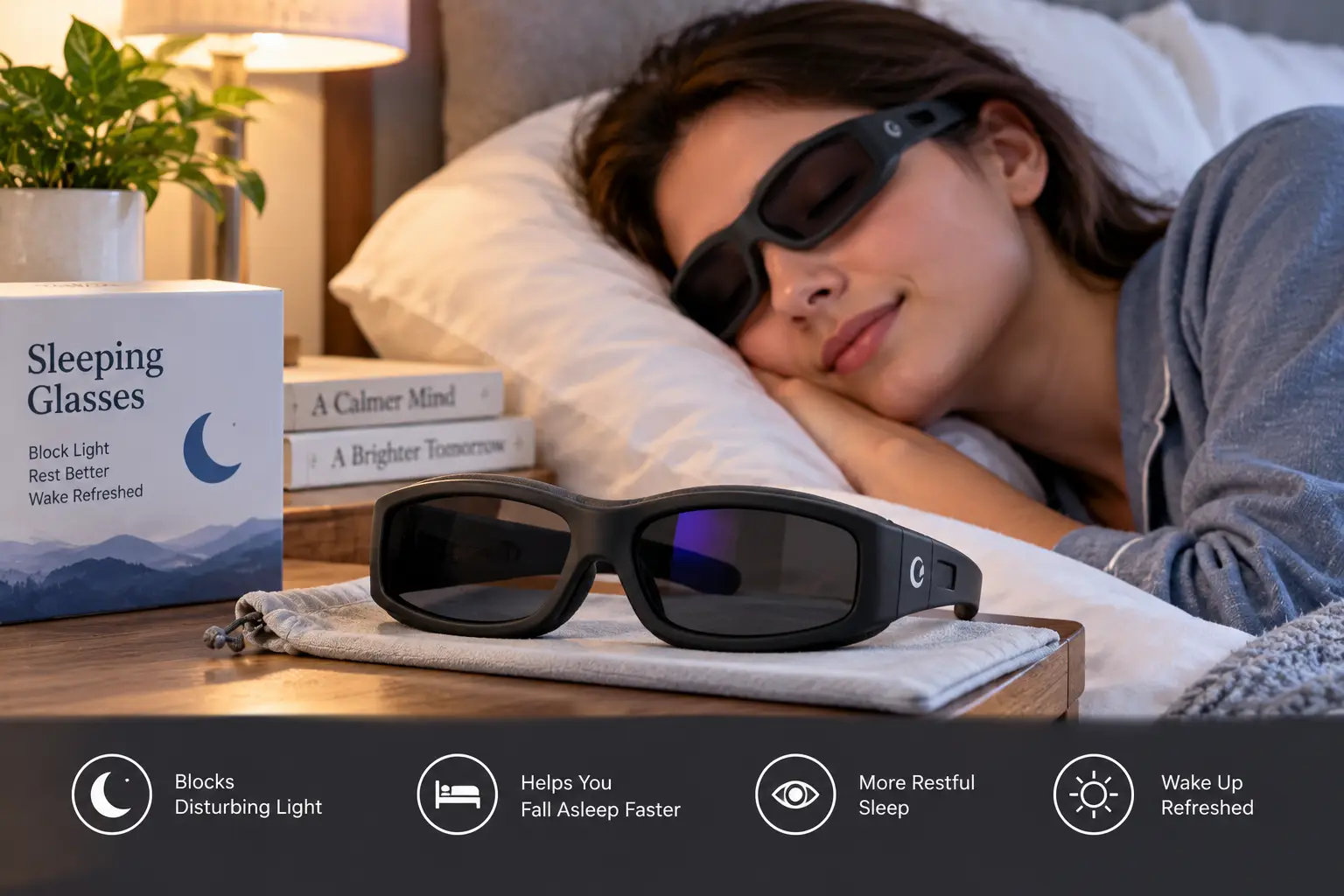
Sleeping glasses are amber- or red-tinted eyewear designed to filter out the specific wavelengths of light that keep your brain wide awake after sundown. If you’ve ever scrolled your phone in bed and then stared at the ceiling for an hour, you already know the problem sleeping glasses are trying to solve. Unlike a sleep mask, which blocks all light once your eyes are closed, sleeping glasses work while your eyes are still open — letting you read, watch TV, or answer one last email without flooding your retinas with the wavelengths your body reads as “it’s still daytime.”
The science behind this is well established. Researchers at Harvard have shown that blue light suppresses the sleep hormone melatonin far more aggressively than other colors of light, which is exactly why amber and red lenses — engineered to block that portion of the spectrum — have become a legitimate category of sleep gear rather than a wellness fad. This guide breaks down seven real, purchasable sleeping glasses spanning budget safety-glasses hacks to premium, university-studied designs, with honest analysis of what each one actually delivers and who should buy it.
We’re not going to pretend every pair on this list performs identically, because they don’t. Lens coverage, wavelength cutoff, frame comfort, and price vary enormously across this category, and picking the wrong pair for your situation is a common (and avoidable) mistake. By the end of this article, you’ll know exactly which type of sleeping glasses fits your budget, your face, and your bedtime routine.
Sleeping Glasses at a Glance: Quick Comparison
If you’re in a hurry, here’s the short version before we dig into the full breakdown.
| Pick | Best For | Price Range | Lens Type |
|---|---|---|---|
| Uvex Skyper S1933X | Testing the concept on a budget | Under $15 | Amber (SCT-Orange) |
| GUNNAR Intercept Amber Max | Gamers and late-night screen users | $60–$80 | Amber Max |
| Swanwick Night Swannies | Buyers who want peer-reviewed backing | $100–$150 | Deep amber |
| Ra Optics Sunset Lenses | Premium build quality, HSA/FSA use | Around $175 | Red/amber (400–550nm) |
This snapshot only scratches the surface — the Uvex Skyper S1933X proves you don’t need to spend much to test whether sleeping glasses work for you, while the Ra Optics Sunset Lenses sit at the opposite end, trading a higher price for German-steel hinges and full-spectrum melatonin protection. Between those two extremes, the GUNNAR Intercept Amber Max and Swanwick Night Swannies show how much the “right” pair depends on whether you’re gaming until midnight or trying to wind down with a book. We’ll unpack all seven contenders, including three more options, in the sections below.
💬 Curious which pick matches your exact bedtime routine? Keep scrolling — the full breakdown (and pros and cons for every pair) is just below.
Top 7 Sleeping Glasses for Better Rest in 2026
Below are seven real, currently available products that represent the full spectrum of the sleeping glasses category — from a $10 industrial safety-glasses hack to a $175 premium frame. Each entry includes genuine feature analysis, honest aggregated review sentiment, and a clear verdict on who it’s for.
1. Uvex Skyper S1933X — the cheapest way to test sleeping glasses
The Uvex Skyper S1933X started life as industrial safety eyewear, not a sleep product, and that origin story is exactly why it’s worth knowing about. Uvex builds these with an SCT-Orange (amber) polycarbonate lens designed to filter the 450–530nm range, which happens to overlap heavily with the wavelengths most responsible for suppressing melatonin. The wraparound, no-frills frame is nearly weightless, which matters if you plan to wear anything on your face for an hour before bed. Because they were never designed as lifestyle eyewear, don’t expect a flattering look — you’ll resemble someone doing yard work, not someone unwinding with a novel, and that trade-off is the entire value proposition here.
Reviews consistently describe the Uvex Skyper S1933X as an accidental sleep hack: people who bought them for woodworking or lawn care discovered the amber tint helped them wind down after screen time, and the price made it an easy experiment. Aggregated feedback also flags a real limitation worth knowing before you buy — the wraparound curve doesn’t reliably sit over thicker prescription frames, so if you wear glasses full-time, measure your current frame width first. This is the pick for skeptics who want to test the amber-lens concept before spending real money, or for budget-conscious shoppers who genuinely don’t care how they look at 9 p.m.
Pros:
- ✅ Lowest entry price in this entire category
- ✅ Wraparound design blocks peripheral light too
- ✅ Extremely lightweight for long evening wear
Cons:
- ❌ Industrial styling, not built for looking presentable
- ❌ Doesn’t reliably fit over thicker prescription frames
At under $15, the Uvex Skyper S1933X is close to a no-risk purchase — even if it turns out amber lenses aren’t for you, you haven’t lost much.
2. TIJN Blue Light Sleep Glasses — budget pick that still looks like normal glasses
Where the Uvex Skyper S1933X leans industrial, the TIJN Blue Light Sleep Glasses are built to look like an ordinary pair of eyeglasses, which matters if you’d rather not answer questions from your partner about why you’re wearing safety gear to bed. TIJN uses a lightweight TR90 frame material with amber or orange-tinted lenses across several available shapes, so you can pick a style that doesn’t scream “sleep accessory.” The lenses are marketed as blocking blue light in the range associated with melatonin suppression, though — and this matters for honest expectations — TIJN doesn’t publish third-party wavelength testing the way some premium brands do, so you’re relying more on brand claims than independent verification.
What the spec sheet doesn’t say, but the broader budget blue-light category consistently shows, is that lighter amber tints in this price bracket tend to filter a noticeably smaller percentage of the 450–480nm range than deep-amber or red-lens competitors. That’s a real trade-off, not a knock against TIJN specifically — it’s a pattern across nearly every glasses under $25. For someone who wants a low-commitment, normal-looking pair to leave on the nightstand, that’s a reasonable compromise. For someone chasing maximum blockage, it’s worth stepping up a tier.
Pros:
- ✅ Looks like everyday eyeglasses, not a novelty item
- ✅ Comes in multiple frame shapes and colors
- ✅ Comfortable, lightweight TR90 build
Cons:
- ❌ No independent third-party blocking data published
- ❌ Lighter tint likely blocks less than deep-amber rivals
In the $15–$25 range, the TIJN Blue Light Sleep Glasses are a fair pick for anyone who wants sleeping glasses that don’t look like sleeping glasses.
3. GUNNAR Intercept Amber Max — best for gamers and late-night screen work
GUNNAR built its reputation on computer glasses long before “sleeping glasses” was a search term, and the GUNNAR Intercept Amber Max is the brand’s strongest push toward true nighttime blocking. The Amber Max lens sits at the deep end of GUNNAR’s lineup, and the company publishes a “Blue Light Protection Factor” rating so buyers can compare lens strength across its own product line — a level of transparency most budget competitors skip entirely. The Intercept frame itself uses a patented lens geometry (U.S. Patent #9417460) intended to reduce digital eye strain during extended screen sessions, not just at bedtime.
This is genuinely a dual-purpose product, and that’s both its strength and its limitation. On Best Buy, the GUNNAR Intercept Amber Max carries a 4.8-out-of-5 average across more than 1,400 reviews, with recurring praise for reduced eye fatigue during long gaming or work sessions and for the deep amber tint’s noticeable effect on evening sleepiness. A recurring complaint centers on the frame’s bulkier, tech-forward styling, which some buyers find too gamer-coded for daytime or professional settings. If your actual problem is falling asleep after late-night screen sessions rather than general nighttime reading, this is the most screen-focused pick on the list.
Pros:
- ✅ Published Blue Light Protection Factor for transparency
- ✅ 4.8-star average across 1,400+ verified reviews
- ✅ Patented lens geometry reduces digital eye strain
Cons:
- ❌ Bulkier styling than lifestyle-focused competitors
- ❌ Priced above basic amber glasses for similar core function
Between $60 and $80, the GUNNAR Intercept Amber Max is the clearest choice for anyone whose sleep problem starts with a screen.
4. Bon Charge Sleep Glasses — strongest full-spectrum block for the price
Most amber glasses stop filtering around 450–480nm, which blocks the worst offenders but still leaves a chunk of the melatonin-disrupting spectrum untouched. The Bon Charge Sleep Glasses are built specifically to close that gap, using a red-tinted lens engineered to block the full 400–550nm range — the entire window that sleep researchers associate with melatonin suppression, not just the peak of it. That distinction matters more than it sounds: a lens that blocks to 450nm only partially protects your circadian rhythm, while one that blocks to 550nm is doing the whole job.
Independent write-ups in the blue-light-glasses space regularly flag the Bon Charge Sleep Glasses as one of the most accessible “full block” options at a premium (not luxury) price point, and the brand has built a loyal following in the biohacking and sleep-optimization community specifically because of that wavelength coverage. The honest trade-off is color perception — a lens this aggressive turns your room a deep amber-red, which makes reading text easy but makes anything color-dependent (folding laundry, checking a recipe) genuinely difficult. That’s a feature, not a flaw, if your goal is strictly winding down before bed rather than functioning normally.
Pros:
- ✅ Blocks the full 400–550nm melatonin-disrupting range
- ✅ Strong reputation in the sleep-optimization community
- ✅ More accessible price than similarly rated rivals
Cons:
- ❌ Heavy tint makes color-dependent tasks difficult
- ❌ Fewer frame style options than mainstream eyewear brands
Around $80, the Bon Charge Sleep Glasses deliver the same wavelength coverage as glasses costing twice as much.
5. Swanwick Night Swannies — the most university-studied amber lens
The Swanwick Night Swannies carry something few competitors in this list can claim: over a decade in the market and third-party research from institutions including the University of Washington and the University of Indiana, along with findings referenced by SleepScore Labs. Swanwick states its deep amber lenses block roughly 99% of sleep-disrupting blue light, and the company builds its frames from acetate or alloy with spring hinges and CR-39 lenses carrying anti-glare coating on both sides — meaning the design has clearly been through more engineering iterations than a typical drugstore amber pair.
Aggregated customer sentiment on Trustpilot and Swanwick’s own site skews strongly positive, with buyers frequently mentioning that the amber tint took a few nights to feel normal before becoming part of their routine, and consistent praise for build comfort during extended wear. A smaller but recurring theme in reviews involves sizing — Swanwick offers multiple frame widths precisely because one-size designs tend to feel loose on smaller faces, so first-time buyers should check the brand’s measurement guide before ordering. For anyone who wants the reassurance of published, independent research behind their purchase rather than just marketing claims, this is the strongest pick on the list.
Pros:
- ✅ Backed by multiple university research partnerships
- ✅ Comfortable spring-hinge acetate or alloy frames
- ✅ Available in prescription and fit-over versions
Cons:
- ❌ Premium price for what is fundamentally an amber lens
- ❌ Deep tint requires an adjustment period for new users
Between $100 and $150 depending on frame, the Swanwick Night Swannies justify their price with research most competitors simply don’t have.
6. TrueDark Twilight Elite — EEG-tested for serious insomniacs
Founded by biohacker Dave Asprey after his own struggles with sleep, TrueDark Twilight Elite takes a more aggressive engineering approach than almost anything else on this list. The lens blocks roughly 99% of blue, green, and violet light — a wider spectral cut than the standard amber approach — and TrueDark states the design has been EEG-tested to help shift brainwave activity from alert “beta” patterns toward the calmer “alpha” and sleep-ready “delta” states. The sport-style polycarbonate frame includes a full-coverage foam barrier along the brow and cheek line, which functions almost like a hybrid between glasses and a sleep mask by blocking light leakage from above and below the lens.
Customer reviews are candid about the adjustment period: several buyers describe the visual effect as making everything “look like the surface of Mars,” a side effect of blocking such a wide slice of the visible spectrum, and note it takes real getting-used-to before the glasses feel wearable rather than disorienting. Once past that adjustment, sentiment turns strongly positive, particularly from users managing chronic sleep-onset issues who report the broader spectral block feels noticeably more effective than lighter amber alternatives they’d tried previously. This is the pick for people who’ve already tried basic amber glasses and found them insufficient.
Pros:
- ✅ EEG-tested design targeting brainwave shifts before sleep
- ✅ Foam-lined frame blocks peripheral light leakage
- ✅ Blocks blue, green, and violet wavelengths, not just blue
Cons:
- ❌ Heavy tint requires a real adjustment period
- ❌ Limited frame style selection at this price tier
In the $130–$150 range, the TrueDark Twilight Elite is built for people who need more than a standard amber fix.
7. Ra Optics Sunset Lenses — premium build, HSA/FSA eligible
If build quality and long-term durability matter as much to you as lens performance, the Ra Optics Sunset Lenses are the clear standout. Ra Optics uses German stainless-steel hinges and Italian acetate frame material — components more commonly found in mid-range prescription eyewear than in a sleep accessory — paired with a lens that, like the Bon Charge Sleep Glasses, blocks the full 400–550nm range associated with melatonin suppression. The brand also positions itself around “photobiology,” framing its products less as a wellness gadget and more as light-management tools grounded in circadian science.
A practical detail that sets the Ra Optics Sunset Lenses apart from every other product on this list: they’re HSA/FSA eligible in the US, meaning many buyers can purchase them with pre-tax healthcare dollars, which meaningfully offsets the sticker price for anyone with an active health savings account. Aggregated reviews and independent comparisons consistently place Ra Optics alongside Bon Charge as the two most complete full-spectrum options on the market, with Ra Optics earning particular praise for frame durability over years of nightly use, while some buyers note the premium construction is genuinely more than a casual user strictly needs.
Pros:
- ✅ German steel and Italian acetate build quality
- ✅ HSA/FSA eligible, lowering real out-of-pocket cost
- ✅ Full 400–550nm melatonin-range blocking
Cons:
- ❌ Highest price point in this lineup
- ❌ Premium construction may be overkill for casual users
Around $175, the Ra Optics Sunset Lenses are the choice for buyers who want their sleeping glasses to last as long as a real pair of eyeglasses.
✨ Ready to try a pair for yourself? Check current pricing and availability on any of the seven picks above — your future well-rested self will thank you.
Sleeping Glasses Comparison: Full Head-to-Head
Now that you’ve seen each product individually, here’s how all seven stack up side by side on the factors that actually matter when you’re choosing between them.
| # | Product | Lens Coverage | Price Range | Frame Style | Best For |
|---|---|---|---|---|---|
| 1 | Uvex Skyper S1933X | ~450–530nm | Under $15 | Wraparound safety | First-time testers |
| 2 | TIJN Blue Light Sleep Glasses | ~450–480nm (est.) | $15–$25 | Standard eyeglass | Everyday look on a budget |
| 3 | GUNNAR Intercept Amber Max | Deep amber, rated | $60–$80 | Gaming/tech frame | Gamers, screen workers |
| 4 | Bon Charge Sleep Glasses | 400–550nm (full) | Around $80 | Lifestyle frame | Full-spectrum block on a budget |
| 5 | Swanwick Night Swannies | ~99% deep amber | $100–$150 | Acetate/alloy | Research-backed buyers |
| 6 | TrueDark Twilight Elite | ~99% blue/green/violet | $130–$150 | Foam-lined sport | Chronic sleep-onset issues |
| 7 | Ra Optics Sunset Lenses | 400–550nm (full) | Around $175 | German steel/acetate | Long-term durability, HSA/FSA use |
Looking at the table above, two clear patterns emerge. First, price tracks lens coverage fairly closely — the Uvex Skyper S1933X and TIJN Blue Light Sleep Glasses filter a narrower band of blue light, while the Bon Charge Sleep Glasses and Ra Optics Sunset Lenses justify their higher price with documented full-spectrum (400–550nm) coverage. Second, the “best for” column matters as much as the spec sheet: the GUNNAR Intercept Amber Max and TrueDark Twilight Elite aren’t necessarily “better” than the others in an absolute sense, they’re built for different problems — screen-driven eye strain versus stubborn sleep-onset insomnia, respectively. Match the use case first, then let budget narrow the field.
What Are Sleeping Glasses, Exactly?
Sleeping glasses are amber- or red-tinted eyewear engineered to filter the specific light wavelengths — roughly 450 to 550 nanometers — that suppress melatonin production and delay sleep onset. Unlike sunglasses, which reduce overall brightness, sleeping glasses target a narrow color band while leaving the rest of your vision largely unaffected, letting you keep reading, watching TV, or working while your body still winds down.
The category sits at the intersection of two related but distinct groups of products. “Blue light blocking glasses for sleep” typically use amber or orange lenses that filter light in the 450–480nm range, the segment Harvard researchers found suppresses melatonin roughly twice as long as comparable green light exposure. The more aggressive subcategory — red or deep-amber “sleep glasses” like the Bon Charge Sleep Glasses and Ra Optics Sunset Lenses — extends that block up to 550nm, catching a wider slice of the disruptive spectrum. Both approaches share the same underlying goal: letting your evening screen time and lamp-lit reading happen without telling your brain it’s still noon.
It’s worth being precise about what these products are not. They’re not a cure for insomnia, they don’t replace good sleep hygiene, and they won’t undo the effects of, say, doomscrolling until 2 a.m. What they do is remove one specific, well-documented obstacle — light-driven melatonin suppression — from your evening routine, which for many people is enough to meaningfully shift how quickly they fall asleep.
Getting Started With Sleeping Glasses: Your First 30 Nights
Buying a pair is the easy part — using them correctly is where most people either see real results or give up too early. Here’s a realistic first-month routine.
Week 1: Build the habit, not the results. Put your sleeping glasses on 60 to 90 minutes before your target bedtime, every night, regardless of whether you notice anything yet. Most people report the amber or red tint feels strange or even mildly disorienting for the first three to five nights — that’s normal, not a sign the product doesn’t work.
Week 2: Pair with a wind-down cue. Sleeping glasses work best as part of a broader signal to your body that bedtime is approaching, not as a standalone fix. Put them on at the same time you dim your lamps, brew decaf tea, or start your usual pre-bed routine, so your brain starts associating the tint itself with winding down.
Weeks 3–4: Track what actually changed. Note roughly how long it takes you to fall asleep and how alert you feel the next morning. Most aggregated user feedback across this category suggests noticeable changes emerge within two to three weeks of consistent use, not overnight.
A few common first-month mistakes are worth avoiding entirely: wearing sleeping glasses only occasionally (consistency matters more than any single night), buying the most aggressive red-lens option first without testing a lighter amber pair, and expecting the glasses to compensate for an otherwise bright, screen-lit bedroom. Sleeping glasses reduce one specific obstacle to sleep — they work best alongside, not instead of, basic sleep hygiene like a dark room and a consistent bedtime.
Real-World Scenarios: Matching Sleeping Glasses to Your Lifestyle
The late-night gamer. If your screen time regularly stretches past 11 p.m. and you’re gaming or working right up until bed, prioritize a dual-purpose option like the GUNNAR Intercept Amber Max, which is engineered for extended screen sessions rather than just passive winding down. Budget for the $60–$80 range and expect to wear these for hours, not just the final 30 minutes before sleep.
The frequent traveler managing jet lag. Someone crossing time zones regularly benefits from a portable, durable pair that can survive a carry-on bag — the Swanwick Night Swannies or Ra Optics Sunset Lenses both fit this use case well, since sturdier frame materials hold up better to travel wear than lighter budget options.
The budget-conscious first-timer. If you’re not sure sleeping glasses will work for you and don’t want to commit real money to find out, start with the Uvex Skyper S1933X or TIJN Blue Light Sleep Glasses. Both let you test the core concept — wearing amber lenses before bed — for under $25 combined, before deciding whether to upgrade.
The chronic insomniac who’s tried everything. If lighter amber glasses haven’t moved the needle and you’re managing genuine sleep-onset struggles, the TrueDark Twilight Elite‘s broader blue-green-violet block and foam-lined design represents a meaningfully different (and more aggressive) approach worth trying before assuming glasses “don’t work” for you.
Problem → Solution: Fixing the Most Common Sleeping Glasses Complaints
Problem: “Everything looks orange and I can’t stand it.” This is the single most common complaint across this entire category, and it’s largely a matter of adjustment, not defect. Start with a lighter amber pair like the TIJN Blue Light Sleep Glasses rather than a full-spectrum red lens, and limit initial wear to 20–30 minutes before extending the duration.
Problem: “They don’t fit over my prescription glasses.” Not every frame in this list is designed as a fit-over. The Swanwick Night Swannies offers dedicated fit-over and prescription-compatible versions specifically to solve this, so check for those variants before assuming you need contacts.
Problem: “I keep forgetting to put them on.” Store your sleeping glasses somewhere you’ll physically trip over them — next to your toothbrush or on top of your phone charger — rather than in a drawer. Habit-stacking with an existing routine (charging your phone, brushing your teeth) dramatically improves consistency.
Problem: “I don’t notice any difference.” Give any pair a full two to three weeks of consistent nightly use before judging results, and audit the rest of your sleep environment — a bright bedroom, late caffeine, or an inconsistent bedtime can all mask the benefit of sleeping glasses even when the lenses themselves are working exactly as designed.
Problem: “The frame feels loose or uncomfortable after an hour.” Frame fit varies significantly by face shape and size. Brands like Swanwick and GUNNAR offer multiple frame widths for exactly this reason — if your current pair feels loose, check whether the manufacturer offers a different size before writing off the entire product.
How to Choose Sleeping Glasses: 7 Expert Criteria
- Lens wavelength coverage. Look for lenses that specify a wavelength range (ideally covering up to 500–550nm) rather than vague “blue light blocking” marketing language — the wider the documented range, the more complete the melatonin protection.
- Frame fit over existing eyewear. If you already wear prescription glasses, confirm the sleeping glasses you’re considering offer a fit-over version, or budget for prescription lenses if the brand supports them.
- Tint intensity vs. tolerance. Deeper red and amber tints block more light but take longer to adjust to; first-time buyers generally do better starting lighter and working up.
- Intended use case. Decide whether you need glasses for hours of screen work (favoring a GUNNAR-style dual-purpose design) or purely passive pre-sleep winding down (favoring a lighter, more comfortable lifestyle frame).
- Third-party validation. Brands with published research or independent testing, like Swanwick’s university partnerships, offer more confidence than marketing claims alone — though that backing typically comes at a price premium.
- Frame material and durability. If you’ll wear these nightly for years, steel hinges and acetate frames (Ra Optics, Swanwick) outlast basic plastic construction.
- HSA/FSA eligibility. For US buyers with a health savings account, checking eligibility before purchase — as with the Ra Optics Sunset Lenses — can meaningfully reduce your real out-of-pocket cost.
Sleep researchers consistently point back to the same underlying mechanism regardless of brand: short-wavelength light exposure resets the body’s circadian melatonin rhythm with a sensitivity that’s higher than most people assume, which is exactly why even a modest amber lens can produce a noticeable effect for light-sensitive sleepers.
Common Mistakes to Avoid When Buying Sleeping Glasses
The biggest mistake is treating this as a one-size-fits-all category and buying whatever pair has the flashiest marketing. Buyers who skip straight to the cheapest amber glasses without checking documented wavelength coverage sometimes end up disappointed not because the concept doesn’t work, but because a narrow 450nm-only filter leaves a meaningful chunk of the disruptive spectrum untouched.
A second common error is buying the most aggressive red-lens option as a first purchase. Full-spectrum designs like the Bon Charge Sleep Glasses or TrueDark Twilight Elite are excellent products, but the visual adjustment is real, and first-time users sometimes abandon sleeping glasses altogether after one uncomfortable night rather than starting with a gentler amber pair like the TIJN Blue Light Sleep Glasses.
Third, many shoppers ignore frame fit entirely and focus only on lens specs. A pair that pinches after 20 minutes won’t get worn consistently no matter how good its wavelength coverage is — comfort and habit-formation matter as much as the underlying optics. Finally, don’t expect sleeping glasses to substitute for basic sleep hygiene; they remove one obstacle (light exposure) but won’t offset a genuinely disruptive sleep environment, inconsistent bedtimes, or late caffeine intake.
Sleeping Glasses vs Blackout Sleep Masks
Sleeping glasses and blackout sleep masks solve overlapping but genuinely different problems, and understanding the distinction helps you decide whether you need one, the other, or both.
| Factor | Sleeping Glasses | Blackout Sleep Mask |
|---|---|---|
| When you use it | While awake, before bed | After eyes are closed, during sleep |
| What it blocks | Specific wavelengths (blue/green light) | All light, regardless of color |
| Compatible with screen time | Yes — can watch TV or read while wearing | No — mask blocks all vision |
| Best for | Melatonin protection during evening activity | Total darkness during sleep itself |
| Typical price range | $15–$175 | $15–$60 |
The two products aren’t competitors so much as complementary tools that solve different halves of the same problem. Sleeping glasses address what happens before your eyes close — filtering the light that delays melatonin release while you’re still reading or watching something. A blackout mask addresses what happens after — ensuring a hallway light or early sunrise doesn’t interrupt sleep once you’re actually unconscious. Frequent travelers and shift workers in particular tend to benefit from owning both: sleeping glasses for the pre-bed wind-down, and a mask for maintaining total darkness in hotel rooms or daytime sleeping situations that curtains alone can’t fully solve.
What to Expect: Everyday Performance With Sleeping Glasses
On paper, wavelength specs and blocking percentages tell part of the story, but real-world performance depends heavily on consistency and environment. Most aggregated user feedback across this category describes a gradual rather than instant effect — noticeably easier sleep onset emerging over one to three weeks of nightly use, rather than a single dramatic night-one transformation.
Expect an adjustment period regardless of which pair you choose. Even users who eventually rate their sleeping glasses highly commonly describe the first several nights as visually strange, with colors appearing muted or shifted toward orange and red. This isn’t a defect; it’s the lens doing exactly what it’s designed to do. What the spec sheet doesn’t fully convey is how much daily context matters — someone who also keeps their bedroom brightly lit or checks their phone at full brightness immediately before sleep will see a smaller benefit than someone who pairs sleeping glasses with a genuinely dim, wind-down evening routine.
Side sleepers and people who read in bed tend to report the most consistent satisfaction, since sleeping glasses let them keep their pre-bed habits largely intact while still gaining the melatonin benefit. People who fall asleep the moment their head hits the pillow, with minimal pre-bed screen or lamp exposure, often see a smaller marginal benefit — for that group, a blackout mask or improved bedroom darkness may matter more than the glasses themselves.
Long-Term Cost and Maintenance
Sleeping glasses require essentially no ongoing maintenance beyond basic lens care — wiping with a microfiber cloth and avoiding harsh cleaners that can degrade anti-glare coatings. Where the category differs meaningfully is total cost of ownership over time, since cheaper frames tend to need replacing far sooner than premium builds.
| Tier | Upfront Price | Typical Lifespan | Est. Cost Per Year |
|---|---|---|---|
| Budget (Uvex Skyper, TIJN) | $15–$25 | 6–12 months | $15–$50 |
| Mid-range (GUNNAR, Bon Charge) | $60–$80 | 2–3 years | $20–$40 |
| Premium (Swanwick, TrueDark, Ra Optics) | $100–$175 | 4+ years | $25–$44 |
Looking at the table above, the “cheapest” option isn’t necessarily the best value once you account for replacement frequency — a $15 pair that needs replacing every eight months can cost more annually than a $150 pair built with steel hinges that lasts four years or longer. That said, budget options remain the smarter starting point if you’re not yet sure sleeping glasses will work for your specific sleep pattern; there’s little sense paying a premium-tier price before confirming the underlying concept fits your routine. Once you’ve confirmed the habit sticks, upgrading to a durable frame like the Ra Optics Sunset Lenses or Swanwick Night Swannies genuinely pays for itself over a few years of nightly use.
Safety, Regulations, and Standards for Blue Light Glasses
Unlike prescription eyewear, non-prescription sleeping glasses aren’t subject to FDA medical-device regulation in the US, since they make no drug or disease-treatment claims — they’re marketed and regulated as general consumer eyewear rather than a therapeutic device. That means the industry currently lacks a standardized, government-mandated test for “how much blue light” a given lens blocks, which is exactly why third-party research and published wavelength data (like Swanwick’s university partnerships or Ra Optics’ 400–550nm spec) matter more in this category than in more heavily regulated product types.
From a shopping-safety standpoint, look for lenses that specify actual nanometer ranges rather than vague “blocks blue light” claims, and favor brands transparent enough to publish that data openly. As with any affiliate content, it’s worth knowing that recommendations across this article — and across the wider review industry — are required to follow FTC guidance on clear disclosure of affiliate relationships, which is why every legitimate sleeping glasses review, including this one, should disclose upfront that purchases made through its links may generate a commission. That transparency requirement exists specifically to protect shoppers from marketing dressed up as neutral advice.
FAQs
❓ Do sleeping glasses actually work?
❓ How long before bed should you wear sleeping glasses?
❓ Are sleeping glasses better than a blackout sleep mask?
❓ Can you wear sleeping glasses over prescription glasses?
❓ How much do good sleeping glasses cost?
Conclusion
Sleeping glasses are one of the rare sleep products where the underlying science — blue light’s outsized effect on melatonin — is genuinely well documented, even if individual product marketing sometimes outpaces the evidence behind it. The right pair for you depends far more on your specific situation than on chasing the “best overall” pick: gamers and late-night screen users get the most out of dual-purpose options like the GUNNAR Intercept Amber Max, budget-conscious first-timers can validate the concept for under $25 with the Uvex Skyper S1933X or TIJN Blue Light Sleep Glasses, and anyone chasing maximum melatonin protection should look toward full-spectrum 400–550nm lenses like the Bon Charge Sleep Glasses or Ra Optics Sunset Lenses.
What matters most isn’t which specific pair you choose from this list — it’s whether you actually wear them consistently as part of a genuine wind-down routine. Sleeping glasses remove one real, well-documented obstacle to falling asleep, but they work best alongside a dim bedroom, a consistent bedtime, and reasonable screen habits, not as a standalone fix. Start with a pair that matches your budget and comfort tolerance, give it a fair two-to-three-week trial, and adjust from there.
✨ Found the right pair for your bedtime routine? Check current pricing on your top pick and give it a real two-week trial — your sleep schedule will thank you! 💬🤗
Recommended for You
- 7 Best Shatterproof Sunglasses in 2026: Unbreakable & Tough
- Eyeglass Scratch Coating: 7 Best Options for Clearer Lenses in 2026
- Best Eye Protection for Red Light Therapy: 7 Safe Picks (2026)
Disclaimer: This post contains affiliate links. As an Amazon Associate, I earn from qualifying purchases made through these links, at no additional cost to you.
✨ Found this article helpful? Share it with someone who needs it! 💬🤗