
In This Article
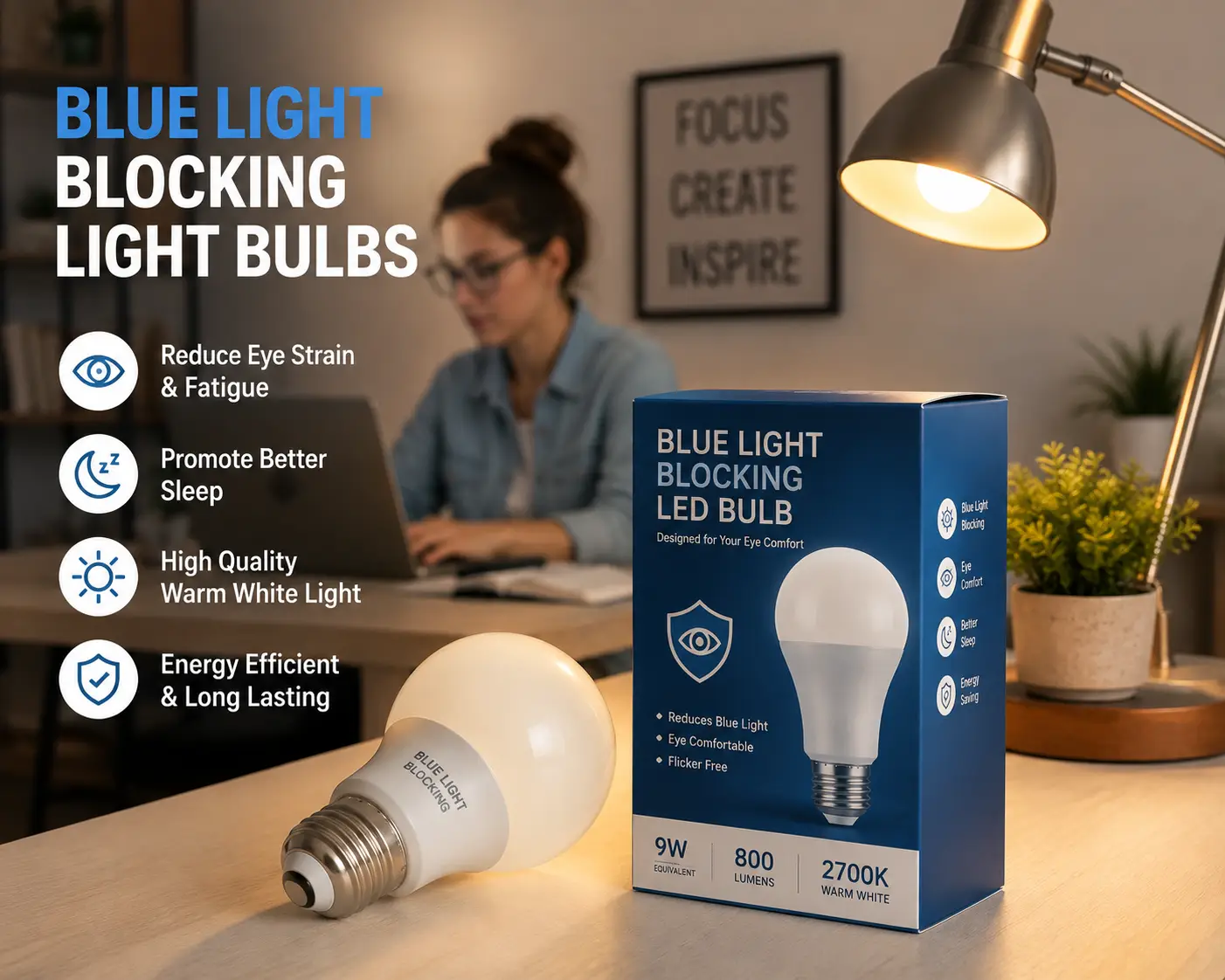
If you’ve ever scrolled your phone at 11 p.m. and then stared at the ceiling for an hour afterward, you already know the problem, even if you didn’t know the name for it. Blue light blocking light bulbs have quietly become one of the most searched sleep-hygiene upgrades in the country, and for good reason: they tackle a very specific, very fixable piece of the puzzle — the light in the room you’re trying to fall asleep in.
Unlike blue light glasses (which only help while you’re wearing them) or screen filters (which only help on one device), a blue light blocking bulb changes the entire environment. Screw it into a bedside lamp, and every light source in the room stops fighting your body’s natural wind-down signal.
This guide walks through what blue light blocking light bulbs actually are, how they differ from a regular “warm white” LED, and a hands-on breakdown of seven real products you can buy today — from budget four-packs to a clinically tested premium option. You’ll also get a practical buying framework, room-by-room setup advice, and answers to the questions people search most before buying. According to the Sleep Foundation, blue wavelengths are the most disruptive to the body’s production of melatonin, the hormone that signals it’s time to sleep — which is exactly the mechanism these bulbs are designed around.
What Is a Blue Light Blocking Light Bulb?
A blue light blocking light bulb is an LED bulb engineered to emit little or no light in the 380-500 nanometer range — the blue and blue-green wavelengths most responsible for suppressing melatonin production at night. Instead, it produces amber, orange, or red-toned light, typically rated between 1400K and 2200K on the Kelvin color temperature scale, well below the 2700K-5000K range of standard household bulbs.
Because these bulbs strip out the wavelengths your eyes’ light-sensitive retinal cells are most tuned to detect, using one in the hour or two before bed lets your body’s internal clock behave the way it would near a campfire or candlelight — dim, warm, and unmistakably “nighttime.” That’s a very different signal than the cool-white glow of a kitchen ceiling fixture or a bathroom vanity light.
Blue Light Blocking Light Bulbs at a Glance
Before diving into full reviews, here’s a fast snapshot of how the top options stack up on color temperature, form factor, and who each one suits best.
| Bulb | Color Temp | Base/Style | Best For |
|---|---|---|---|
| Sunco Amber Sleep A19 | 1800K | E26 A19 | Best overall value |
| JandCase Amber Sleep Bulb | 1900K | E26 A19 | Best budget nursery pick |
| Neporal Amber Sleep Bulb | 1800K | E26 A19 | Best blue-blocking percentage |
| hooga Circadian Rhythm Bulb | 1400K-2700K (3-mode) | E26 A19 | Best adjustable/versatile |
| Sunco BR30 Sleep Bulb | 2000K-2700K (dual CCT) | E26 BR30 | Best for recessed lighting |
| Philips SceneSwitch A19 | 2200K-2700K (3-setting) | E26 A19 | Best mainstream brand |
| Bon Charge Blue Light Blocking Bulb | ~2800K (red-dominant) | E26/E12 | Best premium/clinical-grade |
The pattern worth noticing here: the lower the Kelvin number, the deeper into amber-and-red territory the light sits, and the closer it gets to a true “zero blue light” output. Bulbs like the Neporal and Bon Charge picks push furthest into that range, while the Philips SceneSwitch sits at the warmer edge of “still technically white light” — useful context for the full breakdown below.
💬 One click helps other shoppers make an informed choice too! 😊
Top 7 Blue Light Blocking Light Bulbs for 2026: Expert Analysis
Here’s the full lineup, covering budget four-packs, a switchable circadian model, a recessed-lighting option, a household name, and a clinically tested premium pick. Every product below is real, currently available (or easily orderable) on amazon.com, and evaluated on actual specs and aggregated review sentiment — not marketing copy.
| Product | Wattage/Lumens | Dimmable | Price Range | Best For |
|---|---|---|---|---|
| Sunco Amber Sleep A19 | 9W / 800lm | Yes (select packs) | Around $20-$25 (4-pack) | Overall value |
| JandCase Amber Sleep Bulb | 7W / 750lm | No | Around $13-$18 (2-pack) | Nursery/baby room |
| Neporal Amber Sleep Bulb | 9W / 800lm | No | Around $18-$24 (4-pack) | Blue-blocking percentage |
| hooga Circadian Rhythm Bulb | 7W / 550lm | 3-mode switch | Around $40-$55 (4-pack) | Adjustable evening/night light |
| Sunco BR30 Sleep Bulb | 8.5W / 800lm | 10-100% | Around $35-$45 (6-pack) | Recessed/can lighting |
| Philips SceneSwitch A19 | 9W / up to 800lm | 3-setting switch | Around $18-$26 (4-pack) | Mainstream brand, multi-use |
| Bon Charge Blue Light Blocking Bulb | 7W / 600-700lm | No | Around $20-$25 (single bulb) | Premium/clinical-grade |
Looking at the table, the Sunco Amber Sleep A19 and JandCase Amber Sleep Bulb dominate the price-per-bulb math for anyone outfitting multiple lamps, while the hooga Circadian Rhythm Bulb and Bon Charge Blue Light Blocking Bulb justify their higher cost through added functionality (switchable modes) or independently tested blocking performance. If you only need one nightstand lamp handled, the math changes fast — a single premium bulb can cost less over its 25,000-hour lifespan than replacing a cheaper bulb twice.
1. Sunco Amber Sleep A19 LED Bulb — best overall value for whole-home use
The Sunco Amber Sleep A19 earns the top spot mainly because it’s easy to buy in bulk without the price climbing out of reach. At 9 watts (a 60-watt incandescent equivalent) and 1800K, it puts out 800 lumens of warm amber light — bright enough to read a book by, dim enough to avoid tripping your circadian rhythm.
What the spec sheet doesn’t say outright is that Sunco backs this bulb with a 5-year warranty, which is unusually long for a sub-$25 lighting product and signals real confidence in the LED driver’s longevity. Reviews consistently report that the amber tone reads as “cozy” rather than “sickly orange,” a common complaint with cheaper competitors that skew too far into a hazard-light hue. This bulb is best suited to buyers who want to convert an entire bedroom — nightstand lamps, a floor lamp, maybe a hallway fixture — without spending a premium price per socket.
Pros:
- ✅ 5-year manufacturer warranty backs long-term use
- ✅ Dimmable variants let you fine-tune evening brightness
- ✅ 1800K amber glow targets the wavelengths tied to melatonin suppression
Cons:
- ❌ Emits no white light, so it doubles poorly as a daytime bulb
- ❌ Not every pack size is dimmable — check the specific listing
At around $20-$25 for a four-pack, this works out to roughly $5-$6 per bulb, making it one of the better values in the category for anyone equipping more than one room.
2. JandCase Amber Sleep Therapy Light Bulb — best budget pick for nurseries
The JandCase Amber Sleep Therapy Light Bulb is built around one specific use case: the 2 a.m. feeding or diaper change where you need just enough light to see, without fully waking the baby (or yourself). Its 1900K color temperature and modest 750-lumen output keep the room dim and amber-toned rather than blasting a cold white glow that resets everyone’s circadian clock at the worst possible moment.
The rated 25,000-hour lifespan means, at typical nursery usage patterns, this bulb can realistically last several years before needing replacement — a meaningful practical detail for parents who don’t want lighting maintenance added to their list. Reviews of similarly specced amber nursery bulbs note the light is soft enough not to startle sleeping infants, though the tradeoff is a lower Color Rendering Index, meaning skin tones and colors look flatter under this light than under a standard bulb.
Pros:
- ✅ Budget-friendly two-pack, ideal for testing before committing further
- ✅ 25,000-hour rated lifespan reduces replacement hassle
- ✅ 1900K tone is gentle enough for nursery night feeds
Cons:
- ❌ Non-dimmable, so brightness is fixed at one level
- ❌ Lower CRI makes skin tones and colors look noticeably flat
Priced around $13-$18 for a two-pack, it’s one of the most accessible entry points into blue light blocking light bulbs, especially for a single-room, single-purpose need.
3. Neporal Amber Sleep Light Bulbs — best blue-light-blocking percentage
Where the Neporal Amber Sleep Light Bulbs separate themselves is independent testing: this bulb is rated at 99.94% blue light blocked, among the highest verified figures in the amber-bulb category, alongside a Color Rendering Index above 80 — noticeably better color accuracy than most bulbs in this price tier.
What that CRI number means in practice is that, even though the light is still a warm amber, objects and skin tones under it look less washed-out than under a typical 1800K sleep bulb. Based on comparing the specs across this roundup, the Neporal bulb is the strongest pick specifically for buyers whose main priority is verified blue-light performance rather than brightness or versatility. Its estimated annual operating cost of roughly $1 per bulb also makes it one of the cheapest bulbs in the category to actually run.
Pros:
- ✅ Independently tested at 99.94% blue light blocked
- ✅ CRI above 80 renders warm tones more accurately than typical amber bulbs
- ✅ Low estimated annual running cost, around $1 per bulb
Cons:
- ❌ 800 lumens at 1800K reads dim for anyone doing close work
- ❌ Amber-only light isn’t well suited to shared living spaces
At around $18-$24 for a four-pack, it sits right in the middle of the pack on price while offering some of the best-documented performance data of any bulb here.
4. hooga Circadian Rhythm Full Spectrum LED Bulb — best adjustable, 3-mode option
The hooga Circadian Rhythm Full Spectrum LED Bulb takes a different approach than the fixed-amber bulbs above: a physical switch cycles the bulb through three color temperatures — 2700K, 2100K, and 1400K — letting one bulb cover early evening, late-night wind-down, and near-blackout ambient use.
What most buyers overlook with this model is that the mode memory feature means the bulb remembers its last setting even after a power outage, so you’re not stuck re-cycling through modes every time a breaker trips. Reviews consistently report the flicker-free driver as a genuine strength, particularly for anyone sensitive to the subtle strobing some cheap LEDs produce. This bulb is best suited to buyers who want one flexible fixture — a reading lamp that needs to work at 8 p.m. and again at midnight — rather than a dedicated bedtime-only bulb.
Pros:
- ✅ Three switchable color temperatures cover evening wind-down through near-blackout mode
- ✅ Flicker-free driver with mode memory skips reprogramming after outages
- ✅ No hub or app required — works with a standard wall switch
Cons:
- ❌ Highest price per bulb among the entry- and mid-range options
- ❌ The 1400K setting is quite dim for anything beyond ambient mood lighting
Running around $40-$55 for a four-pack, this is a premium price relative to fixed-amber alternatives, but the added flexibility can offset needing to buy two different bulb types for two different rooms.
5. Sunco BR30 Sleep Light Bulb — best for recessed and can lighting
Most blue light blocking light bulbs come in the standard A19 pear shape, which is a problem if your bedroom or living room uses recessed can lights instead of table lamps. The Sunco BR30 Sleep Light Bulb solves that gap directly, using the wider BR30 flood shape sized for recessed housings.
Beyond the shape, this is one of the more feature-rich bulbs in the roundup: it offers dual color-temperature switching between 2700K and 2000K, and — unlike most amber bulbs, which are typically non-dimmable — supports a genuine 10-100% dimming range. Based on comparing the specs, that dimming flexibility, paired with UL listing and Sunco’s 5-year warranty, makes this the strongest choice for anyone retrofitting an entire recessed-lighting bedroom ceiling rather than a single lamp.
Pros:
- ✅ BR30 shape fits standard recessed and can-light housings
- ✅ Dimmable from 10-100%, unusual for a blue-light-blocking bulb
- ✅ UL listed with a 5-year manufacturer warranty
Cons:
- ❌ BR30 base only works in recessed or floodlight fixtures, not table lamps
- ❌ Six-bulb pack is a larger upfront commitment for outfitting just one lamp
At around $35-$45 for a six-pack, the per-bulb cost is competitive once you factor in that most recessed-light retrofits need four to six bulbs anyway.
6. Philips LED SceneSwitch A19 — best mainstream brand pick
The Philips LED SceneSwitch A19 isn’t a dedicated amber bulb — it’s included here because it’s the most recognizable name in this list, and its three-setting design (Daylight, Soft White, and Warm Glow at roughly 2700K/2500K/2200K) gives buyers a lower-commitment way to reduce blue-heavy light in the evening without replacing every bulb in the house with a single-purpose amber one.
Here’s the honest tradeoff: the Warm Glow setting meaningfully reduces blue-heavy output compared to a standard daylight bulb, but it does not eliminate blue wavelengths the way a dedicated 1800K amber or red-spectrum bulb does. What the spec sheet doesn’t say, but the “EyeComfort” flicker-free branding suggests, is that Philips designed this primarily around reducing visible flicker and eye strain rather than maximizing circadian-friendly output — a legitimate but different goal. For someone who wants one bulb that works for daytime tasks and evening relaxation without carrying two bulb types, this is a reasonable middle ground; for someone whose main goal is sleep-specific blue light elimination, one of the dedicated amber bulbs above will perform better.
Pros:
- ✅ Recognized brand name with wide retail availability and warranty support
- ✅ Three-setting switch covers daytime brightness and evening warmth in one bulb
- ✅ EyeComfort flicker-free design reduces eye strain during extended use
Cons:
- ❌ Warm Glow setting reduces, but doesn’t eliminate, blue-heavy light output
- ❌ Not dimmable beyond its three fixed preset levels
At around $18-$26 for a four-pack, it’s competitively priced with dedicated amber bulbs, but buyers should go in understanding it’s a compromise pick, not a maximum-blocking one.
7. Bon Charge Blue Light Blocking Light Bulb — best premium, clinically tested pick
The Bon Charge Blue Light Blocking Light Bulb sits at the top of this roundup on both price and documented performance. Independent spectrometer testing cited by the manufacturer shows 100% of light blocked between 380-580 nanometers — covering both blue and blue-green wavelengths — with the bulb’s highest emission point sitting at 630 nanometers, deep into pure red light.
That distinction matters: most “amber” bulbs still emit some residual blue-green light because their LEDs aren’t spectrally pure, while a true red-dominant design like this one pushes further toward the zero-blue-light end of the spectrum. A reviewer at Reviewed.com, the USA Today network’s product-testing site, who tested the bulb nightly for a week described “a wave of warmth” during the wind-down period and noted a low-flicker design with minimal reported EMF — but also flagged that the bulb works best as part of a pre-sleep ritual rather than left on all night, since it offers no benefit once you’re already asleep. That’s an honest limitation worth weighing against the premium price.
Pros:
- ✅ Spectrometer-tested at 100% blue/green light blocked between 380-580nm
- ✅ Backed by a 30-day money-back guarantee for a risk-free trial
- ✅ Low-flicker design reported to minimize EMF exposure
Cons:
- ❌ Highest per-bulb price of any option in this roundup
- ❌ Most effective as a pre-sleep ritual light, not an all-night solution
At around $20-$25 per bulb, this is priced closer to a specialty wellness product than a standard light bulb — reasonable for buyers who want documented performance, less so for anyone furnishing five bedrooms on a budget.
How to Set Up Blue Light Blocking Bulbs in Your Home: A Room-by-Room Guide
Buying the bulb is the easy part — getting the setup right is what actually changes your sleep. Start with the bedroom, and specifically the last light source you interact with before turning in: usually a nightstand lamp or an overhead fixture. Swap that one first, since it’s the light your eyes see closest to bedtime and for the longest uninterrupted stretch.
For hallways and bathrooms used during nighttime trips, a lower-lumen amber bulb (or a dedicated night light like the hooga Circadian Rhythm Bulb‘s dimmest 1400K setting) prevents the jarring full-brightness wake-up effect of flipping on a standard vanity light at 3 a.m. Nurseries benefit most from a non-dimmable, low-CRI-acceptable option like the JandCase Amber Sleep Therapy Light Bulb, since simplicity and reliability matter more than color accuracy for a 2 a.m. diaper change.
Living rooms and home offices are trickier: most people still need functional white light there during the day. This is where a switchable option like the Philips LED SceneSwitch A19 or the multi-mode hooga Circadian Rhythm Bulb earns its higher price — one bulb handles both daytime tasks and evening wind-down instead of requiring a bulb swap twice a day. A common first-30-days mistake is installing an amber bulb in a fixture with no separate switch, forcing an all-or-nothing choice between bright white light and dim amber; a plug-in lamp with its own switch, rather than a wired ceiling fixture, avoids that problem entirely.
Timing matters as much as bulb choice. The Harvard Health overview of blue light’s effects notes that even modest evening light exposure can shift circadian timing, so switching to amber lighting starting 90 minutes to two hours before bed — rather than only in the final ten minutes — gives your body a meaningfully longer runway to wind down.
Real-World Scenarios: Which Blue Light Blocking Bulb Fits Your Life?
The new parent on a budget. A couple furnishing a nursery and a bedroom on a tight budget doesn’t need premium performance — they need reliability and low cost. The JandCase Amber Sleep Therapy Light Bulb for the nursery, paired with a Sunco Amber Sleep A19 four-pack for the bedroom and hallway, covers the whole use case for well under $50 total.
The shift worker sleeping during the day. Someone working overnight hours and sleeping through daylight has a harder circadian challenge than a typical evening user, since they’re fighting both artificial and natural light. For this profile, the higher-verified blocking percentage of the Neporal Amber Sleep Bulb, combined with blackout curtains, gives the most controlled sleep environment — the near-total blue light elimination matters more here than in a standard evening-only routine.
The renter with recessed ceiling lights. Apartment dwellers who can’t swap fixtures but have recessed can lighting in the bedroom are the exact use case the Sunco BR30 Sleep Light Bulb was built for — no lamp needed, no fixture changes, just a bulb swap in an existing housing, with the added benefit of real dimming control.
The multitasker who reads and works in the same room. Someone using one lamp for both daytime reading and nighttime wind-down benefits most from a switchable bulb rather than a fixed-amber one. Both the hooga Circadian Rhythm Bulb and the Philips LED SceneSwitch A19 solve this, with the hooga pick going further into true amber/red territory on its lowest setting, and the Philips pick staying closer to conventional warm white throughout.
The buyer who wants documented results. For anyone who wants a bulb backed by third-party spectrometer testing rather than marketing claims alone, the Bon Charge Blue Light Blocking Light Bulb is the clearest match, particularly for buyers already using other sleep-optimization tools like blackout curtains or a consistent wind-down routine.
How to Choose the Right Blue Light Blocking Light Bulb
- Check the color temperature (Kelvin rating) first. Anything above roughly 2200K starts allowing meaningful blue-heavy light back into the mix; true amber and red-spectrum bulbs sit between 1400K and 1900K.
- Match the base type to your fixture. Standard lamps and most ceiling fixtures use an E26 A19 bulb; recessed can lighting needs a BR30 like the Sunco BR30 Sleep Light Bulb.
- Decide if you need dimming. Most amber bulbs are non-dimmable by design; if you want brightness control, look specifically for a dimmable-rated model or a multi-mode switch like the hooga Circadian Rhythm Bulb.
- Look for independently verified blocking percentages when possible. Marketing terms like “blue light blocking” aren’t regulated the way “ENERGY STAR” is, so a documented figure (like the Neporal Amber Sleep Bulb‘s tested 99.94%) is a more reliable signal than the phrase alone.
- Factor in CRI if the room serves other purposes. A low Color Rendering Index makes skin tones and colors look flat, which matters more in a nursery you’ll actually spend time in than in a hallway you walk through.
- Buy a single bulb before committing to a multi-pack. Amber light reads very differently room to room depending on wall color and existing decor; testing one bulb avoids an expensive four- or six-pack mismatch.
- Check warranty length as a quality signal. A 5-year warranty, like the one Sunco offers on several models, generally reflects more confidence in LED driver longevity than a 1-year or unspecified warranty.
Common Mistakes to Avoid When Buying Blue Light Blocking Bulbs
The most common mistake is buying based on the phrase “blue light blocking” alone without checking the Kelvin rating. Since the term isn’t formally regulated, some listed products sit at 2700K or higher — a warm white, but not a genuine low-blue bulb. Always cross-check the actual color temperature number against the roughly 1400K-2000K range that meaningfully reduces blue wavelengths.
A second frequent error is installing these bulbs in a fixture without a separate switch from the room’s main white-light source, which forces an all-or-nothing choice and often leads to buyers abandoning the bulb within weeks out of frustration. A third mistake, especially common with nursery purchases, is prioritizing brightness over color temperature — a bright 2700K bulb marketed for “better sleep” does less for melatonin production than a dimmer 1800K one, even though it looks more premium in a store display.
Finally, many buyers assume any amber-colored bulb performs the same, when independently tested blocking percentages (like Neporal‘s 99.94% or Bon Charge‘s spectrometer-verified 100% between 380-580nm) can differ meaningfully from untested competitors that simply look similar on a product photo.
Blue Light Blocking Bulbs vs. Regular LED Bulbs and Blue Light Glasses
| Solution | Blocks Blue Light? | Covers Whole Room? | Ongoing Effort |
|---|---|---|---|
| Blue light blocking light bulbs | Yes, at the source | Yes | None after install |
| Standard “warm white” LED (2700K-3000K) | Partial reduction only | Yes | None after install |
| Blue light blocking glasses | Yes, but only while worn | No | Must remember to wear nightly |
| Phone/screen night mode software | Yes, but only on that device | No | Must enable on every device |
The table makes the core advantage clear: a bulb swap is a one-time action that protects the whole room every night going forward, while glasses and screen filters both depend on remembering to use them consistently — and neither helps with ambient room lighting from lamps, ceiling fixtures, or a partner’s phone screen. That said, a standard warm-white LED bulb rated 2700K-3000K, which most households already have, does reduce blue output somewhat compared to a 5000K “daylight” bulb, just not nearly as dramatically as a dedicated 1400K-1900K amber or red-spectrum product.
The most effective approach, based on the available evidence, combines methods rather than relying on one: a dedicated bulb like the Sunco Amber Sleep A19 for the bedroom’s main light source, paired with a phone’s built-in night mode for the unavoidable last-minute scroll. Research on this exact interaction is informative here — a study published via PubMed found that blocking low-wavelength (blue) light prevented nocturnal melatonin suppression without hurting performance during simulated night-shift conditions, supporting the core mechanism these bulbs rely on.
What to Expect: Everyday Performance of Amber and Red-Spectrum Lighting
The biggest adjustment for first-time buyers isn’t the color — it’s the brightness. Even an 800-lumen amber bulb, technically comparable to a 60-watt incandescent, feels noticeably dimmer than a same-wattage white bulb because the human eye perceives amber and red wavelengths as less bright at equal lumen output. Expect to need a bulb rated slightly higher in lumens than you’d otherwise choose if reading or close work happens under it regularly.
Color rendering is the second adjustment. Under a typical 1800K amber bulb with CRI in the 50-70 range, blues and greens in decor or clothing will look muted or shift toward gray, while reds and oranges appear more saturated. Bulbs with a higher CRI, like the Neporal Amber Sleep Bulb‘s 80+ rating, narrow that gap but don’t eliminate it entirely — amber light will always favor warm tones by its nature.
On the plus side, reviews consistently report that the adjustment period is short — most users report the light feeling normal within a few nights, similar to how eyes adjust to sunglasses or a dimly lit restaurant. The wind-down effect itself, several reviewers note, tends to feel more like “the room got cozier” than a dramatic sensory shift, which is part of why these bulbs have higher long-term adoption rates than more disruptive sleep interventions.
Blue Light Blocking Bulbs for Shift Workers, New Parents, and Screen-Heavy Professionals
Shift workers face the toughest version of this problem: sleeping during daylight hours while their body’s internal clock is calibrated to a schedule most of society isn’t on. For this group, amber and red-spectrum bulbs matter most in the hour before their daytime sleep period, paired with blackout curtains to control the natural light their bedroom bulb alone can’t block. The Neporal Amber Sleep Bulb‘s independently verified 99.94% blocking rate is particularly relevant here, since even small amounts of residual blue light matter more when fighting daylight rather than just evening ambient light.
New parents deal with a different challenge: needing enough light to function safely during nighttime wakings without fully waking themselves or the baby. A simple, non-dimmable, budget-friendly option like the JandCase Amber Sleep Therapy Light Bulb removes decision fatigue at 3 a.m. — there’s no dial to fumble with, just a switch.
Screen-heavy professionals — people who go from a monitor at work to a phone in bed — benefit most from a flexible, switchable bulb like the hooga Circadian Rhythm Bulb or Philips LED SceneSwitch A19, since their evening routine typically still involves some functional light for changing clothes or reading before the final wind-down phase. For this group, gradually stepping down color temperature (bright, then medium, then amber) mirrors natural dusk far better than an abrupt switch from a 5000K desk lamp straight to darkness.
Safety, Regulations, and Standards for Blue Light Blocking Bulbs
Blue light blocking light bulbs are standard LED products and fall under the same safety framework as any other household bulb sold in the US. Look for UL or ETL listing — both the Sunco Amber Sleep A19 and Sunco BR30 Sleep Light Bulb carry UL certification, confirming the bulb has been independently tested against US electrical safety standards for fire and shock hazard.
ENERGY STAR certification is a separate, voluntary program, and most bulbs in this specialty category (including all seven featured here) are not ENERGY STAR certified, largely because the certification process is built around standard white-light color rendering and efficacy metrics that amber and red-spectrum bulbs aren’t designed to optimize for. That doesn’t mean these bulbs are inefficient — a 7-9 watt LED still uses roughly 85-90% less energy than an incandescent equivalent — it simply means the ENERGY STAR label isn’t the relevant benchmark here. The ENERGY STAR program is still a useful resource for understanding baseline LED efficiency standards if you’re comparing these bulbs against your home’s other lighting.
On the health-claims side, be aware that “blue light blocking” marketing language is not FDA-regulated for light bulbs the way it might be for medical devices, so claims about sleep improvement should be read as reasonable, evidence-supported expectations rather than guaranteed medical outcomes. The underlying science, however, is well established, and the Harvard Health review referenced earlier in this guide remains a solid, non-commercial starting point for anyone who wants the research behind the marketing.
Frequently Asked Questions
❓ What is the best blue light blocking light bulb for sleep?
❓ Do blue light blocking light bulbs actually work?
❓ Can I put a blue light blocking bulb in any lamp?
❓ Are blue light blocking light bulbs safe for babies and kids?
❓ How much do blue light blocking light bulbs cost?
Conclusion
Blue light blocking light bulbs aren’t a miracle fix, but they address a real, well-documented mechanism: the way blue-heavy light in the evening suppresses melatonin and delays your body’s natural wind-down process. Whether you go with a budget-friendly four-pack like the Sunco Amber Sleep A19, a nursery-focused option like the JandCase Amber Sleep Therapy Light Bulb, or a clinically tested premium pick like the Bon Charge Blue Light Blocking Light Bulb, the underlying value is the same — one bulb swap that quietly protects your sleep environment every single night without requiring you to remember glasses or enable a setting.
Start with the light source closest to your bed, give it a week or two to feel normal, and expand which rooms get blue light blocking light bulbs from there based on actual need. The research is consistent enough, and the cost of entry low enough, that this is one of the easier sleep-hygiene changes to actually stick with long-term.
✨ Ready to upgrade your bedroom lighting?
🔍 Take your evening wind-down routine to the next level with this carefully researched lineup. Click a highlighted pick above to check current pricing and availability, and start building a bedroom that actually helps you sleep — not fight your body’s own clock.
Recommended for You
- Childrens Blue Light Glasses: 7 Best Picks for Kids in 2026
- 7 Best Chunky Blue Light Glasses of 2026 for Screen-Heavy Days
- Bright Blue Contacts: 7 Best Picks for a Bold Blue Look (2026)
Disclaimer: This post contains affiliate links. As an Amazon Associate, I earn from qualifying purchases made through these links, at no additional cost to you.
✨ Found this article helpful? Share it with someone who needs it! 💬🤗