
In This Article
What Are Blue Blocking Light Bulbs? A Quick Introduction
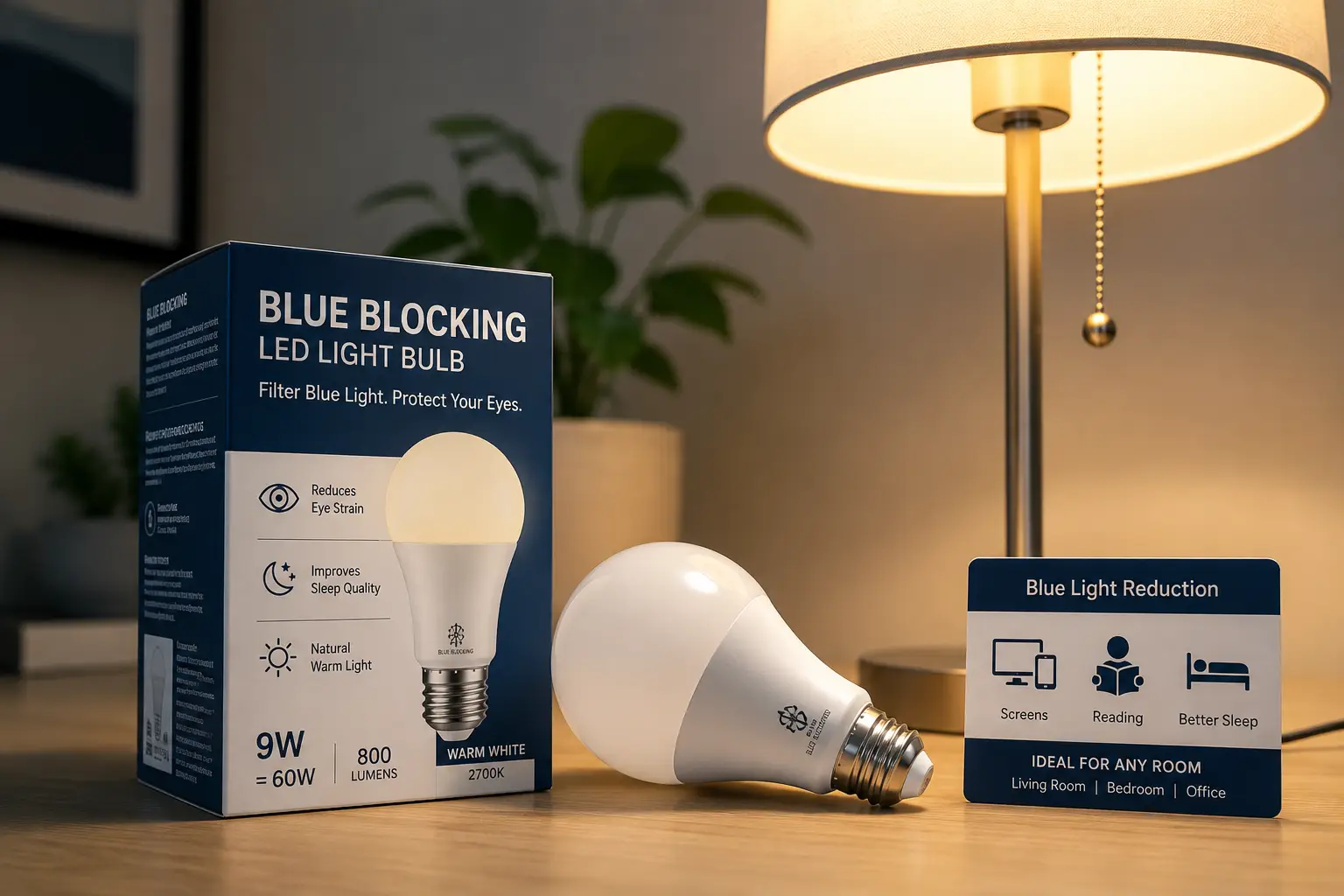
If you’ve ever laid in bed wide awake after scrolling your phone or leaving a lamp on too late, the culprit is probably light wavelength, not willpower. Blue blocking light bulbs are LED bulbs engineered to emit little to no light in the blue wavelength range (roughly 400-500nm), replacing it with warm amber or red tones that don’t interfere with your body’s natural melatonin production. Unlike standard “warm white” bulbs, which still leak a meaningful amount of blue light, these bulbs are built specifically around that gap.
The science behind this isn’t fringe wellness talk. According to the Sleep Foundation, blue wavelengths suppress melatonin more powerfully than any other part of the visible spectrum, which is why evening exposure to cool white or daylight bulbs can quietly wreck your sleep quality without you noticing why. Swapping a bedside lamp or hallway fixture over to blue blocking light bulbs is one of the simplest, cheapest changes you can make to your evening routine — no app, no subscription, no behavior change required beyond screwing in a bulb.
This guide breaks down seven real, currently available options across every price tier — from $10 single bulbs to smart, app-controlled fixtures — along with the honest tradeoffs of each. We’ll also cover how to choose the right one for your specific room, lamp, and sleep situation, plus the mistakes that trip up most first-time buyers.
Disclosure: This post contains affiliate links, and as an Amazon Associate, we may earn from qualifying purchases at no extra cost to you.
Quick Comparison: 7 Best Blue Blocking Light Bulbs at a Glance
Before diving into full reviews, here’s a fast snapshot of how these seven picks stack up against each other.
| Product | Color Temp | Form Factor | Best For | Price Range |
|---|---|---|---|---|
| Sunco Amber Sleep Light Bulb | 1800K | A19 | Budget multi-room setups | Around $18-$24 (4-pack) |
| Neporal Amber Light Bulb | 1800K | A19 | Everyday bedroom use | Around $15-$20 (3-pack) |
| JandCase Sleep Light Bulb | 1900K | A19 | Nursery and kids’ rooms | Around $13-$18 (2-pack) |
| KOZE Sleep Light Bulb | 1600K | A19 | Maximum blue-light avoidance | Under $10 (single) |
| TCP Color Flip LED | Red / 2700K | A19 | Flexibility in one bulb | Around $10-$15 (single) |
| Govee Smart RGBWW Bulb | Adjustable | A19 | Automated evening routines | Around $15-$25 (single) |
| Sunco BR30 Sleep Light Bulb | 2700K/2000K | BR30 (recessed) | Recessed can lighting | Around $50-$70 (6-pack) |
Looking at the table, the split comes down to form factor and control, not just color. The four A19 amber bulbs (Sunco Amber Sleep Light Bulb, Neporal Amber Light Bulb, JandCase Sleep Light Bulb, and KOZE Sleep Light Bulb) are the simplest and cheapest way to get a blue-free bedside lamp, while the TCP Color Flip LED and Govee Smart RGBWW Bulb trade a bit of simplicity for flexibility you’ll actually use if the same fixture needs to serve daytime and nighttime duty. The Sunco BR30 Sleep Light Bulb is the outlier here — it’s the only recessed-can option, which matters a lot if your bedroom or living room uses overhead pot lights instead of lamps.
💬 One click helps other shoppers make an informed choice too! 😊
Top 7 Blue Blocking Light Bulbs: Expert Analysis
1. Sunco Amber Sleep Light Bulb — best value for multi-room setups
The Sunco Amber Sleep Light Bulb earns its spot here mostly on math: a 4-pack lets you outfit an entire bedroom, hallway, and bathroom in low-blue sleep lighting without spending much more than a single premium smart bulb.
Each 9-watt bulb (60-watt equivalent) puts out an 1800K amber glow, is ETL listed for safety, and is dimmable on standard lamp dimmers — a detail plenty of budget amber bulbs skip. Practically speaking, dimmability matters because a full-brightness amber bulb can still feel too stimulating right before bed; being able to dial it down to a 10-15% glow is what actually gets you into sleep-ready lighting.
This is the pick for anyone converting multiple fixtures at once — parents doing a whole house, or renters who want blue-free lighting in every room they use after 8 p.m. It’s less suited to someone who only wants one nightstand lamp converted, since you’ll have three spare bulbs sitting in a drawer.
Reviews consistently mention that the amber tone is deeper and more orange than buyers expect from photos, which most people report as a positive once they adjust, though a small minority find it too dim for reading.
Pros:
- ✅ Four bulbs cover a whole bedroom-and-hallway setup
- ✅ Dimmable on standard lamp and wall dimmers
- ✅ ETL listed for verified electrical safety
Cons:
- ❌ Amber tone is too dim for close-up reading
- ❌ Non-smart, so no scheduling without a separate timer
At around $18-$24 for four bulbs, the Sunco Amber Sleep Light Bulb is one of the most cost-effective ways to convert several fixtures to amber sleep lighting in one order.
2. Neporal Amber Light Bulb — most consistent everyday amber tone
The Neporal Amber Light Bulb is the “no surprises” pick — a straightforward 1800K amber A19 bulb that reviewers repeatedly describe as matching its listing photos almost exactly.
At 9 watts (60-watt equivalent) with an E26 base, it fits nearly any standard lamp or fixture without an adapter. The practical upside of the consistent 1800K rating is that if you buy a 3-pack for a bedside lamp, hallway sconce, and reading lamp, all three will visually match — something cheaper unbranded amber bulbs don’t always guarantee across a single order.
This is a strong fit for buyers who specifically want a reliable, repeatable amber tone across multiple fixtures without hunting for exact color matches. It’s a less exciting pick for anyone who wants smart features or dimming flexibility, since this is a fixed-output bulb.
Aggregated review sentiment points to strong satisfaction with build quality and instant-on performance, with an occasional complaint about lifespan falling short of the advertised rating after roughly a year of nightly use.
Pros:
- ✅ Consistent 1800K amber tone across multiple bulbs
- ✅ Standard E26 base fits nearly any fixture
- ✅ Reliable instant-on with no flicker or warm-up delay
Cons:
- ❌ Not dimmable on most standard dimmer switches
- ❌ Some buyers report shorter-than-advertised bulb lifespan
Priced around $15-$20 for a 3-pack, the Neporal Amber Light Bulb delivers solid value if consistency across fixtures matters more to you than dimming flexibility.
3. JandCase Sleep Light Bulb — gentlest option for nurseries
The JandCase Sleep Light Bulb is positioned specifically around nursery and kids’-room use, and its 1900K amber output backs that up with one of the softer, less intense glows in this lineup.
Its 60-watt equivalent output at 1900K sits just slightly warmer than the standard 1800K amber tone, which in practice means a touch less brightness and a softer visual edge — useful for late-night diaper changes or feedings where you want just enough light to see, not enough to fully wake anyone up. The 2-pack format is sized right for a nursery plus a parents’ room, rather than a whole-house conversion.
This bulb is best suited to parents managing overnight infant care, or anyone who wants the gentlest possible amber output rather than the brightest. It’s not the right choice if you need enough light output to comfortably read by.
Real customer feedback frequently highlights how much easier late-night nursery visits become without a stark white bulb jolting the room awake, alongside occasional notes that the light is almost too dim for changing-table tasks without a secondary light source.
Pros:
- ✅ Extra-gentle 1900K tone suited to nursery use
- ✅ Two-pack fits a nursery-plus-bedroom setup well
- ✅ Standard 60-watt equivalent brightness for the price
Cons:
- ❌ May be too dim for detailed nighttime tasks
- ❌ Limited to two bulbs per pack, not a whole-house set
At roughly $13-$18 for two bulbs, the JandCase Sleep Light Bulb is a smart, targeted buy for new parents rather than a general household upgrade.
4. KOZE Sleep Light Bulb — lowest color temperature for maximum blue avoidance
The KOZE Sleep Light Bulb goes further than most competitors on paper, rated at 1600K — meaningfully warmer than the 1800K standard most amber sleep bulbs use.
At just 3.5 watts, it’s built purely as a low-output night bulb rather than a general-purpose lamp bulb, and that 1600K rating theoretically pushes it even further from the blue end of the spectrum than its 1800K competitors. In practice, this means it’s genuinely dim — closer to a traditional nightlight than a reading lamp — which is exactly the point if your only goal is zero sleep disruption from a bedside or hallway fixture left on overnight.
This is the pick for anyone prioritizing blue-light avoidance above all else, including light-sensitive sleepers, migraine sufferers, or people doing overnight shift work who need total darkness compensation. It’s a poor match for anyone who wants a bulb bright enough to double as a reading or task light.
Reviewers who bought it specifically for light sensitivity or migraine-related sleep issues report it as noticeably gentler on the eyes than standard “warm white” LED alternatives, while some note the low wattage makes it too dim for anything beyond a true nightlight role.
Pros:
- ✅ Lowest color temperature (1600K) in this roundup
- ✅ Genuinely low output, ideal as a pure nightlight
- ✅ Compact, affordable single-bulb entry point
Cons:
- ❌ Too dim for reading or general room lighting
- ❌ Sold as a single bulb, so multi-room setups cost more per bulb
At under $10 per bulb, the KOZE Sleep Light Bulb is an easy, low-risk way to test whether truly minimal blue light exposure changes how you sleep.
5. TCP Color Flip LED — best flexibility in a single bulb
The TCP Color Flip LED solves a real problem: most people don’t want a dedicated “sleep bulb” and a separate “normal bulb” in the same lamp — they want one bulb that does both.
This bulb physically switches between a 2700K soft white mode for daytime and evening use and a red-toned mode with minimal blue output for nighttime, controlled by flipping the light switch off and on in quick succession rather than an app or remote. Practically, that means a single nightstand lamp can serve as your regular reading light in the evening and then flip to a blue-free mode right before sleep, without any extra hardware.
This is the strongest pick for anyone who only wants to convert one or two fixtures but doesn’t want to give up normal white light entirely in that same lamp. It’s overkill if you’re fully converting a dedicated nightlight or hallway fixture that never needs white light.
Aggregated reviews describe the flip mechanism as reliable after some initial trial-and-error learning the exact switch timing, with a subset of buyers wishing the red mode were dimmable independently of the white mode.
Pros:
- ✅ One bulb replaces two — white light and red mode in one
- ✅ No app, hub, or remote required to switch modes
- ✅ Great for shared fixtures used both day and night
Cons:
- ❌ Switch-based mode change has a learning curve
- ❌ Red mode brightness isn’t independently adjustable
Priced around $10-$15 per bulb, the TCP Color Flip LED offers strong value specifically because it replaces two bulbs’ worth of function with one.
6. Govee Smart RGBWW Bulb — best for automated evening routines
The Govee Smart RGBWW Bulb is the automation pick: rather than manually swapping bulbs or flipping switches, you set a schedule once and let the app shift your lighting from daylight to blue-free red or amber tones automatically every evening.
Controlled over WiFi and Bluetooth and compatible with Alexa and Google Assistant, this bulb can hit millions of color combinations, but the relevant one here is a pure red or deep-amber setting that eliminates blue wavelength output. What matters practically is scheduling: you can set the bulb to shift to blue-blocking mode at, say, 9 p.m. every night automatically, which removes the “I forgot to switch bulbs” failure point that undermines every non-smart option on this list.
This is the right choice for tech-comfortable households that want their blue-light routine to run itself, or anyone managing a whole smart-home lighting setup already. It’s the wrong choice for anyone who doesn’t want to deal with an app, WiFi setup, or occasional firmware hiccups.
Reviews are broadly positive on color accuracy and app reliability, with recurring feedback that initial WiFi pairing can be finicky on certain router setups before it works smoothly.
Pros:
- ✅ Fully automated color-shift scheduling via app
- ✅ Works with Alexa and Google Assistant for voice control
- ✅ One bulb replaces the need for separate day/night bulbs
Cons:
- ❌ Initial WiFi/app setup can be frustrating for some users
- ❌ Costs more per bulb than basic amber alternatives
At around $15-$25 per bulb, the Govee Smart RGBWW Bulb is priced like a convenience purchase, and for households that will actually use the automation, it earns that premium.
7. Sunco BR30 Sleep Light Bulb — only real option for recessed lighting
The Sunco BR30 Sleep Light Bulb fills a gap none of the other six bulbs address: recessed can lighting, which standard A19 sleep bulbs generally aren’t shaped or rated to work well in.
This BR30 floodlight-style bulb offers a dual color-temperature (2CCT) design, switchable between a 2700K warm white for general use and a 2000K amber-leaning glow for nighttime, dimmable, and sold in a 6-pack sized for a full room of recessed fixtures. In practice, this is the only bulb here suited to bedrooms, bathrooms, or living rooms lit primarily by ceiling cans rather than lamps — a common setup in newer homes and apartments that the A19 bulbs on this list simply can’t serve.
This is the clear pick for anyone whose bedroom or main living space relies on recessed lighting rather than table or floor lamps. It’s unnecessary spending for anyone with standard lamp fixtures, where a cheaper A19 bulb does the same job.
Customer feedback frequently praises the switchable dual-temperature feature as genuinely useful day-to-day, while a smaller number of reviewers note the amber setting is noticeably brighter than the dedicated 1800K amber bulbs earlier in this list.
Pros:
- ✅ Only BR30 recessed-can option in this roundup
- ✅ Switchable 2700K/2000K dual color temperature
- ✅ Dimmable, with a 6-pack sized for a full room
Cons:
- ❌ Amber mode is brighter than dedicated 1800K bulbs
- ❌ Higher upfront cost than A19 multi-packs
At around $50-$70 for six bulbs, the Sunco BR30 Sleep Light Bulb is the priciest option here, but it’s genuinely the only practical route to blue-free lighting if your room uses recessed cans.
Setting Up Your Blue Blocking Light Bulbs: A Step-by-Step Guide
Getting real sleep benefits from these bulbs depends as much on how you use them as which one you buy. Start by identifying which fixtures actually matter — typically your bedside lamp, any hallway light you pass through before bed, and a bathroom fixture if you get up overnight. Converting your entire house on day one isn’t necessary and gets expensive fast.
For the first week, use the bulb at full brightness during your normal evening routine so your eyes adjust to the amber or red tone before you start dimming further. Many first-time buyers dim immediately and find the room “too dark,” which has more to do with adjustment than the bulb itself.
If your fixture supports dimming, gradually lower brightness starting about 90 minutes before your target sleep time — this mirrors the natural dimming pattern the Harvard Health blue light research associates with better melatonin timing. A common early mistake is leaving overhead white lighting on in the same room as a converted lamp; the blue blocking bulb can’t compensate for a competing bright white source nearby.
For maintenance, LED bulbs like these rarely need attention beyond an occasional dust wipe, but track your specific bulb’s rated lifespan (commonly 15,000-25,000 hours) so you know roughly when to expect replacement rather than being surprised by a sudden failure.
Real-World Scenarios: Which Blue Blocking Bulb Fits Your Life?
Different sleep situations call for different bulbs, so here’s how three common profiles map to the picks above.
The new parent doing overnight feedings needs light gentle enough not to fully wake a sleeping baby but bright enough to safely navigate a nursery — the JandCase Sleep Light Bulb or KOZE Sleep Light Bulb fit this best, with the KOZE edging ahead for anyone especially sensitive to light disruption.
The shift worker sleeping during daylight hours has a different problem: their issue is often daytime light exposure through blackout curtains rather than evening bulbs alone, but for the hours they are awake and preparing for sleep, an automated option like the Govee Smart RGBWW Bulb lets them schedule blue-free lighting around an irregular schedule that doesn’t follow a normal evening pattern.
The budget-conscious renter converting an entire apartment on one order is best served by the Sunco Amber Sleep Light Bulb 4-pack, which covers multiple rooms without the per-bulb premium that smart or dual-mode options carry. Meanwhile, anyone in a newer build with recessed ceiling lighting throughout the bedroom has effectively one real option on this list: the Sunco BR30 Sleep Light Bulb.
Common Sleep Lighting Problems (and How to Solve Them)
Problem: The room feels too dark to function in. This usually means you switched a fixture used for tasks (reading, dressing) rather than ambient use. Solution: keep one brighter white-light source in the room and reserve amber or red bulbs for the specific fixture you use in the final hour before bed, like the TCP Color Flip LED in a shared lamp.
Problem: You forget to switch bulbs or modes consistently. Manual bulb-swapping rarely sticks as a long-term habit. Solution: an automated option like the Govee Smart RGBWW Bulb removes the memory requirement entirely by scheduling the shift.
Problem: A nursery bulb is too dim for nighttime tasks. Solution: pair a gentle bulb like the JandCase Sleep Light Bulb with a small, separate task light used briefly and only when needed, rather than relying on one bulb for both ambient and task lighting.
Problem: Recessed lighting has no obvious blue-blocking option. Solution: the Sunco BR30 Sleep Light Bulb is purpose-built for this exact gap in the market.
How to Choose Blue Blocking Light Bulbs: 7 Expert Criteria
Picking the right bulb comes down to matching a handful of specs to your actual use case, not just grabbing the cheapest option.
- Color temperature — Lower Kelvin ratings (1600K-1900K) block more blue wavelength output; general “warm white” 2700K bulbs still leak meaningful blue light despite the name.
- Base type — Confirm E26 (standard) versus a specialty base, and BR30 versus A19 shape, before ordering.
- Dimmability — A dimmable bulb lets you fine-tune brightness for reading versus pure ambient use in the same fixture.
- Wattage/lumen output — Lower-wattage bulbs suit pure nightlight roles; higher output suits rooms where you still need to function.
- Smart features — Only worth paying for if you’ll actually use scheduling or voice control; otherwise it’s an unnecessary cost.
- Safety certification — Look for UL or ETL listing, which confirms independent electrical safety testing.
- Pack size versus room count — Match the pack size to how many fixtures you’re actually converting to avoid overbuying.
Common Mistakes to Avoid When Buying Blue Blocking Light Bulbs
The most frequent mistake is assuming any “warm white” LED counts as blue blocking — a standard 2700K bulb still emits substantially more blue wavelength light than a purpose-built 1800K or lower amber bulb. Read the actual color temperature rating, not just marketing language like “warm” or “soft.”
The second common error is buying a single bulb for a fixture that needs dimming without checking dimmer compatibility first, which leaves buyers stuck at one uncomfortable brightness level. Third, many buyers underestimate how dim true low-blue bulbs are and install one where they still need to read or work, leading to disappointment that’s really a mismatch of bulb to use case rather than a product flaw. Finally, some households buy a full-house set before testing how the amber tone actually feels in their space — a single bulb trial in your main bedroom fixture before a bulk purchase avoids that regret entirely.
Blue Blocking Light Bulbs vs Regular LED Bulbs
The core difference isn’t brightness or efficiency — both types are comparably efficient LEDs — it’s spectral output.
| Type | Blue Light Output | Typical Color Temp | Sleep Impact | Best Use |
|---|---|---|---|---|
| Blue Blocking Bulb | Minimal to none | 1600K-2000K | Minimal melatonin disruption | Evening/nighttime fixtures |
| Standard “Warm White” LED | Moderate | 2700K-3000K | Some melatonin suppression | General daytime/evening use |
| Standard “Daylight” LED | High | 5000K-6500K | Significant melatonin suppression | Daytime task lighting |
The table makes the tradeoff clear: a standard warm white bulb marketed for cozy ambiance still sits well above the color temperature range that research on melatonin suppression flags as disruptive. A peer-reviewed study on home lighting and melatonin found that blue-filtered lighting conditions produced meaningfully less melatonin suppression than standard household lighting, reinforcing that the difference here isn’t cosmetic — it’s measurable. If your fixture is only ever used before bed, there’s little reason to default to a standard warm white bulb over a dedicated amber option.
✨ Don’t miss these picks for a better night’s sleep!
🔍 Take your bedroom lighting to the next level with this lineup of amber and red sleep bulbs. Click a highlighted pick to check current pricing and availability, and start winding down the way your body actually responds to best.
What to Expect: Everyday Performance of Blue Blocking Bulbs
Translating specs into lived experience: an 1800K amber bulb at full brightness produces a noticeably orange-toned room, closer to candlelight or a sunset than any “warm” LED you’ve likely used before. That’s the point, but it does mean these bulbs aren’t a drop-in replacement for your main reading lamp unless you’re comfortable with dimmer, warmer-toned light for that task.
Dimmable models let you use a lower setting purely as a nightlight and step it up slightly for activities like getting dressed. Smart bulbs like the Govee Smart RGBWW Bulb add a layer most static bulbs can’t match: the ability to run at full white brightness during the day and shift automatically as evening arrives, so “everyday performance” for that bulb spans two very different use cases in the same fixture. Across every bulb in this roundup, the consistent theme in aggregated feedback is that adjustment takes a few nights, after which most users report not wanting to go back to standard bulbs in that fixture.
Safety, Regulations, and Standards for Blue Blocking Light Bulbs
Look for UL or ETL certification on any bulb before buying — both indicate the product passed independent electrical safety testing, which matters for anything left plugged in overnight. Several bulbs in this roundup, including the Sunco Amber Sleep Light Bulb and Sunco BR30 Sleep Light Bulb, carry this certification explicitly in their listings.
On the marketing side, the FTC’s Lighting Facts label requirement obligates manufacturers to disclose accurate brightness, wattage, and color temperature information on packaging, which is worth checking against the product listing if a bulb’s real-world color seems inconsistent with reviews. There’s no federal regulation specific to “blue blocking” claims themselves, so color temperature (measured in Kelvin) remains the most reliable, independently verifiable spec to compare across brands rather than relying on blue-blocking percentage claims alone, which aren’t standardized industry-wide.
Long-Term Cost and Maintenance of Blue Blocking Light Bulbs
LED sleep bulbs like these typically carry rated lifespans between 15,000 and 25,000 hours, which at a few hours of nightly use translates to several years of service per bulb. That longevity is the real value story here: even the pricier smart or BR30 options amortize down to a low ongoing cost once you account for years of use versus the several-dollar difference in upfront price between tiers.
Energy costs are negligible across every option in this roundup since all are LED-based rather than incandescent, typically consuming under 10 watts each. The main long-term cost consideration is really about fit rather than price: buying the wrong form factor (an A19 bulb for a recessed can fixture, for instance) means an unnecessary second purchase down the line, which is why matching bulb type to fixture upfront saves more than chasing the lowest sticker price.
Features That Actually Matter (and Ones That Don’t)
Color temperature and dimmability are the two specs that meaningfully affect your actual sleep experience — everything else is largely convenience. A lower Kelvin rating and dimmer compatibility will change how a bulb feels in your room far more than app connectivity or color-changing capability ever will.
Smart features like the ones on the Govee Smart RGBWW Bulb are genuinely useful if you want automation, but they don’t make the light itself any more effective at reducing blue exposure than a well-chosen static amber bulb costing a fraction as much. Similarly, headline “blue-blocking percentage” claims on packaging aren’t standardized or independently verified across brands, so they’re worth far less than simply checking the Kelvin rating yourself and comparing it against the 1600K-2000K range this guide recommends.
Blue Blocking Light Bulbs for Shift Workers, New Parents, and Light-Sensitive Users
Shift workers face a layered problem: daytime sleep requires blocking outside light entirely (blackout curtains, not bulbs), while their limited evening hours before an overnight shift benefit from the same blue-reduction principle as anyone else’s bedtime routine — an automated option like the Govee Smart RGBWW Bulb adapts more easily to an irregular schedule than a manual bulb swap.
New parents benefit most from the gentlest available options, since overnight nursery visits need just enough light to function safely without fully waking anyone; the JandCase Sleep Light Bulb and KOZE Sleep Light Bulb are built for exactly this. Light-sensitive users, including those managing migraines, generally report better outcomes with the lowest color temperature available, making the KOZE Sleep Light Bulb‘s 1600K rating the strongest fit in this group, paired with dimming wherever the fixture allows it.
FAQ
❓ Do blue blocking light bulbs actually work for better sleep?
❓ What color temperature is best for blue blocking light bulbs?
❓ Are blue blocking light bulbs safe to leave on all night?
❓ Can I use blue blocking light bulbs in any lamp or fixture?
❓ How much do blue blocking light bulbs cost?
Conclusion
Blue blocking light bulbs are one of the lowest-effort, most evidence-backed changes you can make to your evening routine, and this roundup covers a real option at every price point and fixture type. Budget shoppers converting multiple rooms should look at the Sunco Amber Sleep Light Bulb, nursery and light-sensitive households are best served by the JandCase Sleep Light Bulb or KOZE Sleep Light Bulb, and anyone wanting automation or recessed-lighting coverage has strong dedicated picks in the Govee Smart RGBWW Bulb and Sunco BR30 Sleep Light Bulb.
The biggest factor in whether these bulbs actually improve your sleep isn’t which specific product you choose — it’s whether you use them consistently in the fixtures that matter most during your final hour before bed. Start with one converted fixture, give it a week to feel normal, and expand from there based on what you notice.
Recommended for You
- Childrens Blue Light Glasses: 7 Best Picks for Kids in 2026
- 7 Best Chunky Blue Light Glasses of 2026 for Screen-Heavy Days
- Bright Blue Contacts: 7 Best Picks for a Bold Blue Look (2026)
Disclaimer: This post contains affiliate links. As an Amazon Associate, I earn from qualifying purchases made through these links, at no additional cost to you.
✨ Found this article helpful? Share it with someone who needs it! 💬🤗