
In This Article
Narrow Frame Glasses in 2026: Why Slim Fits Better Than You Think
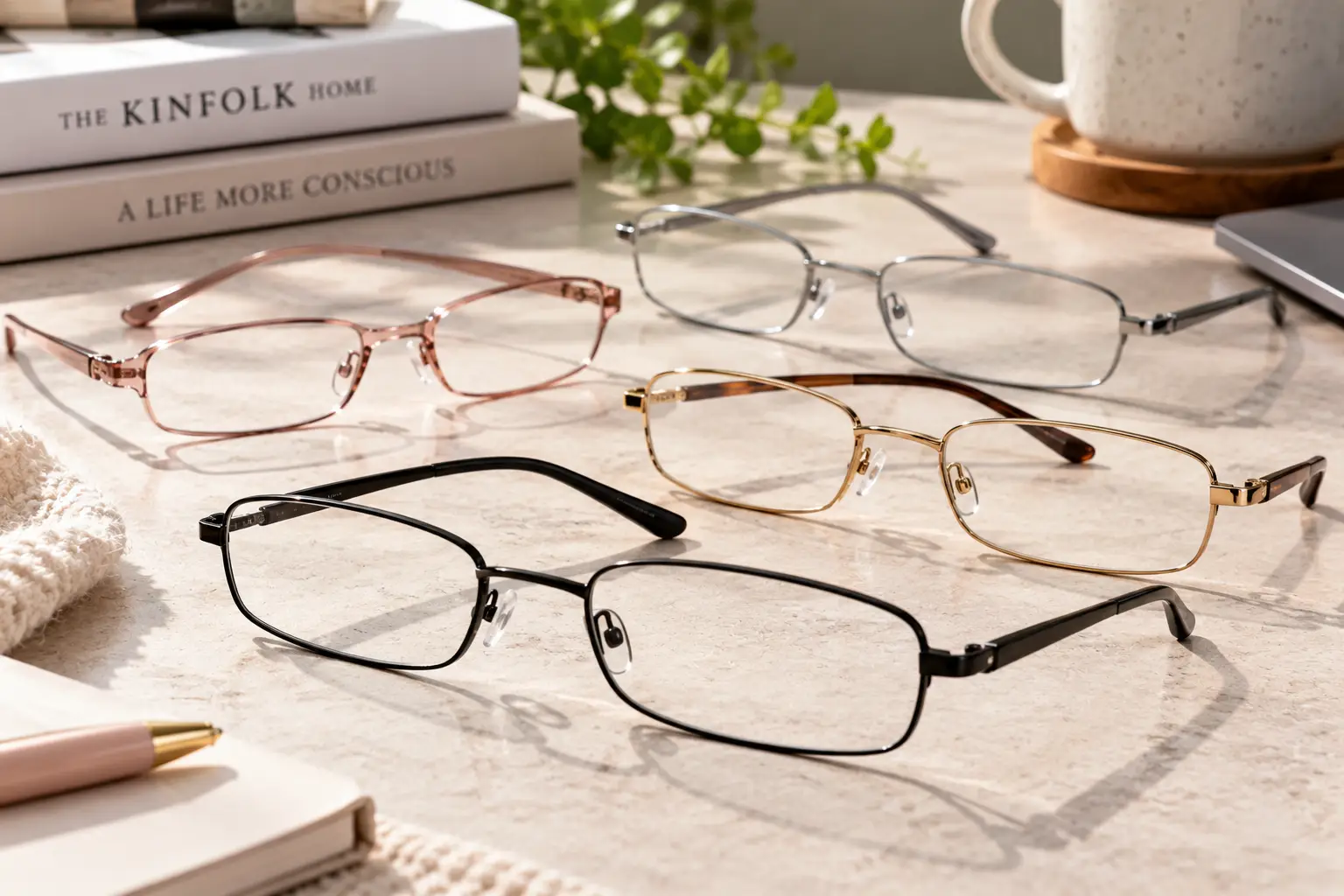
If your glasses keep sliding down your nose, pinching at the hinges, or poking out past your temples like side mirrors, the problem probably isn’t your face. It’s the frame. Narrow frame glasses solve a surprisingly common fit problem: most off-the-rack eyewear is cut for an “average” face that’s wider than a lot of real ones. 👓
Here’s the thing most shopping guides skip. “Narrow” means two different things in eyewear, and mixing them up is how people end up returning glasses. One meaning is horizontal — a total frame width that suits a slim or petite face. The other is vertical — a short, slim lens height that gives you that sleek rectangular look. Narrow frame glasses can be one, the other, or both, and each version affects comfort, style, and even which lenses you can put in them.
That’s why this guide doesn’t just list pretty frames. We compared real spec sheets (lens width, bridge, temple length, and the often-hidden fourth number: lens height), read through aggregated customer feedback, and checked what those numbers mean in practice. You’ll find seven real options available on amazon.com — from designer Ray-Ban and Oakley frames to budget readers under $20 — plus the lens-height math that decides whether a slim frame can take progressive lenses.
One quick consumer tip before we dive in: under federal law, your eye doctor has to hand you a copy of your eyeglass prescription after a refraction, at no extra charge. The FTC explains your rights in its guide to buying prescription glasses or contact lenses — and that copy is exactly what you need to order prescription narrow frame glasses online.
What Are Narrow Frame Glasses?
Narrow frame glasses are eyeglasses with a slim profile — either a total frame width under roughly 130mm for smaller faces, or a short lens height (often about 30-35mm) that creates a sleek rectangular look. They suit narrow faces, minimalist styles, and readers, but very shallow lenses can limit progressive-lens options.
To put numbers on it, one eyewear brand’s sizing chart labels frames under 130mm wide as “Narrow,” 131-139mm as average, and 140mm or more as wide. Those are useful guardrails, not laws — your own face measurement always wins.
✅ The quick takeaway: before you fall for a style, find the frame width and lens height. Those two numbers predict fit and lens compatibility better than any marketing photo ever will.
Quick Comparison: 7 Narrow Frame Glasses at a Glance
| Frame | Size (lens-bridge-temple) | Lens height | Type | Price range | Best for |
|---|---|---|---|---|---|
| Ray-Ban RX6285 | 53-18-140 | ~33mm | Semi-rimless metal | Around $150-$230 | Ray-Ban RX6285: sleek office look |
| Ray-Ban RX5228 | 50-17-140 / 53-17-140 | ~35-37mm | Full-rim acetate | Around $140-$230 | Ray-Ban RX5228: everyday prescription wear |
| Ray-Ban RX5154 Clubmaster | 49-21-140 | ~38mm | Browline acetate/metal | Around $150-$260 | Ray-Ban RX5154 Clubmaster: narrow faces, progressives |
| Oakley Plank 2.0 OX8081 | 53-18-139 | ~34mm | Full-rim plastic | Around $130-$220 | Oakley Plank 2.0 OX8081: active, sporty wearers |
| TIJN Semi-Rimless Rectangle | 52-17-145 | ~32mm | Half-frame, blue light lens | Under $30 | TIJN Semi-Rimless Rectangle: budget screen glasses |
| Foster Grant T10 | Not published by retailer | Not verified | Titanium readers | Around $20-$40 | Foster Grant T10: minimalist men’s readers |
| Eyekepper Small Lenses Rimless Readers | ~130mm frame width (men’s version) | Not verified | Rimless readers | Under $20 | Eyekepper Small Lenses Rimless Readers: petite faces on a budget |
Prices are approximate ranges at the time of writing and vary by color, size, and seller — always check the current price on Amazon.
Looking at the table, the real split isn’t brand — it’s lens height. The Ray-Ban RX6285, TIJN Semi-Rimless Rectangle, and Oakley Plank 2.0 OX8081 deliver the slim, low-profile look, but they sit close to the 28-30mm zone where standard progressives start to struggle. If you need multifocals, the Ray-Ban RX5154 Clubmaster (49mm size) is the smart compromise: narrow overall width with a roomier 38mm lens.
💬 One click helps other shoppers make an informed choice too! 😊
Top 7 Narrow Frame Glasses: Expert Analysis
Each pick below was chosen from real, currently listed models, judged on published measurements and aggregated buyer sentiment — not on marketing copy. Where a spec or review trend couldn’t be verified, we say so.
1. Ray-Ban RX6285 — slimmest designer profile here
The Ray-Ban RX6285 is the most “executive” frame in this lineup: a semi-rimless metal rectangle with a lens height of about 33mm. On paper, that 53-18-140 size with a roughly 134mm total width puts it at the upper edge of narrow, so it suits slim-to-average faces rather than truly petite ones.
The semi-rimless build matters more than it looks. With no bottom rim, the lower edge of the lens disappears, which keeps the face looking open — a real plus if heavy frames tend to swallow your features. The adjustable nose pads let an optician fine-tune height and grip, which is exactly what a slim metal frame needs to stop sliding.
Who’s it for? Professionals who want narrow rectangle glasses with designer polish, and single-vision wearers. The 33mm lens height is workable for some short-corridor progressives, but standard designs may feel cramped — ask your optician before ordering multifocals. Retailer reviews for this model are limited, so we can’t summarize a strong review trend; the analysis here rests on specs and Ray-Ban’s general build reputation.
Pros:
- ✅ Semi-rimless design keeps the look light and modern
- ✅ Adjustable nose pads allow a precise optician fit
- ✅ Slim 33mm lens height delivers a true low-profile look
Cons:
- ❌ Limited verified customer reviews for this specific model
- ❌ Shallow lenses narrow your progressive-lens options
💲 Expect around $150-$230 for the frame (check the current price); fair value if you want a designer metal frame that stays understated.
2. Ray-Ban RX5228 — the dependable everyday rectangle
If you want one frame that simply works, the Ray-Ban RX5228 is it. It comes in multiple sizes — 50, 53, and 55mm lens widths with a 17mm bridge — and lens heights land around 35mm (50 size) to about 37mm (53 size).
That size range is the hidden superpower. Narrow faces can choose the 50mm version instead of settling for a “standard” fit, and the 35-37mm lens height leaves comfortable room for most single-vision and many progressive prescriptions. The full-rim acetate holds thicker lenses cleanly, so higher prescriptions look neater than in rimless styles.
Aggregated buyer feedback consistently describes the frame as light, and at least one European retailer notes it fits snugly at the ears and nose. Reviews also suggest people with smaller faces are happier in the 50mm size than the 53mm. Based on comparing the specs, the 17mm bridge suits average-to-narrow noses; low or very wide bridges may need nose-pad adjustments.
Pros:
- ✅ Three sizes, including a genuinely narrow 50mm option
- ✅ Lens height friendly to many progressive designs
- ✅ Full-rim acetate hides thick prescription lens edges
Cons:
- ❌ Molded acetate bridge offers less adjustability than pads
- ❌ Classic styling may feel too safe for bold dressers
💲 Usually around $140-$230 depending on size and color; strong value for a frame you’ll wear daily for years.
3. Ray-Ban RX5154 Clubmaster — narrow width, roomy lens
The Ray-Ban RX5154 Clubmaster is the retro browline icon, and its 49mm size is one of the smartest picks for glasses for narrow faces. Clearly lists the 49-21-140 version at about 131mm total width with a 38.3mm lens height — and tags its fit as “Narrow.”
Here’s what that combination means in practice: you get a slim overall footprint that won’t overhang your temples, yet a deeper lens than any other frame on this list. That’s rare. Most narrow frame glasses buy their slimness by cutting lens height; the Clubmaster keeps the height and trims the width instead. The acetate brow plus metal lower rim and adjustable nose pads add stability.
It’s ideal for petite or slim faces, and especially for anyone who needs progressives but hates bulky frames. Larger 51mm and 53mm sizes exist if your face is closer to average. Real-world feedback across retailers centers on the timeless look; the trade-off reviewers mention is that the bold brow line is a statement — it frames your eyebrows, for better or worse.
Pros:
- ✅ Narrow 131mm width with a generous 38mm lens
- ✅ Excellent candidate for progressive or bifocal lenses
- ✅ Adjustable nose pads improve grip on slim noses
Cons:
- ❌ Strong browline styling doesn’t suit every face
- ❌ Wider 21mm bridge may sit low on very narrow noses
💲 Typically around $150-$260 for the frame; the best value here if you need multifocals in a narrow fit.
4. Oakley Plank 2.0 OX8081 — sporty slim for active days
The Oakley Plank 2.0 OX8081 brings Oakley’s athletic DNA to a clean rectangular frame. Published measurements show a 53-18-139 size, a 131mm total frame width, and a 34mm lens height.
That 131mm width is the number to notice: it’s right on the narrow/average border, so the Plank fits slim faces without looking undersized on average ones. The 34mm lens is slim enough for a low-profile look yet roomier than the RX6285, giving you a bit more flexibility at the optician. Oakley’s sport heritage generally translates into frames built to stay put during movement — useful if you bike, hike, or chase toddlers.
It’s for active wearers who want narrow rectangle glasses that don’t look like safety goggles. Honest caveat: we couldn’t verify a robust, model-specific review trend for the Plank 2.0 on US retail pages, so this assessment rests on measurements and brand positioning rather than aggregated sentiment.
Pros:
- ✅ 131mm width suits slim and average faces alike
- ✅ Sporty, lightweight build made for moving around
- ✅ 34mm lens balances slim looks with lens flexibility
Cons:
- ❌ Model-specific customer reviews are hard to verify
- ❌ Sport branding may feel too casual for formal settings
💲 Around $130-$220 depending on color and seller; solid value if durability matters more than designer cachet.
5. TIJN Semi-Rimless Rectangle — best budget slim screen glasses
The TIJN Semi-Rimless Rectangle blue light glasses deliver the trendy half-frame look for a fraction of designer prices. The listing gives 52-17-145 measurements, a 137mm frame width, and a 32mm lens height.
Translate that: the 32mm lens gives you the slim retro-minimal silhouette, but the 137mm width actually lands in the “average” bracket, so this is a narrow-height frame, not a narrow-width one. That’s fine for most faces, but truly petite faces may find it slightly wide. The blue light lenses are aimed at screen comfort; keep expectations realistic, since the science on blue light and eye strain is still developing.
It’s for students, remote workers, and anyone testing whether slim frames suit them before paying designer prices. TIJN’s best-selling blue light models carry tens of thousands of Amazon ratings with a generally positive average — but note that sentiment is aggregated across the brand’s popular models, not this exact frame.
Pros:
- ✅ Very low price for a stylish semi-rimless look
- ✅ Lens height and full specs clearly published
- ✅ Good trial pair before investing in designer frames
Cons:
- ❌ 137mm width may feel wide on petite faces
- ❌ Blue light benefits are modest and not guaranteed
💲 Usually under $30; excellent value as a non-prescription or backup pair.
6. Foster Grant T10 — featherweight titanium readers
The Foster Grant T10 is a men’s reading glass built around minimalism: a slim, narrow rectangular titanium frame with plastic-covered ear tips and adjustable clear nose pads.
Titanium is the key feature. It’s light and corrosion-resistant, so a narrow titanium frame can rest on your nose all afternoon without leaving deep pad marks. Adjustable pads are unusual on drugstore-style readers, and they matter: they let you raise or lower the lens so your eyes look through the optical center instead of the edge.
The Foster Grant T10 suits men who want discreet readers that look closer to prescription eyewear. Honest note: the retail listings we found don’t publish lens height or full frame width, so verify dimensions on the Amazon listing before buying. Across Foster Grant’s men’s readers, a recurring theme in reviews is that frames can run smaller or narrower than expected — good news for slim faces, a warning for wider ones.
Pros:
- ✅ Lightweight titanium for comfortable all-day reading
- ✅ Adjustable nose pads, rare on ready-made readers
- ✅ Understated look that passes for prescription frames
Cons:
- ❌ Full frame dimensions are not clearly published
- ❌ Brand reviews note sizing can run small
💲 Generally in the $20-$40 range at the time of writing; good value for a premium-feeling reader.
7. Eyekepper Small Lenses Rimless Readers — tiny budget fit for petite faces
The Eyekepper Small Lenses Rimless Readers are designed specifically for narrow head sizes, with aspheric acrylic lenses in a frameless setup. A related men’s frameless version lists a 130mm frame width with anti-reflective and scratch-resistant coatings.
Why it matters: rimless designs are the lightest possible construction, and the small lens footprint keeps the readers from overhanging a slim face. Aspheric lenses help reduce edge distortion, which is noticeable when you glance down at a phone or book.
Aggregated reviews are a genuine mixed bag — and that’s useful information. Buyers frequently praise how light and inconspicuous they are, and several reviewers with narrow faces say these finally fit after years of oversized readers. On the flip side, a recurring complaint is fragility, plus a very narrow bridge that some noses find tight. Treat them as affordable “everywhere” readers rather than heirlooms.
Pros:
- ✅ Sized specifically for narrow head sizes
- ✅ Ultra-light rimless build feels almost invisible
- ✅ Very affordable, easy to stash multiple pairs
Cons:
- ❌ Reviews report fragility with rough handling
- ❌ Narrow bridge can pinch wider noses
💲 Typically under $20; unbeatable value for spare readers, less so as a primary pair.
Detailed Comparison of the Top 7
| Frame | Frame width | Weight class | Progressive-friendly? | Best for |
|---|---|---|---|---|
| Ray-Ban RX5154 Clubmaster | ~131mm | Medium | Yes (38mm lens) | Ray-Ban RX5154 Clubmaster: narrow faces needing multifocals |
| Ray-Ban RX5228 | ~130mm (53 size) | Light | Usually (35-37mm) | Ray-Ban RX5228: all-day prescription wear |
| Oakley Plank 2.0 OX8081 | ~131mm | Light | Often, ask optician (34mm) | Oakley Plank 2.0 OX8081: active lifestyles |
| Ray-Ban RX6285 | ~134mm | Light | Limited (33mm) | Ray-Ban RX6285: minimalist professionals |
| TIJN Semi-Rimless Rectangle | 137mm | Light | Limited (32mm) | TIJN Semi-Rimless Rectangle: budget screen wear |
| Foster Grant T10 | Not published | Very light | No (readers) | Foster Grant T10: men’s readers |
| Eyekepper Small Lenses Rimless Readers | ~130mm | Very light | No (readers) | Eyekepper Small Lenses Rimless Readers: petite faces, spares |
The table makes the trade-off obvious: the slimmer the lens, the fewer progressive options you have. For single vision, the Ray-Ban RX6285 and TIJN Semi-Rimless Rectangle give the sleekest look, while the Ray-Ban RX5154 Clubmaster and Ray-Ban RX5228 are the safer bets if your prescription might become multifocal in the next few years.
✨ Don’t miss these slim-fit standouts!
🔍 Take your eyewear to the next level with this carefully curated lineup. Click a highlighted frame to check current pricing and availability — and find the narrow fit you’ve been missing!
Getting Started: Your First 30 Days With Narrow Frame Glasses
New narrow frame glasses rarely feel perfect out of the box — and that’s normal. Slim frames have less surface area to spread weight and less lens area to look through, so small adjustments make a big difference. Here’s a practical first-month plan.
🗓️ Days 1-3: Check the fit, not just the look
- ✅ The frame front should be about as wide as your face at the temples — no gap of more than a finger’s width on each side.
- ✅ Your pupils should sit near the horizontal center of each lens. On a shallow 30-33mm lens, eyes sitting too high or low is instantly noticeable.
- ✅ Temples should touch lightly behind the ears, not press. Pressure points show up as headaches by day two.
🔧 Days 4-10: Get a professional adjustment
Most optical shops will adjust frames bought elsewhere, sometimes for free or a small fee. Ask them to set nose-pad height (on the Ray-Ban RX6285, Ray-Ban RX5154 Clubmaster, or Foster Grant T10) and to bend the temple tips for grip. Acetate frames like the Ray-Ban RX5228 can be gently heated and reshaped — never try this with a hair dryer at home.
👀 Days 11-30: Build habits that protect a slim frame
- ❌ Don’t push glasses up onto your head — it stretches narrow temples fast, a complaint that shows up repeatedly in reader reviews.
- ✅ Take them off with two hands to keep hinges aligned.
- ✅ Clean with lukewarm water, a drop of dish soap, and a microfiber cloth; skip paper towels, which scratch coatings.
- ✅ If you’re wearing progressives, give your brain one to two weeks to adapt — and go back to your optician if the reading zone still feels “cut off.”
Real-World Scenarios: Which Narrow Frame Fits Your Life?
Specs only matter when they meet a real routine. Here are four common buyer profiles and the frames that match them best.
💼 The slim-faced professional, single vision, $150-$250 budget
You wear glasses 10+ hours a day, mostly at a desk and in meetings. The Ray-Ban RX6285 gives the sharpest minimalist look, while the Ray-Ban RX5228 in 50mm is the comfort pick if your face is truly narrow. Choose the RX6285 if style is the priority, the RX5228 if you want a thicker rim to hide a moderate prescription.
🧓 The first-time progressive wearer, 45+, narrow face
You need distance, computer, and reading vision in one pair. The Ray-Ban RX5154 Clubmaster (49mm) is the strongest fit: around 131mm wide but with a 38mm lens, giving progressive designs room to breathe. Your second choice is the Ray-Ban RX5228 in 53mm. Skip ultra-slim lenses for now.
🚴 The active weekend warrior, $130-$220
You move a lot and want frames that survive it. The Oakley Plank 2.0 OX8081 balances a narrow-to-average 131mm width with a sporty build. Pair it with polycarbonate or Trivex lenses for extra impact resistance.
📚 The budget reader with a petite face, under $40
You just need readers that don’t slide off. Keep the Foster Grant T10 as your main pair for its adjustable pads, and stash a few Eyekepper Small Lenses Rimless Readers in the car, kitchen, and bag. If you stare at screens all day, add the TIJN Semi-Rimless Rectangle as a non-prescription computer pair.
Problem → Solution: Fixing Common Narrow-Frame Annoyances
Problem 1: Glasses slide down your nose. ➡️ Solution: Choose frames with adjustable nose pads (Ray-Ban RX6285, Ray-Ban RX5154 Clubmaster) and have an optician tighten the temple bend. With molded acetate bridges, add-on silicone pads help.
Problem 2: Your eyebrows sit above the frame, making you look “surprised.” ➡️ Solution: Slim lenses can sit low on longer faces. A browline like the Ray-Ban RX5154 Clubmaster lines up the top edge with your brows.
Problem 3: You’re always looking over the top of your readers. ➡️ Solution: That’s usually a sign the lens is too shallow for how you use it. Move to a slightly deeper frame or use readers only for close tasks.
Problem 4: Progressive lenses feel like reading through a keyhole. ➡️ Solution: Ask your optician about a short-corridor design, or switch to a frame with at least 30mm of lens height.
Problem 5: Hinges loosen within months. ➡️ Solution: Tighten screws with an eyeglass screwdriver every few weeks. Budget readers like the Eyekepper Small Lenses Rimless Readers are worth treating as replaceable.
How to Choose Narrow Frame Glasses
- Measure your current frame width. Lay a pair that fits well face-down and measure hinge to hinge across the front. That single number is your best predictor of fit.
- Read the full size code. The numbers on the inside of the temple are lens width, bridge, and temple length (e.g., 49-21-140). Some brands add a fourth number: lens height.
- Match frame width to face width. Under about 130mm generally reads as narrow; 131-139mm as average. Petite faces should stay at or under ~131mm.
- Check lens height against your prescription. Single vision works in almost any height; progressives generally want 28-30mm or more.
- Pick a bridge that suits your nose. Low or narrow nose bridges usually do better with adjustable pads than molded acetate bridges.
- Choose material for your day. Titanium and thin metal for featherweight comfort; acetate for durability and hiding thick lens edges.
- Confirm temple length. Most adults land between 135mm and 145mm; too long and the frame slides, too short and it pinches.
Based on comparing dozens of spec sheets, step 3 is where most online returns start — people buy by lens width alone and forget the bridge adds to total width.
Narrow Frame Glasses and Progressive Lenses: The Lens-Height Math
This is the section most style guides leave out, and it can save you an expensive remake. A progressive lens stacks three zones vertically: distance at the top, intermediate in the middle, and reading at the bottom. All three need vertical room.
Industry guidance commonly cites a minimum lens height of about 28-30mm for standard progressives, and some online retailers simply block progressive orders on frames at or below 30mm. Short-corridor designs exist for smaller frames — some lens makers advertise minimum fitting heights well below 20mm — but there’s a trade-off: compressed zones can feel narrower and take longer to adapt to.
What this means for the lineup:
- ✅ Ray-Ban RX5154 Clubmaster (~38mm) and Ray-Ban RX5228 (~35-37mm): comfortable territory for most progressives.
- ⚠️ Oakley Plank 2.0 OX8081 (~34mm) and Ray-Ban RX6285 (~33mm): workable with the right design — confirm with your optician first.
- ❌ TIJN Semi-Rimless Rectangle (~32mm): technically above the minimum, but semi-rimless construction is generally considered less stable for multifocals.
Also note that lens height isn’t the same as fitting height — the distance from your pupil to the bottom of the lens. A 33mm lens with your pupil sitting high can still leave too little reading area.
Narrow Frame Glasses vs Taller, Wider Frames
Oversized frames dominated the last decade, so it’s worth asking what you actually gain by going slim.
| Factor | Narrow frame glasses | Taller/wider frames | Best for |
|---|---|---|---|
| Fit on slim faces | Sits flush, less sliding | Overhangs temples | Narrow: petite faces |
| Weight | Usually lighter | Heavier lenses and fronts | Narrow: all-day wear |
| Progressive lenses | Limited if lens <30mm | Plenty of zone room | Taller: multifocal wearers |
| Field of view | Smaller, more edge in view | Wider, less frame in view | Taller: driving, sports |
The trade-off is clean: narrow frame glasses win on fit, weight, and a sharp minimalist look, while taller frames win on lens real estate. That’s why the Ray-Ban RX5154 Clubmaster is so useful — it splits the difference with slim width and generous height.
Glasses for Narrow Faces: Advice by Wearer
Petite women and teens with adult-size prescriptions: look for frame widths under 130mm. Cat-eye and browline shapes add visual width at the top, which balances a slim face.
Men with long, narrow faces: narrow rectangle glasses with a bit of height (34mm or more) balance length better than ultra-thin slits. The Oakley Plank 2.0 OX8081 and Ray-Ban RX5228 both work here.
Seniors and readers: prioritize light weight and adjustable pads. The Foster Grant T10 wins on comfort; the Eyekepper Small Lenses Rimless Readers win on price.
Heavy screen users: a slim frame keeps your peripheral view less cluttered at a desk. The TIJN Semi-Rimless Rectangle is the low-cost entry point.
Features That Actually Matter (and Ones That Don’t)
Matters: total frame width, lens height, bridge style (pads vs. molded), hinge quality, and lens material. Spring hinges are genuinely useful on cheap readers because they absorb the stress of one-handed removal.
Matters less than marketing suggests: “ultra-HD” lens claims on plano screen glasses, decorative temple logos, and blue light percentages. If a frame doesn’t fit, no coating can save it.
Sleeper feature: a published lens height. Brands that list it — as TIJN does — make your decision dramatically easier.
Common Mistakes to Avoid When Buying Narrow Frame Glasses
- ❌ Shopping by lens width only. A 49mm lens with a 21mm bridge can be wider overall than a 52mm lens with a 17mm bridge.
- ❌ Ignoring lens height until checkout. Many buyers discover their progressive order is blocked only after falling for a frame.
- ❌ Assuming “narrow fit” means the same across brands. Sizing labels aren’t standardized; compare millimeters.
- ❌ Forgetting your PD. Your pupillary distance isn’t always printed on the prescription, and with small lenses, an off-center PD is more noticeable.
- ❌ Buying rimless for a strong prescription. Thick lens edges show, and rimless mounts are less forgiving of high powers.
Long-Term Cost and Maintenance
The frame price is only part of the bill. Prescription lenses often cost as much as the frame — or more for progressives and premium coatings.
| Frame | Frame cost (approx.) | Expected lifespan | Value verdict | Best for |
|---|---|---|---|---|
| Ray-Ban RX5228 | $140-$230 | Several years with care | High: re-lens later | Ray-Ban RX5228: long-term primary pair |
| Ray-Ban RX5154 Clubmaster | $150-$260 | Several years | High for progressives | Ray-Ban RX5154 Clubmaster: multifocal users |
| TIJN Semi-Rimless Rectangle | Under $30 | 1-2 years typical | High as backup | TIJN Semi-Rimless Rectangle: second pair |
| Eyekepper Small Lenses Rimless Readers | Under $20 | Months to a year | Fine as spares | Eyekepper Small Lenses Rimless Readers: stash pairs |
The pattern is simple: designer frames cost more upfront but can be re-lensed when your prescription changes, spreading the cost over years. Budget frames are better viewed as replaceable — great value, as long as you don’t expect them to last like acetate. Your annual upkeep is mostly a new pair of nose pads and a screw tightening, both cheap at most optical shops.
Safety, Regulations, and Standards
In the US, eyeglass and sunglass lenses must generally be impact-resistant under FDA regulation 21 CFR 801.410. The reference “drop ball” test drops a 5/8-inch steel ball weighing about 0.56 ounce from 50 inches onto the lens. Impact-resistant doesn’t mean shatterproof, though — for sports or kids, ask for polycarbonate or Trivex.
On the prescription side, the FTC’s Eyeglass Rule (16 CFR Part 456) requires prescribers to give you your prescription after a refraction. Your PD measurement is a different story: only a few states require it on the prescription, and some allow a fee — so ask during your exam.
FAQ: Narrow Frame Glasses
❓ Can I buy narrow frame glasses on Amazon with my prescription?
❓ Are narrow frame glasses good for round faces?
❓ What size is considered a narrow frame for glasses?
❓ Do narrow glasses frames work for reading glasses?
❓ Are cheap narrow frame glasses worth buying?
Conclusion: Finding Narrow Frame Glasses That Actually Fit
The best narrow frame glasses aren’t simply the thinnest ones — they’re the ones whose numbers match your face and your lenses. Start with total frame width for comfort, then check lens height for prescription compatibility, and only then fall in love with a style.
For most people with slim faces who need progressives now or soon, the Ray-Ban RX5154 Clubmaster in 49mm is the standout: narrow footprint, roomy lens. If you want a do-everything daily frame, the Ray-Ban RX5228 in 50mm is hard to beat. Style-first minimalists will love the Ray-Ban RX6285, active wearers should look at the Oakley Plank 2.0 OX8081, and anyone on a tight budget can test the slim look with the TIJN Semi-Rimless Rectangle. For readers, the Foster Grant T10 brings comfort and the Eyekepper Small Lenses Rimless Readers bring unbeatable spare-pair value.
Whichever you choose, get a professional adjustment in the first couple of weeks. With narrow frames, a few millimeters of nose-pad height is the difference between “almost right” and “forgot I’m wearing them.”
🎯 Ready to find your perfect slim fit?
👓 Click any highlighted frame above to check today’s price and availability — your next favorite pair of glasses could be one click away!
Recommended for You
- Glasses Without Prescription Lenses: 7 Best Picks for 2026 (Honest)
- Are Anti Fatigue Lenses Worth It? 7 Best Picks for 2026
- Big Frame Reading Glasses: 7 Best Picks That Actually Fit (2026)
Disclaimer: This post contains affiliate links. As an Amazon Associate, I earn from qualifying purchases made through these links, at no additional cost to you.
✨ Found this article helpful? Share it with someone who needs it! 💬🤗