In This Article
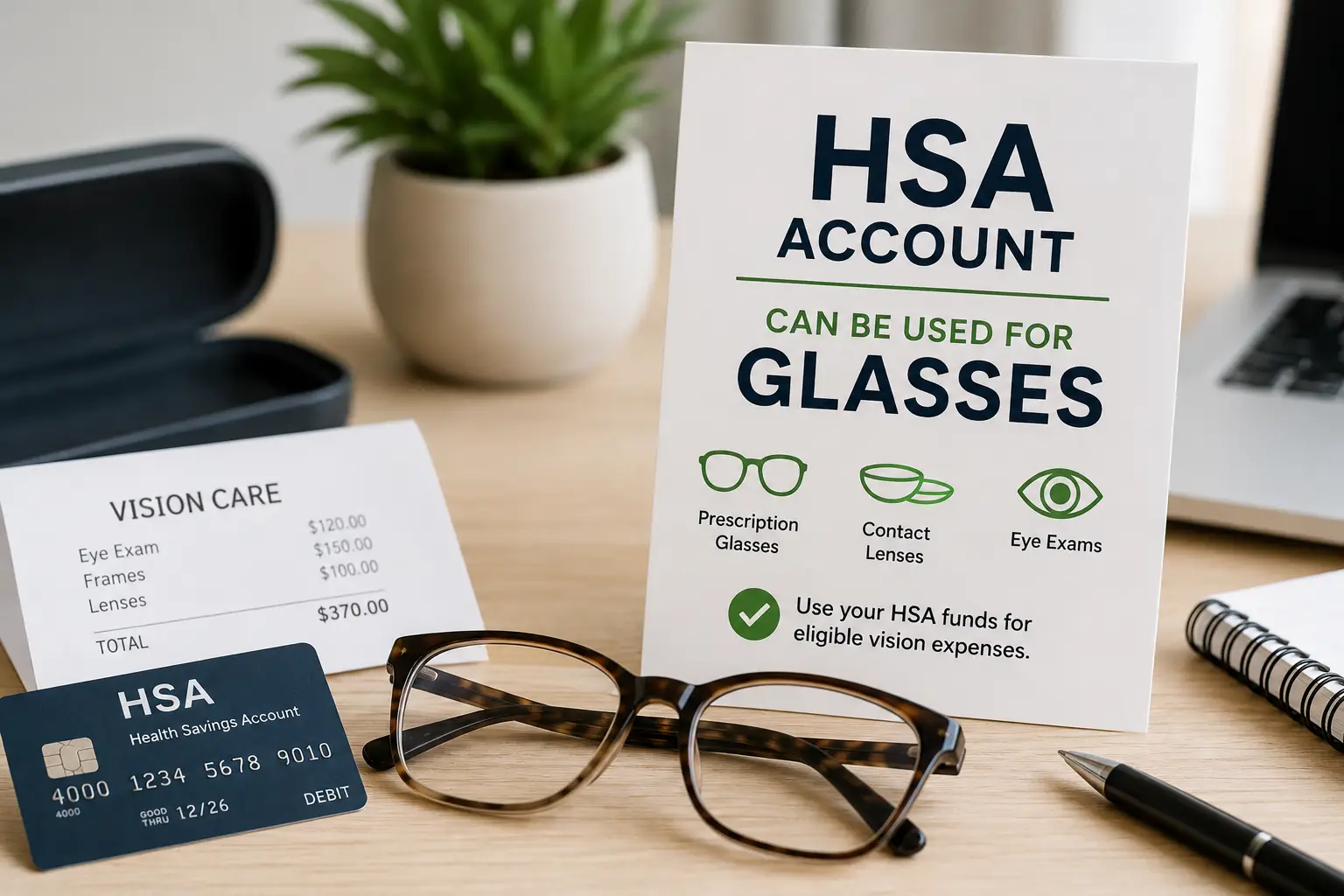
If you’ve got money sitting in a health savings account and a stack of receipts you never got around to filing, you’re not alone. A surprising number of HSA holders let their balance grow quietly for years without realizing one of the easiest, most guaranteed ways to spend it is sitting right on their face. An hsa account for glasses is one of the most straightforward, IRS-sanctioned ways to put pre-tax dollars to work, because vision correction is squarely defined as a qualified medical expense.
Here’s the short version, since it’s the question most people actually type into Google: prescription eyeglasses, prescription sunglasses, and even non-prescription reading glasses are generally eligible for HSA reimbursement, according to IRS guidance covering eyeglasses and contact lenses needed for medical reasons, as detailed in IRS Publication 502. What’s murkier — and what trips people up every single tax season — is where the line falls for blue light glasses, designer sunglasses, and computer eyewear that doesn’t come with a prescription attached.
That’s exactly what this guide untangles. We’ll walk through what genuinely qualifies, what doesn’t, and seven real, currently available glasses you can buy on Amazon today using HSA or FSA funds — spanning ultra-budget multi-packs to premium gaming-grade lenses. Along the way, we’ll cover how to choose the right pair for your prescription needs, screen habits, and budget, plus the common mistakes that get people denied at reimbursement time. For 2026, individuals can contribute up to $4,400 to an HSA and families up to $8,750, so there’s a decent chance you have more room to spend than you think.
Let’s get your eyes — and your HSA balance — sorted out.
What Is an HSA Account for Glasses?
An hsa account for glasses simply means using pre-tax dollars from your health savings account to pay for prescription eyewear, non-prescription readers, or prescription sunglasses. Because vision correction is classified as a qualified medical expense under IRS Code Section 213(d), you can pay directly with your HSA debit card or submit a receipt for reimbursement — no separate vision insurance required.
Quick Comparison: 7 HSA/FSA-Eligible Glasses at a Glance
| Product | Best For | Price Range | Rating (Aggregated) |
|---|---|---|---|
| GUNNAR Intercept | All-day computer work | $50–$65 | ~4.4/5 |
| ThinOptics Reading Glasses | Ultra-portable readers | $20–$30 | ~4.5/5 |
| Gaoye 5-Pack Readers | Budget multi-pack | $15–$25 | ~4.6/5 |
| Foster Grant Callie | Classic everyday style | $15–$25 | ~4.3/5 |
| Peepers Center Stage | Fashion-forward readers | $30–$45 | ~4.5/5 |
| GUNNAR Vertex | Gamers and streamers | $60–$80 | ~4.3/5 |
| Eyekeeper Blue Light Glasses | Budget alternative brand | $15–$20 | ~4.4/5 |
Looking at the table, the split is really about how you use your eyes each day rather than brand loyalty. Budget multi-packs like the Gaoye 5-Pack Readers dominate on value because you’re covering multiple prescriptions and locations for the price of one premium pair, while the GUNNAR Intercept and GUNNAR Vertex justify their higher price tags with more durable frames and better-tested blue light filtration for people staring at screens eight-plus hours a day. If you split your HSA dollars between a workhorse computer pair and a cheap backup reader for the nightstand, you’ll usually come out ahead financially and practically.
💬 One click helps other shoppers make an informed choice too! 😊
Can You Use an FSA for Glasses Too?
fsa eligible glasses work almost identically to HSA-eligible ones, which causes a lot of the confusion in the first place. Both account types draw on IRS Code Section 213(d)’s definition of qualified medical expenses, so if a pair of glasses is HSA-eligible, it’s virtually always FSA-eligible too — eyeglasses are eligible for reimbursement with a prescription with a flexible spending account (FSA), health savings account (HSA), health reimbursement arrangement (HRA), and a limited-purpose flexible spending account (LPFSA).
The practical differences come down to account mechanics, not eligible products. As Wikipedia’s overview of flexible spending accounts explains, an FSA is typically employer-sponsored, funded through payroll deduction, and subject to a “use it or lose it” deadline each plan year (sometimes softened by a grace period or a small carryover). An HSA, by contrast, requires you to be enrolled in a qualifying high-deductible health plan, but the balance rolls over indefinitely and stays with you even if you switch jobs. If you’re the type of shopper who forgets to spend down FSA funds before December 31, glasses are one of the easiest last-minute purchases to make, since most FSA and HSA debit cards work instantly at checkout on Amazon’s FSA/HSA storefront without needing to submit a claim afterward.
One nuance worth flagging: a Limited Purpose FSA (LPFSA), often paired with an HSA, restricts spending to dental and vision expenses only. If your employer offers one, glasses are exactly the category it exists for — so it’s worth checking whether you’re sitting on an LPFSA balance in addition to your HSA.
Top 7 HSA/FSA-Eligible Glasses to Buy on Amazon
The seven picks below cover the realistic range of what shows up filtered under Amazon’s “FSA or HSA Eligible” badge — from ultra-cheap multi-packs to premium computer eyewear. None of these require a prescription to purchase (Amazon doesn’t process prescription verification at checkout), so if you need true prescription lenses, pair this list with the guidance in the “Prescription vs. Non-Prescription” section below.
1. GUNNAR Intercept Computer Glasses — best all-around for screen fatigue
The GUNNAR Intercept built its reputation as the go-to option for people who live in front of a monitor, and the amber-tinted lens is the reason why. The lenses use a patented lens tint plus a slight base curve that GUNNAR says reduces glare and screen reflection rather than just tinting the world yellow — in practice, this means less squinting under fluorescent office lighting and fewer end-of-day headaches for people doing 6+ hour screen sessions.
What most buyers overlook with this model is that it’s available in a genuine prescription lens option, not just plano (non-prescription) blue light filtering, which is what actually makes it fully HSA-reimbursable in the strictest IRS sense rather than a gray-area purchase. Based on comparing the frame specs against cheaper alternatives, the spring hinges and lightweight polymer frame also hold up better to being tossed in a bag daily than the ultra-thin plastic used in $15 blue light glasses.
Reviews consistently report solid comfort during long wear and noticeably less eye strain by evening, though a recurring complaint is that the amber tint noticeably shifts color perception, which some designers and photo editors find distracting for color-sensitive work.
Pros:
- ✅ Genuine prescription lens option available
- ✅ Durable, adjustable spring-hinge frame construction
- ✅ Reviewers consistently report reduced end-of-day eye strain
Cons:
- ❌ Amber tint shifts on-screen color accuracy
- ❌ Pricier than basic plano blue light glasses
Expect to pay in the $50–$65 range for the non-prescription version; prescription lenses push the total higher, so check the current price before ordering. For anyone doing serious daily screen work, the value case is strong — this is a legitimate medical-grade tool, not just an accessory.
2. ThinOptics Reading Glasses with Universal Pod — most portable for readers
The ThinOptics Reading Glasses solve a problem almost every reading-glasses owner has: losing the pair the moment you actually need them. The frameless, ultra-thin lenses fold flat and snap into a magnetic pod that sticks to the back of a phone case, so the glasses genuinely travel with you rather than living in a junk drawer.
The lenses themselves are a straightforward magnification design (available from +1.00 up through +3.00), with no bells and whistles — no blue light coating, no anti-glare layer — which keeps them squarely in the “corrective reading glasses” category the IRS explicitly lists as HSA-eligible even without a prescription. What most people underestimate is how much this changes daily behavior: when the glasses are always within reach, you’re far less likely to squint at a menu or a prescription label and strain your eyes unnecessarily.
Reviews consistently report high satisfaction with the portability factor specifically, with many buyers mentioning they bought a second or third pod for a work bag, car, and nightstand.
Pros:
- ✅ Genuinely pocket-sized, unlike standard folding readers
- ✅ Magnetic pod keeps them from getting lost
- ✅ Multiple magnification strengths available
Cons:
- ❌ No blue light filtering or anti-glare coating
- ❌ Frameless lenses feel less sturdy than full-rim glasses
Pricing typically falls in the $20–$30 range depending on the pod style you choose. Given how often misplaced readers get replaced out of frustration, the built-in portability arguably pays for itself within a year.
3. Gaoye 5-Pack Blue Light Reading Glasses — best budget multi-pack
The Gaoye 5-Pack Readers consistently show up as a bestseller in Amazon’s reading glasses category, and the value proposition is simple: five distinct frame styles and colors for roughly the cost of one premium pair elsewhere. Each pair includes a light blue-light-filtering coating alongside the magnification, which functionally means you get both correction and screen glare reduction without paying separately for the two features.
What the spec sheet doesn’t say, but the sheer volume of reviews suggests, is that these are commonly bought as “one for every room” glasses rather than a single primary pair — kitchen, office, car, nightstand, and a backup. That distribution strategy is smart from an HSA standpoint too, since a lost or scratched $4 pair is a non-issue compared to losing a $60 GUNNAR pair.
Reviews consistently report that the lenses meet expectations for casual reading and phone use, though a recurring theme in customer feedback is that the frame plastic feels noticeably lighter-duty than premium brands, and hinges can loosen after several months of daily folding.
Pros:
- ✅ Five frame styles included in one purchase
- ✅ Built-in blue light filtering at a budget price
- ✅ Reviews report solid comfort for light daily use
Cons:
- ❌ Hinges reported to loosen with heavy daily folding
- ❌ Frame plastic feels less substantial than premium brands
At around $15–$25 for the full five-pack, the cost-per-pair is genuinely hard to beat, and it’s one of the easiest ways to burn down a small leftover FSA balance before a year-end deadline.
4. Foster Grant Callie Blue Light Reading Glasses — best classic everyday pick
Foster Grant has been a household eyewear name for decades, and the Callie style leans into that legacy with a simple, professional rectangular frame that doesn’t scream “reading glasses” the way some drugstore styles do. Foster Grant’s own guidance confirms reading glasses are FSA-eligible, meaning pre-tax health care FSA money can go toward readers in any magnification power and style, and the same logic extends to HSA funds.
The practical draw here is consistency: Foster Grant has decades of manufacturing experience behind frame durability and lens clarity, so buyers aren’t gambling on an unfamiliar overseas brand. Based on comparing this against the ultra-budget options above, the trade-off is a slightly higher price point in exchange for tighter quality control and a frame that’s held up in mainstream retail for years.
Reviews consistently report accurate diopter strength (a common complaint with off-brand readers is mislabeled magnification) and comfortable, lightweight wear for extended periods, though some buyers note the semi-rimless design feels less protective against scratches than a full-rim frame.
Pros:
- ✅ Long-standing, trusted eyewear manufacturer
- ✅ Reviewers report accurate, consistent lens magnification
- ✅ Professional-looking frame suitable for office wear
Cons:
- ❌ Semi-rimless design more prone to lens scratching
- ❌ Fewer color options than newer indie brands
Expect a price in the $15–$25 range, positioning it as a dependable middle ground between disposable budget readers and premium designer frames.
5. Peepers by PeeperSpecs Center Stage Reading Glasses — best fashion-forward pick
Peepers built its entire brand around the idea that reading glasses shouldn’t look like a medical device, and the Center Stage frame — an oversized, slightly cat-eye silhouette — is a good example of that philosophy in action. Peepers directly confirms on their own site that while FSAs and HSAs will typically pay for reading glasses, they typically will not pay for non-corrective blue light glasses or non-corrective sunglasses, which is a useful reminder that this specific pair’s corrective magnification is what makes it HSA-eligible in the first place.
What sets Peepers apart from more clinical-looking readers is design intent: bold acetate frames, seasonal colorways, and shapes clearly borrowed from fashion eyewear rather than pharmacy shelves. For buyers who’ve avoided wearing readers in public out of self-consciousness, this is the category built specifically to solve that problem — the frame is meant to be a style statement first and a magnification tool second.
Reviews consistently report strong satisfaction with the aesthetic and fit, particularly for buyers with narrower face shapes who found generic drugstore frames too wide; a recurring critique is that the bold styling isn’t for everyone and some buyers found the frame too large for a subtler, work-appropriate look.
Pros:
- ✅ Distinctive, fashion-forward frame design
- ✅ Strong reviewer satisfaction with fit and comfort
- ✅ Multiple magnification strengths available
Cons:
- ❌ Bold styling may be too statement-making for office wear
- ❌ Priced higher than basic reader brands
Pricing typically lands in the $30–$45 range. If your HSA balance is padded and you’ve been putting off readers purely because you didn’t like how they looked, this is the pair worth the upgrade.
6. GUNNAR Vertex Gaming Glasses — best high-end pick for gamers
The GUNNAR Vertex sits at the top of GUNNAR’s lineup and is explicitly marketed toward gamers and streamers who spend extended sessions under artificial lighting and LED monitor glow. Independent testing from Tom’s Guide’s blue light glasses review specifically flags GUNNAR’s lineup as the top pick for gamers, noting that Gunnar’s blue light blocking glasses target gamers with a large range of coverage, and while more expensive than what typically comes up on Amazon, most people think they’re worth it.
The distinguishing feature here is lens variety: GUNNAR offers this frame with Amber, Amber Max, Clear, or Clear Pro tints depending on how aggressively you want blue light filtered, which matters because heavier filtration trades off against color accuracy — something competitive gamers evaluating on-screen detail actually care about. Here’s what to weigh: this is the pair to choose if you game or stream for multiple hours nightly and have already tried a budget option that didn’t cut it, not a first purchase for casual users.
Reviews consistently report the frame holds up well to repeated on/off wear during long sessions and fits comfortably under most gaming headsets, though the price point draws frequent comparison to cheaper Amazon alternatives that reviewers say perform “close enough” for casual use.
Pros:
- ✅ Multiple lens tint options for different filtering needs
- ✅ Reviewers confirm comfortable headset compatibility
- ✅ Backed by GUNNAR’s established gaming-eyewear reputation
Cons:
- ❌ Premium pricing compared to generic gaming glasses
- ❌ Heavier tints noticeably alter color perception
Expect a price range of roughly $60–$80. For serious daily gamers, the incremental cost over budget alternatives is easy to justify with an HSA covering it tax-free anyway.
7. Eyekeeper Blue Light Blocking Computer Glasses — best lesser-known alternative
Eyekeeper doesn’t have the brand recognition of GUNNAR or Foster Grant, but it’s earned a loyal following in Amazon’s computer glasses category as a reliable mid-tier alternative that undercuts premium brands on price without dropping to the flimsiest budget tier. The frames use a lightweight TR90 plastic — a material also common in sports eyewear — which flexes rather than snapping under pressure, a meaningful durability advantage over rigid acrylic frames.
What the spec sheet doesn’t say, but the review pattern reveals, is that Eyekeeper has built a niche specifically among remote workers and students who want genuine blue light filtering without paying GUNNAR-level prices. Based on comparing lens coatings across this price tier, the anti-glare and UV400 coating combination here matches what pricier brands offer, even if the frame styling is less distinctive.
Reviews consistently report satisfaction with comfort during multi-hour wear and note the lightweight frame doesn’t leave the nose-bridge marks heavier glasses can cause, though a recurring complaint is a more limited style selection than the bigger-name competitors.
Pros:
- ✅ Flexible, durable TR90 frame material
- ✅ Comparable lens coatings to pricier competitor brands
- ✅ Reviewers report comfortable multi-hour wear
Cons:
- ❌ Smaller range of frame styles than bigger brands
- ❌ Less established brand reputation than GUNNAR or Foster Grant
Pricing typically runs $15–$20, making it one of the strongest value-for-money picks on this list for anyone who wants genuine screen protection without a premium price tag.
How to Choose HSA-Eligible Glasses
Picking the right pair comes down to matching the glasses to how — and how often — you actually use your eyes each day. Here’s the process worth running through before you buy:
- Confirm the corrective purpose. Whether it’s magnification for reading or an actual prescription, the glasses need to correct vision, not just filter light, to sit cleanly within IRS Publication 502’s definition.
- Decide prescription vs. non-prescription. If you have a current prescription, decide whether you’re buying readers (off-the-shelf magnification) or true prescription lenses through an optical retailer.
- Match the lens coating to your screen time. Heavy computer or gaming use benefits from blue light filtering; casual reading generally doesn’t need it.
- Weigh frame durability against how roughly you treat glasses. If you’re prone to losing or crushing eyewear, a $15–$25 pair or a multi-pack is the financially smarter HSA purchase than a $70 premium frame.
- Check the “FSA or HSA Eligible” badge on the listing. Amazon flags eligible items directly at checkout, which removes the guesswork before you submit a claim.
- Save the itemized receipt. Your HSA administrator or the IRS may request documentation showing the purchase was corrective eyewear, not a cosmetic accessory.
- Buy the frame and lens together when possible. A single transaction with a clear “prescription eyewear” description on the receipt is easier to substantiate than a fragmented purchase.
Prescription Glasses vs. Non-Prescription Readers: What Your HSA Actually Covers
prescription glasses hsa purchases and off-the-shelf reading glasses both qualify, but the IRS treats them slightly differently in practice, and that distinction matters for how you document the purchase. According to guidance from Firstcard, non-prescription reading glasses qualify under IRS rules since they correct vision, while sunglasses without a prescription generally do not, even expensive designer pairs.
Prescription eyeglasses require a valid prescription from a licensed optometrist or ophthalmologist, and the frames, lenses, and standard add-ons (anti-reflective coating, progressive lenses, photochromic transition lenses) are all bundled into the eligible expense when purchased as part of the prescription order. This is where Amazon has a structural limitation worth knowing upfront: Amazon doesn’t verify or process eyeglass prescriptions at checkout, so true prescription eyewear generally needs to come from a dedicated optical retailer, your eye doctor’s office, or an online prescription specialist rather than Amazon’s general marketplace.
Non-prescription readers, by contrast, are exactly what you see filtered under Amazon’s FSA/HSA eyewear categories — pre-set magnification strengths (+1.00 through +3.50, typically) that correct presbyopia (age-related close-up vision loss) without requiring an eye exam. The IRS treats these as medically corrective in the same way as prescription lenses, which is why they show up as fully eligible on every major HSA/FSA administrator’s eligibility list. If you need a genuine prescription filled — astigmatism correction, significant nearsightedness, or a bifocal — plan to split your purchase: readers or blue light glasses from Amazon for daily screen work, and true prescription lenses from an optical provider for your primary corrective eyewear.
Are Blue Light Glasses HSA Eligible?
hsa blue light glasses eligibility is genuinely the murkiest corner of this whole topic, and it depends entirely on one factor: whether the lenses also correct vision. According to Truemed’s medical director interview, prescription eyeglasses and prescription contact lenses usually qualify for HSA use because they correct eyesight, but assuming non-prescription blue light glasses are automatically eligible is a mistake — without a prescription or vision correction, they’re often treated as general-use eyewear rather than a medical expense.
In practice, this creates two clean categories. Blue light readers — glasses that combine magnification with a blue-light-filtering coating, like several picks on this list — are eligible because the magnification itself is corrective, and the blue light coating rides along as a feature of an otherwise-qualified item. Plano blue light glasses (zero magnification, filtering only) sit in a gray area; some HSA/FSA administrators accept them because they’re merchant-coded and flagged “FSA or HSA Eligible” at checkout, while others may request a letter of medical necessity tying the purchase to a documented condition like chronic migraines or diagnosed digital eye strain.
The safest practical approach: if Amazon’s listing explicitly shows the “FSA or HSA Eligible” badge, your card will typically process the purchase without issue, since that badge reflects merchant category coding accepted by HSA administrators. If you’re audited or asked for documentation later and the glasses were plano (no magnification, no prescription), having a letter of medical necessity on file is worth the extra step.
Are Sunglasses HSA Eligible?
hsa eligible sunglasses come down to the same corrective-vision test as everything else on this list, and the rule is stricter than most people expect. Per the guidance summarized by Firstcard, prescription sunglasses are HSA-eligible, but non-prescription sunglasses are not eligible, even expensive designer pairs, since they don’t correct vision — and if you specifically want both UV protection and HSA coverage, asking your optometrist to write the prescription for sunglasses is the documented path to eligibility.
This trips people up because designer sunglasses feel like a legitimate health purchase (UV protection genuinely matters for long-term eye health), but the IRS doesn’t extend HSA eligibility based on UV protection alone — it’s strictly about vision correction. If you already wear prescription lenses and are due for an update, it’s worth asking your eye doctor to write two prescriptions in the same visit: one for your everyday frames and one for sunglasses, since bundling both into the same appointment and receipt makes the HSA documentation cleaner and the sunglasses fully reimbursable.
Common Mistakes to Avoid When Buying Glasses With Your HSA
Even straightforward purchases go sideways when the paperwork doesn’t match IRS expectations. A few recurring pitfalls:
Buying non-prescription designer sunglasses and assuming style justifies the purchase — it doesn’t, regardless of UV protection claims. Letting a receipt bundle everything into a vague “eyewear purchase” line item instead of clearly itemizing prescription lenses, frames, and any add-ons separately. Assuming every blue light glasses listing is automatically covered just because it shows up in an Amazon search for “HSA glasses” — always confirm the specific listing carries the FSA/HSA-eligible badge rather than assuming the whole category qualifies. Forgetting that a Dependent Care FSA cannot be used for a spouse’s or dependent’s glasses — that’s a Health Care FSA or HSA function only. And finally, waiting until December 31st to use FSA funds (which typically expire) rather than tracking your balance throughout the year and pacing purchases like new readers or an updated computer-glasses pair.
How to Use Your HSA Card to Buy Glasses on Amazon
Getting from “I know this is eligible” to “the purchase is done and documented” is simpler than most first-time HSA shoppers expect. Here’s the practical walkthrough:
Start by filtering Amazon’s Health & Household store specifically for the “FSA or HSA Eligible” badge rather than searching generically, since that filter reflects merchant category codes your HSA administrator’s card network will recognize automatically at checkout. Add your HSA debit card as a payment method the same way you’d add any other card — no special account linking is required on Amazon’s end. At checkout, the transaction typically processes instantly if the item carries the eligibility badge; you won’t need to submit a separate claim in most cases.
Immediately after the order confirms, download or screenshot the itemized receipt and save it in a dedicated folder (a simple “HSA receipts 2026” folder works fine) rather than relying on Amazon’s order history alone, since some administrators request documentation years later during an audit. If you’re buying a genuinely gray-area item — plano blue light glasses without magnification, for instance — proactively note the reason for purchase (e.g., “digital eye strain related to remote work”) in case documentation is requested. Finally, if your card is declined at checkout despite an eligible badge, it usually means your specific plan administrator restricts that subcategory; in that case, pay out of pocket and file a manual reimbursement claim with the receipt attached.
A common mistake in the first 30 days of HSA ownership is assuming the card works everywhere prescription glasses are sold — many optical retailers and in-person eye doctor offices still require manual reimbursement rather than direct card processing, so always ask before you’re standing at checkout with an unexpected declined card.
✨ Don’t miss these exclusive deals!
🔍 Take your vision care to the next level with this carefully curated lineup. Click a highlighted item to check current pricing and availability. These picks will help you see clearly without spending a dollar of post-tax income.
Real-World Scenarios: Which HSA-Eligible Glasses Fit Your Life
The remote worker glued to two monitors. If you’re spending eight-plus hours daily on video calls and spreadsheets, screen fatigue is a real, cumulative cost. The GUNNAR Intercept or Eyekeeper Blue Light Blocking Computer Glasses make sense here — both offer genuine blue light filtering suited to long sessions, with the Eyekeeper option being the budget-conscious pick and the GUNNAR pair the upgrade if you want a prescription lens option bundled in.
The parent who keeps losing their readers. If reading glasses vanish into couch cushions and diaper bags on a weekly basis, the math strongly favors the Gaoye 5-Pack Readers. Distributing five pairs across the house, car, and diaper bag means a lost pair is a minor inconvenience rather than a $60 re-purchase, and the whole set still counts as a single qualified HSA expense.
The gamer or streamer with irregular sleep. Extended nighttime screen exposure is exactly the scenario blue light research focuses on, and the GUNNAR Vertex was purpose-built for it — the multiple tint options let you dial in filtering strength depending on whether you’re gaming competitively (lighter tint, better color accuracy) or winding down before bed (heavier amber tint).
The professional who wants readers that don’t look clinical. If you’ve avoided wearing readers in meetings out of self-consciousness, the Peepers Center Stage frame solves the actual problem — a design built to look intentional rather than medical, at a price point ($30–$45) that’s still an easy HSA purchase.
Long-Term Cost and Maintenance of HSA-Purchased Eyewear
Thinking about eyewear as a recurring HSA line item rather than a one-time purchase changes the math meaningfully. A single $65 pair of premium computer glasses replaced once every two to three years works out to roughly $22–$32 per year — genuinely inexpensive compared to most other HSA-eligible medical costs like copays or prescriptions. A $15–$25 multi-pack, replaced as pairs get lost or scratched over the same period, often lands in a similar or lower annual cost while providing more physical backups.
The maintenance side matters too: anti-reflective and blue light coatings on any glasses degrade faster with harsh cleaning chemicals or paper towels, which is a preventable cost most buyers don’t think about. A microfiber cloth and lens spray (both separately HSA-eligible as accessories) extend the usable life of any pair by a meaningful margin, which is a small additional purchase worth pairing with your glasses order.
If your prescription is stable, buying two identical pairs in the same HSA transaction — one primary, one backup — is often cheaper per-pair than replacing a single lost pair later at full price, and it still counts as one clean, well-documented purchase for your records.
Features That Actually Matter (and Ones That Don’t)
Marketing copy on blue light glasses listings tends to overstate what the science actually supports, so it’s worth separating signal from noise. What genuinely matters: accurate magnification strength for readers (mislabeled diopter power is a common complaint across budget brands), frame durability if you’re rough on glasses, and a comfortable nose bridge and temple fit for anything worn multiple hours daily. UV400 protection matters specifically for sunglasses, prescription or not, since it protects against long-term retinal damage.
What matters less than the marketing suggests: aggressive blue light filtering claims promising to eliminate headaches or “cure” digital eye strain — the research consensus, as Wirecutter’s testing notes, is genuinely mixed on how much blue light filtering alone accomplishes versus simply taking regular screen breaks. Similarly, exotic coatings bundled into ultra-cheap listings (claims of “99.9% blue light blocked” with no independent verification) are difficult to substantiate and shouldn’t be the deciding factor over frame quality and fit.
Safety, Regulations, and Standards for HSA-Eligible Eyewear
Eyewear sold in the US, including budget options on Amazon, generally needs to meet baseline impact-resistance standards set by the FDA for lenses, and reputable brands note ANSI-aligned UV protection ratings on sunglasses listings. For HSA purposes specifically, the relevant “regulation” isn’t a safety standard at all — it’s the IRS’s own definition of a qualified medical expense under Section 213(d), which is what ultimately determines reimbursement eligibility rather than any product safety certification.
It’s also worth understanding the account mechanics that govern how much you’re working with. According to HealthCare.gov’s guide to flexible spending accounts, a Flexible Spending Account lets you set aside pre-tax money for certain out-of-pocket health care costs, while a Health Savings Account requires enrollment in a high-deductible Marketplace health plan — a distinction worth confirming with your specific employer or plan documents before assuming your account type matches the rules described here, since individual plan administrators can add restrictions beyond the federal baseline.
Best Glasses to Buy With HSA for Every Budget
best glasses to buy with hsa really depends on which budget tier you’re shopping in, so here’s a simple decision framework: if your remaining HSA balance is under $30, the Gaoye 5-Pack Readers or Eyekeeper Blue Light Blocking Computer Glasses deliver the most coverage per dollar. If you’re working with $30–$50, the Peepers Center Stage or Foster Grant Callie balance style and quality without stretching into premium territory. And if you’re specifically clearing out a larger year-end balance before a deadline, the GUNNAR Intercept or GUNNAR Vertex represent the most substantial, longest-lasting purchases on this list, especially with the added option of true prescription lenses.
If [situation]: you spend under two hours daily on screens, choose basic readers or a light blue-light coating, because heavier filtering offers diminishing returns for your usage pattern. If you spend six-plus hours on screens daily, choose a dedicated computer glasses pair like the GUNNAR line, because the cumulative eye strain reduction compounds meaningfully over a full workday.
FAQs
❓ Can I use my HSA for prescription glasses?
❓ Are non-prescription reading glasses HSA eligible?
❓ Does Amazon accept HSA cards directly at checkout?
❓ Are blue light glasses covered by HSA if they have no prescription?
❓ How much can I contribute to my HSA in 2026?
Conclusion
An hsa account for glasses is one of the lowest-friction ways to put pre-tax dollars to work on something you’ll use every single day. Between prescription eyewear, reading glasses, and computer glasses with genuine blue light filtering, there’s a qualified option for nearly every budget and screen-time habit — and the seven picks covered here, from the ultra-affordable Gaoye 5-Pack Readers to the premium GUNNAR Vertex, represent real, currently available choices rather than a generic wish list.
The core rule to remember: corrective purpose is what makes eyewear HSA-eligible, not price, brand, or how good the marketing copy sounds. Stick with genuine prescription lenses, corrective readers, or magnification-plus-blue-light combinations, keep your itemized receipts, and you’ll rarely run into reimbursement trouble. If you’ve been letting your HSA balance sit untouched, upgrading your eyewear is a genuinely practical, guilt-free place to start spending it.
✨ Ready to see the difference? Check today’s price on your top pick and treat your eyes to an upgrade your HSA already covers! 👓
Recommended for You
- Gray Glasses: 7 Best Picks for 2026 (Pros, Cons & Buying Tips)
- Zoom Eyeglasses: 7 Best Adjustable-Focus Picks for 2026 (Pros & Cons)
- Best Bike for a Petite Frame: 7 Top Picks for 2026
Disclaimer: This post contains affiliate links. As an Amazon Associate, I earn from qualifying purchases made through these links, at no additional cost to you.
✨ Found this article helpful? Share it with someone who needs it! 💬🤗