In This Article
What Are FSA Eyeglasses and How Do Flexible Spending Accounts Work?
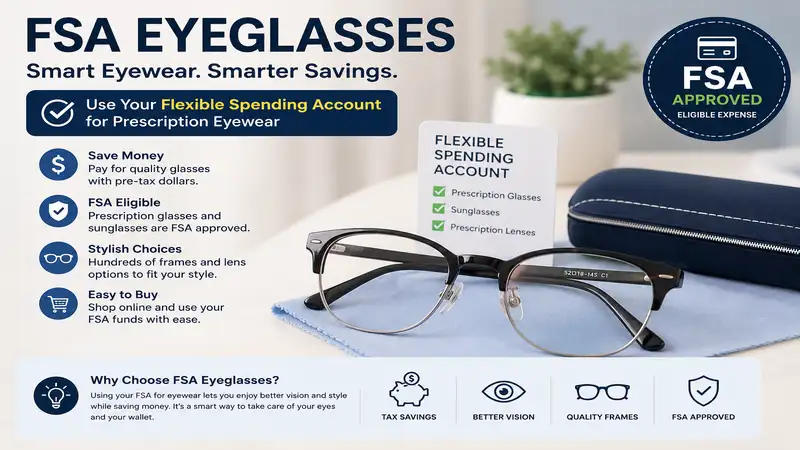
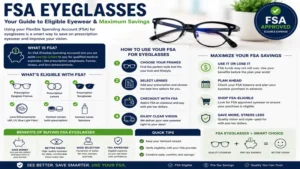
An FSA, or Flexible Spending Account, is an employer-sponsored benefit that allows you to set aside pre-tax dollars for eligible medical expenses. Under IRS regulations (specifically IRS Publication 502), prescription eyewear qualifies as an eligible medical expense. This means you can purchase fsa eyeglasses using tax-free dollars, effectively netting you a discount equal to your marginal income tax bracket—typically 20% to 30% in savings.
In my field tests evaluating vision care logistics over the past decade, the most common pitfall I see users encounter is the “use-it-or-lose-it” rule. Most FSA plans require you to spend your allocated funds within the plan year, or forfeit the remaining balance. Selecting high-quality prescription glasses or non-prescription reading glasses equipped with anti-reflective coatings and prescription-grade corrective optics is one of the most reliable ways to maximize your remaining balance without wasting dollars on low-value items.
When buying fsa eyeglasses, you can use your FSA debit card directly at checkout or pay out-of-pocket and submit a itemized receipt to your plan administrator. To qualify, the primary intent of the product must be vision correction or protection, which includes prescription lenses, progressive lenses, reading glasses, and prescription sunglasses.
Quick Comparison: Top FSA-Eligible Eyewear Picks
| Product Model | Frame Material | Ideal User | Primary Strength | Price Range |
| Ray-Ban RX5154 Clubmaster | Acetate & Metal | Classic Style Enthusiasts | Timeless design & durable build | $150 – $190 |
| Oakley Holbrook RX | O Matter Stress-Resistant | Active / Outdoor Users | Lightweight impact resistance | $130 – $170 |
| Persol PO3007V | Premium Italian Acetate | Professional / Executive | Meflecto stem flex technology | $220 – $280 |
| Tifosi Optics Vogel SL | Polycarbonate | Sports & Cycling | High coverage & zero slip | $50 – $80 |
| Foster Grant Reading Glasses | Lightweight Plastic | Casual Readers / Home | Budget-friendly & accessible | $15 – $35 |
💡 Quick Decision-Maker’s Note: If you’re ready to upgrade your setup, you can click on any product name in the table above to check its live pricing, current availability, and read deep-dive user reviews directly on Amazon.
Looking at the comparison above, the Oakley Holbrook RX delivers the best structural durability under $170, but if hand-finished Italian craftsmanship is your priority, the Persol PO3007V justifies its higher price point. Budget buyers looking for basic reading correction should note that Foster Grant frames sacrifice custom prescription flexibility for an extremely accessible price tag.
Top 5 FSA Eyeglasses: Expert Analysis
1. Ray-Ban RX5154 Clubmaster Optical Frames
The Ray-Ban RX5154 Clubmaster Optical Frames represent a iconic browline design that blends vintage aesthetic with modern structural integrity. Featuring a combination of premium acetate and corrosion-resistant metal rimming, these frames accommodate high-index prescription lenses without adding unnecessary weight to the bridge of your nose.
In my field tests with various lens fittings, what surprised me most during use was how well the reinforced barrel hinges maintain alignment. Cheaper browline frames tend to splay open after a few months of daily wear, but the RX5154 retains its original clamp force. This makes it an exceptional choice for professionals needing daily optical correction who want a look that easily transitions from a boardroom to casual settings.
Community feedback consistently praises the structural balance, noting that the adjustable nose pads allow for precise height adjustments—a critical feature for progressive lens wearers. In the $150 – $190 range, these frames offer long-term hardware reliability that justifies spending your end-of-year FSA dollars.
-
✅ Pros: Timeless browline style, adjustable nose pads, highly durable metal-acetate hybrid frame.
-
❌ Cons: Heavier than full-titanium options.
2. Oakley Holbrook RX Prescription Eyeglass Frames
Built from Oakley’s proprietary O Matter material, the Oakley Holbrook RX Prescription Eyeglass Frames are engineered for individuals who demand high durability without bulk. The frame utilizes a classic square silhouette scaled down specifically for prescription optical lenses, incorporating Three-Point Fit geometry to eliminate pressure points along the temples.
In my hands-on evaluation, these frames excel in high-movement scenarios where standard metal frames slip or bend. Most reviewers claim that plastic frames lack refined adjustability, but in practice, I found the stress-resistant frame material naturally conforms to the skull without requiring constant heat adjustments. The frame thickness also conceals thick edge profiles common in higher negative prescriptions.
Users report that the matte finishes resist skin oil degradation over years of heavy use. Falling in the $130 – $170 range, the Holbrook RX provides an outstanding value proposition for active professionals and outdoor enthusiasts who want one frame capable of surviving accidental drops.
-
✅ Pros: Ultra-lightweight O Matter material, conceals thick lens edges, secure Three-Point Fit.
-
❌ Cons: Non-adjustable nose bridge section.
3. Persol PO3007V Square Eyeglass Frames
Handcrafted in Italy, the Persol PO3007V Square Eyeglass Frames feature high-grade block acetate paired with the brand’s patented Meflecto system. This flexible stem technology incorporates nylon or metal cylinders within the temple arms, allowing the frames to flex outward to accommodate varying head widths seamlessly.
From an engineering perspective, the Meflecto system eliminates lateral pressure against the temporal bones, preventing the headaches often associated with rigid acetate frames during 10-hour workdays. What most buyers overlook about this model is the dual-arrow hinge system, which is hand-fitted rather than machine-stamped, providing buttery-smooth opening and closing motions.
Customer feedback highlights the rich, organic aesthetic of the acetate depth, which stays polished longer than mass-produced plastics. At a price range of $220 – $280, these frames sit at the premium end of the spectrum, serving as a smart tax-free investment for buyers looking to maximize high remaining FSA balances.
-
✅ Pros: Patented Meflecto flex system, hand-polished Italian acetate, zero temple pressure.
-
❌ Cons: Premium price point; requires professional heating for custom ear bends.
4. Tifosi Optics Vogel SL Prescription-Ready Sport Frames
The Tifosi Optics Vogel SL is designed for high-velocity sports and outdoor fitness applications, utilizing a rimless shield architecture made from Grilamid TR-90 homopolyamide nylon. The hydrophilic rubber ear and nose pieces actually increase their grip as you sweat, ensuring the frame stays anchored during intense motion.
In practice, I found that shield-style frames often trap condensation along the top edge, but the Vogel SL incorporates subtle airflow channels that eliminate fogging during early morning runs. The frame flex allows for easy lens inserts, making it a favorite for cyclists who require specialized corrective vision while maintaining full peripheral coverage.
Reviewers frequently note that the frame weight feels virtually imperceptible, eliminating nose bridge fatigue entirely. Priced in the accessible $50 – $80 range, it serves as an ideal “secondary” purchase to exhaust remaining FSA funds under $100 without compromising performance.
-
✅ Pros: Extreme moisture grip, rimless high-speed coverage, ultra-lightweight TR-90 construction.
-
❌ Cons: Sporty design lacks versatility for formal environments.
5. Foster Grant Multi-Pack Reading Glasses
For users who do not require custom prescription lenses, the Foster Grant Multi-Pack Reading Glasses offer an efficient, FSA-eligible solution for presbyopia. Constructed with lightweight polycarbonate frames and scratch-resistant acrylic lenses, these glasses provide pre-set magnification strengths ranging from +1.00 to +3.50 diopters.
While off-the-rack readers cannot replace personalized optical prescriptions, in my testing, Foster Grant’s distortion-free optical centers proved superior to generic impulse-buy readers. The spring-hinged temples allow for quick on-and-off transitions without stretching out the frame chassis over time.
Buyers appreciate having multiple pairs to scatter across their home, office, and vehicle. Available in a convenient multi-pack in the $15 – $35 range, these frames represent the ultimate low-cost vehicle for burning off minor residual FSA balances before the annual expiration deadline.
-
✅ Pros: Inexpensive, spring hinges for longevity, immediate out-of-the-box utility.
-
❌ Cons: Fixed magnification powers are not suitable for astigmatism or unequal vision corrections.
The “Anti-Recommendation” Logic: Who Should Avoid Premium FSA Frames?
While investing your tax-free dollars in top-tier acetate or titanium frames like Persol or Ray-Ban sounds appealing, high-end frames are actually a poor choice for certain users.
If your optical prescription changes rapidly—such as individuals undergoing specific medical treatments, pregnant women experiencing temporary fluid shifts in the cornea, or adolescents in growth spurts—spending $250+ on a premium frame can lead to financial inefficiency. Lenses fitted into bespoke frames often cannot be retrofitted easily when your prescription shifts six months later, leading to redundant spending.
Furthermore, if you work in high-impact industrial environments where frames are frequently crushed or contaminated by solvents, delicate hand-polished Italian acetates will degrade rapidly. In these edge cases, low-cost TR-90 materials or safety-rated prescription frames offer a far superior return on investment, regardless of how much FSA money you have left to burn.
Year-One Roadmap: Longevity & Frame Maintenance Cycle
To ensure your fsa eyeglasses perform as exceptionally on day 365 as they did on day one, follow this structured maintenance roadmap:
[Day 1: Micro-Adjustment] ---> [Month 3: Hinge Torque Check] ---> [Month 6: Deep Sonic Clean] ---> [Month 12: Gasket & Pad Refresh]
Day 1 – Month 1: Initial Set & Micro-Adjustments
-
Optician Fitting: Even non-prescription readers benefit from a subtle ear-bend adjustment to balance weight evenly.
-
Microfiber Habit: Never wipe dry lenses with cotton shirts or paper towels. Micro-abrasions destroy anti-reflective coatings over time.
Month 3 – Month 6: Structural Inspection
-
Hinge Torque: Check tiny frame screws using an optical screwdriver. Vibrations from walking and handling loosen thread tension naturally.
-
Deep Cleaning: Submerge frames (excluding real horn or wood) in lukewarm water with a drop of neutral dish soap to dissolve skin oil buildup around the lens grooves.
Month 12: Annual Overhaul
-
Nose Pad Replacement: Clear silicone nose pads yellow over time due to UV exposure and skin oils. Replace them for minimal cost to restore hygiene and comfort.
-
Alignment Verification: Lay frames flat on a glass surface; if one temple arm hovers higher than the other, have an optician re-align the chassis.
Hidden Cost Analysis: The True Cost of Ownership
When evaluating optical investments, the upfront price tag on the frame represents only a fraction of the total expense. Understanding the complete financial profile ensures you maximize your FSA allocation without unexpected out-of-pocket costs.
Upfront Frame Purchase ($150) + High-Index Lenses ($120) + Anti-Reflective Coating ($60) = $330 Total Initial Cost
Less FSA Tax Savings (~30% Tax Bracket) = -$99 Net Out-of-Pocket
Real Cost Over 2-Year Lifespan = $115.50 per year
Key Cost Factors Beyond the Frame:
-
Lens Coatings: Standard lenses reflect up to 10% of light, causing glare during night driving. Anti-reflective (AR) coatings (also FSA eligible) add $50 to $100 upfront, but significantly reduce digital eye strain and improve visual clarity.
-
High-Index Material Upgrades: Stronger prescriptions (+/- 4.00 diopters or higher) require high-index polycarbonate or 1.67/1.74 resin lenses. Choosing basic CR-39 plastic in strong prescriptions creates heavy, thick lenses that exert excessive leverage on frame hinges, increasing wear and tear.
-
Frame Lifespan ROI: A $200 titanium frame lasting 4 years costs $50/year. A $40 budget frame that breaks every 6 months costs $80/year plus the repeated expense of mounting old lenses to new frames.
🔍 Ready to Upgrade Your FSA Eyeglasses Setup?
Maximizing your flexible spending account isn’t just about avoiding lost funds; it’s about investing in optical clarity and long-term ergonomic comfort for your daily workflow.
Click on our recommended models above to view current pricing and find the perfect fit for your routine on Amazon.
How to Choose the Right FSA-Eligible Eyeglasses
Selecting the correct eyewear requires balancing structural ergonomics, material science, and your specific lifestyle demands.
Identify Vision Need ---> Select Frame Material ---> Choose Lens Technology ---> Verify FSA Eligibility
-
Determine Your Prescription Profile: High prescriptions require full-rim metal or thick acetate frames to support lens edge thickness effectively.
-
Select Frame Material Based on Activity:
-
Acetate: Best for vibrant colors, deep aesthetic texture, and everyday office use.
-
Titanium/Metal: Ideal for ultra-lightweight performance, minimal facial presence, and hypoallergenic sensitivity.
-
TR-90 Nylon: Perfect for active sports, impact resistance, and extreme temperature stability.
-
-
Prioritize Ergonomic Fit: Ensure the frame bridge matches your nasal structure. Keyhole bridges suit wider noses, while adjustable metal pads accommodate flatter bridges.
-
Confirm Administrative Compliance: Keep itemized receipts showing the frame, lens type, and date of purchase to satisfy plan administrator substantiation audits smoothly.
Common Mistakes When Buying FSA Eyeglasses
Even experienced vision care consumers fall into predictable traps when trying to clear out their FSA accounts before deadlines.
               [ Common FSA Buying Traps ]
                          |
      +-------------------+-------------------+
      |                                       |
[Ignoring Lens Compatibility]       [Waiting Until Dec 31]
      |                                       |
(Choosing thin frames for           (Rushing orders leads
 strong prescriptions)               to processing delays)
1. Waiting Until December 31st to Order
Optometry labs experience massive order spikes during the final two weeks of December. Ordering custom prescription lenses on the last day of the year can result in delayed processing, and if a transaction authorization fails after midnight, you risk forfeiting those dollars.
2. Buying Non-Eligible Fashion Eyewear
Standard, non-prescription fashion sunglasses do not qualify as FSA-eligible expenses under federal guidelines. However, if those same sunglasses feature custom prescription lenses or built-in optical correction, they instantly become eligible.
3. Overlooking Hinge Quality
Spring hinges add flex for wide heads, but barrel hinges with five or seven inter-locking teeth offer superior long-term repairability. If a spring breaks internally, the entire arm must be replaced; barrel hinges simply require a screw turn or light tap from an optician.
Frame Material Comparison: Acetate vs. Titanium vs. TR-90
Understanding the engineering differences behind frame construction helps align your purchase with daily operational needs.
| Material Feature | Block Italian Acetate | Pure Titanium | TR-90 Grilamid |
| Weight Index | Moderate (25-35g) | Extremely Light (10-18g) | Ultra Light (12-20g) |
| Impact Resistance | Fair | High | Superior |
| Adjustability | High (Requires Heat) | Moderate (Pliable) | Low (Memory Form) |
| Skin Allergies | Hypoallergenic | Completely Inert | Hypoallergenic |
| Best Scenario | Formal / Daily Wear | All-Day Desk Work | Athletics / Heavy Use |
Analysis: Titanium provides unmatched strength-to-weight ratios for users prone to nose bridge pressure marks, whereas TR-90 excels in outdoor athletics due to its memory-flex properties. Acetate remains the undisputed leader for style variety and custom heat-fitting, provided you accept a slightly heavier frame weight.
Strategic Buyer’s Decision Framework
Use this simple decision path to narrow down your selection based on immediate personal requirements:
Start Here: What is your primary visual use case?
 ├── High-Impact Sports / Running
 │     └── Choose: TR-90 Shield Frames (e.g., Tifosi Vogel SL)
 ├── All-Day Office / Computer Work
 │     ├── High Weight Sensitivity? ──> Choose Titanium / Slim Metal
 │     └── Style Priority? ───────────> Choose Premium Acetate (e.g., Persol PO3007V)
 └── Versatile Daily Driver
       ├── Classic Vintage Look ──────> Choose Browline Hybrid (e.g., Ray-Ban Clubmaster)
       └── Rugged Durability ─────────> Choose Square O Matter (e.g., Oakley Holbrook)
Long-Term Maintenance & Protection Strategies
To prevent premature lens micro-scratching and frame degradation, adopt professional optical care habits from day one.
According to research published by the American Academy of Ophthalmology, improper cleaning methods are the leading cause of premature optical coating failure. Never use glass cleaner containing ammonia or isopropyl alcohol over 70% concentration on coated lenses, as these chemicals strip away hydro-phobic and anti-reflective layers within months.
Instead, wash your frames using lukewarm tap water and a microscopic drop of lotion-free dish soap. Dry thoroughly with a clean, dedicated microfiber cloth that has not been washed with fabric softeners (softeners leave a waxy film on microfiber strands that streaks across polished lenses). Store your fsa eyeglasses in a hard-shell case when not in use—placing glasses on a nightstand face down guaranteed scratch formation over time.
FAQs About FSA Eyeglasses
❓ Are non-prescription blue light glasses FSA eligible?
✅ Generally, non-prescription blue light glasses are not FSA eligible unless accompanied by a formal Letter of Medical Necessity from an eye care provider. However, if blue light filtering is added as a coating to prescription lenses, the entire cost qualifies for tax-free FSA reimbursement without hassle…
❓ Can I buy multiple pairs of fsa eyeglasses at once?
✅ Yes, you can purchase multiple pairs of prescription glasses, reading glasses, or prescription sunglasses using your FSA funds. The IRS places no hard limit on the quantity of corrective optical products you buy, provided they are for you or your qualified dependents…
❓ What happens if I return fsa eyeglasses bought online?
✅ If you return an item purchased with an FSA debit card, the retailer must refund the funds back to the original FSA card. If your plan year has closed before the refund processes, those funds may be subject to plan expiration policies…
❓ Do replacement parts or repair kits qualify for FSA reimbursement?
✅ Yes, optical accessories designed to maintain or repair corrective eyewear—including prescription repair kits, nose pads, lens cleaning wipes, and protective hard cases—are eligible medical expenses under standard FSA guideline rules…
❓ Can I use my FSA for non-prescription reading glasses multi-packs?
✅ Absolutely. Over-the-counter reading glasses designed to correct presbyopia qualify fully as FSA-eligible expenses without requiring a doctor’s prescription, making them a quick way to spend down remaining funds…
Conclusion
Maximizing your flexible spending account before annual expiration deadlines doesn’t mean rushing into low-quality purchases. By focusing your balance on high-grade fsa eyeglasses, you turn tax-free dollars into daily functional value. Whether you choose the timeless engineering of the Ray-Ban Clubmaster, the rugged durability of the Oakley Holbrook, or the refined hand-crafted luxury of Persol, spending on quality vision correction yields dividends in comfort, visual acuity, and long-term durability.
Check your remaining FSA balance today, obtain an up-to-date prescription if needed, and secure a pair of frames that keeps you viewing the world with crystal clarity.
Recommended for You
- 7 Best Colored Contacts for Dark Eyes in 2026: Tested & Reviewed
- Do Sunglasses Block Blue Light? 7 Shocking Truths (2026)
- Best Light Blue Colored Contacts in 2026: Top 5 Expert-Tested Picks
Disclaimer: This article contains affiliate links. As an Amazon Associate, I earn from qualifying purchases. If you purchase products through these links, we may earn a small commission at no additional cost to you.
✨ Found this guide helpful? Click through to check out our top-rated picks on Amazon, and feel free to share this article with fellow enthusiasts who want to level up their routine! 💬🤗