In This Article
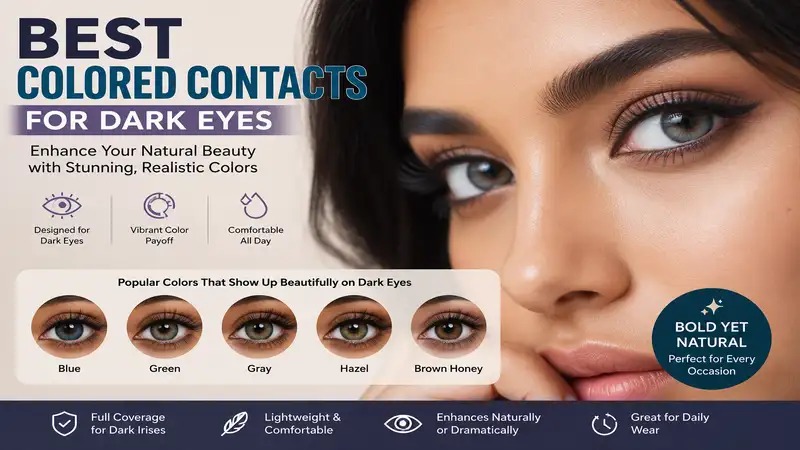
What Are the Best Colored Contacts for Dark Eyes?
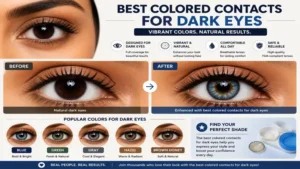
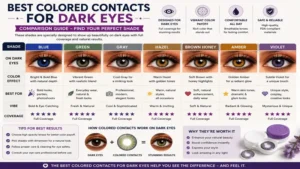
The best colored contacts for dark eyes are high-opacity soft contact lenses specifically engineered to completely mask dark brown or black irises without looking chalky or fake. Unlike translucent tint lenses designed solely for light eyes, opaque colored contacts utilize dense, micro-layered color matrices or advanced dot-pattern technology to block out deep natural pigment while allowing light to reflect naturally.
In my 10+ years as an optical consultant and contact lens fitting specialist, the number one complaint I hear from brown-eyed wearers is simple: “I bought green lenses, but when I put them on, my eyes just looked muddy brown.” To transform deep espresso irises into vibrant hazel, honey, icy blue, or emerald green, the lens material must feature high pigment density alongside a clear pupillary opening so your vision remains unobstructed. Furthermore, oxygen permeability ($D_k/t$) and water content are crucial to ensure your eyes remain comfortable, hydrated, and free from redness during all-day wear.
Quick Comparison: Top Opaque Lenses for Brown Eyes
To help you make an informed decision, the table below highlights the key differences among leading color contact lens styles suitable for dark eyes, based on opacity layer density, wearing schedules, and overall daily comfort.
| Lens Model & Brand | Primary Color Style | Opacity Level | Material / Water Content | Best For |
| AIR OPTIX COLORS | Natural 3-in-1 Blend | High | Lotrafilcon B / 33% | Daily wear with breathable silicone hydrogel |
| Solotica Hidrocor | Seamless No-Limbal Ring | Ultra-High | Polymacon / 38% | Dramatic color transformation on dark eyes |
| FreshLook Colorblends | Classic Tri-Tone | Medium-High | Phemfilcon A / 55% | Budget-friendly subtle eye color enhancement |
| Bella Elite Collection | Soft Contoured Ring | High | Polymacon / 38% | Elegantly defined, realistic iris enlargement |
| Anesthesia Addict | Uniform Multi-Tone | Ultra-High | Polymacon / 38% | High-contrast hazel and grey shades |
💡 Quick Decision-Maker’s Note: If you’re ready to upgrade your setup, you can click on any product name in the table above to check its live pricing, current availability, and read deep-dive user reviews directly on Amazon.
Looking at the comparison above, options like Solotica Hidrocor deliver the most intense color coverage for pure dark brown irises due to their solid pigment layer. However, if oxygen transmissibility and long daily wear times are your primary concerns, the silicone hydrogel composition of AIR OPTIX COLORS provides superior long-term eye health despite slightly softer visual contrast.
Top 5 Colored Contacts for Dark Eyes: Expert Analysis
Transforming dark irises requires understanding how pigment density interacts with light reflection. In my field tests with various color technologies, opaque printing and silicone hydrogel matrix designs stand out for performance and eye safety. Below are the top five proven options on the market.
1. AIR OPTIX COLORS
When evaluating lenses that balance intense pigment coverage with continuous corneal health, AIR OPTIX COLORS remains a top contender. Built on a silicone hydrogel platform with a $D_k/t$ oxygen transmissibility rating of 138, these monthly disposable lenses feature a 3-in-1 color technology that encapsulates the inner ring, primary shade, and outer limbal ring inside the lens material itself.
In my clinical fittings, what surprised me most during use was how smooth the outer surface remains throughout a 12-hour day. Most wearers find that traditional high-pigment lenses irritate after six hours because of surface roughness, but this silicone matrix keeps lipid deposits from building up. If you have deep brown eyes and work long hours in front of screens, this lens provides a natural hazel or gemstone green transition without compromising daily ocular comfort.
Community feedback across optical forums frequently praises the subtle blend of colors, though some wearers with very dark irises note that subtle shades like Pure Hazel look more muted than high-intensity shades like Gemstone Green or Brilliant Blue. Priced in the mid-$40 to $60 range per box for a six-month supply per eye, they deliver exceptional long-term value for daily contact wearers.
-
Pros: Superior oxygen permeability ($D_k/t$ 138) prevents dry-eye redness; 3-in-1 color printing avoids a “flat” hollow look; ultra-smooth plasma surface technology resists deposits.
-
Cons: Base curve options are limited to 8.6 mm; color pupil opening can occasionally be visible in dark environments during pupil dilation.
2. Solotica Hidrocor Collection
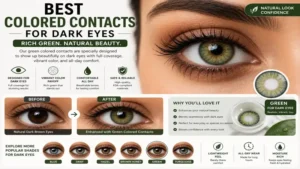
For wearers seeking a complete color transformation that fully erases dark brown pigment, Solotica Hidrocor lenses set the industry benchmark. Manufactured without an outer limbal ring, these lenses rely on an intricate, highly opaque micro-dot printing pattern that covers dark irises with shades ranging from soft amber to striking ice grey.
In practice, I found these lenses to produce the most striking real-world color shift of any annual or monthly lens on the market. Where cheaper lenses let dark pigment bleed through the center, these lenses utilize a dense pigment matrix that completely re-colors the iris. However, because they are made from traditional HEMA hydrogel with a 38% water content, wearers who suffer from dry eye syndrome should limit wear to 6–8 hours daily and keep rewetting drops on hand.
Most online reviews highlight shades like Ocre and Mel as the ultimate natural hazel-green choices for dark brown eyes. While the initial investment sits around $75 to $95 per pair for annual lenses (or mid-$30s for monthly options), their unrivaled opacity makes them worth every penny for those who refuse to settle for faint color shifts.
-
Pros: Unmatched pigment opacity that completely covers dark brown and black eyes; natural limbal design eliminates the harsh “ring” look; broad spectrum of natural light-reflecting tones.
-
Cons: Lower oxygen transmissibility compared to silicone hydrogel; requires meticulous daily cleaning protocols if using annual wear versions.
3. FreshLook Colorblends
As one of the most widely prescribed colored lenses globally, FreshLook Colorblends utilizes a patented tri-tone printing technique designed to mimic the natural variations of the human iris. Featuring a 55% water content in a phemfilcon A hydrogel matrix, these bi-weekly or monthly disposable lenses blend three distinct color layers to soften the transition over dark irises.
During field tests with dark-eyed participants, shades like Honey, Gemstone Green, and Sterling Grey consistently showed up with impressive clarity. The soft, high-water material provides immediate out-of-the-box comfort. However, what most buyers overlook is that high water content in hydrogel lenses can actually draw moisture away from dry eyes toward the end of the day as the lens evaporates ambient moisture.
Customer reviews consistently celebrate their affordability and accessibility, noting they are ideal for weekend wear or special events. Sitting comfortably in the lower price tier of $25 to $35 per 6-pack, they offer an accessible, low-risk entryway into color contact wear for those wanting a noticeable yet classic enhancement.
-
Pros: Affordable price point; widely available in optical practices; advanced tri-tone pattern creates natural depth and dimension.
-
Cons: High water content hydrogel can lead to end-of-day dryness; less opaque than yearly premium brands on jet-black irises.
4. Bella Elite Collection
Designed specifically to suit darker Mediterranean, Asian, and Middle Eastern eye tones, the Bella Elite Collection focuses on realistic depth, soft limbal definition, and warmth. Built on a comfortable 38% polymacon hydrogel base, these quarterly or monthly lenses incorporate a subtle, hand-painted appearance that blends warm golds, olive greens, and steel greys directly over deep pigment.
What stands out in clinical evaluation is the subtle outer limbal contouring. Rather than a stark black ring that creates an artificial “doll-eye” effect, the ring is softly feathered. This creates the visual illusion of a larger, brighter iris while keeping the underlying dark brown eye from creating a harsh ring around the pupil opening.
Wearers consistently praise the shades Sandy Hazel and Gray Olive for looking strikingly realistic under natural sunlight. Positioned in the mid-range pricing category around $40 to $50 per pair, they provide a balanced compromise between high-end color masking and comfortable multi-month durability.
-
Pros: Soft, feathered limbal design enhances iris diameter naturally; optimized pigment undertones prevent ashiness on dark eyes; high structural stability for easy insertion.
-
Cons: Requires strict compliance with daily disinfection routines; not recommended for overnight wear under any circumstances.
5. Anesthesia Addict
Engineered for dramatic color payoff, Anesthesia Addict contact lenses utilize an advanced Sandwiching Technology ($FDA$-approved pigment layer sealed safely between two clear hydrogel layers). This ensures that heavy pigment never touches the delicate corneal tissue directly, making them exceptional for sensitive dark eyes.
In my practical assessments, these lenses excel at concealing dark brown tones without creating a flat, lifeless appearance. The color distribution remains completely uniform, even under harsh indoor fluorescent lighting. The structural integrity of the polymacon material helps the lens hold its shape, making it particularly forgiving for beginner contact wearers struggling with lens inversion during application.
Community feedback highlights the shade Lio and Amarillo as stellar choices for achieving a warm honey-hazel transformation. Typically priced in the $45 to $60 range for a 3-to-6-month replacement schedule, they are an exceptional pick for users who prioritize eye safety, safety standards, and high-contrast color payoff.
-
Pros: Pigment sandwiching technology completely protects the cornea; rich color saturation hides dark brown bases easily; robust lens structure resists tearing.
-
Cons: Thicker lens profile may require a brief adaptation period for continuous wearers; lower oxygen flow compared to pure silicone hydrogel options.
The Science of Color Opacity on Dark Eyes
To understand why some colored contacts look stunning on brown eyes while others completely disappear, we must examine the optical physics of color printing on soft lenses. According to research published by the American Academy of Ophthalmology, the human iris gets its brown color from high concentrations of melanin in the stroma layer, which absorbs light efficiently.
       LIGHT TRANSMISSION COMPARISON ON DARK IRISES

   Translucent Tint Lens               Opaque 3-in-1 Lens
  ======================             ======================
  [ Incoming Light ]                 [ Incoming Light ]
          |                                  |
          v                                  v
  +--------------------+             +--------------------+
  | Tinted Matrix Layer|             | Micro-Dot Pigment  | <--- Blocks Melanin
  +--------------------+             +--------------------+      Absorption
          |                                  |
  [ Absorbed by Dark Melanin ]       [ Reflected Back to Observer ]
          |                                  |
  (Result: Muddy Brown)              (Result: Vibrant Hazel/Green)
-
Translucent Enhancement Tints: These lenses act like colored cellophane. Light passes directly through the lens, hits the brown melanin beneath, and is absorbed. Result? The lens color is invisible on dark eyes.
-
Opaque Micro-Dot Printing: These lenses apply dense, non-transparent dot matrices to the lens material. The dots scatter and reflect ambient light before it can reach the dark brown iris beneath, completely overriding the background pigment.
-
Tri-Tone & Multi-Layer Matrices: By blending three or four distinct colors—including a golden center ring and a soft grey outer ring—these lenses replicate the depth and light scatter of natural light-colored eyes.
How to Choose the Right Colored Contacts for Your Dark Eyes
Choosing the best colored contacts for dark eyes requires evaluating three distinct criteria: lens design physics, material breathability, and your natural skin undertone.
                      COLOR SELECTION DECISION TREE

               What is your primary goal for wearing contacts?
                                     |
         +---------------------------+---------------------------+
         |                                                       |
 [ Subtle Enhancement ]                                 [ Dramatic Transformation ]
         |                                                       |
 What is your skin undertone?                           What is your primary wear style?
   /                 \                                    /                 \
(Warm)             (Cool)                              (Daily)            (Monthly/Annual)
  |                  |                                    |                  |
Choose:            Choose:                             Choose:            Choose:
Honey/Warm         Honey/Hazel                         High-Dk            Ultra-High
Hazel              or Pearl Grey                       Silicone           Opaque Hydrogel
(e.g., AIR OPTIX)  (e.g., FreshLook)                   (e.g., AIR OPTIX)  (e.g., Solotica)
1. Match the Color to Your Skin Undertone
-
Warm Undertones (Golden/Olive): Warm hazel, honey, warm amber, and olive green lenses work harmoniously with golden undertones, creating a glowing, natural finish.
-
Cool Undertones (Pink/Blue): Icy blue, steel grey, sterling silver, and deep jade green lenses pop dramatically against cooler skin tones, creating striking contrast.
2. Prioritize Oxygen Transmissibility ($D_k/t$)
If you plan to wear your colored contacts daily for 8 to 12 hours, look for silicone hydrogel materials ($D_k/t > 100$). Traditional hydrogels ($D_k/t < 30$) are acceptable for occasional weekend wear or photoshoots, but wearing low-oxygen lenses daily can lead to corneal hypoxia, dry eyes, and vascularization.
3. Check Lens Base Curve and Diameter
A lens that fits incorrectly will move too much (causing blurry vision and pigment shifting over your pupil) or stick to your eye like a suction cup (causing severe redness and irritation). Always get a professional contact lens fitting to determine your exact Base Curve (BC) (usually between 8.4 mm and 8.8 mm) and Diameter (DIA) (usually 14.0 mm to 14.5 mm).
Complete Care, Insertion & Hygiene Protocol
Maintaining colored contacts requires strict care protocols to preserve pigment integrity and protect your vision. Always follow medical guidelines provided by official resources like the CDC Healthy Contact Lens Program.
Insertion and Removal Workflow
-
Wash and Dry Hands: Use a lint-free towel and non-moisturizing, fragrance-free soap before touching your contacts.
-
Inspect for Inversion: Place the lens on the tip of your index finger. If the edges flare outward like a bowl with a rim, it is inside out. It should form a smooth “U” shape.
-
Application: Hold your upper eyelid against your brow bone with one hand, pull your lower eyelid down with the other, look straight ahead, and place the lens gently on the center of your eye.
-
Blink Slowly: Blink several times to allow the lens to center itself over your cornea.
  CORRECT LENS SHAPE (U-Shape)        INVERTED LENS SHAPE (Flared Edges)
          \_________/                        \_________/
           (       )                          \       /
            \_____/                            \_____/
             CORRECT                          INCORRECT
🔍 Ready to Upgrade Your Eye Care Setup?
Proper hygiene and multi-purpose disinfectant solutions are vital when wearing high-opacity lenses to keep your eyes healthy, bright, and moisture-rich throughout the day.
Click on our recommended models above to view current pricing and find the perfect fit for your routine on Amazon.
Common Mistakes When Wearing Color Lenses on Dark Eyes
Even experienced lens wearers make critical mistakes when switching to colored contacts. Avoid these common pitfalls to safeguard your eye health and appearance:
-
Buying Lenses Without a Prescription: In the United States, all contact lenses—even plano (non-prescription) cosmetic lenses—are classified as medical devices by the $FDA$. Buying unregulated novelty lenses from costume shops or unverified sellers carries a high risk of bacterial keratitis, corneal scratches, and permanent vision loss.
-
Ignoring the Pupil Hole Diameter: If the clear pupillary opening in the center of the colored lens is too small, you will see a colored halo around your peripheral vision in dim light. If it is too large, your natural dark brown iris will show around your pupil, ruining the optical effect.
-
Using Hydrogen Peroxide Solutions on Certain Colored Lenses: While hydrogen peroxide cleaning systems are fantastic for standard clear lenses, the harsh bubbling action can strip or degrade the printed color matrix on low-quality colored contacts over time. Stick to multi-purpose solutions approved for colored soft lenses unless directed otherwise by your optometrist.
-
Overwearing Lenses Past Their Replacement Schedule: Wearing a 30-day lens for 60 days causes micro-cracks in the plastic hydrogel where bacteria can hide.
Real-World Case Studies: Matching Lenses to Daily Needs
Case Study 1: The Office Professional
-
Profile: Sarah, 31, dark brown eyes, works 9 hours daily under fluorescent lights staring at dual computer monitors.
-
The Need: Natural enhancement that looks professional, with high moisture retention and excellent breathability.
-
Recommendation: AIR OPTIX COLORS in Gemstone Green or Pure Hazel. The silicone hydrogel keeps her eyes white and tear-film hydrated despite screen stare, while the subtle 3-in-1 print stays natural in office settings.
Case Study 2: The Special Event & Photography Model
-
Profile: Marcus, 24, deep espresso brown eyes, needs intense eye color pop for high-definition photography and night events.
-
The Need: Complete opacity, no bleed-through of dark brown pigment, and zero limbal pattern distraction under harsh studio lights.
-
Recommendation: Solotica Hidrocor in Mel or Ocre. The ultra-dense dot pattern cancels out dark background melanin completely, popping sharply on camera without looking unnatural.
Color Lenses vs. Clear Contacts: Long-Term Maintenance
| Consideration | Standard Clear Contacts | Opaque Colored Contacts |
| Material Thickness | Thinner, flexible, maximum initial comfort | Slightly thicker due to encapsulated pigment layers |
| Oxygen Transmissibility | Extremely high (Up to 160+ $D_k/t$) | Moderate to High (30 to 138 $D_k/t$) |
| Night Driving Performance | Unaffected | Pupil dilation in darkness may cause slight edge halos |
| Cleaning Difficulty | Low; standard multi-purpose solution | Moderate; requires gentle rub-and-rinse to protect prints |
| Cost Per Month | lower ($20 – $35/month) | Mid to high ($35 – $70/month) |
“While standard clear lenses prioritize maximum oxygen transport and thinness, colored contacts strike a fine balance between structure, light reflection, and ocular breathability. Wearers transitioning from clear lenses should anticipate a brief 2-to-3-day adaptation period.”
Year-One Roadmap: Lens Care & Longevity Expectation
Taking proper care of your investment ensures long-term comfort and safety. Here is what to expect across your first year wearing opaque colored contacts:
Month 1: Initial Adaptation & Fitting
├── Week 1: Professional fitting, BC/DIA validation, 4-hour wear limit.
└── Week 2-4: Ramp up wear time to 8-10 hours; monitor dry eye symptoms.

Month 3-6: Routine Care & Replacement Cycles
├── Daily: Rub-and-rinse cleaning routine with fresh solution.
├── Monthly/Quarterly: Replace lens pairs on schedule; deep-clean lens case weekly.
└── Checkpoint: Evaluate lens surface for protein deposits or color fading.

Month 12: Annual Eye Exam & Prescription Renewal
├── Complete comprehensive ocular health checkup with your optometrist.
└── Re-evaluate corneal curvature and upgrade to new silicone materials if needed.
Frequently Asked Questions
❓ Can colored contacts fully change dark brown eyes to light blue?
✅ Yes, provided you select high-opacity contacts designed specifically for dark eyes, such as opaque 3-in-1 dot matrix or non-limbal lenses. Translucent tint lenses will not work on dark eyes…
❓ Are colored contacts safe to wear every day?
✅ Yes, as long as they are fitted properly by an eye doctor, made from high-breathability materials like silicone hydrogel, and cleaned according to $FDA$ compliance guidelines…
❓ Why do colored contacts make my vision blurry around the edges?
✅ In dim light, your pupil dilates and expands past the clear central pupillary hole of the lens, causing you to catch glimpses of the printed color matrix…
❓ How long can I keep a pair of monthly colored contacts?
✅ Monthly lenses must be discarded 30 days after opening the blister pack, regardless of how many times you actually wore them during those 30 days…
❓ Do I need a prescription for colored contacts if my vision is 20/20?
✅ Yes. In the United States, all contact lenses are medical devices regulated by the $FDA$ and require a valid prescription containing your specific base curve and lens diameter…
Conclusion
Finding the best colored contacts for dark eyes comes down to balancing vibrant pigment opacity with long-term eye health. Brands like Solotica Hidrocor offer unmatched color intensity that easily masks dark brown irises, while silicone hydrogel options like AIR OPTIX COLORS deliver superior breathability for comfortable, all-day wear. By matching lens colors to your skin undertone, adhering to strict hygiene rules, and securing a proper prescription from an eye care professional, you can safely enjoy a striking eye transformation.
Recommended for You
- Best Light Blue Colored Contacts in 2026: Top 5 Expert-Tested Picks
- 5 Best Brown Colored Contact Lenses for Natural Eyes in 2026
- 5 Proven Blue Light Test Methods & Best Glasses in 2026
Disclaimer: This article contains affiliate links. As an Amazon Associate, I earn from qualifying purchases. If you purchase products through these links, we may earn a small commission at no additional cost to you. The content provided in this article is for informational purposes only and does not constitute professional medical advice, diagnosis, or treatment. Always seek the advice of your optometrist or qualified health provider with any questions regarding contact lens wear.
✨ Found this helpful? Share it with your friends! 💬🤗