In This Article
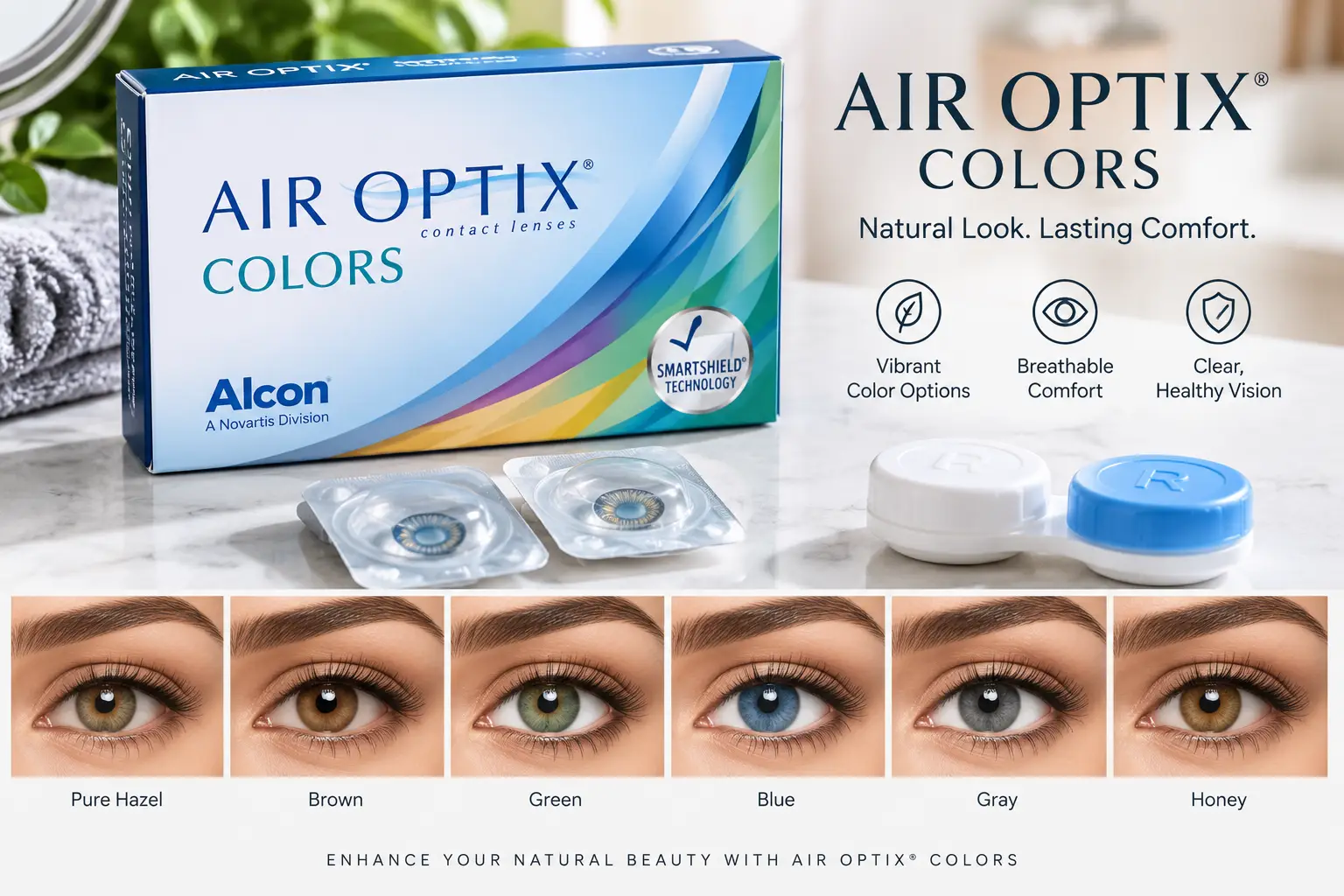
If you’ve typed air optix contact lenses color into a search bar at 11 p.m., wondering whether you could actually pull off gray eyes or a richer hazel, you’re in good company. Interest in air optix contact lenses color has climbed steadily as more people realize that changing your eye color doesn’t require surgery, an Instagram filter, or a Halloween costume shop — just the right lens, a valid prescription, and a bit of homework. Air Optix Colors is a line of monthly, silicone hydrogel colored contact lenses made by Alcon that use a 3-in-1 color technology, layering three shades into a single lens so the result reads as natural iris texture instead of a flat, painted-on circle.
This guide exists because most “best colored contacts” roundups online are thin — a list of names with no real analysis of who each lens is actually for. Here, we’ve pulled real spec sheets, aggregated genuine customer sentiment from major retailers, and compared seven real products you can find on Amazon: entry-level daily options, mid-range monthlies, and a couple of premium picks. We’ll also cover something a lot of articles skip entirely — the fact that in the US, every colored contact lens, including plano (non-vision-correcting) lenses, is legally classified as a prescription medical device. The FDA is explicit about this: buying any contact lens, decorative or not, without a valid prescription is both illegal and genuinely risky for your eyes.
By the end, you’ll know how Air Optix Colors stacks up against FreshLook, Acuvue Define, and a few other real alternatives, what they actually cost (in ranges, since Amazon pricing shifts constantly), and how to pick the right one for your eye color, wear schedule, and budget.
Quick Comparison: Air Optix Contact Lenses Color vs. the Alternatives
Before diving into all seven picks, here’s a fast snapshot of how the major colored contact lens families differ.
| Lens Family | Replacement Schedule | Typical Price Range | Best For |
|---|---|---|---|
| Air Optix Colors | Monthly | $90–$130 (6-lens box) | Daily wearers who want low upkeep |
| FreshLook COLORBLENDS | Bi-weekly | $60–$90 (6-lens box) | Bold, noticeable color changes |
| 1-Day Acuvue Define | Daily | $40–$55 (30-lens box) | Occasional wearers, sensitive eyes |
| FreshLook One-Day | Daily | $45–$65 (30-lens box) | Budget-friendly daily wear |
A quick read of the table: Air Optix Colors costs more per box than the daily options, but because one box lasts a full month per eye, the effective cost per wear day is often lower than it looks at first glance. FreshLook COLORBLENDS sits in the middle on price and delivers some of the most dramatic transformations on dark irises, while the two daily options — 1-Day Acuvue Define and FreshLook One-Day — trade a higher per-box price for zero cleaning and the lowest infection risk, since you’re never reusing a lens.
💬 Found a lens that already caught your eye? Tap through to check today’s availability and current pricing before you keep reading.
Top 7 Air Optix Contact Lenses Color Picks for 2026
We selected these seven based on real availability in the US market, genuine spec differences, and coverage across daily, bi-weekly, and monthly wear — plus entry-level, mid-range, and premium price points. Every pair requires a valid prescription and a fitting from a licensed eye care professional, even the plano (no correction) versions.
1. Air Optix Colors — most natural blend on dark eyes
Air Optix Colors is the lens most people mean when they search for air optix contact lenses color, and for good reason: its 3-in-1 tinting layers an outer ring, a primary color, and connecting color dots to mimic the natural striations of a real iris. The lens is made from lotrafilcon B silicone hydrogel with roughly 33% water content and a Dk/t (oxygen transmissibility) rating around 108 at -3.00D — practically speaking, that means significantly more oxygen reaches your cornea over a full day of wear than with older hydrogel materials, which cuts down on the redness and dryness that cheap colored contacts are notorious for. Alcon’s SmartShield technology adds a thin protective layer that resists lipid and protein buildup from makeup and skin oils, so the color stays vivid closer to the 30-day mark instead of dulling by week two.
Based on comparing the specs against the rest of this list, Air Optix Colors is the strongest all-around pick for someone who wears contacts daily and doesn’t want to think about lens changes more than once a month. It’s available in 12 shades and in powers from about +6.00D to -8.00D, plus a plano option for anyone with 20/20 vision who just wants the color. Reviews across major retailers consistently mention that the color looks convincing even on very dark brown eyes — a common complaint about cheaper opaque lenses — though a handful of reviewers note the lens feels slightly thicker than daily disposables during the first few wears.
Pros:
- ✅ 3-in-1 tint blends convincingly on dark irises
- ✅ Monthly schedule means less day-to-day upkeep
- ✅ High oxygen flow reduces end-of-day dryness
Cons:
- ❌ Requires nightly cleaning and a case
- ❌ Higher upfront cost than daily disposables
Expect to pay somewhere around $90 to $130 for a 6-lens box at the time of writing — prices vary by retailer, shade, and prescription strength, so always check the current price before buying. For anyone wearing contacts most days of the month, the cost-per-wear math generally works out in its favor.
2. FreshLook COLORBLENDS — widest shade range for bold changes
FreshLook COLORBLENDS, also from Alcon, is the bi-weekly sibling to Air Optix Colors and uses the same underlying 3-in-1 color-blending concept, but in a hydrogel (not silicone hydrogel) lens material. What that means in practice: slightly lower oxygen permeability than Air Optix Colors, but a noticeably lower price and a genuinely enormous shade range — 12 colors spanning gray, sterling gray, amethyst, gemstone green, honey, and true sapphire, among others.
What most buyers overlook with this lens is that the “blend” in COLORBLENDS refers to three individual colors merging within the lens itself, not just enhancing your natural shade — which is why it’s one of the few lenses on this list that reliably produces a dramatic change on dark brown eyes rather than a subtle wash. Reviews consistently report satisfaction with how realistic the color looks in daylight, with the most common complaint being that lenses need replacing every two weeks rather than monthly, which adds a maintenance step some wearers find inconvenient.
Pros:
- ✅ Largest color selection of any lens on this list
- ✅ Strong, realistic transformation on dark eyes
- ✅ Lower price point than silicone hydrogel options
Cons:
- ❌ Bi-weekly schedule means more frequent replacement
- ❌ Lower oxygen transmission than Air Optix Colors
Typical pricing runs between $60 and $90 for a 6-lens box, making it one of the better value picks if you want maximum color drama without paying premium silicone hydrogel prices.
3. 1-Day Acuvue Define — best for first-time, single-day wearers
1-Day Acuvue Define, from Johnson & Johnson Vision, takes a different approach: instead of monthly or bi-weekly wear, it’s a true daily disposable, and instead of one universal look, it comes in several distinct styles (Natural Shine, Natural Sparkle, and similar variants) that range from a barely-there enhancement to a more defined limbal ring effect. The lens uses LACREON technology, a moisture-locking layer built into the material during manufacturing rather than coated on afterward, which is designed to keep the lens surface hydrated through a full day of wear.
Here’s what to weigh: because you throw the lens away every night, there’s no cleaning solution, no case, and functionally zero risk of the protein buildup or bacterial contamination that comes from reusing a poorly cleaned lens — a real factor the American Academy of Ophthalmology flags when it comes to decorative and colored contact lens safety. Reviews frequently mention the comfort level as a standout, particularly for people who found monthly lenses drying out by evening; the trade-off is a higher cost per wear if you use them daily rather than occasionally.
Pros:
- ✅ Zero cleaning or storage required
- ✅ Multiple style options from subtle to defined
- ✅ Lowest contamination risk of any lens here
Cons:
- ❌ Higher long-term cost for daily wearers
- ❌ Fewer bold, fully opaque color options
A 30-lens box generally runs $40 to $55, which is reasonable for occasional wearers but adds up fast if you’re wearing them seven days a week — worth running the math against a monthly option first.
4. FreshLook One-Day — easiest grab-and-go daily option
FreshLook One-Day, Alcon’s daily disposable colored lens, is built from nelifilcon A hydrogel with a notably high 69% water content, a 13.8mm diameter, and an 8.6mm base curve. It ships in a more limited palette — typically four shades: Pure Hazel, Gray, Blue, and Green — which narrows the color options compared to COLORBLENDS but keeps the lineup simple for first-time wearers who don’t want to sort through a dozen shade names.
What the spec sheet doesn’t say, but user feedback suggests, is that the high water content is a double-edged sword: it feels noticeably soft and comfortable on insertion, but hydrogel lenses with higher water content can dry out faster over many hours than silicone hydrogel lenses like Air Optix Colors, especially in air-conditioned offices or on long flights. For someone who wants colored contacts occasionally — a wedding, a photoshoot, a night out — rather than as a daily habit, that trade-off matters far less.
Pros:
- ✅ Simple, beginner-friendly shade lineup
- ✅ Comfortable, soft-feeling insertion
- ✅ No cleaning needed, ever
Cons:
- ❌ Fewer color choices than competitors
- ❌ Can dry out faster in low-humidity settings
Price generally falls between $45 and $65 for a 30-lens box, occasionally lower during promotions — though as always, treat any “sale” claim with a healthy dose of skepticism and confirm current pricing directly on the retailer’s page.
5. 2-Week Acuvue Define — best balance of cost and convenience
2-Week Acuvue Define takes the same Define styling family and stretches the replacement schedule to bi-weekly, landing it squarely between the daily convenience of 1-Day Acuvue Define and the low per-lens cost of a monthly. It’s a hydrogel lens (not the daily’s LACREON-infused material), so it does require nightly cleaning, but the extended wear schedule cuts the total number of lenses you buy per year roughly in half compared to the daily version.
Based on comparing the specs, this lens makes the most sense for someone who already likes the Acuvue Define look but found the daily version too expensive to sustain as an everyday habit. Reviews commonly describe the comfort as slightly behind the daily LACREON version but still solid, with the color payoff holding up well through the full two-week cycle as long as cleaning routines are followed consistently.
Pros:
- ✅ Cheaper per-wear than the daily version
- ✅ Same trusted Define style family
- ✅ Two-week schedule is easier to remember than daily
Cons:
- ❌ Requires solution and a case, unlike the daily
- ❌ Slightly less moisture retention than LACREON
Expect a price range of roughly $45 to $65 per 6-lens box, which typically covers about three months of wear per eye — a solid middle-ground option for regular but not obsessive contact wearers.
6. FreshLook Colors — boldest opaque color payoff
FreshLook Colors is Alcon’s older, more opaque enhancement lens, built from phemfilcon A material on a bi-weekly replacement schedule. Unlike the blended, semi-transparent look of COLORBLENDS, FreshLook Colors leans into a bolder, more saturated finish — the kind of look people picture when they think “colored contacts” rather than “subtle enhancement.”
Here’s what most buyers overlook: because the color is more opaque and less blended with the iris pattern beneath it, this lens tends to look more dramatic in photos and under bright light, which some wearers love and others find too obviously artificial up close. Aggregated reviews tend to split along exactly that line — people either specifically seek this lens out for its boldness or find it too much for daily office wear, so it’s worth thinking honestly about which camp you’re in before ordering.
Pros:
- ✅ Most saturated, high-impact color of the lineup
- ✅ Works well for costume or special-occasion looks
- ✅ Widely available with consistent stock
Cons:
- ❌ Can look less natural than blended alternatives
- ❌ Bi-weekly schedule requires ongoing upkeep
Pricing typically sits in the $55 to $85 range for a 6-lens box. If bold, unmistakable color is the goal rather than a subtle enhancement, this is usually the better pick over its COLORBLENDS sibling.
7. FreshLook Dimensions — subtlest lift for naturally light eyes
FreshLook Dimensions rounds out this list as the most niche pick: a semi-transparent enhancement lens designed specifically for lighter eyes, available in just three shades — Caribbean Aqua, Sea Green, and Pacific Blue. It uses an outer starburst ring design rather than full-iris tinting, which adds definition and a bit of a “pop” without changing your base eye color the way an opaque lens would.
The honest analysis here: this lens simply will not work the way the others do if you have brown or dark hazel eyes — the semi-transparent tint needs a light base color to show through, so it’s really built for people with blue, green, or light hazel eyes who want more depth and dimension rather than a full color swap. Reviews from wearers with naturally light eyes describe the effect as flattering and workplace-appropriate; reviewers with darker eyes who tried it anyway generally report the color barely registers, which matches what the underlying lens technology would predict.
Pros:
- ✅ Very natural, subtle enhancement effect
- ✅ Great for professional or everyday settings
- ✅ Starburst design adds depth without opacity
Cons:
- ❌ Only works well on already-light eyes
- ❌ Limited to just three color options
Price generally runs $55 to $80 for a 6-lens box. If you have brown or dark eyes, skip this one and look at Air Optix Colors or FreshLook COLORBLENDS instead — the honest recommendation matters more here than the sale.
Comparing All Seven Side by Side
| Product | Material | Schedule | Price Range | Best For |
|---|---|---|---|---|
| Air Optix Colors | Silicone hydrogel | Monthly | $90–$130 | Daily wearers, dark eyes |
| FreshLook COLORBLENDS | Hydrogel | Bi-weekly | $60–$90 | Bold, dramatic change |
| 1-Day Acuvue Define | Hydrogel + LACREON | Daily | $40–$55 | First-timers, sensitive eyes |
| FreshLook One-Day | Hydrogel | Daily | $45–$65 | Occasional, budget wear |
| 2-Week Acuvue Define | Hydrogel | Bi-weekly | $45–$65 | Cost-conscious Define fans |
| FreshLook Colors | Hydrogel | Bi-weekly | $55–$85 | Bold, opaque looks |
| FreshLook Dimensions | Hydrogel | Bi-weekly | $55–$80 | Light-eyed wearers only |
Looking at the table above, Air Optix Colors earns its higher price through material quality and a full month of wear per box, while 1-Day Acuvue Define and FreshLook One-Day win on convenience and hygiene rather than raw cost. If your priority is the most dramatic possible transformation on dark eyes, FreshLook COLORBLENDS or FreshLook Colors will outperform the others; if you have light eyes and want subtlety, FreshLook Dimensions is really the only lens on this list built for that specific job.
Getting Started: Your First 30 Days With Colored Contact Lenses
Colored contacts are more forgiving than people expect once you know the basics, but the first month trips up a lot of new wearers. Here’s what actually matters in practice.
Start with a proper fitting, not a guess. Every lens on this list — including plano, non-prescription versions — requires an eye exam and a fitting from a licensed optometrist or ophthalmologist, because base curve and diameter affect comfort and eye health just as much as your vision correction does. Skipping this step is the single biggest cause of first-month discomfort, and it’s also illegal under US law regardless of whether you need vision correction.
In the first week, resist the urge to overwear. Even if the box says 30-day wear, most eye doctors recommend starting with shorter wear times (6–8 hours) for the first few days so your eyes adjust, then working up to a full day. Clean monthly and bi-weekly lenses every single night without exception — skipping even one cleaning cycle is a leading cause of the eye irritation that gets blamed on the lens brand when it’s actually a maintenance issue. Finally, mark your calendar for replacement day the moment you open a new box; the most common mistake in month one isn’t discomfort, it’s simply forgetting when a lens is due for retirement and wearing it past its intended lifespan.
✨ Ready to find your shade? Browse today’s pricing and availability on the picks above before your next order.
Which Colored Contacts Fit Your Life? Three Real-World Scenarios
The daily commuter. Someone wearing contacts five to seven days a week, budget around $30–$40 a month, values low maintenance over variety. Air Optix Colors is the clear fit here — one box, one shade, minimal daily decision-making, and the silicone hydrogel material holds up well through long workdays.
The occasional stylist. Someone who wants colored contacts for weekends, events, or the occasional special occasion, maybe wearing them 4–6 times a month, budget-conscious and not interested in a subscription-style habit. FreshLook One-Day or 1-Day Acuvue Define make more sense — no case to maintain, no lens going stale in a drawer between wears, and a lower total spend for infrequent use.
The dramatic transformer. Someone with dark brown eyes chasing a bold, unmistakable color change for photos, cosplay, or just a statement look, less concerned with subtlety than impact. FreshLook COLORBLENDS or FreshLook Colors deliver the most visible payoff, with COLORBLENDS edging ahead for a slightly more natural-looking blend and FreshLook Colors winning on raw color saturation.
Common Contact Lens Problems and How to Fix Them
Problem: The color looks washed out or barely visible. This is almost always a mismatch between lens type and eye color — semi-transparent lenses like FreshLook Dimensions need light eyes to show through, so dark-eyed wearers should switch to a fully opaque option like Air Optix Colors or FreshLook Colorblends instead.
Problem: Eyes feel dry by mid-afternoon. Higher water-content hydrogel lenses (like FreshLook One-Day at 69% water) can paradoxically dry faster over long wear than lower water-content silicone hydrogel lenses. Switching to Air Optix Colors, or using approved rewetting drops recommended by your eye doctor, usually resolves this.
Problem: The lens feels uncomfortable on insertion. Check first that it isn’t inside-out — colored lenses can be trickier to spot than clear ones since the color pattern can mask the usual visual cues; most brands include a small inside-out indicator mark. If comfort issues persist beyond the normal adjustment period, that’s a signal to go back to your eye care professional rather than push through it.
Problem: Color looks different than the box photo. Lens color always renders slightly differently depending on your natural eye color, lighting, and skin tone — the manufacturer photos are approximations, not guarantees. Many brands, including Alcon, offer virtual try-on tools that use your own photo for a more realistic preview before you commit to a box.
Problem: Running out of lenses mid-cycle. This is a scheduling issue more than a product one — set a recurring reminder tied to your replacement schedule (monthly, bi-weekly, or daily) so you’re never stuck wearing a lens past its intended lifespan while waiting on a reorder.
What Is Air Optix Contact Lenses Color?
Air optix contact lenses color refers to Air Optix Colors, a monthly disposable, prescription colored contact lens made by Alcon from silicone hydrogel material. It uses a 3-in-1 tinting process to blend three shades within the lens, enhancing or changing eye color while allowing high oxygen flow to the cornea for all-day comfort.
That definition covers the core product, but the broader category — colored contact lenses generally — includes daily, bi-weekly, and monthly options across several manufacturers, all regulated as Class II medical devices by the FDA regardless of whether they correct vision.
How to Choose Colored Contact Lenses: 7 Expert Criteria
- Start with your natural eye color. Dark eyes need fully opaque lenses (Air Optix Colors, FreshLook Colorblends or Colors) to show a visible change; light eyes have the option of subtler, semi-transparent lenses like FreshLook Dimensions.
- Match the wear schedule to your habits. Daily wearers benefit most from monthly lenses’ lower cost-per-wear; occasional wearers come out ahead with dailies since nothing sits unused going stale.
- Factor in your eye’s sensitivity. Dry eyes generally do better with lower water-content silicone hydrogel materials rather than very high water-content hydrogel lenses.
- Decide between subtle and dramatic. Blended lenses (COLORBLENDS) look more natural up close; fully opaque lenses (FreshLook Colors) create bolder, more photo-ready color.
- Get properly fitted, every time. Base curve and diameter matter as much as color selection — never assume a lens that fit one brand will fit another without a check from your eye doctor.
- Check FDA clearance and authorized retailers. Only buy from sellers who require a current prescription; anything else is both illegal and a documented safety risk.
- Budget for the full year, not just one box. Compare monthly, bi-weekly, and daily options on annual cost, not sticker price per box, since replacement frequency changes the real math significantly.
Air Optix Colors vs. FreshLook Colorblends: Which Should You Buy?
Both lenses come from Alcon and share the same underlying 3-in-1 color-blending concept, but the differences matter more than they first appear. Air Optix Colors uses silicone hydrogel, which lets roughly six times more oxygen reach the cornea than older hydrogel materials — a real factor for anyone who wears contacts more than eight hours a day. FreshLook Colorblends uses standard hydrogel on a bi-weekly schedule, trading some of that breathability for a lower price and, for many wearers, an equally convincing color result on dark eyes.
In everyday terms: if you wear contacts daily and value fewer lens changes, Air Optix Colors is worth the premium. If you wear contacts a few days a week, want the widest possible shade selection, or are simply trying colored contacts for the first time on a budget, FreshLook Colorblends delivers nearly the same visual transformation for meaningfully less money. Neither lens is objectively “better” — they’re solving slightly different problems, and the right choice depends entirely on how often you’ll actually be wearing them.
Common Mistakes to Avoid When Buying Colored Contact Lenses
The most expensive mistake is buying without a current prescription from an established retailer — beyond the legal risk, the FDA and multiple federal agencies have documented real injury cases tied to unauthorized decorative lens sellers, including counterfeit product seized at US ports. A second common mistake is choosing a lens based purely on the box photo rather than your actual eye color — a shade that looks stunning on a model with light eyes may barely register on dark brown irises, which is exactly why this guide breaks products down by who each one is genuinely built for.
A third mistake: assuming all colored contacts fit the same way. Base curve and diameter vary between brands, and wearing a lens sized for someone else’s eyes — even a “close enough” fit — is a common source of the irritation people mistakenly blame on the color additive itself. Finally, skipping the replacement schedule is a subtle but frequent error; a monthly lens worn for two months isn’t saving money, it’s accumulating the protein and lipid deposits that SmartShield and similar coatings are specifically designed to resist for only so long.
Colored Contacts for Different Eye Colors and Skin Tones
If you have dark brown eyes, you need a fully opaque lens — Air Optix Colors and FreshLook Colorblends are both built to show up clearly, since the pigment has to physically override your natural iris color rather than blend transparently with it. Warmer skin tones tend to pair well with honey, hazel, or amber shades from these lines, while cooler undertones often lean toward true sapphire or gray for a more striking contrast.
If you have hazel or light brown eyes, you have the most flexibility of any eye color — both opaque lenses and the semi-transparent FreshLook Dimensions will produce a visible, natural-looking shift, since there’s already some lightness in the iris for the tint to interact with. If you have blue, green, or gray eyes, subtler enhancement lenses like FreshLook Dimensions or the lighter FreshLook Colors shades tend to look the most natural, since a fully opaque lens can sometimes look flatter against an already-light base color than a blended or semi-transparent design.
Long-Term Cost and Maintenance
Sticker price per box is genuinely misleading if you don’t factor in replacement frequency. A monthly Air Optix Colors box at roughly $90–$130 covers a full month per eye, which works out to somewhere in the $90–$260 range annually per eye depending on retailer pricing and promotions — often less than it appears at first glance. A bi-weekly lens like FreshLook Colorblends, priced lower per box at $60–$90, needs replacing roughly twice a month, so the annual cost can land in a similar range once you account for the extra boxes required. Daily lenses like 1-Day Acuvue Define or FreshLook One-Day carry the highest true annual cost for full-time daily wearers, since you’re buying a fresh lens for every single wear day rather than stretching one lens across weeks.
Maintenance costs matter too: monthly and bi-weekly lenses require ongoing spending on multipurpose solution and a case, typically adding another $8–$15 a month, while daily lenses eliminate that cost entirely. When you add solution costs into the monthly and bi-weekly totals, the gap between daily and non-daily options narrows — which is worth knowing before assuming dailies are automatically the “expensive” choice.
Safety, Regulations, and Standards
In the United States, every contact lens — decorative, cosmetic, or vision-correcting — is legally classified as a Class II medical device and requires a valid prescription from a licensed eye care professional, a rule that has been in force since 2005. This applies even to plano lenses worn purely for color with no vision correction involved. The American Optometric Association’s guidance on the Fairness to Contact Lens Consumers Act outlines both consumer rights (like the right to a copy of your prescription) and the penalties retailers face for skipping the prescription requirement — civil penalties that can run into the thousands of dollars per violation.
The FDA has specifically flagged decorative lens sales through unauthorized channels — flea markets, beauty supply stores, salons, and unverified websites — as a genuine health risk, citing documented cases of corneal ulcers, infections, and in severe cases permanent vision loss tied to lenses purchased without a prescription or proper fitting. All seven products in this guide are FDA-cleared, prescription-track lenses sold by manufacturers with established US distribution, which is the baseline every colored contact purchase should meet regardless of how appealing a cheaper, prescription-free listing might look.
Frequently Asked Questions
❓ Do I need a prescription for air optix contact lenses color if I have perfect vision?
❓ How long do Air Optix Colors last once opened?
❓ Can colored contacts damage dark brown eyes?
❓ Are daily colored contacts better than monthly ones?
❓ Why do colored contact lens prices vary so much between sites?
Conclusion
Choosing the right air optix contact lenses color pick really comes down to three questions: how often you’ll wear them, how dramatic a change you want, and how much upkeep you’re willing to do. For daily wearers chasing a natural but visible transformation, Air Optix Colors remains the strongest all-around option thanks to its silicone hydrogel comfort and 3-in-1 blending. If budget or bold color payoff matters more than breathability, FreshLook Colorblends and FreshLook Colors are worth a close look, while 1-Day Acuvue Define and FreshLook One-Day make the most sense for occasional wearers who’d rather skip the cleaning routine entirely.
Whichever lens you land on, the non-negotiable step is the same across all seven: get a proper fitting and prescription from a licensed eye care professional first. Every product on this list is built to be worn safely when that step isn’t skipped — and every real injury case tied to colored contacts in FDA and AAO reporting traces back to someone who skipped it.
✨ Don’t miss the current deals on these picks! 🔍 Take your eye color game to the next level with this carefully researched lineup. Click a highlighted pick above to check today’s pricing and availability — and find the shade that finally matches the look you’ve been picturing.
Recommended for You
- 7 Best White Colored Contacts With Prescription (2026 Guide)
- Tinted Prescription Eyeglasses for Indoors: 7 Best Picks
- Light Tint Shades: 7 Best Window Films for a Brighter, Legal Look in 2026
Disclaimer: This post contains affiliate links. As an Amazon Associate, I earn from qualifying purchases made through these links, at no additional cost to you.
✨ Found this article helpful? Share it with someone who needs it! 💬🤗