In This Article
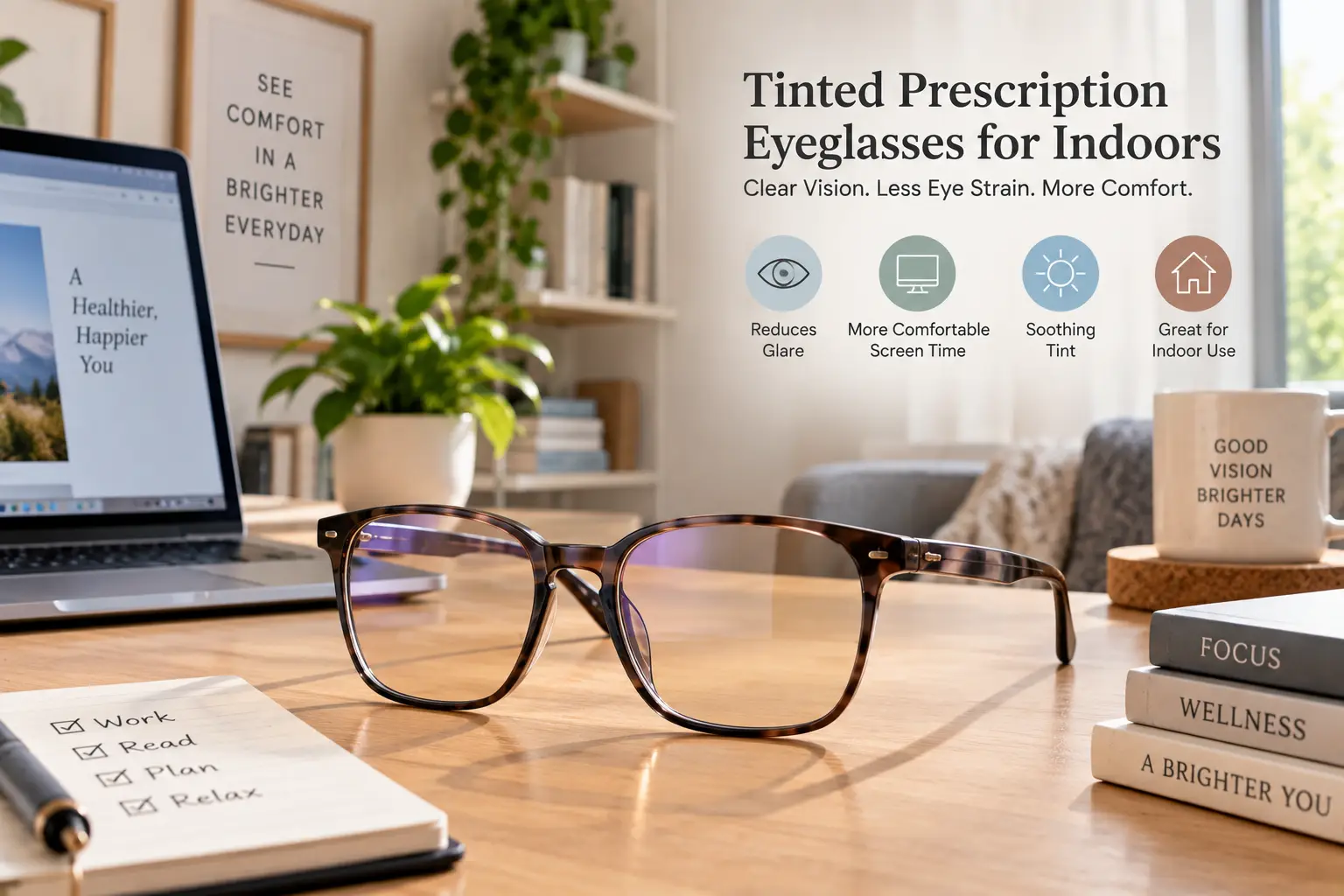
If overhead fluorescent tubes at the office or the blue glow of your monitor leave your eyes aching by 2 p.m., you’re far from alone. Tinted prescription eyeglasses for indoors are prescription lenses finished with a light-filtering tint — most often the rose-colored FL-41 tint or an amber blue-light tint — designed to calm harsh artificial lighting while still correcting your vision. Unlike sunglasses, they’re built to stay comfortable under indoor light levels rather than block out the sun. This guide walks through what actually works, why it works, and which real products are worth your money in 2026.
We dug into spec sheets, clinical research, and aggregated customer feedback rather than repeating manufacturer marketing copy, because the difference between a genuinely helpful pair of glasses and an overpriced pink filter often comes down to details most listings skip. Whether you’re managing migraine-related photophobia, a diagnosed eye condition, or just eight hours a day under LED panels, there’s a meaningful difference between the seven options below — and knowing which one fits your situation can save you both money and eye strain. A 2023 fMRI study on FL-41 lenses found that most subjects showed measurably reduced light-evoked brain activity tied to discomfort while wearing the tint, though a small subset reported no change or even increased sensitivity — a useful reminder that no single tint works identically for everyone.
Below, you’ll find seven real, purchasable products, honest side-by-side comparisons, and practical guidance for choosing (and actually using) tinted prescription eyeglasses for indoors without wasting money on the wrong tint level.
Quick Comparison: Indoor Tinted Prescription Glasses at a Glance
Before diving into the full lineup, here’s a fast snapshot of how the standout picks stack up on tint type, ideal use case, and price tier.
| Product | Tint Type | Best For | Price Range |
|---|---|---|---|
| Zenni FL-41 Tint (Any Frame) | Rose FL-41 (25/50/80%) | Budget-conscious first-timers | Under $50 for the lens add-on |
| TheraSpecs Lane | Custom Rx FL-41 | Everyday indoor wear with a fashion frame | Around $100–$150 |
| Axon Optics Prescription Migraine Glasses | Avulux precision filter | Diagnosed migraine/photophobia | Roughly $150–$250 |
| GUNNAR Optiks Intercept (Prescription) | Amber blue-light (65%) | Office and screen-heavy work | Around $70–$140 |
| SomniLight Rose FL-41 Fitover Glasses | Rose FL-41, UV400 | Wearing over existing prescription glasses | Under $30 |
Looking at this snapshot, the split really comes down to whether you’re managing a diagnosed light-sensitivity condition or just fighting everyday screen glare. Axon Optics Prescription Migraine Glasses justify their higher price with a clinically studied filter, while Zenni FL-41 Tint and SomniLight Rose FL-41 Fitover Glasses are smarter entry points if you’re not yet sure a tint will help you. GUNNAR Optiks Intercept stands apart because it’s optimized for screens rather than photophobia specifically, so it’s a different tool for a related problem.
💬 Bookmark this comparison — you’ll want to reference it once you see the full lineup below!
The 7 Best Tinted Prescription Eyeglasses for Indoors
1. Zenni FL-41 Tint (Any Frame) — most affordable way to test the tint
If you’ve never tried a light-filtering tint and don’t want to commit hundreds of dollars to find out whether it helps, this is where to start. Zenni offers FL-41 as an add-on lens option that can be applied to a wide range of its prescription frames, rather than as a single fixed product. The lens comes in three tint strengths — 25%, 50%, and 80% — with the 25% version specifically designed for indoor fluorescent and screen glare, while heavier tints lean outdoor. In practice, that tiered system matters: picking 80% for an office job means an unnecessarily dark lens indoors, while 25% won’t do much if you’re also light-sensitive outside. Every tint level ships with full UVA/UVB protection and is compatible with single-vision, progressive, and even non-prescription orders, which makes it one of the more flexible options on this list for people juggling astigmatism or bifocal needs.
Zenni’s own product materials describe the tint as filtering the 480–520nm range most associated with discomfort, and the brand markets it as a lower-cost entry point compared to specialty migraine-eyewear companies — a fair characterization based on the lens pricing alone. What the marketing doesn’t emphasize as clearly is that frame selection still matters for fit and coverage; a small frame with a lot of light leaking around the edges undercuts even a good tint. Independent, verified review data broken out specifically for the FL-41 add-on (separate from Zenni’s frame ratings generally) is limited, so treat this as a reasonably priced way to experiment rather than a guaranteed fix.
Pros:
- ✅ Lowest-cost way to add a real FL-41 tint to a prescription
- ✅ Three tint strengths let you match indoor vs. outdoor needs
- ✅ Works with progressives, bifocals, and single-vision prescriptions
Cons:
- ❌ Frame quality varies widely across Zenni’s budget lineup
- ❌ Independent review data specific to the tint itself is limited
At under $50 for the lens upgrade before frame cost, this is the cheapest legitimate way to find out whether a rose tint helps your indoor light sensitivity before spending more.
2. TheraSpecs Lane — purpose-built frame with custom prescription FL-41 lenses
Where Zenni FL-41 Tint treats the tint as an add-on, TheraSpecs Lane is a frame designed from the ground up around light-sensitivity relief. TheraSpecs manufactures each lens to your exact prescription rather than tinting a stock lens, and the company offers four distinct FL-41 lens variants tuned for different triggers — screens, fluorescent and LED lighting, sunlight, and night driving glare. That distinction matters in practice: someone whose main trigger is office fluorescents needs a different filtering profile than someone bothered mainly by headlights, and a one-size-fits-all tint can under- or over-correct for either case.
This is a genuinely mid-range pick for people who want a dedicated pair rather than a repurposed everyday frame. TheraSpecs states that the large majority of its customers find the glasses helpful across a range of lighting situations — a brand-reported figure worth noting as self-reported marketing data rather than independent clinical evidence, though it’s consistent with the peer-reviewed research on FL-41 more broadly. Aggregated customer feedback on major retail platforms for TheraSpecs products skews positive, with recurring praise for comfort during extended wear and recurring complaints centered on the adjustment period some users need before colors look “normal” again through a rose lens.
Pros:
- ✅ Prescription lenses custom-cut to your exact vision needs
- ✅ Four lens variants targeted at specific light triggers
- ✅ Frame designed specifically around comfort for all-day wear
Cons:
- ❌ Pricier than off-the-shelf tinted lens add-ons
- ❌ Custom manufacturing means a longer turnaround than stock frames
Expect to land in the $100–$150 range once your prescription is factored in — a reasonable mid-tier investment if indoor light sensitivity is a recurring, not occasional, problem for you.
3. TheraSpecs Original WearOver FL-Pro — fits over glasses you already own
Not everyone wants to redo their prescription lenses just to test a tint, and that’s exactly the gap TheraSpecs Original WearOver FL-Pro fills. This fitover style is designed to sit comfortably over your existing prescription eyewear, meaning you keep your current lenses, coatings, and prescription exactly as they are while adding the FL-41 filtering layer on top. It’s a practical middle ground between a full custom-Rx pair and a non-prescription option that doesn’t correct your vision at all.
The trade-off is bulk: fitover frames are inherently larger and less discreet than a standard pair, which some wearers find noticeable in professional settings. Aggregated Amazon feedback for TheraSpecs’ WearOver line frequently praises the ability to skip a costly lens replacement, while a recurring critique involves fit — glasses with larger or wraparound frames underneath may not sit comfortably beneath the fitover shell. This product genuinely shines for people testing whether FL-41 helps before committing to prescription lenses, or for anyone who simply doesn’t want to touch a well-fitted existing pair of glasses.
Pros:
- ✅ No need to alter or replace your current prescription lenses
- ✅ Meaningfully cheaper than a full custom-Rx tinted pair
- ✅ Easy to remove for outdoor or low-light moments
Cons:
- ❌ Bulkier profile than a dedicated prescription frame
- ❌ Fit depends heavily on the shape of your existing glasses
Priced roughly in the $30–$60 range, this is one of the best value plays here if your only goal is layering FL-41 protection onto glasses you already like.
4. Axon Optics Prescription Migraine Glasses — clinically studied filter for serious photophobia
For buyers managing a diagnosed migraine or photophobia condition rather than mild office glare, Axon Optics Prescription Migraine Glasses sit at the premium end of this list for a defensible reason. The lenses use the Avulux optical filter, developed out of University of Utah research and now available as an FDA-authorized, over-the-counter optical filter indicated to attenuate light around the 480nm and 590nm wavelengths — the same wavelength ranges researchers have repeatedly implicated in triggering photophobic discomfort. Unlike standard FL-41’s pink cast, Avulux uses a more neutral gray-toned filter, which some wearers prefer because it distorts color perception less noticeably during screen or paperwork-heavy days.
Researchers at the University of Utah’s Moran Eye Center, who pioneered much of the original FL-41 research, note that in head-to-head comparisons against conventional gray sunglasses and standard rose-tinted lenses, most patients in their testing preferred the FL-41-style filtered spectacles — context that helps explain why specialized migraine-lens brands have built businesses around refining that original filter design. Axon backs its frames with a 60-day trial window, and aggregated customer reviews collected on the brand’s own site and third-party retailers consistently mention meaningful relief for chronic light sensitivity, alongside a smaller number of reviewers who found even the “indoor” strength too dark for detail-oriented screen work like photo editing.
Pros:
- ✅ Built on a clinically studied, FDA-authorized optical filter
- ✅ Neutral gray tone causes less noticeable color distortion
- ✅ Backed by a 60-day trial period for testing at home
Cons:
- ❌ Highest price point of any product on this list
- ❌ Overkill for mild, occasional fluorescent-light sensitivity
At an estimated $150–$250 for a prescription pair, this is the pick for people who’ve already identified light as a real medical trigger and want the most rigorously engineered filter available.
5. GUNNAR Optiks Intercept (Prescription) — amber tint tuned for screens, not migraines
GUNNAR Optiks Intercept takes a different approach than the rose-tinted options above: instead of targeting migraine-related photophobia, its amber-tinted lens is engineered specifically around digital eye strain from monitors, phones, and gaming displays. GUNNAR states the lens blocks roughly 65% of blue light along with 100% UV protection, and the frame geometry is designed to wrap slightly to limit airflow across the eye, which the company markets as a way to reduce the dry, gritty feeling that comes from staring at a screen without blinking enough. GUNNAR also offers a “Max” amber tint variant with a heavier 98% blue-light block for late-night screen use, though that strength trades more contrast accuracy for stronger filtering.
This is a genuinely different use case than FL-41: if fluorescent office lighting itself is your trigger, GUNNAR’s amber tint won’t target the same wavelengths that FL-41 does. But if your discomfort is specifically screen-driven — tired eyes, mild headaches after long monitor sessions, trouble sleeping after late-night laptop use — the blue-light-forward design is arguably the better-matched tool. Aggregated retail reviews for GUNNAR’s computer glasses lineup frequently cite reduced end-of-day eye fatigue, with a recurring complaint that the amber cast makes color-accurate work (design, video editing) impractical while wearing them.
Pros:
- ✅ Purpose-built for screen glare rather than general photophobia
- ✅ Available with a full prescription through GUNNAR’s Rx program
- ✅ Wraparound frame design helps reduce dry-eye airflow
Cons:
- ❌ Amber tint noticeably shifts color perception on screens
- ❌ Not targeted at fluorescent-light or migraine-specific triggers
Non-Rx frames typically run $45–$95, with prescription lenses adding to that; it’s a strong value pick specifically for screen-driven strain rather than broader light sensitivity.
6. Braddell Optics FL-41 Rose Tinted Glasses — budget indoor/outdoor bundle
Braddell Optics FL-41 Rose Tinted Glasses is a budget-tier Amazon-marketplace option that pairs an indoor-strength FL-41 rose lens with a separate outdoor-strength tinted lens in some bundle configurations, giving buyers coverage for both settings without ordering two separate specialty brands. The core value proposition here is price: it’s meaningfully cheaper than the specialty migraine-eyewear brands above while still using the same general FL-41 tinting approach that’s been studied for decades.
The honest trade-off with budget marketplace brands like this one is quality consistency and support. You’re less likely to get the custom prescription fitting, four-variant lens system, or dedicated customer support that TheraSpecs and Axon Optics build their higher prices around. Aggregated Amazon feedback for this category of budget FL-41 glasses tends to be mixed — positive on initial comfort and tint color, with a recurring theme of frames feeling less durable over months of daily wear compared to established optical brands. For someone who wants to try FL-41 in a frame style rather than as an add-on lens, and who is comfortable with a marketplace-brand fit process, it’s a reasonable low-risk entry.
Pros:
- ✅ Bundles indoor and outdoor tint strengths in one purchase
- ✅ Noticeably cheaper than specialty migraine-eyewear brands
- ✅ Easy, no-commitment way to try FL-41 in a full frame
Cons:
- ❌ Build quality is less consistent than established optical brands
- ❌ Limited dedicated customer support compared to specialty brands
Priced generally under $40, this is a low-stakes way to try FL-41 as a complete frame rather than a lens upgrade to an existing pair.
7. SomniLight Rose FL-41 Fitover Glasses — lightweight fitover with UV400 rating
Closing out the list, SomniLight Rose FL-41 Fitover Glasses is another fitover-style option, similar in concept to TheraSpecs Original WearOver FL-Pro but positioned at a noticeably lower price point. The glasses use the standard rose FL-41 tint and carry a full UV400 rating, meaning 100% protection against UVA and UVB rays — a detail worth checking on any tinted eyewear, since tint color alone doesn’t guarantee UV protection. SomniLight markets the fitover design (measuring roughly 160mm wide) as effective for both indoor and outdoor lighting situations, which makes it a reasonably versatile single purchase for people who don’t want separate indoor and outdoor pairs.
Independent research on FL-41 broadly supports the underlying tint technology SomniLight uses, including studies referenced by SomniLight itself citing meaningful average reductions in migraine frequency among study participants over several months — a brand-cited figure that should be read as referencing published third-party research rather than SomniLight’s own clinical trial. As with any fitover, comfort depends heavily on how your existing glasses are shaped underneath; wearers with larger or heavily wrapped frames may find the fit tighter than expected.
Pros:
- ✅ Full UV400 rating in addition to the FL-41 tint
- ✅ Markedly cheaper than premium fitover competitors
- ✅ Marketed for both indoor and outdoor light situations
Cons:
- ❌ Fitover bulk is more noticeable than a dedicated frame
- ❌ Comfort varies based on your underlying glasses’ shape
At under $30, this is one of the most accessible ways on this list to add both light filtering and UV protection over glasses you already wear.
Full Lineup Comparison: Features, Price, and Best Use Case
With all seven products laid out, here’s how they compare directly on the details that actually drive a purchase decision.
| Product | Lens Technology | Price Range | Best For |
|---|---|---|---|
| Zenni FL-41 Tint (Any Frame) | FL-41, 3 tint strengths | Under $50 (lens add-on) | Testing the tint affordably |
| TheraSpecs Lane | Custom Rx FL-41, 4 variants | $100–$150 | Dedicated everyday relief frame |
| TheraSpecs Original WearOver FL-Pro | FL-Pro fitover FL-41 | $30–$60 | Layering over existing glasses |
| Axon Optics Prescription Migraine Glasses | Avulux precision filter | $150–$250 | Diagnosed migraine/photophobia |
| GUNNAR Optiks Intercept (Prescription) | Amber, 65% blue-light block | $70–$140 | Screen-driven eye strain |
| Braddell Optics FL-41 Rose Tinted Glasses | FL-41 rose + outdoor bundle | Under $40 | Budget full-frame trial |
| SomniLight Rose FL-41 Fitover Glasses | FL-41 rose, UV400 | Under $30 | Budget fitover with UV protection |
The clearest pattern here is that price scales with how targeted and clinically backed the filtering technology is: Axon Optics Prescription Migraine Glasses and TheraSpecs Lane justify their higher cost with custom Rx manufacturing and multi-variant lens systems, while Zenni FL-41 Tint and SomniLight Rose FL-41 Fitover Glasses compress cost by using a simpler, single-strength tint. Notice also that GUNNAR Optiks Intercept doesn’t fit neatly into a “cheap vs. premium” FL-41 spectrum at all, since it’s solving a related but different problem — that’s worth remembering before you assume more expensive automatically means more effective for your specific trigger.
💬 One click on any bolded pick above helps you compare current pricing before it changes! 😊
Getting Started: Your First 30 Days With Indoor Tinted Prescription Glasses
The biggest first-30-day mistake is over-wearing a strong tint before your eyes adjust. Start by wearing your new tinted glasses for shorter stretches — an hour or two at a time — during your worst-offending lighting situations (typically open-plan offices under fluorescent panels or extended monitor sessions), then gradually extend wear time as your eyes and brain adapt to the altered color perception. Most wearers report the “everything looks pink” adjustment period fades within a few days to two weeks; if it hasn’t improved by week three, that’s a signal the tint strength may be mismatched to your actual sensitivity level, not a sign you should push through discomfort.
Keep a simple symptom log for those first weeks: note when you wore the glasses, for how long, and whether headaches, eye strain, or squinting episodes changed in frequency. This matters more than it sounds — TheraSpecs and Axon Optics both build multi-variant lens systems specifically because light triggers vary person to person, and a log gives you (and your eye doctor, if you’re working with one) concrete data on whether you need a stronger tint, a different lens type entirely, or a change in indoor lighting rather than eyewear. Clean lenses with a microfiber cloth rather than clothing to avoid scratching the anti-reflective coating most of these lenses ship with, and store them in a hard case when not in use — tinted coatings are often more prone to visible scuffing than clear lenses because scratches show up more obviously against a colored background.
Real-World Scenarios: Who Actually Benefits From Tinted Prescription Eyeglasses for Indoors
The open-plan office worker. If you spend eight-plus hours under fluorescent panels and notice a dull headache creeping in by mid-afternoon, a moderate FL-41 indoor tint like the one available through Zenni FL-41 Tint or TheraSpecs Lane is a reasonable first move, since fluorescent lighting is one of the most well-documented FL-41 trigger categories. Budget for the lighter 25% tint strength first rather than jumping to a heavier filter you don’t yet know you need.
The diagnosed migraine sufferer. If a neurologist has already flagged photophobia as part of your migraine pattern, the calculus changes: you’re not testing a hunch, you’re managing a documented trigger, which makes the higher upfront cost of Axon Optics Prescription Migraine Glasses easier to justify given the clinical research behind the Avulux filter specifically. Someone in this category is also the most likely to benefit from logging symptom frequency, since insurance or FSA/HSA reimbursement conversations often go smoother with documented before-and-after data.
The remote worker glued to two monitors. If your discomfort is clearly screen-driven rather than tied to ambient room lighting — dry eyes, blurry focus by evening, disrupted sleep after late work sessions — GUNNAR Optiks Intercept is the better-matched tool, since its amber tint and blue-light filtering target device emissions specifically rather than fluorescent wavelengths. Pair it with the 20-20-20 rule (every 20 minutes, look at something 20 feet away for 20 seconds) for a bigger combined effect than the glasses alone will deliver.
Problem → Solution: Fixing the Most Common Indoor Light Sensitivity Complaints
Problem: Colors look “off” and it’s distracting at work. This is the single most common early complaint with any rose-tinted FL-41 lens, since the tint intentionally filters specific wavelengths that affect color perception. Solution: if precise color work (design, photo editing, color-coded spreadsheets) is a daily requirement, consider Axon Optics Prescription Migraine Glasses or GUNNAR Optiks Intercept, both of which use less visually intrusive tint tones than a strong rose FL-41, or keep a clear pair on hand for color-critical tasks.
Problem: The glasses help indoors but do nothing outside. This isn’t a defect — most indoor-strength FL-41 lenses (25% tint) are intentionally too light for outdoor glare. Solution: pair an indoor pair with a dedicated outdoor-strength option, or choose a bundled product like Braddell Optics FL-41 Rose Tinted Glasses, which pairs indoor and outdoor tint strengths together.
Problem: A fitover pair feels bulky and slides down. Solution: fitover fit depends heavily on your underlying frame shape; a smaller, closer-fitting base pair of glasses will sit better under TheraSpecs Original WearOver FL-Pro or SomniLight Rose FL-41 Fitover Glasses than a large or heavily curved frame.
Problem: You’re not sure the tint is actually helping. Solution: return to the symptom log from the “Getting Started” section above — subjective impressions of relief are notoriously unreliable without a few weeks of consistent tracking to compare against.
Problem: The lenses seem too dark for indoor use. Solution: this usually means you were sold (or self-selected) a heavier outdoor-strength tint. Double-check the tint percentage on your order — the FL-41 25% tier is the one purpose-built for indoor fluorescent and screen glare.
What Are Tinted Prescription Eyeglasses for Indoors?
Tinted prescription eyeglasses for indoors are corrective lenses finished with a light-filtering tint — typically FL-41 rose or an amber blue-light coating — engineered to reduce discomfort from fluorescent lighting and screens while still correcting your vision, without the heavy darkness of outdoor sunglasses.
The concept traces back to research from the 1990s at the University of Utah, where clinicians developed the original FL-41 tint to help patients with fluorescent light sensitivity. Since then, the underlying science has been refined and studied across conditions ranging from blepharospasm to traumatic brain injury, with one notch-filter study finding measurable headache-score improvements in migraine patients using a filter in the same wavelength family as FL-41, according to research summarized by clinicians at the Association of Migraine Disorders. Modern versions range from simple add-on tints at budget optical retailers to precision-engineered filters like Avulux that hold formal regulatory clearance as an optical device.
How to Choose Tinted Prescription Eyeglasses for Indoors
- Identify your actual trigger first. Fluorescent lighting, screens, and outdoor sun each respond differently to tint type; guessing wrong wastes money on the wrong lens.
- Match tint strength to setting. A 25% FL-41 tint suits typical indoor lighting; heavier tints are built for outdoor glare and can feel overly dark inside.
- Decide between a new Rx pair and a fitover. Fitovers protect an existing prescription investment; a dedicated frame gives a cleaner, less bulky fit.
- Check for real UV protection separate from the tint. Color alone doesn’t guarantee UVA/UVB coverage — confirm it’s listed explicitly.
- Weigh clinical backing against price for medical-grade triggers. If a doctor has flagged photophobia as a symptom, filters with documented research, like Avulux, may be worth the added cost.
- Consider your color-accuracy needs. Designers, photographers, and colorists should test lighter tints or amber alternatives rather than a heavy rose filter.
- Confirm return or trial policies before committing. Because comfort with a tint is highly individual, a trial window protects you from being stuck with the wrong strength.
Indoor Tinted Lenses vs. Blue Light Blocking Glasses vs. Sunglasses Indoors
These three categories get confused constantly, and picking the wrong one is the most common mistake shoppers make. FL-41 tinted lenses target a specific 480–520nm wavelength band linked to photophobic discomfort and migraine triggers; standard blue light blocking glasses, like the amber lenses in GUNNAR Optiks Intercept, filter a broader blue-light range primarily to reduce digital eye strain and improve sleep; and wearing prescription sunglasses indoors simply blocks too much overall light, which can strain your eyes further by forcing pupils to dilate excessively in already-dim indoor settings.
The practical distinction: if your main complaint is headaches or discomfort under fluorescent office lighting specifically, FL-41-style products such as TheraSpecs Lane or Zenni FL-41 Tint are the better-matched category. If your complaint is screen fatigue and disrupted sleep from late-night device use, blue-light-forward options like GUNNAR Optiks Intercept are the closer fit. Sunglasses indoors, meanwhile, aren’t a substitute for either — they’re simply the wrong tool, since they’re engineered for an entirely different light intensity range than any indoor environment produces.
Common Mistakes to Avoid When Buying Indoor Tinted Prescription Glasses
The most expensive mistake is buying based on tint color alone rather than tint percentage and purpose — a rose-colored lens marketed generically as “migraine glasses” isn’t automatically FL-41-grade, and some inexpensive marketplace listings use decorative pink lenses with none of the actual wavelength filtering research behind FL-41 or Avulux. A second common error is ordering an outdoor-strength tint for indoor use, which leaves the lenses feeling unnecessarily dark and can actually worsen visual comfort rather than help it. Third, many buyers skip checking whether a product is genuinely available with a full prescription (versus reader-strength magnification only), which matters significantly for anyone with astigmatism, a strong prescription, or a need for progressives.
Finally, don’t assume a single pair will solve indoor and outdoor sensitivity simultaneously unless you’ve specifically chosen a bundled or photochromic product designed for that; expecting an indoor-strength FL-41 lens to double as effective outdoor sun protection is a frequent source of buyer disappointment that’s easily avoided by reading tint-strength specifications closely before ordering.
Features That Actually Matter (and Ones That Don’t)
Tint percentage and wavelength targeting matter enormously — the difference between a 25% and an 80% FL-41 tint is the difference between comfortable indoor wear and unusably dark lenses at your desk. Genuine UV400 or UVA/UVB certification matters too, since it’s a separate spec from tint color and shouldn’t be assumed. Anti-reflective and scratch-resistant coatings, standard on most of the products above, meaningfully extend lens life and reduce glare bouncing off the lens surface itself, which compounds discomfort from the very light sensitivity you’re trying to fix.
What matters far less than marketing suggests: frame “gaming” branding on computer glasses, which is largely cosmetic and doesn’t change the underlying amber lens technology, and exaggerated blue-light-blocking percentages above roughly 60-65%, since research on blue light’s actual role in eye strain (as opposed to sleep disruption) remains more limited than some product marketing implies. A designer frame name also doesn’t correlate with filtering effectiveness — the lens technology, not the brand’s fashion positioning, is what determines whether your light sensitivity actually improves.
Long-Term Cost and Maintenance
Factor in more than the sticker price when comparing these seven options. Custom-Rx products like TheraSpecs Lane and Axon Optics Prescription Migraine Glasses cost more upfront but typically include more durable coatings and dedicated customer support for lens-specific issues, which can reduce the odds of an early replacement purchase. Budget options like Braddell Optics FL-41 Rose Tinted Glasses and SomniLight Rose FL-41 Fitover Glasses cost less initially but, based on aggregated marketplace feedback, may need replacing sooner if frame hinges or coatings wear faster under daily use.
Also worth factoring in: many FL-41 and blue-light prescription products qualify for FSA or HSA reimbursement when purchased with a valid prescription, which can meaningfully offset the higher-tier options if you have either account available. Routine maintenance is simple across all seven picks — clean with a microfiber cloth, avoid setting lenses tint-side-down on hard surfaces, and store in a hard case — but replacing a scratched tinted lens is often pricier than replacing a clear one, since the tint itself, not just the lens blank, has to be reapplied or reordered.
Safety, Regulations, and Standards for Prescription Eyewear
Any prescription eyewear sold in the U.S., tinted or not, should meet basic impact-resistance standards for everyday lenses, and reputable optical retailers will note compliance on request even when it isn’t printed directly on a product listing. For the FL-41 and Avulux category specifically, it’s worth understanding that the FDA classifies these as optical filters rather than drugs or medical treatments — Avulux, for instance, holds FDA authorization as an over-the-counter optical filter, not as a cure for migraine or photophobia, and the American Academy of Ophthalmology notes that photophobia itself can stem from a wide range of underlying causes, from dry eye to neurological conditions, that eyewear alone won’t address.
That distinction matters practically: if light sensitivity is new, sudden, or paired with other symptoms like vision changes or eye pain, a comprehensive eye exam should come before — not instead of — ordering tinted lenses. Recent research on light-filtering lenses in traumatic brain injury patients found meaningful improvements in visual comfort with FL-type filters compared to plain gray tints, but researchers were careful to frame this as symptom management rather than a standalone treatment, noting that both lens types produced some improvement — underscoring that response varies by individual and underlying condition.
✨ Ready to Stop Squinting Through Your Workday?
🔍 Take your indoor comfort to the next level with this carefully researched lineup. Click a highlighted pick above to check current pricing and availability, and start narrowing down the tint strength that actually matches your triggers. The right pair can turn a headache-inducing office into a genuinely comfortable one.
FAQs
❓ Can I get FL-41 tint added to my regular prescription glasses?
❓ What's the difference between FL-41 tint and blue light blocking glasses?
❓ Will tinted indoor glasses change how I see colors?
❓ Are indoor tinted prescription glasses covered by FSA or HSA funds?
❓ How do I know if I actually need tinted prescription eyeglasses for indoors?
Conclusion
Tinted prescription eyeglasses for indoors aren’t a one-size-fits-all fix, and the right pick genuinely depends on what’s actually triggering your discomfort. If you’re just starting to explore whether a tint helps, Zenni FL-41 Tint or SomniLight Rose FL-41 Fitover Glasses offer a low-risk way to test the waters. If you’re managing a diagnosed migraine or photophobia condition, the clinically backed filter in Axon Optics Prescription Migraine Glasses is worth the higher investment. And if your discomfort is clearly tied to screens rather than ambient lighting, GUNNAR Optiks Intercept targets that specific problem more directly than any FL-41 product will.
Whatever you choose, match the tint strength to the setting, give your eyes a real adjustment window before judging results, and don’t hesitate to loop in an eye doctor if light sensitivity is new or worsening rather than a longstanding, mild annoyance. Comfortable indoor lighting shouldn’t be a luxury — with the right lens, it’s a fairly straightforward fix.
✨ Found Your Match in This Lineup?
💬 Take one more look at the comparison table above, pick the tint that matches your actual trigger, and check current pricing before you decide. Your eyes will thank you by the end of the workday.
Recommended for You
- Light Tint Shades: 7 Best Window Films for a Brighter, Legal Look in 2026
- Tinted Eyeglasses for Indoors: 7 Best Picks for Light Sensitivity (2026)
- Blue Tinted Spectacles: 7 Best Picks & Buying Guide (2026)
Disclaimer: This post contains affiliate links. As an Amazon Associate, I earn from qualifying purchases made through these links, at no additional cost to you.
✨ Found this article helpful? Share it with someone who needs it! 💬🤗