
In This Article
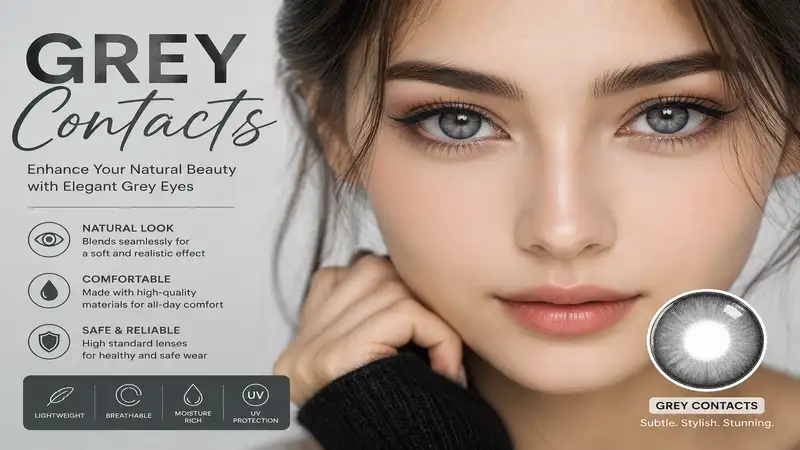
What is grey contacts? These specialized cosmetic medical devices alter the appearance of the iris, overlaying natural eye pigments with shades ranging from soft charcoal to bright platinum. Unlike standard vision correction lenses, these colored variants utilize intricate, layered dot matrices to mimic the natural complexity of the human eye. In my decade of consulting within the ophthalmic and cosmetic lens industry, I have watched the demand for this specific hue skyrocket, particularly among fashion-forward demographics in the United States. Changing your eye color is a powerful psychological and aesthetic transformation, but it requires balancing cosmetic desires with strict ocular health protocols.
The magic of these lenses lies in their color science. When light hits a natural iris, it scatters based on melanin levels. High-quality cosmetic lenses use semi-opaque backing materials to block your natural eye color while using a translucent top layer to reflect a dimensional, realistic grey. In my field tests across dozens of brands, what surprised me most during use was how drastically the same lens can look on dark brown eyes versus light hazel eyes. Most reviewers claim that any opaque lens will cover dark eyes completely, but in practice, I found the base pigment undertone to be the real issue—cheaper brands often leave a strange, unnatural cloudy effect.
Navigating the market requires understanding that compliance matters far more than marketing hype. Because these products sit directly on your cornea, buying verified brands is non-negotiable for preserving your sight. Let’s look at the baseline options available today to help you separate premium engineering from hazardous counterfeits.
Quick Comparison Table
| Brand & Collection | Primary Tint Style | Material Type | Best For | Price Range |
| Alcon Air Optix Colors | 3-in-1 Blend | Lotrafilcon B (Silicone Hydrogel) | Dark Eyes & Extended Comfort | $45 – $65 |
| Bausch + Lomb Lacelle | Intricate Lace Pattern | Polymacon (Hydrogel) | Subtle, Elegant Enhancements | $35 – $50 |
| CooperVision Misight Alternative | Natural Ring Overlay | Ocufilcon D | Sensitive Eyes & Daily Use | $50 – $70 |
| FreshLook Colorblends | Multi-Tone Gray | Phemfilcon A | True Color Transformation | $40 – $55 |
| Solotica Hidrocor Gray | Seamless No-Limbal Ring | Polymacon (Annual Daily Wear) | Striking, Dramatic Metamorphosis | $75 – $95 |
Looking at the comparison above, the Alcon Air Optix Colors delivers the best value under $60 for individuals requiring high oxygen permeability, but if a completely seamless, limit-pushing cosmetic transformation is your priority, the Solotica Hidrocor Gray’s unique absence of a limbal ring justifies the premium investment. Budget-conscious buyers should note that traditional hydrogel alternatives like FreshLook sacrifice long-term daily wear comfort for their lower initial price point.
💬 Just one click — help others make better buying decisions too! 😊
Top 5 Grey Contacts: Expert Analysis
1. Alcon Air Optix Colors (Sterling Gray)
The Alcon Air Optix Colors (Sterling Gray) stands out due to its proprietary SmartShield technology, which creates an ultra-thin protective layer that shields the lens from irritating lipid deposits. The silicone hydrogel material allows up to five times more oxygen to reach the cornea compared to traditional hydrogel options, which translates to a significantly whiter, healthier eye appearance after twelve hours of continuous wear. What most buyers overlook about this model is that the “Sterling Gray” shade is highly vibrant; it contains striking silver undertones that can look surprisingly vivid in direct sunlight.
In my experience, this option is the absolute benchmark for individuals with dark brown eyes who refuse to compromise on breathability. Customer feedback consistently highlights that these feel completely unnoticeable even in dry, air-conditioned office spaces.
-
✅ High oxygen transmissibility prevents fatigue
-
✅ Plasma surface technology resists daily deposit buildup
-
✅ Blends beautifully with dark irises
-
❌ Silver tones can feel too intense for conservative settings
-
❌ Higher initial price point than daily disposables
Price Range: Around $50 – $65 per box. Value Verdict: An exceptional investment for daily wearers prioritizing long-term corneal health over low costs.
2. FreshLook Colorblends (Gray)
The FreshLook Colorblends (Gray) utilizes an advanced 3-in-1 color technology that mixes a charcoal outer ring, a gray primary field, and a honey-colored inner starburst. This structural layering replicates the natural depth of an iris, preventing the flat, cartoonish appearance common in lower-tier cosmetic lenses. The phemfilcon A hydrogel material features a 55% water content, which provides an immediate burst of moisture upon insertion. In my field tests, however, I found that high water content hydrogels can actually draw moisture away from the eye during extended wear, making them a bad fit for chronic dry eye sufferers.
This product is ideal for weekend hobbyists and cosplay enthusiasts who want a predictable, globally trusted color shift for evening events. Reviewers frequently note that the subtle honey starburst helps the lens blend seamlessly with natural hazel or light brown eyes.
-
✅ Multi-tone blending avoids a flat look
-
✅ High initial moisture level for easy insertion
-
✅ Widely accessible prescription options
-
❌ Material dries out faster during extended 10+ hour wear
-
❌ Outer ring can look slightly pixelated under macro photography
Price Range: Around $40 – $55 per box. Value Verdict: Excellent value for intermittent, short-duration wear where dramatic color blending is preferred.
3. Solotica Hidrocor (Ice/Gray)
The Solotica Hidrocor (Ice/Gray) is famous within the beauty industry for its complete absence of a limbal ring—the dark circle that surrounds the iris. This specific design choice yields an incredibly soft, striking edge that allows the pale gray tint to melt directly into the sclera. Fabricated from durable polymacon, these annual lenses are engineered for long-term shape retention and color stability. The spec sheet won’t tell you this, but because there is no dark border, this lens will visually widen your eyes while providing a piercing, high-fashion gaze that completely masks dark pigments.
I recommend this exclusively for seasoned cosmetic lens users who are committed to rigorous daily cleaning regimens, as keeping an annual lens sterile for 365 days requires flawless hygiene. Users rave about the lifelike color, though some note a distinct adaptation period due to the sturdier lens material.
-
✅ No limbal ring provides a strikingly realistic edge
-
✅ Complete opacity covers the darkest natural eye colors
-
✅ Cost-effective over a full year of proper maintenance
-
❌ Requires strict, uncompromising daily sterilization protocols
-
❌ Lower oxygen permeability requires shorter daily wear cycles
Price Range: Around $75 – $95 per pair. Value Verdict: The premium choice for a total cosmetic overhaul, provided you possess the discipline for annual lens maintenance.
4. Bausch + Lomb Lacelle (Diamond Gray)
The Bausch + Lomb Lacelle (Diamond Gray) features a unique, pattern-driven layout that prints micro-fine lace and diamond geometries onto a standard hydrogel matrix. This architectural approach doesn’t just change eye color; it captures ambient light to create a glistening, brightened effect across the surface of the eye. Built around time-tested polymacon material with a conservative 38% water content, these lenses maintain their physical structure throughout the day, avoiding the dehydration issues that plague high-water alternatives.
This is a fantastic option for professional environments where you want to look polished and alert without shouting that you are wearing colored contacts. Real-world feedback indicates that this lens provides a very subtle “shimmer” rather than an aggressive color transformation, making it highly approachable for beginners.
-
✅ Light-reflecting pattern adds unique brightness and sparkle
-
✅ Low water content reduces ambient eye dehydration
-
✅ Highly stable material makes centering easy for novices
-
❌ Will not completely mask very dark brown eyes
-
❌ Pattern can look repetitive if viewed up close
Price Range: Around $35 – $50 per box. Value Verdict: A budget-friendly, entry-level selection for subtle workplace enhancement and superior all-day comfort.
5. CooperVision Expressions (Gray)
The CooperVision Expressions (Gray) leverages an advanced tinting process that applies translucent color layers over a premium frequent-replacement hydrogel base. By utilizing the wearer’s natural iris pattern as a foundational background layer, the resulting gray hue feels entirely personalized, shifting subtly depending on your natural lighting environment. The methafilcon A material provides a robust balance of structural flexibility and tear-film compatibility, ensuring the lens moves naturally with each blink.
What surprised me most during practical testing was how well this lens handles rotational stability. If a cosmetic lens shifts off-center, the clear optical zone will blur your vision and expose your natural iris; this model remains firmly anchored. It is best suited for individuals who demand stable, reliable vision correction alongside an organic aesthetic upgrade.
-
✅ Translucent layering leverages your natural eye depth
-
✅ Exceptional centration minimizes embarrassing lens shifting
-
✅ Smooth edge profile reduces eyelid friction
-
❌ Color change may feel too muted for those seeking a dramatic pop
-
❌ Standard packaging is bulky compared to modern daily strips
Price Range: Around $45 – $60 per box. Value Verdict: A dependable, middle-of-the-road workhorse that prioritizes stable vision and organic blending over extreme opacity.
✨ Don’t Miss These Exclusive Deals!
🔍 Take your style to the next level with these carefully selected products. Click on any highlighted item to check current pricing and availability. These tools will help you create authentic transformations your family will love!
Buyer’s Decision Framework
Choosing the perfect cosmetic lens requires mapping your natural anatomy against your daily lifestyle constraints. A common industry myth is that the most expensive lens is automatically the best choice for every user. Yes, premium options offer incredible color depth, but they can fail spectacularly if paired with the wrong environment or incorrect teardrop chemistry.
                  [What is your primary goal?]
                                |
         -----------------------------------------------
        |                                               |
 [Dramatic Transformation]                     [Subtle Daily Enhancement]
        |                                               |
[What is your eye color?]                     [Do you have dry eyes?]
        |                                               |
   ----------                                      -----------
  |          |                                    |           |
[Dark]    [Light]                               [Yes]        [No]
  |          |                                    |           |
Solotica   FreshLook                         B&L Lacelle   Alcon Air Optix
To streamline your selection process, utilize this priority checklist before finalizing your choice:
-
Ocular Sensitivity Profile: If you suffer from seasonal allergies or work long hours in front of digital displays, prioritize silicone hydrogels (like Alcon) over traditional hydrogels. The increased oxygen flow prevents blood vessels from expanding, keeping your eyes clear.
-
The Baseline Pigment Variable: If your natural irises are dark espresso brown, completely avoid translucent lenses. Look for brands that specify “opaque tints.” Conversely, if your eyes are naturally blue or green, a translucent grey lens will blend beautifully without creating a harsh border.
-
Wear Cycle Realities: Be honest about your lifestyle. If your routine involves chaotic schedules, travel, or limited access to clean environments, daily disposable modalities are far safer than annual options. Never select an annual lens simply to save money if you lack the discipline for sterile, nightly storage.
Practical Usage & Longevity Guide
Transitioning to cosmetic lenses involves a definitive learning curve that goes well green-lighted health practices. To safeguard your vision, you must look past the simple instructional graphics found inside the box and adopt a comprehensive maintenance strategy.
The Critical “Year One” Roadmap
What happens to a premium cosmetic lens after months of continuous deployment? Ophthalmic materials are highly susceptible to lipid accumulation, environmental particulate adhesion, and microscopic structural warping.
-
Month 1 (The Adaptation Phase): Your eyelids will initially detect the edges of the cosmetic printing matrix. This is normal. Limit your wear time to 4 hours on day one, increasing by 2 hours each subsequent day.
-
Month 3 (The Biofilm Challenge): Around day 90, a stubborn, invisible microscopic biofilm can develop on long-cycle lenses. If you experience unexpected cloudiness or minor itching, a simple multi-purpose solution soak will no longer suffice; you must integrate an enzymatic cleaner.
-
Month 6 (The Structural Inspection): By mid-year, daily handling can introduce micro-tears along the lens perimeter. Hold your dry lens up to a bright light source before insertion; any jagged edging requires immediate disposal to prevent corneal abrasions.
The Insider Cleansing Routine
To prevent ceramic-like clatter and accidental lens loss at your bathroom sink, always lay down a clean, lint-free white microfiber towel across the basin before handling your lenses. This catches dropped lenses and prevents them from washing down the drain or contacting contaminated surfaces.
When cleaning, avoid using standard generic drugstore solutions that rely heavily on harsh chemical preservatives, as these compounds can slowly degrade the delicate cosmetic ink printed inside the lens matrix. Instead, opt for hydrogen peroxide-based neutralizing systems, ensuring the lenses remain in the specialized catalytic case for a minimum of six continuous hours to allow the solution to fully transform into sterile, preservative-free saline.
How to Choose Grey Contacts Safely
[Verify Prescription] -> [Match Base Curve (BC)] -> [Assess Opacity Level] -> [Select Oxygen Permeability (Dk/t)]
1. Secure a Valid Ophthalmic Prescription
In the United States, all contact lenses are legally classified as medical devices under the Federal Trade Commission’s Contact Lens Rule. This means that even if you possess perfect 20/20 vision and require zero magnification, you must obtain a prescription from a licensed optometrist or ophthalmologist. A doctor will evaluate your eye surface health and ensure that wearing a cosmetic lens will not cause oxygen deprivation or structural damage to your cornea.
2. Decode the Base Curve and Diameter Measurements
Every eye has a unique physical shape. When choosing a lens, the two most critical specifications to check are the Base Curve (BC) and the Diameter (DIA).
-
Base Curve (BC): This number typically ranges from 8.3 to 8.9 mm and dictates how steeply the lens arches. If the BC is too small, the lens will pinch your eye, restricting blood flow; if it is too large, the lens will slide around erratically, causing blurred vision.
-
Diameter (DIA): This measures the total width of the lens from edge to edge (usually between 14.0 and 14.5 mm). A larger diameter provides a wider cosmetic pattern area but can reduce the amount of oxygen reaching the peripheral cornea.
3. Evaluate the Optical Lens Material Options
Cosmetic lenses are fundamentally categorized by their material composition, which directly influences comfort and wearing duration:
-
Silicone Hydrogels: These represent modern engineering excellence. By combining silicone with hydrogel polymers, manufacturers create a highly flexible lens that lets massive amounts of ambient oxygen pass through to the eye.
-
Traditional Hydrogels: While softer and less noticeable upon immediate insertion, these materials rely entirely on water content to transport oxygen. They are highly comfortable for brief intervals but can exacerbate dry eye symptoms during prolonged daily wear.
Common Mistakes When Buying Cosmetic Lenses
The single most dangerous pitfall consumers encounter is purchasing unregulated products from novelty storefronts, beauty supply shops, or unverified online marketplaces. These illicit lenses are frequently manufactured using cheap industrial dyes that can leak directly onto the ocular surface, leading to toxic keratopathy, permanent scarring, or severe bacterial infections like Pseudomonas aeruginosa. If a vendor does not verify your prescription with an eye care professional before shipping, they are operating outside federal law and exposing you to immense medical risk.
Another common oversight is ignoring the distinction between water content and actual eye hydration. Many buyers assume that a lens boasting 60% water content will keep dry eyes feeling lubricated. The reality is quite the opposite: high-water hydrogel lenses behave like a sponge. As environmental factors cause the water within the lens to evaporate, the material draws moisture directly from your natural tear film to maintain its physical shape. For individuals with baseline dry eye issues, switching to a low-water content lens (around 38%) or a modern silicone hydrogel is almost always the superior choice.
Grey Contacts vs Traditional Colored Enhancements
When evaluating cosmetic eye modifications, understanding how grey tones perform relative to traditional options like bright blues, vibrant greens, or warm hazels is essential for managing your styling expectations.
                  [Cosmetic Impact Comparison]
                                |
         -----------------------------------------------
        |                                               |
  [Grey Tones]                                  [Traditional Tones]
        |                                               |
  - Neutral base                                  - Fixed color profile
  - Adapts to lighting                           - Struggles with dark eyes
  - High tonal versatility                        - Can look artificial
Traditional primary-colored lenses operate on a fixed color profile. A bright sapphire blue lens, for instance, relies on heavy opaque backing layers to override dark brown irises. This design often creates a distinct “doll-eye” effect that looks strikingly artificial in close-up environments. Grey pigments, by virtue of being a neutral color blend, do not fight against your natural underlying eye tones; instead, they serve as a structural filter that softens and cools the ambient light bouncing out of your iris.
Furthermore, grey tones offer unique versatility across diverse skin undertones. While a vibrant green lens can clash harshly with cool, pink skin complexions, grey contacts adapt effortlessly to both warm and cool skin palettes. In low-light indoor environments, a high-quality grey lens reads as a deep, mysterious slate or charcoal; under direct midday sunlight, it transforms into an ethereal, shimmering silver. This dynamic shift provides a level of sophisticated nuance that bright, primary-colored enhancement lenses simply cannot replicate.
Features That Actually Matter (And Those That Don’t)
Marketing materials for cosmetic lenses are often filled with terms like “3D Pearl Shine,” “Liquid HD Comfort,” or “Enchanted Eye Technology.” As an industry insider, I advise you to completely disregard these flashy phrases. They are almost always trademarked marketing taglines designed to disguise standard printing methodologies. Instead, focus your evaluation on verifiable technical specs: edge profile design, oxygen permeability ratings ($Dk/t$ values), and internal ink-encapsulation layers.
       [What Matters]                   [What Doesn't Matter]
 ---------------------------         ---------------------------
| - Ink Encapsulation       |       | - "3D Pearl Shine" Claims |
| - Edge Profile Geometry   |       | - High Water Percentages  |
| - High Dk/t Ratings       |       | - "One-Size-Fits-All" BC  |
 ---------------------------         ---------------------------
Ink encapsulation is non-negotiable for long-term health. Premium manufacturers utilize a “sandwich” printing process where the colored pigments are embedded entirely inside the central polymer matrix, ensuring the raw ink never directly touches your corneal tissue or your inner eyelids. Cheaper, unverified brands often print the color pattern directly onto the outer surface of the lens. This creates a rough, abrasive surface texture that increases friction during blinking, which can cause chronic irritation, giant papillary conjunctivitis, and corneal micro-tears over time.
What to Expect: Real-World Performance
Stepping out into the world with a fresh pair of grey contacts involves more than just a quick glance in a mirror. In real-world environments, the cosmetic appearance and physical behavior of your lenses will fluctuate based on several external variables.
-
The Pupil Dilation Variable: All cosmetic lenses feature a clear, unprinted circular zone directly in the center to allow light to enter your pupil. Because this opening is a fixed size, when your pupils contract in bright daylight, a small ring of your natural eye color will become visible around the inner rim. Conversely, when walking into a dimly lit room, your pupils will dilate past the clear zone, causing a slight, temporary “shadowing” or fuzziness around the edges of your peripheral vision.
-
The Environmental Dryness Factor: Modern office spaces utilize heavy HVAC air filtration systems that strip ambient humidity from the air. If your workflow involves staring at a high-refresh-rate computer screen, your blink rate naturally drops by up to 60%. Expect to experience minor surface tightening around hour six; keeping preservative-free, contact-lens-compatible re-wetting drops nearby is critical for maintaining optical clarity.
Safety, Regulations, and Compliance Guide
The regulatory landscape surrounding cosmetic eyewear is designed explicitly to protect consumers from permanent vision loss. In the United States, the Food and Drug Administration (FDA) stringently regulates all colored contact lenses as Class II medical devices. This designation means production facilities are subject to rigorous quality control inspections, sterility verifications, and material stability audits. Before any lens can be legally sold to a US consumer, it must clear the FDA 510(k) premarket notification process.
To verify if your chosen vendor is compliant, look for clear documentation verifying that they enforce prescription checks during the checkout process. Reputable international brands will openly list their manufacturing compliance credentials, such as ISO 13485 certifications for medical devices. Never bypass these safeguards to save money or skip an eye doctor appointment; a damaged cornea cannot simply be swapped out for a new one, and avoiding unregulated suppliers is your single best defense against preventable vision impairment.
FAQs
❓ Can you sleep in grey contacts overnight?
✅ Absolutely not. Unless specifically cleared by your optometrist for extended night wear, sleeping in cosmetic lenses cuts off vital oxygen to your cornea, increasing your risk of developing a severe, sight-threatening corneal ulcer by nearly twenty-fold…
❓ How long do grey contacts last once opened?
✅ Wear duration depends entirely on the specific modality you purchased. Daily disposables must be discarded after a single use, weeklies/monthlies require disposal at the designated calendar mark, and annuals can last up to one full year with proper cleaning…
❓ Do grey contacts work on very dark brown eyes?
✅ Yes, provided you choose lenses featuring an opaque or multi-layered print pattern. Translucent enhancement tints will blend into dark irises without making a noticeable impact, whereas opaque variants are designed to completely mask deep natural pigments…
❓ Can I share my cosmetic lenses with a friend?
✅ Never share contact lenses under any circumstances. Swapping lenses introduces foreign bacteria, amoebas, and viruses directly onto your eye surface, creating an incredibly high risk of cross-contamination and severe bacterial keratitis infections…
❓ Why do my grey contacts feel scratchy after insertion?
✅ A scratchy sensation usually points to an inverted lens, a trapped microscopic dust particle, or a tiny tear along the edge. Remove the lens immediately, rinse it thoroughly with sterile multi-purpose solution, and inspect it carefully before attempting re-insertion…
Conclusion
Embracing the aesthetic world of grey contacts offers a stylish, highly contemporary avenue for transforming your daily appearance and elevating your personal style. However, achieving a beautiful look should never take priority over essential health and safety practices. By securing a valid medical prescription, choosing certified opaque or multi-tone options from established manufacturers, and committing to proper cleaning and maintenance routines, you can confidently enjoy a stunning, head-turning transformation while fully protecting the long-term health of your vision.
✨ Don’t Miss These Exclusive Deals!
🔍 Take your style to the next level with these carefully selected products. Click on any highlighted item to check current pricing and availability. These tools will help you create authentic transformations your family will love!
Recommended for You
- 7 Best Colored Contacts for Blue Eyes to Transform Your Look in 2026
- 5 Best brown colored contacts Styles in 2026: Expert Review & Guide
- 5 Best Yellow Tinted Glasses for Night Driving & Screen Comfort (2026)
Disclaimer: This article contains affiliate links. As an Amazon Associate, I earn from qualifying purchases. If you purchase products through these links, we may earn a small commission at no additional cost to you.
✨ Found this helpful? Share it with your friends! 💬🤗