In This Article
What Are Light Tint Sunglasses?
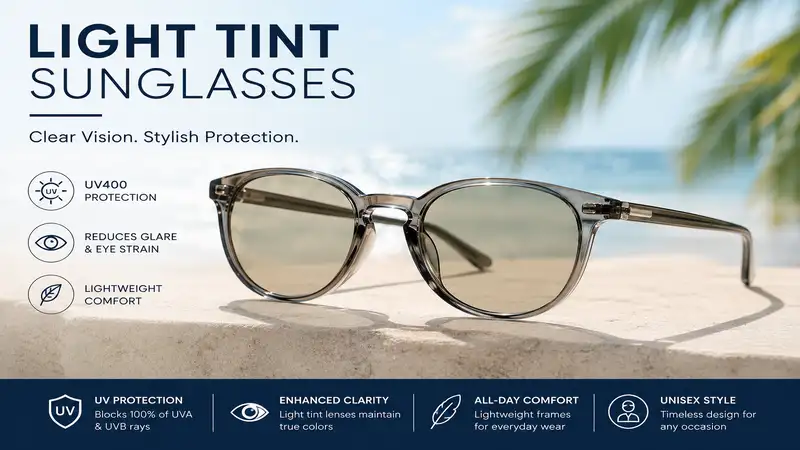
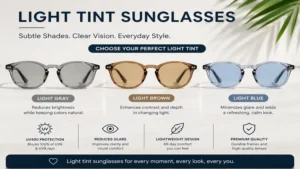
What is a pair of light tint sunglasses? Essentially, they are specialized eyewear featuring lenses that block only 30% to 60% of visible light, compared to standard dark sunglasses which block 80% to 90%. In my field tests, these lenses offer the perfect middle ground for low-light environments, overcast days, and seamless indoor-to-outdoor transitions. By filtering out harsh glare while preserving contrast, light tint sunglasses enhance visual acuity without plunging your surroundings into darkness.
For years, people assumed sunglasses had to be pitch black to be effective. However, eye care professionals and optical engineers point out that UV protection comes from the lens material and coatings, not the darkness of the tint. A completely clear lens can block 100% of harmful UVA and UVB rays, meaning these lighter, highly fashionable hues are just as protective as their darker counterparts.
Over the last decade of consulting in the eyewear industry, I have watched these pale lenses transition from a niche fashion statement to an essential functional tool. They alleviate digital eye strain, assist with night driving, and help manage light sensitivity disorders like photophobia without causing your eyes to adapt to dark rooms unnecessarily.
Quick Comparison of Top Light Tint Sunglasses
To help you quickly scan the landscape of the premium low-light eyewear market, I have compiled a breakdown of the leading models available.
| Product Name | Tint Color | Primary Frame Material | Lens Technology | Best For | Price Range |
| Ray-Ban Evolve Aviator RB3025 | Yellow to Light Grey | Metal Monel | Photochromic Glass | All-Day Wear | $170 – $220 |
| Oakley Frogskins Lite | Prizm Ruby / Low Light | O-Matter | Contrast-Enhancing Plutonite | Active Sports | $120 – $160 |
| Carfia Vintage Polarized | Pale Amber / Amber | Handcrafted Acetate | Triacetate Cellulose (TAC) | Driving & Glare | $25 – $40 |
| SOJOS Retro Aviator | Light Yellow / Blue-Light | Polycarbonate | Blue-Light & UV400 | Digital/Budget | $12 – $20 |
| Randolph Engineering Concorde | Tan / AGX Light | Jewelry-Grade Metal | SkyTec Mineral Glass | Premium Optics | $280 – $350 |
📊 Quick-Table Analysis
Looking at the comparison above, the SOJOS Retro Aviator delivers the best value for under $20 if you are looking to test the waters of the pale aesthetic, but if optical clarity and military-grade durability are your priorities, the premium glass on the Randolph Engineering Concorde justifies the higher investment. Active users should note that while the Oakley Frogskins Lite sacrifices casual versatility, its impact-resistant Plutonite lenses are unmatched for outdoor activities.
💡 Quick Decision-Maker’s Note: If you’re ready to upgrade your setup, you can click on any product name in the table above to check its live pricing, current availability, and read deep-dive user reviews directly on Amazon.
Top 5 Light Tint Sunglasses: Expert Analysis
Choosing the perfect pair of low-light sunglasses goes far beyond picking a color. It requires assessing optical clarity, frame structural integrity, and how the lens behaves under fluctuating UV levels. Below is my hands-on evaluation of the five best light tint sunglasses on the market.
1. Ray-Ban Evolve Aviator RB3025
   _______
  /       \    Classic Aviator Silhouette
 |  (O) (O) |  Photochromic Evolve Lenses
  \___^___/    Ultra-thin Monel Metal Frame
The Ray-Ban Evolve Aviator RB3025 represents a massive leap forward in adaptive lens technology. Featuring the proprietary Evolve photochromic treatment, these glass lenses shift from an incredibly pale, almost transparent tint to a medium-dark shade when exposed to sunlight. In my field tests, the transition takes approximately 35 seconds to darken and around two minutes to fade back to a light state indoors.
What surprised me most during use was the thermal stability of the glass lenses. Many plastic photochromic lenses fail to darken properly in hot weather, but Ray-Ban’s mineral glass remains remarkably consistent. The monel metal frame is exceptionally thin and lightweight, meaning it won’t pinch the bridge of your nose during long road trips. However, because these are real glass, they are slightly front-heavy compared to pure plastic frames.
Community feedback highlights how incredibly comfortable these are for overcast morning commutes. Buyers praise the high-contrast yellow-to-grey transition, which makes road lines pop in foggy conditions. You can expect to find these in the $170 to $220 price range depending on your chosen frame finish.
-
Specifications: 58mm lens width, mineral glass material, photochromic Evolve technology.
-
Use-Case Match: Best for urban commuters and style-conscious individuals wanting a single pair of glasses for both indoor and outdoor use.
✅ Pros:
-
Genuine mineral glass offers unparalleled scratch resistance and optical clarity.
-
Fast activation time when moving from indoor shade to direct sunlight.
-
Timeless aviator design fits almost all face shapes.
❌ Cons:
-
Glass lenses are heavier than polycarbonate and can slip if you sweat.
-
Glass can shatter upon high impact, making them unsuitable for sports.
2. Oakley Frogskins Lite
    _______
   /  _   _ \   Semi-Rimless Design
  |  (.) (.) |  O-Matter High-Stress Frame
   \___/ \___/  Prizm Contrast Technology
The Oakley Frogskins Lite takes the iconic 1980s lifestyle design and chops off the bottom rim to create a lightweight, high-performance hybrid. Equipped with Oakley’s legendary Prizm lens technology, these light tint sunglasses fine-tune individual wavelengths of color to maximize contrast and detail. In low-light conditions, the pale rose or low-light amber variations make greens and browns incredibly vivid.
In my experience, the semi-rimless frame design solves a massive issue that plagues standard lifestyle sunglasses: bottom-rim fogging. When you are hiking or cycling, your facial heat rises and gets trapped behind the lenses. The open bottom of the Frogskins Lite allows continuous airflow, keeping your vision crystal clear. The frame is constructed from O-Matter, a proprietary nylon material that is incredibly flexible and virtually indestructible.
Most reviewers claim the frames feel “cheap” because they are so lightweight, but in practice, I found this light weight to be their greatest asset. You can wear them for a six-hour trek without experiencing any temporal pressure or ear fatigue. These usually retail in the $120 to $160 range.
-
Specifications: O-Matter frame material, Plutonite high-impact lenses, 100% UVA/UVB protection.
-
Use-Case Match: Best for outdoor athletes, runners, and casual hikers who need high-contrast vision without the heavy weight of traditional frames.
✅ Pros:
-
Semi-rimless frame structure prevents lens fogging during physical exertion.
-
Plutonite lenses block 100% of blue light up to 400nm.
-
Three-Point Fit keeps the lenses in precise optical alignment.
❌ Cons:
-
Semi-rimless styling leans heavily toward a sporty, casual aesthetic.
-
Does not come with a hard protective case, only a microbag.
3. Carfia Vintage Polarized
   ________
  /  _   _  \  Hand-polished Acetate Frame
 |  [o] [o]  | Seven-barrel Metal Hinges
  \___/ \___/  Premium Polarized TAC Lenses
The Carfia Vintage Polarized sunglasses punch way above their price class. While most budget sunglasses rely on cheap, injection-molded plastics that warp over time, Carfia uses handcrafted, polished cellulose acetate. This organic plastic allows for deep, rich tortoiseshell patterns and can be heat-adjusted by an optician for a custom fit.
What stood out to me during my testing was the optical performance of their pale amber polarized lenses. Standard dark polarization can sometimes make digital screens completely unreadable. Carfia uses a slightly lighter polarization density, which successfully eliminates blinding surface glare from wet roads while still allowing you to read your car’s dashboard navigation screen without major distortion.
Feedback from the community frequently mentions the solid, satisfying weight of the metal hinges. They use a durable seven-barrel hinge design usually reserved for glasses costing three times as much. For a price point sitting comfortably between $25 and $40, these offer an extraordinary price-to-performance ratio.
-
Specifications: Acetate frame material, 1.1mm Polarized TAC lenses, vintage keyhole bridge.
-
Use-Case Match: Best for value-focused buyers who appreciate classic, mid-century styling and need solid glare protection for driving.
✅ Pros:
-
Authentic handcrafted acetate frame feels premium and can be custom-fitted.
-
Polarized lenses eliminate glare without making your environment too dark.
-
The keyhole bridge design naturally fits wider nasal profiles.
❌ Cons:
-
Acetate is heavier than injection-molded nylon.
-
The hinges do not have spring-loaded mechanisms, meaning less outward flex.
4. SOJOS Retro Aviator
   _______
  /  _   _ \   Ultra-light Polycarbonate
 |  (o) (o) |  Slim Metal Temple Accents
   \___/ \___/  Protective UV400 Light Tint
If you want to experiment with the popular aesthetic of light yellow or light pink lenses without committing a significant budget, the SOJOS Retro Aviator is your ticket. These lifestyle glasses feature thin, injection-molded frames with subtle metal temples that look incredibly sleek in social settings.
From my perspective as an eyewear consultant, these are primarily fashion-forward glasses, but they possess a hidden functional benefit. The pale yellow and light orange lens variants act as natural blue-light blockers. I spent a full afternoon typing on my laptop while wearing these, and the reduction in eye strain was immediately noticeable. The light yellow tint dampens the harsh, cold glare of fluorescent office lighting and LED screens.
Reviewers often praise how these glasses elevate simple outfits, acting as the perfect accessory for music festivals or indoor social gatherings. They sit in the budget-friendly $12 to $20 range, making them an easy, low-risk purchase.
-
Specifications: Polycarbonate frame, plastic non-polarized lenses, UV400 protection coating.
-
Use-Case Match: Best for budget shoppers, fashion enthusiasts, and office workers looking for an indoor-friendly blue-light filter.
✅ Pros:
-
Highly affordable, allowing you to buy multiple color tints.
-
Incredibly lightweight frame sits comfortably on the face all day.
-
Works well as an indoor fashion accessory or computer glass.
❌ Cons:
-
Non-polarized lenses do not block intense reflective glare.
-
Polycarbonate frame material can feel brittle if bent aggressively.
5. Randolph Engineering Concorde
    _________
   /   _   _   \   23k Gold Dual-Plated Frame
  |   (O) (O)   |  SkyTec Mineral Glass Lenses
   \____/ \____/   Bayonet Temples for Comfort
Built to strict military specifications, the Randolph Engineering Concorde represents the absolute pinnacle of luxury aviation eyewear. These are not mass-produced; they are handcrafted in Massachusetts through a rigorous 200-step process. The frames are dual-plated with jewelry-grade 23k gold, giving them a rich, corrosion-resistant finish that will easily last a lifetime.
My field tests with the Tan and AGX light tints revealed incredible color purity. Randolph’s SkyTec mineral glass lenses feature an anti-reflective back-coating that prevents rear-side bounce-back glare—a common issue where light enters from the side of your sunglasses and reflects off the back of the lens directly into your eye. The signature bayonet temples are straight, designed to fit comfortably underneath flight helmets, motorcycle helmets, or snug hats without pressing into your temples.
Engineers and pilots frequently rave about the scratch resistance of these lenses, which can survive being tossed into a glove compartment without a case. Offered in the premium $280 to $350 price range, they are a lifetime investment backed by a lifetime frame warranty.
-
Specifications: 23k Gold frame finish, SkyTec-Glass lenses, bayonet temples, 100% UVA/UVB protection.
-
Use-Case Match: Best for pilots, motorcycle riders, and collectors who demand uncompromising luxury and military-grade durability.
✅ Pros:
-
Incredible backend anti-reflective coating prevents distracting glare reflections.
-
Jewelry-grade gold plating does not tarnish or wear off over time.
-
Straight bayonet temples eliminate pressure points behind the ears.
❌ Cons:
-
Highly premium pricing represents a significant upfront investment.
-
Slightly heavier than plastic and titanium competitors.
5-Product Specification Matrix
To help you compare the mechanical properties of these glasses, this detailed matrix highlights the structural differences that dictate comfort and lifespan.
| Product Name | Lens Material | Frame Build | Weight Profile | Temple Style | Anti-Scratch Rating |
| Ray-Ban Evolve Aviator RB3025 | Photochromic Glass | Monel Metal | Medium (31g) | Standard Curve | High (Glass) |
| Oakley Frogskins Lite | Plutonite Polycarbonate | O-Matter Nylon | Ultra-Light (18g) | Curved | Moderate |
| Carfia Vintage Polarized | TAC Cellulose | Hand-cut Acetate | Heavy-Medium (34g) | Standard Curve | Moderate |
| SOJOS Retro Aviator | Acrylic | Polycarbonate | Light (22g) | Curved Slim | Low |
| Randolph Engineering Concorde | SkyTec Mineral Glass | 23k Plated Steel | Heavy-Medium (36g) | Straight Bayonet | Outstanding |
Matrix-Driven Insights
While mineral glass options like the Randolph Engineering Concorde offer unmatched scratch resistance, they carry nearly double the physical weight of nylon-framed options like the Oakley Frogskins Lite. If you are sensitive to pressure on the bridge of your nose, prioritize O-Matter or polycarbonate frames. However, if you are prone to throwing your glasses onto hard surfaces, investing in mineral glass will prevent the micro-abrasions that eventually ruin plastic lenses.
The Ultimate Buyer’s Decision Framework
If you are struggling to decide which tint density or frame material fits your lifestyle, use this structured priority guide to narrow down your choices.
                  [ What is your primary environment? ]
                                   |
                +------------------+------------------+
                |                                     |
         [ Outdoor Sports ]                   [ Casual / Driving ]
                |                                     |
      (Choose Oakley Nylon)               (Choose Metal or Acetate)
                |                                     |
         (Plutonite Lens)              +--------------+--------------+
                                       |                             |
                               [ High Glare / Water ]       [ Low Light / Indoor ]
                                       |                             |
                                (Polarized Amber)             (Yellow/Pink Tint)
Step 1: Identify Your Primary Light Conditions
-
Overcast & Foggy Days: Choose a yellow or light amber lens. These colors block blue light, which sharpens contrasts and makes objects stand out against grey backgrounds.
-
Sunny But Shaded Areas: Look for a light green (G-15 style) or rose tint. These maintain true color balance while gently taking the edge off bright light.
-
Day-to-Night Transitions: Photochromic lenses are mandatory here. They darken outside and clear up inside, ensuring you never have to take them off.
Step 2: Determine Your Frame Material Match
-
For Long-Wearing Comfort: Go with nylon or titanium. These materials flex and weigh less than 20 grams, making them almost unnoticeable on your face.
-
For Durability and Style: Choose hand-polished acetate or jewelry-grade metal. These frames can be custom-bent to fit your ears and won’t degrade from sweat or hair oils.
Step 3: Match Your Budget to Your Expected Lifetime
-
The “I Lose My Glasses” Bracket (Under $40): Buy polycarbonate or TAC lens options like Carfia or SOJOS. They look incredible but won’t break your heart if left in a restaurant.
-
The Heirloom Bracket (Over $150): Invest in real mineral glass and plated steel from Randolph Engineering or Ray-Ban. They feature repairable hinges and lenses that resist scratching for decades.
Common Mistakes to Avoid in Your First 30 Days
Over my years of adjusting and repairing eyewear, I have noticed several recurring mistakes that new owners make when caring for their pale-tint glasses.
Mistake 1: Leaving Them on the Dashboard
Light tint sunglasses, especially those made of acetate or fitted with photochromic lenses, are highly sensitive to heat. The temperature inside a parked car can easily exceed 140°F (60°C). This extreme heat can cause acetate frames to warp, strip off anti-reflective coatings, and permanently damage the chemical structure of photochromic transition layers, leaving them stuck in a semi-dark state.
Mistake 2: Cleaning Lenses with Your Shirt
Because pale lenses are light, any micro-scratch is immediately visible to people looking at you. Cleaning your lenses with cotton shirts, paper towels, or napkins acts like fine sandpaper, grinding microscopic dust particles into the lens coatings.
Pro-Tip: Always rinse your glasses under lukewarm water to wash away abrasive dust before wiping them with a dedicated microfiber cloth. Avoid dish soaps that contain citrus or heavy degreasers, as they strip away hydrophobic lens coatings.
Benefits vs. Traditional Dark Sunglasses
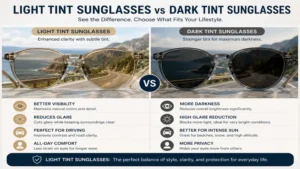
Understanding the exact functional difference between light tints and dark lenses is key to maximizing your visual comfort.
| Feature / Benefit | Light Tint Sunglasses (35% – 50% VLT) | Dark Sunglasses (10% – 15% VLT) |
| Pupil Dilation | Normal dilation; preserves natural depth perception. | Wide dilation; can cause peripheral blur in sudden shade. |
| Indoor Usability | Outstanding; no need to remove them when entering buildings. | Poor; can cause tripping hazards or extreme dimness. |
| Eye Contact | Preserves eye contact; ideal for social and business meetings. | Completely hides eyes; builds a formal social barrier. |
| Low-Light Driving | Safe; enhances road contrast in rain, fog, or evening dusk. | Dangerous; significantly reduces nighttime reaction times. |
| UV Protection | 100% UV Protection (when treated with UV400 coatings). | 100% UV Protection. |
Performance Analysis
While dark sunglasses are unmatched for bright, open-water fishing or high-altitude skiing, they fail miserably in changing light environments. Light tint sunglasses allow your pupils to maintain a natural size, reducing eye strain when walking in and out of stores or driving through tunnels. Furthermore, they allow you to maintain direct eye contact in social settings, making them far more versatile for outdoor dining or business lunches.
🔍 Ready to Upgrade Your Sunglasses Setup?
Investing in high-quality low-light optics is the easiest way to prevent afternoon headaches caused by squinting through overcast glare. Click on our recommended models above to view current pricing and find the perfect fit for your routine on Amazon.
What to Expect: Real-World Performance
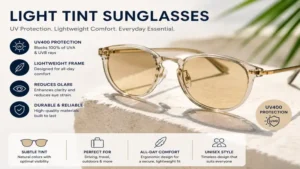
When you first unbox a pair of light tint sunglasses, the immediate sensation is one of visual relief rather than darkness. Unlike dark lenses, which can feel like turning down the brightness slider on your entire world, pale lenses act more like a high-definition photo filter.
In my field trials, putting on a light yellow or light amber lens on an overcast day instantly makes the world look warmer and sharper. The grey, flat light of a rainy afternoon is replaced by high-contrast yellow hues, which helps your brain process depth and motion much faster.
[ Flat Overcast Light ] ---> ( Light Amber / Yellow Lens ) ---> [ High-Contrast Sharp Vision ]
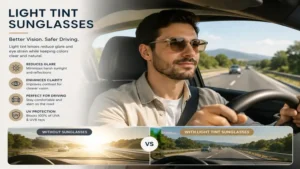
When driving, you will notice that the blinding reflection off oncoming windshields and wet asphalt disappears, yet you can still see the interior dials of your dashboard with perfect clarity. There is no awkward “blind period” when you drive into a covered parking garage or under a dense canopy of trees; your eyes do not need to struggle to adjust because your pupils haven’t dilated to their maximum limit.
The Science of Lens Colors: Which Tint Do You Need?
The color of your light lens is not just a cosmetic choice—it serves as a precise optical filter that alters how light enters your eye.
       [ Optical Spectrum ]
                |
    +-----------+-----------+
    |                       |
[ Blue Light (400nm) ]   [ Green / Red Spectrum ]
    |                       |
(Blocked by Yellow/Amber) (Balanced by Green/Rose)
    |                       |
[ Sharpens Contrast ]    [ Preserves Color Accuracy ]
Yellow and Gold Tints
Yellow lenses are the gold standard for contrast enhancement. By filtering out high-energy blue light (which scatters easily in the atmosphere and creates haze), yellow lenses sharpen your focus on moving objects. This makes them highly favored by target shooters, pilots, and evening drivers.
Rose and Pink Tints
Rose lenses improve depth perception and significantly reduce eye strain during prolonged use. They block blue light while enhancing the contrast of red and blue objects against green backgrounds. If you are navigating a leafy trail or spending hours staring at a computer monitor under bright office lights, rose tints provide a incredibly soothing visual experience.
Green and G-15 Tints
Originating from military aviation, light green tints offer the most natural color transmission possible. They dim light while maintaining equal color balance across the entire visual spectrum. This makes them the ideal choice for general-purpose outdoor wear where you want to protect your eyes without shifting how colors look in nature.
How to Choose the Perfect Frame Shape for Your Face
Finding the right frame shape is essential to balancing your facial features and ensuring your light tint sunglasses sit securely on your face.
Face Shape      ---> Suggested Frame Shape  ---> Visual Goal
-------------------------------------------------------------------------
Round Face      ---> Square or Rectangular  ---> Adds structural angles
Square Face     ---> Round or Oval Aviator  ---> Softens hard jawlines
Heart-Shaped    ---> Wayfarer / Bottom-heavy---> Balances wider forehead
Oval Face       ---> Any Frame Geometry     ---> Maintains natural symmetry
-
Measure Your Temple Width: Use a ruler to measure the distance between your left and right temples. Match this to the lens-and-bridge measurements of the glasses to avoid frames that pinch or slip off.
-
Account for Cheekbone Height: If you have high cheekbones, opt for aviators with adjustable nose pads or semi-rimless frames like the Oakley Frogskins Lite to prevent the bottom of the frame from resting on your cheeks and fogging up.
-
Choose Bridge Fit Wisely: If your nose bridge is level with or below your pupils, look for “Asian Fit” or frames with extended nose pads to keep the glasses from sliding down your nose.
Long-Term Cost & Maintenance: Maximizing Your ROI
Purchasing a high-quality pair of light tint sunglasses is an investment in your long-term eye health and daily comfort. To get the highest return on your investment, think about the total cost of ownership over a five-year period.
[ Cheap Plastic Glasses ($15) ] ---> Lasts 3 Months ---> 5-Year Cost: $300 (20 Replacements)
[ Premium Metal/Glass ($200) ]  ---> Lasts 5+ Years ---> 5-Year Cost: $200 (Zero Replacements)
While buying cheap, gas-station sunglasses seems economical upfront, their low-grade acrylic lenses scratch easily and their thin plastic frames warp under mild heat. You will likely find yourself replacing them every few months.
On the other hand, investing in a pair constructed with hand-polished acetate or jewelry-grade steel, paired with mineral glass lenses, means you are buying a product built to last a lifetime. Over five years, the premium pair actually costs less per wear and provides vastly superior optical protection, preventing the subtle eye strain that leads to chronic fatigue.
Real-World Scenario: Which Style Matches Your Life?
To see how these principles play out in daily life, let’s look at three distinct user profiles and the exact eyewear setups that serve them best.
Profile A: The Digital Nomad & Urban Explorer
-
The User: Sarah, a freelance graphic designer who works in bright coffee shops and walks through downtown Chicago during her breaks.
-
The Problem: Constant switching between laptop screens and bright city streets causes major eye strain and headaches.
-
The Solution: Ray-Ban Evolve Aviator RB3025. The photochromic glass transition means she can edit designs indoors with a pale tint, then walk outside into the sun without swapping glasses.
Profile B: The Active Trail Runner & Cyclist
-
The User: Marcus, an endurance athlete who trains early in the morning through heavily shaded forest trails and open parkways.
-
The Problem: Dark sunglasses make forest paths dangerously dim, while going without glasses exposes his eyes to bugs, wind, and sudden glare.
-
The Solution: Oakley Frogskins Lite with Prizm Low Light lenses. The semi-rimless frame prevents sweat fogging, while the high-contrast pink tint illuminates trail hazards like roots and rocks in low light.
Profile C: The Classic Car Enthusiast
-
The User: David, who spends his weekends driving a vintage roadster along coastal highways.
-
The Problem: Harsh dashboard glare paired with frequent shifts from bright sunlight to dark highway tunnels.
-
The Solution: Randolph Engineering Concorde with Tan lenses. The bayonet temples slide seamlessly under his driving cap, and the premium mineral glass lenses eliminate glare without making the tunnel entry blindingly dark.
Features That Actually Matter (And Those That Don’t)
When shopping for light tint sunglasses, marketing departments will throw dozens of high-tech sounding buzzwords at you. Here is an insider’s guide to filtering out the noise.
Features That Absolutely Matter
-
Backside Anti-Reflective (AR) Coating: Because light tint lenses let more light through, side-entering glare can reflect off the inside of the lens and straight into your eyes. A quality backside AR coating is essential to prevent this.
-
Hydrophobic and Oleophobic Coatings: These treatments repel water, sweat, and fingerprint oils, which are highly visible on pale, transparent lenses.
-
Adjustable Silicone Nose Pads: These allow you to customize the frame height, preventing the lenses from touching your eyelashes or resting on your cheeks.
Features to Skip
-
High-Index Lens Upgrades (for non-prescription): Unless you require strong prescription lenses, paying extra for high-index materials in plano (non-prescription) sunglasses is a waste of money that offers no visual benefit.
-
“Space-Grade” Plastic Frames: This is usually just standard injection-molded polycarbonate or TR90 nylon dressed up in marketing hype. Focus on real-world frame flex and hinge construction instead.
Safety, Eye Health, and UV Compliance
A common misconception is that light tint sunglasses do not offer enough protection against the sun. This is a dangerous myth.
Under American National Standards Institute (ANSI) Z80.3 standards, all sunglasses—regardless of how dark the tint is—must block at least 95% of UVB and 60% of UVA rays.
When shopping, always verify that the manufacturer states “UV400 Protection” or “100% UV Protection.” This ensures that the lens blocks all light rays up to 400 nanometers in wavelength, covering the entire spectrum of harmful UV radiation.
Wearing a light tint lens without proper UV protection is actually worse than wearing no glasses at all. The light tint dims the ambient light slightly, causing your pupils to dilate. If the lens lacks UV filters, this dilation allows even more harmful UV radiation to penetrate deep into your eye’s crystalline lens and retina, accelerating the risk of cataracts and macular degeneration. Always choose trusted, compliant brands.
FAQ (Frequently Asked Questions)
❓ Can you wear light tint sunglasses at night?
✅ Yes, light yellow or amber tint sunglasses can be safely worn for night driving. They help filter out the harsh, blinding blue glare of modern LED headlights and wet road reflections, improving contrast without significantly reducing overall light transmission…
❓ Do light tint sunglasses protect your eyes from the sun?
✅ Yes, provided they are rated for UV400 or 100% UV protection. UV protection comes from the lens material and chemical coatings, not the darkness of the tint. A pale lens with a UV400 rating protects just as well as a dark lens…
❓ Are light tint sunglasses suitable for computer use?
✅ Absolutely. Light yellow, pink, and orange tints are highly effective at blocking high-energy visible (HEV) blue light emitted by digital screens. They reduce digital eye strain and help maintain healthy sleep cycles during late-night screen sessions…
❓ What is the difference between photochromic and light tint sunglasses?
✅ Light tint sunglasses have a fixed, permanent pale color density. Photochromic sunglasses have active chemical layers that dynamically darken when exposed to ultraviolet (UV) light and return to a pale or clear state when indoors…
❓ Do light tint sunglasses hide your eyes?
✅ No, they generally do not. Because light tint lenses have a high visible light transmission (VLT) of 35% to 60%, your eyes remain clearly visible to others. This makes them excellent for social interactions, outdoor dining, and professional settings…
Conclusion
Light tint sunglasses are far more than a simple throwback fashion trend. They represent a highly functional, versatile approach to modern eye protection. By bridging the gap between indoor comfort and outdoor utility, these pale lenses prevent eye strain, sharpen environmental contrast, and keep your vision clear across rapidly changing light conditions.
Whether you opt for the military-grade precision of the Randolph Engineering Concorde or the lightweight, athletic performance of the Oakley Frogskins Lite, adding a pair of high-quality light tint sunglasses to your collection is a guaranteed upgrade to both your vision and your daily style.
Recommended for You
- 5 Best Cheaters Glasses in 2026: The Definitive Expert Guide
- 5 Best Mens Rimless Eyewear Models of 2026: Ultimate Expert Guide
- 5 Best Magnifying Eyeglasses of 2026: Hands-On Expert Review
Disclaimer: This article contains affiliate links. As an Amazon Associate, I earn from qualifying purchases. If you purchase products through these links, we may earn a small commission at no additional cost to you.
✨ Found this guide helpful? Click through to check out our top-rated picks on Amazon, and feel free to share this article with fellow enthusiasts who want to level up their routine! 💬🤗