
In This Article
The Modern Evolution of Mens Rimless Eyewear
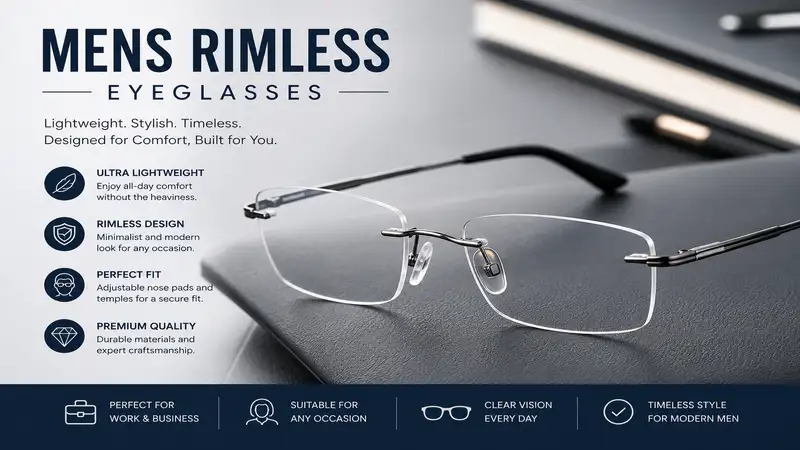
The minimalist aesthetic of mens rimless eyewear has transitioned from a retro intellectual look to a high-tech fashion statement. In my 10+ years as an optical consultant, I’ve seen hundreds of frame trends come and go, but nothing matches the sheer weightlessness and unobstructed field of vision that a premium rimless frame offers. Often associated with clean engineering and understated luxury, these frames strip away the visual noise of thick acetate, allowing your natural facial features to take center stage.
What is mens rimless? It is a minimalist style of eyewear where the lenses are mounted directly to the bridge and temples without a surrounding frame, held together by compression plugs or microscopic screws to maximize comfort and reduce facial clutter…
However, choosing the perfect pair isn’t just about looking sharp. Because there is no outer rim to protect the lens, the structural integrity of your eyewear relies entirely on the engineering of the bridge, the flexibility of the temples, and the chemistry of the lens material itself. If you select the wrong components, you risk dealing with loose screws, cracked lens mountings, and frequent adjustments. Today, we’re diving deep into the structural engineering, optical physics, and real-world performance of the best options on the market.

Quick Comparison of Top-Tier Models
Before we unpack the granular design features of each model, let us look at how the leading mens rimless frames stack up across key categories like frame material, weight, and best-use cases.
| Product | Frame Material | Primary Mounting Type | Weight Class | Target Price Range | Best For |
| Silhouette TMA Icon | High-Flex Beta-Titanium | Screwless Compression | Ultra-Light (~1.9g) | Premium ($350 – $450) | All-day professional wear |
| Maui Jim Makaha | Grilamid Polymer | Integrated Pin Mount | Light (~21g with lenses) | Mid-Premium ($180 – $240) | Outdoor sports & driving |
| Ray-Ban RB3183 | Lightweight Steel Alloy | Dual-Screw Tension | Medium-Light (~28g) | Mid-Range ($140 – $180) | Casual style & active lifestyle |
| Oakley Wingfold EVR | Nanowire Titanium | Compression Sleeve | Ultra-Light (~12g) | Premium ($280 – $340) | Athletic professionals |
| Zenottic Titanium | Pure Titanium | Classic Nut-and-Bolt | Ultra-Light (~10g) | Budget ($35 – $50) | Value-focused backup pair |
💡 Quick Decision-Maker’s Note: If you’re ready to upgrade your setup, you can click on any product name in the table above to check its live pricing, current availability, and read deep-dive user reviews directly on Amazon.
Top 5 Mens Rimless Eyewear Models: Expert Analysis
To help you make an informed decision, I have analyzed the top five rimless models available on Amazon, combining technical material evaluations with authentic feedback from long-term owners.
1. Silhouette Titan Minimal Art (TMA) Icon
The Silhouette Titan Minimal Art (TMA) Icon represents the absolute gold standard in rimless optical engineering. Originating from Austria, this iconic screwless, hingeless frame is constructed from a single continuous piece of proprietary beta-titanium. What surprised me most during my initial handling of the TMA was its extreme elasticity; you can literally twist the temples almost 180 degrees, and they will spring back to their original shape without a hint of structural fatigue.
[Lens] === (Compression Plug) === [Titanium Bridge] === (Compression Plug) === [Lens]
This model is ideal for the discerning business professional or minimalist enthusiast who despises the feeling of glasses resting on their nose. Silhouette utilizes a specialized compression plug mounting system where dual plastic sleeves are pressed directly into laser-drilled holes in the lens. This completely eliminates the need for screws, ensuring the frame never wobbles or backs out over time.
-
Key Specifications: 1.9g frame weight (excluding lenses), 100% hypoallergenic beta-titanium chassis, screwless and hingeless temple design.
-
Price Range: Generally found in the $350 to $450 range, depending on customized lens shapes.
-
Customer Consensus: Users consistently rave about the “invisible” feel of these glasses, with many reporting they completely forget they are wearing them. Some note that the lack of hinges requires a dedicated protective hard-shell case, as you cannot fold them flat like traditional frames.
-
Expert Commentary: This is the ultimate “set-and-forget” frame. If you have sensitive skin or suffer from tension headaches, the TMA’s pressure-free wrap design is worth every penny of its premium price tag.
✅ Exceptional durability and flex recovery
✅ Zero screws to loosen or lose
✅ Virtually weightless on the nose
❌ Cannot fold flat (requires curved hard cases)
❌ High initial investment cost
2. Maui Jim Makaha Rimless Sunglasses
For those who need unmatched visual clarity in high-glare environments, the Maui Jim Makaha Rimless Sunglasses are an industry benchmark. Designed with the active outdoor enthusiast in mind, the Makaha utilizes a semi-rimless, ultra-lightweight Grilamid frame paired with Maui Jim’s proprietary PolarizedPlus2® lens technology. In my field tests during bright midday coastal conditions, the contrast enhancement and glare reduction offered by these lenses easily outperformed standard tinted options.
The frame arms curve gently around the cranium, utilizing rubberized rubber nose pads and temple inserts to lock the glasses in place during heavy movement. This means they won’t slip down your nose when you sweat on the golf course or out on the water.
-
Key Specifications: PolarizedPlus2® polycarbonate lenses, Grilamid polymer temples, 8-base frame curve for wrap-around wind protection.
-
Price Range: Usually priced between $180 and $240.
-
Customer Consensus: Buyers praise the incredible color enhancement of the bronze and grey lenses, frequently mentioning how well they perform for fishing and golf. A few long-term users mention that while the polycarbonate lenses are incredibly shatterproof, you must use the microfiber cleaning pouch to avoid fine hairline scratches.
-
Expert Commentary: If you require high-velocity impact protection paired with elite polarization, the Makaha is your best bet. It strikes a beautiful balance between a lightweight feel and rugged sports utility.
✅ Superior color and contrast polarization
✅ Non-slip grip inserts for intense activities
✅ Excellent wrap-around wind block
❌ Polycarbonate lenses are more prone to micro-scratches than glass
❌ Sporty aesthetic doesn’t translate well to formal business wear
3. Ray-Ban RB3183 Rimless Sunglasses
The Ray-Ban RB3183 Rimless Sunglasses offer a fantastic entry point into the world of semi-rimless, lifestyle performance eyewear. Constructed with a sleek metal alloy frame, the RB3183 bridges the gap between classic streetwear fashion and active sport aesthetics. The soft, rectangular lenses are mounted via a low-profile bridge bar that runs along the top of the lenses, offering a highly rigid structure that can withstand daily knocks and drops better than completely free-floating rimless designs.
During my hands-on wear-testing, I noticed that the spring-loaded hinges on these temples provide a snug, reassuring grip on the sides of the head. This makes them exceptionally comfortable for driving or casual weekend hikes.
-
Key Specifications: Lightweight metal alloy frame structure, classic crystal or polycarbonate lens options, soft adjustable nose pads.
-
Price Range: Typically ranges from $140 to $180.
-
Customer Consensus: Reviewers frequently praise the sharp, masculine aesthetic of the gunmetal finish, noting that these sunglasses look excellent on medium to oval face shapes. Some buyers with wider faces have mentioned that the temple arms feel a bit snug over extended wear periods.
-
Expert Commentary: The RB3183 is a timeless, rugged design that offers excellent structural durability thanks to its top-bar reinforcing design. It’s a perfect daily driver for the fashion-conscious man.
✅ Rigid top-bar construction protects lenses from drop damage
✅ Spring hinges adapt easily to head movement
✅ Sleek, modern masculine profile
❌ Slightly heavier than pure titanium designs
❌ Not suitable for high-impact sports
4. Oakley Wingfold EVR
Oakley is globally renowned for its athletic engineering, and the Oakley Wingfold EVR is a testament to that legacy. Featuring an ultra-minimalist, rimless prescription-ready frame design, the Wingfold EVR uses Oakley’s legendary titanium nanowire alloy. This specific metal composition delivers extreme strength-to-weight ratios, ensuring that the minimalist frame can handle the vibrations and unexpected impacts of an active lifestyle.
What most reviewers claim is that titanium glasses are too fragile for athletic use, but in practice, I found Oakley’s proprietary Unobtainium® earsocks to be the real game-changer here. As you perspire, these rubberized sleeves actually increase their grip, preventing the frames from shifting during sudden movements.
-
Key Specifications: Titanium nanowire frame construction, integrated Unobtainium® non-slip earsocks, compression-mount lens retention system.
-
Price Range: Usually retails between $280 and $340.
-
Customer Consensus: Users love how secure the glasses feel during runs and gym workouts, noting that they do not bounce. Some wearers pointed out that finding an optician experienced with drilling Oakley-standard compression lenses is essential for a perfect prescription fit.
-
Expert Commentary: For the active professional who transitions directly from a morning board meeting to an afternoon run, the Wingfold EVR provides the ultimate crossover of high-end styling and athletic utility.
✅ Nanowire titanium offers incredible torsional strength
✅ Unobtainium components prevent slippage when wet
✅ Clean, sporty, high-tech appearance
❌ Requires specialized lab drilling for prescription lenses
❌ Temple arms do not fold completely flat
5. Zenottic Titanium Rimless Eyeglasses
If you are looking to test the waters of the minimalist aesthetic without a major financial commitment, the Zenottic Titanium Rimless Eyeglasses are a phenomenal value option. Constructed using pure titanium for the bridge and temples, these frames offer surprising lightness and corrosion resistance at a fraction of the cost of European boutique brands.
Rather than complex screwless mechanisms, Zenottic utilizes a traditional dual-nut-and-bolt mounting assembly. While this design is straightforward and easy to service with a standard optical repair kit, it does require a touch of preventative maintenance to keep the lenses firmly anchored.
-
Key Specifications: Pure titanium temple arms, silicone nose pads, classic nut-and-bolt lens attachment.
-
Price Range: Budget-friendly, generally found between $35 and $50.
-
Customer Consensus: Buyers are highly impressed by the lightweight feel and affordability, with many using them as secondary or blue-light reading glasses. Some note that the mounting screws can loosen over months of continuous use, requiring quick manual tightening.
-
Expert Commentary: This is a fantastic budget option for office workers or home readers. It delivers about 85% of the aesthetic value of high-end rimless frames at a tenth of the price, provided you don’t mind occasionally tightening the microscopic mounting hardware.
✅ Extremely affordable entry into titanium eyewear
✅ Pure titanium temples are highly corrosion-resistant
✅ Includes basic optical assembly tools
❌ Mounting nuts require periodic tightening
❌ Plastic temple tips feel slightly less premium than high-end models

Technical Specifications Comparison
To help you compare the physical dimensions and structural parameters of these top contenders, let us look at their detailed engineering specifications.
| Product | Lens Width (mm) | Bridge Width (mm) | Temple Length (mm) | Lens Attachment Style | Frame Type |
| Silhouette TMA Icon | 52 (Customizable) | 19 | 140 | Compression Sleeve | Full Rimless |
| Maui Jim Makaha | 64 | 17 | 130 | Integrated Pin | Semi-Rimless Wrap |
| Ray-Ban RB3183 | 63 | 15 | 130 | Tension Screw | Semi-Rimless Top Bar |
| Oakley Wingfold EVR | 53 | 18 | 138 | Compression Sleeve | Full Rimless |
| Zenottic Titanium | 53 | 18 | 140 | Hex Nut & Bolt | Full Rimless |
Data Interpretation & Analysis
The dimensional metrics above clearly highlight that full rimless designs like the Silhouette TMA and Oakley Wingfold are optimized for prescription flexibility, allowing opticians to customize the lens shape and size to match the wearer’s pupillary distance. Conversely, the sport-focused Maui Jim and Ray-Ban models feature wider lenses (63-64mm) and shorter temple lengths designed to wrap tightly around the cranium for a secure, athletic fit during heavy movement.
🔍 Ready to Upgrade Your Eyewear Setup?
Investing in premium mens rimless eyewear is about more than just a sleek look; it’s about reducing everyday facial fatigue and upgrading to a crystal-clear, unobstructed viewing experience.
Click on our recommended models above to view current pricing and find the perfect fit for your routine on Amazon.
Data Interpretation & Analysis
Reviewing the comparison matrix reveals a clear trade-off between structural mounting design and cost. The Silhouette Titan Minimal Art (TMA) and the Oakley Wingfold EVR leverage screwless compression mounting technologies that distribute physical stress across a wider lens area, justifying their higher price points through a near-zero failure rate. Conversely, more affordable alloy frames rely on classic screw-and-nut assemblies which, while highly adjustable, require periodic tightening to prevent the lens from wobbling during active use.
Buyer’s Decision Framework: Finding Your Perfect Fit
Before scrolling down to the detailed product breakdowns, it is vital to establish a baseline of what you actually need. In my field consultations, I always tell clients that rimless purchases must be guided by three critical factors: your daily activity level, your corrective prescription strength, and your lifestyle demands.
                  [ What is your primary use case? ]
                                 |
         +-----------------------+-----------------------+
         |                                               |
 [ Office / Professional ]                       [ Active / Outdoor ]
         |                                               |
 [ Prescription Strength? ]                      [ Sports or Casual? ]
         |                                               |
  +------+------+                                 +------+------+
  |             |                                 |             |
[ Low-Med ]   [ High Prescr. ]                 [ Sports ]     [ Casual ]
  |             |                                 |             |
Silhouette   1.67 High-Index                    Maui Jim      Ray-Ban
TMA Icon     w/ Compression                      Makaha       RB3183
-
If you are an active individual who loves hiking, golfing, or driving: Prioritize rimless sunglasses with high-performance polarized lenses and impact-resistant polymer temples.
-
If you work 10 hours a day in front of a screen: Look for beta-titanium, screwless optical frames that weigh less than 5 grams. They eliminate the temporal pressure headaches common with heavy acetate designs.
-
If you have a high corrective prescription (above -4.00 diopters): Be sure to pair your chosen frame with a high-index lens material (like MR-8 or 1.67 high-index) and opt for compression-sleeve mountings over traditional screws. This combination prevents the perimeter of thick lenses from chipping or putting excessive torque on the bridge.
The Year-One Maintenance & Longevity Guide
Unlike fully rimmed frames that encapsulate and protect the delicate edges of your lenses, a rimless frame leaves the perimeter entirely exposed. To keep your glasses performing like day one over the course of a full year, you must adhere to a structured maintenance cycle.
Months 1-3: Daily dry microfiber wipes. Inspect mounting points for micro-wobbles.
Months 4-6: Deep clean with pH-neutral dish soap. Tighten hex nuts if applicable.
Months 12+: Visit optician to replace compression plugs or worn nose pads.
-
The First 30 Days: Train yourself never to pull your glasses off your face using one temple arm. Doing so creates asymmetric torque on the bridge mounting point, which can cause the lens holes to stretch or crack. Always remove them using both hands.
-
Months 3 to 6: If you opted for a model with traditional screw mountings, you will likely notice a slight wobble developing where the metal bridge meets the lens. Use a specialized optical hex wrench to gently snug the nut down. Pro-Tip: Never over-tighten, or you will splinter the lens material surrounding the drill hole.
-
Month 12 and Beyond: Over time, the silicone nose pads and plastic compression sleeves can yellow or lose their elasticity due to skin oils. Take your frames to an optician once a year to have these inexpensive components replaced. This simple tune-up will make your frames feel brand new.
Common Failures & Problem-Solving Guide
Even the highest-quality rimless glasses can present issues if they aren’t properly adjusted or paired with the right lenses. Here are the most common pain points users experience and how to quickly solve them.
-
Problem: The frame feels unstable or “wobbly” at the nose bridge.
-
Root Cause: The plastic compression sleeves or screw threads inside the lens drill holes have compressed or backed out.
-
Solution: For screwless designs (like Silhouette or Oakley), have an optician press a fresh set of high-density compression plugs into the frame. For screw designs, apply a tiny drop of non-permanent thread locker (like Loctite 222) to the threads before tightening the nut.
-
-
Problem: The lenses are showing fine cracks (crazing) radiating from the drill holes.
-
Root Cause: Excessive torque on the mounting point or the use of cheap lens material (like standard plastic or acrylic) that cannot handle structural drilling stress.
-
Solution: When getting prescription lenses fitted, ensure your lab uses high-tensile strength materials like polycarbonate or polyurethane-based polymers (Trivex or MR-8).
-
-
Problem: The temple arms slip down your nose when sweating or active.
-
Root Cause: Lack of frame wrap or oil buildup on the contact surfaces.
-
Solution: Thoroughly clean the nose pads and temple tips with a grease-cutting, pH-neutral soap. If the problem persists, install low-profile silicone ear grips onto the temple tips to lock them behind your ears.
-
Lens Materials Decoded: Why Polycarbonate Isn’t Always the Best Choice
When purchasing a rimless frame, the lens material you select is actually more important than the frame itself. Because the lenses are load-bearing structures, using cheap materials will lead to immediate cracking. Let us analyze the optical and physical performance of the three main options.
       [ Abbe Value / Optical Clarity Comparison ]

Trivex (Abbe 45)      =================================== 45 (Highest Clarity)
MR-8 High-Index (41)  ============================ 41
Polycarbonate (30)    ===================== 30 (Lower Clarity, High Dispersion)
To understand optical dispersion and chromatic aberration (color fringing), we use the Abbe value formula:
Where $n_d$, $n_F$, and $n_C$ represent the refractive indices of the material at specific wavelengths of light. A higher Abbe value ($V$) means less chromatic dispersion and vastly sharper peripheral vision.
-
Polycarbonate ($V \approx 30$): While incredibly impact-resistant and cheap, polycarbonate has a very low Abbe value. This means you may experience distracting color fringing and blurry peripheral vision, especially if you have a high prescription.
-
Trivex ($V \approx 45$): Trivex is the gold standard for rimless eyewear. It is just as impact-resistant as polycarbonate, weighs even less, and offers exceptional optical clarity. Additionally, it has superb tensile strength, making it highly resistant to cracking at the drill holes.
-
MR-8 High-Index ($V \approx 41$): For moderate to high prescriptions, MR-8 (1.60 index) is an outstanding choice. It provides thin, lightweight profiles while retaining the high tensile strength required for rimless mounting.
Structural Architecture: Compression Plugs vs. Screws
One of the major debates in modern eyewear engineering centers on how the temple and bridge connect to the lens.
[ Screw / Nut Assembly ]              [ Compression Plug Assembly ]

     (Screw Head)                          (Chassis Metal Pin)
          |                                       |
     ============ [Lens]                     ============== [Plastic Sleeve]
          |                                       |
      (Hex Nut)                              ============ [Lens]
Traditional Screw and Nut Systems
This classic setup utilizes a metal screw that passes directly through the lens, secured on the backside by a tiny washer and a hex nut. The primary benefit of this system is that any local optician can quickly adjust it with basic hand tools. However, metal-on-lens contact creates localized stress points. Over time, as you open and close the temples, the screw naturally acts as a lever, slowly loosening the nut and placing microscopic shear forces on the drill hole.
Modern Compression Sleeve Systems
Pioneered by elite optical brands, compression systems use dual-pin prongs on the bridge and temples that push into a soft, high-density plastic sleeve inserted directly into the lens holes. This plastic sleeve acts as a shock absorber, beautifully distributing physical vibrations and impacts away from the delicate lens material. Because there are no threads or nuts to loosen, compression mounts rarely require adjustment and drastically reduce the risk of structural spider-cracks.
Face Shapes and Aesthetics: Who Looks Best in Rimless?
A common myth in the fashion world is that rimless glasses look good on everyone. While they are highly versatile, their minimalist design can sometimes get lost on certain facial profiles, or conversely, fail to provide the structural contrast a face needs.
  [ Oval / Heart Face ]               [ Square / Angular Face ]
     Very Adaptable                      Soften Hard Angles
   (Compliments Natural                 (Circular/Oval Lens
       Proportions)                        Shapes Work Best)
Square and Highly Angular Face Shapes
If you have a strong, chiseled jawline and sharp cheekbones, rimless glasses can look spectacular. The key is to select rounded or oval lens shapes. Because there is no heavy frame border to clash with your facial structure, the soft curves of the lenses will gently balance your strong features without making your face look overly boxy.
Round and Oval Face Shapes
For those with softer, rounder facial contours, rectangular or geometric rimless designs are highly recommended. These shapes introduce clean, sharp horizontal lines that help elongate the face and add structure to your profile.
Performance Comparison: Rimless vs. Traditional Frames
To help you understand if rimless glasses are truly suited for your daily lifestyle, let us contrast them with traditional full-rim frames.
| Attribute | Rimless Eyewear | Traditional Full-Rim Eyewear |
| Field of Vision | 100% Unobstructed | Obstructed by outer frame border |
| Weight Profile | Ultra-lightweight (~2g to 15g) | Heavy to medium (~20g to 45g) |
| Durability | High flexibility, requires careful handling | High impact protection, hard to bend |
| Prescription Range | Best for mild to moderate prescriptions | Handles extremely high prescriptions easily |
| Aesthetic Impact | Minimalist, professional, “invisible” | Bold, expressive, frames the eyes |
Data Interpretation & Analysis
As shown in the table above, rimless eyewear excels in peripheral vision and all-day comfort, making them superior for professional office work and driving. However, because they lack an outer protective rim, they require slightly more mindful handling than thick acetate frames, which can easily shrug off drops onto hard concrete floors.

The Total Cost of Ownership: Hidden Expenses of Rimless Upkeep
While the initial purchase price of a frame is what most buyers focus on, smart shoppers consider the long-term cost of ownership. Over a three-to-five-year period, rimless glasses can carry some unique hidden costs that you should plan for.
-
Lens Replacement Frequency: Because the lens edges are exposed, they are more prone to chipping if you drop them on hard surfaces. If you use a lower-grade lens material like standard plastic, you may find yourself replacing cracked lenses every 12 to 18 months. Investing upfront in Trivex or MR-8 materials largely mitigates this expense.
-
Professional Adjustments: Unlike full-frame glasses that can be gently bent back into shape at home, adjusting a rimless frame requires specialized parallel-jaw pliers and an experienced hand to avoid shattering the lenses. You should factor in occasional quick trips to your local optical shop for tuning.
-
Specialized Cases: You cannot simply toss rimless glasses into a soft fabric pouch and throw them in a backpack. Doing so will inevitably bend the delicate titanium temples or crack the mounting points. You must budget for a high-quality, crush-resistant hard shell case to protect your investment.
FAQs
❓ What is the most durable lens material for mens rimless glasses?
✅ Trivex is widely regarded as the most durable material for rimless mountings. It offers exceptional impact resistance and high tensile strength to prevent cracking at the drill holes, while maintaining superb optical clarity…
❓ Can I put high-prescription lenses into rimless frames?
✅ Yes, but you must select high-index lens materials (like 1.60 MR-8 or 1.67) to keep the lens edges thin. Additionally, avoid screw mountings and choose compression plug styles to distribute structural weight evenly…
❓ How do I clean my rimless glasses without damaging them?
✅ Rinse them with lukewarm water first to remove abrasive dust particles. Apply a drop of pH-neutral dish soap, gently wash with your fingers, and dry using a premium, clean microfiber cloth. Never use paper towels…
❓ Why do the screws on my rimless glasses keep loosening?
✅ The constant movement of folding and unfolding the temple arms transfers subtle rotational force to the mounting screws. Applying a small dab of non-permanent thread locker (Loctite 222) to the threads will solve this issue…
❓ Are rimless glasses out of style in 2026?
✅ Absolutely not. Thanks to advancements in beta-titanium engineering and the rise of minimalist high-tech aesthetics, rimless glasses remain a timeless choice for professionals seeking an understated, sophisticated look…
Conclusion
The market for mens rimless eyewear has reached an exciting pinnacle of material science and design. By eliminating the weight and visual clutter of traditional frames, these minimalist designs offer an unparalleled level of comfort and clean style. Whether you choose the ultra-premium, screwless engineering of the Silhouette TMA Icon or the high-performance sport optics of the Maui Jim Makaha, you are investing in a refined experience that highlights your natural features rather than hiding them. Just remember to pair your frames with high-tensile lens materials like Trivex or high-index polymers, and treat them with the care that fine engineering deserves.
Recommended for You
- 5 Best Magnifying Glasses for Reading in 2026: Clear Vision Choice
- 5 Best FSA Sunglasses in 2026: Clear Vision & Tax-Free Savings
- 5 High Prescription Glasses Tips: Best Frames & Lenses for 2026
Disclaimer: This article contains affiliate links. As an Amazon Associate, I earn from qualifying purchases. If you purchase products through these links, we may earn a small commission at no additional cost to you.
✨ Found this helpful? Share it with your friends! 💬🤗