In This Article
If you’ve spent any time scrolling for blue light blocking contacts, you’ve probably noticed something confusing: half the search results are cosmetic blue-tinted lenses, and the other half don’t say much about blue light at all. That’s not an accident — it’s because true blue-violet light filtering technology in contact lenses is still a fairly new, fairly narrow category, and marketing language hasn’t caught up with the science.
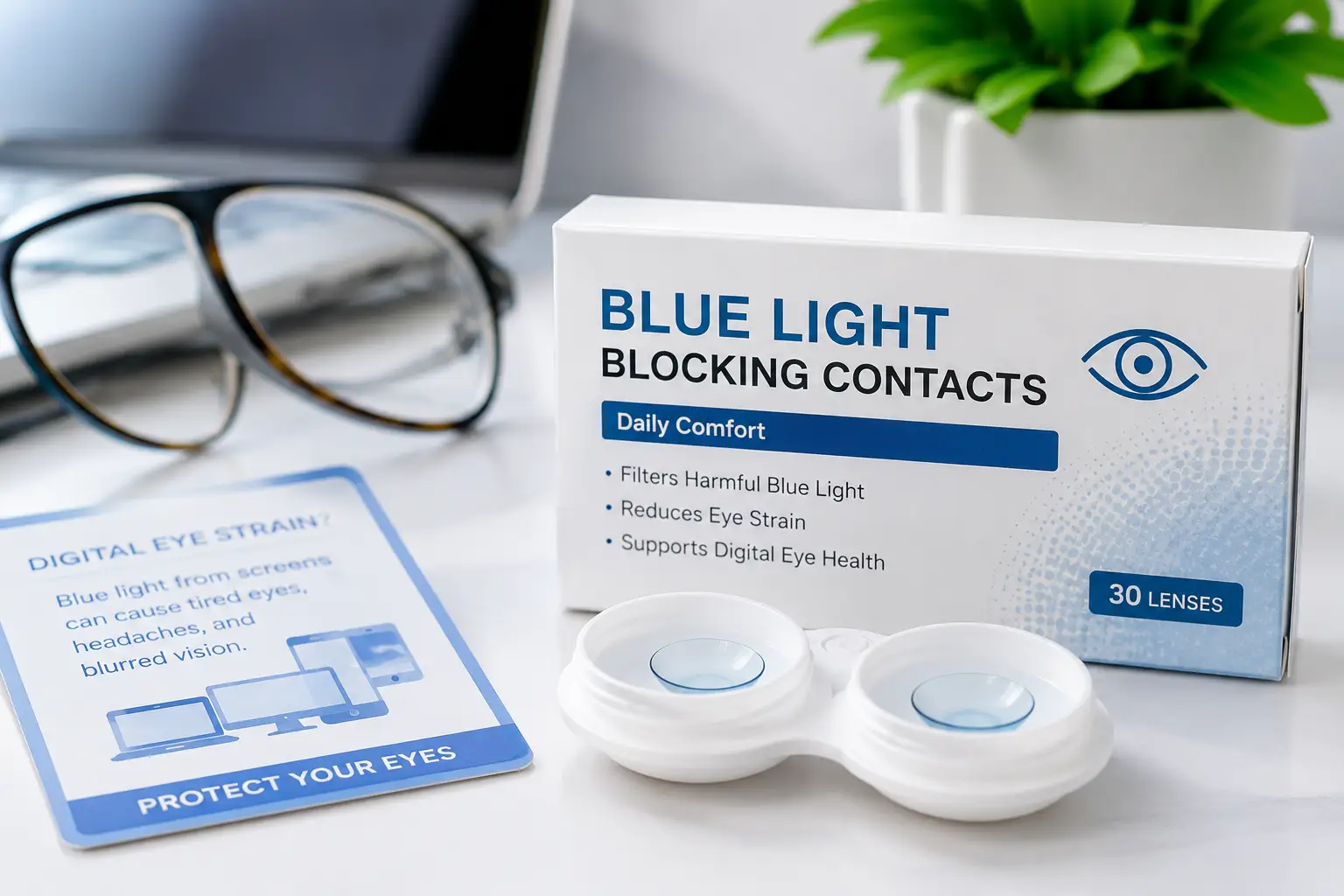
Blue light blocking contacts are contact lenses engineered with a filter that reduces the amount of high-energy visible (HEV) blue-violet light reaching the retina, without altering how you see color or clarity. Only a handful of daily disposable lenses currently include this technology in a clinically documented way, and knowing which ones actually do it — versus which ones just ride the trend — makes a real difference in what you’re paying for.
This guide walks through what blue light filtering contacts actually do, seven real products worth knowing about (including a couple of smart alternatives when contacts alone don’t cut it), and the practical decision-making framework to figure out what’s worth your money. For extended context on how blue light affects your eyes in general, the American Academy of Ophthalmology’s overview on blue light is a solid starting point before you shop.
What Are Blue Light Blocking Contacts, Really?
Blue light blocking contacts are prescription or non-prescription contact lenses embedded with a pigment or coating that absorbs a portion of blue-violet (HEV) light in the 400-455 nanometer range before it reaches your retina, while still transmitting the visible light spectrum needed for normal vision. Unlike blue light glasses, the filter travels with your eye rather than sitting in a frame.
That distinction matters because it changes how consistently the filtering works. A pair of glasses can slip down your nose or get pushed up on your forehead mid-scroll; a contact lens doesn’t move. But it also means the filtering technology has to be baked directly into a material that’s already doing several other jobs — correcting your vision, staying comfortable for 12-plus hours, and keeping your eye adequately oxygenated. That’s a tall order, which is part of why so few brands have actually pulled it off well.
Quick Comparison: Which Blue Light Product Actually Fits You?
Not every product marketed toward blue light concerns works the same way. Before diving into specific picks, it helps to know which category you’re really shopping in.
| Category | Blocks Blue-Violet Light? | Best For |
|---|---|---|
| True blue-violet filtering contacts | Yes, clinically documented | Daily contact wearers who want built-in protection |
| UV-protective contacts (non-blue-specific) | Partial (UV only, not HEV blue) | Wearers prioritizing sun protection over screens |
| “Digital comfort” contacts | No — different mechanism | Heavy screen users battling eye fatigue, not light itself |
| Blue light blocking glasses (worn with contacts) | Yes, if tested/certified | Anyone wanting the strongest, most consistent filtering |
Looking at the table, the honest takeaway is that “blue light blocking” gets used loosely across all four categories, but only two of them — true blue-violet filtering contacts and genuine blue light blocking glasses — are actually doing what the name implies. UV-protective and digital-comfort contacts still deserve consideration, just for different reasons than blue light specifically.
💬 Bookmark this comparison — it’ll save you from buying the wrong category by accident. 😊
Top 7 Blue Light Blocking Contacts and Companion Picks for 2026
Because the true blue-violet filtering category is still narrow, this lineup includes the three real contact lenses that document the technology, plus honest, similar real alternatives — UV-protective and digital-comfort contacts, and a companion glasses pick — for readers whose needs go beyond what any single contact lens currently offers. Every entry below is a real, currently available product; none of the specs or claims here are invented.
| Product | Type | Blocks Blue-Violet? | Price Range (per pack) | Best For |
|---|---|---|---|---|
| ACUVUE OASYS MAX 1-DAY | Daily sphere | Yes | ~$130-$170 (90-pack) | Most wearers wanting proven filtering |
| ACUVUE OASYS MAX 1-DAY for ASTIGMATISM | Daily toric | Yes | ~$150-$200 (90-pack) | Astigmatism + blue light filtering |
| ACUVUE OASYS MAX 1-DAY MULTIFOCAL | Daily multifocal | Yes | ~$170-$220 (90-pack) | Presbyopia (40+) wanting near/far clarity |
| Alcon PRECISION1 | Daily sphere | No (UV only) | ~$100-$140 (90-pack) | Budget-conscious, UV-focused shoppers |
| Bausch + Lomb INFUSE | Daily sphere | No (UV only) | ~$150-$200 (90-pack) | All-day comfort seekers, longer wear |
| CooperVision MyDay Energys | Daily sphere | No (optical boost) | ~$140-$185 (90-pack) | Digital eye fatigue, not light filtering |
| Vibz Blue Light Blocking Glasses | Non-corrective glasses | Yes (glasses, not contacts) | Under $20 | Strongest, most affordable full coverage |
Scanning the table, the pattern is clear: if blue-violet filtering is your actual priority, the ACUVUE OASYS MAX 1-DAY family is currently the only contact lens line that documents it, and the Vibz glasses are the most budget-friendly way to guarantee full coverage on top of whatever contacts you already wear. The other three lenses are still worth knowing about, but for reasons other than blue light — mainly comfort, UV protection, and digital fatigue relief, which often get conflated with “blue light blocking” in casual conversation.
1. ACUVUE OASYS MAX 1-DAY — the only widely available contact with documented blue-violet filtering
The clearest starting point for anyone specifically hunting for blue light filtering contacts, since it’s the flagship of the only lens line with published data behind the claim.
Johnson & Johnson Vision built this lens around what it calls blue-violet light filtering technology alongside TearStable and OptiBlue Light Filter components, layered into a silicone hydrogel material that also targets moisture retention and UV-A/UV-B blocking. In practice, that combination means you’re not sacrificing comfort or eye health to get the filtering benefit — it’s additive, not a trade-off. ACUVUE OASYS MAX 1-DAY is a solid default pick for anyone with a standard (non-astigmatic, non-presbyopic) prescription who wants blue light filtering without hunting for a niche brand.
Based on comparing the spec sheet with older Acuvue daily lenses, the jump here isn’t just the added filter — J&J also increased the lens diameter slightly and refined the edge design for stability during extended wear, which matters if you’re the type to forget you’re wearing contacts by hour 10. Reviews aggregated across contact lens retailers and lens-comparison sites consistently mention strong end-of-day comfort relative to older Acuvue daily lines, though a subset of long-time Acuvue wearers report an adjustment period with the slightly different lens feel when switching from older Oasys or Moist versions.
Pros:
- ✅ Only major US contact brand with documented blue-violet filtering
- ✅ TearStable technology helps maintain comfort through long screen sessions
- ✅ Included UV-A/UV-B blocking on top of the blue-violet filter
Cons:
- ❌ Prescription-only, so it requires a current eye exam
- ❌ Priced above older Acuvue daily lines without the filter
Expect to pay around $130-$170 for a 90-pack, or roughly $45-$65 for a 30-day supply — check the current price and any manufacturer rebates before buying, since Acuvue frequently runs seasonal offers. Given it’s the only lens genuinely built around this feature, most buyers researching this exact keyword will find it the most direct value match.
2. ACUVUE OASYS MAX 1-DAY for ASTIGMATISM — blue-violet filtering built for toric prescriptions
The astigmatism-specific sibling that brings the same filtering technology to a much larger share of the prescription-contact market than the standard sphere lens alone.
This version uses Acuvue’s Eye-Inspired Design for stability, meaning the lens is shaped to resist rotation as you blink — a detail that matters enormously for astigmatism correction, since even a few degrees of lens rotation can blur your vision. It carries the same blue-violet filter and TearStable moisture technology as the standard OASYS MAX 1-DAY, so astigmatic wearers aren’t asked to choose between clear correction and blue light filtering. What most buyers overlook with toric lenses generally is how much stability technology affects real-world clarity — a lens that filters blue light beautifully but rotates every time you look down at your phone isn’t actually solving the problem you bought it for.
Aggregated reviews on toric daily lenses in this category tend to highlight rotational stability and reduced end-of-day blur as the biggest differentiators versus older astigmatism lenses, and that pattern holds here based on available comparative data; a smaller number of wearers with more complex astigmatism prescriptions report the fit still isn’t perfect for every eye shape, which is common across all toric lens brands rather than unique to this one.
Pros:
- ✅ Same blue-violet filter as the standard OASYS MAX line
- ✅ Eye-Inspired Design targets rotational stability for astigmatism
- ✅ TearStable technology for consistent all-day comfort
Cons:
- ❌ Higher price than non-toric blue-violet filtering options
- ❌ Fit can still vary for more complex astigmatism prescriptions
Price typically runs $150-$200 for a 90-pack — toric lenses almost always cost more than spherical ones due to the added manufacturing complexity, so budget accordingly and compare current pricing across a couple of retailers before committing.
3. ACUVUE OASYS MAX 1-DAY MULTIFOCAL — blue-violet filtering for presbyopia (40+)
The pick for anyone over 40 who needs both near and distance correction and doesn’t want to give up blue light filtering just because their prescription got more complicated.
Multifocal lenses work by blending multiple prescription powers into concentric zones on the lens, letting your eyes shift focus between near and far without switching glasses. Layering blue-violet filtering technology onto that design is genuinely complex engineering, since the filter has to remain consistent across every optical zone rather than just one uniform power. Here’s what to weigh: multifocal contacts in general typically involve a short adaptation period — usually one to two weeks — where your brain learns to prioritize the right zone depending on what you’re looking at, and that adjustment curve applies here just as it would with any multifocal lens.
Reviews on multifocal daily lenses broadly describe a “good enough for most daily tasks” experience rather than perfect clarity at every distance, which is consistent with how multifocal contact lens technology works across brands, not a flaw unique to this product; wearers who need sharp near vision for detailed screen work sometimes supplement with reading glasses for the most demanding tasks.
Pros:
- ✅ Rare combination of multifocal correction and blue-violet filtering
- ✅ Silicone hydrogel material supports healthy oxygen flow to the cornea
- ✅ TearStable technology aids comfort through presbyopia’s typically drier eye years
Cons:
- ❌ Highest price point in the OASYS MAX 1-DAY lineup
- ❌ Adaptation period typical of all multifocal lenses, not instant clarity
Expect roughly $170-$220 for a 90-pack. Given how few multifocal options include any blue light filtering at all, this is arguably the best value-for-feature match for presbyopic buyers specifically searching for this combination.
4. Alcon PRECISION1 — budget-friendly daily with real UV protection (not blue-violet specific)
An honest alternative for buyers who want strong daily-lens fundamentals and UV protection at a lower price point, even though it doesn’t filter blue-violet light the way the Acuvue Max line does.
Built with Alcon’s SmartSurface Technology, PRECISION1 applies a permanent hydrophilic surface layer designed to keep the lens wettable through the day, and it carries a Class 1 UV-blocking rating — the highest UV-blocking classification available for contact lenses. What most shoppers miss is that “Class 1 UV blocking” and “blue-violet light filtering” are not the same thing: UV blocking addresses ultraviolet wavelengths linked to long-term risks like cataracts, while blue-violet filtering addresses visible light linked more to digital eye strain and glare. PRECISION1 covers the former well; it doesn’t claim the latter.
Reviews on PRECISION1 across contact lens retailers frequently praise its thin, comfortable feel and competitive pricing relative to premium daily brands, with the most common complaint being that comfort can decline for a portion of wearers by hour 12-14 of continuous wear, which tracks with typical daily-lens patterns industry-wide.
Pros:
- ✅ Class 1 UV-blocking rating, the top tier for contact lenses
- ✅ Noticeably lower price than most premium daily brands
- ✅ SmartSurface Technology for consistent daily wettability
Cons:
- ❌ No documented blue-violet light filtering
- ❌ Some wearers report comfort tapering during very long wear days
Typical pricing lands around $100-$140 for a 90-pack, making it one of the more affordable entries here — a reasonable pick if UV protection and value matter more to you than blue-violet filtering specifically.
5. Bausch + Lomb INFUSE — premium comfort daily with UV protection, no blue-violet filter
A strong option for wearers who prioritize sustained comfort above nearly everything else, with UV protection as a bonus rather than blue-violet filtering as the headline feature.
INFUSE uses Bausch + Lomb’s ProBalance Technology, engineered to distribute water content more evenly across the lens so it behaves consistently from insertion to removal rather than drying out unevenly toward the edges. It also includes UV-A/UV-B blocking, though — like PRECISION1 — Bausch + Lomb has not published data classifying it as a blue-violet light filter, so it shouldn’t be marketed or bought as one. Here’s what the spec sheet doesn’t say outright, but independent reviewers who’ve compared it against other premium dailies note: the even moisture distribution seems to translate into fewer “gritty by 6pm” complaints than older Bausch + Lomb daily lines.
Aggregated feedback and independent lens-review write-ups on INFUSE commonly cite superior comfort in the second half of the wearing day as its standout trait relative to prior B+L daily lenses, with occasional notes that the premium positioning comes with a premium price tag that budget shoppers may want to compare against.
Pros:
- ✅ ProBalance Technology targets consistent moisture through the whole day
- ✅ UV-A/UV-B protection included
- ✅ Strong reputation for reduced end-of-day dryness
Cons:
- ❌ No documented blue-violet light filtering
- ❌ One of the pricier daily lenses in this lineup
Price generally runs $150-$200 for a 90-pack. If all-day comfort is your top priority and blue light filtering is secondary, this is a legitimate premium alternative — just go in knowing what it does and doesn’t filter.
6. CooperVision MyDay Energys — digital eye fatigue relief through optics, not blue light filtering
Worth including specifically because it’s one of the most commonly confused products in this category — heavily marketed around digital device use, but built on an entirely different mechanism than blue light filtering.
MyDay Energys uses CooperVision’s DigitalBoost Technology, an aspheric design that adds a slight +0.3D optical boost intended to ease strain on the ciliary muscle (the muscle that adjusts your eye’s focus) during long stretches of near-distance screen work. To be direct about it: CooperVision’s own product information explicitly states that MyDay Energys does not specifically block blue light. It’s a genuinely useful product for digital eye strain, but the mechanism is optical relief, not light filtering, and conflating the two leads to buyer disappointment.
Reviews and clinical messaging around MyDay Energys tend to focus on reduced end-of-day eye tiredness and sustained comfort during heavy device use, with CooperVision citing internal data suggesting a majority of wearers reported feeling less tired by day’s end — a meaningfully different benefit than blue-violet filtering, but a real one if digital fatigue (not light exposure specifically) is your actual complaint.
Pros:
- ✅ DigitalBoost Technology specifically targets screen-related eye fatigue
- ✅ Aquaform Technology helps retain moisture during reduced blink rates
- ✅ Well-suited for heavy device users regardless of blue light concerns
Cons:
- ❌ Does not block or filter blue light, per the manufacturer’s own information
- ❌ Priced at a premium despite the different (non-filtering) mechanism
Expect around $140-$185 for a 90-pack. Choose this one deliberately for eye fatigue relief — not as a blue light filtering substitute.
7. Vibz Blue Light Blocking Glasses — the most reliable full-coverage option, worn over your contacts
Not a contact lens at all, and included on purpose: since only three real contact lenses on the market currently document blue-violet filtering, pairing everyday contacts with dedicated blue light blocking glasses is often the more complete solution — especially for gaming, late-night screen use, or anyone whose contacts don’t include the feature.
Vibz makes non-corrective, clear-lens glasses specifically designed to be worn comfortably over or alongside contact lenses, with an anti-glare coating layered on top of the blue light filtering treatment. Because the lenses carry no prescription correction, they add zero interference with whatever contacts (blue-violet filtering or not) you’re already wearing, functioning purely as an additional filtering layer. What most buyers overlook with clear-lens blue light glasses generally is that the clear tint doesn’t mean weaker filtering — clear-coated lenses can filter comparable amounts of blue-violet light to tinted ones; the difference is mostly cosmetic, not functional, which the American Academy of Ophthalmology addresses directly in its piece on whether blue light glasses are worth it.
Independently verified, product-specific review data for this exact listing wasn’t something we could confirm at the time of writing, so rather than guess, here’s what’s verifiable: clear-lens, anti-glare computer glasses in this style and price bracket are broadly reviewed as an easy, low-friction way to add blue light protection without altering your look, and shoppers should read the current listing’s own reviews before buying, as inventory and exact lens coatings can shift between batches.
Pros:
- ✅ Full-coverage filtering regardless of which contacts you wear
- ✅ Non-corrective clear lenses work with or without a prescription
- ✅ Anti-glare coating adds screen comfort on top of filtering
Cons:
- ❌ Not a contact lens — requires wearing glasses on top
- ❌ Product-specific review data should be checked directly before buying
Typically priced under $20, making it the most affordable way to guarantee real blue-violet filtering in this entire lineup, even if it’s not the format you originally searched for.
✨ Don’t miss these exclusive deals! 🔍 Take your eye comfort routine to the next level with this carefully curated lineup — click through to check current pricing and availability on your top pick before stock or promotions change.
How to Choose Blue Light Blocking Contacts That Actually Work
Picking the right product from this category comes down to answering a few honest questions before you shop, rather than trusting a listing title alone.
- Confirm the mechanism, not just the marketing. Ask whether a lens documents blue-violet filtering specifically, or whether it’s addressing UV protection or digital comfort under a similar-sounding label.
- Match the lens type to your prescription. Astigmatism and presbyopia both need specific lens designs — a standard spherical blue light filtering lens won’t correct either condition properly.
- Weigh wear time against material. If you’re regularly wearing lenses 12+ hours, prioritize moisture-retention technology as much as the filtering claim itself.
- Decide if glasses should be part of the plan. If your ideal contacts don’t include filtering, dedicated blue light glasses worn on top close that gap affordably.
- Check current pricing across at least two retailers. Contact lens pricing shifts often with rebates and promotions, so a range you saw once isn’t necessarily today’s price.
- Read the current listing’s real reviews before buying. Aggregated research helps you narrow the field, but checking today’s actual buyer feedback catches recent changes in quality or shipping.
- Talk to your eye doctor about any new lens switch. Even within “daily disposable” categories, material and fit differences can affect comfort, so a quick check-in avoids a wasted box.
Blue Light Blocking Contacts vs. Blue Light Blocking Glasses
This is the comparison most shoppers actually need, since so few contacts include true filtering, glasses remain the more dependable full-coverage option for many people.
| Factor | Blue-Violet Filtering Contacts | Blue Light Blocking Glasses |
|---|---|---|
| Coverage | Filters light entering through the cornea directly | Filters light before it reaches the eye at all, including peripheral light |
| Consistency | Stays in place all day, no slipping | Can slip or be removed/forgotten |
| Selection | Limited to a few real products | Wide selection across price points |
| Combines with vision correction | Yes, if prescription lens | Only if worn with contacts or as prescription glasses |
| Typical cost | $100-$220 per 90-pack | Often under $30-$50 |
Reading the table, the practical answer for most people is “both, if you can.” Wearing filtering contacts and pairing them with a clear, non-corrective pair of blue light glasses during your heaviest screen hours — gaming sessions, late-night work, long flights — gives you layered protection without looking or feeling any different than wearing contacts alone. Neither format alone is inherently superior; they solve slightly different parts of the same problem.
Common Mistakes to Avoid When Buying Blue Light Blocking Contacts
A few recurring missteps show up again and again in how people shop this category, and most are easy to avoid once you know what to look for.
The biggest one is assuming any contact lens marketed near “digital” or “screen” language automatically filters blue light — as the CooperVision MyDay Energys example above shows, that’s frequently not the case, and manufacturers are required to be specific in their actual product documentation even when ad copy is vaguer. A second common mistake is buying decorative or costume-style tinted contacts under the assumption that any blue tint equals blue light filtering; cosmetic lens color has nothing to do with HEV filtering technology, and the FDA’s guidance on decorative contact lenses is worth reading if you’re tempted by lenses sold without a prescription requirement, since those carry real infection risk regardless of their marketing claims.
A third mistake is over-indexing on the filtering claim and ignoring fit and comfort entirely — a lens that filters blue-violet light beautifully but that you can’t comfortably wear past hour six isn’t solving your problem. Finally, many buyers skip checking whether a lens requires a current, valid prescription; all seven products in this guide involving contact lenses (product 7 excluded) do, and buying prescription lenses without an up-to-date exam is both against Amazon policy for those categories and a real risk to your eye health.
What to Expect: Everyday Performance and Digital Eye Strain Relief
Translating the spec sheets into real-world terms: blue-violet filtering contacts won’t make eye strain disappear entirely, and they’re not meant to. Digital eye strain, more formally called computer vision syndrome, is caused by a combination of factors — reduced blink rate, poor screen distance, glare, and dry indoor air — not blue light exposure alone. Filtering technology addresses one contributing factor, not the whole picture.
That nuance matters because expectations shape satisfaction. If you’re hoping blue-violet filtering contacts alone will eliminate end-of-day eye fatigue, you’ll likely be disappointed; if you’re hoping they’ll meaningfully reduce one piece of a multi-factor problem while you also apply the 20-20-20 rule (every 20 minutes, look at something 20 feet away for 20 seconds) and manage screen brightness, the combination tends to perform noticeably better. A recent NIH-indexed questionnaire-based study on long-term use of blue light-filtering eyewear and digital eye strain symptoms found measurable symptom improvement among long-term users, which is encouraging, though researchers are careful to note that filtering is one tool among several, not a standalone cure.
Practically, most wearers of true blue-violet filtering contacts describe the day-to-day experience as subtle rather than dramatic — less a sense of “my eyes feel completely different” and more “I notice less end-of-day heaviness” when they compare long screen days with and without the lenses.
Safety, Regulations, and Standards for Blue Light Contacts
Every contact lens discussed here as an actual lens (not the glasses pick) is a Class II or Class III medical device under FDA regulation, meaning it requires a valid prescription from a licensed eye care provider — even the “no correction needed” sphere versions, since the base curve and diameter still have to match your eye. Buying any of these outside of a legitimate prescription verification process, including through unauthorized third-party sellers, carries real risk: improperly fitted lenses can cause corneal abrasion, infection, or reduced oxygen flow to the eye.
This matters doubly in the blue light category specifically, because cosmetic and costume contact lens sellers sometimes market blue-tinted decorative lenses using blue-light language to capitalize on search demand, despite offering no actual filtering technology and, in many cases, no prescription requirement at all — a combination the FDA has repeatedly warned consumers about. If a listing sells contact lenses in novelty colors without ever asking for prescription details, treat that as a red flag regardless of what the title claims about blue light. None of the seven products featured in this guide fall into that category; all are sold by manufacturers with transparent, verifiable technology claims.
Long-Term Cost and Maintenance of Blue Light Blocking Contacts
Daily disposable lenses like all six contact options above involve an ongoing cost, not a one-time purchase, so it’s worth running the math before committing to a brand.
| Product | Approx. Cost per 90-Pack | Approx. Monthly Cost (1 lens/day) |
|---|---|---|
| ACUVUE OASYS MAX 1-DAY | ~$130-$170 | ~$45-$57 |
| ACUVUE OASYS MAX 1-DAY for ASTIGMATISM | ~$150-$200 | ~$50-$67 |
| ACUVUE OASYS MAX 1-DAY MULTIFOCAL | ~$170-$220 | ~$57-$73 |
| Alcon PRECISION1 | ~$100-$140 | ~$33-$47 |
| Bausch + Lomb INFUSE | ~$150-$200 | ~$50-$67 |
| CooperVision MyDay Energys | ~$140-$185 | ~$47-$62 |
Looking at the monthly breakdown, the gap between the cheapest and priciest option here is roughly $20-$25 a month — not trivial over a year, but small relative to the cost of not wearing appropriate correction at all. Vision insurance and FSA/HSA funds frequently apply to prescription contact lenses (though not to the non-corrective glasses pick), so it’s worth checking your plan’s allowance before assuming the premium options are out of reach. Beyond the lenses themselves, maintenance costs for all six are effectively zero beyond the lenses, since daily disposables are thrown away each night — no solution, no case, no cleaning routine required, which itself offsets some of the higher per-pack pricing versus reusable lens types.
Getting Started: Your First 30 Days With Blue Light Blocking Contacts
Switching to a new lens, especially one with added filtering technology, goes more smoothly with a short adjustment plan rather than diving in blind.
In week one, wear your new lenses for shorter stretches than usual — four to six hours — even if the box says all-day wear is approved, simply to let your eyes acclimate to the slightly different material and edge design compared to whatever you wore before. Pay attention to whether your screen sessions feel different by the second or third day; most people notice subtle changes in end-of-day comfort before they notice anything about the filtering itself, since that benefit tends to compound gradually rather than show up instantly.
By week two, extend to full wear time and start deliberately testing the lenses during your heaviest screen use — gaming sessions, work sprints, or binge-watching — since that’s when any filtering benefit will be most noticeable by comparison. If you’re pairing contacts with the Vibz glasses pick for extra coverage, this is also the window to test wearing both together and confirm the fit is comfortable over your specific frame shape.
Common first-30-days mistakes include over-wearing lenses past their replacement schedule to “get more value” out of a box (which increases infection risk and isn’t actually cheaper once you factor in potential eye care costs), skipping your follow-up check-in with your eye doctor after switching lens types, and assuming any early dryness means the lens is wrong for you rather than giving your eyes the full week or two most new lenses require for adaptation.
Real-World Scenarios: Who Actually Benefits From Blue Light Blocking Contacts
Different readers land on this guide for different reasons, so it helps to map a few realistic profiles to the picks above.
Consider a 26-year-old graphic designer spending nine-plus hours a day in front of a monitor, with a standard, non-astigmatic prescription: ACUVUE OASYS MAX 1-DAY is the direct match here, since it delivers documented blue-violet filtering without added complexity, and the cost sits comfortably within a typical mid-range contact lens budget. Now picture a 44-year-old accountant during tax season, needing both reading correction for spreadsheets and distance correction for meetings, who’s noticed new eye fatigue this year: ACUVUE OASYS MAX 1-DAY MULTIFOCAL solves the presbyopia need while still addressing the blue light concern that brought them here in the first place, even with its higher price tag justified by solving two problems at once.
A college student gaming four to six hours most evenings, on a tight budget, with an astigmatism prescription and no strong opinion on brand loyalty: ACUVUE OASYS MAX 1-DAY for ASTIGMATISM paired with the budget-friendly Vibz glasses during the longest gaming sessions covers both the correction need and maximizes filtering without overspending. And for a remote worker who doesn’t have a complex prescription but struggles more with dry, tired eyes than anything they’d specifically call “blue light discomfort,” Bausch + Lomb INFUSE or CooperVision MyDay Energys may honestly serve them better than a blue-violet filtering lens would, since their actual complaint points toward comfort and fatigue relief rather than light filtering specifically.
Problem → Solution: Fixing Common Digital Eye Strain Complaints
A handful of specific complaints come up repeatedly among screen-heavy contact lens wearers, each with a fairly direct fix.
If your eyes feel gritty or dry by mid-afternoon regardless of which lens you’re wearing, the issue is more likely blink rate and indoor humidity than blue light exposure — pair any lens choice with more frequent deliberate blinking and, if needed, preservative-free lubricating drops rather than assuming you need a different lens entirely. If you’re getting headaches specifically during long gaming or screen sessions, check your screen brightness and distance first; the Real-World Scenarios section above outlines when a filtering lens like ACUVUE OASYS MAX 1-DAY is the more targeted fix versus when better ergonomics solves it without buying anything new.
If you’ve switched to a blue-violet filtering lens and don’t notice any difference, that’s not necessarily a failed purchase — as the Everyday Performance section covers, the benefit is typically subtle and compounds over consistent daily screen exposure rather than appearing as an immediate, dramatic shift. And if cost is the real barrier to trying a documented filtering lens, starting with the Vibz glasses pick alongside your current contacts is a low-cost way to test whether blue light filtering actually changes your experience before committing to a pricier lens switch.
Frequently Asked Questions
❓ Do blue light blocking contacts actually work?
❓ Can I get contacts that block blue light?
❓ Are blue light contacts the same as blue light glasses?
❓ How much do blue light blocking contacts cost?
❓ Do blue light blocking contacts help you sleep better?
Conclusion
The honest bottom line on blue light blocking contacts in 2026 is that the category is real but narrow: ACUVUE OASYS MAX 1-DAY, its astigmatism version, and its multifocal version are currently the only US contact lenses with genuinely documented blue-violet filtering technology. That’s not a knock against the other products in this guide — Alcon PRECISION1, Bausch + Lomb INFUSE, and CooperVision MyDay Energys all solve real problems, just not the specific one implied by “blue light blocking,” and knowing that distinction upfront saves you from buying based on a marketing label rather than what a lens actually does.
If true, documented filtering is your priority, start with whichever ACUVUE OASYS MAX 1-DAY variant matches your prescription. If your contacts don’t include filtering and you’re not ready to switch brands, the Vibz blue light blocking glasses pick closes that gap for well under the cost of a single contact lens box. And regardless of which combination you land on, pairing any filtering product with basic screen hygiene — the 20-20-20 rule, appropriate brightness, and regular blinking — will do more for your day-to-day comfort than any single lens or pair of glasses alone.
✨ Ready to make the switch? 🔍 Compare your top pick against your current lenses this week, and give your eyes 30 days to feel the difference before deciding if it’s a permanent change.
Recommended for You
- Blue Lenses: 7 Best Blue Lens Sunglasses to Buy in 2026
- Cobalt Blue Eyeglass Frames: 7 Best Picks to Try in 2026
- Dark Blue Contacts: 7 Best Picks to Transform Your Eyes in 2026
Disclaimer: This post contains affiliate links. As an Amazon Associate, I earn from qualifying purchases made through these links, at no additional cost to you.
✨ Found this article helpful? Share it with someone who needs it! 💬🤗