
In This Article
Petite Womens Frames: Why Fit Beats Fashion Every Time
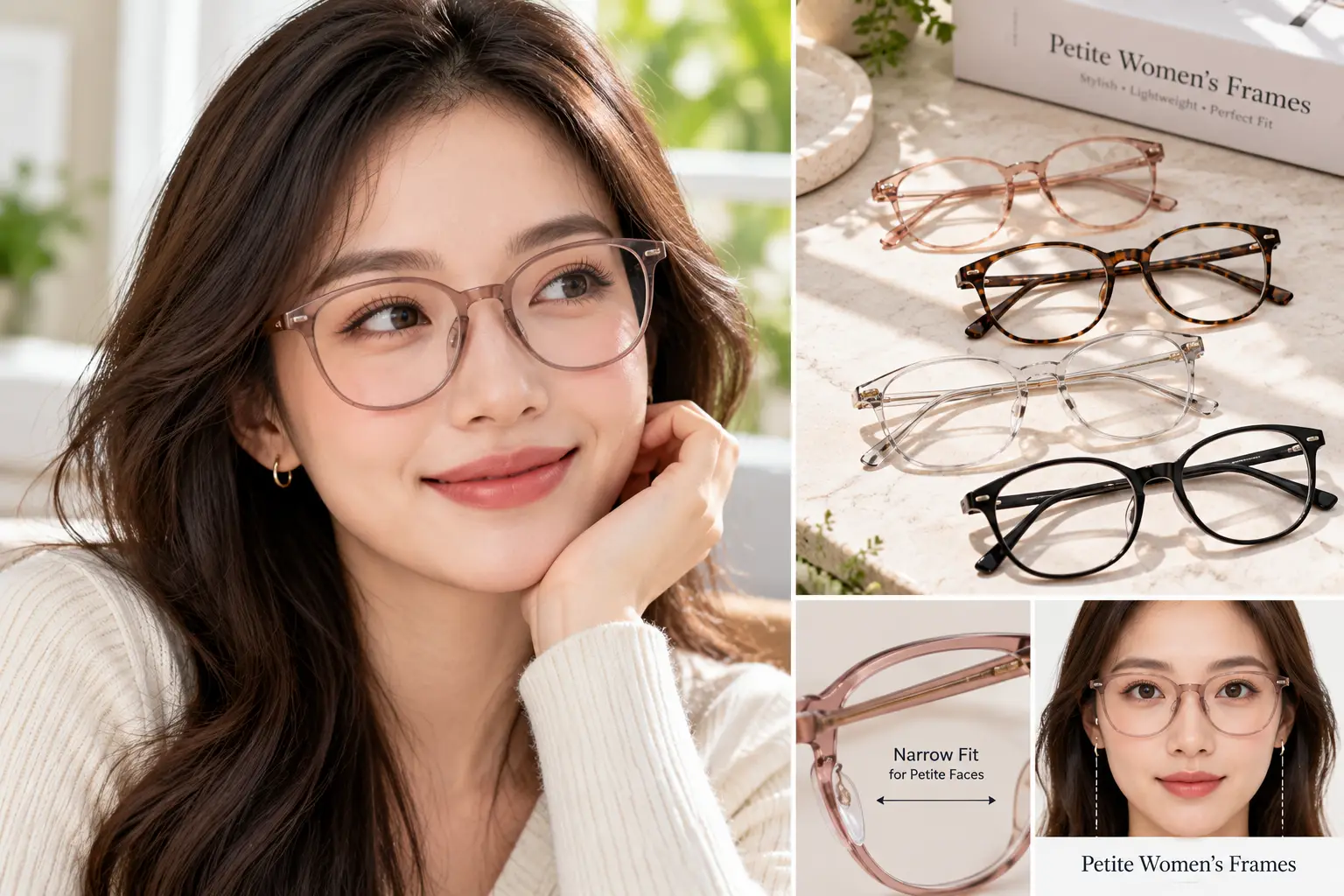
If your glasses slide down your nose every time you glance at your phone, or the hinges stick out past your temples like tiny wings, you already know the problem. Most eyewear is cut for an “average” adult face. Anyone below that average gets stuck choosing between frames that swallow her features and kids’ styles that pinch behind the ears. Petite womens frames fix this by shrinking the measurements that actually matter: total frame width, lens width, bridge width, and temple length.
Here’s the good news for 2026: you no longer have to dig through the children’s aisle. Major brands like Ray-Ban, Vogue Eyewear, and Coach now sell genuinely small sizes (often labeled 47, 49, 50, or 51) on amazon.com, while budget brands offer narrow round and wire-rim styles for a fraction of the price. The catch? “Small” and “narrow” aren’t standardized labels, so two frames with the same tag can fit completely differently.
That’s why this guide leads with numbers, not adjectives. We compared real spec sheets for seven petite womens frames, translated each measurement into what it means on your face, and summarized what real buyers report about fit — only where that feedback could be verified. As a quick benchmark, the eye-care publisher All About Vision suggests shopping for smaller glasses when your total frame width falls between about 109 and 122 mm, which is far narrower than many standard women’s frames.
You’ll also find a step-by-step measuring guide, fixes for the most common fit headaches, and an honest take on extras like blue-light lenses. ✅ By the end, you’ll know exactly which size numbers to type into the search bar — and which ones to skip.
What Are Petite Womens Frames?
Petite womens frames are eyeglass frames sized for narrow or small adult faces, typically with a total width under about 130 mm, lens widths of roughly 41–51 mm, bridges of 15–18 mm, and temples of 135–140 mm. They keep adult styling and hinges while scaling everything down so the lenses center on your pupils.
Quick Comparison: 7 Petite Womens Frames at a Glance
Before the deep dives, here’s the cheat sheet. Frame sizes follow the standard industry order printed inside the temple arm: lens width, bridge width, temple length, all in millimeters. Price ranges reflect what we saw at the time of writing; prices may vary, so always check the current listing.
| Frame | Size (lens-bridge-temple) | Shape & material | Approx. price range | Best for |
|---|---|---|---|---|
| Vogue VO5276 (51) | 51-17-140 | Cat-eye, injected plastic, metal temples | $120–$185 | Vogue VO5276: feminine everyday style |
| Ray-Ban RX5228 (50) | 50-17-140 | Square, acetate | $150–$225 | Ray-Ban RX5228: timeless, all-purpose wear |
| Coach HC6065 (49) | 49-17-135 | Rectangle, acetate | $100–$250 | Coach HC6065: small heads needing shorter temples |
| Ray-Ban RX3447V Round Metal (47) | 47-21-140 | Round, metal, adjustable pads | $150–$210 | Ray-Ban RX3447V Round Metal: ultralight minimalists |
| Kate Spade Jodie (50) | 50-16-140 | Rectangle, plastic readers | $30–$70 | Kate Spade Jodie: petite reading glasses |
| COASION CA7031 | 48-15-143 | Round, plastic front, metal temples | Under $30 | COASION CA7031: budget screen-time pair |
| Agstum Retro Small Round (41) | 41-24-120~140 | Round wire rim, cable temples | Under $40 | Agstum Retro Small Round: the very smallest faces |
Looking at the table, the Coach HC6065 and Kate Spade Jodie stand out because they shrink the bridge or temples, not just the lenses — the two measurements most likely to cause slipping on a petite face. If budget is the deciding factor, the COASION CA7031 and Agstum Retro Small Round cost a fraction of the designer picks, but they trade brand warranties and premium acetate for basic materials. The Ray-Ban RX3447V Round Metal has the widest bridge here (21 mm), so it relies on adjustable nose pads to fit narrow noses.
💬 One click helps other shoppers make an informed choice too! 😊
Top 7 Petite Womens Frames: Expert Analysis
Every pick below is a real, currently sold frame with published measurements. We focused on the specific small sizes, because several of these models also come in larger versions that won’t fit a petite face. When you shop, make sure the size number in the listing matches the one we name.
1. Vogue VO5276 — most flattering cat-eye for narrow faces
The Vogue VO5276 proves a cat-eye can lift small features without overwhelming them. In its 51 mm size, the frame measures 51-17-140 with a lens height of roughly 40 mm, and US optical retailers classify it as a narrow, high-bridge fit. In practice, that 17 mm bridge keeps the lenses closer together than many fashion cat-eyes, so each lens stays centered over your pupil instead of drifting outward. Meanwhile, the super-thin metal temples cut visual bulk at the sides — exactly where petite faces tend to look crowded.
Based on the specs, this frame suits women with an average-to-higher nose bridge who want something polished enough for the office and fun enough for weekends. The keyhole bridge adds a subtle lift. However, if you have a low or flat nose bridge, a key-bridge design without adjustable pads can sit low on the cheeks, so budget for an optician adjustment or choose a frame with pads.
We couldn’t verify a substantial pool of customer reviews for this exact 51 mm version, so we won’t summarize sentiment we can’t confirm. What is verifiable: multiple US retailers list it as narrow-fitting and progressive-friendly. One warning — it also sells in a 53 mm size, which runs noticeably wider.
Pros:
- ✅ Genuinely narrow 51 mm size with a 17 mm bridge
- ✅ Thin metal temples keep the sides looking light
- ✅ Lens height works for most progressive lenses
Cons:
- ❌ Key bridge may slip on low nose bridges
- ❌ Easy to order the wider 53 mm by mistake
Expect roughly $120 to $185 depending on color and seller — solid value for a designer cat-eye that’s truly sized small.
2. Ray-Ban RX5228 — timeless square in a true XS size
The Ray-Ban RX5228 is the classic you’ve seen everywhere, but its 50 mm version is the one petite shoppers should target. At 50-17-140 with a 34.5 mm lens height, retailers label this size “extra small,” with a total frame width of about 124 mm. That puts it comfortably inside the range most small faces need, so the hinges line up with your temples instead of hovering beyond them.
The all-acetate build matters more than it sounds. Acetate can be warmed and reshaped by an optician, which means the temples can be curved snugly behind small ears — a fix that’s much harder on rigid budget plastics. Based on comparing the specs, this is the safest “first good pair” for a petite face: neutral square lines suit round and oval faces, and the frame comes in dozens of colorways, from black to transparent tones.
Review-wise, the Ray-Ban RX5228 is sold by many retailers in three sizes, and we couldn’t isolate verified feedback for the 50 mm size alone. Rather than guess, we’ll point to what the spec sheet confirms: an XS fit, a 2-year retailer warranty on authentic frames, and a design that’s prescription-ready for single-vision and progressive lenses.
Pros:
- ✅ True XS sizing with a 124 mm total width
- ✅ Acetate is easy for opticians to adjust
- ✅ Huge color range for every style
Cons:
- ❌ Shorter 34.5 mm lens height limits some progressives
- ❌ Larger 53 and 55 mm sizes cause ordering mix-ups
It typically lands between $150 and $225 — a fair price for a frame you can realistically wear for years.
3. Coach HC6065 — shorter temples that actually reach your ears
The Coach HC6065 solves a problem many petite women never put a name to: temples that are too long. Its 49 mm size measures 49-17-135, and that 135 mm arm is 5 mm shorter than the 140 mm standard most frames use. On a small head, those 5 mm decide whether the curve wraps behind your ear or sits awkwardly on top of it — the main reason glasses creep forward during the day.
The acetate rectangle is slim, with a lens height around 34 mm, and retailers list it as a narrow, high-bridge fit for women. A small metal Coach accent at the corners adds polish without bulk. Here’s what to weigh: the rectangle shape is especially flattering on round or heart-shaped faces, because straight lines add gentle structure to soft features. It’s also listed as progressive-friendly, though at a 34 mm lens height you should confirm with your optician.
Customer sentiment is encouraging. At the time of our research, one US online optical retailer showed an average near 4.7 stars across roughly 76 ratings. That’s a meaningful sample, though not an Amazon-specific one.
Pros:
- ✅ 135 mm temples suit smaller heads
- ✅ Slim acetate rectangle flatters soft features
- ✅ Well-rated by verified optical buyers
Cons:
- ❌ Prices swing widely between sellers
- ❌ Only a few colorways in the 49 mm size
Prices usually fall between $100 and $250, so shop around — at the lower end, it’s outstanding value.
4. Ray-Ban RX3447V Round Metal — featherweight round that disappears on your face
The Ray-Ban RX3447V Round Metal in its 47 mm size is the lightest designer option here. European retailers list individual colorways at about 15–16 grams, and the 47-21-140 measurements keep the overall footprint compact. In everyday terms, that low weight means far less pressure on the bridge of your nose, which is where heavy frames leave red marks by mid-afternoon.
On paper, the 21 mm bridge looks wide for a petite face. However, this model uses adjustable metal nose pads, so an optician can pinch them closer to fit a narrow nose. That’s the practical advantage of metal frames: the fit can be fine-tuned in ways a fixed acetate bridge can’t match. Round lenses also soften angular or square jawlines, making this a strong choice if your face has sharper features.
We weren’t able to verify a large body of reviews tied to the 47 mm size, so we won’t present sentiment we can’t back up. The verifiable advantage is construction: a full metal rim with adjustable pads and a style that has stayed in Ray-Ban’s lineup for years.
Pros:
- ✅ Roughly 15–16 g, among the lightest options
- ✅ Adjustable pads fit narrow or low bridges
- ✅ Round shape softens angular features
Cons:
- ❌ Small round lenses can limit progressive designs
- ❌ Wide 21 mm bridge needs pad adjustment
It generally runs between $150 and $210 — worth it if lightweight comfort is your priority.
5. Kate Spade Jodie — reading glasses that finally fit small faces
The Kate Spade Jodie is the go-to for petite women who need readers. The classic version measures 50-16-140, and that 16 mm bridge is narrower than most drugstore readers, so the magnified sweet spot actually lines up with your eyes. Integrated nose pads add grip, and the lightweight plastic frame comes with a branded case.
This is where the Kate Spade Jodie really earns its reputation. Reviews on its Amazon listing average around 4.5 stars across several hundred ratings, and a recurring theme stands out: shoppers with small or narrow faces repeatedly say these are the first readers that don’t slide off. The most common complaint is price, since they cost more than multipack drugstore readers. One important caution — Kate Spade also sells a newer Jodie blue-light version with a listed 58 mm lens width, which is far wider. Check the lens size before you buy.
Good to know: the frame accepts prescription lenses, so you can have an optician swap in your exact correction later.
Pros:
- ✅ 16 mm bridge suits narrow noses
- ✅ Frequently praised by small-faced buyers
- ✅ Can be refitted with prescription lenses
Cons:
- ❌ Pricier than typical drugstore readers
- ❌ Newer variants run noticeably wider
Expect to pay between $30 and $70 — a smart upgrade from readers that never fit.
6. COASION CA7031 — budget round with a petite-friendly bridge
The COASION CA7031 is the low-risk way to test a round style. It measures 48-15-143 with a tall 45 mm lens height and weighs about 22 grams. The 15 mm bridge is the narrowest on this list, which matters because a bridge that’s too wide is the number-one reason glasses slide down small noses.
Let’s be honest about the trade-offs, though. Its 133 mm total width is closer to medium than truly petite, so it suits women with small-to-average faces better than very narrow ones. The tall round lenses also give a bigger, more retro look. On the plus side, the metal temples and spring hinges help it hold its shape during heavy daily use.
Real review sentiment is positive on fit: several buyers describe it as finally fitting a petite face. One reviewer noted the nose pads are larger than usual, which makes the frame friendlier to flat or low nose bridges. Keep in mind it ships with blue-light-filtering lenses, a feature with limited scientific support (more on that below).
Pros:
- ✅ Narrow 15 mm bridge reduces sliding
- ✅ Spring hinges and metal temples add durability
- ✅ Very low cost to experiment with round shapes
Cons:
- ❌ 133 mm width is medium, not tiny
- ❌ Blue-light lenses add little proven benefit
Usually under $30 — excellent value as a backup or screen-time pair.
7. Agstum Retro Small Round — smallest adult-sized option on the list
The Agstum Retro Small Round wire-rim frame is built for faces that every other brand ignores. Its 41 mm size has a total width of only about 120 mm — inside that small-face benchmark range — with 41 mm round lenses and a 24 mm bridge. Cable temples curl fully around the ear, with an acceptable length range of roughly 120–140 mm, so the frame stays locked in place even if you lean over a desk all day.
That wrap-around design is the key advantage. Short or hard-to-fit ears are a common petite problem, and cable arms solve it without heat adjustments. The trade-off is style: the tiny round lenses read as distinctly vintage, and a wide 24 mm bridge on a narrow nose means you’ll want an optician to check the fit. Small lenses also have a practical upside — less lens area means thinner edges at higher prescriptions.
Verified review data is limited. On one major US retailer, the frame showed about 4.7 stars, but from a small sample of roughly 22 ratings, so treat that as an early signal rather than proof.
Pros:
- ✅ About 120 mm wide, ideal for very small faces
- ✅ Cable temples stay put on short ears
- ✅ Small lenses keep strong prescriptions thinner
Cons:
- ❌ Vintage look isn’t for everyone
- ❌ Small review sample so far
Often under $40, it’s a low-cost answer for the smallest faces.
Detailed Spec Comparison
| Frame | Total width | Lens height | Temple | Weight / material | Verified review data | Best for |
|---|---|---|---|---|---|---|
| Vogue VO5276 | Narrow class | ~40 mm | 140 mm | Plastic + metal | Not verified | Vogue VO5276: progressive wearers |
| Ray-Ban RX5228 | ~124 mm | 34.5 mm | 140 mm | Acetate | Not verified for 50 mm | Ray-Ban RX5228: first quality pair |
| Coach HC6065 | Narrow class | ~34 mm | 135 mm | Acetate | ~4.7★ (76, optical retailer) | Coach HC6065: small heads |
| Ray-Ban RX3447V Round Metal | Compact | Round | 140 mm | ~15–16 g metal | Not verified for 47 mm | Ray-Ban RX3447V Round Metal: lightness |
| Kate Spade Jodie | Narrow | — | 140 mm | Plastic | ~4.5★ (hundreds, Amazon) | Kate Spade Jodie: readers |
| COASION CA7031 | 133 mm | 45 mm | 143 mm | 22 g plastic/metal | Positive fit themes | COASION CA7031: budget |
| Agstum Retro Small Round | ~120 mm | 41 mm | 120–140 mm | Wire rim | ~4.7★ (22, small sample) | Agstum Retro Small Round: tiny faces |
This side-by-side view makes the trade-offs clear: the Coach HC6065 and Agstum Retro Small Round are the only picks that shorten the temples, while the Ray-Ban RX5228 offers the best-documented small total width among the designer frames. If you wear progressives, prioritize lens height — the Vogue VO5276 gives the most vertical room. Review depth also varies a lot, so the Kate Spade Jodie is the safest bet if crowd validation matters to you.
✨ Don’t miss these petite-friendly picks!
🔍 Take your eyewear game to the next level with this carefully curated lineup. Click a highlighted frame to check current pricing and size availability — these picks will help you finally get glasses that stay put and flatter your face!
How to Measure Your Face for Small Eyeglass Frames for Women (5-Minute Guide)
You don’t need an optician’s tools to figure out your size — just your current glasses, a ruler with millimeters, and a mirror. Here’s the process we recommend before you shop for small eyeglass frames for women online.
Step 1: Read the numbers on your current pair
Look inside the temple arm for three numbers, such as 50□17-140. That’s lens width, bridge width, and temple length. If your current pair fits well, those numbers are your starting template. If it slides or pinches, note which number is the likely culprit.
Step 2: Measure total frame width
Lay your glasses flat and measure hinge to hinge across the front. Petite faces usually land between about 115 and 130 mm. Frames more than 3–4 mm wider than your ideal number will look oversized.
Step 3: Check your pupillary distance (PD)
Your PD comes from your eye doctor or a careful mirror measurement. Small faces often have a PD in the high 50s to low 60s. When your PD is much narrower than the frame’s optical centers, the lab must shift the lens centers inward, which can add thickness at the outer edges.
Step 4: Match the temple length
Measure from the hinge to the point behind your ear where the arm should start curving. Many petite women need 135 mm instead of 140 mm.
Your first 30 days
- ✅ Book a free adjustment if the frame shifts after a week.
- ✅ Clean lenses with a microfiber cloth, never your shirt.
- ❌ Don’t bend temples yourself on acetate frames — heat is required.
Real-World Scenarios: Matching Petite Glasses Frames to Your Life
Numbers only go so far. Here’s how the picks above play out for three common buyer profiles, with budget and daily use factored in.
The grad student on a tight budget
She’s 24, has a narrow face, and stares at a laptop 8–10 hours a day. Her budget is under $50, and she breaks or loses glasses regularly. Our pick: the COASION CA7031 as a daily pair, with the Agstum Retro Small Round as a backup if her face is on the very small end. Both cost less than a single copay at many optical shops, and the cable temples on the Agstum Retro Small Round survive being shoved into a backpack. Her real eye-strain fix, though, is taking regular screen breaks rather than relying on lens coatings.
The executive who wears progressives
She’s 48, works in client meetings, and needs one frame that does it all. Progressive lenses need vertical room, so lens height becomes the deciding number. Our pick: the Vogue VO5276, whose roughly 40 mm lens height gives an optician more room to fit reading and distance zones. The Coach HC6065 is the alternative if her head is smaller and standard temples always slide.
The retiree who just needs readers
She’s 67, wears petite glasses frames only for books and recipes, and hates drugstore readers that slip off. Our pick: the Kate Spade Jodie, thanks to its 16 mm bridge and consistent praise from small-faced buyers. Because it accepts prescription lenses, she can upgrade later without changing frames.
Problem → Solution: Fixing the Most Common Petite Fit Issues
Even well-sized frames sometimes need help. These are the five fit problems petite women report most, with fixes that actually work.
1. Glasses slide down your nose. The bridge is too wide or the temples are too long. Choose a narrower bridge, like the 15 mm COASION CA7031 or 16 mm Kate Spade Jodie, or ask an optician to tighten the temple bend behind your ears.
2. Hinges stick out past your temples. The total frame width is too large. Size down to a frame near 120–124 mm, such as the Agstum Retro Small Round or the 50 mm Ray-Ban RX5228.
3. Pressure or soreness behind the ears. The temples are too long and bend in the wrong spot, or too short and dig in. The 135 mm arms on the Coach HC6065 often solve this for smaller heads.
4. Eyelashes brush the lenses. This is common with low nose bridges. Frames with adjustable nose pads, like the Ray-Ban RX3447V Round Metal, can be raised to create clearance.
5. Lenses look thick at the edges. Your pupils sit far from the lens centers. Smaller lenses, closer to your PD, keep edges thinner — another reason petite womens frames beat oversized styles for strong prescriptions.
How to Choose Petite Womens Frames: 6 Steps That Actually Work
Choosing petite womens frames comes down to six measurable checks, in this order:
- Start with total frame width. Aim for roughly 115–130 mm. It’s the single best predictor of whether the frame looks proportional on a small face.
- Narrow the bridge. Look for 15–18 mm. A bridge that’s too wide drops the frame onto your cheeks and makes it slide.
- Check temple length. Most petite heads do best at 135–140 mm. Shorter arms curve behind your ear at the right spot.
- Match lens height to your lens type. Single-vision lenses work with almost anything; progressives generally need more vertical room, so confirm with your optician.
- Choose an adjustable material. Acetate can be heat-shaped, and metal frames with nose pads can be fine-tuned. Rigid budget plastics offer the least wiggle room.
- Pick a shape that contrasts your features. Round lenses soften angular faces, while rectangles add structure to round faces.
Follow these steps in order and you’ll eliminate most bad fits before you ever click “add to cart.” Style comes last for a reason: a gorgeous frame that slides down your nose all day won’t stay your favorite for long.
Common Mistakes to Avoid When Buying Narrow Eyeglass Frames
Even savvy shoppers trip over the same pitfalls when hunting for narrow eyeglass frames. Here’s what to watch for.
Trusting the word “small.” Labels aren’t standardized. One brand’s “small” is another brand’s medium, so always compare the actual millimeter measurements with a pair that already fits you.
Ordering the wrong size of the right model. The Ray-Ban RX5228, Vogue VO5276, and Coach HC6065 all sell in multiple sizes. Many disappointing reviews of “narrow” frames come from buyers who received a larger size than they intended.
Focusing only on lens width. A 48 mm lens on a 20 mm bridge can be wider overall than a 50 mm lens on a 16 mm bridge. Add lens width × 2 plus bridge width for a rough front-width estimate, then remember that hinges add a few more millimeters.
Ignoring temple length. Standard 140–145 mm arms often extend past small ears, causing the frame to slide forward.
Skipping the adjustment. Almost every frame benefits from a professional fit. Many optical shops will adjust frames bought elsewhere, sometimes for a small fee, so ask before you assume it’s off-limits.
Choosing oversized “trend” frames. Oversized styles can look striking on a mood board, but on narrow faces they often hide your features and push lenses outward, away from your pupils.
Petite Frames vs. Kids’ Frames vs. Standard Women’s Frames
Many women with small faces end up in the children’s section because nothing else fits. It works for some, but there are real trade-offs to understand.
| Factor | Petite womens frames | Kids’ frames | Standard women’s frames |
|---|---|---|---|
| Typical total width | ~115–130 mm | ~105–125 mm | ~130–145 mm |
| Temple length | 135–140 mm | Often 120–135 mm | 140–145 mm |
| Styling | Adult designs, scaled down | Bright, playful colors | Full adult range |
| Hinge and build | Adult-grade hinges | Often flexible, kid-proofed | Adult-grade hinges |
| Best for | Ray-Ban RX5228, Coach HC6065 buyers | Very small faces with short temples | Average and wider faces |
The table shows why petite sizing is usually the sweet spot: you get adult styling and proper temple length without the cartoonish colors or overly short arms of kids’ frames. Kids’ frames can still make sense for the very smallest faces, but their shorter temples may press behind adult ears. Standard women’s frames, meanwhile, simply start too wide for most narrow faces.
For glasses for small faces women can wear to the office without looking like they borrowed a teenager’s pair, petite adult sizes deliver the best balance of fit, style, and durability.
Petite Womens Frames by Face Shape
Size gets the fit right; shape gets the look right. Here’s how to pair petite proportions with your face shape.
Round faces: Angular shapes add definition. The Coach HC6065 rectangle and the Ray-Ban RX5228 square both create gentle structure without adding width.
Heart-shaped faces: Your forehead is wider than your chin, so frames that lift the eye line work well. The Vogue VO5276 cat-eye balances a pointed chin while keeping the frame narrow.
Square or angular faces: Curves soften strong jawlines. The Ray-Ban RX3447V Round Metal and COASION CA7031 add roundness, with the metal option looking more refined and the COASION CA7031 reading more retro.
Oval faces: Lucky you — most shapes work. Focus purely on measurements, and use color to express personality.
Very narrow, long faces: Taller lenses visually shorten a long face. The COASION CA7031’s 45 mm lens height does this well, while the Agstum Retro Small Round suits faces that are both narrow and short.
One extra tip: frame color changes perceived size. Clear, light tortoise, and thin metal frames look lighter on small features than solid black acetate.
Features That Actually Matter (and Ones That Don’t)
Eyewear marketing is full of buzzwords. Here’s our honest take on which features earn their place in petite womens frames.
Features that matter
- ✅ Adjustable nose pads — crucial for low or narrow bridges, because they let an optician raise or narrow the fit.
- ✅ Spring hinges — they flex outward, so a slightly snug frame stays comfortable and survives one-handed removal.
- ✅ Lightweight materials — titanium, thin metal, and well-made acetate reduce nose pressure, which is magnified on a small face.
- ✅ Progressive-friendly lens height — essential if you wear or will soon need multifocals.
Features that matter less than you think
- ❌ Blue-light filtering lenses. The American Academy of Ophthalmology does not recommend blue-light glasses for digital eye strain, citing a lack of evidence that screen light harms the eyes. It suggests the 20-20-20 rule instead: every 20 minutes, look at something 20 feet away for 20 seconds. Blue-light lenses aren’t harmful, but don’t pay a big premium for them.
- ❌ “One size fits most” claims. On petite faces, it usually doesn’t.
- ❌ Logo-heavy temples. Big branding adds visual bulk exactly where small faces need less.
Long-Term Cost and Maintenance
The sticker price of a frame is only part of what you’ll spend. Prescription lenses, coatings, adjustments, and replacements all add up — so here’s how the tiers compare over time.
| Tier | Examples | Approx. frame price | Realistic lifespan (our estimate) | Best for |
|---|---|---|---|---|
| Budget | COASION CA7031, Agstum Retro Small Round | Under $40 | 1–2 years | Backups, experiments |
| Mid-range | Kate Spade Jodie, Coach HC6065 (on sale) | $30–$150 | 2–3 years | Readers, daily wear |
| Premium | Ray-Ban RX5228, Vogue VO5276, Ray-Ban RX3447V Round Metal | $120–$225 | 3–5 years | Daily prescription pair |
The math often favors quality: a $180 frame worn for four years costs about $45 a year, while a $30 frame replaced annually costs $30 a year but gets re-lensed each time. Since prescription lenses frequently cost as much as the frame itself, durable frames you can re-lens when your prescription changes usually win long term.
That’s also why your prescription matters. Under the FTC’s updated Eyeglass Rule, eye doctors must automatically give you a copy of your eyeglass prescription after an exam, which makes it easier to compare prices online. For maintenance, tighten hinge screws every few months, store glasses in a hard case, and rinse lenses before wiping to avoid scratches.
Safety, Regulations, and Standards
Petite frames are a fit question, but the lenses inside them are a safety question — and US rules set a baseline you should know about.
Impact resistance is required. Federal regulation 21 CFR 801.410 requires eyeglass and sunglass lenses sold in the US to be impact resistant, with limited exceptions when a doctor directs otherwise. The reference test drops a 5/8-inch steel ball weighing about 0.56 ounce from 50 inches onto the lens. Importantly, impact-resistant doesn’t mean shatterproof.
Lens materials matter for active wearers. Polycarbonate and Trivex lenses are common choices for impact protection and light weight, which pairs well with light petite frames like the Ray-Ban RX3447V Round Metal.
Non-prescription “fashion” lenses still count. If you buy clear-lens or blue-light glasses such as the COASION CA7031, the same impact-resistance rule applies to the lenses sold in the US.
Readers are not a substitute for an eye exam. Over-the-counter readers like the Kate Spade Jodie correct only simple near-vision blur. If you notice headaches, double vision, or sudden changes, book a full exam with an optometrist or ophthalmologist.
FAQ: Petite Womens Frames
❓ Can I buy prescription glasses for a small face on Amazon?
❓ Do petite sizes of designer frames cost more?
❓ Are petite womens frames good for high prescriptions?
❓ Which petite frame works with progressive lenses?
❓ What if petite frames still slide after I buy them?
Conclusion: Find Petite Womens Frames That Fit Like They Were Made for You
The right glasses shouldn’t feel like a compromise. Once you know your numbers — total width, bridge, and temple length — petite womens frames stop being a hunt and become a simple checklist. Most small faces do best around 115–130 mm wide, with a 15–18 mm bridge and 135–140 mm temples.
From there, the choice depends on your life. The Ray-Ban RX5228 in 50 mm is the safest all-around designer pick, while the Vogue VO5276 brings feminine flair and extra lens height for progressives. The Coach HC6065 is the hidden gem for smaller heads thanks to its shorter temples, and the Ray-Ban RX3447V Round Metal wins on featherweight comfort. Need readers? The Kate Spade Jodie earns its loyal small-face fan base. On a budget, the COASION CA7031 and Agstum Retro Small Round let you experiment without much risk.
Whichever you choose, double-check the size number in the listing, skip paying a premium for blue-light claims, and book a quick professional adjustment. Those three habits matter more than any brand name. With the right measurements and a little fine-tuning, you’ll finally have glasses that stay put, flatter your features, and feel like part of your face.
✨ Ready to find your perfect fit?
👓 Pick the frame that matches your measurements, click a highlighted name to check today’s price and size options, and enjoy glasses that finally fit as beautifully as they look!
Recommended for You
- Glasses Without Prescription Lenses: 7 Best Picks for 2026 (Honest)
- Are Anti Fatigue Lenses Worth It? 7 Best Picks for 2026
- Big Frame Reading Glasses: 7 Best Picks That Actually Fit (2026)
Disclaimer: This post contains affiliate links. As an Amazon Associate, I earn from qualifying purchases made through these links, at no additional cost to you.
✨ Found this article helpful? Share it with someone who needs it! 💬🤗