In This Article
Introduction: Why the best sunglasses for driving day and night Need a Smarter Answer
The best sunglasses for driving day and night aren’t one magic pair — they’re a lens strategy. In daylight, you want polarized or contrast-boosting lenses that tame glare off hoods and wet asphalt. After sunset, you want clear (or near-clear) lenses with an anti-reflective coating, because any real tint costs you light you can’t afford to lose.
That’s the short, honest version. Now for the reason it matters.
Search Amazon for “day and night driving glasses” and you’ll find hundreds of listings promising one pair that does it all — often with yellow lenses and bold claims about “HD night vision.” The problem? Eye-care professionals don’t back those claims. The American Academy of Ophthalmology points out that tinted or polarized “night vision” glasses reduce the light reaching your eyes, which makes it harder — not easier — to see after dark.
So this guide takes a different approach. Instead of pretending a single tint works at 2 p.m. and 2 a.m., we analyzed real spec sheets, light-transmission numbers, lens technologies, and aggregated owner feedback to build a practical day-to-night driving eyewear plan. You’ll get:
- ✅ 7 real products, from budget to premium, each matched to a specific driver
- ✅ Plain-English explanations of VLT, polarization, and photochromic lenses
- ✅ What the research actually says about night driving glasses
- ✅ A simple kit you can keep in your car for every lighting condition
Whether you’re a sunrise commuter, a long-haul road-tripper, or a rideshare driver working the evening rush, you’ll leave knowing exactly which lens belongs on your face — and when.
Quick Comparison: Top Driving Sunglasses at a Glance
| Product | Lens Tech | Approx. Light Transmission | Best For | Price Range |
|---|---|---|---|---|
| Serengeti Carrara | Photochromic + polarized mineral glass | ~9%–23% | Serengeti Carrara: all-day daytime driving in changing light | $250–$400 |
| Maui Jim Ho’okipa | PolarizedPlus2, HCL Bronze | ~12% | Maui Jim Ho’okipa: long highway hauls | $230–$330 |
| Oakley Holbrook | Prizm Polarized | 11%–17% (by lens) | Oakley Holbrook: everyday style + impact protection | $180–$290 |
| Ray-Ban RB3025 Aviator | G-15 Polarized | ~11%–15% | Ray-Ban RB3025 Aviator: classic look, true-color driving | $170–$280 |
| Smith Lowdown 2 | ChromaPop Polarized Brown | ~14% | Smith Lowdown 2: contrast on gray, mixed days | $150–$220 |
| Tifosi Veloce Fototec | Light Night photochromic | ~28%–76% | Tifosi Veloce Fototec: dawn, dusk, and overcast | $70–$90 |
| DUCO 8177 | TAC polarized | Dark (category 3 class) | DUCO 8177: budget glovebox backup | $20–$35 |
Reading the table, the pattern jumps out: six of these seven pairs sit well below 25% light transmission, which makes them daytime-only tools no matter what a listing says. Only the Tifosi Veloce Fototec gets close to the 75% threshold standards bodies use for low-light driving, and even it should be treated as a dusk companion rather than a true night lens. That’s why the smartest buyers pair one premium daytime shade with a clear or near-clear option.
💬 One click helps other drivers make an informed choice too — share this comparison with someone who squints through every sunset! 😊
Top 7 best sunglasses for driving day and night: Expert Analysis
1. Serengeti Carrara — the purpose-built driver’s lens
The Serengeti Carrara is the closest thing to a dedicated driving instrument on this list, built around Serengeti’s amber Drivers lens, first launched in 1985.
Its lenses combine three technologies: photochromic glass that darkens and lightens with conditions, polarization to kill hood and wet-road glare, and Spectral Control filtering that amplifies contrast. Serengeti says its borosilicate mineral glass from Corning is about 20% thinner and lighter than standard glass, and retailers note it’s engineered to keep adapting behind a windshield, where ordinary photochromics stall. In practice, that means fewer lens swaps as you move from bright freeway to shaded downtown streets.
Based on the specs, the Drivers lens absorbs roughly 77%–91% of visible light. That’s ideal for daytime driving, but it also means the lens never gets light enough for night — at its clearest, it still blocks more than three-quarters of incoming light. Buy the Serengeti Carrara as your daytime workhorse, not your after-dark solution.
Customer ratings on Serengeti’s own US product page sit in a middling range at the time of writing, and detailed, verifiable Amazon review themes were limited — so weigh the excellent spec sheet against the fact that fit and personal preference for amber tints vary.
Pros:
- ✅ Polarized, photochromic, and contrast filtering in one lens
- ✅ Mineral glass resists scratches better than most plastics
- ✅ Hidden double-flex spring hinges improve all-day comfort
Cons:
- ❌ Never light enough for night or deep twilight driving
- ❌ Glass lenses are heavier and can shatter if dropped
Expect around $250–$400 depending on finish — premium, but justified if you drive daily in variable sun.
2. Maui Jim Ho’okipa — lightest feel for long highway hauls
The Maui Jim Ho’okipa wins on comfort, thanks to a minimal rimless design that practically disappears on a long drive.
Its HCL Bronze lens (“High Contrast Lens”) lets about 12% of visible light through and is marketed as Maui Jim’s most versatile everyday tint. Every pair uses PolarizedPlus2, which pairs polarization with color-enhancing filters. Translation: brake lights and lane markings look warm and distinct, while glare off a chrome bumper ahead gets knocked down hard. Maui Jim also offers gradient versions that are lighter at the bottom — handy for glancing at your dashboard or a navigation screen.
This is the pair for drivers who spend three-plus hours behind the wheel and get headaches from heavy frames. The Maui Jim Ho’okipa suits narrow-to-medium faces best; Maui Jim sells an XL version for larger heads.
Owner feedback on Maui Jim’s HCL Bronze lens across retailers is consistently positive about clarity and color, while common gripes target the price and, in some reviews, the quality of the included case.
Pros:
- ✅ Extremely light rimless frame for all-day wear
- ✅ HCL Bronze adds warm contrast on hazy days
- ✅ Gradient option keeps the dashboard easy to read
Cons:
- ❌ Rimless lenses need careful handling and storage
- ❌ Too dark for dusk, dawn, or night use
Typically $230–$330 — strong value if comfort over long distances is your top priority.
3. Oakley Holbrook — tough everyday style with lens choices
The Oakley Holbrook is the most versatile mainstream frame here, because you can match the lens to your driving conditions.
The frame measures 57/17/135 mm with a lightweight O Matter build and 6-base lens curvature. Lenses are Plutonite polycarbonate and impact-tested — a meaningful safety edge if a rock ever bounces off your windshield with a window down. Prizm Polarized options range from about 11% light transmission (Prizm Black) to 17% (Prizm Ruby), with Shallow Water around 15%.
Here’s what most buyers overlook: for driving, the lens choice matters more than the frame. Enthusiast discussions on Oakley forums suggest bronze- and rose-based lenses like Ruby or Shallow Water feel more comfortable on the road than the darkest gray options, because they keep a touch more light and contrast. Choose the Oakley Holbrook if you want one sporty frame for driving, errands, and weekend trips.
Owner sentiment around the Holbrook generally praises durability and fit for average-sized heads, while long-time fans note Oakley doesn’t make a dedicated polarized “road” lens.
Pros:
- ✅ Impact-resistant polycarbonate adds real protection
- ✅ Multiple Prizm Polarized tints for different preferences
- ✅ Prescription-ready through Oakley’s Rx program
Cons:
- ❌ Sporty look may not suit formal settings
- ❌ No Prizm option is safe for night driving
Expect $180–$290 depending on lens — solid value for a durable daily pair.
4. Ray-Ban RB3025 Aviator — the classic true-color driver
The Ray-Ban RB3025 Aviator earns its spot because its G-15 lens was built for one thing: natural color under bright light.
G-15 lenses absorb about 85% of visible light and transmit colors evenly, so red lights look red and green looks green — exactly what you want at a busy intersection. Ray-Ban says its polarized lenses block 99% of reflected light. The 58 mm version measures 58-14-135 and weighs about an ounce, with adjustable nose pads for a personalized fit. Lenses are prescription-ready.
Based on the specs, the aviator’s large teardrop lens gives excellent downward coverage for sun bouncing off a dashboard. The Ray-Ban RB3025 Aviator suits drivers who want timeless style with dependable optics, and it works for both men and women.
Aggregated buyer feedback consistently praises comfort and color accuracy; a recurring concern on marketplaces is authenticity, so buy from Ray-Ban’s official storefront or listings sold by Amazon. Also note that Ray-Ban’s two-year warranty doesn’t cover scratched lenses.
Pros:
- ✅ G-15 tint keeps traffic signal colors accurate
- ✅ Featherlight metal frame with adjustable nose pads
- ✅ Prescription-ready in multiple sizes
Cons:
- ❌ Thin metal frames bend if sat on
- ❌ Counterfeits circulate through some third-party sellers
Typically $170–$280 — fair value for an icon that genuinely drives well.
5. Smith Lowdown 2 — contrast champion for gray, mixed days
The Smith Lowdown 2 shines on the days most drivers dread: bright haze, partial cloud, and flat light that hides potholes.
Its ChromaPop Polarized Brown lens transmits about 14% of visible light and filters two specific wavelength bands where colors tend to blur together. On the road, that means lane lines, signs, and brake lights separate more clearly from the background. Smith adds anti-reflective and hydroleophobic coatings — so fewer reflections from behind and easier cleanup of fingerprints. The flatter 4-base front and auto-lock hinges keep the fit secure, and the Evolve frame uses 53% bio-based material.
Choose the Smith Lowdown 2 if you drive under mixed skies or in regions where weather changes fast. It suits medium-sized faces; Smith also offers XL and Slim versions.
Aggregated reviews highlight standout color “pop” and glare reduction while driving; the most common criticism involves durability disputes and frustrating warranty experiences reported by a minority of owners.
Pros:
- ✅ ChromaPop sharpens contrast in flat, hazy light
- ✅ Backside anti-reflective coating reduces distracting reflections
- ✅ Multiple sizes for small to large faces
Cons:
- ❌ Some owners report warranty disputes over damage
- ❌ Daytime-only; far too dark after sunset
Usually $150–$220 — excellent value for contrast-focused drivers.
6. Tifosi Veloce Fototec — the dawn-to-dusk bridge
The Tifosi Veloce Fototec is the only pair here designed to stay nearly clear in low light, making it the bridge between your sunglasses and your clear night lenses.
Its Light Night Fototec lens ranges from about 75.9% light transmission (virtually clear) down to about 27.7% in bright sun, with a transition time of around 10 seconds. The frame is Grilamid TR-90 with adjustable hydrophilic nose pads and temples, and vented lenses reduce fogging on humid mornings.
Here’s the honest analysis: standard photochromic lenses need UV to darken, and modern windshields block most UV. Inside the car, the Tifosi Veloce Fototec will usually sit near its lightest state — which is exactly why it’s useful at dawn, dusk, and on overcast days, and why it’s a weak choice for blinding midday sun. Even at its clearest, it barely meets the 75% low-light threshold, so it’s a twilight helper, not a guarantee of safe night vision.
Tifosi buyers generally praise the value-to-quality ratio; a recurring complaint across Tifosi models is occasional lens breakage, and its sporty look won’t appeal to everyone.
Pros:
- ✅ Near-clear lightest state suits twilight and overcast driving
- ✅ Fast photochromic transition outdoors
- ✅ Lightweight, adjustable TR-90 frame
Cons:
- ❌ Barely darkens behind a UV-blocking windshield
- ❌ Sporty cycling style looks out of place for some
Around $70–$90 — great value as a second pair for the edges of the day.
7. DUCO 8177 — the budget glovebox backup
The DUCO 8177 proves you don’t need to spend triple digits to get real polarization for daytime driving.
It pairs TAC polarized UV400 lenses with a lightweight aluminum-magnesium metal frame, and the box includes a polarization test card so you can confirm the filter works right out of the box. You also get a zip case, cleaning cloth, and a tiny screwdriver for tightening hinges. In practice, that test card is more useful than it sounds: it lets you verify you’re actually getting polarization, which isn’t a given at this price.
This is the pair to toss in the glovebox, keep in a second car, or hand to a passenger. The DUCO 8177 won’t match premium optical clarity, but it handles everyday glare competently.
Aggregated Amazon feedback centers on comfort, value, and the generous accessories; several reviewers note it’s too early to judge long-term durability. One caution: DUCO also sells yellow “night driving” glasses — research doesn’t support using tinted lenses like those after dark.
Pros:
- ✅ Real polarization at a fraction of premium prices
- ✅ Includes test card, case, and repair screwdriver
- ✅ Light metal frame works for long commutes
Cons:
- ❌ Optical clarity trails premium glass and Prizm lenses
- ❌ Long-term frame and coating durability is unproven
Expect $20–$35 — unbeatable as a backup or starter pair.
✨ Don’t miss the right lens for every hour of your drive!
🔍 Build your perfect day-to-night setup with this carefully curated lineup. Click a highlighted pair to check current pricing and availability — and enjoy calmer, clearer drives from sunrise to sunset!
How to Build a Day-to-Night Driving Eyewear Kit (Step-by-Step)
The single most useful upgrade isn’t a fancier pair — it’s a system. Here’s how to set one up in under an hour.
Step 1: Choose your daytime anchor. Pick one polarized or contrast-enhanced pair from the list above based on your typical light. Bright, sunny states (Arizona, Texas, Florida) favor darker lenses like the Ray-Ban RB3025 Aviator or Maui Jim Ho’okipa. Hazy or changeable climates favor the Smith Lowdown 2 or Serengeti Carrara.
Step 2: Add a twilight option. A near-clear photochromic like the Tifosi Veloce Fototec covers the 30–45 minutes around sunrise and sunset, when sunglasses are too dark but low sun still stings.
Step 3: Sort out your night lenses. If you wear prescription glasses, ask your optometrist about a premium anti-reflective (AR) coating — it reduces the halos and reflections that make oncoming headlights feel worse. If you don’t need correction, simply drive without eyewear at night.
Step 4: Store smart. Use a visor clip or hard case — never the dashboard, where heat can stress coatings and frames.
Step 5: Keep a cleaning kit. A microfiber cloth and lens spray in the door pocket fixes more “night glare” than any gadget.
Common mistakes in the first 30 days
- ❌ Leaving sunglasses on as you enter a tunnel or parking garage
- ❌ Wiping lenses with a shirt or paper napkin (micro-scratches scatter light)
- ❌ Forgetting to clean the inside of the windshield, where film builds up and amplifies glare
Real-World Scenarios: Matching Drivers to the Right Pair
Specs are useful, but context decides. Here are three common driver profiles and the logic behind each match.
🚗 The sunrise commuter (budget: around $200)
Maria drives 35 miles east every morning, straight into the rising sun, and returns at 6 p.m. Her biggest problems are low-angle glare and flat morning light. The Smith Lowdown 2 fits her well: ChromaPop contrast makes lane lines pop in hazy light, and polarization cuts glare off the road. For her evening drive in winter, when she leaves after dark, she should go lens-free — or use clear AR-coated prescription glasses if she needs them.
🛣️ The weekend road-tripper (budget: $300+)
James does 400-mile drives a few times a month through deserts and mountains. Light shifts constantly with elevation, clouds, and canyon shadows. The Serengeti Carrara suits him: its photochromic glass adapts behind the windshield, so he’s not swapping glasses every hour. He adds a Tifosi Veloce Fototec for the final stretch into dusk.
🚕 The rideshare driver (budget: under $100)
Priya drives evenings and late nights, with a few afternoon shifts. She needs one affordable daytime pair plus a twilight helper. A DUCO 8177 handles afternoon glare, and the Tifosi Veloce Fototec covers sunset. After full dark, she drives without tint — and keeps her windshield spotless, since her passengers depend on her vision too.
The takeaway: almost nobody is best served by a single pair. Matching two lenses to your schedule costs less than one luxury frame and covers far more of your driving hours safely.
Problem → Solution: Fixing the Most Common Driving Glare Issues
Problem 1: “My phone or dashboard screen goes black with sunglasses on.” Solution: Many LCD screens emit polarized light, so polarized lenses can dim them at certain angles. Rotate the phone mount, or choose a gradient lens like the Maui Jim Ho’okipa gradient version, which is lighter at the bottom.
Problem 2: “I see rainbow patterns in my windshield.” Solution: That’s stress in tempered or laminated glass revealed by polarization. It’s harmless, but if it distracts you, a non-polarized contrast lens like a non-polarized Serengeti Carrara version can help.
Problem 3: “My photochromic glasses don’t darken in the car.” Solution: Your windshield blocks the UV they need. Use a lens designed to react behind glass, or keep dedicated sunglasses in the car.
Problem 4: “Headlights look smeared and starry at night.” Solution: Clean both sides of your windshield, replace worn wiper blades, and get an eye exam — an outdated prescription or early cataracts can cause halos. Tinted glasses won’t fix this.
Problem 5: “My eyes ache after long sunny drives.” Solution: Your lens may be too light. Move up to a category 3 lens such as the Ray-Ban RB3025 Aviator or Oakley Holbrook, and take breaks every two hours.
How to Choose the best sunglasses for driving day and night
Use these seven steps to narrow your options quickly:
- Check visible light transmission (VLT). For bright daytime driving, 8%–18% (category 3) is the sweet spot. Below 8% (category 4) is not suitable for driving at all.
- Choose polarization for daytime. It cuts reflected glare from hoods, wet roads, and bodies of water — the glare that causes squinting and fatigue.
- Pick a road-friendly tint. Gray, green, and brown/bronze keep traffic signals accurate. Avoid heavily colored fashion tints that distort reds and greens.
- Look for anti-reflective backside coatings. They stop light from behind you bouncing off the inner lens surface into your eyes.
- Verify UV400 protection. All seven picks block UV; cheap unbranded pairs sometimes don’t.
- Confirm fit and coverage. Wide lenses and close fits block side and overhead light, but make sure frames don’t create blind spots near the temples.
- Plan your night solution separately. Clear AR-coated lenses — or no eyewear — for full darkness.
A study of sunglasses on the market found that a meaningful share of sunglasses failed to meet driving-suitability requirements under ISO 12312-1, especially uncertified products. That’s a strong argument for buying from brands that publish their lens specs.
Polarized Sunglasses for Driving vs Photochromic vs Clear AR Lenses
Each lens type solves a different problem, so comparing them side by side helps you understand why one pair can’t do everything.
| Lens Type | Best Light Condition | Works Behind Windshield? | Safe at Night? | Best for |
|---|---|---|---|---|
| Polarized sunglasses | Bright sun, wet roads | Yes | No | Ray-Ban RB3025 Aviator, Maui Jim Ho’okipa |
| Standard photochromic | Outdoors, variable sun | Barely | Only in clearest state, if above 75% | Tifosi Veloce Fototec |
| Windshield-reactive photochromic | Variable daytime driving | Yes | No (if darkest-state tint stays above 20%) | Serengeti Carrara |
| Clear with AR coating | Night, rain, fog | N/A | Yes | Night driving for everyone |
The table shows why “one pair for day and night” is mostly a marketing idea. Polarized sunglasses for driving dominate in full sun but become dangerous after dark, while clear AR lenses are the only option eye-care professionals broadly support for night driving. Photochromic lenses sit in between — useful, but limited by how windshields filter UV.
Polarized sunglasses for driving are the right choice for most daytime commuters. Polarization targets horizontally reflected glare, which is exactly what bounces off a sunlit road or the car in front of you. The tradeoffs are minor: dimmed LCD screens and occasional windshield patterns.
Photochromic sunglasses for driving appeal to people who hate swapping glasses. But standard photochromics react to UV, and windshields block most of it. Only lenses engineered to respond to visible light — such as Serengeti’s mineral glass — adapt meaningfully inside the car.
Clear AR lenses don’t reduce daytime glare at all, but at night they’re the gold standard because they let nearly all available light through while reducing reflections.
Night Driving Glasses: What the Research Actually Says
Yellow-lens “night driving glasses” remain hugely popular on Amazon, so they deserve a straight answer.
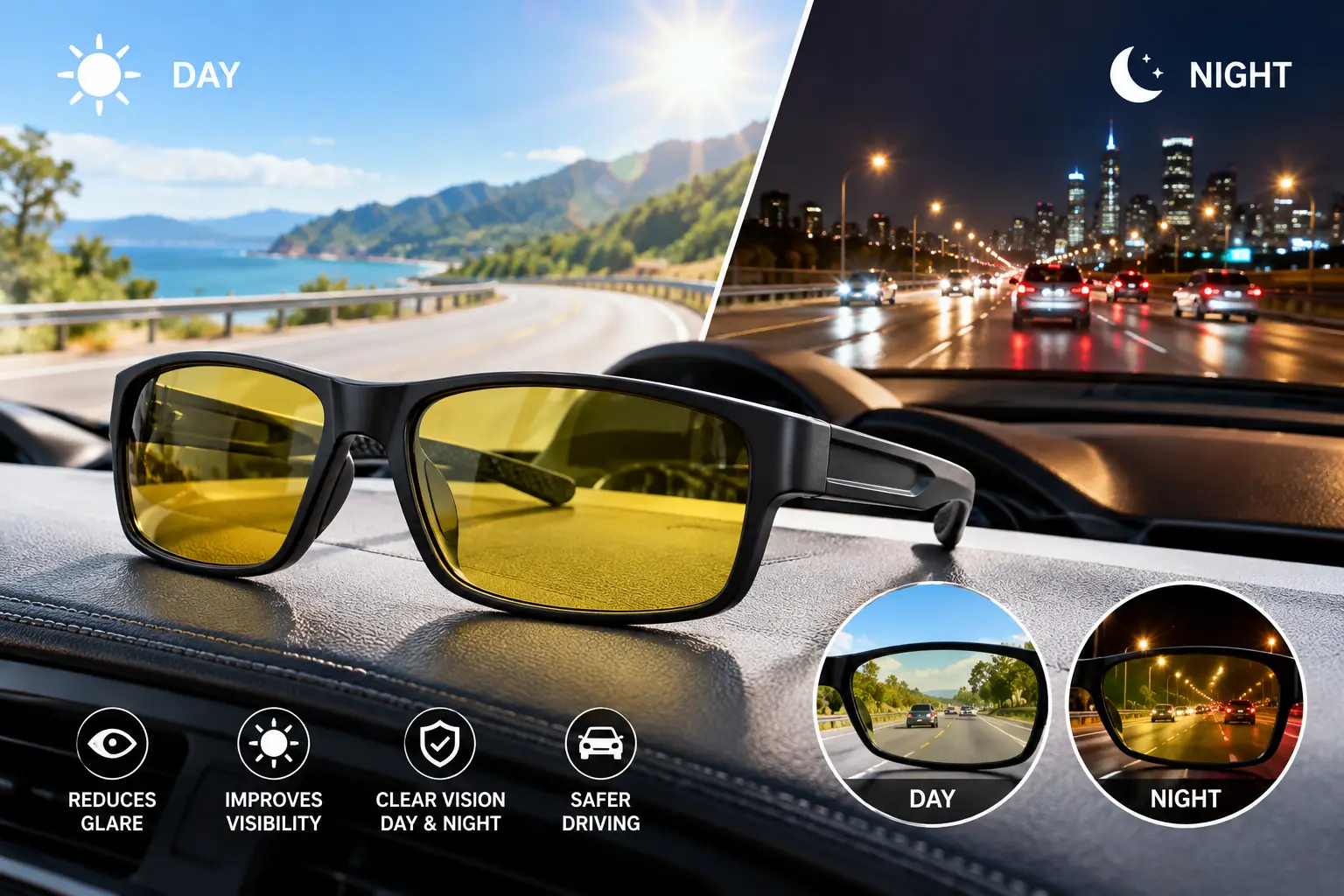
In a 2019 driving-simulator study led by Harvard Medical School researcher Alex Hwang, 22 participants drove night scenarios wearing three commercially available yellow-lens products and clear lenses. As reported by Review of Optometry, yellow lenses did not improve pedestrian detection or reduce the effect of headlight glare. The researchers also warned that wearers may feel they see “brighter,” which can create overconfidence.
Why would they feel better yet perform no better? Yellow lenses filter blue light, which can make scenes look warmer and headlights feel less harsh. But every tint removes some light — and at night, your eyes need every bit of it to spot a dark-clothed pedestrian or debris.
Here’s how to translate that into buying decisions:
- ✅ Yellow or amber lenses can be pleasant on overcast daytime drives
- ❌ They’re not a proven solution for night driving
- ❌ Polarized yellow lenses add another layer of light reduction after dark
- ✅ Real fixes include an updated prescription, AR coatings, a clean windshield, aimed headlights, and dimmed dashboard lights
If night glare feels worse than it used to, treat it as a signal — not a shopping prompt. Cataracts, dry eye, and outdated prescriptions are common causes, and an eye exam can address them directly.
Features That Actually Matter (and Ones That Don’t)
Marketing language can make every pair sound miraculous. Here’s how to cut through it.
✅ Features that actually matter
- Published VLT or lens category. If a brand won’t tell you how much light gets through, you can’t judge whether it’s road-safe.
- Real polarization you can verify. The DUCO 8177 test card is a simple, honest example.
- Backside anti-reflective coating. Reduces reflections from the sun behind you — common on the Smith Lowdown 2 and Serengeti Carrara.
- Fit and coverage. A secure fit prevents constant adjusting, which is itself a distraction.
- Lens material. Glass offers excellent scratch resistance and clarity; polycarbonate offers impact protection and lighter weight.
❌ Features that matter less than you think
- “HD” or “night vision” labels. These aren’t regulated terms and say nothing about light transmission.
- Mirror coatings. Mostly cosmetic for drivers; they can slightly reduce light but don’t add meaningful glare control behind a windshield.
- “Blocks 100% blue light.” Excessive blue filtering can shift colors, including traffic signals.
- Super-dark lenses. Category 4 lenses are too dark for driving — darker is not “better.”
Focusing on the first list will save you money and frustration. A modest pair with honest specs often outperforms an expensive one bought on hype.
Common Mistakes to Avoid When Buying Driving Sunglasses
Even experienced drivers make these errors. Avoid them, and you’ll get far more value from your purchase.
1. Buying one pair for both day and night. No tinted lens is ideal for both. Plan two solutions, as covered in the kit section above.
2. Ignoring lens category. A category 4 lens marketed for glaciers or deserts is too dark for driving. Check the category or VLT before buying.
3. Choosing fashion over function. Heavily colored lenses (blue, deep red, purple) can distort traffic signals. Stick with gray, green, or brown/bronze bases.
4. Overlooking your dashboard. If you rely on a phone mount or touchscreen, test polarized lenses with it — or choose a gradient option.
5. Assuming photochromic lenses will darken in the car. Most won’t. Read the specs carefully.
6. Buying from unverified sellers. Counterfeit premium sunglasses can carry fake UV and polarization claims. For brands like Ray-Ban or Oakley, buy from official storefronts.
7. Skipping an eye exam. If glare is getting worse, sunglasses may be treating a symptom rather than the cause.
8. Forgetting comfort. A pair that pinches your temples will end up in the glovebox, not on your face. Look for spring hinges, adjustable nose pads, or lightweight frames like the Maui Jim Ho’okipa.
The common thread here: buy for the conditions you actually drive in, not for the claims printed on the box.
Safety, Regulations, and Standards for Driving Eyewear
Sunglasses sold in the US generally follow ANSI Z80.3, the national standard for nonprescription sunglasses and fashion eyewear. It states that lenses with less than 75% luminous transmittance are not suitable for driving in low-light conditions such as twilight or night.
Internationally, ISO 12312-1 sorts sunglass lenses into five categories:
| Category | Light Transmission | Driving Use |
|---|---|---|
| 0 | Over 80%–100% | Suitable day and night |
| 1 | Over 43%–80% | Daytime; night only if above 75% |
| 2 | Over 18%–43% | Daytime only |
| 3 | Over 8%–18% | Bright daytime only |
| 4 | Over 3%–8% | Not suitable for driving |
This table is the most useful shortcut in this article. Most premium driving sunglasses — including the Oakley Holbrook, Ray-Ban RB3025 Aviator, Smith Lowdown 2, and Maui Jim Ho’okipa — fall into category 3, which is perfect for bright days and wrong for night. Only category 0 (and the clearest end of category 1) works after dark.
The UK’s College of Optometrists summarizes the same rule in its clinical guidance: sunglass filters below 75% transmittance aren’t suitable for road use at twilight or at night. It also sets minimum requirements for recognizing red, yellow, and green signal lights.
On the legal side, there’s generally no specific US federal rule banning sunglasses at night, but state traffic laws on careless or reckless driving could apply if eyewear clearly impairs your vision. When in doubt, the safest rule is simple: once the sun is down, the tint comes off.
Long-Term Cost and Maintenance
The sticker price is only part of the story. Here’s how these seven pairs compare over a typical five-year ownership period.
| Product | Price Range | Expected Lifespan (with care) | Value Notes | Best for |
|---|---|---|---|---|
| Serengeti Carrara | $250–$400 | 5+ years | Glass resists scratches | Serengeti Carrara: daily high-mileage drivers |
| Maui Jim Ho’okipa | $230–$330 | 4–6 years | Rimless needs careful storage | Maui Jim Ho’okipa: comfort-first drivers |
| Ray-Ban RB3025 Aviator | $170–$280 | 4–6 years | Warranty excludes scratches | Ray-Ban RB3025 Aviator: style-conscious buyers |
| DUCO 8177 | $20–$35 | 1–2 years | Cheap to replace | DUCO 8177: backups and second cars |
The math is revealing. A premium pair that lasts five years often costs less per year than replacing a budget pair annually — but only if you store it properly. Meanwhile, the DUCO 8177 remains the smartest low-risk option for a second vehicle where sunglasses tend to get lost or crushed.
Maintenance tips that protect your investment:
- ✅ Rinse lenses with water before wiping to remove grit
- ✅ Use only microfiber cloths and lens-safe sprays
- ✅ Never leave glasses on the dashboard in summer heat
- ✅ Tighten hinge screws every few months
- ✅ Store in a hard case when not on your face or visor
A well-maintained premium pair keeps its coatings intact, and intact coatings are what deliver the glare control you paid for.
FAQ: best sunglasses for driving day and night
❓ Can I wear polarized sunglasses for driving at night?
❓ Are photochromic sunglasses good for driving?
❓ Do anti-glare glasses for night driving really work?
❓ What lens color is best for daytime driving?
❓ How much should I spend on driving sunglasses?
Conclusion: The Real best sunglasses for driving day and night
Here’s the bottom line: the best sunglasses for driving day and night are really two tools working together. During the day, a polarized or contrast-enhancing lens protects your eyes, reduces fatigue, and makes the road easier to read. After dark, clear lenses — ideally with an anti-reflective coating — give your eyes the light they need.
If you want a premium all-day driving lens, the Serengeti Carrara is the most driving-specific choice. For long highway comfort, the Maui Jim Ho’okipa is hard to beat. The Oakley Holbrook and Ray-Ban RB3025 Aviator offer proven style and dependable optics, while the Smith Lowdown 2 excels in hazy, mixed light. Add the Tifosi Veloce Fototec for dawn and dusk, and keep a DUCO 8177 in the glovebox as a budget backup.
Most importantly, ignore any listing that promises one tinted lens can make night driving safer. Standards bodies and eye-care professionals agree on the threshold, and the research on yellow night lenses is clear. Choose your daytime pair carefully, keep your windshield clean, and get regular eye exams.
Do that, and you’ll drive more comfortably at noon — and more safely at midnight.
🚗 Ready to see the road more clearly?
✨ Pick the pair that fits your drive, check current pricing and availability, and build a day-to-night setup that keeps every trip calmer, safer, and more comfortable!
Recommended for You
- UV Light Safety Glasses: 7 Best Picks That Truly Protect in 2026
- Colored Eyeglass Lenses: 7 Best Tints That Actually Work (2026)
- Tinted Eyeglass Lenses: 7 Best Picks That Actually Work (2026)
Disclaimer: This post contains affiliate links. As an Amazon Associate, I earn from qualifying purchases made through these links, at no additional cost to you.
✨ Found this article helpful? Share it with someone who needs it! 💬🤗