
In This Article
Scratched eyeglasses are more than a cosmetic annoyance. A few fine marks across the lens can become especially noticeable when light hits them at an angle, while deeper scratches may interfere with visual clarity and make glasses feel older than they really are. This is why eyeglass scratch coating has become such an important part of modern prescription and non-prescription eyewear. Rather than treating scratch resistance as an optional luxury, many lens designs now use a hard protective layer to help the underlying lens material withstand everyday contact with clothing, cases, dust, and accidental handling.
The important thing to understand is that an eyeglass scratch coating does not make a lens completely scratch-proof. No conventional optical lens coating can guarantee that a lens will never develop scratches. Instead, a quality hard coating increases the lens surface’s resistance to the small abrasions that naturally occur during normal use. The result can be a lens that stays clearer and looks newer for longer, especially when the coating is combined with good cleaning and storage habits.
Not every coating works in exactly the same way, either. Some products focus primarily on surface hardness, while premium lens systems combine scratch resistance with additional treatments such as anti-reflective, UV-protective, water-repellent, or oleophobic layers. Because these technologies can be stacked together, shopping for lenses is not simply a matter of asking whether they are “scratch resistant.” You also need to understand what type of coating is being used, how it affects everyday maintenance, and whether the coating matches your lifestyle.
This guide explains the major types of eyeglass scratch coating, compares seven practical coating approaches, and shows how to choose and maintain lenses so you get the longest useful life from your eyewear.
What Is Eyeglass Scratch Coating?
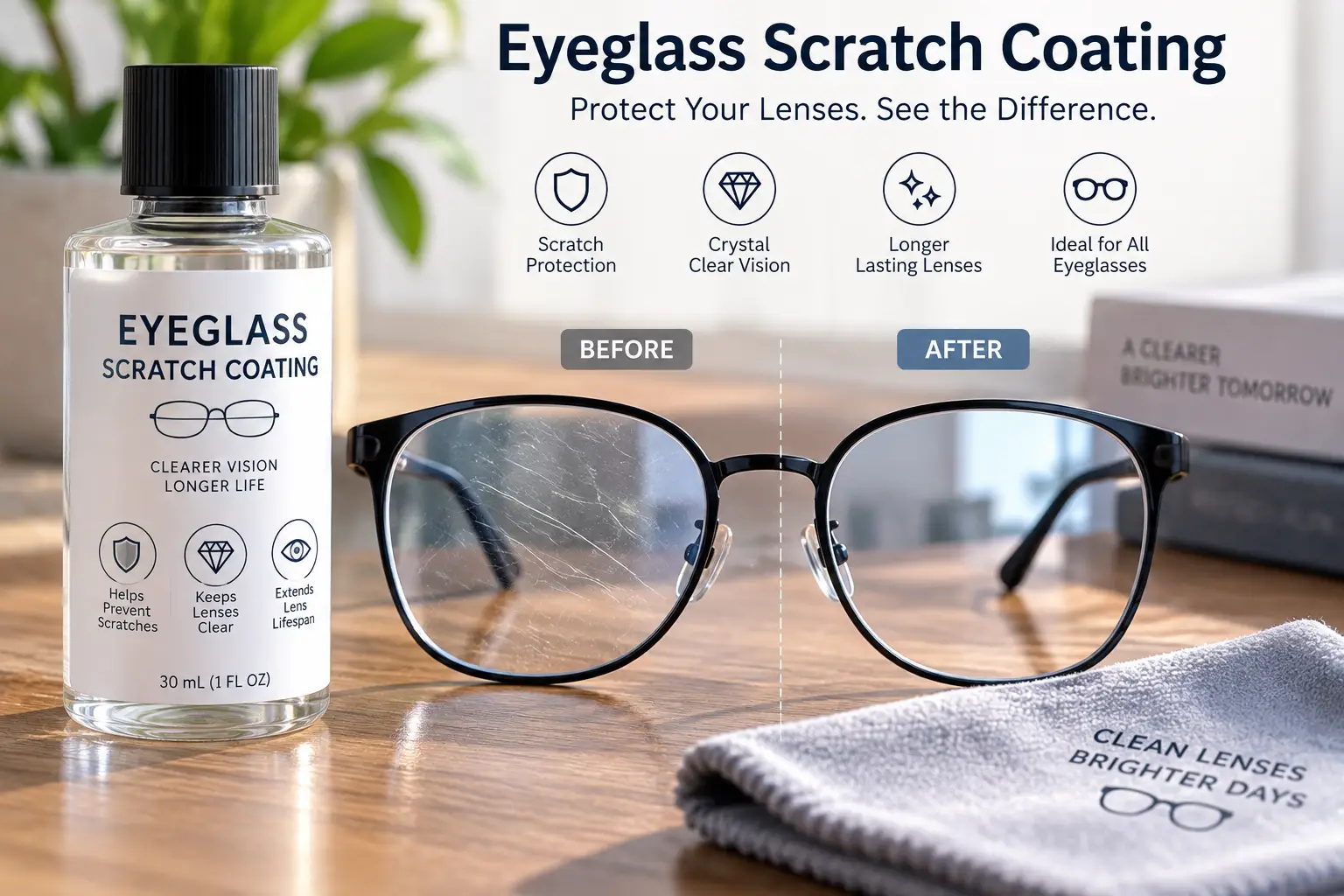
Eyeglass scratch coating is a thin protective hard layer applied to an optical lens to increase its resistance to surface scratches and everyday abrasion. The coating is particularly useful on materials such as polycarbonate and high-index plastics, which are lightweight and optically useful but can be more vulnerable to surface scratching than untreated glass.
A scratch-resistant coating is generally positioned on top of the lens material rather than replacing the lens itself. Depending on the lens system, it may be combined with other coatings to create a multilayer surface. This means the phrase “scratch coating” can refer specifically to the hard coat, while a premium coated lens may contain several different functional layers.
The distinction between scratch-resistant and scratch-proof is important. Scratch resistance describes improved durability, not immunity. Sand, grit, abrasive paper products, improper cleaning techniques, and repeated friction can still damage coated lenses. The coating works best when it is treated as a protective barrier rather than an invitation to clean the lenses with anything that happens to be nearby.
For most eyeglass wearers, the biggest benefit is long-term clarity. A lens with good surface protection is better equipped to handle the small daily challenges of being taken on and off, placed in a case, cleaned repeatedly, and exposed to ordinary dust and debris.
Quick Comparison
| Eyeglass Scratch Coating Type | Main Benefit | Best For | Durability Focus | Maintenance |
|---|---|---|---|---|
| Standard Hard Coat | Basic scratch resistance | Everyday glasses | Moderate | Easy |
| Premium Hard Coat | Improved surface durability | Frequent wearers | High | Easy |
| Anti-Reflective + Hard Coat | Clarity plus protection | Screens and night driving | High | Moderate |
| Polycarbonate Hard Coat | Protection for impact-resistant lenses | Active lifestyles | High | Easy |
| High-Index Hard Coat | Protection on thin lenses | Strong prescriptions | High | Moderate |
| Hydrophobic Multicoat | Easier cleaning plus scratch resistance | Busy daily use | High | Easy |
| Premium Multilayer Coating | Comprehensive lens protection | Long-term eyewear users | Very high | Moderate |
The table highlights an important point: the best eyeglass scratch coating is not necessarily the coating with the most features. If your main problem is lenses becoming scratched quickly, a well-applied hard coat may be more valuable than adding several treatments you do not actually need. On the other hand, people who spend hours at a computer, drive frequently at night, or wear high-index lenses may benefit from a more advanced coating system.
✨ Want lenses that stay clearer for longer? Start by choosing the right scratch-resistant coating for your lens material and daily routine.
Top 7 Eyeglass Scratch Coating Options
1. Standard Hard Coat — Simple Everyday Scratch Protection
A standard hard coat is the foundation of most discussions about eyeglass scratch coating because it addresses the most basic problem: protecting the relatively soft surface of a plastic lens from everyday abrasion. This type of treatment is particularly useful for people who wear glasses throughout the day and regularly handle their lenses, because repeated cleaning and contact with dust can gradually create tiny surface marks.
The main advantage of a standard hard coating is simplicity. Instead of relying on a complex collection of treatments, the lens receives a dedicated protective layer designed primarily to increase surface hardness. That makes it an especially sensible choice when the wearer wants better durability without paying for a premium coating package.
Standard hard coatings are also useful for children’s eyewear, spare glasses, and everyday prescription lenses where practical durability matters more than having every available optical feature. They do not eliminate the need for careful cleaning, but they can provide an additional layer of protection against minor contact and abrasion.
One limitation is that the term “hard coat” does not tell you everything about the actual performance of a lens. Different manufacturers use different formulations and application processes, so two lenses advertised as scratch resistant may not perform identically. The quality of the coating application, lens material, and overall lens design all influence real-world durability.
For a straightforward pair of everyday glasses, however, a good standard hard coat can be an excellent baseline. It provides meaningful protection without turning lens selection into an unnecessarily complicated decision.
2. Premium Hard Coat — Better Protection for Heavy Daily Use
A premium hard coat is designed for wearers who put significantly more demands on their glasses. If your eyewear is worn from morning until night, frequently removed and replaced, or regularly exposed to environments where dust and debris are present, a more advanced hard coating can make sense.
The key benefit is not that the lens becomes impossible to scratch. Instead, the coating is intended to provide a stronger protective surface that can better tolerate routine wear. This distinction matters because many people buy “scratch-resistant” glasses expecting complete protection, only to discover later that improper cleaning or abrasive particles can still damage the surface.
Premium coatings can be particularly attractive when the lenses themselves are expensive. A thin high-index prescription lens, for example, may represent a substantial investment, making additional surface protection worthwhile. The coating helps protect the optical surface that you rely on every day.
Another advantage is that premium hard coatings are often incorporated into broader lens-treatment systems. Rather than treating scratch resistance as a standalone feature, manufacturers may design the hard layer as part of a coating stack that also supports anti-reflective or water-repellent properties.
For people who have historically gone through multiple pairs of glasses because their lenses become visibly marked, upgrading the protective layer can be one of the more practical improvements available. The best results still depend on handling habits, but stronger surface protection gives those good habits more room to work.
3. Anti-Reflective Coating with Hard Coat — Clarity and Surface Protection
An anti-reflective coating combined with a hard coat is one of the most useful configurations for people who want both visual clarity and improved lens durability. The hard coating provides the scratch-resistant foundation, while the anti-reflective layers are designed to reduce reflections from the lens surface.
This combination becomes particularly valuable when glasses are used around bright screens, overhead lighting, headlights, or photography and video environments. Reflections can make lenses appear cloudy or produce distracting highlights even when the optical prescription itself is perfectly correct. Reducing those reflections can make the lenses appear cleaner and may improve the overall viewing experience.
The hard layer is important because anti-reflective coatings can be more sensitive to poor cleaning practices than a simple untreated lens. A properly designed coating system can provide a durable surface, but the wearer still needs to remove dust and grit before wiping and use suitable lens-cleaning materials.
For people who work at computers for long periods, drive at night, or regularly interact with bright artificial lighting, this combination is often more useful than focusing on scratch resistance alone. You are effectively addressing two common sources of lens frustration: surface marks and reflections.
The trade-off is that premium anti-reflective systems can cost more than basic hard-coated lenses. Nevertheless, if your goal is to keep glasses looking clean while also improving their optical appearance, this type of multilayer approach can provide more practical value than a scratch coating by itself.
4. Polycarbonate Hard Coat — Protection for Active Lifestyles
Polycarbonate lenses are widely valued for their impact resistance and lightweight construction, making them a popular choice for active wearers and certain safety-oriented applications. However, the lens material itself benefits from an appropriate hard coating because polycarbonate is not inherently immune to surface scratches.
A polycarbonate hard coat therefore combines the strengths of the underlying material with additional surface protection. The result is a lens that can be suitable for situations where impact resistance matters while still addressing the everyday problem of surface abrasion.
This configuration is especially relevant for people who play sports, spend time outdoors, work in physically active environments, or need eyewear that can tolerate more demanding handling. Parents may also consider coated polycarbonate lenses for children because children’s glasses can experience significantly more handling and accidental contact than adult eyewear.
However, users should avoid confusing impact resistance with scratch resistance. These are different properties. A lens can be highly resistant to impact while still developing scratches if it is rubbed with abrasive material. The hard coat addresses the surface; the polycarbonate material addresses the structural properties of the lens.
Proper cleaning is therefore still essential. Dust particles should be rinsed or blown away rather than rubbed directly across the lens. A clean microfiber lens cloth and an appropriate optical cleaner are much safer choices than paper towels, clothing, or household cleaning products.
For active users, this combination provides a balanced approach: a durable lens material underneath and a protective surface above.
5. High-Index Lens with Hard Coat — Protecting Thin Prescription Lenses
High-index lenses are designed to provide thinner and often lighter alternatives for people with stronger prescriptions. Because these lenses can represent a significant investment, protecting their surface is especially important.
A quality eyeglass scratch coating on a high-index lens provides a protective barrier against the everyday abrasions that can accumulate during months or years of use. This is particularly valuable because replacing an expensive pair of prescription lenses simply because of preventable surface damage can be frustrating and costly.
High-index lenses are often chosen for appearance as well as optical performance. Their thinner profile can make frames look more balanced, particularly when strong prescriptions would otherwise produce noticeably thick lens edges. Keeping those lenses in good condition therefore helps preserve both their visual function and appearance.
Many high-index lens systems can also be paired with anti-reflective treatments. This can be useful because thinner lens materials may produce noticeable surface reflections, and a multilayer coating can address that issue while the hard coat provides a protective foundation.
The best choice depends on the specific prescription, lens material, frame design, and intended use. A coating should not be viewed separately from the lens itself. Instead, think of the lens as a complete optical system in which the substrate and surface treatments work together.
If you have a strong prescription and plan to wear the same glasses for several years, investing in a reputable hard coating can be a sensible long-term decision.
6. Hydrophobic Multicoat — Easier Cleaning with Added Protection
A hydrophobic multilayer coating takes the concept of eyeglass scratch coating one step further by combining surface protection with water- and oil-repellent properties. Instead of focusing exclusively on hardness, this type of coating is designed to make the lens surface easier to maintain.
The practical advantage becomes obvious during everyday use. Fingerprints, water droplets, skin oils, and smudges are some of the most common reasons glasses appear dirty. A surface that is less receptive to these contaminants can be easier to wipe clean, meaning you may spend less time repeatedly rubbing the lenses.
This does not mean the coating makes the lenses maintenance-free. Dust and grit can still scratch a surface when rubbed aggressively, and even a premium hydrophobic coating should be cleaned with appropriate materials. The coating simply changes how easily contaminants adhere to the lens.
For commuters, office workers, travelers, and people who frequently move between indoor and outdoor environments, this can be particularly convenient. Rain droplets may be less troublesome, and fingerprints can often be removed more easily when the surface is designed to resist oils.
The biggest reason to choose this type of coating is therefore convenience rather than scratch protection alone. When combined with a durable hard layer, it can create a lens surface that is easier to maintain while also helping resist everyday abrasion.
7. Premium Multilayer Coating — Comprehensive Long-Term Protection
A premium multilayer coating represents the most comprehensive approach to lens surface treatment. Instead of asking one coating to perform every job, the lens uses multiple specialized layers, with each layer contributing a different function.
A typical premium system may incorporate a hard protective layer along with anti-reflective and surface treatments designed to improve cleaning and reduce reflections. Depending on the manufacturer and lens package, additional optical or protective treatments may also be available.
This approach is particularly attractive for people who wear glasses every day and want to maximize the usefulness of a relatively expensive prescription lens. Someone who spends most waking hours wearing glasses experiences far more opportunities for lens contamination, handling, and abrasion than someone who only wears eyewear occasionally.
The major advantage is convenience. Rather than choosing between scratch resistance and easy cleaning or between protection and reduced reflections, a multilayer system can address several concerns simultaneously.
There is, however, a point of diminishing returns. More coating layers do not automatically mean that every user will see a dramatic improvement. If your glasses are inexpensive, rarely worn, or frequently replaced, an advanced coating package may not provide enough additional value to justify its cost.
For long-term prescription eyewear, though, premium multilayer protection can be one of the most complete ways to improve the durability and everyday usability of the lens surface.
Side-by-Side Comparison
| Coating Approach | Scratch Resistance | Cleaning Convenience | Reflection Control | Best Use |
|---|---|---|---|---|
| Standard Hard Coat | Good | Good | Basic | Everyday wear |
| Premium Hard Coat | Very Good | Good | Basic | Heavy daily use |
| Hard Coat + AR | Very Good | Good | Excellent | Screens and night driving |
| Polycarbonate + Hard Coat | Very Good | Good | Optional | Active users |
| High-Index + Hard Coat | Very Good | Good | Optional/AR available | Strong prescriptions |
| Hydrophobic Multicoat | Very Good | Excellent | Very Good | Frequent cleaning |
| Premium Multilayer | Excellent | Excellent | Excellent | Long-term daily wear |
The comparison shows why there is no universal “best” eyeglass scratch coating. A person who primarily wants basic protection can stop at a good hard coat, while someone who wants easier cleaning and reduced reflections may benefit from a multilayer system.
The most important consideration is to match the coating to the lens material and your actual lifestyle rather than automatically choosing the most expensive package.
How to Protect Your Eyeglass Scratch Coating for Maximum Longevity
The best coating in the world can still be damaged by poor cleaning habits. One of the most common mistakes is wiping a dusty lens immediately with a dry cloth. Small particles of sand, grit, or other debris can become trapped between the cloth and lens and create microscopic scratches.
Instead, begin by removing loose debris. Rinsing the lenses with clean water can help reduce the amount of particulate matter being dragged across the surface. Once the loose material is gone, use a suitable lens-cleaning solution and a clean microfiber cloth specifically intended for optical lenses.
Your storage routine matters as well. Leaving glasses lens-down on a desk or counter exposes the most important surface to direct contact. A hard case is much safer when the glasses are not being worn, particularly during travel.
It is also worth remembering that coatings can be affected by heat and harsh chemicals. Avoid placing glasses on a vehicle dashboard under strong sunlight for extended periods, and do not assume that household glass cleaner is appropriate for optical lenses. Products designed for windows, mirrors, or other household surfaces may contain ingredients that are unsuitable for specialized lens coatings.
Good maintenance does not replace a quality eyeglass scratch coating, but it allows the coating to do its job more effectively.
Real-World Scenarios
Everyday Office Use
For an office worker who wears glasses from morning until evening, the main threats are repeated handling, fingerprints, dust, and frequent cleaning. A hard coat combined with an anti-reflective treatment can be particularly practical because it addresses both surface durability and reflections from monitors and overhead lighting.
Driving at Night
Drivers often notice reflections and glare more than scratches alone. A durable hard coat paired with a quality anti-reflective system can provide a better overall experience than choosing scratch resistance in isolation.
Children’s Glasses
Children can be rough on eyewear, making durable lens materials and surface protection particularly valuable. Polycarbonate lenses with a suitable hard coating can provide a practical combination of impact resistance and surface durability.
Outdoor Activities
Hikers, cyclists, runners, and other active users may encounter dust, moisture, sweat, and frequent lens handling. A durable coating combined with easy-clean surface properties can make maintenance simpler.
Strong Prescriptions
For people who invest in high-index lenses, protecting the lens surface becomes more important because replacing damaged prescription lenses can be expensive. A reputable hard coating or multilayer system can therefore make sense as part of a longer-term eyewear strategy.
Eyeglass Scratch Coating vs. Traditional Lens Protection
A scratch-resistant coating and careful physical handling solve different parts of the same problem. The coating creates a more durable surface, while proper storage and cleaning reduce the amount of abrasion that surface experiences.
An untreated plastic lens may be more vulnerable to everyday scratches, but simply adding a coating does not eliminate the need for careful maintenance. Conversely, even excellent handling cannot make an untreated surface immune to damage.
This is why the most effective approach combines both. Choose a lens with appropriate surface protection, then reinforce that protection through good habits.
A lens case, clean microfiber cloth, suitable cleaning solution, and careful handling can extend the practical benefit of an eyeglass scratch coating considerably. Think of the coating as the first line of defense rather than the entire defense system.
How to Choose the Right Eyeglass Scratch Coating
1. Start With Your Lens Material
Different lens materials have different surface characteristics. Ask your optician which coating is recommended for the specific lens material you are choosing rather than treating every coating as interchangeable.
2. Consider How Long You Keep Your Glasses
If you typically keep prescription glasses for several years, paying more for durable surface protection may make more sense than it would for someone who replaces eyewear frequently.
3. Think About Your Cleaning Habits
If you clean your glasses many times each day, consider a coating system designed to tolerate regular maintenance and make fingerprints or water spots easier to remove.
4. Evaluate Reflections Separately
Scratch resistance and anti-reflective performance are different properties. If reflections bother you, look for a coating package that combines a hard coat with anti-reflective treatment.
5. Match the Coating to Your Lifestyle
Children, athletes, commuters, office workers, drivers, and outdoor workers can all have different coating priorities. The best choice is the one that addresses the conditions your glasses actually experience.
6. Ask About Warranty and Coating Support
Before purchasing premium lenses, ask what warranty or remake policy applies to the coating. The details vary by manufacturer and optical provider, so understanding the coverage beforehand can prevent unpleasant surprises.
7. Prioritize Application Quality
A sophisticated coating is only useful if it is properly applied to the lens. A reputable optical provider and established lens manufacturer can be more important than simply choosing the longest feature list.
Common Mistakes
One of the biggest mistakes is assuming that “scratch resistant” means “scratch proof.” This expectation can lead people to handle coated lenses carelessly, only to become disappointed when marks eventually appear.
Another common error is cleaning lenses with clothing. A shirt may look soft, but it can contain dust particles that act as abrasives. Paper towels and tissues can also leave fibers behind and may not be appropriate for repeated lens cleaning.
People also sometimes forget to clean the microfiber cloth itself. A cloth that has collected dust, skin oil, or grit can become part of the problem. Keeping several clean lens cloths available is a simple way to reduce this risk.
Another mistake is choosing a coating based entirely on marketing terminology. “Premium,” “advanced,” and “ultra” do not necessarily tell you how a particular treatment will perform in your circumstances. Ask what the coating actually does and which lens material it is designed for.
Finally, do not ignore heat. Excessive temperatures can affect some lens coatings and materials. Storing glasses in a hot car for long periods is therefore not a good habit even if the lenses have a high-quality scratch coating.
What to Expect From an Eyeglass Scratch Coating
A good eyeglass scratch coating should primarily be viewed as a durability upgrade. You should expect better resistance to everyday surface abrasion, but not complete protection from scratches under all circumstances.
Over time, the coating may still show signs of wear if the glasses are exposed to aggressive cleaning, grit, impact, heat, or poor storage. The exact lifespan depends heavily on the coating system, lens material, usage patterns, and maintenance.
You should also expect differences between coating packages. A simple hard coat may improve durability without dramatically changing how the lens looks, while a premium multilayer system may provide additional benefits such as reduced reflections and easier cleaning.
If a coating begins to show widespread damage, peeling, crazing, or cloudiness, cleaning the glasses more aggressively is usually not the answer. At that point, an optician should inspect the lenses and determine whether the problem is contamination, surface damage, or coating failure.
The goal is not to make a lens indestructible. The goal is to extend the period during which the lens remains clear, comfortable, and useful.
Eyeglass Scratch Coating for Every Type of Wearer
There is a strong case for basic hard coating on ordinary everyday glasses because it addresses one of the most common sources of lens deterioration. For more demanding users, however, a more complete coating system may be worthwhile.
A student who carries glasses in a backpack may benefit from durable scratch protection and a reliable case. An office worker may prioritize anti-reflective performance in addition to surface protection. Someone with an expensive high-index prescription may want maximum long-term durability. An outdoor enthusiast may prefer a combination of durable lens material and easy-clean surface treatment.
This is why coating selection should begin with your routine rather than a product label. Consider where your glasses go, how often you clean them, what kind of lens material you use, and how long you expect the pair to last.
Once those factors are clear, the coating decision becomes much easier.
Long-Term Cost and Maintenance
The cheapest lens is not necessarily the least expensive option over time. If a lower-cost lens becomes badly scratched within a short period and needs to be replaced, the initial savings can disappear quickly.
This is particularly relevant for prescription lenses. The total replacement cost can include the lens material, prescription processing, frame, fitting, and optical service. Protecting the surface of a lens that you plan to use for several years can therefore be a reasonable investment.
Maintenance also has a financial component. A clean microfiber cloth, appropriate lens cleaner, and protective case are inexpensive compared with replacing a pair of prescription lenses because of preventable damage.
However, spending more on coating does not automatically guarantee better value. If you replace your glasses frequently or use them only occasionally, an expensive multilayer package may not provide enough additional benefit to justify the premium.
The ideal approach is to balance initial coating cost against expected wear period, lens price, prescription strength, and daily use. A durable coating makes the most financial sense when the underlying lenses are valuable and you intend to keep them for a long time.
Safety, Materials, and Standards to Know
When choosing coated prescription eyewear, it is important to distinguish optical performance from safety claims. A scratch-resistant coating primarily concerns surface durability; it does not automatically mean that a lens is suitable for occupational eye protection, impact protection, or specialized safety applications.
For workplace environments, consumers should look for eyewear that meets the appropriate safety requirements for the intended hazard rather than assuming ordinary prescription glasses are sufficient. In the United States, workplace eye and face protection requirements are addressed by OSHA, while relevant protective eyewear standards are developed through organizations such as ANSI.
The lens material also matters. Polycarbonate, high-index plastic, and other materials can have different optical and physical characteristics. The coating should be compatible with the lens substrate and applied according to the manufacturer’s specifications.
Consumers should also be cautious about claims such as “unbreakable” or “100% scratch proof.” Such absolute language can create unrealistic expectations. Even highly durable optical surfaces can be damaged by abrasive particles or improper cleaning.
For general information about workplace eye and face protection requirements, consult the OSHA eye and face protection guidance.
When purchasing prescription lenses, the safest approach is to discuss the intended use with a qualified optical professional and select a lens/coating combination designed for that environment.
FAQs
❓ What does eyeglass scratch coating do?
❓ Is scratch-resistant coating worth it on glasses?
❓ Can eyeglass scratch coating be repaired?
❓ Does anti-reflective coating protect against scratches?
❓ How can I prevent scratches on coated eyeglasses?
Conclusion
Choosing the right eyeglass scratch coating is ultimately about protecting the investment you have already made in your lenses. A quality hard coat can improve resistance to everyday abrasion, while more advanced coating systems can combine scratch protection with reduced reflections and easier cleaning.
The right choice depends on your lens material, prescription, lifestyle, cleaning habits, and expected period of use. Basic hard coating can be perfectly adequate for straightforward everyday glasses, while heavy users may benefit from premium hard coats or multilayer systems. People who spend long hours around screens or drive at night may also find anti-reflective treatment valuable, while active users may want to combine durable lens materials with suitable surface protection.
Most importantly, remember that no coating replaces proper care. Even the most advanced lens surface can be damaged by grit, abrasive cleaning, excessive heat, or careless storage. Treat the coating as an extra layer of protection and support it with good maintenance habits.
If you are ordering new prescription lenses, ask specifically what type of eyeglass scratch coating is included, what additional treatments are available, and what warranty applies to the coating. That small conversation can help you choose a lens system that remains clear and useful for much longer.
✨ Ready for clearer, more durable glasses? Choose a scratch-resistant coating that matches your prescription, lifestyle, and long-term eyewear needs.
Recommended for You
- Best Eye Protection for Red Light Therapy: 7 Safe Picks (2026)
- Reading Glasses 4: 7 Best +4.00 Readers to Try in 2026
- 7 Best Glasses to Help With Night Driving for Clearer Vision
Disclaimer: This post contains affiliate links. As an Amazon Associate, I earn from qualifying purchases made through these links, at no additional cost to you.
✨ Found this article helpful? Share it with someone who wants to keep their eyeglasses clearer and scratch-free for longer! 💬🤓