In This Article
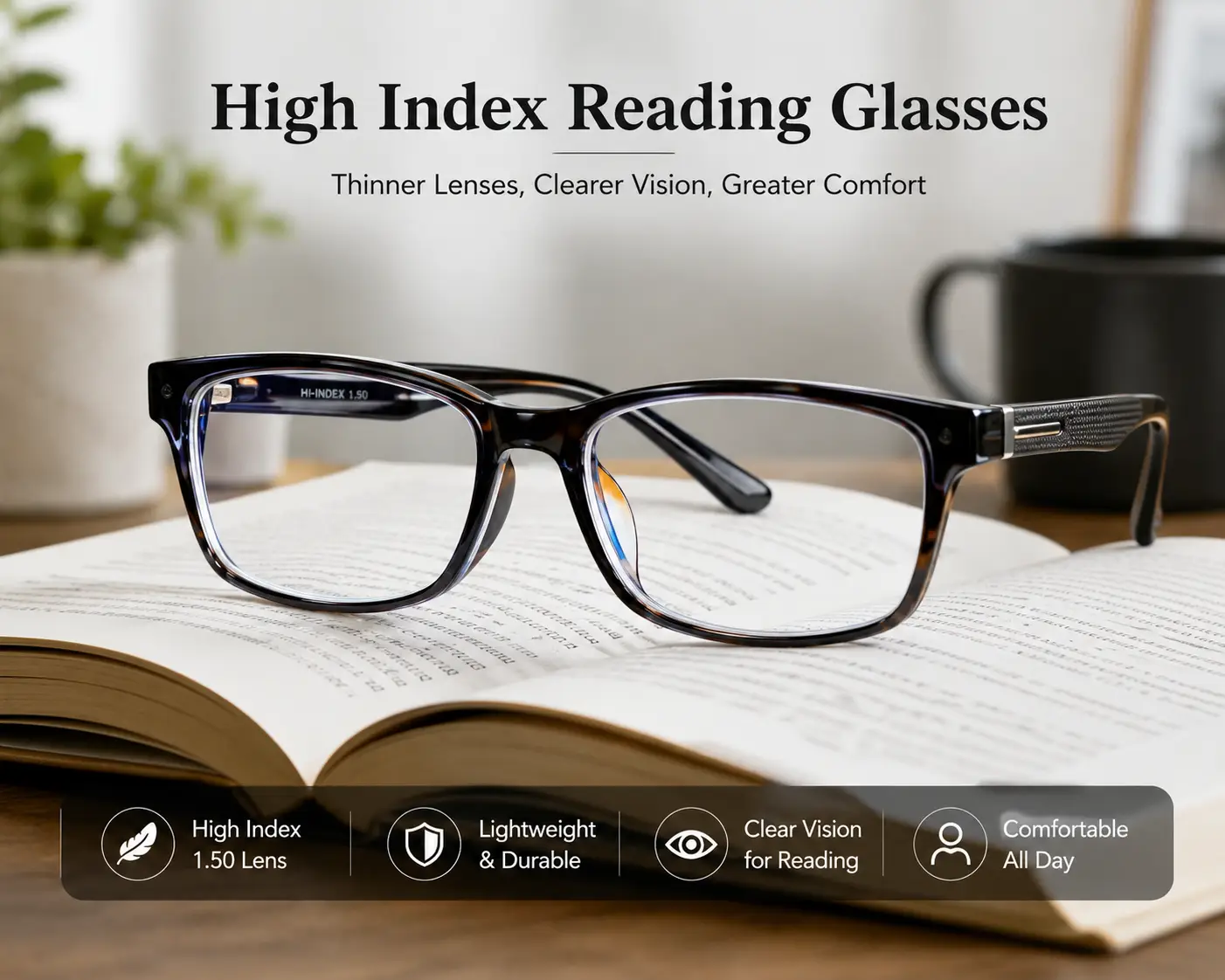
If you’ve ever slid on a pair of readers and immediately felt like you were peering out from behind two hockey pucks, you already know why high index reading glasses exist. Standard plastic lenses get noticeably thicker as your prescription strength climbs, and that extra glass (or resin) doesn’t just look bulky — it adds weight, distorts your eyes behind the lens, and can even limit which frames you’re able to wear. High index reading glasses solve this by using a lens material that bends light more efficiently, so the same magnification power comes in a slimmer, lighter package.
This guide isn’t a rehash of a product listing. It’s a side-by-side, spec-driven comparison of seven real, currently available reading glasses that use thinner, high-index or inherently high-index-equivalent lens materials, built for US shoppers who want something that actually fixes the “thick lens” problem instead of just promising to. We’ll walk through what the lens index numbers actually mean in daily wear, which pair fits which lifestyle, and where the marketing claims (yes, we’re looking at you, blue light blocking) hold up to scrutiny and where they don’t.
As an Amazon Associate, this post may contain affiliate links, and purchases made through them can earn a small commission at no extra cost to you — full disclosure is at the bottom of this article. Let’s get into the comparison.
What Is High-Index Lens Technology?
High-index lenses are eyewear lenses made from a material with a refractive index higher than standard CR-39 plastic (1.50), which lets them bend light more efficiently and stay thinner and lighter at the same prescription strength. The higher the index number, the thinner the lens can be for an equivalent correction — which is exactly why two pairs of readers at the same strength can look and feel completely different on your face.
Reading glasses don’t usually list a lens index the way prescription eyewear does, but the physics is identical: polycarbonate lenses (the material most non-prescription readers on this list use) sit around a 1.59 refractive index, noticeably higher than the 1.50 CR-39 plastic found in old-school drugstore readers. High-index lens materials reduce both the thickness and the curvature of the lens, which is why premium readers feel flatter against your face and don’t magnify your eyes as dramatically to someone looking at you.
Quick Comparison: 7 Best High-Index Reading Glasses at a Glance
| Product | Lens Material | Strengths Available | Price Range | Best For |
|---|---|---|---|---|
| ThinOptics Rectangular Reading Glasses | Optical-grade polycarbonate | 1.00–3.50 | Around $20–$35 | Ultra-portability |
| Eyekepper Polycarbonate High-Index Readers | High-index polycarbonate | 0.50–6.00 | Around $15–$25 | Strong prescriptions |
| Gaoye Professional 5-Pack Readers | Polycarbonate/TR90 blend | 1.00–3.50 | Around $15–$20 | Budget multi-pack |
| JOLISU Blue Light Blocking Readers | Polycarbonate, metal frame | 1.00–4.00 | Around $15–$25 | Computer work |
| Foster Grant Reading Glasses | Scratch-resistant plastic/polycarbonate | 1.00–3.50 | Around $10–$20 | Everyday drugstore value |
| Peepers by PeeperSpecs | Polycarbonate with anti-glare coat | 1.00–3.00 | Around $25–$40 | Style-forward everyday wear |
| kate spade new york Readers | Acetate frame, polycarbonate lens | 1.00–2.50 | Around $45–$65 | Designer aesthetics |
Looking at this table, the pattern is clear: nearly every genuinely thin, lightweight pair on the market today relies on polycarbonate rather than old-fashioned CR-39 plastic, because polycarbonate’s higher refractive index does double duty — it’s both thinner and shatter-resistant. The price spread mostly tracks frame materials and brand positioning rather than lens performance, since Eyekepper‘s budget-friendly polycarbonate readers and kate spade new york‘s designer acetate pair use functionally similar lens chemistry. If your prescription is on the stronger end (+2.50 and up), prioritize the rows offering strengths up to 4.00 or 6.00, since that’s where lens-thickness differences become most visible.
💬 Ready to stop squinting through thick lenses? Compare the full lineup below and find your strength. 😊
Top 7 High-Index Reading Glasses for Thick Prescriptions
1. ThinOptics Rectangular Reading Glasses — thinnest, most pocketable pair
The defining feature of the ThinOptics Rectangular Reading Glasses is right there in the brand name — these are built to be as slim as two stacked credit cards, and they deliver on that promise better than almost anything else in this category. The lenses are optical-grade, thermo-injection molded polycarbonate, paired with stainless steel arms that fold completely flat. In practice, that means the arms don’t add bulk the way thicker plastic temple pieces do, and the whole pair slides into the included ultra-slim case that clips to the back of a phone or a laptop lid. For anyone who’s ever left readers at home because a case felt like one more thing to carry, this solves that specific problem. Reviews for this line consistently mention the case itself as much as the glasses — people report keeping a pair in their car, purse, and desk drawer because the form factor makes multiples painless to stash. The main trade-off is fit: because the frame is minimalist by design, it sits closer to the face and offers a smaller lens area than a standard full-rim reader, which isn’t ideal if you want the “bug-eye correction” effect that a larger lens can help minimize at higher strengths.
Pros:
- ✅ Genuinely pocket- and phone-mountable slim case
- ✅ Stainless steel arms fold completely flat
- ✅ Backed by a lifetime guarantee against defects
Cons:
- ❌ Smaller lens area than standard full-rim readers
- ❌ Limited style variety compared to fashion-forward brands
Expect to pay somewhere in the $20–$35 range at the time of writing, and given how few readers actually solve the “I never have them when I need them” problem, this is solid value for anyone who reads on the go.
2. Eyekepper Polycarbonate High-Index Readers — best for strong prescriptions
The Eyekepper Polycarbonate High-Index Readers lean into what polycarbonate does best: at a refractive index around 1.59, it lets Eyekepper offer strengths up to +6.00 without the lens ballooning into a hockey-puck shape the way CR-39 would at that power. The line includes bifocal and photochromic (light-adaptive) versions, plus spring-hinge temples that flex outward instead of snapping under repeated on-off wear. What most buyers overlook here is that photochromic readers gradually tint outdoors and clear back up indoors over about ten minutes — useful if you split time between porch reading and desk work, but not an instant transition like true transition prescription lenses. Based on comparing this line against thinner-lens competitors, Eyekepper’s biggest strength is prescription range: shoppers with a +4.00 or stronger correction, who are often stuck with genuinely heavy glass, have real options here. Customer reviews commonly mention the lifetime breakage warranty as a deciding factor, since it removes the sting of a $20 impulse buy snapping in a bag.
Pros:
- ✅ Strengths go up to +6.00, rare for OTC readers
- ✅ Spring hinges reduce breakage from daily on/off use
- ✅ Lifetime breakage warranty on frame and lenses
Cons:
- ❌ Frame styling skews classic/basic rather than trendy
- ❌ Photochromic tint change is gradual, not instant
Price typically falls between $15 and $25 depending on pack size and finish — a strong value-for-money verdict for anyone at the higher end of the prescription spectrum.
3. Gaoye Professional 5-Pack Readers — best budget multi-pack
If you’re the type to lose a pair of glasses every few weeks, the Gaoye Professional 5-Pack Readers are built around exactly that reality: five pairs, assorted colors, at a per-pair cost that makes losing one a shrug instead of a setback. The lenses use a polycarbonate/TR90 blend, which keeps them meaningfully thinner than the CR-39 plastic still found in some dollar-store readers, while the blue light filter coating targets the blue-violet wavelength range from screens. Here’s what to weigh, though: the “blue light blocking” claim is common across this entire category, and it’s worth knowing upfront that the science behind it is far shakier than the marketing suggests (more on that in the features section below). What genuinely holds up is the value proposition — reviewers consistently note that having multiples scattered around the house or office solves the “where are my glasses” problem better than any single premium pair could. TR90 frame material also flexes rather than cracking, which matters if these end up getting sat on.
Pros:
- ✅ Five pairs at a genuinely low per-unit cost
- ✅ TR90 frame material resists cracking under pressure
- ✅ Assorted colors make each pair easy to tell apart
Cons:
- ❌ Blue light claims aren’t backed by strong clinical evidence
- ❌ Lens coating quality varies more than single-pair premium brands
At around $15–$20 for the full set, this is one of the strongest dollar-per-pair values in this comparison, provided you go in with realistic expectations about the blue light feature.
4. JOLISU Blue Light Blocking Readers — best thin metal frame for computer work
The JOLISU Blue Light Blocking Readers pair a genuinely thin metal frame with polycarbonate lenses, which is a meaningfully different look and feel than the plastic-frame readers that dominate the budget end of this list. Metal temples flex less than plastic but also weigh less than you’d expect thanks to thin-gauge construction, and the lens profile stays low even at moderate strengths. In practice, this is a pair that reads more like a “real glasses” aesthetic than a drugstore reader — useful if you wear yours all day at a desk rather than only pulling them out for a menu. The blue light coating is marketed the same way as most competitors in this space, so treat that claim with the same skepticism outlined above; the more defensible benefit here is the anti-glare property, which does measurably cut screen reflection regardless of what it does for blue wavelengths specifically. Reviews for thin-metal-frame readers in this category frequently mention that the nose pads (rather than a molded plastic bridge) make a noticeable comfort difference during 8-hour workdays.
Pros:
- ✅ Genuinely thin metal frame, lighter than it looks
- ✅ Adjustable nose pads improve all-day comfort
- ✅ Anti-glare coating measurably cuts screen reflection
Cons:
- ❌ Metal hinges can loosen faster than spring-hinge plastic
- ❌ Blue light benefit claims are largely unproven
Expect a price in the $15–$25 range, which is competitive for a metal-frame reader and a reasonable pick for a primary desk pair.
5. Foster Grant Reading Glasses — best everyday drugstore value
Foster Grant Reading Glasses come from a brand that’s been making American eyewear since the early 20th century, and that legacy shows up in the sheer availability of strengths and colors rather than in any single standout feature. The lenses use scratch-resistant coated plastic or polycarbonate depending on the specific style, and while these aren’t the thinnest option on this list, they hit a sweet spot between the ultra-minimalist ThinOptics and the heavier CR-39 readers still sold at gas stations. What most buyers overlook with a legacy drugstore brand like this is consistency: because Foster Grant sells at genuinely massive volume, quality control tends to be more predictable pair-to-pair than with smaller direct-to-consumer brands. Reviews consistently report that these hold up well to the specific abuse of being tossed in a bag or glovebox — nothing fancy, just durable, familiar hardware. If your priority is simply replacing a pair of thick, heavy old readers with something noticeably lighter, without spending much, this is a sensible entry point before stepping up to a dedicated high-index line.
Pros:
- ✅ Extremely wide range of strengths and colors
- ✅ Reliable, brand you’ll find in nearly any pharmacy
- ✅ Durable for the price point
Cons:
- ❌ Not the thinnest lens option at higher strengths
- ❌ Styling leans more functional than fashionable
Price ranges from around $10 to $20 depending on style, making this one of the most accessible entry points in the entire lineup.
6. Peepers by PeeperSpecs — best style-forward everyday pick
Peepers by PeeperSpecs occupies the middle ground between budget drugstore readers and full designer pricing, and the brand leans hard into fashion-forward frame shapes — think oversized cat-eye or bold tortoiseshell — that most of the purely functional options on this list don’t offer. The lenses use polycarbonate with an anti-glare, scratch-resistant coating, and the company markets sustainability features on some frame lines, which is a differentiator if that matters to your buying decision. Based on comparing feature sets across this list, Peepers’ real advantage isn’t lens thinness (several competitors here match or beat it) — it’s that the frames are genuinely designed to be worn as a fashion accessory rather than a medical necessity you’re trying to hide. What the spec sheet doesn’t say, but customer reviews reveal, is that the spring hinges on this line tend to hold their tension longer than ultra-cheap alternatives, likely because the frame material itself is a step up from entry-level plastic.
Pros:
- ✅ Genuinely fashion-forward frame shapes and colors
- ✅ Anti-glare, scratch-resistant lens coating included
- ✅ Spring hinges hold tension well over time
Cons:
- ❌ Priced above basic drugstore alternatives
- ❌ Bold frame styles won’t suit every face shape
Typical pricing lands around $25–$40, positioning this as a solid mid-tier pick for anyone who wants their readers to double as a style statement.
7. kate spade new york Readers — best designer aesthetic
At the top of this lineup, kate spade new york Readers trade some of the ultra-thin engineering focus of the other picks for acetate frame construction and unmistakably designer styling — the kind of pair you’d wear even if you didn’t strictly need the magnification. The lenses are still polycarbonate, so you’re not sacrificing meaningful thinness compared to the rest of the list, but the acetate frame itself adds a bit more visual weight than the metal or TR90 options above. Here’s what to weigh: you’re largely paying for brand and design language rather than a lens-technology upgrade, which is a completely reasonable trade-off if styling is your top priority, but not the right pick if lens thinness alone is your main pain point. Reviews for designer reading glasses in this price bracket tend to focus heavily on compliments received while wearing them — a real, if intangible, benefit that’s hard to quantify but shows up again and again in aggregated customer feedback for fashion-first eyewear.
Pros:
- ✅ Distinctive, recognizable designer frame styling
- ✅ Acetate construction feels more premium in hand
- ✅ Comes packaged with a branded case
Cons:
- ❌ Highest price point in this comparison
- ❌ Fewer strength options than budget-focused competitors
Pricing generally runs in the $45–$65 range, which puts it well above the rest of the list — a value-for-money verdict that only makes sense if the design itself is part of what you’re buying.
Full Comparison Table: Lens Index, Weight, and Price Range
| Product | Frame Weight Feel | Lens Coating | Ideal Prescription Range | Price Range |
|---|---|---|---|---|
| ThinOptics Rectangular Reading Glasses | Very light | Scratch-resistant | +1.00 to +3.50 | Around $20–$35 |
| Eyekepper Polycarbonate High-Index Readers | Light | UV400, scratch-resistant | +0.50 to +6.00 | Around $15–$25 |
| Gaoye Professional 5-Pack Readers | Light | Blue light filter | +1.00 to +3.50 | Around $15–$20 |
| JOLISU Blue Light Blocking Readers | Light-medium | Anti-glare, blue light filter | +1.00 to +4.00 | Around $15–$25 |
| Foster Grant Reading Glasses | Medium | Scratch-resistant | +1.00 to +3.50 | Around $10–$20 |
| Peepers by PeeperSpecs | Light-medium | Anti-glare, scratch-resistant | +1.00 to +3.00 | Around $25–$40 |
| kate spade new york Readers | Medium | Scratch-resistant | +1.00 to +2.50 | Around $45–$65 |
The clearest takeaway from this table is that prescription range and price don’t move together in a straight line — Eyekepper covers the widest strength range at one of the lowest price points, while the priciest option, kate spade new york Readers, actually offers the narrowest strength selection. If you’re shopping primarily by prescription strength rather than style, that makes budget and mid-range picks like Eyekepper or JOLISU the more logical starting point, reserving the designer options for once you know your strength and just want a nicer everyday pair.
Getting the Right Strength and Fit: A First-Time Buyer’s Guide
Buying your first pair of over-the-counter high-index readers is straightforward, but a few first-30-days mistakes are extremely common. Start by getting an actual eye exam or using a printed reading chart at the recommended 14-inch distance rather than guessing your strength from an old pair — over-the-counter readers assume both eyes need identical correction, which isn’t always true, and a mismatch will cause headaches within the first week.
Once you know your approximate strength, prioritize trying on frame width before worrying about lens thinness; a frame that’s too narrow will pinch at the temples regardless of how light the lenses are. For maintenance, rinse lenses under lukewarm water before wiping to avoid grinding dust into the coating, and store every pair in a hard case rather than a bag pocket — scratch-resistant coatings resist minor scuffs, not direct contact with keys or coins. Finally, expect an adjustment period of two to five days if you’re stepping up in strength from an old pair; mild visual “swimming” during that window is normal and typically resolves as your eyes adapt to the new correction.
Real-World Scenarios: Which Pair Fits Your Life
Consider a remote worker in their late 40s who spends six-plus hours a day between a laptop and a phone: the anti-glare coating and thin metal frame of the JOLISU Blue Light Blocking Readers suit that all-day desk use better than a fashion-forward frame that wasn’t designed for extended wear. For a retiree on a fixed budget who mainly reads paperbacks and prescription labels, the wide strength range and lifetime warranty on the Eyekepper Polycarbonate High-Index Readers offer the best long-term value, especially if their prescription may need to climb over the next few years.
A frequent traveler who reads on planes, in hotel lobbies, and at restaurant tables is the textbook use case for the ThinOptics Rectangular Reading Glasses — the phone-mountable case solves the “I left them at home” problem better than any other option here. And for someone who wants their readers to look intentional rather than medical — say, someone attending client meetings or social events regularly — either Peepers by PeeperSpecs or kate spade new york Readers deliver a look that doesn’t scream “reading glasses” the way a basic drugstore frame does.
✨ Not sure which strength or style fits your routine? Check the current pricing and pick the pair built for how you actually use your glasses! 🔍
Common Problems With Thick Lenses — and How to Fix Them
Problem: Lenses make your eyes look magnified or shrunken to others. This “bug-eye” effect gets more pronounced with thicker CR-39 lenses at higher strengths. Switching to a polycarbonate high-index option like the Eyekepper Polycarbonate High-Index Readers meaningfully reduces this distortion at equivalent strength.
Problem: Readers feel heavy after a few hours. Weight usually comes from both lens thickness and frame material. Pairing thinner lenses with a lightweight frame — the ThinOptics Rectangular Reading Glasses or JOLISU Blue Light Blocking Readers — addresses both sources at once rather than just one.
Problem: Glasses constantly get left behind. This is a storage and habit problem more than a glasses problem. A slim, portable case like the one bundled with ThinOptics solves this more reliably than simply buying a “better” pair.
Problem: Screen time causes eye fatigue, and you’ve been told blue light glasses will fix it. According to the American Academy of Ophthalmology, there’s no strong scientific evidence that blue light from screens damages the eyes, and the organization does not recommend special eyewear for computer use. The real fix tends to be the 20-20-20 rule (every 20 minutes, look at something 20 feet away for 20 seconds) combined with proper screen distance, not a coating.
Problem: Frames loosen or lenses pop out within months. Spring hinges, like those on the Eyekepper Polycarbonate High-Index Readers and Peepers by PeeperSpecs, distribute stress more evenly than rigid hinges and are worth prioritizing if you tend to be rough on glasses.
How to Choose High-Index Reading Glasses: 6 Criteria That Matter
- Prescription strength range. Confirm the brand actually offers your needed diopter strength — some lines top out at +3.00, which won’t help if you need +4.00 or higher.
- Lens material. Polycarbonate (roughly 1.59 index) beats standard CR-39 plastic (1.50) for thinness and impact resistance at nearly every price point on this list.
- Frame weight and material. Metal and TR90 frames generally distribute weight more evenly across the nose than thick molded plastic.
- Hinge type. Spring hinges outlast rigid hinges under the repeated on/off motion of daily wear.
- Coating claims vs. reality. Scratch-resistant and anti-glare coatings are measurable and worthwhile; blue light claims should be treated as a nice-to-have, not a health feature.
- Case and portability. If you tend to lose or forget glasses, prioritize a compact case over marginal lens-thinness gains.
High-Index vs. Standard Plastic Lenses: What the Difference Really Means
Standard CR-39 plastic lenses have been the reading-glasses default for decades because the material is cheap and easy to mold, but that 1.50 refractive index means the lens has to physically curve more to achieve the same magnification a higher-index material could deliver with less material. In practice, at +1.00 or +1.50, the difference between CR-39 and polycarbonate is barely noticeable — both are thin enough that most wearers won’t register a difference. The gap widens dramatically past +2.50, where CR-39 lenses start visibly bulging at the center and edges, adding weight that pulls on the bridge of your nose over hours of wear.
The trade-off worth knowing: polycarbonate is inherently more impact-resistant, which is part of why it dominates this category, but it’s also somewhat softer and more prone to surface scratching without a quality coating — which is exactly why coating quality, not just lens material, should factor into your buying decision. Between Eyekepper‘s wide strength range and Foster Grant‘s classic plastic-leaning options, the practical decision point is simple: if your strength is below +2.00, either material works fine, but above that, high-index polycarbonate is the more comfortable long-term choice.
Common Mistakes to Avoid When Buying Thin Lens Readers
The single most common mistake is buying strength based on a friend’s or family member’s prescription rather than testing your own — reading distance and eye strength vary enough that a shared pair often causes headaches. A second frequent error is assuming “high index” or “blue light blocking” automatically means better quality; neither label guarantees a good frame fit or hinge durability, which matter just as much day-to-day. Shoppers also commonly overlook pupillary distance (the space between your eyes) — readers are built for an average distance, so if your eyes sit noticeably wider or narrower than average, even a thin, correctly-powered lens can feel slightly off-center. Finally, many buyers skip checking return policies on multi-packs; if strength turns out to be wrong, a single-pair return is usually simple, but bundled packs sometimes have stricter terms.
What to Expect: Everyday Performance With High-Index Lenses
In daily use, the difference a high-index lens makes shows up less in how well you see through it — both CR-39 and polycarbonate correct vision equally well at the same power — and more in how the glasses feel and look on your face after hours of wear. Thinner lenses sit flatter, which reduces the amount of light-bending distortion visible to other people looking at your eyes, and lighter overall weight means less pressure on the bridge of your nose and behind your ears by the end of a workday. Where you’ll notice the biggest real-world difference is at higher strengths: someone wearing a +1.00 pair may not register much difference between lens materials, but a +4.00 wearer switching from CR-39 to a high-index polycarbonate pair like Eyekepper’s often reports it feels like a completely different category of product, not just a lighter version of the same one.
High-Index Readers for Different Users: Office, Outdoors, and On-the-Go
Office workers spending long hours at a screen benefit most from anti-glare coatings and lightweight metal frames — the JOLISU Blue Light Blocking Readers are built with that use case in mind, even if the blue-light-specific benefit is overstated in marketing. Outdoor readers, gardeners, and anyone reading in bright conditions should look toward photochromic options like those in the Eyekepper lineup, which tint slightly in sunlight without requiring a second pair of sunglasses. Commuters and frequent travelers get the most practical value from portability-focused designs — the ThinOptics case genuinely changes whether glasses make it out the door with you. And anyone whose readers double as a visible style accessory, whether for work meetings or social settings, should prioritize the frame design of Peepers or kate spade new york over marginal differences in lens thickness that most people won’t notice at a glance.
Long-Term Cost and Lens Care
Over-the-counter high-index readers are inexpensive enough individually that the bigger long-term cost driver is replacement frequency, not the per-pair price. A $15 pair that lasts eighteen months because of a durable spring hinge and quality coating is a better value than a $10 pair replaced every four months due to loose hinges or scratched lenses. Multi-packs, like the Gaoye Professional 5-Pack Readers, change this math by spreading risk across several pairs rather than betting everything on one — if one pair gets scratched or sat on, you’re not starting from zero.
Coating longevity matters more than most buyers expect: scratch-resistant coatings degrade with harsh cleaning methods, so avoiding paper towels, clothing, and household glass cleaners meaningfully extends lens life regardless of which product you choose. Over a three-year window, buyers who invest in a hard case and proper cleaning cloth tend to spend noticeably less on replacements than those who store readers loose in a bag.
Features That Actually Matter (and Ones That Don’t)
Genuinely worthwhile features on this list include spring hinges, polycarbonate lens material, UV400 protection, and anti-glare coating — all of these have a clear, measurable effect on comfort, durability, or glare reduction. Blue light blocking, on the other hand, is the feature most heavily marketed and least supported by evidence: a 2023 Cochrane systematic review and the American Academy of Ophthalmology’s official position both concluded that blue-light-filtering lenses show little to no measurable benefit for digital eye strain compared to standard clear lenses. That doesn’t make blue light readers a bad purchase — several pairs on this list, like the Gaoye Professional 5-Pack Readers and JOLISU Blue Light Blocking Readers, are still good products because of their fit, hinge quality, and price — it just means you shouldn’t pay a meaningful premium specifically for the blue light claim itself.
Safety, Regulations, and Standards for Eyewear Sold in the US
Non-prescription reading glasses sold in the United States fall under FDA oversight as Class I medical devices, which means they’re subject to general controls but are exempt from premarket notification requirements — a lighter regulatory bar than prescription eyewear, but not an unregulated one. Under FDA labeling and impact-resistance guidance for spectacle lenses and magnifying spectacles, manufacturers are expected to follow general device labeling rules and, where applicable, impact-resistance testing similar to what’s required of eyeglass and sunglass lenses more broadly. In practical terms, this means legitimate reading glasses brands should list accurate diopter strengths, avoid making unverified medical claims (like guaranteed eye-health protection from blue light), and use lens materials that hold up to reasonable impact — polycarbonate’s inherent shatter resistance is a meaningful safety plus here, not just a thinness benefit. If a listing makes bold medical claims without any supporting citation, that’s a reasonable signal to shop elsewhere.
FAQs
❓ What does 'high index' mean on reading glasses?
❓ Are high index reading glasses worth the extra cost?
❓ Do blue light blocking reading glasses actually reduce eye strain?
❓ What strength of reading glasses should I buy first?
❓ How long do high index reading glasses typically last?
Conclusion
Thick, heavy reading glasses aren’t a fact of life you have to accept once your prescription climbs past +2.00 — they’re a lens-material problem with a well-established solution. Across this comparison, the Eyekepper Polycarbonate High-Index Readers stand out for anyone with a stronger prescription who wants the widest strength range without paying designer prices, while the ThinOptics Rectangular Reading Glasses solve the very real problem of glasses you actually remember to carry. Budget shoppers do well with the Gaoye Professional 5-Pack Readers or Foster Grant Reading Glasses, desk-bound workers should look toward the JOLISU Blue Light Blocking Readers for the anti-glare benefit alone, and anyone prioritizing style over marginal lens-thickness gains will get the most satisfaction from Peepers by PeeperSpecs or kate spade new york Readers.
Whichever pair you choose, the core buying principle stays the same: prioritize polycarbonate lens material, a spring hinge, and an accurate strength match over marketing claims that sound impressive but don’t hold up to scrutiny — your eyes, and the bridge of your nose, will notice the difference within the first week.
Recommended for You
- Ultra Thin Reading Glasses: 7 Best Lightweight Options for Everyday Reading in 2026
- HSA Account for Glasses: 7 Best Eligible Picks (2026 Guide)
- Gray Glasses: 7 Best Picks for 2026 (Pros, Cons & Buying Tips)
Disclaimer: This post contains affiliate links. As an Amazon Associate, I earn from qualifying purchases made through these links, at no additional cost to you.
✨ Found this article helpful? Share it with someone who needs it! 💬🤗