In This Article
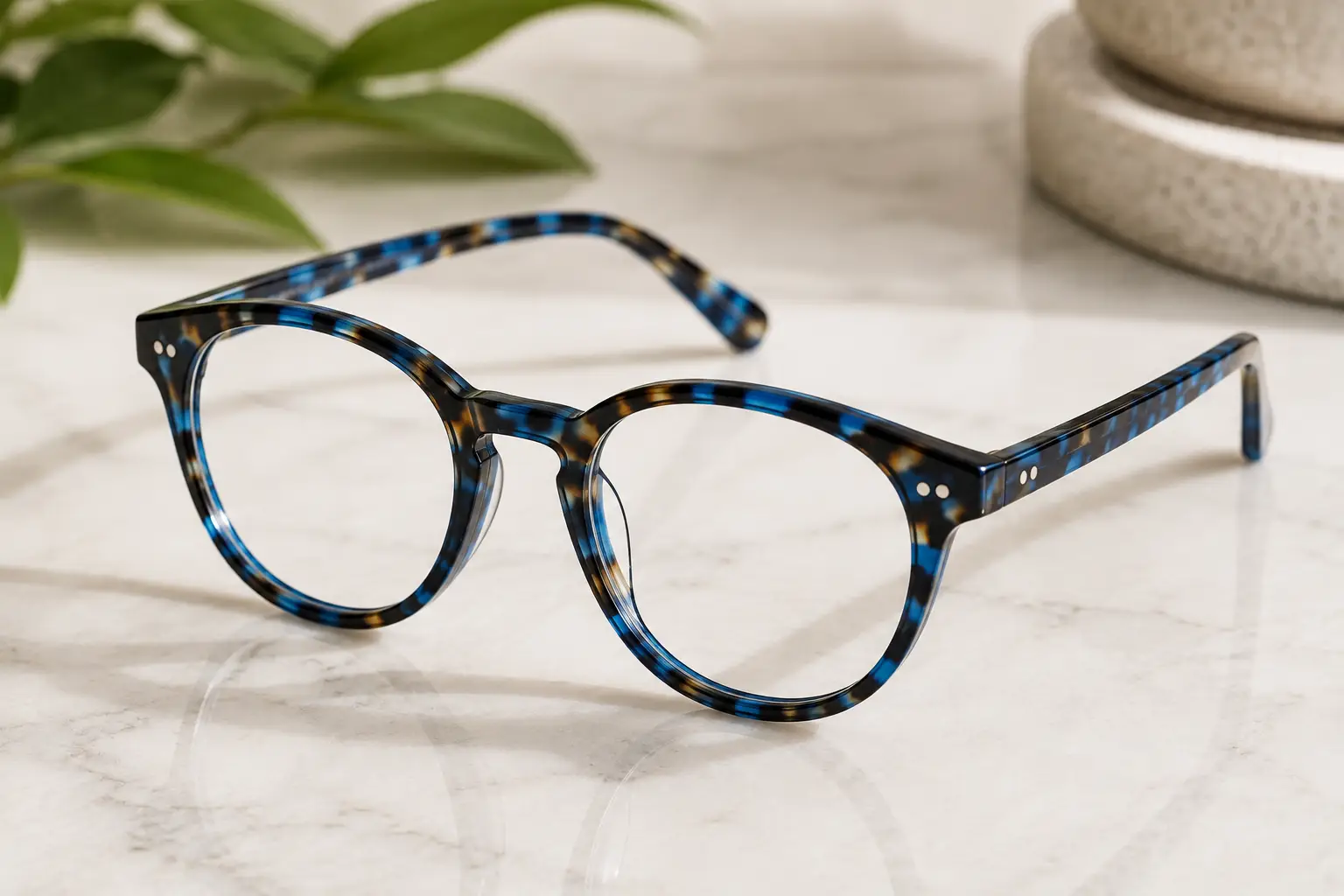
If you’ve spent any time scrolling eyewear listings, you’ve probably noticed that blue tortoise shell glasses are having a real moment. The pattern takes the warm, mottled look of classic tortoiseshell and cools it down with streaks of navy, slate, or cobalt running through the acetate or metal — the result is a frame that feels both nostalgic and current at the same time. But “blue tortoise shell glasses” is a surprisingly broad category: it covers everyday blue light blocking computer glasses, cat-eye and round fashion frames, reading glasses, polarized sunglasses, and designer prescription eyewear, all sharing that same two-tone tortoise-meets-blue aesthetic.
That breadth is exactly why picking the “right” pair is harder than it looks. A hexagonal computer frame that’s perfect for eight-hour workdays isn’t the same thing you want for a night out, and a $15 pair of readers won’t hold up the same way a metal designer frame will. In this guide, we dug into real spec sheets, aggregated customer feedback, and current market data to put together seven genuinely different blue tortoise shell glasses — spanning entry-level computer glasses, mid-range everyday frames, and one designer option — so you can match a pair to how you actually plan to wear it.
We’ll also walk through what the tortoiseshell pattern actually is (and isn’t), whether blue light lenses are worth the hype, how to avoid the most common buying mistakes, and which pair fits which lifestyle. As an Amazon Associate, this article contains affiliate links, and we’ll flag that again clearly before you reach any of them.
Quick Comparison: Blue Tortoise Shell Glasses at a Glance
Before the deep dive, here’s a snapshot of how these seven picks stack up on style, use case, and price range.
| Product | Best For | Frame Style | Price Range |
|---|---|---|---|
| SOJOS One and Only SJ5036 | Budget computer glasses | Hexagonal, metal | Under $20 |
| TIJN Round Metal Blue Light Glasses | Retro oversized look | Round-cat eye, TR90 | Under $25 |
| Breaksun Oval Retro Glasses | Tightest budget | Oval, plastic/metal | Under $15 |
| SOJOS SJ5025 Cat-Eye Glasses | Feminine vintage style | Cat-eye, plastic | Under $20 |
| 2SeeLife Wide Reading Glasses | Wide/large face readers | Rectangular, TR + CP | $20-$30 range |
| SOJOS SJ2113 Polarized Sunglasses | Driving and outdoor glare | Small round, plastic | Under $20 |
| Kate Spade Joetta Eyeglasses | Designer prescription frame | Rectangular, metal | $150-$220 range |
Looking at this lineup, the split is intentional: four picks live in the sub-$25 blue light and fashion category where most shoppers start browsing, one is dedicated specifically to reading glasses, one covers sunglasses, and the Kate Spade Joetta Eyeglasses anchor the designer end for anyone who wants a prescription-ready frame from a recognized fashion house. If your priority is simply reducing screen glare at your desk, the SOJOS One and Only SJ5036 or TIJN Round Metal Blue Light Glasses are the logical starting point; if you want something that reads as “real eyewear” rather than a desk accessory, skip down to the Kate Spade Joetta Eyeglasses.
💬 One click helps other shoppers make an informed choice too! 😊
Top 7 Blue Tortoise Shell Glasses: Expert Analysis
1. SOJOS One and Only SJ5036 — best value for all-day screen work
The SOJOS One and Only SJ5036 earns its spot here because it solves a specific problem: long stretches in front of a monitor without frames that feel heavy by hour six. Its hexagonal shape sits inside a large frame with a tortoise front and an anti-blue-light lens tint, and SOJOS builds it from ultra-thin metal with soft silicone nose pads and metal hinges. In practice, that combination means the glasses distribute weight across the bridge instead of pinching, which matters more than most buyers expect once they’ve worn cheaper plastic frames for a full workday. Based on comparing the specs against other budget blue light frames, the hexagonal cut also does something most round or square shapes don’t: it softens angular faces without disappearing on rounder ones, which is why SOJOS uses the same shell across multiple face-shape marketing photos.
This is the pick for remote workers, students, and anyone doing a first trial run of blue light glasses before spending more. Reviews consistently report that the fit feels lighter than expected for a “large frame” style, though a recurring theme in aggregated feedback is that the hinges can loosen slightly after several months of daily folding and unfolding — a normal wear pattern for metal hinges at this price point, not a defect unique to this model.
Pros:
- ✅ Lightweight metal frame despite the oversized hexagonal shape
- ✅ Silicone nose pads reduce pressure during long wear
- ✅ Rx-able lenses if you later want a prescription swap
Cons:
- ❌ Hinges may loosen with months of daily folding
- ❌ Anti-blue-light tint adds a faint yellow cast to whites
At around $15-$20, this is one of the cheapest genuine entry points into blue tortoise shell glasses, and the value holds up well if you treat it as a desk-only pair rather than an everyday driver.
2. TIJN Round Metal Blue Light Glasses — best oversized retro look
Where the SOJOS hexagonal pair leans practical, the TIJN Round Metal Blue Light Glasses lean into vintage styling. TIJN builds the frame around an oversized round-cat eye silhouette, rimmed in eco-friendly TR90 material and paired with stable metal hinges — a construction choice that means the frame keeps its shape better than a fully plastic build after repeated bending. The tortoise colorway shows the blue running through the mottled pattern rather than sitting as a flat tint, which is part of why this style photographs well for anyone shopping primarily on looks. What most buyers overlook with a frame this size is fit tolerance: at 134mm frame width, this runs large, so it suits medium-to-wide faces far better than narrow ones.
TIJN backs the frame with a one-year warranty, which is a meaningful signal at this price tier — most competitors in the same range offer 30 or 90 days, if anything. Reviews consistently mention the retro shape as the main draw, while a common complaint in customer reviews is that the nose pads sit a little high for people with lower nose bridges, requiring a small manual adjustment out of the box.
Pros:
- ✅ TR90 rim construction holds shape better than pure plastic
- ✅ One-year manufacturer warranty is above average for the price
- ✅ Oversized round shape suits medium and wide face shapes
Cons:
- ❌ Nose pads may need manual bending for lower bridges
- ❌ Runs large — not ideal for narrow or petite faces
Priced in the same $15-$25 range as our first pick, the extra warranty coverage makes the TIJN Round Metal Blue Light Glasses worth the marginal cost difference for buyers who want more style payoff for a nearly identical budget.
3. Breaksun Oval Retro Tortoise Glasses — lightest on the wallet
If price is the deciding factor, the Breaksun Oval Retro Tortoise Glasses typically undercut every other pick on this list, often landing under $15. Breaksun builds these around a classic oval shape with side temples finished in metal rivets — a detail meant to nod at “nerd chic” styling rather than pure minimalism. The brand is upfront in its own listing that the lenses show some blue reflection in bright light and aren’t fully transparent, which is refreshingly honest disclosure for a budget accessory brand, and it’s worth taking that note seriously if you photograph or video-call frequently, since reflective tint can show up on camera.
Here’s what the spec sheet doesn’t say outright but is worth flagging: Breaksun itself notes the round frame isn’t suited to very thin, narrow faces or very full faces, which is unusually candid sizing guidance for this price category. For anyone in that in-between range, this is a solid low-commitment way to try the blue tortoise aesthetic before investing in a pricier frame. Aggregated reviews skew positive on value-for-money, with the most common critique being that the printed “anti-fatigue” claims on blue light lenses at this price point should be read as marketing language rather than a clinically proven benefit — a caveat that, as we’ll cover later in this guide, actually applies across the entire blue light glasses category, not just this one brand.
Pros:
- ✅ Lowest price point of any pick on this list
- ✅ Honest sizing disclosure from the brand itself
- ✅ Classic oval “nerd chic” shape works for casual and office wear
Cons:
- ❌ Lenses show visible blue reflection, less ideal for video calls
- ❌ Not a good fit for very narrow or very full face shapes
For a first pair, a backup pair, or a gift where sizing feedback matters more than brand prestige, the Breaksun Oval Retro Tortoise Glasses deliver acceptable quality at the lowest possible buy-in.
4. SOJOS SJ5025 Retro Cat-Eye Glasses — best feminine vintage silhouette
The SOJOS SJ5025 Retro Cat-Eye Glasses target a different aesthetic entirely: a hipster-party cat-eye shape built from reinforced plastic with European-style nose pads and durable metal hinges. SOJOS pairs the yellow-leaning tortoise pattern with anti-blue-light lenses that are explicitly designed to be swapped for a real prescription later, which extends the useful life of the frame well past its original blue-light-blocking purpose. On paper, this means you’re not just buying a novelty accessory — you’re buying a frame shell that can graduate into your actual daily glasses if your prescription changes or you decide to add one.
The cat-eye cut is noticeably smaller than the hexagonal and round options earlier on this list (47mm lens width versus 51mm), so it suits narrower and more angular faces that the oversized picks don’t flatter as well. Reviews consistently report strong compliments on the retro styling itself, while a recurring critique in customer feedback is that the lens coating shows minor scratching faster than the frame’s build quality would suggest — a mismatch worth knowing about if you’re rough on your glasses case habits.
Pros:
- ✅ Smaller cat-eye shape flatters narrower face shapes
- ✅ Rx-able lenses extend the frame’s usable life
- ✅ European-style nose pads improve all-day comfort
Cons:
- ❌ Lens coating scratches more easily than the frame construction suggests
- ❌ Smaller lens size won’t suit wider or fuller faces
At a similar $15-$20 price range to the hexagonal and round picks, this is the clearest choice on the list for anyone specifically shopping for a feminine, retro-leaning silhouette rather than a unisex or oversized look.
5. 2SeeLife Wide Reading Glasses, Tortoise Blue — best for wide or large faces needing readers
Every pick so far has been either blue light or fashion-forward, but the 2SeeLife Wide Reading Glasses solve a genuinely different problem: magnification for close-up tasks in a frame built specifically for medium-to-large faces, a sizing gap that a lot of mainstream reading-glasses brands skip entirely. 2SeeLife uses a TR frame front for durability paired with lightweight CP material temples, spring hinges for flex, and scratch-resistant lensing — a combination that, based on comparing the materials to typical drugstore readers, should hold up to more daily flexing without the hinge screws working loose over time.
As a small-business-tagged listing, this pair carries a slightly higher price than the mass-market blue light frames above, generally landing in the $20-$30 range, and it comes in a range of magnification strengths so you can match it to your actual reading prescription rather than guessing. What the spec sheet doesn’t say, but the design choices reveal, is that this frame is aimed squarely at people who’ve been frustrated by readers that pinch at the temples — the wide, sturdy construction is a direct answer to that complaint category across the reading-glasses market generally.
Pros:
- ✅ Purpose-built wide fit for medium-large faces
- ✅ Spring hinges add flex most rigid readers lack
- ✅ Available across multiple magnification strengths
Cons:
- ❌ Higher price than mass-market blue light frames on this list
- ❌ Not suitable if you need a distance or blue-light prescription instead
If you’ve struggled to find reading glasses that don’t feel tight after twenty minutes, the 2SeeLife Wide Reading Glasses are the most targeted solution here, even if they cost a bit more than the computer-glasses picks above.
6. SOJOS SJ2113 Small Round Polarized Sunglasses, Tortoise/Grey — best for driving and outdoor glare
Moving outside the blue-light and reading categories, the SOJOS SJ2113 Polarized Sunglasses bring the blue tortoise pattern into sun protection. SOJOS fits these with high-definition TAC polarized lenses, which filter reflected glare specifically — the kind that bounces off wet roads, car hoods, and water — rather than just darkening your overall field of view the way a cheap tinted lens does. At 2.08 ounces, the plastic frame with metal hinges is genuinely light for all-day wear, and the small round silhouette keeps the vintage tortoise theme consistent with the rest of this list rather than jumping to an oversized aviator shape.
Here’s what most shoppers overlook with polarized lenses generally: they cut glare, but they can also make it harder to read certain LCD screens (like some gas pump displays or car dashboards) at an angle, since polarization interacts with how those screens emit light. That’s a trade-off inherent to any polarized lens, not a flaw specific to SOJOS. Reviews consistently mention comfort during long drives as the standout benefit, while the most common size-related complaint is that the small round shape runs snug on wider faces — worth trying before committing if you fall into that category.
Pros:
- ✅ TAC polarized lenses meaningfully cut road and water glare
- ✅ Lightweight build at roughly 2 ounces for all-day wear
- ✅ Small round shape keeps the tortoise pattern visually consistent
Cons:
- ❌ Polarization can interfere with reading some digital screens at an angle
- ❌ Runs snug — less ideal for wider face shapes
Priced similarly to the fashion frames above, this is the clear pick on this list if your main use case is driving, walking, or general outdoor glare reduction rather than screen work.
✨ Don’t Miss These Exclusive Deals!
🔍 Take your eyewear collection to the next level with this carefully curated lineup. Click a highlighted item to check current pricing and availability. These picks will help you find a pair that actually matches how you live, work, and wear glasses every day!
7. Kate Spade Joetta Eyeglasses, Tortoise Blue — best designer prescription frame
Every pick above sits in the accessible, mass-market tier — the Kate Spade Joetta Eyeglasses are the deliberate exception, representing the designer end of the blue tortoise shell spectrum. Built with a metal rectangular frame in a full-rim, single-bridge construction and sized at 52-18-135mm, this is a genuine prescription-ready frame from a recognized fashion house rather than a novelty or computer-glasses accessory. Safilo Group, the Italian eyewear manufacturer behind several designer licenses, produces Kate Spade’s eyewear line, which is part of why the build quality and hinge tolerances read differently in hand compared to the sub-$25 frames earlier in this list.
Here’s the honest picture on reviews: aggregated Amazon feedback for this specific style sits around 4.2 out of 5 stars, but based on a relatively small number of ratings, so treat that figure as directionally useful rather than statistically robust — a caveat that applies to a lot of designer frame listings, which sell in far lower volumes than mass-market blue light glasses. What the price premium buys you, based on comparing the build against the earlier picks, is primarily materials and finish: a metal frame with tighter tolerances, better long-term hinge durability, and a resale/status value that acetate fashion frames don’t carry. Availability can fluctuate on designer styles more than mass-market ones, so check current stock before counting on this exact colorway.
Pros:
- ✅ Genuine designer construction from an established fashion house
- ✅ Metal frame offers better long-term hinge durability
- ✅ Prescription-ready for buyers who need corrective lenses
Cons:
- ❌ Meaningfully pricier than every other pick on this list
- ❌ Limited rating volume makes the review average less statistically reliable
Expect a price range in the $150-$220 range depending on retailer and lens options at the time of purchase — a significant step up, but one that makes sense if you want a frame that reads as “real eyewear” rather than an accessory.
Looking at the Comparison Above
Looking at the full lineup, the SOJOS One and Only SJ5036 and Breaksun Oval Retro Tortoise Glasses offer the best entry point if you just want to try the blue tortoise look without much financial commitment, but if all-day comfort during work hours matters more than price, the TIJN Round Metal Blue Light Glasses‘s reinforced TR90 rim and one-year warranty justify the small price gap. Budget-conscious buyers focused specifically on sun protection should note that the SOJOS SJ2113 Polarized Sunglasses trade a snugger fit for meaningfully better glare control than a non-polarized pair would offer at the same price. And anyone who wants the pattern in a frame built to last years rather than months should look past the accessory tier entirely toward the Kate Spade Joetta Eyeglasses.
How to Choose Blue Tortoise Shell Glasses That Actually Fit You
Picking a frame off a product photo is risky, because tortoiseshell patterns and blue undertones photograph differently depending on lighting and screen calibration. Here’s a practical, step-by-step approach that cuts through that uncertainty:
- Measure your current frames first. Check the small numbers printed inside the temple arm of glasses you already own (often formatted like 51-18-145) — lens width, bridge width, and temple length — and use those as your baseline before comparing new listings.
- Match frame width to face width, not face shape alone. Face-shape charts are a decent starting point, but actual frame width relative to your face width matters more for whether a pair looks proportional.
- Decide the lens purpose before the color. Blue light blocking, reading magnification, polarized sun protection, and plain prescription lenses are different products wearing the same pattern — pick the function first.
- Check the material, not just the price. TR90 and metal generally outlast basic injection-molded plastic at the same price point, especially at the hinges.
- Read the sizing notes in the actual listing. As we saw with a couple of picks above, some brands explicitly flag which face shapes their frame does and doesn’t suit — that’s more useful than generic marketing copy.
- Factor in your screen habits if buying blue light glasses. If you’re already taking regular breaks and adjusting your monitor brightness, the marginal benefit of blue light lenses shrinks considerably (more on this below).
- Confirm return policy before buying frames sight-unseen. Because you can’t try these on in person, a flexible return window matters more here than with almost any other accessory category.
Do Blue Light Blocking Lenses Actually Work?
This is worth addressing honestly rather than repeating marketing claims, since four of the seven picks above are marketed as blue light blockers. According to the American Academy of Ophthalmology, there is no solid scientific evidence that the amount of blue light coming from phone, tablet, or computer screens actually damages the eyes, and the Academy does not recommend special blue-light-blocking eyewear for computer use. Several controlled studies cited by ophthalmologists have found that blue-light-filtering lenses don’t meaningfully reduce digital eye strain symptoms compared to standard clear lenses.
What most buyers overlook is that the discomfort people associate with “blue light” is very often ordinary digital eye strain — caused by reduced blink rate, poor screen distance, or an outdated prescription, not by the light spectrum itself. That doesn’t mean blue tortoise shell blue-light glasses are worthless: some wearers report a genuine comfort preference for the slightly warmer tint, and there’s more tentative research suggesting blue light exposure close to bedtime may affect sleep onset for some people. But if your primary goal is treating eye strain, pairing any of the frames above with the 20-20-20 rule — every 20 minutes, look at something 20 feet away for 20 seconds — will likely do more for your comfort than the tint itself. Buy these frames for the style and the mild filtering benefit, not as a guaranteed medical fix.
Blue Tortoise Shell vs. Classic Tortoise vs. Solid-Color Frames
| Attribute | Blue Tortoise Shell | Classic (Havana) Tortoise | Solid-Color Frames |
|---|---|---|---|
| Versatility | High — cooler undertone pairs with both warm and cool wardrobes | High — pairs almost universally | Depends heavily on the specific color |
| Trend cycle | Currently trending, contemporary feel | Timeless, rarely feels dated | Trend-sensitive, ages faster |
| Visual impact | Statement-adjacent without being loud | Subtle, professional | Can be either subtle or bold |
| Best paired with | Cool-toned or neutral wardrobes | Almost any wardrobe | Coordinated, color-matched outfits |
The practical takeaway from this comparison is that blue tortoise shell glasses sit in a genuinely useful middle ground: they carry more personality than a plain black or clear frame, but the mottled pattern still reads as “classic eyewear” rather than a novelty color choice the way a solid neon frame might. If you’re buying your very first statement frame and worry about it feeling dated in two years, blue tortoise is a safer long-term bet than a fully solid trend color, while still standing out more than a traditional brown Havana tortoise.
What Is Tortoiseshell, and Why Is There a Blue Version?
Tortoiseshell as an eyewear pattern predates plastic entirely. Historically, the mottled brown-and-amber pattern came from the shell of the hawksbill sea turtle, which was carved into combs, decorative objects, and eventually eyeglass frames as far back as the 1920s, when eyewear first became a fashion statement rather than a purely medical device. That changed for good reasons: the hawksbill is now listed as endangered, and according to the U.S. Fish and Wildlife Service, its population decline is due primarily to historical human exploitation for tortoiseshell material, with illegal trade still a threat today even though legal international trade ended decades ago.
Every frame on this list, including the tortoise patterns, is made from synthetic materials — acetate, TR90, or metal-and-plastic composites — that recreate the visual pattern without using any animal-derived material. The “blue” variation is a modern design choice: manufacturers blend cooler pigments into the acetate or lens tint during production, which is why you’ll see the same tortoise base pattern sold in traditional brown, blue, gray, and even green colorways depending on the brand. So when you buy blue tortoise shell glasses today, you’re buying a pattern that pays visual homage to a historical material while having nothing to do with actual tortoises or turtles.
Real-World Scenarios: Which Pair Fits Your Life
Rather than guessing from specs alone, here’s how three different buyer profiles map onto this list:
The remote worker on back-to-back video calls. If you’re on camera six hours a day, avoid frames with visible lens reflection (a known trait of the Breaksun Oval Retro Tortoise Glasses) and lean toward the SOJOS One and Only SJ5036, whose thinner metal build reduces the amount of frame visible at the edge of a webcam frame.
The student on a tight budget who wants to try the trend. The Breaksun Oval Retro Tortoise Glasses or the smaller SOJOS SJ5025 Cat-Eye Glasses make sense here — both sit under $20, and neither requires you to commit before knowing if the style suits your face.
The professional who wants one “good” pair that lasts. Skip the accessory tier and go straight to the Kate Spade Joetta Eyeglasses. The higher upfront cost is offset by meaningfully better hinge durability and a frame that reads as intentional eyewear in a client meeting rather than a desk accessory.
Common Mistakes to Avoid When Buying Blue Tortoise Shell Glasses
Even with good research, a few recurring errors show up across buyer feedback for this entire category:
- Buying based on color alone. The tortoise pattern varies dramatically between “cool blue-gray” and “blue with warm amber undertones” depending on the brand — always check multiple product photos, not just the thumbnail.
- Ignoring frame width measurements. A frame that looks proportional on a model’s face may run noticeably large or small on yours; always compare the millimeter measurements against a pair you already own.
- Assuming all blue light lenses are equal. Coating quality and the intensity of blue-light filtering vary between brands, and as covered above, the actual eye-strain benefit is modest regardless of brand.
- Skipping the return policy. Since you can’t try these on beforehand, always confirm the seller’s return window before purchasing, especially for designer frames where return costs can be higher.
- Overlooking hinge material. Spring hinges and metal hinges generally outlast basic pin hinges, particularly if you take your glasses on and off dozens of times a day.
Long-Term Cost and Maintenance
A $15 pair of blue tortoise shell glasses and a $200 designer pair aren’t really competing on the same axis — they’re solving different problems. The budget frames in this guide are reasonably priced enough that most buyers treat them as semi-disposable: if the hinges loosen or the coating scratches after a year of heavy use, replacing the entire pair costs less than a single professional lens replacement would. The Kate Spade Joetta Eyeglasses, by contrast, are built with metal hardware and construction standards meant to support lens replacements and adjustments over several years, which is the more standard model for how people traditionally think about eyewear ownership.
Practically, that means your total cost of ownership depends heavily on how you use the glasses. If you’re buying primarily for the blue light or fashion accessory function and expect to swap styles every year or two anyway, the sub-$25 tier represents genuinely good value — you’re not leaving durability on the table relative to what you’re actually asking the product to do. If you want one frame you can keep wearing for five-plus years, adjust as your prescription changes, and have professionally repaired if a hinge loosens, the designer tier’s higher upfront cost amortizes into a lower cost per year of ownership.
Safety, Regulations, and What to Check Before You Buy
Because several picks on this list are non-prescription fashion or blue-light frames rather than corrective eyewear, it’s worth knowing what oversight does and doesn’t apply. Non-prescription blue light and reading glasses generally aren’t subject to the same regulatory testing as prescription lenses, which are dispensed based on an eye exam and fitted by a licensed professional. If you have an existing prescription, none of the non-prescription frames on this list are a substitute for it — magnification-only readers and blue light lenses don’t correct astigmatism or more complex vision needs.
For sunglasses specifically, look for a listing that states UV400 protection, which indicates the lens blocks light up to 400 nanometers, covering the full range of UVA and UVB rays; the SOJOS SJ2113 Polarized Sunglasses meet this standard. On the shopping side, Consumer Reports’ eyeglass buying guide notes that satisfaction rates between online and in-person eyewear retailers run roughly comparable overall, but that buying frames without trying them on first carries real fit risk — which is exactly why the measurement and sizing steps earlier in this guide matter more for online purchases than they would in a physical store.
Problem → Solution: Fixing the Most Common Frustrations
Problem: The glasses slide down your nose during the day. Solution: Look for silicone nose pads (present on the SOJOS One and Only SJ5036) or ask about temple tip adjustments; a local optical shop can often bend metal temples for a better grip at no cost even if you didn’t buy the frame there.
Problem: The tortoiseshell pattern looked different in person than online. Solution: Cross-reference at least three product photos taken in different lighting before buying, since the blue undertone in particular can appear muted or vivid depending on screen calibration and photo lighting.
Problem: The frame feels tight after a few hours. Solution: Check the frame width and temple length against your current glasses before buying, and consider a wider-fit option like the 2SeeLife Wide Reading Glasses if you’ve had this issue with standard-width frames before.
Problem: You’re not sure if you need blue light, reading, or plain prescription lenses. Solution: If you already have a prescription, prioritize an Rx-able frame (several picks above support this); if you don’t and mainly want reading magnification, a dedicated readers-style frame will serve you better than a general blue-light frame with no magnification.
Problem: You bought online and the fit is slightly off. Solution: Check the seller’s return policy immediately after purchase, before you remove any tags or packaging, since return windows are often shorter for eyewear than for standard apparel.
Blue Tortoise Shell Glasses for Different Audiences
For students and remote workers: prioritize comfort and price over designer status — the sub-$25 picks on this list cover this need well, particularly anything with silicone nose pads for multi-hour wear.
For professionals in client-facing roles: a frame with tighter build tolerances, like the Kate Spade Joetta Eyeglasses, tends to read as more intentional in person and on video, which matters more in this context than in casual settings.
For anyone with a wider or larger face: standard “one size” frames often run tight; the 2SeeLife Wide Reading Glasses and the oversized TIJN Round Metal Blue Light Glasses are the two picks on this list explicitly built with wider fits in mind.
For frequent drivers: polarized lenses meaningfully reduce glare from wet roads and other vehicles’ windshields, which is why the SOJOS SJ2113 Polarized Sunglasses earn their spot as the dedicated sun-protection pick here rather than a general fashion sunglasses option.
Features That Actually Matter (and Ones That Don’t)
Actually matters: frame material at the hinge point, nose pad type, accurate millimeter sizing, and UV400 rating for sunglasses. These directly affect comfort, durability, and — for sunglasses — actual eye protection.
Matters less than marketing suggests: the specific percentage of blue light blocked by a lens coating. As covered earlier, the clinical benefit of blue light filtering for eye strain is modest at best according to ophthalmology research, so a listing that heavily emphasizes “blocks 99% of blue light” is describing a real lens property, but not necessarily a proportional real-world benefit.
Doesn’t matter much: minor variations in box packaging or bundled extras like microfiber cloths and cases — nice to have, but not a reason to choose one frame over another if the core fit and material differ.
Frequently Asked Questions
❓ Are blue tortoise shell glasses real tortoise shell?
❓ Do blue light blocking glasses really reduce eye strain?
❓ What's the difference between blue tortoise and classic tortoise glasses?
❓ Can I put my own prescription in blue tortoise shell glasses?
❓ How do I know what size blue tortoise shell glasses to buy?
Conclusion
Blue tortoise shell glasses manage a rare trick in eyewear: they feel both of-the-moment and quietly timeless, because the underlying tortoiseshell pattern has been part of eyewear design for a century, while the blue undertone keeps it feeling current. Whether you land on the budget-friendly SOJOS One and Only SJ5036 for desk work, the vintage-leaning TIJN Round Metal Blue Light Glasses, the ultra-affordable Breaksun Oval Retro Tortoise Glasses, the feminine SOJOS SJ5025 Cat-Eye Glasses, the wide-fit 2SeeLife Wide Reading Glasses, the glare-cutting SOJOS SJ2113 Polarized Sunglasses, or the designer-grade Kate Spade Joetta Eyeglasses, the right choice comes down to matching the frame’s actual purpose — screen work, reading, driving, or everyday prescription wear — to how you’ll really use it, not just how it looks in a thumbnail photo.
Take the sizing and material notes in this guide seriously before you buy, keep your expectations realistic about what blue light lenses can and can’t do for eye strain, and lean on return policies as your safety net for any pair you can’t try on first. Done right, a well-matched pair of blue tortoise shell glasses is a small purchase that pays off in comfort and style for years, not just weeks.
🛍️ Ready to Find Your Pair?
Browse the picks above and check current pricing before it changes! ✨👓
Recommended for You
- 7 Best No Blue Light Bulbs for Sleep in 2026 (Buyer’s Guide)
- Blue Light Blocking Light Bulbs: 7 Best Picks for 2026
- 7 Best Blue Blocking Light Bulbs for Deeper Sleep in 2026
Disclaimer: This post contains affiliate links. As an Amazon Associate, I earn from qualifying purchases made through these links, at no additional cost to you.
✨ Found this article helpful? Share it with someone who needs it! 💬🤗