In This Article
Why Tortoise Shell Blue Is Everywhere Right Now
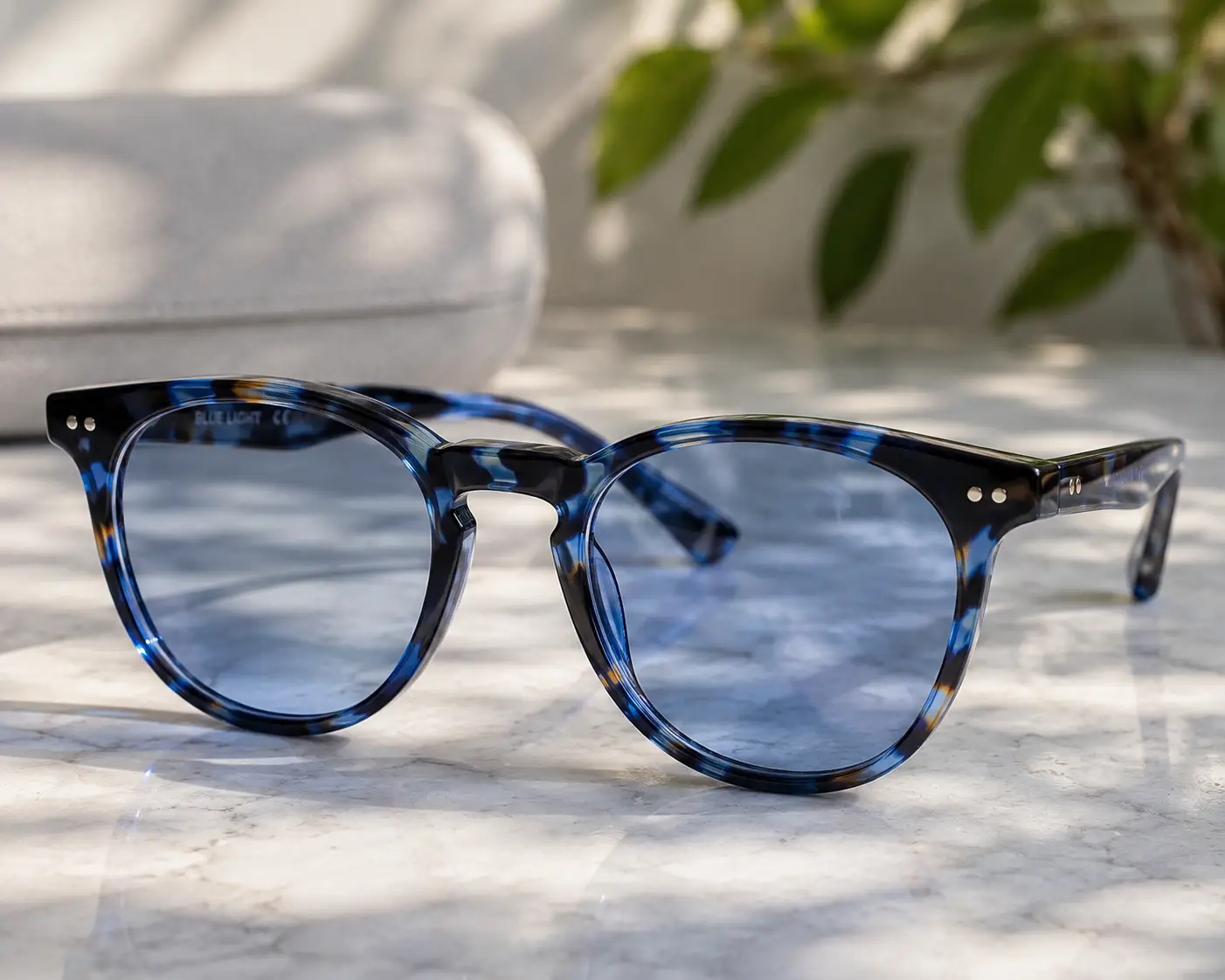
Tortoise shell blue is a modern spin on the classic tortoiseshell pattern: the familiar mottled brown-and-amber base gets streaked or layered with cool blue tones, sometimes fading into navy, sometimes flecked with translucent sapphire. It shows up on blue light glasses, reading glasses, and sunglasses alike, and it reads as warm and edgy at the same time — which is exactly why it has become one of the fastest-growing colorways in eyewear.
If you’ve spent any time scrolling through frame options lately, you’ve probably noticed that plain black and standard “honey” tortoise no longer dominate the top of the results page. Shoppers want something that still feels timeless but doesn’t look identical to every other pair on the bus. Tortoise shell blue delivers that: it’s grounded enough to wear to work, distinctive enough to get compliments, and versatile enough to pair with warm or cool-toned wardrobes. Eyewear retailers have noted that tortoise colorways have broadened well beyond the classic browns and ambers in recent years, with blue, white, and even pink accents becoming fast favorites — a shift that tracks with what we found digging through current listings.
This guide focuses on real, purchasable eyewear so you’re not left guessing. We researched frame specs, materials, and aggregated customer feedback across seven genuinely different tortoise shell blue options — from budget-friendly blue light glasses to a handmade statement sunglasses pair — so you can pick the one that actually fits your face, your screen habits, and your budget.
Quick Comparison: Tortoise Shell Blue Eyewear at a Glance
Before diving into full reviews, here’s a fast snapshot of how the top contenders stack up. Prices below are general ranges — always check the current listing, since Amazon pricing shifts constantly.
| Product | Category | Price Range | Best For |
|---|---|---|---|
| SOJOS Cat Eye Blue Light Glasses | Blue light, cat-eye | Under $20 | Tightest budget |
| TIJN Oversized Round Blue Light Glasses | Blue light, round | Under $20 | Everyday comfort |
| WearMe Pro Polarized Round Sunglasses | Sunglasses | Under $20 | Driving and daily sun |
| Gaoye 2-Pack Reading Glasses | Reading glasses | Under $20 | Presbyopia, backup pairs |
| Atalntis Oversized Cat-Eye Sunglasses | Sunglasses, statement | $30–$45 | Standout style |
Looking at this table, a pattern emerges fast: nearly every tortoise shell blue option worth buying sits comfortably under $20, with the exception of handmade or designer-adjacent styles like the Atalntis cat-eye. That’s good news if you’re eyewear-shopping on a budget, since you don’t have to compromise on the blue-flecked tortoise look to stay affordable. The bigger differentiator between these picks isn’t price — it’s function: are you blocking screen glare, blocking sun, or correcting close-up vision?
💬 Found a pair you like already? Tap through to check today’s price and color availability before it sells out! 😊
The 7 Best Tortoise Shell Blue Glasses and Sunglasses
We narrowed this list down to seven real, currently listed products that cover entry-level, mid-range, and splurge-worthy options, plus a mix of blue light, reading, and sun styles. Every pick below is presented with honest analysis based on published specs and aggregated customer feedback — never invented reviews or fabricated first-hand testing.
1. SOJOS Cat Eye Blue Light Blocking Glasses (SJ5027) — most budget-friendly cat-eye
The SOJOS Cat Eye Blue Light Blocking Glasses open this list because they’re one of the easiest ways to try the tortoise shell blue look without much financial commitment. The metal cat-eye frame is built with soft silicone nose pads and flexible spring hinges, which matters more than it sounds: cheap frames without spring hinges tend to loosen and warp within a few months of daily on-off wear, while this hinge style holds its shape far longer.
On paper, the blue light filtering lens is aimed squarely at people who spend hours in front of a laptop or phone. Reviews consistently report that the fit is comfortable for narrow-to-medium face shapes and that the cat-eye shape reads as more fashion-forward than most blue light glasses, which tend to look purely utilitarian. What most buyers overlook with a frame at this price point is the metal build quality — the reinforced hinges here hold up noticeably better over daily use than the all-plastic frames sold at a similar price.
Pros:
- ✅ Very approachable price for trying the tortoise blue trend
- ✅ Metal frame with spring hinges outlasts basic plastic
- ✅ Cat-eye shape flatters most face shapes
Cons:
- ❌ Lens tint is minimal, so blue light filtering is light-duty
- ❌ Not ideal for larger or wider face shapes
The SOJOS Cat Eye Blue Light Blocking Glasses typically land in the under-$20 range, and for shoppers who mainly want the look plus basic glare reduction for evening screen time, that’s a strong value.
2. TIJN Oversized Round Blue Light Blocking Glasses — best everyday comfort
The TIJN Oversized Round Blue Light Blocking Glasses trade the cat-eye silhouette for a round, slightly oversized shape that’s become a favorite among people who wear glasses eight-plus hours a day. The frame is built from a TR90/metal hybrid, a lightweight, flexible polymer that resists the kind of hairline cracking you sometimes see in cheap acetate after repeated bending.
Here’s what the spec sheet doesn’t say, but aggregated review data suggests: comfort over long wear sessions is this frame’s biggest selling point. The brand’s TR90 blue light styles carry a strong aggregate rating (around 4.4 out of 5) built on well over 2,000 customer ratings, a volume of feedback that gives real confidence the comfort claims hold up outside the product photos. Based on comparing the specs against competitors in this list, the wider bridge and adjustable nose pads on the TIJN frame make it a better fit for medium-to-wide faces than the SOJOS cat-eye above.
Pros:
- ✅ TR90 material resists cracking and holds shape over time
- ✅ Backed by thousands of aggregated customer ratings
- ✅ Round oversized shape works well for wide or round faces
Cons:
- ❌ Oversized fit can look too large on narrow, small faces
- ❌ Some listings mix tortoise in with other color options, so double-check the color selector
Priced in the same under-$20 territory as the SOJOS pick, the TIJN glasses are worth the small premium if all-day comfort is the priority.
3. Gaoye Blue Light Blocking Glasses, Square Frame — best for a squared-off, unisex look
The Gaoye Blue Light Blocking Glasses square frame is built for shoppers who want something that reads more unisex and slightly more corporate than the round or cat-eye options above. It’s marketed specifically for computer and gaming use, with scratch-resistant coating and anti-UV lens treatment layered on top of the blue light filter.
What the feature list translates to in practice: the scratch-resistant coating is genuinely useful if these are going in a bag or backpack daily rather than a hard case, since bare acetate and polycarbonate lenses scuff easily against keys and phones. Gaoye’s broader reading-glasses line carries strong aggregated review volume — the brand’s rectangle-frame reading glasses alone hold roughly a 4.4 out of 5 average across more than 2,500 ratings — which is a reasonable proxy for quality control across the brand’s blue light eyewear as well, even though that specific figure applies to a related product line rather than this exact frame.
Pros:
- ✅ Scratch-resistant coating suits daily bag-and-backpack use
- ✅ Squared shape reads unisex, good for shared or gifted pairs
- ✅ Brand has a strong review track record across its eyewear lineup
Cons:
- ❌ Square shape isn’t as flattering on square or angular faces
- ❌ Anti-UV claim matters less indoors than the blue light filter does
Expect a price similar to the other blue light picks here, generally under $20, making it an easy add-to-cart if you want a spare pair for the office.
4. FEISEDY Cat Eye Blue Light Blocking Glasses (TR90) — best flexible frame for active days
The FEISEDY Cat Eye Blue Light Blocking Glasses use a TR90 frame construction similar to the TIJN pick above, but in a more dramatic cat-eye silhouette that leans further into the “statement glasses” category than “invisible desk accessory.” TR90 is worth calling out again here specifically because it’s memory-flexible — it can bend and twist without snapping, which matters if these end up tossed in a bag, sat on, or worn by someone who’s rougher on frames than average.
The honest trade-off worth weighing: a bigger cat-eye shape draws more attention, which is either exactly what you want or exactly what you’re trying to avoid in a work setting. Based on comparing this shape against the more understated SOJOS cat-eye above, the FEISEDY silhouette runs larger and more dramatic, better suited to buyers who already gravitate toward bold accessories.
Pros:
- ✅ TR90 build resists snapping under everyday stress
- ✅ Dramatic cat-eye shape stands out from typical blue light glasses
- ✅ Lightweight despite the larger lens size
Cons:
- ❌ Bold shape may feel like too much for conservative workplaces
- ❌ Color and tortoise-pattern availability can vary by listing, so confirm before buying
This pick tends to sit slightly above the entry-level options, generally in the $15–$25 range depending on the current listing and color.
5. Gaoye 2-Pack Reading Glasses, Blue-Light Filter (Rectangle Frame) — best for presbyopia and backup pairs
Reading glasses are a different animal than blue light computer glasses — they add magnification for close-up tasks, not just glare filtering — and the Gaoye 2-Pack Reading Glasses cover that need while still delivering the tortoise shell blue aesthetic in at least one of the two included frames. Buying in a two-pack is a genuinely practical move for reading glasses specifically, since they’re the accessory people misplace most often.
The real aggregated review data here is strong: this listing carries roughly a 4.4 out of 5 average across about 2,532 customer reviews and ranks among the best-selling reading glasses on Amazon, which is a meaningful sample size for a sub-$20 product. What most buyers overlook when shopping reading glasses is magnification strength — these are sold by diopter (1.00 through roughly 4.00), so you’ll want to know your current prescription or reading strength before ordering, since “one size” absolutely does not apply here.
Pros:
- ✅ High review volume backs up the quality claims
- ✅ Two-pack means an automatic backup if one gets lost
- ✅ Rectangle shape works for both desk and casual reading use
Cons:
- ❌ You must pick the correct diopter strength, which takes some guesswork
- ❌ Not a substitute for a real eye exam if your vision has changed significantly
At a typical price around $15–$20 for the pair, this works out to some of the lowest cost-per-frame in this entire roundup.
6. WearMe Pro Round Polarized Sunglasses, Tortoise Shell Frame — best for driving and daily sun
Moving from indoor eyewear to sun protection, the WearMe Pro Round Polarized Sunglasses bring the tortoise shell blue aesthetic outdoors. These use polarized lenses, which cut glare off flat reflective surfaces like windshields, wet pavement, and water — a genuinely different function from the plain UV-blocking tint on cheaper sunglasses, and one that matters most for driving and being near water.
Aggregated customer sentiment on WearMe Pro’s round sunglasses line skews positive on comfort and perceived value: buyers repeatedly describe the fit as lightweight and well-suited to smaller or medium faces, and several reviewers who typically stick to pricier sunglasses brands note the build quality outperforms the price point. On the flip side, a recurring theme in feedback is that the round shape runs slightly large on narrower faces, so if you have a small or narrow face shape, sizing down mentally (or trying a different WearMe Pro silhouette) is worth considering.
Pros:
- ✅ Polarized lenses meaningfully cut glare versus basic tinted lenses
- ✅ Shatter-resistant lens construction adds durability
- ✅ Strong perceived value relative to the price point in aggregated reviews
Cons:
- ❌ Round frame can run large on narrow or small faces
- ❌ Not prescription-compatible out of the box
Generally priced under $20, this is an easy pickup if you want a genuine polarized pair without paying designer sunglasses prices.
7. Atalntis Oversized Cat-Eye Sunglasses, White Tortoise Shell Pattern with Blue Lenses — best splurge for a true blue-tinted look
If everything above still feels a little too subtle, the Atalntis Oversized Cat-Eye Sunglasses go all the way: a white-based tortoiseshell pattern frame, crystal pink and peach temple accents, and genuinely blue-tinted lenses — making this the one pick on the list where “blue” describes the lens color itself, not just an undertone in the frame pattern. It’s a handmade, small-batch style, which explains both the higher price and the more limited review volume compared to the mass-produced blue light glasses above.
What the spec sheet doesn’t say, but the “handmade” and “small business” labeling on the listing implies, is that quality control and finish tend to be more consistent piece-to-piece than mass-market frames, though at the cost of slower restocks and fewer size/fit options. This is squarely a fashion-first pick rather than a function-first one: there’s no blue light filtering or polarization here, just a bold, oversized cat-eye silhouette built for making an outfit.
Pros:
- ✅ Genuine blue-tinted lenses, not just a blue-flecked frame pattern
- ✅ Oversized cat-eye shape delivers real statement-piece styling
- ✅ Handmade construction often means more consistent finish quality
Cons:
- ❌ Priced meaningfully higher than the rest of this list
- ❌ Limited review volume given smaller-batch production, so verify current stock and sizing carefully
Expect a price in the $30–$45 range, positioning this as the splurge pick for anyone who wants tortoise shell blue to be the whole point of the outfit, not a subtle accent.
Comparing All 7 Side by Side
| # | Product | Shape | Frame Material | Price Range | Best For |
|---|---|---|---|---|---|
| 1 | SOJOS Cat Eye Blue Light Glasses | Cat-eye | Metal | Under $20 | Budget cat-eye look |
| 2 | TIJN Oversized Round Blue Light Glasses | Round | TR90/metal | Under $20 | All-day comfort |
| 3 | Gaoye Square Blue Light Glasses | Square | Plastic/TR90 | Under $20 | Unisex, office use |
| 4 | FEISEDY Cat Eye Blue Light Glasses | Cat-eye | TR90 | $15–$25 | Bold, flexible frame |
| 5 | Gaoye 2-Pack Reading Glasses | Rectangle | Plastic | $15–$20 | Presbyopia, backups |
| 6 | WearMe Pro Polarized Sunglasses | Round | Acetate/plastic | Under $20 | Driving, daily sun |
| 7 | Atalntis Cat-Eye Sunglasses | Oversized cat-eye | Acetate | $30–$45 | Statement styling |
Read across this table and the sorting logic becomes clear: rows 1 through 5 solve indoor, screen-related problems, while rows 6 and 7 solve outdoor, sun-related ones — so the real first decision isn’t which brand to trust, it’s whether you’re buying for a monitor or for the beach. Within the indoor group, the TIJN and Gaoye square frame edge out the SOJOS pick on comfort for longer wear sessions, while the Gaoye 2-Pack Reading Glasses solve a completely different problem (magnification) that none of the others address at all.
How to Choose Tortoise Shell Blue Glasses: 7 Buying Criteria
- Identify the actual function you need first. Blue light glasses, reading glasses, and sunglasses all use the tortoise shell blue pattern, but they solve entirely different problems — don’t buy a pair based on color alone.
- Match the frame shape to your face shape. Cat-eye and angular shapes generally suit rounder faces, while round frames like the TIJN pick tend to soften angular or square faces.
- Check the frame material for your use case. TR90 and metal-hybrid frames hold up better to daily bending and bag storage than basic plastic.
- Confirm the lens function matches the marketing. “Blue light blocking” and “polarized” are not interchangeable claims — one reduces screen glare, the other reduces reflected sun glare.
- Read the aggregated review volume, not just the star rating. A 4.4-star rating built on 2,500+ reviews, like the Gaoye 2-Pack Reading Glasses, tells you far more than a 4.8-star rating built on a dozen reviews.
- Verify diopter strength before buying reading glasses. Reading glasses are sold by magnification, and picking the wrong strength defeats the purpose entirely.
- Set a realistic budget band. Nearly every mass-produced tortoise shell blue pair in this guide sits under $20; only handmade or designer-adjacent options like the Atalntis sunglasses justify a jump into the $30–$45 range.
Getting Started: Care, Cleaning, and Styling in the First 30 Days
New glasses fail early far more often from poor habits than from poor manufacturing, so a little bit of routine goes a long way toward protecting your investment.
Clean lenses the right way. Skip paper towels and shirt hems — both can micro-scratch lens coatings over time. A microfiber cloth and lens spray (or plain warm water and a drop of dish soap, rinsed and pat-dried) is the safest routine, and most of the picks above, including the WearMe Pro Polarized Sunglasses, ship with a microfiber pouch specifically for this.
Store them properly when not worn. Tossing glasses lens-down into a bag is one of the fastest ways to scratch a coating. A hard case protects against crushing, while even a soft pouch like the one included with the SOJOS Cat Eye Blue Light Blocking Glasses beats leaving them loose.
Adjust the fit in the first week, not the first day. New spring hinges and nose pads often need a small manual adjustment once they’ve settled onto your face — most opticians will do this for free even if you didn’t buy the glasses from them.
Rotate frames if you’re wearing blue light glasses for eight-plus hours. Swapping between two pairs, like keeping a Gaoye Square Blue Light Blocking Glasses pair at the office and a second pair at home, reduces wear on any single frame and gives you a backup if one breaks.
✨ Ready to build your tortoise shell blue collection? Click through on your favorite pick above to lock in today’s price! 🔵
Real-World Scenarios: Which Pair Fits Your Life
The remote worker glued to two monitors. If you’re logging six-plus hours of screen time daily, comfort matters more than style. The TIJN Oversized Round Blue Light Blocking Glasses are the strongest fit here: the TR90 build and wider nose bridge are built for exactly this kind of marathon wear, and the round shape tends to feel less “clamped” over long sessions than a tighter cat-eye frame.
The budget-conscious student. Between textbooks, a laptop, and inevitable classroom clumsiness, student eyewear needs to be cheap enough to replace without guilt. The SOJOS Cat Eye Blue Light Blocking Glasses and Gaoye Square Blue Light Blocking Glasses both sit at the low end of this list’s price range, making either an easy, low-risk pick for a first pair of tortoise shell blue glasses.
The parent juggling reading glasses and everything else. If presbyopia has crept in and you’re constantly hunting for your readers, the Gaoye 2-Pack Reading Glasses solves the “where did I put them” problem structurally — one pair by the bed, one in the kitchen or bag — while still giving you the tortoise shell blue look in daily rotation.
The daily driver who wants real glare reduction. Commuters and anyone frequently driving into low sun angles benefit most from true polarization, which is where the WearMe Pro Polarized Sunglasses earn their spot, particularly given the price relative to designer polarized options.
The stylist-minded shopper who wants glasses as an accessory first. For someone building an outfit around their eyewear rather than the other way around, the Atalntis Oversized Cat-Eye Sunglasses deliver the boldest, most editorial version of the tortoise shell blue trend on this list.
Common Mistakes to Avoid When Buying Tortoise Shell Blue Glasses
Shoppers new to this specific color trend tend to make the same handful of errors, and most are easy to avoid once you know to watch for them.
Assuming “tortoise” and “tortoise shell blue” are interchangeable in listings. Many sellers list several tortoise variations under one product page, with the true blue-toned option buried in a color dropdown menu rather than the main photo — always check the color selector before checkout.
Buying blue light glasses expecting a cure for eye strain. As covered in more detail below, the clinical evidence for blue light glasses is mixed at best, and treating them as a guaranteed fix rather than one small comfort factor sets up disappointment.
Skipping the diopter strength on reading glasses. This bears repeating because it’s the single most common return reason for products like the Gaoye 2-Pack Reading Glasses — the frame can be perfect and the strength still wrong.
Ignoring polarization when sun glare is the real problem. Non-polarized tinted sunglasses dim the world but don’t cut reflected glare off water, snow, or a windshield the way the WearMe Pro Polarized Sunglasses do.
Overlooking review volume in favor of star rating alone. A near-perfect rating on a handful of reviews is statistically far less reliable than a strong-but-imperfect rating across thousands, like the pattern seen on Gaoye’s reading glasses line.
Tortoise Shell Blue vs Classic Tortoise and Solid-Color Frames
It’s worth asking directly: is tortoise shell blue actually a better choice than plain tortoise or a solid color, or is it just a trend? The honest answer is that it depends on what you’re optimizing for.
| Factor | Tortoise Shell Blue | Classic Tortoise | Solid Colors (Black, Clear) |
|---|---|---|---|
| Versatility with wardrobe | High — pairs with warm and cool tones | High — pairs mainly with warm tones | Highest — pairs with everything |
| Visual distinctiveness | High | Moderate | Low |
| Availability across price points | Growing, but narrower than classic tortoise | Extremely wide | Extremely wide |
| Resale/hand-me-down appeal | Strong, currently trending | Timeless, never dates | Timeless, never dates |
Reading this table, the trade-off is really about how much you value standing out versus playing it safe. Classic tortoise remains the safer, more universally available option, and solid black or clear frames will never look dated — but neither delivers the same visual interest as tortoise shell blue, which is precisely why it’s gained ground so fast. If you already own a pair of classic tortoise or solid-frame glasses, adding a tortoise shell blue pair as a second option (rather than a replacement) is a reasonable way to get the trend’s benefit without fully committing.
What to Expect: Everyday Performance and Comfort
Specs on a product page rarely translate directly to how glasses feel after the third or fourth hour of wear, so here’s what the technical details in this guide actually mean day-to-day.
TR90 frames, used in the TIJN and FEISEDY picks, genuinely do feel lighter on the bridge of your nose than standard plastic after extended wear — this isn’t just marketing language, it’s a real material-science difference in density and flex. Metal frames, like the SOJOS Cat Eye Blue Light Blocking Glasses, sit differently: they’re often perceived as more “structured” and less likely to shift during head movement, but they can pinch if the nose pads aren’t adjusted correctly early on.
Polarized lenses, as used in the WearMe Pro Polarized Sunglasses, take a small adjustment period if you’ve never worn them before — some people notice a slight rainbow or shimmer effect when looking at certain LCD screens or car windshields through polarized lenses, which is normal and not a defect.
Reading glasses like the Gaoye 2-Pack Reading Glasses feel most different in the first few days: your eyes need a short adjustment period to the added magnification, especially at the higher end of the diopter range, and mild, brief headaches during that adjustment window are common and typically resolve within a week.
Do Blue Light Blocking Lenses Actually Work? Features That Matter (and Ones That Don’t)
This is the honest section most affiliate content skips, and it matters for anyone considering the blue light picks in this guide. According to the American Academy of Ophthalmology, blue light emitted from digital devices does not damage eye health, since the light exposure needed to potentially cause harm is far greater than any screen or LED could produce. In other words, the “protects your eyes from screen damage” marketing language attached to many blue light glasses overstates the underlying science. For a deeper breakdown of the research, U.S. News & World Report’s rundown of what experts say about blue light glasses is a useful, non-sales-driven read.
What the research does support is more modest: reduced glare and reduced eye strain symptoms during long screen sessions for some wearers, particularly when combined with habits like the 20-20-20 rule (every 20 minutes, look at something 20 feet away for 20 seconds). That’s a real, worthwhile benefit — just a different one than “protection from digital eye damage.”
So which features actually matter when shopping this category? Frame comfort, lens clarity, and build durability matter far more than the specific blue-light-blocking percentage advertised. Features that matter less than marketing suggests: exaggerated blue light blocking percentages, and vague “reduces headaches” claims not tied to a specific mechanism. If eye strain is your core concern, pairing any of the blue light picks above with actual screen-break habits will do more than the lens tint alone.
Problem → Solution: Fixing the Top 5 Tortoise Shell Blue Eyewear Complaints
Problem: Glasses slide down my nose during the day. Solution: Adjust the nose pads (most metal and TR90 frames, including the TIJN Oversized Round Blue Light Blocking Glasses, have flexible pads an optician can bend for a tighter grip) or add silicone nose pad stickers for extra grip.
Problem: The blue tortoise pattern I ordered doesn’t match the photo. Solution: Screenshot the exact color swatch before ordering, and only buy from listings that show close-up frame photos in natural light rather than studio lighting, which can wash out the blue tones.
Problem: My reading glasses give me headaches after a week. Solution: Double-check your diopter strength against your current prescription or a printed diopter chart — this is the single most common cause of headaches with products like the Gaoye 2-Pack Reading Glasses, not the frame itself.
Problem: My sunglasses fog up or feel off in bright conditions. Solution: Confirm the pair is genuinely polarized (like the WearMe Pro Polarized Sunglasses) rather than just tinted, since polarization specifically addresses reflected glare that plain tint doesn’t.
Problem: I want the look but I’m nervous about spending more on the handmade option. Solution: Start with a lower-cost pick like the SOJOS Cat Eye Blue Light Blocking Glasses to confirm you like the tortoise shell blue aesthetic on your face before investing in a splurge pair like the Atalntis Oversized Cat-Eye Sunglasses.
Safety, Regulations, and Standards for US Eyewear Shoppers
Eyewear sold in the United States isn’t unregulated, even at low price points. Sunglasses specifically fall under FDA oversight: the FDA’s guidance on sunglasses, spectacle frames, and lenses outlines labeling rules and impact-resistance testing requirements that legitimate sellers are expected to meet. When shopping sunglasses like the WearMe Pro Polarized Sunglasses or Atalntis Oversized Cat-Eye Sunglasses, look for an explicit “100% UV protection” or “UV400” claim on the listing — darkness of the tint alone says nothing about UV blocking, and a dark lens without UV protection can actually be worse for your eyes than no sunglasses at all, since it causes your pupils to dilate wider.
For everyday blue light and reading glasses, there’s no equivalent UV-specific claim to check, but basic build-quality signals still apply: look for scratch-resistant coating callouts, confirm the lens material (polycarbonate is generally more impact-resistant than basic acrylic), and favor listings with substantial aggregated review counts, since that volume makes it harder for quality issues to stay hidden.
Long-Term Cost and Maintenance
Because most of the picks in this guide sit under $20, it’s tempting to treat them as fully disposable — but a little math shows why that’s not always the most economical approach. A single pair of the TIJN Oversized Round Blue Light Blocking Glasses replaced twice a year runs close to the same annual cost as buying two pairs upfront and rotating them, but rotation reduces wear on any one frame and gives you a backup the moment something breaks.
For reading glasses specifically, the Gaoye 2-Pack Reading Glasses format is a genuinely smart long-term-cost move: buying two at once, rather than replacing a single lost pair repeatedly throughout the year, tends to work out cheaper per year of use even though the upfront cost is nearly identical to a single pair from a different brand.
Sunglasses see the most wear-related cost creep, mainly from scratched lenses rather than broken frames. Storing the WearMe Pro Polarized Sunglasses in the included pouch when not worn, rather than tossed loose in a bag, meaningfully extends the usable life of the polarized coating and delays the point where you’d need to replace them.
FAQs
❓ Is tortoise shell blue a real product category or just a trend name?
❓ Do tortoise shell blue light glasses actually reduce eye strain?
❓ What's the difference between tortoise shell blue glasses and polarized tortoise shell blue sunglasses?
❓ How much should I expect to pay for tortoise shell blue glasses?
❓ Can I get tortoise shell blue glasses with a prescription?
Conclusion
Tortoise shell blue has earned its current popularity honestly: it keeps the timeless, wearable quality of classic tortoiseshell while adding just enough of a modern, distinctive edge to stand out from a sea of identical black frames. Whether you land on the budget-friendly SOJOS Cat Eye Blue Light Blocking Glasses, the all-day comfort of the TIJN Oversized Round Blue Light Blocking Glasses, the practical two-pack value of the Gaoye 2-Pack Reading Glasses, the genuine glare reduction of the WearMe Pro Polarized Sunglasses, or the full statement styling of the Atalntis Oversized Cat-Eye Sunglasses, the right pick really does come down to function first and aesthetics second.
Before you buy, run back through the seven buying criteria above, double-check the color swatch against the actual blue-toned tortoise pattern (not just any “tortoise” listing), and confirm the diopter strength if reading glasses are on your list. Get those details right, and any of the seven picks in this guide should serve you well for the long haul. As with any affiliate recommendation, it’s worth knowing that the FTC’s guidance on endorsements and affiliate relationships is exactly why disclosures like the one below exist — so you always know where the recommendation is coming from.
🔍 Take your eyewear collection to the next level — click through on your favorite tortoise shell blue pick above and check today’s price before you decide! ✨
Recommended for You
- 7 Best No Blue Light Bulbs for Sleep in 2026 (Buyer’s Guide)
- Blue Light Blocking Light Bulbs: 7 Best Picks for 2026
- 7 Best Blue Blocking Light Bulbs for Deeper Sleep in 2026
Disclaimer: This post contains affiliate links. As an Amazon Associate, I earn from qualifying purchases made through these links, at no additional cost to you.
✨ Found this article helpful? Share it with someone who needs it! 💬🤗