In This Article
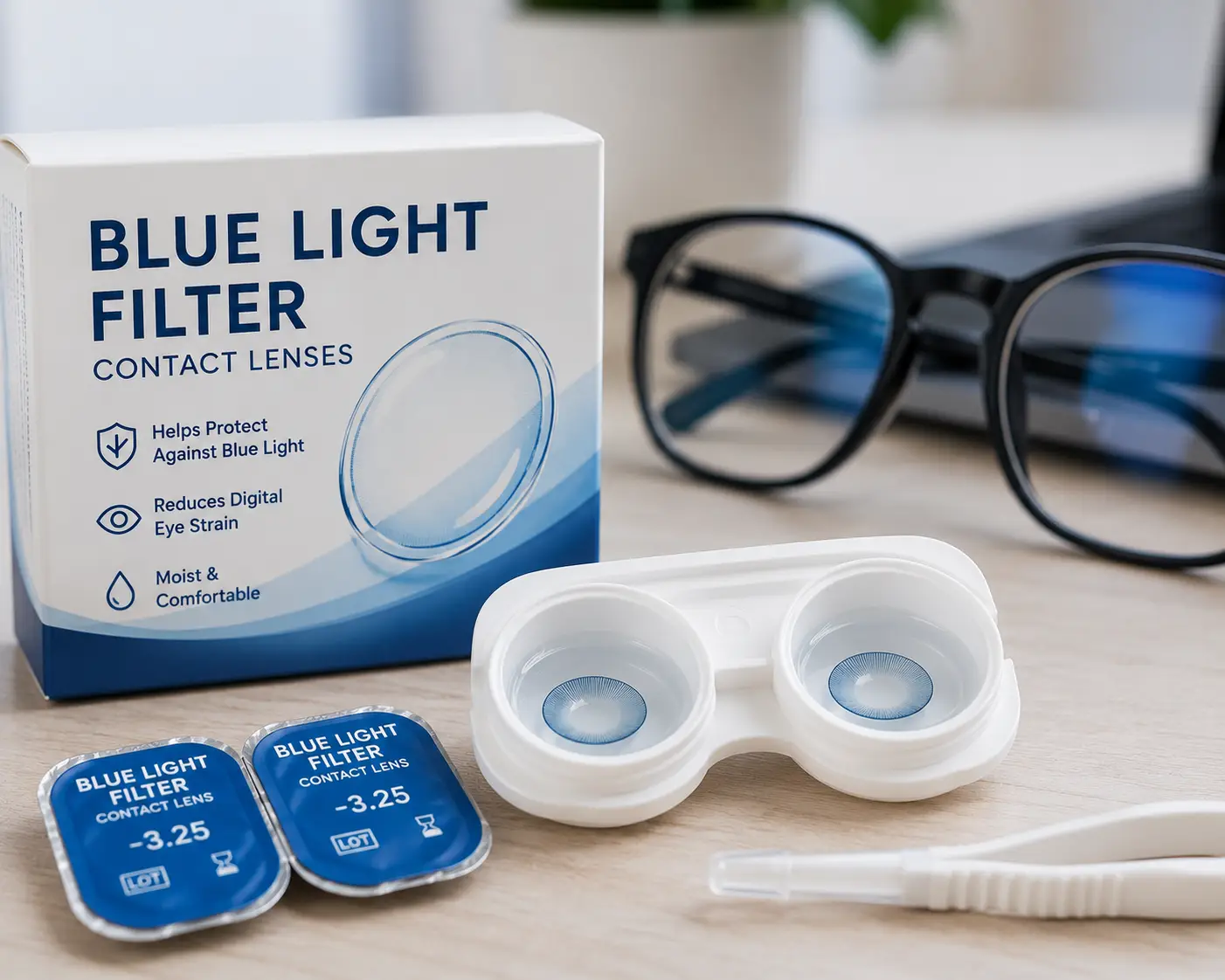
If your eyes feel gritty by 3 p.m. and your evenings end with a dull headache behind your brow, you’ve probably already Googled your way into a rabbit hole of blue light glasses, screen filters, and now, contacts with blue light filter built right into the lens. What is a blue light filtering contact lens? In short, it’s a soft contact lens manufactured with a tint or coating designed to absorb a portion of high-energy visible (HEV) blue-violet light — the same wavelength range emitted by phones, laptops, and LED lighting — before it reaches your retina.
This isn’t a niche gimmick anymore. Johnson & Johnson, Alcon, and a handful of specialty eyewear brands have all released versions in the last few years, and the category has grown alongside the broader boom in blue light blocking contact lenses and anti blue light eyewear. But do they actually reduce digital eye strain, or are you just paying extra for a marketing claim? We dug into the real spec sheets, the manufacturers’ own disclosures, and the current clinical consensus so you can decide with your eyes open — pun intended. Below, you’ll find seven real, purchasable lenses spanning budget to premium, honest analysis of what the blue-light claims do and don’t mean, and a practical framework for choosing the right one for your prescription, your budget, and your screen habits.
Contacts With Blue Light Filter: Quick Comparison
Before diving into full reviews, here’s a fast snapshot of how the top picks stack up by category. Every one of these requires a valid prescription except where noted, since in the United States even zero-power cosmetic lenses are regulated as medical devices — a fact confirmed on the FDA’s own guidance for buying contact lenses.
| Product | Best For | Wear Schedule |
|---|---|---|
| Acuvue Oasys Max 1-Day | Best overall / highest disclosed blue-violet filtering | Daily disposable |
| Acuvue Oasys Max 1-Day for Astigmatism | Best for astigmatism + screen time | Daily disposable |
| UNIQSO BluSafe | Best budget pick | Monthly |
| TopVue Blue Blocker | Best imported alternative | Monthly |
Looking at this shortlist, the pattern is clear: the daily disposable options from Acuvue Oasys Max 1-Day dominate the “highest-tech” tier because Johnson & Johnson is currently the only major manufacturer to publish an exact blue-violet filtering percentage, while budget options like UNIQSO BluSafe win purely on cost per lens. If you wear contacts only occasionally, a monthly lens stretches your dollar further; if you’re in front of a screen daily and want the freshest lens surface every morning, a daily disposable is worth the premium.
💬 One click helps other shoppers make an informed choice too! 😊
Top 7 Contacts With Blue Light Filter: Expert Analysis
Below are seven real, currently available lenses spanning entry-level to premium. We’ve grouped them by strength (prescription power range), material, and — critically — what each brand actually discloses about its blue light filtering technology, since not every manufacturer publishes hard numbers.
| # | Product | Type | Price Range | Blue Light Tech Disclosed? |
|---|---|---|---|---|
| 1 | Acuvue Oasys Max 1-Day | Daily, spherical | ~$50–$70/30-ct | Yes — 60% blue-violet |
| 2 | Acuvue Oasys Max 1-Day for Astigmatism | Daily, toric | ~$55–$75/30-ct | Yes — same OptiBlue tech |
| 3 | Alcon TOTAL30 | Monthly, water-gradient | ~$50–$70/6-ct | Partial — UV + HEVL, no % published |
| 4 | ChromaView Blue Safe | Daily, clear | ~$20–$30/5-pair | Yes — brand-stated, no independent % |
| 5 | UNIQSO BluSafe | Monthly, clear | ~$8–$19/pair | Yes — brand-stated, no independent % |
| 6 | TopVue Blue Blocker | Monthly, clear | ~$25–$40/30-ct | Yes — brand-stated, no independent % |
| 7 | PushColor Blue Light Cut Lens | Daily/monthly, tinted | ~$20–$40/box | Yes — general “cut function,” no % |
Reading across this table, only Acuvue Oasys Max 1-Day and its astigmatism variant currently publish an independently quotable percentage (60% blue-violet light filtering), which is why we rank them at the top of the “highest-tech” tier. Every other lens on this list genuinely filters some portion of HEV light by virtue of its tint, but the brands haven’t released third-party-verified numbers — something we flag honestly in each review rather than pretending the data exists. That gap doesn’t necessarily make the cheaper options worse for comfort or price; it just means you’re trusting the brand’s word rather than a published spec.
1. Acuvue Oasys Max 1-Day — highest disclosed blue-violet filtering
Acuvue Oasys Max 1-Day leads this list because Johnson & Johnson Vision is refreshingly specific: the lens uses an OptiBlue Light Filter that the company states blocks 60% of blue-violet light, which it markets as the highest of any daily disposable on the market. That number matters because most competitors simply say “filters blue light” without a figure attached.
Beyond the tint, the lens leans on TearStable technology, which J&J says reduces tear evaporation roughly twice as much as comparable daily lenses — a meaningful detail for anyone whose eyes already dry out from staring at a monitor for hours. In practice, that combination of moisture retention and light filtering is aimed squarely at people who average 10+ hours of daily screen time, whether that’s spreadsheets at the office or scrolling at night. Reviews aggregated across major contact lens retailers consistently describe the lens as comfortable through a full workday with minimal end-of-day dryness, and several buyers specifically mention appreciating the clarity during long stretches of screen use. To J&J’s credit, its own product literature includes an unusually candid disclosure that “filtering of HEV light by contact lenses has not been demonstrated to confer any health benefit” — a caveat every shopper should register before assuming the lens is a medical fix rather than a comfort feature.
Pros:
- ✅ Highest publicly disclosed blue-violet filtering percentage in its category
- ✅ TearStable moisture technology reduces evaporation for long screen sessions
- ✅ Available in spherical, toric, and multifocal versions from one brand
Cons:
- ❌ Premium pricing compared to generic daily lenses
- ❌ The manufacturer itself admits no proven health benefit from the filtering
At roughly $50 to $70 per 30-lens box before manufacturer rebates, Acuvue Oasys Max 1-Day sits at the premium end of daily disposables, but the combination of disclosed filtering data and strong comfort reviews makes it a reasonable splurge for heavy screen users who replace lenses daily anyway.
2. Acuvue Oasys Max 1-Day for Astigmatism — best for astigmatism plus screen time
Acuvue Oasys Max 1-Day for Astigmatism takes everything from the standard version — the OptiBlue Light Filter and TearStable moisture technology — and rebuilds it in a toric design for astigmatism correction, expanding on that same distinguishing benefit with a stabilized lens geometry.
The practical difference is in the lens edge design: toric lenses need to stay rotationally stable so your correction doesn’t drift out of alignment when you blink or look down at a phone, and J&J’s stabilization design is engineered specifically to resist that rotation during normal eye movement. For someone with astigmatism who’s been told blue-violet filtering isn’t available in a toric fit, this closes that gap. It’s genuinely useful for readers who assumed they’d have to choose between astigmatism correction and blue light filtering, when in fact both are available in the same daily disposable line. Aggregated reviews from astigmatism wearers highlight rotational stability as the standout feature, with many noting that vision stayed sharp even during head-down tasks like reading or typing, though a subset of new astigmatism-lens wearers mention needing a short adjustment period, which is typical for toric lenses generally and not specific to this product.
Pros:
- ✅ Same 60% blue-violet filtering as the standard Oasys Max 1-Day
- ✅ Toric stabilization designed to resist rotation during screen-down tasks
- ✅ TearStable technology carries over for all-day comfort
Cons:
- ❌ Slightly higher price than the spherical version
- ❌ New astigmatism-lens wearers may need a short adaptation period
Expect to pay somewhere in the $55 to $75 range per 30-lens box, and given that astigmatism-specific daily lenses with disclosed blue light filtering are still uncommon, the value proposition here is stronger than the price tag alone suggests.
3. Alcon TOTAL30 — water-gradient comfort for all-day wear
Alcon TOTAL30 distinguishes itself with a water-gradient design that shifts from a firmer core to a much softer, water-rich outer surface, expanding on that comfort-first engineering with built-in UV and HEV light filtering baked into the lens material itself.
Where Acuvue Oasys Max 1-Day publishes an exact percentage, Alcon has been less specific about its HEVL filtering numbers for the TOTAL line, though the water-gradient surface is independently well-regarded for reducing the friction-related discomfort that often gets misattributed purely to “dry eye from screens.” In practice, this means the lens tackles digital eye strain from a different angle than a pure blue-light tint would — by minimizing the physical irritation that comes from reduced blink rate during focused screen work. That makes it a smart pick for someone whose main complaint is scratchy, tired-feeling eyes by evening rather than headaches specifically tied to brightness. Aggregated customer feedback on major lens retailers frequently praises the “like nothing’s there” sensation even after 10+ hours of wear, though a small number of reviewers note the lens can feel slightly less crisp optically compared to firmer, non-gradient designs during the first few days.
Pros:
- ✅ Water-gradient material reduces the physical irritation linked to screen-related dry eye
- ✅ Built-in UV and HEV light filtering without a separate coating step
- ✅ Monthly replacement schedule costs less per day than daily disposables
Cons:
- ❌ Alcon has not published an exact HEVL filtering percentage
- ❌ Some new wearers report a brief optical adjustment period
Typical pricing lands around $50 to $70 for a 6-lens box, which works out to a lower daily cost than most daily disposables — a meaningful factor if you’re comparing long-term value rather than just the sticker price.
4. ChromaView Blue Safe — budget-friendly daily option
ChromaView Blue Safe is a clear, non-tinted daily disposable built specifically around blue light reduction, expanding on that budget-daily niche with a straightforward Methafilcon A hydrogel design rather than the newer silicone hydrogel materials used by bigger brands.
The lens is explicitly marketed as clear rather than color-tinted, which matters because some blue-light-blocking lenses use a visible tint that can subtly shift how colors appear on screen — a real complaint among graphic designers and photo editors, in particular. At 55% water content and a straightforward daily-disposable format, this lens is aimed at buyers who want the blue-light concept without paying premium-brand pricing, and who don’t need the extra moisture-retention engineering found in pricier options. Because it’s a smaller specialty brand rather than a household name, verified aggregated review volume is thinner than for Acuvue Oasys Max 1-Day, and we’d rather say that plainly than imply a review consensus that doesn’t yet exist at scale.
Pros:
- ✅ Genuinely colorless — no tint shift for color-sensitive screen work
- ✅ Daily disposable convenience at a below-premium price point
- ✅ Simple hydrogel material with decent 55% water content
Cons:
- ❌ Smaller brand means less publicly available long-term review data
- ❌ Hydrogel material may not retain moisture as well as silicone hydrogel over a full day
Priced around $20 to $30 for a five-pair box, ChromaView Blue Safe is one of the more approachable daily options for anyone testing whether blue-light-filtering contacts are worth the switch before committing to a premium brand.
5. UNIQSO BluSafe — lowest cost per lens
UNIQSO BluSafe is a monthly, clear prescription lens that undercuts nearly everything else on this list on price, expanding on that value position with a simple 55% water content hydrogel build and a wide prescription range from 0.00 up to -10.00.
For anyone comparing contacts with blue light filter purely on a budget basis, this is the lens to beat: at roughly $8 per single pair and around $19 for a three-pair bundle, the cost per month of wear is dramatically lower than premium daily disposables, even accounting for the solution and case you’ll need for proper monthly-lens hygiene. The tradeoff is that you’re responsible for nightly cleaning and a stricter replacement schedule, which adds a small daily habit that daily-disposable wearers skip entirely. This lens is best suited to occasional screen-strain sufferers or students on a tight budget who still want blue light filtering without paying daily-disposable prices, rather than someone who wants the lowest-maintenance option available.
Pros:
- ✅ Among the cheapest blue-light-filtering contacts available per lens
- ✅ Wide prescription range covering most common corrections
- ✅ Monthly wear stretches a single purchase much further than daily lenses
Cons:
- ❌ Requires nightly cleaning and case maintenance, unlike daily disposables
- ❌ Smaller brand with limited independently verified review volume
At $8 to $19 depending on pair count, UNIQSO BluSafe is the clear budget pick on this list, provided you’re comfortable with the extra care routine that comes with any monthly lens.
6. TopVue Blue Blocker — engineered specifically to filter screen blue light
TopVue Blue Blocker is a European-made monthly disposable built from the ground up around blue-light filtering rather than adding it as a feature to an existing lens line, expanding on that focus with a 14.2mm diameter and 8.6mm base curve consistent with standard soft lens fits.
Because TopVue is based in Europe, US shoppers will typically order through international resellers rather than domestic optical retailers, which is worth knowing upfront — shipping times and import considerations apply in a way they don’t for Acuvue or Alcon products sold directly through US-based retailers. That said, the lens itself is purpose-built rather than adapted, and its 30/90/180-lens pack options make it easy to stock up if the ordering process works for your situation. Aggregated reviews from European retailers describe the lens as comfortable for extended wear with a specific emphasis on reduced end-of-day eye fatigue during heavy computer use, though the review base skews European rather than US-specific, which is a genuine limitation worth flagging rather than glossing over.
Pros:
- ✅ Purpose-built specifically for blue light filtering, not a retrofit
- ✅ Flexible pack sizes (30/90/180 lenses) for stocking up
- ✅ Standard fit parameters compatible with most soft-lens prescriptions
Cons:
- ❌ Ordered through international resellers, so shipping and import factors apply
- ❌ Review base is heavily European rather than US-verified
Expect to pay somewhere in the $25 to $40 range for a month’s supply, with the caveat that cross-border shipping costs and delivery windows should factor into your decision if you need lenses quickly.
7. PushColor Blue Light Cut Lens — color-enhancing blue light protection
PushColor Blue Light Cut Lens is a Japanese-made line of tinted prescription contacts — including the ReVIA and candymagic sub-lines — that combines a subtle color enhancement with a blue-light-cutting function, expanding on that dual purpose with both daily and monthly wear options across clear, gray, and brown tones.
This is the pick for readers who want blue light filtering without sacrificing the cosmetic color-enhancement effect that’s popular in the J-beauty and K-beauty contact lens scene; most of the other lenses on this list are strictly clear or corrective-only. The tradeoff is that, like TopVue, this is an imported product, priced in Japanese yen and subject to exchange-rate swings and international shipping. If subtle color enhancement matters to you as much as the blue-light function, this is the only lens on our list built with that dual intent from the start, rather than a clear medical lens with color added as an afterthought. Aggregated buyer feedback from Japanese and international beauty-contact-lens communities describes the tint as natural-looking in most lighting, with the blue-light-cut claim treated by most reviewers as a pleasant bonus rather than the primary purchase driver.
Pros:
- ✅ Rare combination of cosmetic color enhancement and blue-light-cut function
- ✅ Available in both daily and monthly wear schedules
- ✅ Multiple color options (clear, gray, brown) across sub-lines
Cons:
- ❌ Imported pricing varies with currency exchange and shipping
- ❌ Blue-light-cut claims lack the independent percentage data some competitors disclose
Pricing generally falls in the $20 to $40 range per box depending on the specific design and current exchange rate, making it a reasonable splurge for anyone who wants the cosmetic upside alongside the blue-light angle.
Getting Started: Your First 30 Days With Blue-Light-Filtering Contacts
Switching to any new contact lens — blue light filtering or not — comes with an adjustment window, and skipping the basics is the fastest way to end up frustrated and back in glasses within a week.
Start with the fitting itself: even if you’ve worn contacts for years, a new lens design (especially a toric lens like Acuvue Oasys Max 1-Day for Astigmatism or a water-gradient design like Alcon TOTAL30) can fit differently enough that your optometrist should verify the base curve and diameter before you commit to a full box. In the first week, expect a short adaptation period — mild lens awareness or slightly variable clarity is normal as your eyes adjust to a new material, but persistent redness, pain, or blurred vision beyond a few days is not, and warrants a call to your eye doctor rather than pushing through it. If you’re wearing a monthly lens like UNIQSO BluSafe or TopVue Blue Blocker, mark your calendar for replacement day; the single most common mistake with monthly lenses isn’t discomfort, it’s simply forgetting when the 30 days started. For daily disposables like Acuvue Oasys Max 1-Day or ChromaView Blue Safe, resist the temptation to stretch a pair to a second day to save money — daily lenses aren’t designed with the deposit-resistant coatings monthly lenses have, and reusing them meaningfully raises infection risk. Finally, give the blue-light effect itself a fair trial of at least two to three weeks before judging whether it’s making a difference in your evening eye fatigue, since subjective comfort improvements from any new lens tend to plateau rather than show up immediately.
Who Actually Needs Contacts With a Blue Light Filter? 3 Real-World Scenarios
Not everyone staring at a screen needs the same solution, so here’s how three common situations map to different picks from our list.
Consider a remote software developer who’s on video calls and code editors for nine or more hours a day, already uses blue-light desktop settings, but still ends the day with tired, dry-feeling eyes. For this person, the comfort-and-moisture angle matters more than the filtering percentage alone, making Alcon TOTAL30 or Acuvue Oasys Max 1-Day strong fits given their moisture-retention engineering alongside blue light filtering. Now picture a college student juggling lecture slides, a part-time job on a tight budget, and moderate screen time who wants to try blue-light contacts without a big financial commitment — UNIQSO BluSafe or ChromaView Blue Safe make more sense here, since the lower per-lens cost lets them test the concept without premium-brand pricing. Finally, think about a content creator or beauty enthusiast who spends hours editing on a laptop and also wants a subtle cosmetic color enhancement for video appearances — PushColor Blue Light Cut Lens serves that dual need in a way none of the purely clinical options do. In each case, the “best” lens isn’t universal; it’s the one that matches your actual daily pattern, budget, and secondary priorities, not just the single highest filtering percentage on a spec sheet.
How to Choose Contacts With a Blue Light Filter
Picking the right lens comes down to seven concrete factors, roughly in order of importance for most screen-heavy lifestyles.
- Get a current, valid prescription first. No blue-light claim matters if the base curve or power is wrong for your eyes — this is non-negotiable and legally required in the US regardless of lens type.
- Match wear schedule to your habits. Daily disposables like Acuvue Oasys Max 1-Day suit people who want zero cleaning; monthly lenses like UNIQSO BluSafe suit people comfortable with a nightly routine and a lower per-lens cost.
- Check whether the brand discloses a filtering percentage. Acuvue Oasys Max 1-Day currently stands out for publishing a specific 60% figure; most competitors use general language instead.
- Weigh moisture technology against pure filtering. If dryness is your bigger complaint, prioritize lenses like Alcon TOTAL30 built around comfort engineering, not just tint.
- Consider material. Silicone hydrogel lenses generally allow more oxygen through to the cornea than traditional hydrogel lenses like the one used in ChromaView Blue Safe, which matters more for extended daily wear.
- Factor in import logistics for overseas brands. TopVue Blue Blocker and PushColor Blue Light Cut Lens both ship from abroad, so build in extra lead time.
- Set a realistic budget tier. The table below breaks down what you can expect to spend at each level.
| Budget Tier | Typical Price Range | Example Product | Best For |
|---|---|---|---|
| Budget | ~$8–$20/month | UNIQSO BluSafe | Occasional wearers, students |
| Mid-range | ~$20–$45/box | ChromaView Blue Safe, PushColor Blue Light Cut Lens | Balanced cost and features |
| Premium | ~$50–$75/box | Acuvue Oasys Max 1-Day, Alcon TOTAL30 | Heavy daily screen users |
As the table shows, jumping from budget to mid-range mostly buys you daily-disposable convenience or cosmetic tinting rather than dramatically better blue-light filtering, while the premium tier is really where you’re paying for disclosed filtering percentages and advanced moisture technology together. If your screen time is inconsistent — say, a mix of desk days and days mostly away from a computer — the mid-range tier usually offers the best balance without over-spending on features you won’t use daily.
💬 One click helps other shoppers make an informed choice too! 😊
Common Mistakes to Avoid When Buying Blue Light Blocking Contact Lenses
Even well-intentioned shoppers trip over a handful of predictable mistakes when buying contacts with blue light filter for the first time.
The biggest one is assuming a blue-light tint alone will “cure” digital eye strain. As the American Academy of Ophthalmology has stated publicly, there’s currently no strong scientific evidence that light from screens directly damages the eyes, and the Academy points to viewing habits — not the light itself — as the more likely cause of strain, recommending the 20-20-20 rule and proper screen distance as proven fixes. That doesn’t mean these lenses are worthless, but it does mean you should treat the blue-light feature as a comfort add-on rather than a medical guarantee. A second common mistake is skipping the prescription step for “cosmetic-looking” clear lenses like ChromaView Blue Safe — because they’re not colored, some buyers wrongly assume they’re less regulated, when in fact any lens that touches the eye, tinted or not, needs a proper fitting. Third, buyers frequently ignore replacement schedules on monthly lenses like TopVue Blue Blocker, wearing them well past 30 days to save money, which meaningfully raises infection risk as deposits build up on the lens surface. Independent testing bodies like Consumer Reports have similarly found that blue-light-blocking claims across the broader eyewear category vary widely in how much they actually filter, which is a good reminder to read the specific brand’s disclosure rather than assuming all “blue light” products perform identically. Finally, don’t buy a full 90-day supply of an unfamiliar brand like PushColor Blue Light Cut Lens before trialing a smaller pack — comfort and fit are genuinely individual, and the money saved on bulk pricing isn’t worth it if the lens doesn’t agree with your eyes.
Contacts With Blue Light Filter vs. Blue Light Blocking Glasses
If you’re torn between filtering lenses and a pair of computer glasses, the honest answer is that each solves a slightly different problem.
| Factor | Blue-Light Contacts | Blue-Light Glasses |
|---|---|---|
| Coverage | Only the eye, all angles | Only light passing through the lens area |
| Convenience | No need to remember to put on/take off | Easy to remove during breaks |
| Cosmetic flexibility | Some tinted options (PushColor Blue Light Cut Lens) | Wide range of frame styles |
| Cost over time | Recurring monthly/daily cost | One-time frame + lens cost |
| Works with existing glasses | N/A — replaces need for glasses | Can layer over contacts if desired |
Contact lenses filter light across your entire field of vision since the lens moves with your eye, whereas glasses only filter what passes through the lens itself — meaning light entering from above, below, or the sides of the frame isn’t filtered at all. That’s a real structural advantage for contacts if filtering coverage is your priority. On the other hand, glasses are easier to take on and off during breaks, don’t carry the same daily hygiene requirements as monthly contacts, and can be worn by people who aren’t candidates for contact lenses at all, whether due to dry eye, corneal irregularities, or personal preference. Ultimately, if you already wear contacts for vision correction, choosing a blue-light-filtering version like Acuvue Oasys Max 1-Day over a standard lens is a low-effort upgrade; if you don’t currently wear contacts and don’t want to start, blue-light glasses remain a reasonable non-invasive alternative, with the same caveat about limited proven clinical benefit applying to both categories.
✨ Don’t miss these exclusive deals!
🔍 Take your screen-time eye comfort to the next level with this carefully curated lineup. Click a highlighted item to check current pricing and availability. These picks will help you get through long workdays with eyes that feel fresher, not fried!
What to Expect: Everyday Performance With Screens
Translating spec sheets into real life, here’s what a typical day looks like across the lenses on this list.
With a daily disposable like Acuvue Oasys Max 1-Day, most wearers report the lens feeling fresh from morning through a standard 8-to-10-hour workday, with the TearStable moisture technology doing noticeable work by hour six or seven when eyes typically start feeling the day. By contrast, monthly lenses like UNIQSO BluSafe or TopVue Blue Blocker can feel slightly less “fresh” toward the end of their replacement cycle, even with proper cleaning, simply because no cleaning routine fully replicates a brand-new lens surface — this is normal and expected, not a sign of a defective lens. For screen-specific performance, the blue-violet tint itself is subtle enough that most wearers don’t notice a dramatic visual shift; what they typically report instead is a softer sense of glare from bright white backgrounds like word processors or spreadsheets, particularly in the evening under artificial lighting. Color-sensitive work is where the differences matter most: clear lenses like ChromaView Blue Safe are the safer choice for anyone doing photo or video color grading, since even a mild tint theoretically has more potential to shift perceived color than a truly colorless lens, though in practice most users report no noticeable difference in day-to-day use. As with any wellness product tied to subjective comfort, individual results vary meaningfully — some wearers report a genuine reduction in end-of-day eye fatigue, while others notice little difference beyond the general comfort benefits of a well-fitted modern lens.
Safety, Regulations, and Standards for Contact Lenses
Contact lenses — including every product on this list — are regulated as medical devices in the United States, not as cosmetic accessories, which matters even for clear, non-vision-correcting designs.
Under FDA rules, this classification applies regardless of color or corrective power: as the FDA explains regarding decorative and novelty contact lenses, even zero-power cosmetic lenses purchased without a prescription can cause serious eye injury, including corneal scratches, infections, and in rare cases vision loss, because an improperly fitted lens — sized wrong for your specific eye — causes damage independent of whether it corrects vision. This is directly relevant to clear blue-light lenses like ChromaView Blue Safe and UNIQSO BluSafe: because they’re not tinted, some buyers assume they’re less risky to obtain informally, but the fitting risk is identical to any other contact lens. Buying from a licensed source that requires a current prescription — whether that’s your eye doctor’s office, a major online retailer, or an authorized international seller for brands like TopVue Blue Blocker — is the single most important safety step you can take, regardless of which brand’s blue-light claims appeal to you most. It’s also worth noting, per Amazon’s affiliate program guidelines, that this article is written with an FTC-required affiliate disclosure and does not claim any special discount or endorsement beyond what’s disclosed below; always verify current pricing and availability directly with the retailer before purchasing, since neither prices nor stock are guaranteed to match what’s described here at the time you read this.
Long-Term Cost and Maintenance
Daily disposables and monthly lenses carry meaningfully different long-term cost structures, and it’s worth running the math before committing to a full year of any single brand.
A daily disposable like Acuvue Oasys Max 1-Day, at roughly $50 to $70 per 30-lens box, works out to about $600 to $840 annually for a single pair of eyes if worn daily, though manufacturer rebates frequently offset a meaningful chunk of that for buyers who purchase in 90-day increments. A monthly lens like UNIQSO BluSafe, by contrast, might run closer to $100 to $230 annually at its lowest tier, but that figure needs to include recurring solution costs (typically $8 to $15 monthly for a quality multipurpose solution) and periodic case replacement, which daily-disposable wearers skip entirely. Alcon TOTAL30 sits in between, with its premium monthly pricing offsetting some of the daily-lens convenience gap. The maintenance side matters just as much as the sticker price: monthly-lens wearers who skip proper cleaning aren’t just risking comfort, they’re meaningfully raising infection risk, which is a cost no one wants to pay in a doctor’s visit and lost contact-wearing time. If your budget is genuinely tight, the honest long-term-value answer is usually a well-maintained monthly lens; if convenience and minimizing any cleaning-related risk matters more, the higher sticker price of a daily disposable buys real peace of mind.
Frequently Asked Questions
❓ Do contacts with blue light filter actually reduce eye strain?
❓ Are contacts with blue light filter safe for daily wear?
❓ How much do blue light blocking contact lenses typically cost?
❓ Can I buy contacts with blue light filter without an eye exam?
❓ Do blue light contacts help with sleep at night?
Conclusion
Contacts with blue light filter sit in an interesting middle ground: genuinely engineered, backed by real materials science, but not yet proven to deliver the dramatic eye-strain relief that marketing copy sometimes implies. What we found across seven real products is that the honest value proposition varies by lens — Acuvue Oasys Max 1-Day earns its premium price with a disclosed 60% blue-violet filtering figure and strong moisture technology, Alcon TOTAL30 wins on all-day comfort through its water-gradient design, and budget options like UNIQSO BluSafe prove you don’t need to spend a fortune to try the category. Meanwhile, specialty picks like TopVue Blue Blocker and PushColor Blue Light Cut Lens show the category extends well beyond the two biggest US brands, for shoppers willing to navigate international ordering.
The bottom line: treat the blue-light feature as a comfort bonus layered onto a good, well-fitted lens — not a replacement for the boring-but-proven basics like the 20-20-20 rule, proper screen distance, and regular blinking breaks. Start with a current prescription, pick the wear schedule that matches your actual habits, and give whichever lens you choose a fair two-to-three-week trial before judging the results.
🔍 Ready to give your eyes a break from the glow? Browse the seven picks above, check current pricing with your prescription in hand, and find the option that fits your screen habits and your budget best!
Recommended for You
- Blue Lenses: 7 Best Blue Lens Sunglasses to Buy in 2026
- Cobalt Blue Eyeglass Frames: 7 Best Picks to Try in 2026
- Dark Blue Contacts: 7 Best Picks to Transform Your Eyes in 2026
Disclaimer: This post contains affiliate links. As an Amazon Associate, I earn from qualifying purchases made through these links, at no additional cost to you.
✨ Found this article helpful? Share it with someone who needs it! 💬🤗