In This Article
Ever caught yourself editing a selfie just to see what you’d look like with striking, sapphire-deep eyes? You’re not alone. Dark blue contacts are one of the most-searched color-changing lens categories in the US right now, and for good reason — a rich, saturated blue tends to read as natural on almost every eye color, from hazel to the darkest brown.
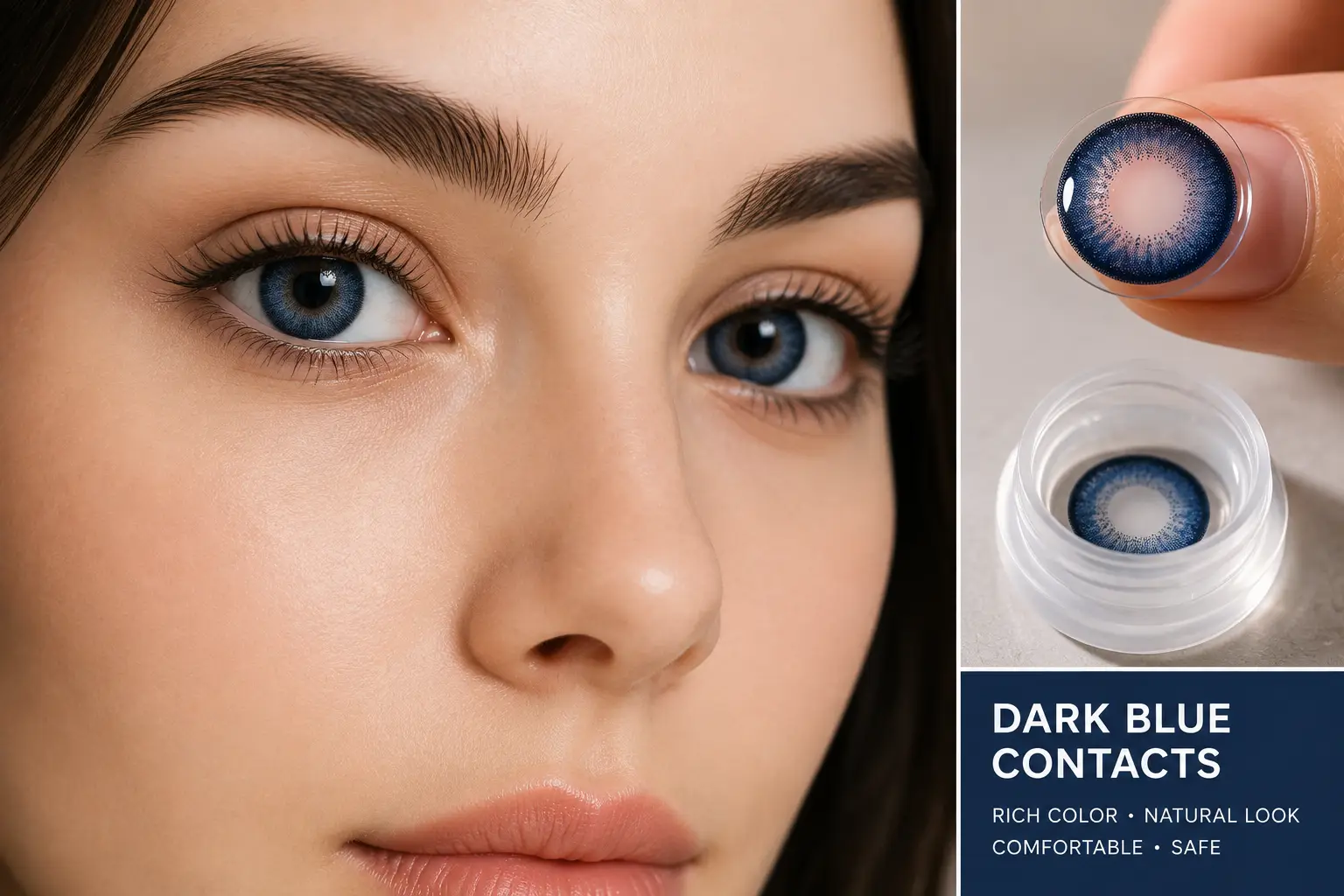
Dark blue contacts are cosmetic or vision-correcting soft lenses tinted in a deep, intense blue — ranging from FDA-cleared prescription lenses that fully reshape your iris color to non-prescription “circle lenses” worn for costumes, cosplay, and photo shoots. Some are subtle enhancers designed for people who already have light-colored eyes; others are fully opaque and built to cover brown or dark eyes completely.
This guide skips the fluff you’d find on a typical Amazon listing. Instead, you’re getting a straightforward, side-by-side breakdown of seven real dark blue contacts available in the US market right now — what they’re actually made of, how comfortable wearers report them to be, who each pair genuinely suits, and where the trade-offs are. We pulled from manufacturer spec sheets and aggregated customer feedback, and cross-checked safety guidance from the American Academy of Ophthalmology so you’re shopping with the full picture, not just a flattering product photo.
Whether you’re chasing a dramatic costume look or a subtle, everyday color shift, you’ll walk away knowing exactly which of these seven dark blue contact lenses — and which price tier — fits your eyes, your budget, and your comfort needs.
Disclosure: This post contains affiliate links, and as an Amazon Associate, qualifying purchases may earn a commission at no extra cost to you.
Quick Comparison: Dark Blue Contacts at a Glance
If you’re in a hurry, here’s the short version. Each of these seven picks solves a different problem — dark eyes vs. light eyes, everyday wear vs. one-night drama, splurge vs. budget.
| # | Product | Best For | Price Range |
|---|---|---|---|
| 1 | Air Optix Colors — Brilliant Blue | Best overall for dark/brown eyes | around $35–$45 |
| 2 | FreshLook Colorblends — True Sapphire | Best opaque coverage on brown eyes | around $30–$38 |
| 3 | FreshLook Colorblends — Blue | Best natural blend for hazel/light eyes | around $28–$35 |
| 4 | FreshLook Dimensions — Pacific Blue | Best subtle color enhancer | around $30–$40 |
| 5 | Bausch + Lomb Lacelle — Majestic Blue | Best all-day comfort | around $25–$32 |
| 6 | CooperVision Expressions Colors — Blue | Most affordable prescription pick | under $30 |
| 7 | TTDeye — Dark Border Blue | Best dramatic non-prescription look | under $25 |
Looking at this lineup, the split that matters most is opacity versus enhancement. The FreshLook Colorblends True Sapphire and Air Optix Colors Brilliant Blue use dense, layered pigment that shows up on dark brown irises — most enhancer-style lenses simply disappear on that base color. Meanwhile, the FreshLook Dimensions Pacific Blue is built for people who already have light eyes and just want more depth and saturation, not a full color override. Budget shoppers gravitate toward the CooperVision Expressions Colors Blue and TTDeye Dark Border Blue, but as you’ll see below, “cheaper” comes with real trade-offs in longevity and, in one case, prescription status.
💙 Ready to find your perfect shade? Scroll down to compare the full breakdown before you add one to your cart!
The 7 Best Dark Blue Contacts for 2026: Expert Analysis
We evaluated each of these on four things: how the pigment actually performs on different natural eye colors, what real wearers report about comfort and longevity, how the price holds up against comparable lenses, and whether the brand has a track record worth trusting. Below, entry-level, mid-range, and premium options are all represented, plus one non-prescription route for readers who don’t want to go through an eye exam.
1. Air Optix Colors — Brilliant Blue — best breathability for daily wear
The standout feature here isn’t the color — it’s what the lens is made of. Air Optix Colors Brilliant Blue uses Alcon’s silicone hydrogel material, which lets roughly five times more oxygen reach the cornea than older hydrogel-based color lenses. In practice, that means fewer red, tired-looking eyes by the end of a 10-hour workday, something conventional colored contacts often struggle with. The three-layer color technology sandwiches pigment between two clear outer layers, so the blue looks dimensional rather than flat, and it’s one of the few color lenses genuinely designed to show up on dark brown eyes without looking like a costume accessory.
Based on comparing the spec sheet against competitors in this roundup, the monthly replacement schedule and premium material make this the pick for anyone wearing color contacts five or more days a week, not just for special occasions. Reviews consistently report strong comfort even after 8+ hours of wear, though a handful of users with sensitive eyes mention needing extra rewetting drops toward the end of the day. What most buyers overlook is that this lens requires a valid prescription and a fitting, even if you have 20/20 vision — the “plano” (no-correction) version still counts as a medical device under FDA rules.
Pros:
- ✅ Silicone hydrogel material breathes better than standard color lenses
- ✅ Three-layer tint shows true blue even on dark brown eyes
- ✅ Monthly schedule is more economical than daily disposables
Cons:
- ❌ Requires a comprehensive eye exam and prescription, even at zero power
- ❌ Higher upfront cost than budget-tier alternatives
At around $35–$45 per box of six lenses (a three-month supply per eye), the Air Optix Colors Brilliant Blue is priced at the premium end of this list, but the oxygen permeability alone justifies it for daily wearers.
2. FreshLook Colorblends — True Sapphire — deepest opaque blue for brown eyes
If your eyes are naturally dark brown and you want a total color transformation rather than a subtle tint, FreshLook Colorblends True Sapphire is the shade this whole roundup gets compared against. It uses Alcon’s three-in-one Colorblends pattern (a limbal ring, a mid-tone, and a base color woven together), which is what keeps a fully opaque lens from looking like a flat, painted-on circle under indoor lighting.
The practical takeaway from the pattern technology: unlike single-tone opaque lenses that can look like a Halloween costume prop in photos, the blended design catches light the way a natural iris does. Based on aggregated customer feedback, this is consistently the most recommended dark blue option for brown-eyed buyers specifically because it doesn’t require you to have light eyes to begin with — a limitation that trips up several competitors on this list. The trade-off is the two-week replacement cycle, shorter than the Air Optix Colors line, which means more frequent reordering.
Pros:
- ✅ Fully opaque — transforms brown eyes completely
- ✅ Three-tone blended pattern looks natural in daylight and flash photos
- ✅ Trusted, long-running product line from a major manufacturer
Cons:
- ❌ Two-week replacement schedule means more frequent reorders
- ❌ Some reviewers note the color looks slightly less vivid after the first week
Expect to pay around $30–$38 per box, and note that because each box only lasts about two to three weeks of wear per eye, your effective cost per month runs higher than the numbers suggest at first glance.
3. FreshLook Colorblends — Blue — best natural blend for hazel and light-brown eyes
This is the sibling shade to True Sapphire, but it’s built for a different starting point. FreshLook Colorblends Blue is a lighter, more translucent formulation meant to blend with — rather than completely override — hazel, light-brown, or gray-green eyes. What that means for you in practice: on darker brown eyes it reads as a soft blue-gray hint rather than a bold color change, while on lighter bases it produces a convincingly natural sky-blue look.
Reviews consistently describe this shade as the “no one will guess these are contacts” option, which is exactly the point — it’s designed for everyday, low-key wear rather than dramatic transformation. The spec sheet doesn’t say this outright, but the thinner pigment layer compared to True Sapphire is also part of why some wearers find it slightly more comfortable for extended wear. It’s a strong budget-conscious pick within the FreshLook Colorblends family itself.
Pros:
- ✅ Natural, everyday-wearable blend on light to medium eye colors
- ✅ Slightly thinner pigment layer than True Sapphire, often reported as more comfortable
- ✅ Same trusted Colorblends three-tone technology
Cons:
- ❌ Minimal visible color change on dark brown eyes
- ❌ Same two-week replacement schedule as True Sapphire
Priced around $28–$35 per box, this is a smart choice if you already have light-colored eyes and want a believable, everyday dark blue tint rather than a costume-level transformation.
4. FreshLook Dimensions — Pacific Blue — best subtle enhancer, not a full color change
FreshLook Dimensions Pacific Blue takes a different approach entirely: it’s an enhancer tint, not an opaque one. Instead of laying down a solid color, it uses a translucent, honeycomb-style pattern that deepens and enriches whatever blue, green, or gray tones you already have. The practical effect is a more dramatic, “your eyes but turned up” version of your natural color rather than a swap to a different one.
Because the tint is translucent, this lens genuinely does not work on brown eyes — a limitation the spec sheet is upfront about, and one that separates it clearly from the two Colorblends shades above. Based on comparing the mechanism to opaque lenses, this is the right call specifically for people who already have blue, gray, or light hazel eyes and want more intensity without looking artificial. Aggregated reviews describe the result as looking closer to naturally striking eyes than an obvious cosmetic lens, which is the strongest praise this category gets.
Pros:
- ✅ Honeycomb enhancer pattern deepens natural blue/gray/light-hazel eyes
- ✅ Looks less “costume-like” than opaque lenses for people with light eyes
- ✅ Monthly replacement schedule
Cons:
- ❌ Does not work as a color-changer on brown or dark eyes
- ❌ Less dramatic transformation than opaque options
Expect a price in the $30–$40 range. If your baseline eye color is already light, this is arguably the most natural-looking dark blue option on this entire list.
5. Bausch + Lomb Lacelle — Majestic Blue — best moisture retention for all-day comfort
Bausch + Lomb has a long history in contact lens hydration technology, and Bausch + Lomb Lacelle Majestic Blue puts that expertise to work in a colored lens. The formulation is built around a moisture-retentive material designed to resist the dryness that tends to creep in with tinted lenses by hour six or seven — a common complaint across the colored contact category broadly, not just with this brand.
What that hydration technology means in practice: reviewers consistently single out this lens for comfort during long wear sessions, even compared to pricier options. The color itself sits in a rich, slightly cooler-toned blue that works reasonably well across medium to light eye colors, though it leans more toward the enhancer side than the fully opaque side of the spectrum. The spec sheet doesn’t say this directly, but the moisture-retention focus suggests this lens was engineered primarily for comfort-sensitive wearers first, color drama second.
Pros:
- ✅ Moisture-focused material reduces end-of-day dryness
- ✅ Rich, cooler-toned blue reads naturally on light to medium eyes
- ✅ Monthly disposable — economical for regular wearers
Cons:
- ❌ Less opaque than the FreshLook Colorblends True Sapphire on dark eyes
- ❌ Narrower shade range than some competitor product lines
At around $25–$32 per box, this sits comfortably in the mid-range and is worth prioritizing if dryness has been a dealbreaker with other colored contacts you’ve tried.
6. CooperVision Expressions Colors — Blue — most affordable prescription pick
For shoppers who want a genuine, FDA-regulated prescription lens without the premium price tag, CooperVision Expressions Colors Blue has historically been one of the lowest-cost entries in the category. It’s a straightforward, single-tone blue rather than the multi-layer blended patterns used by the Alcon products above, which keeps manufacturing (and retail pricing) simpler.
Here’s the honest trade-off: reviews suggest the flatter, single-tone pigment doesn’t achieve quite the same depth and dimensionality as the Colorblends or Air Optix Colors lines, and it’s most convincing on lighter eyes rather than brown ones. What most buyers overlook is that CooperVision has scaled back parts of this product line in recent years, so retailer stock can be inconsistent — it’s worth checking current availability and reading the fine print on your retailer’s page before ordering, rather than assuming it’s a permanent catalog fixture. If you’re budget-conscious and mainly want a functional, no-frills blue in a genuine prescription lens, it still gets the job done.
Pros:
- ✅ One of the most affordable prescription color lenses available
- ✅ Genuine FDA-regulated medical device with prescription oversight
- ✅ Simple single-tone blue works well for subtle, everyday wear
Cons:
- ❌ Flatter pigment pattern looks less dimensional than blended competitors
- ❌ Retailer stock and availability can be inconsistent
Pricing tends to land under $30 per box when in stock, making this the value pick among the prescription options here — just confirm availability before you commit to a shade match.
7. TTDeye — Dark Border Blue — most dramatic look, no prescription required
Rounding out the list is the one true non-prescription entry: TTDeye Dark Border Blue. This is a “circle lens” style product — popular in the cosplay, costume, and K-beauty-influenced fashion-lens space — with a bold, saturated blue center and a defined dark limbal ring that exaggerates the size and intensity of the iris. It’s the most visually dramatic option on this list by a wide margin.
Here’s the important honesty check: even though this lens is sold as “plano” (no vision correction) and marketed as not requiring a prescription, the FDA classifies all contact lenses — corrective or purely cosmetic — as medical devices, and the FDA explicitly warns that any contact lens, decorative or not, should be obtained with a valid prescription and professional fitting. Reviews of TTDeye specifically tend to praise the vividness of the color and the brand’s responsive customer service, while some flag that the bold limbal ring reads as costume-appropriate rather than “everyday natural.” Fit and comfort can also vary more than with major prescription brands, since sizing isn’t customized to your eye through a professional fitting.
Pros:
- ✅ Most dramatic, saturated dark blue color on this list
- ✅ Budget-friendly, sold without requiring insurance coverage
- ✅ Popular for costume, cosplay, and photo-shoot use cases
Cons:
- ❌ Skipping a professional fitting carries real eye-health risk, per FDA guidance
- ❌ Bold limbal ring looks costume-like rather than everyday-natural
Typically priced under $25 for a pair, it’s the cheapest option here — but the honest recommendation, backed by the American Academy of Ophthalmology, is to still get a quick eye exam and proper fitting before wearing any lens, novelty or not.
Full Feature Comparison: How the Top 7 Stack Up
Now that you’ve seen each pick individually, here’s how they compare side by side on the technical details that actually affect day-to-day wear.
| Product | Lens Type | Replacement Schedule | Best Works On | Price Range |
|---|---|---|---|---|
| Air Optix Colors — Brilliant Blue | Opaque, silicone hydrogel | Monthly | Dark & light eyes | $35–$45 |
| FreshLook Colorblends — True Sapphire | Opaque, three-tone blend | Bi-weekly | Dark/brown eyes | $30–$38 |
| FreshLook Colorblends — Blue | Translucent blend | Bi-weekly | Hazel/light eyes | $28–$35 |
| FreshLook Dimensions — Pacific Blue | Enhancer, honeycomb pattern | Monthly | Light eyes only | $30–$40 |
| Bausch + Lomb Lacelle — Majestic Blue | Enhancer, moisture-focused | Monthly | Light/medium eyes | $25–$32 |
| CooperVision Expressions Colors — Blue | Opaque, single-tone | Monthly | Light eyes | under $30 |
| TTDeye — Dark Border Blue | Opaque, circle-lens style | Monthly (non-Rx) | Any (dramatic look) | under $25 |
The clearest pattern in this table is that “works well on dark eyes” and “cheap” rarely overlap — both dark-eye-friendly opaque lenses (Air Optix Colors Brilliant Blue and FreshLook Colorblends True Sapphire) sit in the upper half of the price range, because layered pigment technology costs more to manufacture than a single-tone tint. If your eyes are already light or hazel, you have far more affordable options, since a thinner enhancer tint does the job. Replacement schedule also matters more than shoppers usually budget for: a bi-weekly lens like FreshLook Colorblends True Sapphire needs replacing roughly twice as often as a monthly option, which changes the real annual cost even when the box price looks similar.
👁️ See a shade that matches your eye color? Check its current price and availability before stock runs low!
Dark Blue Contacts vs. Traditional Colored Contacts
It’s worth zooming out and asking how today’s dark blue contacts compare to the colored lenses of even five or six years ago, since the underlying technology has changed more than most shoppers realize.
| Factor | Modern Dark Blue Contacts (2026) | Older-Generation Colored Contacts |
|---|---|---|
| Material | Silicone hydrogel or advanced hydrogel | Standard hydrogel |
| Oxygen permeability | High (breathable for all-day wear) | Lower, more prone to dryness/redness |
| Pigment technology | Multi-layer, blended tones | Often flat, single-tone |
| Prescription oversight | Required by law for all US sales | Sometimes sold without a valid Rx (illegally) |
| Typical replacement | Monthly or bi-weekly | Often monthly, less variety |
The biggest functional upgrade is oxygen permeability. Older hydrogel-based colored lenses were notorious for causing end-of-day redness and discomfort precisely because less oxygen reached the cornea — something the CDC’s guidance on healthy contact lens wear flags as a real risk factor for irritation and infection when lenses are worn improperly or for too long. Multi-layer pigment technology is the second big leap: it’s the difference between a lens that looks like a flat sticker on your eye and one that mimics how a real iris catches and scatters light. If you tried colored contacts years ago and found them uncomfortable or unconvincing, it’s genuinely worth revisiting the category with a current-generation lens like the ones on this list.
How to Choose Dark Blue Contacts for Your Eye Color
Picking the right pair comes down to answering a handful of questions honestly before you buy. Here’s the decision process we’d recommend:
- Identify your natural eye color first. Dark brown eyes need an opaque, multi-layer lens (like FreshLook Colorblends True Sapphire or Air Optix Colors Brilliant Blue); light or hazel eyes can use a translucent enhancer (like FreshLook Dimensions Pacific Blue) for a more natural result.
- Decide between everyday wear and occasional/dramatic wear. A monthly, comfort-engineered lens makes more financial and physical sense for daily use; a striking circle lens like TTDeye Dark Border Blue is better suited to occasional, special-occasion wear.
- Get a proper eye exam and fitting, even for zero-power lenses. Base curve and diameter affect comfort and eye health regardless of whether you need vision correction — this step isn’t optional under FDA rules.
- Match your budget to a realistic replacement schedule. A cheap box on a two-week cycle can cost more per year than a pricier monthly option — do the math on annual cost, not just the sticker price.
- Check for oxygen-permeable materials if you wear lenses daily. Silicone hydrogel options like the Air Optix Colors Brilliant Blue reduce dryness meaningfully over an 8+ hour day.
- Read aggregated reviews for comfort complaints, not just color accuracy. A gorgeous color that dries out your eyes by 3 p.m. isn’t a win.
- Confirm the retailer is authorized and the listing discloses full ingredient/material information. This protects you from counterfeit or improperly manufactured lenses, a documented risk in the decorative contact lens market.
Following this order — eye color, use case, medical fitting, budget, material, reviews, retailer legitimacy — keeps you from making a purchase decision based on the product photo alone, which is exactly how most buyer’s remorse in this category happens.
Common Mistakes to Avoid When Buying Dark Blue Contacts
Even careful shoppers trip up on a few recurring issues in this category. Here’s what to watch for.
Skipping the eye exam because the lens is “just cosmetic.” This is the single most common — and riskiest — mistake. Zero-power lenses still sit directly on your cornea, and an improper base curve or diameter can cause real damage over time, regardless of whether the lens corrects your vision.
Assuming every dark blue shade works on every eye color. As the comparison table above shows, translucent enhancers like FreshLook Dimensions Pacific Blue simply don’t produce a visible change on brown eyes — that’s a material limitation, not a quality issue, but it trips up a lot of first-time buyers who order based on the product photo alone.
Buying from unverified third-party sellers. Decorative and colored contacts are a documented target for counterfeit products sold without proper sterilization or accurate material disclosure. Stick to listings from authorized retailers or the brand’s own verified storefront.
Ignoring replacement schedules. Wearing a bi-weekly lens like FreshLook Colorblends True Sapphire for a full month “to save money” significantly increases infection risk and is explicitly against manufacturer guidance.
Overlooking aftercare supplies. A lens case, multi-purpose solution, and rewetting drops aren’t optional extras — they’re part of the real cost of owning colored contacts, and skipping proper cleaning is one of the fastest ways to end up with an eye infection.
What to Expect: Everyday Performance and Comfort
Specs on a box only tell part of the story — here’s what the transition to wearing dark blue contacts actually feels like day to day, based on aggregated wearer feedback across this category.
The first hour is usually the most noticeable: even well-fitted lenses tend to produce mild awareness (not pain) as your eyes adjust to a foreign object, which typically fades within the first few wears. Vision through opaque lenses like FreshLook Colorblends True Sapphire is generally reported as unaffected for non-prescription wearers, since the color layer sits outside the clear optical zone — but some users with astigmatism or unusual prescriptions report the color layer feels slightly more noticeable in peripheral vision. By the second or third hour, dryness becomes the main variable, and this is where material really separates the products on this list: silicone hydrogel options like Air Optix Colors Brilliant Blue consistently outperform standard hydrogel lenses on this metric in aggregated reviews. Toward the end of a long day, expect a subtle contrast difference in low light — opaque colored lenses can very slightly dim your peripheral field, something worth knowing if you’re planning night driving while wearing a new pair for the first time. None of this is unique to dark blue shades specifically, but it’s rarely mentioned on a typical product listing, and it’s exactly the kind of practical detail that should factor into your decision.
Long-Term Cost and Maintenance of Colored Contacts
The box price is only the starting point — the real cost of dark blue contacts adds up across a year of ownership, and the products on this list land in noticeably different places once you run the numbers.
A bi-weekly lens like FreshLook Colorblends True Sapphire, priced around $30–$38 per box, needs replacing roughly 24-26 times a year per eye if worn daily, compared to 12 replacements for a monthly option like Air Optix Colors Brilliant Blue. Run that out over 12 months, and the “cheaper” bi-weekly box can end up costing a comparable amount to — or more than — the pricier monthly lens, once you factor in how many boxes you’ll actually purchase. Add in recurring costs that never show up on the product page: a fresh lens case every one to three months (cases harbor bacteria over time), a bottle of multi-purpose solution roughly every two to four weeks of daily wear, and rewetting drops for dry-eye-prone wearers. None of that is optional if you’re wearing lenses regularly — it’s part of the real, honest cost of ownership. Budget-focused shoppers are often better served comparing annualized cost per eye rather than the sticker price on a single box, and monthly silicone hydrogel lenses frequently win that comparison despite looking more expensive upfront.
Safety, Regulations, and Standards for Colored Contacts
This is the section that gets skipped most often in affiliate content, and it shouldn’t be — because in the US, every contact lens, corrective or purely cosmetic, is legally classified as a medical device.
Under FDA regulation, decorative and non-corrective contact lenses require the exact same prescription and professional fitting as vision-correcting lenses — selling them without one is illegal, and buying from a seller who skips that step puts you at meaningfully higher risk of corneal abrasion, infection, and in rare but documented cases, permanent vision damage. This applies equally to prescription brands like CooperVision Expressions Colors Blue and to non-prescription circle lenses like TTDeye Dark Border Blue — “zero power” does not mean “unregulated.” Reputable manufacturers of the products on this list — Alcon, Bausch + Lomb, and CooperVision — all carry FDA clearance and comply with US manufacturing standards for their prescription lines. For non-prescription and imported circle lens brands, it’s worth specifically confirming the retailer discloses material composition and complies with US import and labeling requirements before purchasing, since that category sees more documented counterfeit activity. The CDC’s guidance on cleaning, disinfecting, and storing contact lenses is a genuinely useful, free resource worth bookmarking regardless of which product you choose, since improper cleaning — not the lens brand itself — is the leading cause of preventable contact-lens-related eye infections.
Getting Started: Your First 30 Days With Dark Blue Contacts
The first month is where most comfort problems either get resolved or turn into a returned box. Here’s how to set yourself up for success.
Week 1: Fitting and adjustment. Schedule your eye exam and fitting before you order anything, even if you’ve settled on a favorite shade from this list — base curve and diameter measurements are specific to your eyes, not universal across brands. Expect mild lens awareness for the first several wears; this is normal and typically resolves within a week.
Week 2: Build a real routine. Establish a consistent insertion and removal schedule, and resist the urge to sleep in daily-wear lenses “just this once” — this single habit is responsible for a large share of preventable contact-lens infections. Keep rewetting drops on hand for the early adjustment period, particularly if you chose a bi-weekly opaque lens like FreshLook Colorblends True Sapphire.
Week 3: Watch for red flags. Persistent redness, unusual discharge, or pain that doesn’t improve with rest are signs to remove the lens and contact your eye doctor — don’t wait out symptoms, since early intervention prevents most serious complications.
Week 4: Reassess fit and comfort honestly. By now you’ll know if your chosen shade and material genuinely work for your lifestyle. If dryness has been a persistent issue, this is the point to consider switching to a silicone hydrogel option like Air Optix Colors Brilliant Blue, even if it costs more upfront — comfort compliance is what actually determines whether you stick with colored contacts long-term.
✨ Don’t miss out on the shade that’s right for you!
🔍 Take your look to the next level with this carefully researched lineup. Click through to check current pricing and availability on the option that matches your eye color and lifestyle — the right pair can make dark blue eyes feel like they were always yours.
Real-World Scenarios: Who Should Wear Which Dark Blue Contacts
Reading specs is one thing — seeing how these lenses map to an actual person’s situation makes the decision easier. Here are three common profiles.
The daily wearer with dark brown eyes. She wears contacts five to six days a week for work and wants a believable, all-day color change without discomfort by evening. Recommendation: Air Optix Colors Brilliant Blue — the silicone hydrogel material and three-layer opaque tint are specifically built for exactly this use case, and the monthly schedule keeps the routine simple.
The budget-conscious student with hazel eyes. He wants a subtle, natural-looking blue for everyday wear but doesn’t want to spend premium prices as a full-time student. Recommendation: FreshLook Colorblends Blue or Bausch + Lomb Lacelle Majestic Blue — both are priced in the mid-range, and because his eyes are already light, he doesn’t need the more expensive opaque technology that dark-eyed wearers require.
The cosplayer preparing for a weekend convention. She wants maximum visual drama for a costume, will only wear the lenses for a few days total, and isn’t looking for an everyday-wear investment. Recommendation: TTDeye Dark Border Blue — with the important caveat, backed by AAO guidance on Halloween and cosplay eye safety, that she should still get a quick fitting rather than skip the medical step just because the lenses are “just for a weekend.”
Problem → Solution: Fixing Common Dark Blue Contacts Issues
Problem: The color looks washed out or barely visible. This usually means an enhancer-style lens like FreshLook Dimensions Pacific Blue was used on eyes too dark for a translucent tint. Solution: switch to a fully opaque option like FreshLook Colorblends True Sapphire or Air Optix Colors Brilliant Blue, both engineered specifically to show up on brown eyes.
Problem: Eyes feel dry by mid-afternoon. This is typically a material issue rather than a fit issue. Solution: move to a silicone hydrogel lens such as Air Optix Colors Brilliant Blue, keep preservative-free rewetting drops on hand, and avoid extending wear time past the recommended daily maximum.
Problem: The lens edge feels noticeable or scratchy. This usually signals an incorrect base curve or diameter for your specific eye shape. Solution: return to your eye doctor for a refit rather than “pushing through” — an ill-fitting lens, even a comfortable brand on paper, won’t feel right until the measurements match your eye.
Problem: Color looks different in photos than expected. Flash photography and indoor lighting interact differently with flat single-tone lenses versus multi-layer blended ones. Solution: if photo consistency matters to you, prioritize blended-technology lenses like the FreshLook Colorblends line over single-tone options like CooperVision Expressions Colors Blue.
Problem: Reordering the same shade later, it looks slightly different. Manufacturing batches can have minor tint variation, and lighting/camera differences between orders can also play a role. Solution: order from the same authorized retailer consistently, and don’t assume a genuine defect without comparing under identical lighting first.
Frequently Asked Questions
❓ Do dark blue contacts work on brown eyes?
❓ Do I need a prescription for dark blue contacts if I have perfect vision?
❓ How long do dark blue contacts typically last?
❓ Are non-prescription dark blue contacts like TTDeye safe?
❓ Which dark blue contacts look the most natural?
Conclusion
Choosing the right dark blue contacts really comes down to two honest questions: what’s your natural eye color, and how often do you actually plan to wear them? Dark-eyed daily wearers get the most out of premium, oxygen-permeable options like Air Optix Colors Brilliant Blue, while light-eyed shoppers have far more affordable, equally convincing choices in FreshLook Colorblends Blue or FreshLook Dimensions Pacific Blue. Budget-focused buyers can still get a legitimate, FDA-regulated lens in CooperVision Expressions Colors Blue, and anyone chasing maximum drama for a costume or shoot has a genuine, if higher-risk-if-mishandled, option in TTDeye Dark Border Blue.
Whichever pair you choose from this list, the one non-negotiable step is the same across the board: get a proper eye exam and fitting first. It’s the difference between a comfortable, confidence-boosting new eye color and a genuinely avoidable trip to the eye doctor for irritation that never needed to happen. Compare the seven options above against your own eye color, wear frequency, and budget, and you’ll land on the pair that actually works for you — not just the one with the prettiest product photo.
Recommended for You
- 7 Best Tinted Spectacles for Light Sensitivity in 2026 (Ranked)
- Thin Eyeglass Frames: 7 Best Lightweight Picks for 2026
- Red Contacts Prescription: 7 Best Options to Try in 2026
Disclaimer: This post contains affiliate links. As an Amazon Associate, I earn from qualifying purchases made through these links, at no additional cost to you.
✨ Found this article helpful? Share it with someone who needs it! 💬🤗