In This Article
If you’ve started shopping and the photochromic lenses price tags all over the internet seem to swing wildly — from $15 drugstore-style sunglasses to $300+ designer frames — you’re not imagining things. Photochromic lenses price depends on far more than the “light-adapting” gimmick on the box: lens material, coating quality, brand engineering, and whether you’re buying off-the-shelf sunglasses or custom prescription lenses all move the number dramatically.
This guide breaks down exactly what you’re paying for at each price tier, walks through seven real, currently available pairs spanning entry-level to premium, and gives you a framework for deciding how much you actually need to spend. You’ll also find honest, sourced analysis — not marketing copy — on what separates a lens that performs for years from one that fades (literally) after a summer.
Photochromic technology itself isn’t new or exotic anymore, which is exactly why price varies so much: you’re really paying for how well a company executes an established idea, not for the idea itself.
What Are Photochromic Lenses?
Photochromic lenses are optical lenses embedded with light-sensitive molecules that automatically darken when exposed to UV light and fade back to clear indoors. First developed for eyeglasses in the 1960s, the technology has since spread from prescription glasses into everyday sunglasses, safety eyewear, and cycling gear, largely thanks to cheaper manufacturing of the reactive compounds. Learn more about how the chemistry works on Wikipedia.
In practice, this means one pair of glasses functions as both your everyday eyewear and your sunglasses — you’re not juggling two pairs or squinting on a bright afternoon commute. The catch, and the reason photochromic lenses price varies so much, is that “automatically darken” can mean a slow, uneven, low-contrast tint on a $15 pair, or a fast, precisely calibrated, UV400-blocking tint on a $250 pair. Both technically qualify as photochromic. Only one is worth defending as a long-term purchase.
Quick Comparison: Photochromic Sunglasses at a Glance
| Product | Best For | Photochromic Range | Price Range |
|---|---|---|---|
| HCYCFY Photochromic Polarized Sports Sunglasses | Everyday budget pick | Light gray to dark tint | Under $30 |
| TJUTR Photochromic Day & Night Driving Glasses | Driving in changing light | Clear to medium tint | Under $25 |
| Rockbros Photochromic Cycling Sunglasses | Road and gravel cycling | Light to dark, wind-sealed | Around $30-$45 |
| Tifosi Rail Photochromic Shield Sunglasses | Trail running, hiking, biking | Wide 14%-82% VLT swing | Around $80-$95 |
| Wiley X Saber Advanced Photochromic | Shooting, tactical, work sites | Clear to dark, ANSI-rated | Around $90-$140 |
| Wiley X Brick Photochromic Smoke Grey | Rugged daily wear, job sites | Smoke gray adaptive tint | Around $150-$180 |
| Serengeti Photochromic Polarized Sunglasses | Driving, travel, everyday luxury | Deep photochromic + polarized | Around $220-$280 |
Looking at this table, the pattern is clear: photochromic lenses price climbs with two things — the width of the light-adaptation range (how dark it can get, how clear it can go) and the certifications layered on top, like ANSI Z87.1 impact ratings or true glass polarized lenses. The HCYCFY and TJUTR pairs cover the basics for casual, occasional wear, while the Wiley X and Serengeti models justify their higher photochromic lenses price with materials and testing you’d need for daily, all-conditions use.
💬 Ready to stop guessing and start comparing? Scroll down for the full breakdown of all seven picks below.
Top 7 Photochromic Sunglasses Worth Your Money in 2026
1. HCYCFY Photochromic Polarized Sports Sunglasses — best all-around budget pick
The HCYCFY Photochromic Polarized Sports Sunglasses earn the top budget spot because they don’t cut the one corner that matters most: UV blocking. The matte-black wraparound frame houses a polarized photochromic lens that shifts from a light gray indoors toward a much darker tint under direct sun.
Key features worth knowing: the lens carries UV400 polarization, meaning it’s built to block both UVA and UVB rays, not just dim visible light — a distinction plenty of cheap “photochromic-style” sunglasses skip. The wraparound shape also reduces peripheral glare, which matters more than most buyers expect once they’re driving into low afternoon sun.
Based on comparing the specs against similarly priced competitors, this pair is best suited to someone who wants one set of sunglasses for driving, fishing, and casual outdoor use without spending sport-optics money. It’s not built for high-impact activity, and buyers expecting Transitions-lens-level clarity will be disappointed — this is a budget photochromic lens, not a premium one.
Reviews consistently report that the adaptive tint change is noticeable but not instant, typically taking closer to a minute to fully darken, which is normal for lenses in this price bracket. A recurring theme in aggregated feedback is satisfaction with the price-to-performance ratio for occasional wear, with less enthusiasm about long-term scratch resistance under daily rough handling.
Pros:
- ✅ UV400 polarized lens blocks harmful rays
- ✅ Wraparound design cuts peripheral glare
- ✅ Genuinely low photochromic lenses price for casual buyers
Cons:
- ❌ Slower transition speed than premium lenses
- ❌ Coating durability lags behind pricier competitors
At under $30, the HCYCFY sunglasses represent strong value for anyone testing whether photochromic lenses fit their lifestyle before committing to a pricier pair.
2. TJUTR Photochromic Day & Night Driving Glasses — best for drivers
The TJUTR Photochromic Day & Night Driving Glasses were designed with one job in mind: reducing glare and eye strain behind the wheel as light conditions shift. That single-purpose focus shows up in the lens curvature and tint calibration.
The lens is ANSI Z87-rated for impact resistance and uses a photochromic tint tuned specifically for driving — it lightens more readily in overcast or dusk conditions than general-purpose sunglasses, which matters because most standard sunglasses actually get dangerously dark right as the sun sets. Paired with a polarized coating, this cuts windshield glare and oncoming headlight flare simultaneously.
What most buyers overlook with this category of glasses is that automotive glass already blocks a portion of UV light, which changes how fast and how dark photochromic lenses activate compared to wearing them outdoors. The TJUTR glasses account for this by using a formulation less dependent on strong outdoor UV, making them noticeably more reliable through a windshield than budget alternatives.
Aggregated customer sentiment frequently highlights reduced eye fatigue on long highway drives and praises the price point relative to comparable driving-specific eyewear; a common complaint centers on the plastic frame feeling less premium than the lens performance would suggest.
Pros:
- ✅ Tint calibrated to perform through windshield glass
- ✅ ANSI Z87-rated impact-resistant lens
- ✅ One of the lowest photochromic lenses price points for drivers
Cons:
- ❌ Frame material feels basic for daily heavy use
- ❌ Not ideal for high-UV outdoor sports use
For anyone whose primary use case is commuting or road trips, the TJUTR glasses solve a specific problem that general sunglasses don’t, at a price that makes the decision easy.
3. Rockbros Photochromic Cycling Sunglasses — best for road and gravel cycling
The Rockbros Photochromic Cycling Sunglasses target a cycling-specific pain point: swapping lenses mid-ride when clouds roll in or you duck under tree cover. A single photochromic lens replaces that hassle by adjusting continuously.
The wraparound, semi-rimless frame is built from a flexible TR90-style material that resists cracking on impact — a meaningful feature give how often cycling glasses take a spill with the rider. The lens itself shifts across a moderate tint range and includes anti-fog venting along the frame, which matters more on climbs than most riders expect until they’re fogged up mid-ascent.
On paper, this means the Rockbros glasses are built for a rider who wants simplicity: one lens, no case full of swappable tints, reasonable photochromic lenses price, and a frame light enough to forget about for hours. What the spec sheet doesn’t say, but reviews reveal, is that the photochromic transition on wind-sealed cycling frames tends to lag slightly behind open-frame sunglasses because less UV reaches the lens edges — a minor trade-off for the added wind and debris protection.
Reviews consistently report satisfaction with the anti-slip nose and temple grips staying secure through sweaty rides, alongside recurring comments that colors run slightly darker-looking than the product photos suggest.
Pros:
- ✅ Anti-fog venting reduces mid-ride fogging
- ✅ Flexible frame resists impact cracking
- ✅ Competitive photochromic lenses price for cyclists
Cons:
- ❌ Tint transition slightly slower in wind-sealed design
- ❌ Frame runs narrow for larger head sizes
If cycling is your primary use case, the Rockbros glasses solve the lens-swapping problem cleanly without pushing you into premium sport-optics pricing.
4. Tifosi Rail Photochromic Shield Sunglasses — best wide-range photochromic performance
The Tifosi Rail Photochromic Shield Sunglasses step into genuine sport-optics territory, and it shows in the single stat that matters most for photochromic lenses: visible light transmission (VLT) range. The Tifosi Rail spans roughly 14% to 82% VLT — a dramatically wider swing than budget lenses, which typically top out around a 40-50 percentage-point range.
That wide range translates directly into real-world performance: the lens gets meaningfully darker in bright, high-altitude sun and meaningfully clearer in shaded trail sections or overcast starts, instead of settling into a mediocre medium tint that’s never quite right. The fully rimless shield design also maximizes peripheral vision, which matters for trail runners and cyclists scanning terrain.
Based on comparing the specs, this is the pair built for someone who’s outdoors for hours at a stretch across changing light — not someone who wants sunglasses for a beach day. The higher photochromic lenses price reflects genuine lens-technology investment, not just brand markup, and it shows against the narrower-range budget picks earlier in this list.
A recurring theme in aggregated reviews is enthusiasm for the peripheral coverage and lightweight, all-day comfort; the most common criticism is that the fully rimless lens edges are more vulnerable to lateral impact than a semi-rimmed design.
Pros:
- ✅ Exceptionally wide 14%-82% VLT adaptive range
- ✅ Rimless shield maximizes peripheral vision
- ✅ Lightweight enough for multi-hour wear
Cons:
- ❌ Rimless edges less durable against lateral impact
- ❌ Higher photochromic lenses price than casual-use pairs
For serious trail, run, and ride use where light conditions genuinely swing throughout a session, the Tifosi Rail justifies its mid-tier price with performance a narrower-range lens can’t match.
5. Wiley X Saber Advanced Photochromic — best for tactical and work-site use
The Wiley X Saber Advanced Photochromic sunglasses exist at the intersection of eyewear and safety equipment, and the photochromic lenses price reflects that dual role. Built to meet MIL-PRF-32432 ballistic standards and ANSI Z87.1 impact ratings, this isn’t casual eyewear wearing a safety label — it’s certified protective gear that happens to include adaptive tinting.
The changeable-lens system lets you swap in a dedicated photochromic lens alongside clear or smoke options, and the foam-gasket insert seals out dust and debris — a feature aimed squarely at shooters, range workers, and job-site use rather than lifestyle wear. Distortion-free optical clarity is a formal spec here, not marketing language, which matters when precision matters.
What most buyers overlook with certified safety eyewear is that the testing and certification process itself — not just the lens chemistry — is a major driver of photochromic lenses price at this tier. You’re paying for documented impact resistance according to standards set out by organizations like OSHA, which governs eye and face protection requirements on the job, not just for a tint that changes color.
Aggregated feedback consistently praises the secure, no-slip fit during high-motion activity and the genuine ANSI certification; some reviewers note the tactical styling is more utilitarian than fashionable for everyday wear off the range or job site.
Pros:
- ✅ ANSI Z87.1 and ballistic-rated certified protection
- ✅ Interchangeable lens system including photochromic
- ✅ Foam gasket seals against dust and debris
Cons:
- ❌ Utilitarian styling isn’t built for casual fashion wear
- ❌ Premium photochromic lenses price for a single-purpose frame
If your use case involves genuine occupational or range-safety requirements, the Wiley X Saber Advanced is priced accordingly — and worth it.
6. Wiley X Brick Photochromic Smoke Grey — best rugged everyday ANSI-rated pair
The Wiley X Brick Photochromic Smoke Grey sunglasses take the same ANSI Z87.1+ shatterproof lens technology as the Saber Advanced and package it into a more everyday-wearable rectangular frame — part of why it sits at a higher photochromic lenses price than the sport-focused entries on this list.
The photochromic smoke-gray lens is factory-set (not swappable), which means less flexibility but tighter quality control on the transition itself. The temple arms use a partial rubber construction for flexibility under stress, and the frame is rated for small-to-medium fit, filling a gap between bulky tactical wraparounds and delicate fashion frames.
Here’s what to weigh: this pair is built for someone who wants one set of glasses that survives job-site conditions, driving, and daily errands without switching to “nicer” sunglasses for non-work occasions. The 100% UVA/UVB protection is standard at this tier, but the shatterproof, ANSI-tested lens construction is what separates it from the sub-$100 options earlier on this list.
Reviews consistently mention durability holding up over years of regular wear as the standout strength, with occasional aggregated feedback noting the frame runs snug for larger face shapes.
Pros:
- ✅ ANSI Z87.1+ shatterproof, impact-tested lens
- ✅ Rugged build suited to daily job-site wear
- ✅ Flexible rubber-reinforced temple construction
Cons:
- ❌ Fixed lens with no swap-out flexibility
- ❌ Runs small-to-medium; less ideal for larger faces
For buyers who want ANSI-grade durability without the tactical aesthetic, the Wiley X Brick strikes a practical middle ground.
7. Serengeti Photochromic Polarized Sunglasses — best premium, all-conditions performance
At the top of this list, the Serengeti Photochromic Polarized Sunglasses represent where photochromic lenses price reflects genuine materials science rather than brand premium alone. Serengeti’s PhD 2.0 lens combines polarization, color-contrast enhancement, and photochromic response into a single glass lens — a three-in-one approach few competitors attempt.
The lenses are made from borosilicate mineral glass, reportedly around 20% thinner and lighter than typical glass alternatives, and fired through a hydrogen process that fuses the tint directly into the lens rather than coating it on top — a manufacturing detail that affects how evenly and how long the photochromic response holds up over years of UV exposure. That lens-fusion process is a meaningful reason this pair’s price sits well above the sport and safety options above it.
Based on comparing the specs to every other product on this list, the Serengeti pair is the one built for someone who wants sunglasses to double as a daily-driver accessory — travel, driving, outdoor dining — where clarity and reduced eye fatigue matter as much as protection. It’s not the pick for high-impact sport use; the glass lens construction, while optically superior, isn’t the shatter-resistant polycarbonate you’d want on a trail.
Aggregated customer sentiment frequently praises the exceptional clarity and glare reduction, particularly for driving, while noting that the glass-lens weight is noticeably heavier on the face than polycarbonate alternatives — a trade-off buyers should weigh before paying this photochromic lenses price tier.
Pros:
- ✅ Three-in-one PhD 2.0 lens: polarized, photochromic, contrast-enhancing
- ✅ Borosilicate glass lens offers superior optical clarity
- ✅ Long-term photochromic performance from fused-tint manufacturing
Cons:
- ❌ Heavier on the face than polycarbonate options
- ❌ Highest photochromic lenses price point on this list
For buyers prioritizing daily comfort, driving clarity, and long-term lens performance over rugged sport durability, the Serengeti pair is the premium justification on this list.
How to Choose Photochromic Lenses
Choosing the right pair comes down to matching lens technology to how you’ll actually use the glasses — not chasing the widest tint range or the lowest photochromic lenses price in isolation.
- Identify your primary use case first. Driving, cycling, job-site work, and casual wear all call for different lens priorities — glare reduction through glass, wind-sealed frames, ANSI certification, or all-day comfort, respectively.
- Check the VLT (visible light transmission) range. A wider range, like the Tifosi Rail‘s 14%-82%, means the lens adapts across more real-world lighting than a narrow-range budget lens.
- Confirm UV protection separately from tint darkness. A dark lens isn’t automatically a UV-blocking one; look for explicit UV400 or 100% UVA/UVB claims.
- Decide if polarization matters for your use case. Polarized photochromic lenses cut glare off water, roads, and windshields, but can interfere with reading some LCD screens.
- Factor in certification needs. If you need eye protection for work, ANSI Z87.1 rating isn’t optional — it’s the difference between eyewear and safety equipment.
- Consider frame material for your activity. Polycarbonate resists shattering for sport and work use; glass lenses like Serengeti’s offer superior clarity for less impact-prone daily wear.
- Set a realistic photochromic lenses price ceiling based on frequency of use. Occasional wearers rarely need to spend past the mid-tier; daily, all-conditions wearers often save money long-term by buying once at a higher tier.
Photochromic Lenses vs. Polarized Sunglasses: What’s the Real Difference?
These two technologies solve different problems, and conflating them is one of the most common mistakes shoppers make when comparing photochromic lenses price against standard polarized sunglasses.
Polarized lenses use a fixed filter that blocks horizontally scattered light — the kind that causes glare off water, roads, and car hoods — regardless of brightness. Photochromic lenses, by contrast, actively change their overall tint darkness based on UV exposure, but a non-polarized photochromic lens does nothing to cut glare specifically.
| Feature | Photochromic | Polarized | Photochromic + Polarized |
|---|---|---|---|
| Adapts to changing light | Yes | No | Yes |
| Cuts glare off water/road | No | Yes | Yes |
| Works well behind windshield | Sometimes (varies by formula) | Yes | Yes, if formulated for it |
| Typical price tier | Low to premium | Low to mid | Mid to premium |
The table makes the trade-off clear: a combined lens, like the ones on the Serengeti or HCYCFY pairs, costs more precisely because it’s solving two separate optical problems in one lens rather than one. If glare is your main complaint — say, from driving toward the sun — polarization matters more than photochromic adaptation. If your complaint is switching glasses between indoor and outdoor light, photochromic response is the feature to prioritize, and combining both is worth the added photochromic lenses price only if you genuinely need both benefits.
💬 Not sure which combination fits your daily routine? Compare the seven picks above side by side before deciding.
What to Expect: Everyday Performance in Sun, Shade, and at Night
Specs on a page rarely translate cleanly into how a lens actually feels on your face across a normal day, so here’s what the numbers above mean in practice.
In direct outdoor sun, budget lenses like the HCYCFY or TJUTR pairs typically take 30-90 seconds to reach full darkness, while premium lenses like Serengeti‘s fused-glass construction tend to respond faster and more evenly across the lens surface. Moving indoors, clearing back to a lighter tint generally takes longer than darkening — often two to five minutes — a limitation of the underlying chemistry across virtually every brand, confirmed by independent eyewear reporting on how UV exposure and temperature affect photochromic response, according to the American Academy of Ophthalmology’s guidance on sunglasses and UV protection.
At night or in low light, photochromic lenses should return to a near-clear state, but residual tint varies by product — this is precisely why the TJUTR driving glasses were engineered with a dusk-friendly formulation, since a lens that stays too dark at sunset creates a genuine visibility hazard behind the wheel.
Temperature also plays a bigger role than most buyers expect: photochromic lenses darken less effectively in hot weather and more aggressively in cold weather, because the reactive molecules are temperature-sensitive. This means the same pair of sunglasses may perform noticeably differently on a 95°F summer afternoon versus a crisp 40°F fall morning — worth knowing before assuming a lens is defective.
Photochromic Lenses for Drivers, Cyclists, and Outdoor Workers
Different lifestyles call for genuinely different priorities, and treating “photochromic sunglasses” as one interchangeable category is where a lot of shoppers overspend or underspend relative to their needs.
For drivers, the priority is a formula that performs through automotive glass and clears quickly at dusk — the TJUTR and Serengeti picks on this list were built with exactly that in mind, since standard photochromic chemistry underperforms behind a windshield that already filters UV.
For cyclists, wind sealing, anti-fog venting, and impact-resistant polycarbonate matter more than raw lens clarity — the Rockbros and Tifosi Rail options prioritize those features, accepting a slightly slower transition speed as the trade-off for frame protection.
For outdoor and job-site workers, ANSI Z87.1 certification isn’t a nice-to-have feature, it’s frequently a legal or workplace-policy requirement — the Wiley X Saber Advanced and Wiley X Brick are the only two picks on this list built and tested to that standard, and their photochromic lenses price reflects the certification testing behind them.
Photochromic Lenses Price Breakdown: What You’re Really Paying For
It helps to separate two very different products that both get called “photochromic lenses”: off-the-shelf sunglasses like the seven featured above, and prescription photochromic lenses fitted into your own eyeglass frames.
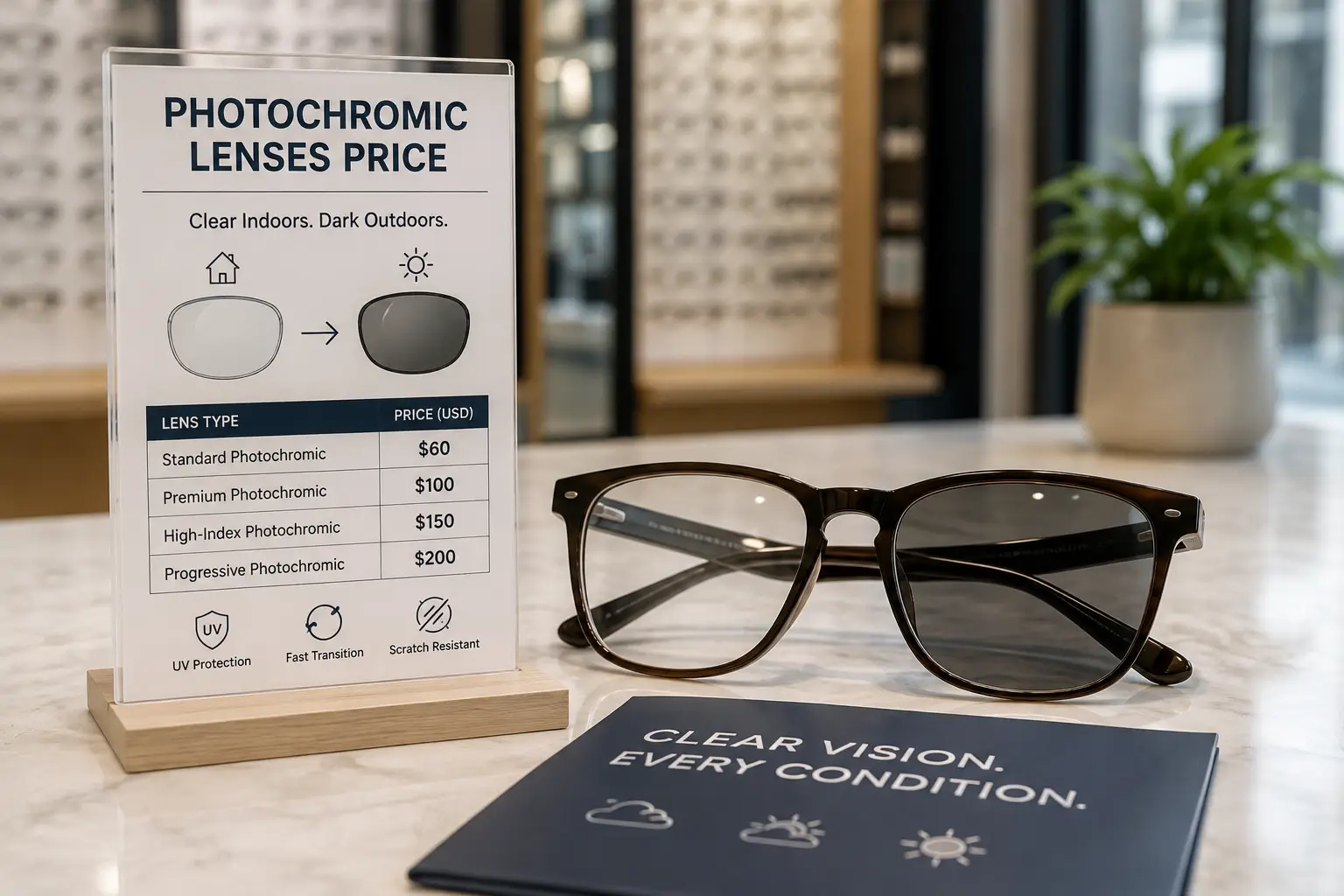
For off-the-shelf sunglasses, photochromic lenses price on Amazon generally breaks down into three tiers: under $30 for basic polycarbonate lenses with standard UV protection, roughly $70-$150 for sport or safety-rated options with wider VLT ranges or ANSI certification, and $150-$300+ for premium glass lenses or dual polarized-photochromic construction.
Prescription photochromic lenses follow a different, generally higher pricing structure, since they involve custom grinding to your prescription plus the photochromic treatment itself. Independent lens-cost breakdowns suggest bifocal or progressive photochromic prescription lenses commonly fall in the $150-$700 range depending on lens index, brand (Transitions-branded lenses typically cost more than generic photochromic treatments), and additional coatings like anti-glare or scratch resistance. Online prescription-lens retailers have pushed entry pricing lower in recent years, but traditional optical retailers using standard vision-insurance network pricing still tend to sit at the higher end of that range.
| Cost Driver | Lower Cost | Higher Cost |
|---|---|---|
| Lens material | Polycarbonate | Glass / high-index |
| Prescription | Non-Rx sunglasses | Custom Rx, especially progressive |
| Certification | None | ANSI Z87.1 / ballistic-rated |
| Brand technology | Generic photochromic | Branded (e.g., proprietary lens systems) |
The takeaway: if you’re buying non-prescription sunglasses, the seven picks above cover the realistic photochromic lenses price range well. If you need prescription photochromic lenses, budget significantly more, and treat lens technology and coatings as separate line items your eye-care provider should itemize clearly.
✨ Don’t miss these carefully compared picks! 🔍 Take your search for the right photochromic lenses price and performance to the next level — click through above to check current availability and pricing on each pair.
Safety, Regulations, and Standards for Photochromic Eyewear
Not all photochromic sunglasses are built to the same protective standard, and understanding the relevant certifications helps explain part of the photochromic lenses price gap between casual and work-rated options.
ANSI Z87.1 is the primary US standard for occupational and recreational eye protection, covering impact resistance, optical clarity, and coverage area — both Wiley X picks on this list carry this certification, while the casual and cycling-focused options do not, which is an appropriate trade-off for their intended use but matters if you need certified protection for work. The OSHA eye and face protection standard outlines when employers are required to provide ANSI-rated eyewear, which is worth checking if photochromic safety glasses are for job-site use rather than personal wear.
UV protection claims (UV400, “100% UVA/UVB”) are separate from impact certification and separate from the FDA’s general oversight of sunglasses as a regulated consumer product; a lens can meet UV-blocking claims without carrying any impact certification at all, which is why checking both specifications independently matters more than trusting a single “protective” label on the packaging.
Getting Started: Your First 30 Days With Photochromic Lenses
New photochromic wearers often run into the same handful of surprises in the first few weeks, so here’s how to set expectations correctly from day one.
Expect a noticeable adjustment period behind glass. Photochromic lenses activate more slowly — and sometimes barely at all — behind car windshields or office windows, since most glass filters a significant portion of UV light. This is normal lens chemistry, not a defect, and it’s exactly why dedicated driving formulas like the TJUTR pair exist.
Clean lenses with a microfiber cloth only for the first month. Photochromic coatings, especially on budget lenses, can be more prone to smudging or micro-scratching than standard tinted lenses if wiped with rough fabric, and early scratches compound the lens’s ability to transition evenly over time.
Store your glasses in a case, not a bag or pocket. This matters more for photochromic lenses than standard sunglasses because the reactive coating sits at or near the lens surface on many budget models, making it more vulnerable to abrasion than a simple tint.
Give the lens temperature time to stabilize before judging tint speed. Moving from an air-conditioned car into 95°F heat, or the reverse, means the lens is adjusting to two variables — light and temperature — simultaneously, and performance in that first minute isn’t representative of normal use.
Real-World Scenarios: Matching the Right Pair to Your Life
Sometimes the clearest way to choose is seeing how a specific buyer profile maps to a specific product.
If you’re a daily commuter who drives 30-45 minutes each way through changing light and glare, the TJUTR Photochromic Day & Night Driving Glasses solve your specific problem directly, at a photochromic lenses price low enough that trying them out is a low-risk decision.
If you’re a weekend cyclist logging 20-40 miles on mixed road and gravel, the Rockbros Photochromic Cycling Sunglasses or the step-up Tifosi Rail Photochromic Shield Sunglasses both address wind, debris, and fluctuating trail light — choose Rockbros for budget-conscious weekend riding, or the Tifosi Rail if you’re logging serious weekly mileage and want a wider adaptive range.
If you work outdoors or on a job site with a documented eye-protection policy, the Wiley X Saber Advanced Photochromic or Wiley X Brick Photochromic Smoke Grey are the only picks on this list that satisfy ANSI Z87.1 requirements — choose the Saber Advanced for tactical or range use, and the Brick for general job-site durability.
If you want one premium pair that handles driving, travel, and daily wear without a sport-specific focus, the Serengeti Photochromic Polarized Sunglasses justify their higher photochromic lenses price with glass-lens clarity that budget and even mid-tier polycarbonate options can’t match.
Problem → Solution: Fixing the Most Common Photochromic Lens Complaints
A handful of complaints show up repeatedly across photochromic lens buyers, and most have a straightforward fix.
Problem: The lenses stay dark inside for too long. This usually means the lens is still cooling down from heat exposure, or it’s simply a slower-clearing budget lens. Solution: give it the full 3-5 minute clearing window before assuming there’s a defect, and consider a faster-clearing option like the Serengeti pair if this happens daily and disrupts indoor visibility.
Problem: The lenses barely darken while driving. This is expected behavior, not a malfunction — most windshields block enough UV to limit standard photochromic activation. Solution: choose a driving-specific formulation like the TJUTR glasses, which are calibrated to respond more readily behind glass.
Problem: The tint looks patchy or uneven after a year of wear. This typically points to surface-level scratching or UV degradation on a budget polycarbonate lens. Solution: store lenses in a hard case, avoid rough cloths, and expect a shorter useful lifespan from sub-$30 pairs than from ANSI-rated or glass-lens options.
Problem: The lenses don’t cut glare even though they’re dark. Darkness and glare reduction are different features — a photochromic lens without polarization won’t cut glare regardless of tint depth. Solution: choose a polarized-photochromic combination like the HCYCFY or Serengeti pairs if glare reduction is the actual goal.
Problem: The frame doesn’t fit securely during activity. Photochromic lens performance is irrelevant if the glasses slide off mid-ride or mid-run. Solution: prioritize frames built for your specific activity, like the wind-sealed Rockbros design for cycling or the rubber-reinforced temples on the Wiley X Brick for active daily wear.
FAQ
❓ How much do photochromic lenses cost on average?
❓ Are photochromic lenses worth the extra price over regular sunglasses?
❓ Do photochromic lenses work well behind a car windshield?
❓ How long do photochromic lenses typically last before performance fades?
❓ Can photochromic lenses be polarized at the same time?
Conclusion
Photochromic lenses price isn’t arbitrary once you understand what drives it: VLT range, UV certification, frame durability, lens material, and whether you’re buying casual sunglasses or custom prescription lenses. The seven pairs covered here — from the budget-friendly HCYCFY and TJUTR options through the sport-focused Rockbros and Tifosi Rail, the certified Wiley X Saber Advanced and Wiley X Brick, up to the premium Serengeti — cover realistic needs across nearly every use case and budget.
The right move isn’t chasing the cheapest photochromic lenses price or assuming premium always means better; it’s matching the lens technology and certification level to how you’ll actually use the glasses day to day. A driver needs different performance than a cyclist, and a job-site worker needs certifications a casual wearer never will.
Whichever tier fits your budget and lifestyle, prioritize genuine UV protection and honest transition performance over marketing language — the difference between a good photochromic lens and a mediocre one shows up in year two, not on day one.
💬 Found the right pair for your needs? One click helps you check current pricing and lets other readers know which comparison was most useful! 😊
Recommended for You
- 7 Best Eyeglasses for Night Driving in 2026 (Tested vs. Overhyped)
- Oversized Frames: 7 Best Sunglasses to Shop in 2026
- Orange Tinted Glasses: 7 Best Picks for Better Sleep in 2026
Disclaimer: This post contains affiliate links. As an Amazon Associate, I earn from qualifying purchases made through these links, at no additional cost to you. Pricing information is accurate at the time of writing but may change; always check the current price before purchasing. This article is not medical advice — consult an eye-care professional for prescription lens needs. For more on affiliate disclosure standards, see the FTC’s endorsement guidance for advertisers.
✨ Found this article helpful? Share it with someone who’s shopping for their next pair! 💬🤗