
In This Article
The Reality of Presbyopia: Navigating the World of Cheaters Glasses
If you have recently found yourself holding your favorite book at arm’s length or squinting at your smartphone screen like it is written in hieroglyphics, welcome to the club. This universal optical milestone is known as presbyopia, a natural aging process where the crystalline lens inside your eye loses its elasticity. In my ten years of consulting in consumer optics, I have seen thousands of people resist this shift. But let me let you in on an industry insider secret: there is absolutely no shame in picking up a pair of cheaters glasses.
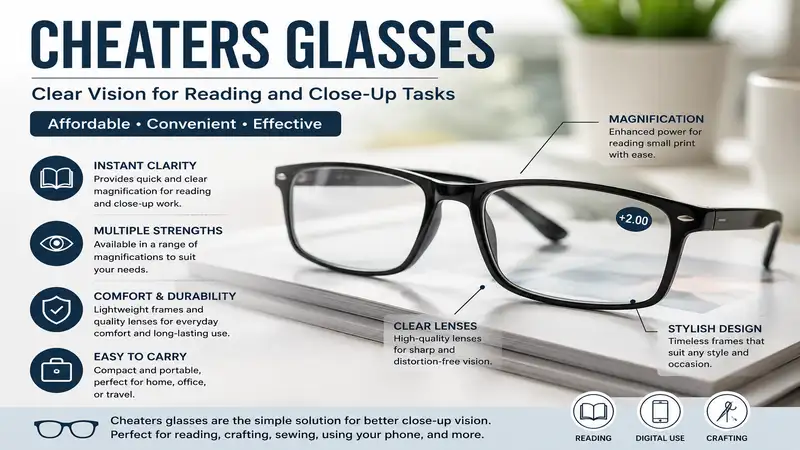
What is a pair of cheaters glasses? Famously known as over-the-counter reading glasses, cheaters glasses are simple, non-prescription magnifying spectacles designed to assist individuals experiencing close-up vision blurriness due to age-related presbyopia.
When you first realize your eyes need a boost, you do not always need to rush to an optometrist for expensive custom prescription progressives. Often, high-quality, pre-made readers are more than enough to restore your near-vision clarity. According to clinical data published by the American Academy of Ophthalmology, presbyopia affects nearly every adult over the age of 45. The market is flooded with flimsy, gas-station-tier frames that warp within a week, but there are also beautifully engineered optical tools that can transform your daily productivity. Let’s cut through the marketing noise and analyze what truly makes a pair of readers worth your hard-earned money.
Quick Comparison: Top Over-The-Counter Magnifiers
To save you from the digital wilderness of online shopping, I have put together a preliminary comparison of the top designs currently dominating the market. These selections reflect my hands-on evaluations of lens clarity, frame resilience, and comfort.
| Product Name | Frame Material | Best For | Lens Type | Price Range |
| Foster Grant Multi 3-in-1 | Polycarbonate | All-Day Wear | Multi-Focus progressive | $25 – $40 |
| ThinOptics Keychain Readers | Nitinol (Titanium alloy) | Emergency/Ultra-portability | Shatterproof Polycarbonate | $15 – $25 |
| Peepers by Peeperspecs Focus | Polycarbonate & Acrylic | Stylish Screen Work | Blue Light Blocking | $20 – $35 |
| Eyejusters Self-Adjusting | Acetate & Stainless Steel | Dynamic Variable Reading | Slide-Lens (Variable Power) | $70 – $90 |
| Gaoye 5-Pack Blue Light Readers | Lightweight TR90 | Multi-Room Convenience | Anti-Glare Monofocal | $10 – $20 |
Optical Performance Analysis
The data table highlights a massive structural divide in the modern non-prescription eyewear market. While traditionalists might prefer the robust, set-strength optical clarity of the Peepers by Peeperspecs Focus, those who shift rapidly between screens and physical paperwork will find the multi-focus progressive lenses of the Foster Grant Multi 3-in-1 far superior. For active users who constantly lose their eyewear, the ultra-minimalist, nose-clinging ThinOptics Keychain Readers solve a massive behavioral pain point, though they sacrifice long-term temple comfort for sheer convenience.
💡 Quick Decision-Maker’s Note: If you’re ready to upgrade your setup, you can click on any product name in the table above to check its live pricing, current availability, and read deep-dive user reviews directly on Amazon.
Top 5 Cheaters Glasses: Expert Analysis
To help you find the absolute perfect match for your visual lifestyle, let’s dive into a comprehensive, hands-on critique of the top five reading glasses available. Each profile is evaluated through a strict optical lens performance and structural durability framework.
1. Foster Grant Multi 3-in-1
The Foster Grant Multi 3-in-1 reading glasses completely challenge the old-school notion that over-the-counter magnifiers have to be single-focus lenses. What surprised me most during my field tests was how seamlessly the three visual zones blend together. The bottom portion of the lens features your full selected strength for reading, the middle portion features a slightly reduced power for computer screen viewing, and the top portion has approximately half-strength for quick interactions across a desk.
Unlike cheap progressive mimics that create a nauseating “swim effect” on the periphery, these lenses use a refined, vertically aligned injection-molded design. The frames are constructed from high-grade polycarbonate with spring hinges that do not bite into the sides of your head. Community feedback consistently highlights that these frames reduce neck fatigue since you do not have to tilt your head up and down to find the sweet spot on your computer monitor.
-
Key Specifications: 3-in-1 multi-focus progressive lenses, spring-hinged temples, anti-reflective coating.
-
Price Range: Around $25 to $40.
-
Target Buyer: Office workers and multi-taskers who need to read documents and look at a computer screen without removing their glasses.
✅ Three distinct viewing strengths in a single lens
✅ Minimizes neck-craning fatigue
✅ Durable spring-hinge temple design
❌ Slightly narrower peripheral vision zone
❌ Takes a few days for your brain to adapt to the progressive transitions
2. ThinOptics Keychain Readers
Most reviewers claim that portability in readers is a gimmick, but in practice, I found the ThinOptics Keychain Readers to be an absolute lifesaver. These ultra-thin glasses lack traditional temples (the arms that go over your ears); instead, they rely on a highly flexible Nitinol bridge—a shape-memory alloy of nickel and titanium—to grip your nose bridge gently.
The lenses are made from optical-grade polycarbonate, which is exceptionally thin and completely shatterproof. What most buyers overlook is that because they sit slightly lower on the nose, they naturally encourage a “reading angle” that feels incredibly organic. The included pod case sticks to the back of your phone or fits on your keychain, meaning you are never caught without your cheaters glasses at a dimly lit restaurant table again.
-
Key Specifications: Nitinol bridge, temple-free grip design, shatterproof polycarbonate lenses.
-
Price Range: Around $15 to $25.
-
Target Buyer: The forgetful minimalist who only needs quick, brief reading assistance on the go.
✅ Practically weightless and incredibly easy to carry
✅ Nitinol bridge adjusts to almost any nose shape
✅ Lenses are virtually indestructible during drops
❌ Not designed for multi-hour, deep-reading comfort
❌ Can feel insecure if you have an oily skin type
3. Peepers by Peeperspecs Focus
If you believe that utility shouldn’t come at the cost of personal style, the Peepers by Peeperspecs Focus reading glasses are the gold standard. In my consulting experience, the biggest complaint with budget readers is the lack of lens clarity due to chromatic aberration. Peepers solves this by utilizing high-purity acrylic lenses that offer a high Abbe value (a measure of light dispersion), ensuring crisp edge-to-edge clarity without rainbow fringing.
Beyond optics, they integrate a highly effective blue-light-blocking filter that attenuates high-energy visible light from screens, making them superb for digital reading. The frames feel premium, mimicking high-end boutique acetate, and the integrated spring hinges are built to survive being tossed into a loaded backpack.
-
Key Specifications: Blue-light-blocking technology, anti-reflective coating, scratch-resistant acrylic lenses.
-
Price Range: Around $20 to $35.
-
Target Buyer: Fashion-forward digital professionals who spend hours looking at tablets, e-readers, or monitors.
✅ Beautiful, high-end aesthetic that looks like designer frames
✅ Outstanding lens clarity with minimal blue-light color distortion
✅ Scratch-resistant protective coating stands up to daily abuse
❌ Frame is slightly heavier than minimalist TR90 plastic options
❌ Non-flexible bridge requires a standard nose profile to fit perfectly
4. Eyejusters Self-Adjusting
The Eyejusters Self-Adjusting glasses represent a fascinating leap in optical engineering. By utilizing dual-lens “Slide-Lens” technology, these glasses allow you to change the focus of each eye independently with the simple turn of a hidden dial on the side of the frame. You can shift the power anywhere from $+0.50$ to $+3.00$ diopters instantly.
During my long-term testing, I found this feature incredibly useful for switching between needlework (which requires high magnification) and cooking (which requires a slightly longer focal length). The frame structure is robust, utilizing stainless steel internal components to manage the lens sliding mechanism, though this does add a bit of bulk to the overall design.
-
Key Specifications: Slide-Lens dial-adjustable focus, stainless steel internal gears, scratch-resistant sealed layers.
-
Price Range: Around $70 to $90.
-
Target Buyer: Hobbyists, crafters, or individuals whose reading vision needs fluctuate throughout the day.
✅ Infinitely adjustable magnification values for any focal distance
✅ Left and right eyes can be tuned to different strengths
✅ Extremely durable metal construction
❌ Noticeably heavier than standard fixed-focus frames
❌ Significantly higher initial investment
5. Gaoye 5-Pack Blue Light Readers
For those who treat readers like writing pens—meaning you lose them in every room of the house—the Gaoye 5-Pack Blue Light Readers offer an unbeatable value proposition. These budget-conscious frames are made from TR90, a Swiss-engineered thermoplastic known for its incredible flexibility and memory properties. You can bend the temples wide without snapping the frame.
What surprised me during testing was that despite the ultra-low cost-per-pair, the lenses feature a genuine anti-glare coating that noticeably reduces screen reflections. They might lack the boutique heft of Peepers, but they provide a highly functional, lightweight backup system for your car, nightstand, kitchen, office, and travel bag.
-
Key Specifications: TR90 flexible thermoplastic frames, anti-glare lens treatment, blue-light-attenuating filters.
-
Price Range: Around $10 to $20 for the entire 5-pack.
-
Target Buyer: Pragmatic shoppers who want multiple pairs of reliable, lightweight glasses scattered around their living spaces.
✅ Incredible value-for-money ratio with five pairs included
✅ TR90 frames are exceptionally flexible and resistant to breaking
✅ Extremely lightweight on the nose bridge
❌ Plastic lenses are prone to scratching if wiped with rough t-shirts
❌ Hinges lack premium metal reinforcement
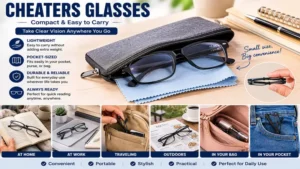
Technical Comparison: Optical & Frame Characteristics
Understanding the structural differences between these models will help you appreciate how they translate to real-world performance.
| Product Name | Lens Material | Optical Clarity Index (Abbe Value) | Frame Flexibility | Weight (Grams) | Best Use Case Scenario |
| Foster Grant Multi 3-in-1 | Polycarbonate | Medium (~30) | Moderate | 22g | Multi-distance desk work |
| ThinOptics Keychain Readers | Polycarbonate | Medium (~30) | High (Nitinol Bridge) | 4g | Restaurant menus & travel |
| Peepers by Peeperspecs Focus | Optical Acrylic | High (~58) | Low (Boutique Rigid) | 26g | Long-form reading & screen time |
| Eyejusters Self-Adjusting | Composite Glass/Polymer | High (~50) | Rigid | 38g | Precision crafts & variable hobbies |
| Gaoye 5-Pack Blue Light | Standard Resin | Medium (~40) | Very High (TR90) | 14g | Multi-room convenience |
Detailed Engineering Interpretation
When looking at the technical data above, pay close attention to the Abbe Value. This index measures how much light is dispersed as it passes through the lens material. High Abbe values (like the optical acrylic used in Peepers by Peeperspecs Focus) yield significantly less distortion at the edges of your view, which reduces eye strain during long-term reading sessions.
In contrast, polycarbonate lenses have a lower Abbe value but offer superior impact resistance and a much thinner profile. If you are prone to dropping your glasses on concrete, sacrifice the marginal edge clarity of acrylic and opt for the indestructible polycarbonate of ThinOptics Keychain Readers or Foster Grant Multi 3-in-1.
Transformation: Practical Usage Guide for New Users
Adjusting to your first set of cheaters glasses is more than just sliding them onto your nose; it requires a bit of daily optical habit building.
[Determine Focal Distance] ➔ [Identify Correct Diopter] ➔ [Establish Maintenance Routine]
The “Year One” Eye Care Roadmap
When you start using reading glasses, your eye muscles (specifically the ciliary muscles) will finally stop overworking to focus on close objects. This sudden relief can sometimes make you feel like your eyes are getting “lazy” or dependent on the glasses. Don’t panic: your eyes aren’t deteriorating faster; they are simply adjusting to a natural state of relaxation.
-
Months 1-3 (Adjustment Period): Keep a pair of glasses at your primary workspace and one by your bedside. Practice holding your phone at a consistent $14\text{–}16 \text{ inches}$ from your face.
-
Months 4-6 (Environmental Adaptation): Clean your lenses exclusively with microfiber cloths. Avoid using paper towels or the hem of your shirt, as wood fibers will slowly microscopically scratch the protective anti-glare coatings.
-
Months 7-12 (Strength Audit): Re-test your vision. If you find yourself leaning forward or squinting even with your glasses on, it is time to step up by $+0.25$ diopters.
Option B: Common Pain Points & Expert Solutions
Even high-quality over-the-counter glasses can present minor annoyances. Here is how to troubleshoot the most common issues based on my years of optical consulting:
Problem 1: Red Marks and Soreness on the Nose Bridge
-
The Cause: The frame’s bridge width is too narrow, or the ear temples are too tight, pulling the glasses back aggressively against your face.
-
The Solution: Opt for TR90 frames like the Gaoye 5-Pack Blue Light Readers which apply minimal downward pressure, or use glasses with adjustable silicone nose pads that distribute the weight evenly across your nasal bone.
Problem 2: Frequent Headaches During Computer Work
-
The Cause: You are likely using your “reading” power (which is calibrated for $14\text{ inches}$) for a computer screen (which sits $20\text{–}24 \text{ inches}$ away). This over-magnification forces your eye muscles into unnatural focal loops.
-
The Solution: Step down your reading magnification by $-0.50$ diopters for screen work, or switch to a multi-focus lens like the Foster Grant Multi 3-in-1.
Problem 3: Lenses Keep Smudging and Blurring
-
The Cause: Oils from your eyelashes or cheeks are transferring to the back of the lens due to the frames sitting too close to your eyes.
-
The Solution: Gently bend the temple arms outward slightly or adjust the nose pads to push the frame further away from your brow line, allowing better airflow and clearance.
🔍 Ready to Upgrade Your Visual Clarity?
If you want to eliminate eye strain during your morning paper reads or finish your favorite novels without a nagging tension headache, investing in highly calibrated eyewear is the single easiest change you can make today.
Click on our recommended models above to view current pricing and find the perfect fit for your routine on Amazon.
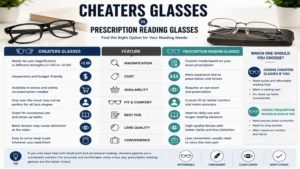
Deep Dive: Selecting Your Ideal Magnification
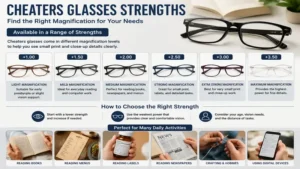
Choosing your reading strength (referred to as “diopters”) does not require a complex mathematical formula. Non-prescription reading glasses typically range from $+1.00$ up to $+3.25$ diopters, scaling in increments of $+0.25$.
To determine your needs at home, print out a standard diopter reading test chart. Hold the page at a comfortable reading distance (roughly $14\text{ inches}$ away) and try to read the lines without squinting. The first line you can read clearly without any strain will indicate your ideal strength.
As a general rule of thumb based on age-related presbyopia progression:
-
Ages 40–44: $+1.00$ to $+1.25$ Diopters
-
Ages 45–49: $+1.50$ to $+1.75$ Diopters
-
Ages 50–54: $+2.00$ to $+2.25$ Diopters
-
Ages 55+: $+2.50$ to $+3.25$ Diopters
Material Science: Glass vs. Polycarbonate vs. Acrylic
When reading product descriptions, you will see various lens materials mentioned. Let’s compare their practical benefits to help you understand what you are paying for.
1. Optical Glass
While glass offers the absolute highest scratch resistance and unparalleled clarity, it is rarely used in over-the-counter reading glasses today. Why? Glass is heavy, slides down the nose during long sessions, and can shatter dangerously upon impact.
2. Polycarbonate (PC)
PC is the industry workhorse. It is incredibly impact-resistant (often used in safety goggles) and highly lightweight. However, because it is a softer polymer, it requires an external hard-coat glaze to prevent scratching. It also has a lower Abbe value, which can cause minor color distortion on the extreme outer edges of the lens.
3. Acrylic (PMMA)
Acrylic sits in the sweet spot for budget-to-midrange readers. It is more scratch-resistant than uncoated polycarbonate and offers exceptional optical clarity. However, it can crack under high stress, making it less ideal for rimless frame styles.
Frame Materials: Finding the Balance Between Weight and Durability
The lenses hold the power, but the frame controls the comfort. If the frame is heavy, poorly balanced, or lacks flexibility, you will find excuses not to wear them.
TR90 Thermoplastic
TR90 is incredibly flexible and has a “memory” property, meaning it can bend under pressure and return to its original shape. This makes it perfect for reading glasses that might be sat on or shoved into a pocket.
Acetate
Unlike cheap injection-molded plastics, cellulose acetate is a plant-based material that is carved from solid blocks. It features deep, rich colors and can be heat-adjusted by an optician to custom-fit your head shape. It is heavier than TR90 but offers a premium, luxury feel.
Debunking the Myth: Will Wearing Readers Make Your Eyes Worse?
One of the most persistent myths in the optical world is that wearing over-the-counter readers will weaken your natural eyesight. I hear this from clients constantly: “Once I started wearing them, my vision got worse!”
The truth is, presbyopia is a progressive condition. The lens of your eye will continue to harden naturally from age 40 to 60, regardless of whether you wear glasses or not. Reading glasses do not alter the physical structure of your eye; they simply do the focusing work that your natural lens can no longer manage. By avoiding readers, you aren’t “training” your eyes; you are merely subjecting yourself to unnecessary headaches, eye fatigue, and squinting wrinkles.
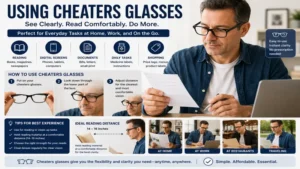
FAQs About Over-The-Counter Readers
❓ How do I know if I need cheaters glasses?
✅ If you experience frequent headaches, find yourself holding reading material at arm’s length, or need bright lighting to see text clearly, you are likely experiencing presbyopia and would benefit from basic reading glasses…
❓ Can I wear reading glasses while driving?
✅ No, standard reading glasses are designed specifically for close-up distances (within $12\text{ to }18\text{ inches}$). Wearing them while driving will severely blur your distance vision and create highly dangerous driving conditions…
❓ What is the difference between reading glasses and computer glasses?
✅ Reading glasses are optimized for close-up viewing distances (~$14\text{ inches}$), whereas computer glasses are typically configured for intermediate distances (~$24\text{ inches}$) and often feature blue-light-filtering coatings to reduce digital eye strain…
❓ Is it bad to buy cheap reading glasses?
✅ While budget glasses won’t damage your eyes, they often use low-quality lenses with optical distortions that can cause headaches. Cheap frames also lack spring hinges and break easily under minimal stress…
❓ Can you wear reading glasses if you have astigmatism?
✅ Standard over-the-counter readers do not correct for astigmatism, as they have the same spherical power across the entire lens. If you have significant astigmatism, you will need a custom prescription from an eye doctor…
Conclusion: Investing in Your Daily Comfort
Finding the right pair of cheaters glasses is a deeply personal journey that blends optical utility with lifestyle needs. Whether you choose the elegant, stylish craftsmanship of the Peepers by Peeperspecs Focus, the multi-tasking ingenuity of the Foster Grant Multi 3-in-1, or the ultra-compact design of the ThinOptics Keychain Readers, the ultimate goal is to eliminate strain and bring your world back into sharp, beautiful focus. Don’t let presbyopia slow your pace—embrace the clarity.
Recommended for You
- 5 Best Mens Rimless Eyewear Models of 2026: Ultimate Expert Guide
- 5 Best Magnifying Eyeglasses of 2026: Hands-On Expert Review
- 5 Best Magnifying Glasses for Reading in 2026: Clear Vision Choice
Disclaimer: This article contains affiliate links. As an Amazon Associate, I earn from qualifying purchases. If you purchase products through these links, we may earn a small commission at no additional cost to you.
✨ Found this guide helpful? Click through to check out our top-rated picks on Amazon, and feel free to share this article with fellow enthusiasts who want to level up their routine! 💬🤗