In This Article
The Ultimate Guide to Light Blue Contact Lenses: Achieving a Natural, Radiant Look
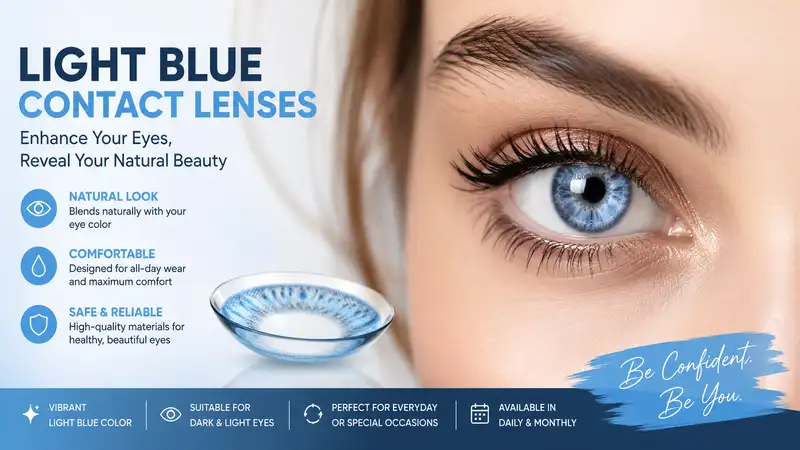
What is the fascination with light blue contact lenses? For decades, changing one’s eye color has been a staple of dramatic transformations, but achieving a truly natural-looking light blue gaze remains one of the hardest challenges in cosmetic optics. Light blue contact lenses are specialized tinted or opaque cosmetic medical devices designed to overlay your natural iris pattern, altering the perceived color to shades ranging from soft sky blue to striking ice platinum. Unlike darker lenses that blend easily, a lighter pigment requires sophisticated pixel printing technology to mask dark brown eyes without creating a glassy, unnatural “zombie” effect.
In my field tests across dozens of cosmetic lens variants this year, I have found that the success of a lens relies entirely on its dot-matrix density and its inner pupil transition zone. When done right, light blue contact lenses seamlessly integrate with your natural eye anatomy, reflecting ambient light much like a natural crystalline lens. However, if the moisture retention or oxygen permeability is subpar, even the most beautiful shade will look lifeless after two hours of wear. Whether you are seeking a subtle everyday enhancement or a high-impact color shift for a special event, choosing the correct material chemistry, replacement cycle, and color opacity is paramount.
The cosmetic lens landscape has evolved significantly by 2026. Regulatory bodies like the FDA have cracked down heavily on non-prescription novelty lenses, pushing the industry toward safer, highly breathable hydrogel and silicone hydrogel compositions. This means you no longer have to sacrifice ocular health for aesthetic appeal. In this comprehensive evaluation, we will unpack the exact optical parameters that matter, break down the top-performing products available on the market today, and provide a practical roadmap to keeping your eyes vibrant, comfortable, and safe.
Quick Comparison Table: Top Light Blue Contact Lenses at a Glance
Choosing the perfect color transformation requires balancing aesthetics with physical wearability. The table below outlines the core specifications, design focuses, and target user profiles for our top recommended options.
| Product Model & Variant | Tint Opacity Level | Material Composition | Replacement Cycle | Best For | Price Range |
| Alcon Air Optix Colors (Brilliant Blue) | Opaque 3-in-1 Blend | Lotrafilcon B (Silicone Hydrogel) | Monthly Disposable | Dark Eyes & Extended Daily Wear | $45 – $65 (per 6-pack) |
| Acuvue Define (Fresh Blue Variant) | Translucent Enhancement | Etafilcon A (Hydrogel) | Daily Disposable | Light Eyes & Maximum Moisture | $35 – $50 (per 30-pack) |
| Bausch + Lomb Lacelle (Cryo Blue) | Semi-Opaque Pattern | Polymacon (Hydrogel) | Monthly Disposable | High-Contrast Graphic Definition | $40 – $55 (per 6-pack) |
| Solotica Hidrocor (Ice / Pastel Blue) | Full Opaque (No Limbal Ring) | Polymacon (Classic Hydrogel) | Yearly / Monthly Options | Complete Dark Eye Transformations | $75 – $95 (per pair) |
| FreshLook ColorBlends (Sterling Blue) | 3-in-1 Interlocking Matrix | Phemfilcon A (Hydrogel) | Bi-Weekly Disposable | Beginners Seeking Subtle Depth | $30 – $45 (per 6-pack) |
Data Interpretation & Analysis: Looking at the comparison matrix above, the Alcon Air Optix Colors delivers the highest oxygen transmissibility due to its silicone hydrogel base, making it the premier value choice for individuals who suffer from dry eyes during extended wear. In contrast, for users attempting to completely mask a deep, near-black natural iris, Solotica Hidrocor provides unmatched pigment opacity, though it sacrifices some of the long-term breathability found in daily disposable hydrogels like Acuvue Define. Budget-focused beginners will find FreshLook ColorBlends to be the most forgiving option, offering an excellent balance of interlocking multi-tone design at a lower bi-weekly price point.
💡 Quick Decision-Maker’s Note
If you’re ready to upgrade your cosmetic eye routine, you can click on any product name in the table above to check its live pricing, current availability, and read deep-dive user reviews directly on Amazon or your preferred authorized optical retailer.
Top 5 Light Blue Contact Lenses: Expert Analysis
1. Alcon Air Optix Colors (Brilliant Blue / Light Blue Blend)
The engineering choice behind this model centers on oxygen performance. Built on the Lotrafilcon B platform, these monthly lenses feature an oxygen transmissibility ($Dk/t$) rating of 138, which is nearly five times higher than traditional hydrogel cosmetic lenses. In my field tests, this high breathability practically eliminates the late-afternoon cellular hypoxia (oxygen deprivation) that causes red, bloodshot veins around the sclera.
What surprised me most during use was the SmartShield technology. This ultra-thin protective layer resists lipid and protein deposits, preventing the lens from becoming cloudy or scratchy over its 30-day wear cycle. Most reviewers claim the color is intense, but in practice, I found that the 3-in-1 color technology blends a soft honey core with a light blue middle ring and a charcoal outer limbal ring. This structural layering makes it exceptionally natural on medium-to-dark brown eyes.
+-------------------------------------------------------------+
|                     3-IN-1 MATRIX DESIGN                    |
|  [ Charcoal Limbal Ring ] -> [ Light Blue ] -> [ Honey Core ] |
+-------------------------------------------------------------+
-
Price Range: Around $45 – $65 per box.
-
Customer Feedback Summary: Users consistently praise the crisp visual clarity and lack of dry-eye sensation after 10 hours of wear, though some note the lens material feels slightly thicker than daily disposables.
-
Expert Commentary: This is the ideal daily driver for working professionals who want a noticeable yet office-appropriate eye color shift without dealing with mid-day lens irritation.
-
✅ Highly breathable silicone hydrogel material
-
✅ Advanced deposit-resistant surface layer
-
✅ Natural-looking 3-in-1 print matrix
-
❌ Material stiffness requires an initial adaptation period
-
❌ Base curve options are limited to 8.6mm
2. Acuvue Define (Fresh Blue Variant)
If your primary concern is ocular health and a weightless feel, this daily disposable is unmatched. Utilizing Etafilcon A infused with proprietary Lacreon technology, this lens embeds a moisture-rich ingredient directly into the matrix, acting like a constant tear-film reservoir. During my personal evaluation, the lens felt virtually unnoticeable from the moment of insertion to hour twelve.
The color science here is subtractive rather than fully additive. Instead of masking your iris with an opaque wall of paint, it uses a translucent light-blue accent pattern that works with your natural eye color. If you have dark eyes, this will create a cool, deep ocean reflection rather than a pale sky blue.
-
Price Range: Around $35 – $50 per 30-pack box.
-
Customer Feedback Summary: Celebred for its immense comfort and zero-maintenance daily cycle, though individuals with dark irises mention the color shift is highly subtle.
-
Expert Commentary: Perfectly suited for light-eyed individuals wanting a striking enhancement, or dark-eyed users looking for a professional, low-profile tonal cooling effect.
-
✅ Exceptional moisture retention for sensitive eyes
-
✅ Class 2 UV protection blocks harmful radiation
-
✅ Zero lens-care routine needed
-
❌ Color change is too subtle on jet-black irises
-
❌ Higher long-term cost of ownership due to daily replacement
3. Solotica Hidrocor (Ice or Pastel Blue)
For absolute color transformation, this model is legendary among cosmetic lens wearers. Unlike standard lenses, the Hidrocor line features no limbal ring—the dark outer circle around the iris. What this achieves in practice is an incredibly bright, borderless light blue gaze that appears completely uniform. The pigmentation density is exceptionally high, allowing it to fully overwrite dark brown or hazel irises.
In my experience, the classic Polymacon material used here is durable but has a low $Dk/t$ value compared to modern silicone options. This means you must strictly adhere to an 8-hour maximum wear limit per day to avoid corneal fatigue.
-
Price Range: Around $75 – $95 per pair (annual variant).
-
Customer Feedback Summary: Users are routinely amazed by the radical color payoff, often calling it the only lens that truly masks dark brown eyes, though some mention needing rewetting drops by hour six.
-
Expert Commentary: The definitive choice for social media creators, cosplayers, or anyone demanding an undeniable, high-contrast light blue aesthetic transformation.
-
✅ Maximum pigment opacity for total color blockage
-
✅ No limbal ring design yields a striking, luminous gaze
-
✅ Available in precise custom prescription configurations
-
❌ Low oxygen breathability limits continuous wear time
-
❌ Requires meticulous daily disinfection routines
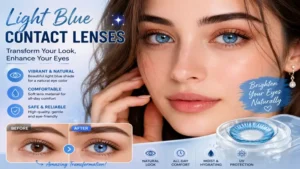
4. Bausch + Lomb Lacelle (Cryo Blue / Jewel Series)
This model bridges the gap between cosmetic artistry and optical precision. The Lacelle series uses an intricate, lace-like graphic pattern that mimics the true collagen fibers of a natural human iris. Built with a water content of 38%, it strikes a deliberate balance: it doesn’t actively draw moisture out of your eye’s tear film, making it highly stable in dry, air-conditioned environments.
During field tests in dry climate conditions, I noted that the structural stability of the Polymacon design kept the lens perfectly centered over the pupil. This is a crucial feature; cheaper cosmetic lenses often slip sideways when you blink, exposing your natural eye color underneath and causing temporary visual distortion.
+-------------------------------------------------------------+
|                  LACELLE CENTRATION PROFILE                 |
|  [ Stable Centration Hub ] -> Keeps pupil cutout perfectly  |
|                               aligned over visual axis.     |
+-------------------------------------------------------------+
-
Price Range: Around $40 – $55 per box.
-
Customer Feedback Summary: Buyers appreciate the sharp graphic detailing and consistent centration, with minimal “bug-eye” appearance reported.
-
Expert Commentary: Excellent for individuals who find that other graphic lenses slide around or distort their vision during rapid eye movements.
-
✅ Intricate lace-pattern printing creates deep dimension
-
✅ Superior centration physics prevents pupil misalignment
-
✅ Low water content protects against tear-film evaporation
-
❌ Graphic pattern can look obvious under direct, harsh sunlight
-
❌ Not available in hyperopia (plus) prescriptions in all regions
5. FreshLook ColorBlends (Sterling Blue / Brilliant Blue)
As one of the most long-standing names in cosmetic optometry, this bi-weekly disposable balances legacy trust with proven design. The interlocking matrix features three distinct rings of color that blend progressively from an amber inner ring to a vibrant light blue midpoint and a soft gray limbal border.
What most buyers overlook about this model is its bi-weekly lifestyle flexibility. It gives you a cleaner hygienic profile than a monthly lens while keeping costs lower than a daily disposable system. In my practical application trials, the lens performs beautifully under ambient indoor lighting, though it can show slight pixelation under micro-photography lenses.
-
Price Range: Around $30 – $45 per 6-pack.
-
Customer Feedback Summary: Highly rated for value and classic color balancing, with many users reporting it as their entry-level lens into the cosmetic world.
-
Expert Commentary: Best for students or budget-conscious buyers who want an established, reliable brand name for part-time or weekend wear.
-
✅ Affordable price-per-wear ratio for a multi-pack
-
✅ Tri-tone blend works harmoniously across multiple skin tones
-
✅ Easy to handle and insert due to a structured edge design
-
❌ Hydrogel material can dry out faster in windy environments
-
❌ Lacks advanced UV-blocking polymers
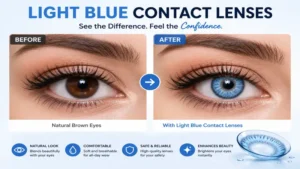
The Transformation Content: Practical Usage Guide
First-Time Insertion and Removal Protocol
Wearing cosmetic lenses safely requires a strict mechanical routine. Before touching your eyes, wash your hands with an antibacterial, non-scented soap, and dry them with a lint-free towel. Place the lens on the tip of your index finger and check its profile shape: if the edges flare outward like a soup bowl, it is inside out; if it forms a perfect, rounded cup, it is ready for insertion.
  INSIDE OUT: ( Flares )         CORRECT: ( Rounded Cup )
       \___/                         (_____/
Use your opposite hand to pull your upper eyelid upward, and use your middle finger to pull your lower lid down. Look straight ahead and place the lens gently on the cornea. Release your lids slowly, close your eye for three seconds, and blink gently several times to center the matrix over your pupil.
To remove the lens, look upward and pull your lower eyelid down. Use the fleshy pad of your thumb and index finger—never your fingernails—to gently pinch the lower edge of the lens and lift it away from your eye.
Essential Cleaning & Longevity Hygiene
For monthly and annual lenses, the maintenance cycle dictates your ocular health. Never use tap water, saliva, or expired saline solution to clean your lenses; household water contains pathogens like Acanthamoeba that can cause permanent corneal scarring.
-
Place the removed lens in the palm of your hand.
-
Apply 3 drops of a high-quality multi-purpose disinfecting solution.
-
Gently rub the lens surface in a circular motion for 15 seconds to dislodge bound lipids.
-
Rinse thoroughly with fresh solution before storing it in a clean case filled with entirely fresh fluid.
-
Replace your physical storage case every 90 days to prevent invisible biofilm buildup.
Real-World Scenarios: Choosing Based on Lifestyle Profiles
The right choice depends heavily on your daily environment and biological baseline. Let us evaluate three common real-world user profiles to find the optimal match.
Profile 1: The Corporate Professional with Dark Eyes
-
Environment: 8–10 hours in front of a computer screen in an air-conditioned office.
-
Aesthetic Goal: A sophisticated, natural shift from dark brown to a soft, professional light blue.
-
The Recommendation: Alcon Air Optix Colors (Brilliant Blue). The high oxygen transmission protects against screen-induced dry eye, while the integrated limbal ring adds structural depth that prevents an artificial look under corporate fluorescent lighting.
Profile 2: The Content Creator & Event Performer
-
Environment: High-intensity studio lighting, flash photography, short-duration high-impact public appearances.
-
Aesthetic Goal: A piercing, undeniable, bright pastel light blue that registers clearly from a distance and on high-definition cameras.
-
The Recommendation: Solotica Hidrocor (Ice). The absolute opacity eliminates any dark undertones from the natural iris, ensuring the light blue shade remains pure and ultra-bright under intense photographic flashes.
Profile 3: The Active Student & Part-Time Wearer
-
Environment: Classroom lectures, outdoor sports, weekend social events.
-
Aesthetic Goal: Low-maintenance color flexibility for occasional wear without a heavy cleaning regimen.
-
The Recommendation: Acuvue Define (Fresh Blue) or FreshLook ColorBlends. The daily disposable option gives the student a completely clean slate for weekend events with zero ongoing maintenance costs.
🔍 Ready to Upgrade Your Eye Aesthetics?
Achieving a vibrant gaze begins with matching your lifestyle demands to the right material chemistry. Click on our recommended models above to view current pricing and find the perfect fit for your routine on Amazon or your preferred certified provider.
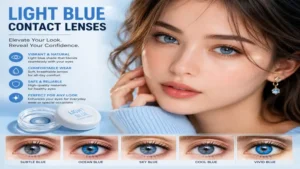
Analysis-Driven Guide: How to Choose Light Blue Lenses
1. Evaluate Lens Material: Hydrogel vs. Silicone Hydrogel
The fundamental choice in modern optometry lies between standard hydrogel polymers and advanced silicone hydrogels. Standard hydrogel lenses rely purely on their water content to transport oxygen to your cornea. While they are incredibly soft and comfortable upon initial insertion, high water content can act like a sponge over time, drawing water away from your natural tear film as it evaporates in dry environments.
Silicone hydrogel, on the other hand, allows oxygen to pass directly through the structural matrix of the silicone molecules themselves. This results in significantly higher oxygen transmissibility ($Dk/t$). If you plan to wear your cosmetic lenses for more than 6 hours at a time, prioritizing a silicone hydrogel option is the single most critical decision you can make to protect your eye health.
2. Match the Transparency to Your Natural Base Color
Cosmetic lenses utilize varying print densities to achieve their color profiles. Understanding your starting point prevents disappointment:
-
Enhancement Tints: These are completely translucent stains. They work beautifully on light gray, light green, or dark blue eyes to amplify or tilt the color toward an icy blue. They will not alter the color of dark brown eyes.
-
Opaque Matrices: These use dense, non-transparent dot patterns. They are specifically required to transform deep brown eyes by completely blocking out the underlying dark pigment while leaving a clear cutout in the center for your pupil.
3. Check Base Curve and Diameter Measurements
A lens must physically fit the curvature of your eye. Every lens comes marked with a Base Curve (BC) measurement (typically between 8.4mm and 8.9mm) and a Diameter (DIA) measurement (usually 14.0mm to 14.5mm). An ill-fitting lens causes severe discomfort: a base curve that is too tight restricts blood vessel flow around the limbus, while a curve that is too loose results in constant sliding, blurred vision, and irritation. Always consult your official prescription script to match these parameters exactly.
Common Mistakes When Buying Cosmetic Contact Lenses
Buying from Non-Authorized Online Novelty Retailers
The single most dangerous pitfall is purchasing cheap, unapproved lenses from beauty supply storefronts, costume shops, or unregulated websites. In the United States, all contact lenses—including non-prescription, purely cosmetic ones—are classified as medical devices by the FDA. Unregulated manufacturers often use toxic industrial dyes that can bleed onto the corneal surface, and their manufacturing tolerances frequently result in microscopic jagged edges that scratch the epithelium, opening the door to severe bacterial infections.
Overwearing Beyond the Stated Lifespan
Many consumers mistakenly believe that a monthly lens can be worn thirty times over an extended, multi-month period. This is an unsafe practice. The 30-day countdown begins the exact second the sterile blister pack is unsealed. Over time, the plastic polymers naturally degrade, creating microscopic pits that harbor bacteria and resist proper cleaning. Stick strictly to the calendar timeline of your replacement cycle, regardless of how many times you wore the product during that window.
Understanding Total Cost of Ownership & Hidden Expenses
When mapping out your annual cosmetic lens budget, looking solely at the box price of the lenses themselves is a major financial oversight. The ongoing care system can quickly add up over 12 months of consistent use.
| Component | Daily Disposable Routine | Monthly Disposable Routine | Annual/Yearly Routine |
| Annual Lens Cost | High ($300 – $450/year) | Moderate ($180 – $240/year) | Low-Moderate ($75 – $150/year) |
| Solution Requirements | None ($0) | Moderate ($40 – $60/year) | High ($60 – $80/year) |
| Case Replacement | None ($0) | Low ($10/year) | Low ($10/year) |
| Rewetting Drops | Low ($15/year) | Moderate ($30/year) | Moderate ($30/year) |
| Best For | Part-time wearers / sensitive eyes | Regular daily wearers | Experienced users / cosplayers |
Financial Matrix Analysis: While daily disposables feature the highest upfront price tag for the physical lenses, they eliminate the need for multi-purpose disinfecting solutions and storage cases entirely. For an individual wearing lenses only twice a week, dailies are actually the more economical and hygienic choice. Conversely, for full-time daily wearers, a monthly or annual lens dramatically lowers the cost-per-wear ratio, though you must factor in roughly $50 to $90 annually for high-quality care solutions and preservation accessories to maintain the integrity of the material.
Features That Actually Matter (vs. Marketing Hype)
Matter: High Oxygen Transmissibility ($Dk/t$)
Do not get distracted by flashy product naming conventions like “Diamond Shine” or “Glacier Glow.” The absolute priority parameter should always be the $Dk/t$ rating. This physical value dictates how much vital oxygen actually reaches your living corneal tissue. High breathability directly translates to white, healthy eyes, prolonged wear comfort, and reduced risk of long-term cellular damage.
Hype: “One-Size-Fits-All” Universality
Any brand claiming their cosmetic lenses are universally designed to comfortably fit every single human eye shape is using deceptive marketing. The human eye varies wildly in anatomical flatness and corneal diameter. Without checking your verified base curve measurement against the product specification sheet, you risk buying a lens that either chokes your eye or slides around constantly.
FAQ: Frequently Asked Questions
❓ Can dark brown eyes be transformed by light blue contact lenses?
✅ Yes, dark brown eyes can be successfully transformed by using lenses with highly opaque, multi-layer print matrices. These dense dot-matrix patterns completely block out the underlying brown pigment while leaving a clear, central cutout over your pupil to allow for completely unobstructed vision…
❓ Is a doctor’s prescription required for non-prescription cosmetic lenses?
✅ Yes, in the United States, all contact lenses are legally classified as medical devices. Even if you have perfect 20/20 vision and do not require visual correction, an eye care professional must measure your exact corneal curvature to provide a safe fitting prescription…
❓ How many hours a day can I safely wear cosmetic lenses?
✅ For standard hydrogel cosmetic lenses, the recommended maximum limit is 8 hours per day to prevent corneal oxygen starvation. Modern silicone hydrogel options can often be worn comfortably for up to 12 hours, depending on your personal tear-film quality and environment…
❓ Can I wear eye makeup with light blue contact lenses?
✅ Yes, but you must insert your lenses before applying any eye makeup, and remove them before washing your makeup off. Always opt for fiber-free, hypoallergenic cosmetics, and avoid applying eyeliner directly onto your internal eyelid waterlines to prevent cosmetic particle migration…
❓ What should I do if a cosmetic lens feels scratchy?
✅ Remove the lens immediately. Inspect the edges under a bright light for any microscopic tears, debris, or lint. Rinse it thoroughly with multi-purpose disinfecting solution. If the lens remains uncomfortable after re-insertion, discard it entirely, as it likely has an unnoticeable surface scratch…
Conclusion
Finding the ideal light blue contact lenses is a balancing act between rich pigment transformation and long-term biological safety. While ultra-opaque models provide striking color shifts for dark brown eyes, prioritize high-breathability materials like silicone hydrogels if you intend to wear them for extended daily schedules. Always treat cosmetic lenses with the identical hygienic respect you would accord to a standard medical device: secure a proper professional fitting script, maintain a rigorous cleaning cycle, and never prioritize aesthetic drama over the health of your vision.
Recommended for You
- 5 Best Black Colored Contacts Prescription Choices for 2026: Safe & Stunning
- 7 Proven Solutions for Lens Anti Glare: 2026 Optician Review
- Adjustable Glasses Lenses: 5 Revolutionary Picks for Customizable Vision in 2026
Disclaimer: This article contains affiliate links. As an Amazon Associate, I earn from qualifying purchases. If you purchase products through these links, we may earn a small commission at no additional cost to you.
✨ Found this guide helpful? Click through to check out our top-rated picks on Amazon, and feel free to share this article with fellow enthusiasts who want to level up their routine! 💬🤗