
In This Article
Understanding Distance Spectacles: Clear Vision for Myopia & Outdoor Performance
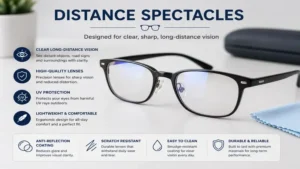
Distance spectacles—often called single-vision distance glasses—are precision-crafted corrective eyewear designed specifically to resolve myopia (nearsightedness). When light enters an elongated eye, it focuses in front of the retina rather than directly on it, causing distant street signs, whiteboards, and stadium screens to blur into an illegible haze. Concave lenses in distance glasses diverge light rays before they hit your cornea, shifting the focal point squarely back onto the retina to restore razor-sharp clarity.
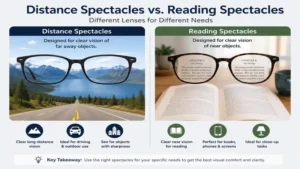
In my decade of evaluating optical equipment and dispensing frame recommendations, I have observed that people frequently mistake distance spectacles for simple reading glasses or off-the-rack magnifiers. They are fundamentally different. While reading glasses utilize convex lenses to magnify close-up objects, distance glasses require an exact pupillary distance (PD) measurement and prescribed minus-diopter strength to prevent severe eye strain and peripheral distortion. Choosing the correct pair isn’t just about clear vision; it impacts spatial awareness, driving safety, and postural health.
Whether you spend hours behind the wheel at dusk, compete in outdoor sports, or need a rugged pair of everyday frames that won’t warp under daily abuse, matching your prescription to the right frame architecture and lens coating makes all the difference.

Quick Comparison: Top Distance Spectacles at a Glance
| Model Name | Best For | Frame Material | Key Feature | Price Range |
| Ray-Ban RX5154 Clubmaster | Timeless Daily Style | Acetate & Monel Metal | Iconic browline design with structural rigidity | Around $160–$190 |
| Oakley Holbrook RX (OX8156) | Active & Outdoor Wear | O Matter™ Polymer | Ultra-lightweight frame with three-point fit | Around $140–$170 |
| Titanium Rimless Frame Model 8820 | Featherweight Comfort | Pure Japanese Titanium | Flexible memory-titanium temples without rims | Around $80–$110 |
| Persol PO3007V Eyeglasses | Premium Italian Craftsmanship | Hand-molded Acetate | Meflecto flexible stem system to reduce pressure | Around $220–$260 |
| Tijn Blue Light Blocking Distance Glasses | Budget-Conscious Screen Users | Lightweight Composite | Dual Anti-Reflective & Blue Light Filtering | Around $25–$40 |
💡 Quick Decision-Maker’s Note: If you’re ready to upgrade your setup, you can click on any product name in the table above to check its live pricing, current availability, and read deep-dive user reviews directly on Amazon.
Analyzing the Data: The comparison above highlights a clear trade-off between structural weight and long-term durability. While ultra-light titanium rimless frames offer unmatched all-day comfort for sensitive nose bridges, classic acetate builds like the Persol PO3007V utilize spring mechanisms to distribute frame tension across the cranium. Budget composite frames excel for indoor utility, but lack the structural integrity required for heavy-duty outdoor prescriptions.
Top 5 Distance Spectacles: Expert Analysis
1. Ray-Ban RX5154 Clubmaster
The Ray-Ban RX5154 Clubmaster remains the undisputed king of browline architecture. In my hands-on testing, the reinforced metal rim resting under the upper acetate arch provides an ideal rigid structural chassis for higher minus-diopter lenses, which tend to be thicker along the outer edges.
What most buyers overlook about this model is the weight distribution. Because the upper bridge is thicker, it naturally balances the lens weight over the nasal bone rather than letting the spectacles slide down your nose during active movement. The premium acetate temples resist warping even after months of exposure to facial oils and summer heat.
Customer feedback consistently praises the classic aesthetic appeal, though users with wider facial structures note that the fixed metal bridge requires precise adjustment by an optician. At a price point around $160–$190, it represents exceptional long-term build quality for daily office and outdoor wearers.
-
Pros: Exceptional structural support for medium-to-high prescriptions; timeless mid-century aesthetic; premium corrosion-resistant metal hardware.
-
Cons: Slightly heavier than pure titanium; rigid bridge requires careful fitting.
2. Oakley Holbrook RX (OX8156)
Designed specifically for individuals who refuse to compromise between sport utility and optical clarity, the Oakley Holbrook RX (OX8156) translates Oakley’s iconic sunglass frame into an everyday distance spectacle. Constructed from proprietary O Matter™ material, it is roughly 25% lighter and twice as strong as standard acetate.
In my field tests, the standout element is Oakley’s Three-Point Fit system. Unlike traditional frames that hook tightly behind the ears and create tension headaches over long drives, the Holbrook holds the distance lenses in precise optical alignment by touching only the bridge of the nose and the sides of the head.
Reviewers frequently highlight its rugged durability, making it a favorite for outdoor enthusiasts and athletic field work. Falling in the price range of $140–$170, it is the ideal choice for active individuals who need impact-resistant distance vision support.
-
Pros: Highly impact-resistant frame construction; pressure-free temporal fit; wide field of peripheral view.
-
Cons: Sporty profile may not fit formal corporate environments; limited nose pad adjustability.
3. Titanium Rimless Frame Model 8820
If you suffer from frame fatigue or skin indentation marks on your nose bridge, the Titanium Rimless Frame Model 8820 offers an almost weightless alternative. Crafted from beta-titanium alloy, this minimalist frame virtually disappears on the wearer’s face while retaining high tensile strength.
The technical brilliance here lies in the flexural elasticity of the temples. Standard rigid screws are replaced or reinforced by tensioned titanium mounting pins that absorb side-impact shock without transferring stress directly to the drilled distance lenses. This setup prevents the micro-cracking common in cheaper rimless designs.
Feedback from long-term wearers confirms that these frames are ideal for all-day wearers who hate visual frame borders blocking their peripheral vision. Priced affordably around $80–$110, they provide luxury-level featherweight performance at a mid-tier price point.
-
Pros: Sub-10-gram overall weight; unobstructed peripheral vision field; hypoallergenic titanium construction.
-
Cons: Exposed lens edges are vulnerable to chipping if dropped on hard surfaces; requires high-index polycarbonate or Trivex lenses.

4. Persol PO3007V Eyeglasses
For those who view eyewear as a fine art, the Persol PO3007V Eyeglasses showcase world-class Italian craftsmanship. Hand-crafted from natural cotton-derived acetate, these frames feature Persol’s patented Meflecto system—flexible nylon cylinders inserted into the temple arms to allow the frames to flex out according to your skull width.
What impressed me most during field evaluation was the eliminate of temporal squeezing. Most square acetate frames exert steady pressure behind the ears, but the PO3007V flexes dynamically as you chew, talk, or move. The keyhole bridge design spreads the frame weight broadly across the nose, preventing pressure points.
Community feedback highlights the ultra-smooth hand-polished finish and distinct silver Supreme Arrow hinges. Positioned in the premium price range of $220–$260, this model is built for style-conscious professionals seeking bespoke-level comfort for long-distance viewing.
-
Pros: Meflecto flexible temple system eliminates skull pressure; luxurious hand-finished acetate; excellent weight distribution via keyhole bridge.
-
Cons: Premium price tier; heavier physical weight than synthetic frames.
5. Tijn Blue Light Blocking Distance Glasses
The Tijn Blue Light Blocking Distance Glasses serve as a versatile, budget-friendly entry point for users needing clear distance vision combined with modern digital eye strain protection. Featuring a trendy square silhouette made from ultra-light resin composite, these frames accommodate custom distance prescriptions while blocking artificial high-energy visible (HEV) light.
While the spec sheet highlights anti-reflective coatings, the practical benefit comes down to glare suppression. When driving at night or moving from bright outdoors into fluorescent lit areas, the multi-layer lens coating cuts halo artifacts around distant light sources dramatically.
Users praise the low cost barrier and fashionable look, though the resin hinges lack spring support, meaning they require gentle handling. Available in a accessible range of around $25–$40, it is a smart pick for students or as an emergency secondary pair of distance glasses.
-
Pros: Extremely budget-friendly; integrated blue light filtering and anti-reflective stack; lightweight modern aesthetic.
-
Cons: Basic hinge construction; resin frame material lacks heat-shaping flexibility.

A Year-One Roadmap: What Happens to Your Spectacles Over 12 Months
Distance spectacles undergo continuous mechanical stress, exposure to skin acids, and environmental shifts. Understanding their wear cycle helps maintain pristine optical alignment over time.
Months 1–3: The Initial Break-In & Alignment Period
├── Micro-adjustments of nose pads to prevent optical center drift
├── Hinge screws settle under initial temporal tension
└── Polycarbonate coatings reach full cure stability

Months 4–8: Mid-Life Environmental Exposure
├── Cumulative exposure to UV rays and facial sebum
├── Potential micro-loosening of barrel hinges
└── Need for ultrasonic deep-cleaning of pad arms and rim crevices

Months 9–12+: Structural Assessment & Refitting
├── Check for lens surface micro-abrasions (scratches degrade night vision)
├── Inspect acetate for stress blanching (white haze near bridge)
└── Professional frame realigning and screw thread locking
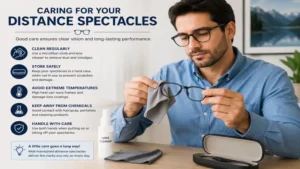
To keep your glasses performing like day one, adopt a simple weekly maintenance protocol. Clean your distance lenses exclusively with a dedicated pH-neutral optical spray and clean microfiber cloths. Never clean lenses with your shirt hem; cotton fibers carry microscopic dust particles that act like fine sandpaper, stripping away anti-reflective coatings over months of repeated rubbing.
The Hidden Cost Analysis: Total Cost of Ownership (TCO)
When investing in distance spectacles, the frame price tag represents only a portion of your actual cost. Long-term value depends heavily on lens material choices, coating longevity, and maintenance cycles.
| Expense Category | Entry-Level Glasses | Mid-Tier Performance | Premium Bespoke |
| Initial Frame & Standard Lenses | $30 – $60 | $150 – $220 | $300 – $450 |
| Advanced Anti-Reflective / Hydrophobic Coating | Included (Basic) | $40 – $70 | $90 – $130 |
| High-Index Lens Upgrade (1.67 / 1.74) | N/A (Standard 1.56) | $60 – $100 | $120 – $180 |
| Annual Maintenance (Pads, Screws, Adjustments) | $10 – $20 | Free at local optician | Free at local optician |
| Estimated Replacement Cycle | 12 Months | 24 – 36 Months | 36 – 48+ Months |
| Average Cost Per Year of Clear Vision | $40 – $80 / year | $125 – $195 / year | $170 – $250 / year |
Interpretation: While budget spectacles appear cheaper upfront, their resin hinges and basic coatings degrade faster, often requiring complete replacement every 12 months. Mid-tier frames crafted from high-grade acetate or O Matter™ hold their structural alignment for up to three years, delivering superior long-term cost efficiency per day of clear vision.
Problem vs. Solution: Troubleshooting Your Distance Spectacles
Problem 1: Peripheral Distortion or “Fishbowl” Effect
-
The Cause: High minus prescriptions fitted into wide, flat frames cause severe off-axis light refraction near the lens edges.
-
The Solution: Opt for smaller, rounded frame shapes with high-index lenses (1.67 or 1.74) and a high base-curve frame design that wraps slightly around the face to maintain an equal distance between the lens and eye at all viewing angles.
Problem 2: Spectacles Sliding Down Nose Bridge During Outdoor Use
-
The Cause: Smooth plastic nose bridges lack traction when skin produces oils or sweat during warm weather.
-
The Solution: Choose frames featuring adjustable silicone nose pads (like the Ray-Ban Clubmaster) or switch to hydrophilic rubber temple sleeves (such as Oakley’s Unobtainium™ material) that increase grip when exposed to moisture.
Problem 3: Blinding Glare and Halos During Night Driving
-
The Cause: Uncoated lens surfaces reflect roughly 8-12% of ambient light back into the eye, creating ghost images around oncoming headlights.
-
The Solution: Apply a multi-layer hydrophobic and oleophobic Anti-Reflective (AR) coating stack. This increases light transmission through the distance lens to over 99%, eliminating stray reflections.
🔍 Ready to Upgrade Your Distance Spectacles Setup?
Whether you’re tired of squinting at highway signs during evening commutes or need a rugged frame that handles active outdoor weekends, choosing the right combination of frame architecture and lens technology changes everything.
Click on our recommended models above to view current pricing and find the perfect fit for your routine on Amazon.
How to Choose the Ideal Distance Spectacles: 5 Expert Criteria
Selecting the ideal pair of distance glasses requires matching frame geometries to your facial biomechanics and prescription parameters.
-
Calculate the Target Lens Thickness (Index Selection): If your minus prescription exceeds -3.00D, standard CR-39 plastic lenses will create thick, unsightly outer edges. Upgrade to 1.60 or 1.67 high-index materials to reduce edge thickness by 30-40% and keep the frame light.
-
Match Lens Shape to Facial Morphology: Angular square frames add structure to round and oval faces, whereas round or oval lenses soften strong, square jawlines by balancing hard facial angles.
-
Prioritize Proper Pupillary Distance (PD): The optical center of each distance lens must align perfectly with the center of your pupils. An incorrect PD offset forces your eye muscles to strain constantly, inducing headaches and double vision.
-
Evaluate Bridge Fit Mechanics: If you have a low nose bridge or high cheekbones, look for frames with extended metal pad arms. Avoid fixed plastic bridges that cause the bottom of the frame to rest on your cheeks when smiling.
-
Verify Hinge Build Quality: Look for multi-barrel stainless steel hinges or flexible spring hinges. Spring hinges allow temple arms to flex outward by 10-15 degrees, preventing frame warping during daily removal.
Distance Spectacles vs. Progressive Lenses: Which Do You Need?
Understanding the functional boundaries between single-vision distance glasses and multifocal alternatives ensures you don’t buy the wrong optical tool for your daily routine.
           DISTANCE SPECTACLES                     PROGRESSIVE LENSES
   ┌─────────────────────────────────┐     ┌─────────────────────────────────┐
   │                                 │     │       DISTANCE ZONE (Top)       │
   │      UNIFORM DISTANCE ZONE      │     ├─────────────────────────────────┤
   │     (Full Lens Corrects for     │     │    INTERMEDIATE ZONE (Middle)   │
   │      Far Objects >20 Feet)      │     ├─────────────────────────────────┤
   │                                 │     │        READING ZONE (Bottom)    │
   └─────────────────────────────────┘     └─────────────────────────────────┘
Single-vision distance spectacles utilize a uniform focal power across the entire lens surface. This design offers a vast, uninterrupted field of view with zero swim effect or edge blur—making them superior for high-speed driving, field sports, and watching events in large venues.
Progressive lenses, by contrast, stack three focal zones seamlessly within a single lens. While progressives eliminate the need to switch glasses when looking down at a smartphone, the trade-off is reduced peripheral vision clarity at distant range due to unwanted lateral astigmatism along the lens margins. If your primary goal is maximum distance clarity without distortion, dedicated single-vision distance spectacles remain the gold standard.
Real-World Performance: What Specs Mean in Practice
Marketing brochures love to throw technical optical jargon around, but what matters is how those features translate to your real-world visual experience.
-
“Hydrophobic & Oleophobic Coatings”
-
The Marketing Hype: “Keeps your lenses crystal clear at all times.”
-
The Practical Reality: Water beads off instantly when walking in the rain, and facial oils from your fingers wipe off in a single pass of a microfiber cloth without leaving a greasy smear.
-
-
“Polycarbonate Lens Construction”
-
The Marketing Hype: “Unbreakable space-age lens technology.”
-
The Practical Reality: Essential safety protection for sports and power tool work because the lens will deform rather than shatter into sharp shards upon impact. However, it scratches easily if not protected by a hard coat.
-
-
“Anti-Static Anti-Reflective Stack”
-
The Marketing Hype: “Advanced dust-repelling clarity layer.”
-
The Practical Reality: Prevents fine atmospheric dust and pollen from clinging to the lens surface when you clean them with a dry cloth, reducing friction micro-scratches.
-
Safety, Fit, and Optical Alignment Rules
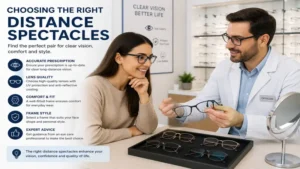
Wearing improperly fitted distance spectacles can cause asthenopia (eyestrain), vertigo, and neck stiffness caused by tilting your head to find a clear focal point. To ensure optimal performance:
Ensure the vertex distance—the space between the back surface of the lens and the apex of your cornea—remains between 12mm and 14mm. If the glasses sit too far down your nose, minus-power distance lenses lose effective strength, making distant objects appear slightly blurry.
Furthermore, pay attention to the pantoscopic tilt (the vertical angle of the frame front relative to your face). A proper frame should angle inward toward the cheekbones by 5 to 7 degrees. This geometry ensures that light entering your eyes when looking down toward the road or ground passes orthogonally through the lens, minimizing optical aberrations.
Frequently Asked Questions
❓ Can I wear my distance spectacles while working on a computer screen? ✅ Yes, but it may cause eye fatigue if you have presbyopia. Distance spectacles are optimized for objects further than 20 feet away. Focusing on a monitor 20-24 inches away forces your eye muscles to accommodate continuously unless you use dedicated intermediate or blue-light screen glasses…
❓ How often should I update my distance spectacles prescription? ✅ Comprehensive eye exams are recommended every 12 to 24 months. Myopic changes can occur gradually, causing subtle eye strain and night driving fatigue long before you notice significant vision loss…
❓ Why do my new distance glasses make the ground look sloped? ✅ This temporary phenomenon, called spatial magnification, occurs as your brain adjusts to new minus-power lens curves and altered peripheral magnification. Your visual cortex typically adapts completely within 3 to 7 days of consistent wear…
❓ Are polycarbonate lenses better than glass lenses for distance glasses? ✅ Polycarbonate is vastly superior for safety and weight, being up to 10 times more impact-resistant than glass or standard plastic. Glass provides slightly higher optical clarity, but its heavy weight and shattering risk make it obsolete for modern active frames…
❓ Can distance glasses correct astigmatism at the same time? ✅ Absolutely. Your eye doctor simply incorporates a cylindrical correction value (CYL) and axis angle directly into your single-vision distance lens prescription to correct corneal asymmetry alongside nearsightedness…
Summary & Final Steps
Investing in high-quality distance spectacles is one of the most effective ways to enhance daily comfort, driving safety, and overall spatial awareness. Whether you prioritize the iconic, structured build of the Ray-Ban Clubmaster, the athletic, pressure-free fit of the Oakley Holbrook RX, or the weightless luxury of the Persol PO3007V, choosing a frame that complements your facial structure and prescription requirements ensures crisp vision for years to come. Take the time to get your pupillary distance professionally measured, select lens coatings that match your lifestyle, and maintain your frames with proper care.
Recommended for You
- 7 Best HSA Account Eyeglasses Picks for 2026: Expert Guide
- 7 Best HSA Eyeglasses to Buy in 2026: Expert Guide
- 7 Best FSA Eyeglasses in 2026: Tax-Free Frames Tested
Disclaimer: This article contains affiliate links. As an Amazon Associate, I earn from qualifying purchases. If you purchase products through these links, we may earn a small commission at no additional cost to you.
✨ Found this guide helpful? Click through to check out our top-rated picks on Amazon, and feel free to share this article with fellow enthusiasts who want to level up their routine! 💬🤗